SPECIFICATION
| Series | R30 Series |
| Item Code | R30317 |
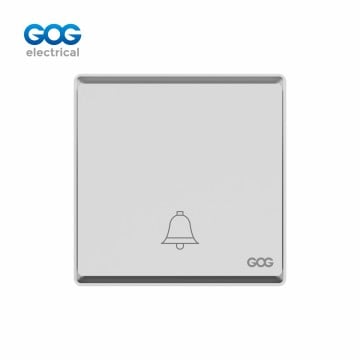
| Description | Neon Indicator Door Bell Switch (Momentary Bell Push) |
| Switch Action | Momentary (Push to Make, Release to Break) |
| Current/Voltage | 16A / 250V~ |
| Indicator | Neon — Always On When in Standby |
| Front Panel | Imported high‑transparency, high‑strength PC |
| Base & Middle Plate | High‑strength PC base + Iron middle plate |
| Switch Internals | Red copper bush, red copper stamping part, red copper bus bar, Φ3.5mm×0.35mm silver touch point |
| Standard | IEC 60669 |
| Product Lifetime | 40,000 cycles |
| Warranty | 12 Years |
| Available Colors | White / Gold / Gray / Black |
| Dimensions | H 86mm × W 86mm |
| MOQ | 2,000 pcs |
| Packaging | 1 pc per plastic bag | 10 pcs per inner box | 100 pcs per outer carton |
Neon Indicator Doorbell Switch 16A: The British Standard Bell Push
The R30317 doorbell switch has been designed specifically for wired chime or bell circuits. The key difference between this bell switch and a standard light switch is the momentary action spring return. When you press the switch to ring the bell, once the switch is released, it automatically springs back to break the circuit. This doorbell switch also includes an integrated neon steady ON light to help you quickly find the bell switch in a dark hallway or at night. Rated at 16A/250V, constructed from red copper with silver contact materials and meets the IEC 60669 standard, carries a 12-year warranty, will fit into a standard British 86x86mm back box and is finished exactly the same way as all other products in the R30 range of products.
Momentary action bell push: The momentary doorbell switch and a standard light switch are entirely different. The momentary bell push switch uses a spring-loaded mechanism to operate. Once you press the bell push, you will complete the circuit and ring the chime. Once you release the bell push, you will break the circuit and stop the chime. The modular bell push switch functions as intended in a matched wired door chime system, ensuring the chime rings only when you are pressing the button.
Illuminated for visibility: The neon indicator on the doorbell switch will provide constant illumination when the chime circuit is on standby. The purpose of this is to assist visitors find the bell push in a dimly lit entryway and to show at a glance that there is power to the bell transformer and the circuit is operational.
R30 Switch Built – Copper Internal Parts + Rigid PC Housing
The internal designs used in the R30 series of switches, excluding their different switching action, share the same layout for their internal components. Doorbell switch components include a red copper bush, red copper stamped parts, red copper bus bar, and a silver alloy contact to achieve a repeated make and break switch action across 40,000 cycles. The front and back panels of the switch have been constructed using imported, high strength, high transparency polycarbonate. An iron plate reinforces the doorbell switch assembly against the wall so that the doorbell switch feels solid when pressed, each time it is pressed.
Factory Direct Supply for Wholesale & OEM Partners
Your Source for Modular Door Bell Switches — Superior to Branded Alternatives
The R30317 doorbell switch gives your wholesale catalog a fully compliant, illuminated bell push that shares the exact same 86×86mm design language as the rest of the R30 series. For markets where retail brands like Anchor, Legrand, Schneider, Havells, GM, or Goldmedal command premium prices for a comparable modular doorbell switch, our factory‑direct model delivers the same momentary action and neon indication at a fraction of the shelf price. OEM branding on the PC panel, custom packaging with box, and even waterproof doorbell switch cover options for outdoor applications are all available. Competitive doorbell switch price points, global logistics, and a 12‑year warranty make this a margin‑building addition to your electrical catalog.
How to Install and Specify This Doorbell Switch
Application notes, wiring guidance, and selection tips for doorbell push installations.
Application Use Cases
For residential front doors and porch entrances, this doorbell switch provides a clean, modern 86×86mm bell push that matches the R30 light switches in the hallway — no more mismatched round plastic buttons. In commercial and office entryways, the neon indicator helps visitors locate the bell push in low light. For multi‑dwelling apartments, pair it with a standard wired chime for a reliable signaling solution that doesn’t rely on batteries or wireless pairing.
Doorbell Switch Connection and Wiring
The R30317 doorbell switch connection follows the same principle as any momentary bell push. Connect the incoming wire from the bell transformer to the common terminal, and the outgoing wire to the chime or bell to L1. The neon indicator is wired internally across the circuit — it illuminates as long as the transformer is supplying power to the switch in standby mode. This bell push requires no separate neutral for the neon to operate. If you are replacing an existing doorbell button, the doorbell switch with box fits directly into a standard 86×86mm back box, making it a straightforward swap. For outdoor installations, a separate waterproof doorbell switch cover can be fitted to protect the panel from rain and dust while keeping the neon visible.
Replacing Legacy Branded Bell Switches
Many electricians replace worn‑out Anchor, Legrand, or Schneider modular doorbell switches with the R30317 because it offers the same momentary action, equivalent build quality, and a cleaner aesthetic — all at a more competitive trade price. The neon indicator is also brighter and more reliable than older designs that use small filament bulbs.




Frequently Asked Questions
Can you replace just the doorbell button?
Yes, the doorbell button is a standalone component. The R30317 door bell switch is designed as a direct replacement for any standard 86×86mm wall‑mounted bell push. You do not need to replace the chime or transformer. Simply isolate the circuit, remove the old button, and connect the two wires to the common and L1 terminals of the new bell push. The neon indicator will illuminate as long as the transformer is supplying power.
How does a door bell switch work?
A door bell switch uses a momentary spring‑return mechanism. Inside, a red copper and silver contact assembly is held apart by a spring. When you press the rocker, the contacts close, completing the circuit and sending a pulse of current to the chime or bell. When you release, the spring pushes the rocker back and breaks the circuit. This is different from a standard latching light switch that stays in position. The built‑in neon indicator is wired in parallel and glows whenever the transformer is powering the standby circuit.
Does it matter which wire goes where on a doorbell button?
On a standard 2‑wire doorbell circuit, polarity does not matter for the bell function — either wire from the transformer can go to the common terminal, and the wire to the chime goes to L1. The bell will ring in either orientation. However, for the neon indicator on the R30317 to light correctly, the internal circuit expects the live from the transformer on the common terminal. We recommend connecting the transformer live to common and the chime return to L1 for proper neon operation.
Do I need to turn off the breaker to replace a doorbell?
Yes, always turn off the breaker supplying the doorbell transformer before replacing the button. The transformer steps down mains voltage to a lower bell voltage, but the primary side is still connected to the mains. Isolate the correct circuit at the consumer unit, verify with a voltage tester, and then proceed with the door bell switch connection. If you are unsure which breaker controls the bell transformer, switch off the main breaker for safety.