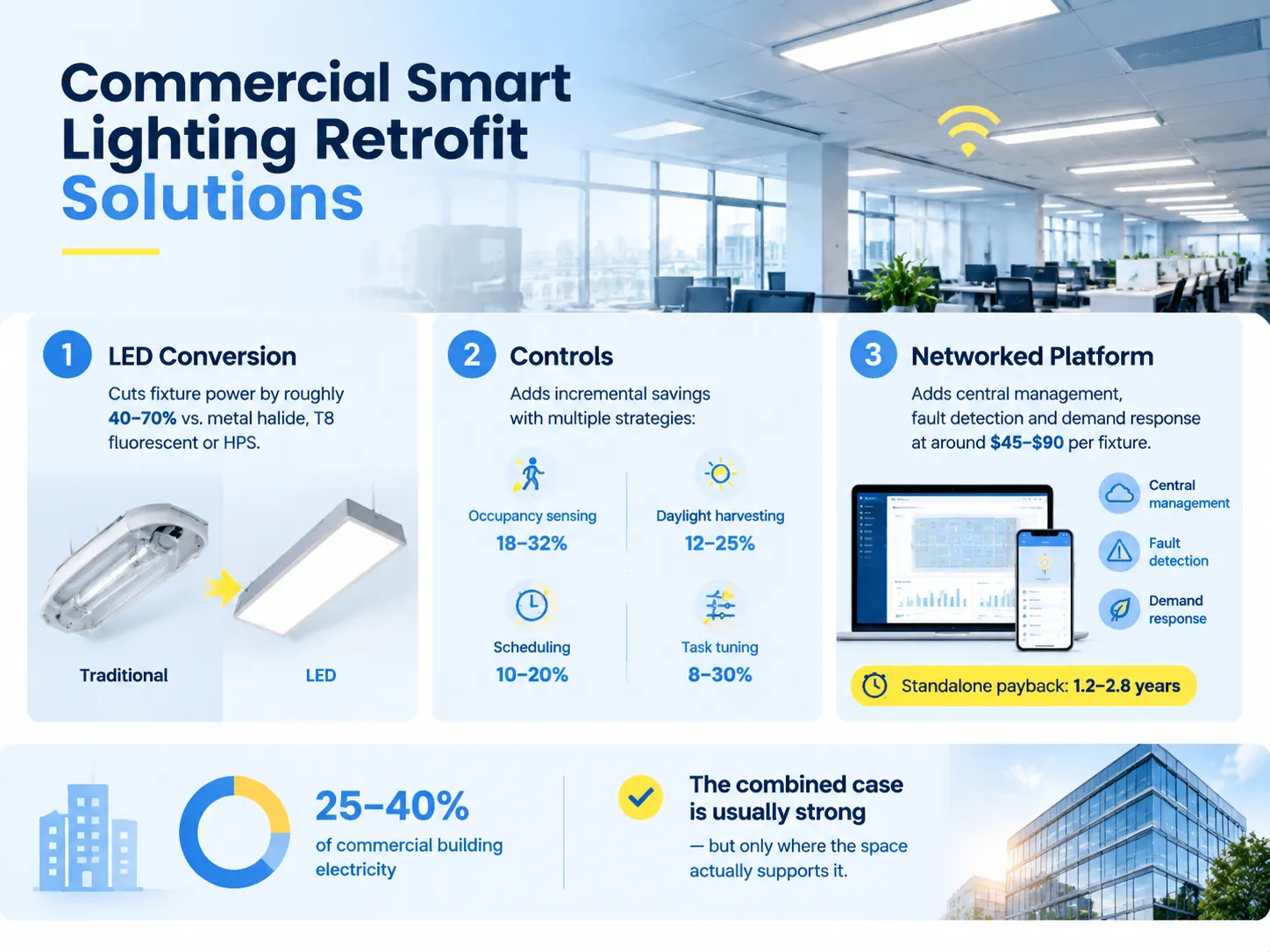
It is recommended to treat commercial smart lighting optimize solutions as three independent upgrades rather than one single technological acquisition. The replacement of lighting fixtures leads to energy savings of 40-70%. Additionally, using occupancy and daylight control provides extra 18-32% of savings. Finally, connecting the entire system to the network may produce at least 15-25% savings through scheduling, task tuning, remote diagnostics, and demand response.
Simply put, a commercial smart lighting retrofit consists of three tiers. The initial level is known as LED conversion, which allows to achieve energy savings of 40-70 % in comparison to the old lighting systems such as metal halide bulbs and T8 fluorescent. The second level is called controls and stands for three technologies, namely occupancy sensing, day lighting harvesting and scheduling and task tuning. The use of these controls helps to increase energy efficiency by additional 18-36 %. The third and final stage is the installation of a networked platform that opens access to centralized management, fault detection and demand response.
What’s Worth Upgrading — and What Isn’t
The math is simple once you are familiar with the space, but it is not identical for each room.
Let’s begin with the fixtures since no other space compensates for a metal halide lamp that was supposed to be of a lower wattage. This can be proven with published comparisons: the 400 W metal halide lamp consuming 456 W with ballast compares favorably with its LED equivalent of only 150 W, thus the savings here amount to 67%; the same goes for four T8 lamps consuming 128 W whereas an excellent LED fixture will consume 40 W instead yielding savings of 69%; last but not least the famous 150 W HPS wall pack and its consumption of 188 W vs. the LED version consuming only 50 W results in 73% saving. These figures only reflect the savings in fixtures alone.
If we want to talk about savings and justification for the upgrade then the only type of buildings where upgrading makes sense is where efficiency is already extremely high, the building is continuously occupied, and there is little to no access to daylight. This type of building is exactly where the efficiency controls do not bring their benefits since this type of building is exactly where the proposals seldom make any sense due to comparing the efficiency of 2026 technology with 10-year-old one, thus neglecting what the controls can add.
Another point that rarely finds its way into proposal is HVAC which will be positively affected by LED as the devices produce 60-70% less heat than previous technologies which means lower cooling load. However, in good insulations on the commercial side, it means little moreover in the warehouse it means nothing
The place to start, if you are still working out what the retrofittable surface actually is, is the control layer itself — because that is where the cost sits and where the specification decisions get made. What a smart switch actually changes compared with a conventional switch is a reasonable first read, particularly the difference between sensing at the switch and sensing at the fixture.
The Three Layers of Savings
The following figures can be considered for explanation to the finance team with the advice of consideration of space requirements.
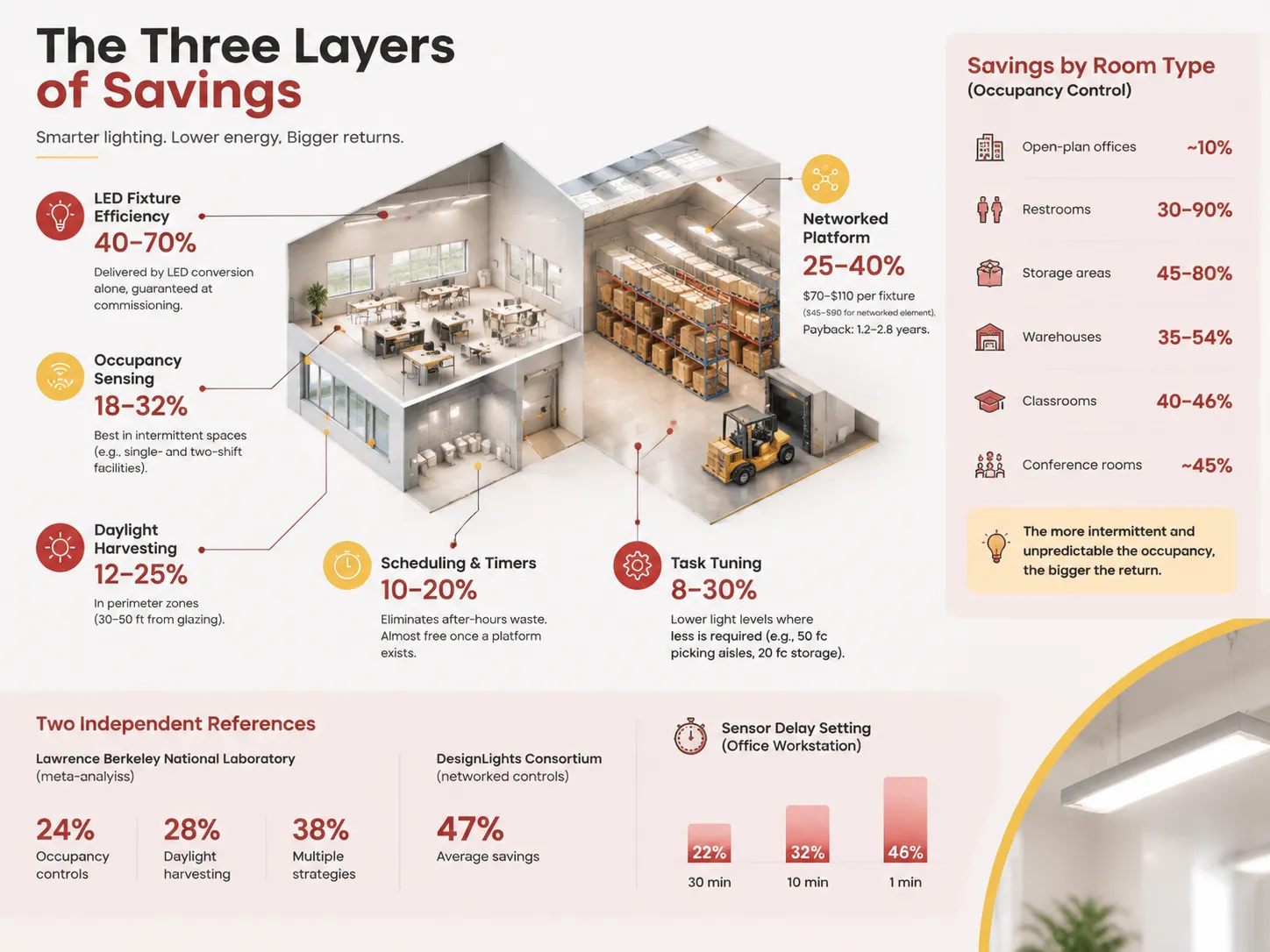
- Efficiency of fittings: 40-70%. It can be granted only because of the LED retrofit.
- Occupancy control: 18-32 % increase in occupied spaces.
- In the analysis of 23 applications of sensors it has been shown that maximum improvement can be achieved in places with separated zones for storage and dispatch of goods. The expense for one sensor can come to $35 – $60.
- Natural light: 12-25% increase near the perimeter of the room. The price for natural light attachment $40 to $75.
- Timers: 10 -20 % for limiting energy use in the off-hours.
- Task tuning: 8-30 % for decreasing light levels in places where there is no need for extra light.
- Network living community: 25-40 % if it is available in the room and $70-110 per light fixture and $45-90 is the charge for networked feature.
Where savings happen in rooms is worth knowing before specifying coverage as the difference is too great. Figures on occupancy control say that there are 10% in open-space offices and from 30-90 % in restrooms, 45 -80% in storage areas, 35-54% in warehouses, 40-46% in classrooms and 45% in conference rooms. The idea is easy: the more sporadic the occupation is, the greater the benefits obtained.
There are several independent sources of data in favor of the data given. The Lawrence Berkeley National Laboratory shows that occupancy control gives average annual savings of 24 %, daylight harvesting – 28 % and the total of 38 % if these two kinds of technology are used together. Another study conducted by the DesignLights Consortium shows that networked lighting controls give 47 % of average savings. It is important to mention that in the case study analysis of various offices with additional presence sensor the testing of delay parameter showed the following results: 22% of energy savings with 30 min delay, 32% and 46 % with 10-minute and 1-minute delay respectively.
Why the Neutral Wire Decides Your Hardware
The need for some kind of extra diligence is mostly responsible for transforming projects that look like they will take two weeks into extended efforts lasting more than one month – hence the need for making sure it is not an issue before dispatching any orders.
Smart dimmers and switches often require a separate neutral wire to be connected. Most commercial buildings, some of the older houses and many similar structures do not keep a neutral wire in the switch itself but use it through the ceiling or the light fixture instead.
The alternatives are not the same.
- Neutral design: In general, the most versatile and efficient device with maximum load capability and no restrictions on minimum load. Use in case neutral wiring is present.
- Without neutral: This type of switch uses some power through the circuit and requires some load to function properly, risking flickers and dimming with low wattage LED lighting. This design becomes problematic in commercial application where 5W LED downlights are used in one circuit.
- Fixture-based control: This technology allows to move intelligence into fixture thus eliminating wiring issues and providing better control, though more expensive.
If the surveying task includes evaluating existing building’s lighting, for each switch the following parameters must be recorded: presence or absence of neutral wire, gang numbers, type and capacity of load, depth of wall box, and whether the circuit is controlled at the loading point or fixture.Those five fields determine the bill of materials, and how neutral and non-neutral smart switches differ in wiring, load limits and reliability is the reference for what each answer means when you get back to the office.
Retrofitting Without Rewiring
The introduction of reliable wireless control technology has changed the economy of commercial retrofitting; the key expense of control system implementation is no longer the devices but the cabling, housing system for it, and disturbance caused by this activity.
Two approaches to communications prevail now:
- Wired digital communications as an example of this technology DALI-2 in compliance with IEC 62386 standard, represents the first approach. Individual addressing, full-duplex communication, low dimming level ability, predictability of latency, and seamless integration with building management qualify this approach for being an ideal one for new buildings or the cases when the ceiling is being opened.
- Wireless mesh represents the second approach. Zigbee 3.0 standard on IEEE 802.15.4 protocol is the bearers of this approach. There is no requirement to install wiring for control, rapid installation, and configuration in favor of wireless technology applications in this case. It has been proved that the installation can cost up to 44% lower, TCO can be 11% lower over the five years, and implementation is 70% faster than with wires.
However, there is a noticeable trade-off present in all of this technology, an example of which is the vulnerability of the receptivity of signals when utilising wireless in frames made of steel and densely interchanged wires of various electronic devices, need for maintenance of battery or capacitor of wireless sensors, and security issues that are absent in wired systems, among others.
One practical constraint applies to both: most controls are still switching conventional loads, so the switch hardware has to match. The straightforward version of that is a conversion from a conventional switch to a smart one using the existing wiring, which is the mechanism most commercial retrofits actually use — replace the plate and the mechanism, keep the circuit, and put the intelligence where the cable already runs.
What Goes on the Wall
The switch plate is the visible part of the project, and in a facility it is intended for three groups of people. The first group is the maintenance people, the second one is the people who use the switch plate, and the last one is the person who designated the interior materials.
So, what has to be taken into consideration when specifying it?
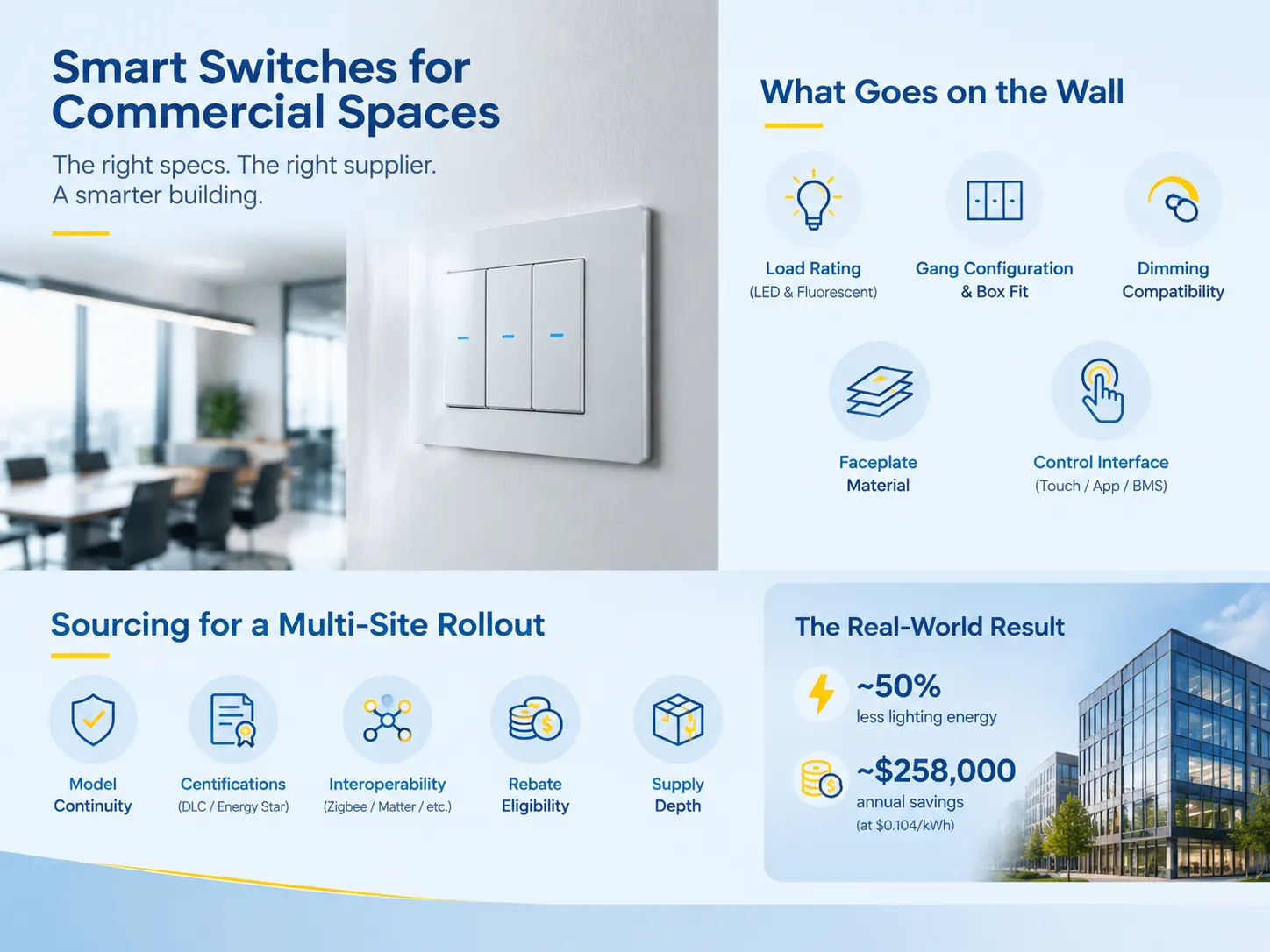
- Loads specification per gang. Commercial load in a circuit is greater than residential one. A gang rating of 600 W LED load device should not be confused with the incandescent one. Besides, make sure that you check LED and fluorescent loads as well since the figures for LEDs tend to be less.
- Gang configuration and box fit. A three-gang smart switch should fit in the same wall box and depth as a three-gang regular one, and this is where the squeezes appear. A multi-gang unit such as this three-gang smart switch is representative of the class — the specification work is in the gang count, the box depth and the load rating rather than in the radio.
- Dimming factors. The use of phase-cut trailing edge technology permits mains dimming which sets the correct stage for any driver such as 0 to 10 V or DALI. The most frequent source of flicker and early driver failures is inconsistency of control type with driver technology.
- Material of faceplate. Commercial interiors feature many materials such as PC, acrylic, glass and stainless, the latter two being quite appropriate in the environment where the cleaning process follows strict hygienic standards.
- Control interface. Options vary from touch or rocker switches via an app through to contact closure. In a commercial building it’s important to check the latter as it usually means that the lighting system is “smart” but also integrated.
Sourcing for a Multi-Site Rollout
A simple building retrofit can be procured from a wholesaler. Obtaining a larger rollout across multiple sites cannot be achieved, owing to the variation in failure modes: discontinuation of a piece of equipment leads to a mismatch of 400 plates, while an update in firmware gradually transforms its app, thereby causing a training issue across all the sites.
Here are five important elements to nail down before making a purchase involving multiple locations:
- Continuity of the model. Request written assurance from the manufacturer that they guarantee a specific model’s production life.
- Certification. Make sure that you ask for regional safety and EMF approvals, as well as a few other certifications (if rebates will be used). Please observe that most utility rebate programs ask for the DLC certification, which currently exists in the 5.2 specification along with Standard and Premium types.
- Interoperability. Ask what ecosystems the chosen device is compatible with (i.e., Zigbee 3.0, Bluetooth Mesh, Matter, or a proprietary hub) and what will happen in the event of the hub discontinuation.
- Rebate eligibility. Rebates usually amount to somewhere between $8-$15 per fixture in the case of a pure LED replacement and $20-$35 when controls are used. Filing the rebate request before or right after the installation is very important; otherwise, a non-compliant product is unusable at all.
- Supply depth. It is important to distinguish between a manufacturer that can provide solutions for all kinds of installations (has production facilities, private-label documentation, stocks spare plates and has redundancy supply,) and from one that sells products through the retail network.That is the practical difference between buying a product and buying a programme, and it is what a dedicated smart switch manufacturing partner is set up to provide for multi-site work.
Three figures are often undervalued in budget management. Commissioning should actually take place at 10-15% of the overall project cost, rather than the standard five percent as suggested in most proposals. This is because a control system installed but not commissioned will produce the LED energy savings, but not the savings from control efficiencies. In fact, control devices will have a shorter life than the luminaires — a refresh is likely in seven to ten years for control units as compared to ten to fifteen years for the fixtures. Furthermore, financial returns from demand response, if applicable, range from $40 to $120 per kW per year; this is a benefit that ought to be included in the design phase instead of added later at retrofit.
The U.S. Department of Energy retrofit project serves as a good benchmark for the entire exercise, since fluorescent tubes were replaced with tubular LEDs and advanced lighting controls were introduced, cutting electricity consumption for lighting by 50%, or roughly 2.4 million kWh per year, which translates into savings of $258,000 per year at the rate of $0.104 per kWh.
Frequently Asked Questions
How much energy does a commercial smart lighting retrofit actually save?
Three layers of energy savings = three numbers. The efficiency of LEDs in reducing the amount of power consumed by lighting fixtures typically amounts to between 40–70% when compared to metal halide, T8 fluorescent, or high-pressure sodium lighting technologies. The efficiency gained by using occupancy and daylight controls adds another 18–32% and 12–25%, respectively. The use of scheduling creates another 10–20% reduction, while task tuning achieves an impact of the order of 8–30%. A networked platform can be expected to generate additional savings in the range of 15–25% on top of the LED base, with published studies revealing potential savings as low as 38% in the form of a combined control strategy and up to 47% with networked systems. Therefore, the expected range of energy savings when a complete retrofit is performed as compared to the baseline scenario is around 50–75%, while the attainment of the highest figures depends on the variability of occupancy patterns and availability of daylight in a given location.
Do smart switches need a neutral wire?
This is mostly true, and it is the main reason why retrofitting is challenging. With a neutral conductor, the switch works independently to power its own radio and relay, providing steady operation with all features and higher load ratings. When there is no neutral supply in a switch box, no-neutral systems instead use load’s supply to craft their operations — this makes sure that there will be minimum connected load while still producing some flickering or faint light on low-wattage LED bulbs. As a result, in a commercial facility with a lot of small LED downlights, the minimum load requirement becomes the real problem and therefore the wiring survey must be done first, followed by the hardware specification.
Is wireless or wired lighting control better for a retrofit?
Use wireless technology when you retrofit an occupied building and wired systems where the ceilings are open or it is a new building. Wireless mesh systems eliminate the biggest cost components of a controls project — the control cable itself, which requires installation and great amount of construction work, which results in possible up to 44% cost reduction for the installation and total cost of ownership to be around 11% less in five years. The drawbacks here include signal reliability in densely utilized space and heavy constructions, need to maintain battery sensors regularly and a significant cybersecurity aspect. Therefore, DALI-2 wired approach as described in IEC 62386 protocols provides reliable performance, good addressing system and proper integration of BMS and is certainly worth the extra investment in case the building will be in use for a long time (up to 30 years).
What is the payback period on a commercial lighting retrofit?
When looking at the LED layer alone, paybacks can be found in less than two years in high-run-hour applications, and rebates reduce this even further, as incentives usually go for around $8-15 per fixture when it comes to basic replacement, and $20-35 per fixture in case control systems are involved. As for the controls layer used on LED installations already in place, the estimated payback period is ranging from 1.2-2.8 years for networking systems, while for the places that do not need daylight or have continuous presence a real payback can go up to 12-35 years. This explains why the average across the whole building can be misleading — in order to calculate the payback correctly for control systems it is necessary to analyze room-by-room situations and exclude places where control systems will not pay off.
References
- DesignLights Consortium — commercial lighting qualified products list and networked lighting controls
- U.S. Department of Energy — lighting controls and solid-state lighting research
- IEEE — IEEE 802.15.4 wireless mesh networking standard
- International Electrotechnical Commission — IEC 62386, digital addressable lighting interface (DALI)
- UL Standards & Engagement — UL 1472, solid-state dimming controls
Conclusion
A retrofit for commercial smart lighting consists of three projects having distinct paybacks. Different disciplines exist that must be followed to achieve success. The first step is to replace the light fixtures for a payback of 40-70%. The next step is to include occupancy and daylight sensors in places with occasional occupancy and daylight, giving an extra payback of 18-32%. After that, connect your lighting to the network of the building, which has several zones and operates on different schedules, so to achieve the last 15-25% of savings. Lastly, prepare for commissioning the lighting, knowing that the control devices will have to be changed before the fixtures.