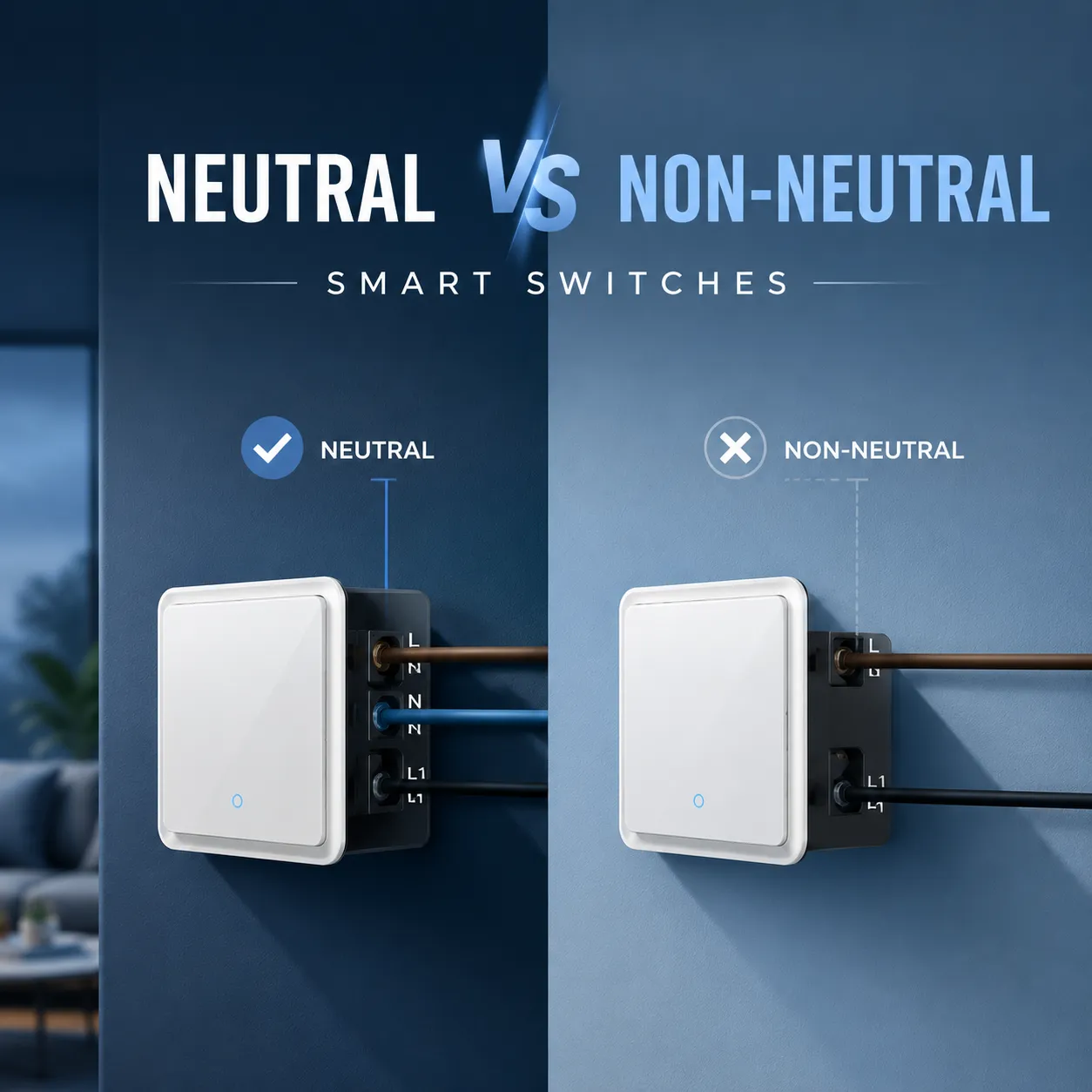
A Chicago homeowner recently purchased a smart dimmer for his 1950s dining room. He watched the installation video and read the instructions, and felt ready to install it. When the homeowner removed the old toggle switch from the wall he found two black wires, a ground wire and a jumble of cloth-wrapped cables. There was no white neutral wire. The smart switch that the homeowner bought needed a neutral wire. He called the manufacturer and was told that, like millions of older homes, his house did not have neutral wires in the switch loops in the wall. The homeowner needed a different type of device, one that was designed to work without a neutral wire. This homeowner’s experience represents one of the most frequently asked questions regarding smart home wiring: what is the difference between a neutral smart switch, and a non-neutral smart switch, and which one fits into your wall?
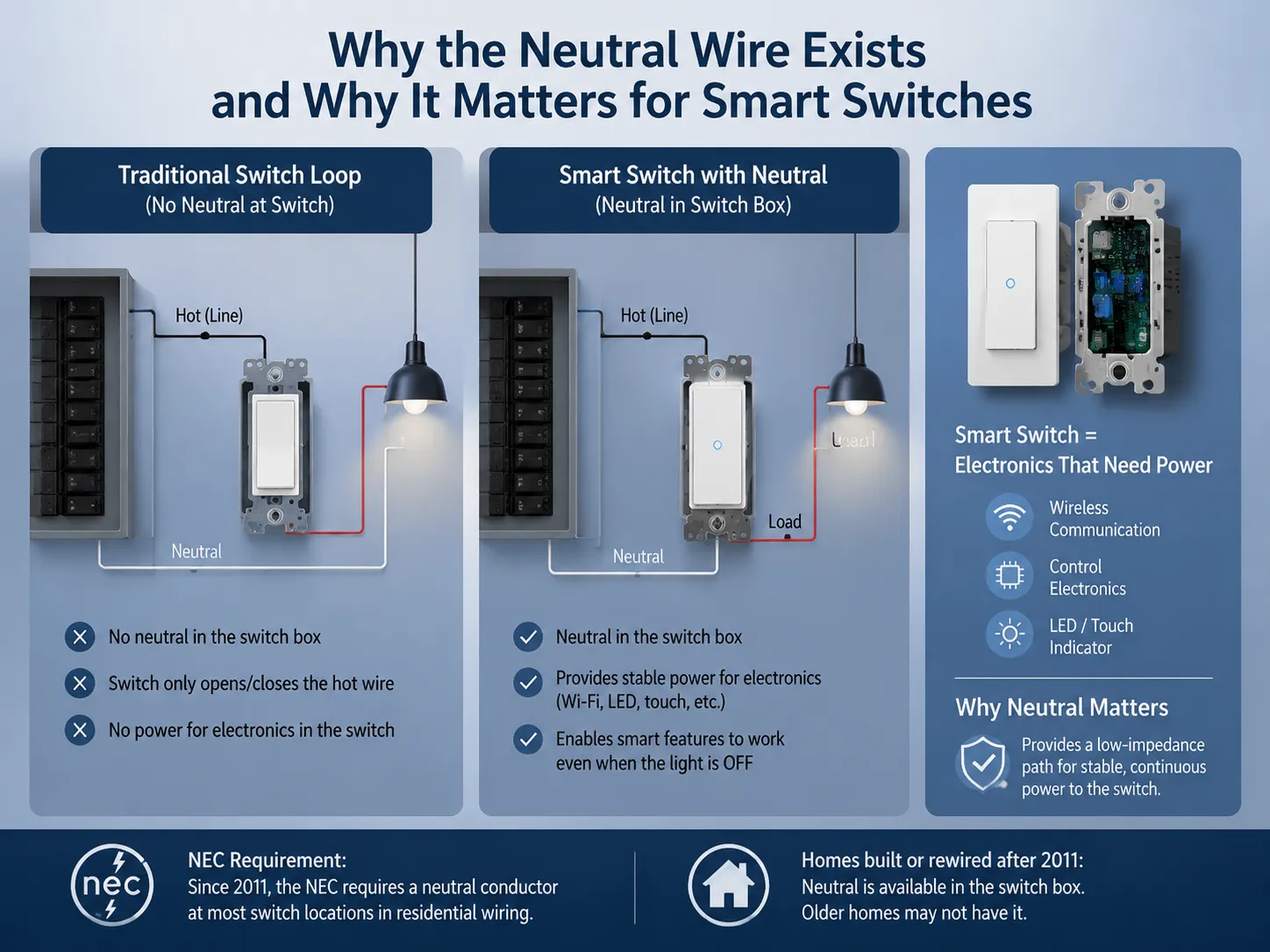
Why the Neutral Wire Exists and Why It Matters for Smart Switches
You must comprehend the neutral wire to appreciate the difference; in a regular 120 vac circuit, the ‘hot’ wire (often black) moves power from the panel to the ‘load’ while the neutral wire (often white) returns current back to the panel thereby completing the circuit. A simple mechanical light switch only needs to open the ‘hot’ wire; it doesn’t ‘consume’ power (i.e., does not provide any body heat). For many years, older systems have not connected the neutral wire through the switch box but have instead gone directly between the fixture and the neutral; this method is known as a switch loop, and it was the practice for many years.
Unlike a traditional switch which has a simple mechanical contact, a smart switch includes electronic components: a circuit board, a wireless radio for communication with other smart devices and often a touch sensor or an LED light to indicate its usage. These components require power to function regardless of whether the light itself is on or off. To accomplish this, a smart switch uses the ‘neutral’ wire of the electrical circuit to provide a connection between the ‘line’ and ‘neutrals’ of the circuit; therefore, providing a low impedance source of stable power to the electronic components of the switch that maintains the radio and electronics operating without interfacing with the light itself. Since 2011, the national electrical code (NEC) has required that there be a neutral conductor present at most switch locations in residential wiring, so any newly built, or rewired, house after 2011 will have neutral wire available in the switch box. Many homes built prior to 2011 do not have a neutral wire in their switch boxes; this is how non-neutral switches become applicable.
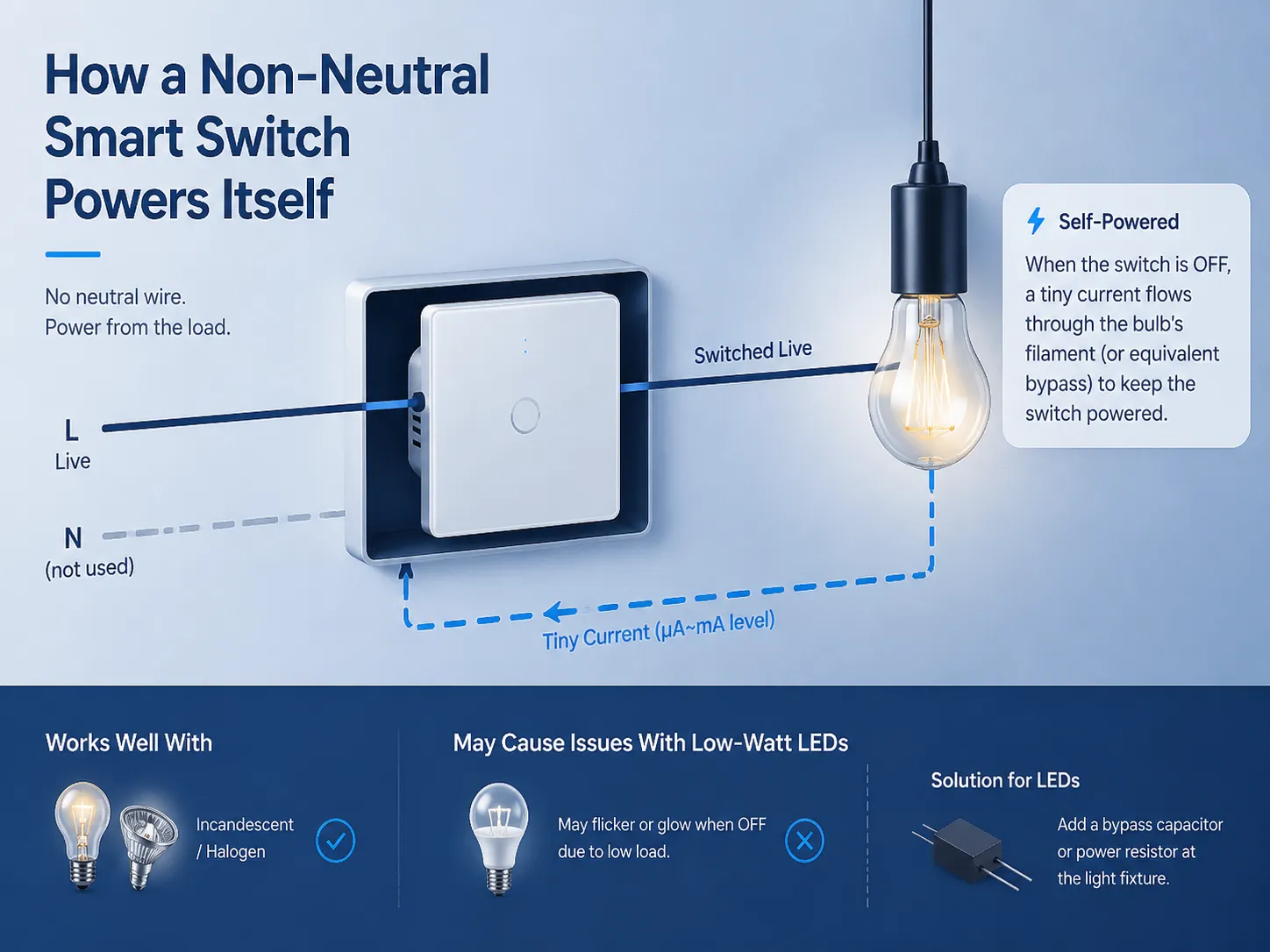
How a Non‑Neutral Smart Switch Powers Itself
A “smart” switching device that is not neutral, operates with no neutral wire, rather gets its power from the load of the lighting device, in this example it is the light bulb however when the switch does not have power and does not illuminate the bulb, it actually uses a small amount of current through the filament of the bulb (not enough to turn on an incandescent bulb or turn on an LED fully), but enough to keep the internal electrical devices of the switch alive. This makes the switch have a secondary load in series with the light fixture.
If you’re using standard incandescent or halogen lightbulbs, this design will work fine. However, it may cause problems if you’re using low-watt LED bulbs; for example, an LED may be made to flicker when too low of a load is connected to the circuit. A lot of non-neutral switches use a little bypass capacitor or a small load power resistor to bypass the LED and allow it to glow when the switch is off, and these components will generally have to be installed at the light fixture while also creating an extra installation step. So, if you’re thinking about purchasing an LED, it is important to know about how LEDs work so that you can make an educated decision. For the basics of wiring these devices correctly, our guide on how to wire a single pole switch covers the core skills that apply to both neutral and non‑neutral installations.
Comparing the Two Technologies Side by Side
| Characteristic | Neutral‑Required Smart Switch | Non‑Neutral Smart Switch |
|---|---|---|
| How it powers itself | Draws from line and neutral; independent of the load | Draws a small leakage current through the load (light bulb) |
| Installation requirement | White neutral wire must be present in the switch box | Works with switch‑loop wiring; neutral not required in box |
| Compatible bulb types | All types, including very low‑wattage LEDs | Best with incandescent, halogen, or dimmable LEDs; may require a bypass capacitor for small LED loads |
| Minimum load requirement | None; the switch is powered independently | Typically requires a minimum load of 5–25 watts to stay powered reliably; check manufacturer specs |
| Stability of Wi‑Fi/Zigbee connection | Excellent; continuous, stable power supply to the radio | Generally good, but can be affected by load characteristics and dimmer settings |
| Best application | Homes with modern wiring; circuits with multiple fixtures; any installation where reliability is paramount | Older homes without neutrals in switch boxes; single‑fixture circuits with appropriate bulbs |
| Typical cost | $25–$60 | $30–$70 |
Installation Scenarios: Which Switch Goes Where
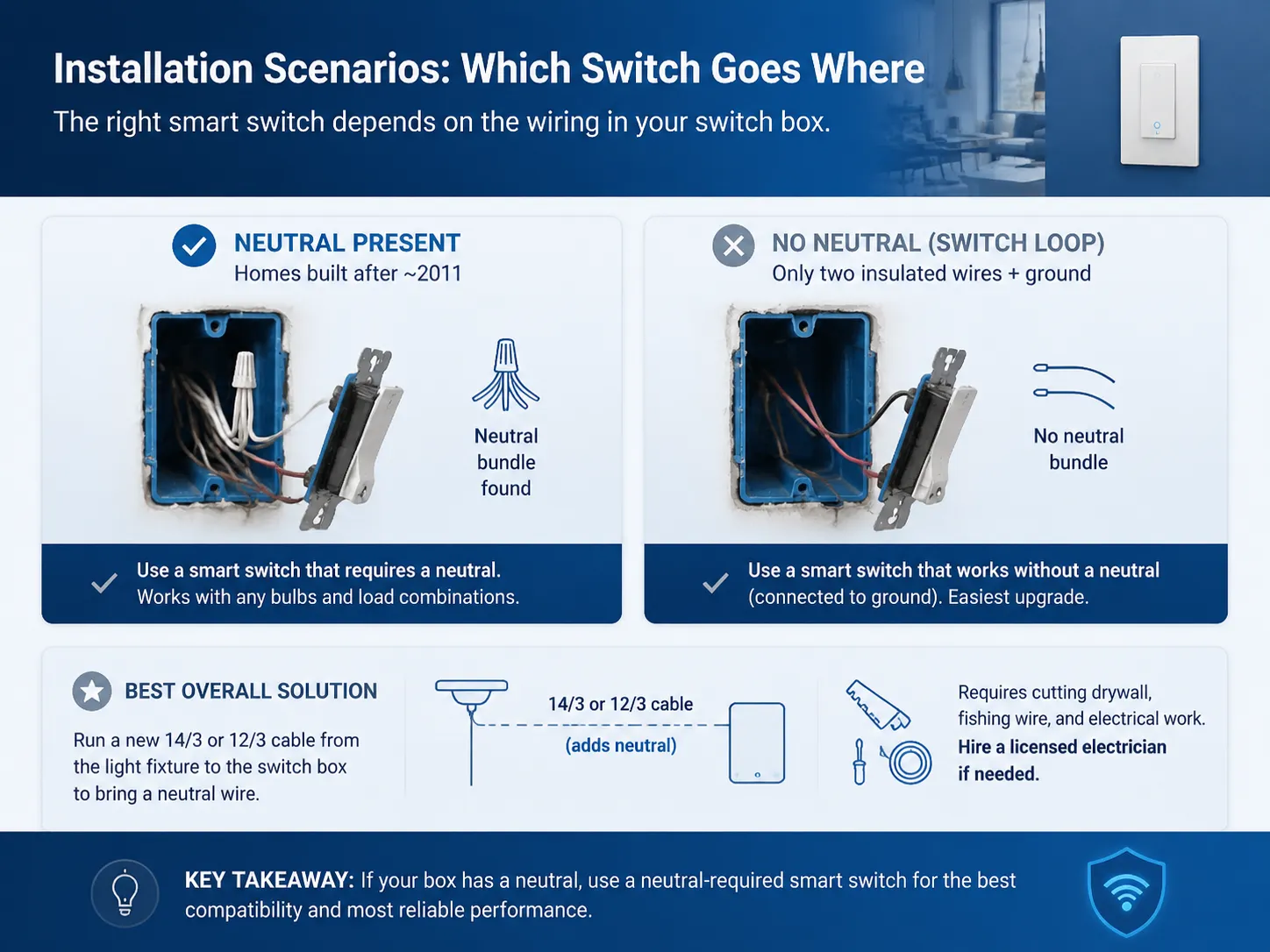
The type of smart switch required by you is determined by the wiring system in the switch location. To check for proper wiring, follow these steps: shut off the circuit breaker for that switch, gently remove the existing switch, and examine the wires on the back of the box. If there is a bundle of white wires connected together with a wire connector (also called a wire nut), that indicates there is a neutral bundle, which is present in virtually all homes built after 2011. If you only see two insulated wires attached to the back of the switch along with a bare ground, then you have a switch loop and a smart switch connected to ground would be the easiest way for you to change out your old switch to a new smart switch.
Another option would be to run a new 14/3 or 12/3 cable from the light fixture back to the switch box to bring a neutral wire into the box. While this is the best overall solution, it does require cutting drywall, fishing wire, and doing electrical work which most homeowners do not want to do themselves; some will hire a licensed electrician to perform this labor. By using a switch without a neutral wire you avoid the cost and complication of doing all of this extra work.
A smart switch that requires a neutral is better suited for your switch box if it’s equipped with a neutral. This type of smart switch can be used with any kind of light bulb and load combinations, and will provide a solid and reliable wireless connection regardless of what type of bulbs or combinations you have. For a broader look at the full range of switch types available, our article on top‑rated smart light switches includes both neutral and non‑neutral options, with specific models that have proven reliable in each category. And for those encountering the three‑way multi‑location configuration, our guide on the difference between a 2 way and 3 way switch clarifies the terminal layout and wiring logic.
The LED Glow Problem and How to Solve It
People who have noticed non-neutral smart switches often complained about LEDs that glow faintly when off, but this is not a defect of the switch but rather how the switch powers itself—there is a small amount of current leaking out to keep the electronics powered up and some LED drivers are sensitive enough to respond and produce visible light from that current as well. The easiest way to fix this issue is to replace your existing bulb with a dimmable LED from a reputable manufacturer that typically uses less sensitive drivers; add the manufacturer’s bypass capacitor at the fixture (this will shunt the leakage current around the bulb); or use a single incandescent or halogen bulb in your multi-bulb fixture to absorb the leakage current through resistance. If none of those solutions work for you, your circuit may just not have the capability to work properly with a non-neutral switch. You would then need to use a neutral-required switch with either the neutral wire already run or have the ability to pull one.
The Bottom Line for Your Home
There are no preferences in choosing between a neutral smart switch versus a non-neutral; it is strictly a wiring compatibility issue. If there is a neutral line in your switch box, utilize a neutral smart switch. If there is no neutral present, and you do not wish to install new wiring, you would then use a non-neutral smart switch subject to the required compatibility with bulbs that it may need to be used with. Each of these technologies has advantages, but only addresses a particular wiring environment. GOG Electric makes both types of switches to accommodate the fact that your home was built at a certain time, and that the switch that you purchase should be compatible with the wiring of your home.
Frequently Asked Questions
How do no neutral smart switches work?
Smart switches that do not use neutrals pull their operational current from the load bulb, and a small amount of current still passes through the load bulb in order to supply power to the smart switch’s electronics/radio even if the load bulb is off. This current is usually too tiny to light most load bulbs, but can make sensitive load LEDs glow dimly. This can be resolved by placing a bypass capacitor at the load.
Can I use a smart switch without a neutral wire?
If the switch is intended for no-neutral installations, you will be able to confirm this based on the manufacturer’s specifications. A typical smart switch that does require a neutral will not operate at all in a switch box that does not have a neutral.
What is a smart switch with no neutral matter?
A smart no-neutral switch is made to work with vintage switch loop systems, as these would not have had a white neutral wire in the switch box. The device utilizes a small voltage drawn through the light bulb to power the internal electronics, enabling smart switching of lights without having to be hardwired into the switch box.
What is the best smart switch that doesn’t require neutral?
A top rated switch has UL certification, minimum load requirement, and uses a bypass capacitor to utilize LEDs properly. GOG Electric offers non-neutral, smart switch options that provide bulb compatibility information and have an included bypass capacitor for situations when LED glow is present.
Why does my smart switch need a neutral wire?
The smart switch depends on a neutral wire to give a direct return path for the minor current needed to run the internal electronics, radio, and status LEDs. Without a neutral wire, the current would need to be drawn through the light bulb instead – this is how a non-neutral designed switch would work.
References
- Lutron Electronics — Technical guides on smart dimmer installation with and without neutral, including LED compatibility and minimum load requirements.
- Leviton Manufacturing — Smart switch product documentation and wiring diagrams for neutral and non‑neutral configurations.
- National Fire Protection Association (NFPA) — NEC 404.2(C) requirement for a neutral conductor at switch locations in new construction since 2011.
- Electrical Construction & Maintenance (EC&M) — Articles on switch‑loop wiring, smart switch installation, and retrofit best practices.