Le marché européen n'est pas uniforme, ce qui montre à toute personne responsable de l'installation électrique à travers plusieurs frontières nationales les difficultés de sélectionner les éléments de câblage corrects pour un projet. Bien que l'Allemagne utilise la prise Schuko, la France utilise la prise avec la broche de terre debout, l'Italie utilise encore les types de connexion standard 10 A et 16 A. De plus, la Suisse et le Danemark ont complètement suivi leur propre voie dans ce domaine.
Cette publication parle des dix plus grandes marques qui dominent ce secteur, des avantages de chaque marque, de leurs gammes de prix, et des industries où les dispositifs de câblage de marques spécifiques peuvent être utilisés. Ensuite, elle explique comment sélectionner la marque européenne premium parmi les autres fabricants, y compris GOG, et comment éviter les problèmes de compatibilité qui peuvent ruiner même le meilleur projet.
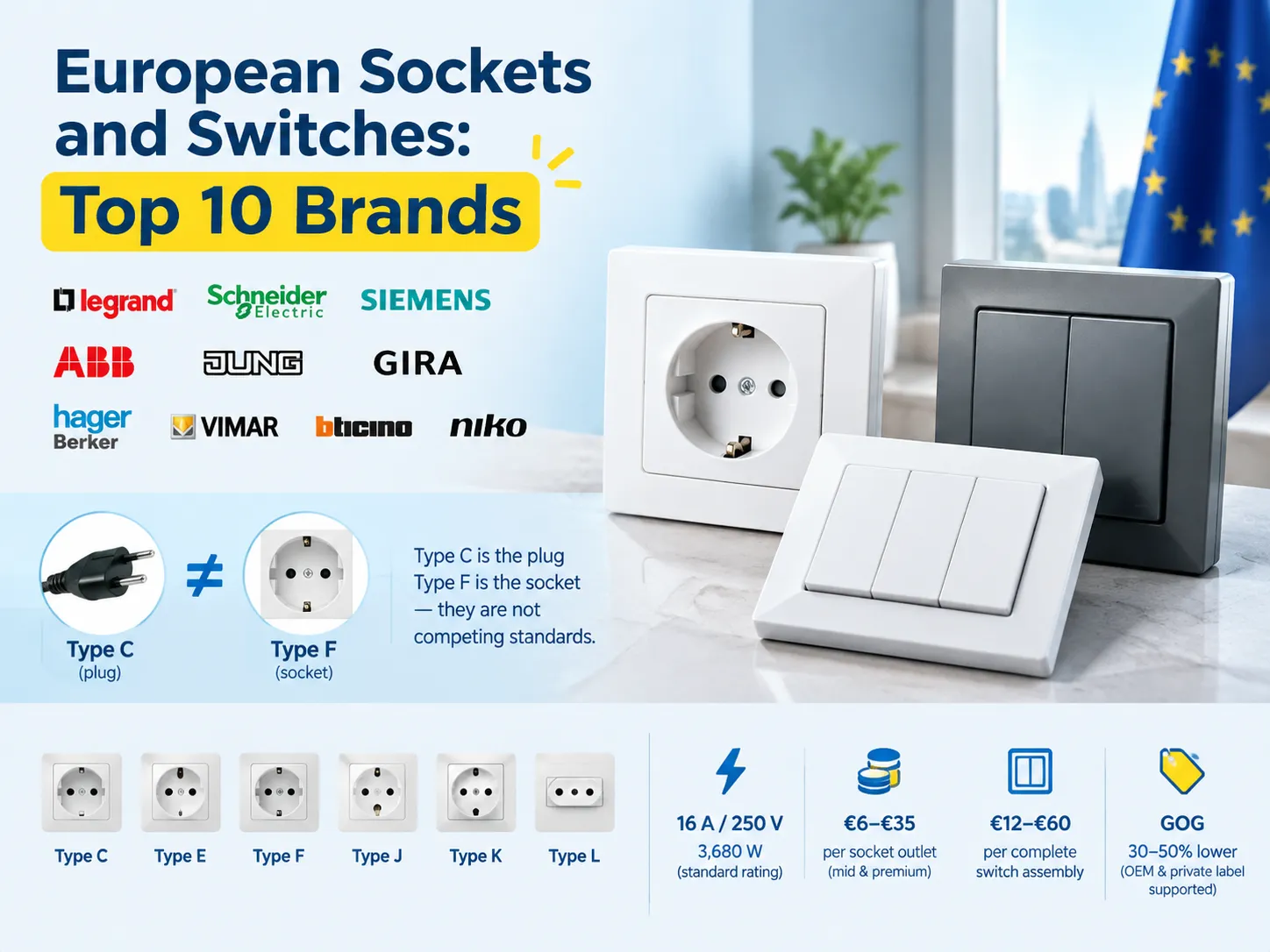
Les dix marques les plus couramment utilisées en matière d'installation de prises et d'interrupteurs en Europe sont Legrand (France), Schneider Electric (France), Siemens (Allemagne), ABB Burners via sa marque Busch-Jaeger (Suisse/Allemagne), JUNG (Allemagne), Gira (Allemagne), Hager + Berker (Allemagne et Luxembourg), Vimar (Italie), BTicino (Italie) (qui fait partie du groupe Legrand) et Niko (Belgique). Elles sont responsables des prises de Type C, Type E, Type F, Type J, Type K et Type L, qui ont une tension nominale standard de 16A/250V et 3680W en Europe. On peut s'attendre à payer entre 6 € et 35 € pour des prises de gamme moyenne à haute et entre 12 € et 60 € pour un interrupteur complet d'une de ces marques principales. D'autre part, GOG, un fabricant moins connu, propose des modèles similaires à un prix inférieur d'environ 30-50% et offre un support OEM ainsi que des options de marque privée. L'aspect crucial à garder à l'esprit avant l'achat est de comprendre que le Type C est une fiche tandis que le Type F est une prise et qu'ils ne peuvent pas être comparés car ce sont simplement deux types de normes différentes.
Type C, Type E, Type F : Ce que l'Europe utilise réellement
Les conventions de dénomination existantes peuvent entraîner des malentendus puisque les types de fiches et les types de prises ne correspondent pas directement. De plus, une prise physique particulière porte 3 noms différents selon l'organisme de normalisation utilisé.
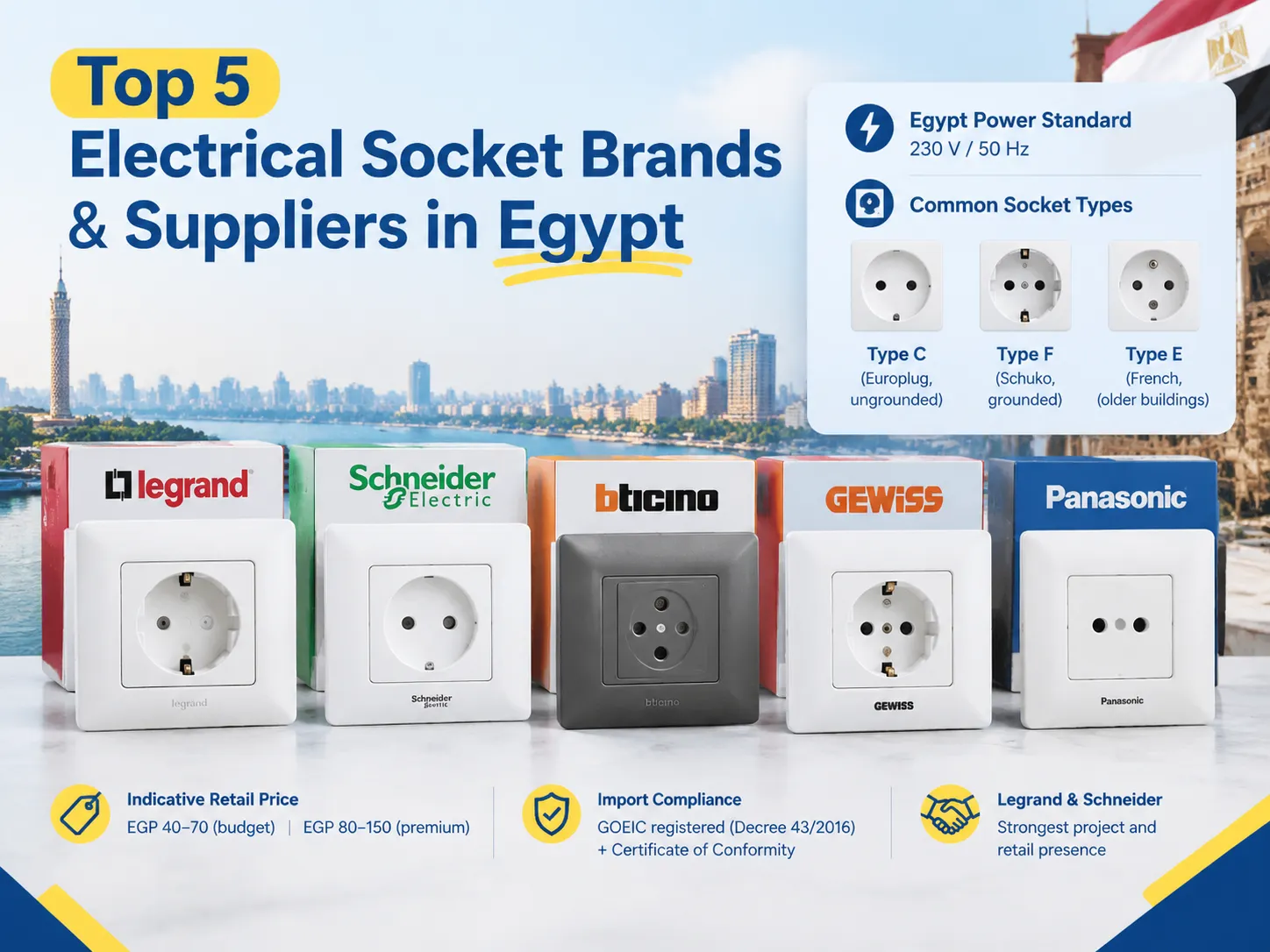
- Le Type C (CEE 7/16), appelé “ Europlug ”, est le nom de la fiche à deux broches que l'on peut voir utilisée dans les petits appareils électroniques, les rasoirs et les chargeurs. Le diamètre des broches mesure 4 mm et la distance entre les broches est de 18,6 à 19 mm. La fiche n'a pas de connexion de terre, ce qui est accepté seulement à 2,5 A et s'adapte aux prises de Types E et F.
- Le Type E (CEE 7/6) décrit une prise avec une broche de terre mâle dépassant de la face avant de la prise, connue pour être évaluée à 16 A. La prise est largement demandée dans des pays tels que la France, la Belgique, la Pologne, la Tchéquie et la Slovaquie. Ainsi, le Type E dispose d'une ligne d'alimentation de 2,5 mm² qui se connecte à un tableau électrique avec un disjoncteur évalué à 16 A.
- Le type F (CEE 7/4), prise Schuko, n’a pas de broche mais possède deux clips de terre placés à l’intérieur de la cavité de la prise. Calibrée à 16 A. Couramment utilisée en Allemagne, Autriche, Pays-Bas, Espagne, Portugal, Suède, Norvège, Finlande, Grèce et une grande partie de l’Europe de l’Est.
- Les types B (Suisse), D (Danemark) et L (Italie) sont encore utilisés. La coexistence des prises de type L en 10 A et 16 A dans un même pays complique la tâche des planificateurs.
Une solution ingénieuse a résolu une grande partie de ce problème : la prise hybride CEE 7/7. Cette prise possède à la fois le trou de terre du type E et les clips de terre du type F, ce qui lui permet de fonctionner avec les deux types de prises. Si vous achetez des appareils pour l’Europe sans connaître le pays final, cette prise peut être la norme. Les détails des différents types de prises électriques utilisées dans le monde valent la peine d’être lus avant de valider une nomenclature, car une erreur signifie une refabrication.
La norme pertinente sur laquelle tout repose est la IEC 60884-1, avec ses diverses déviations nationales telles que NF C 61-314 en France, DIN VDE 0620 en Allemagne, CEI 23-50 en Italie, SEV 1011 en Suisse, et BS 1363 au Royaume-Uni. Cependant, cela ne signifie pas qu’un produit conforme à la IEC 60884-1 respecte automatiquement les différences nationales de certains pays comme l’Allemagne ou l’Italie.
L’exception Royaume-Uni et Irlande
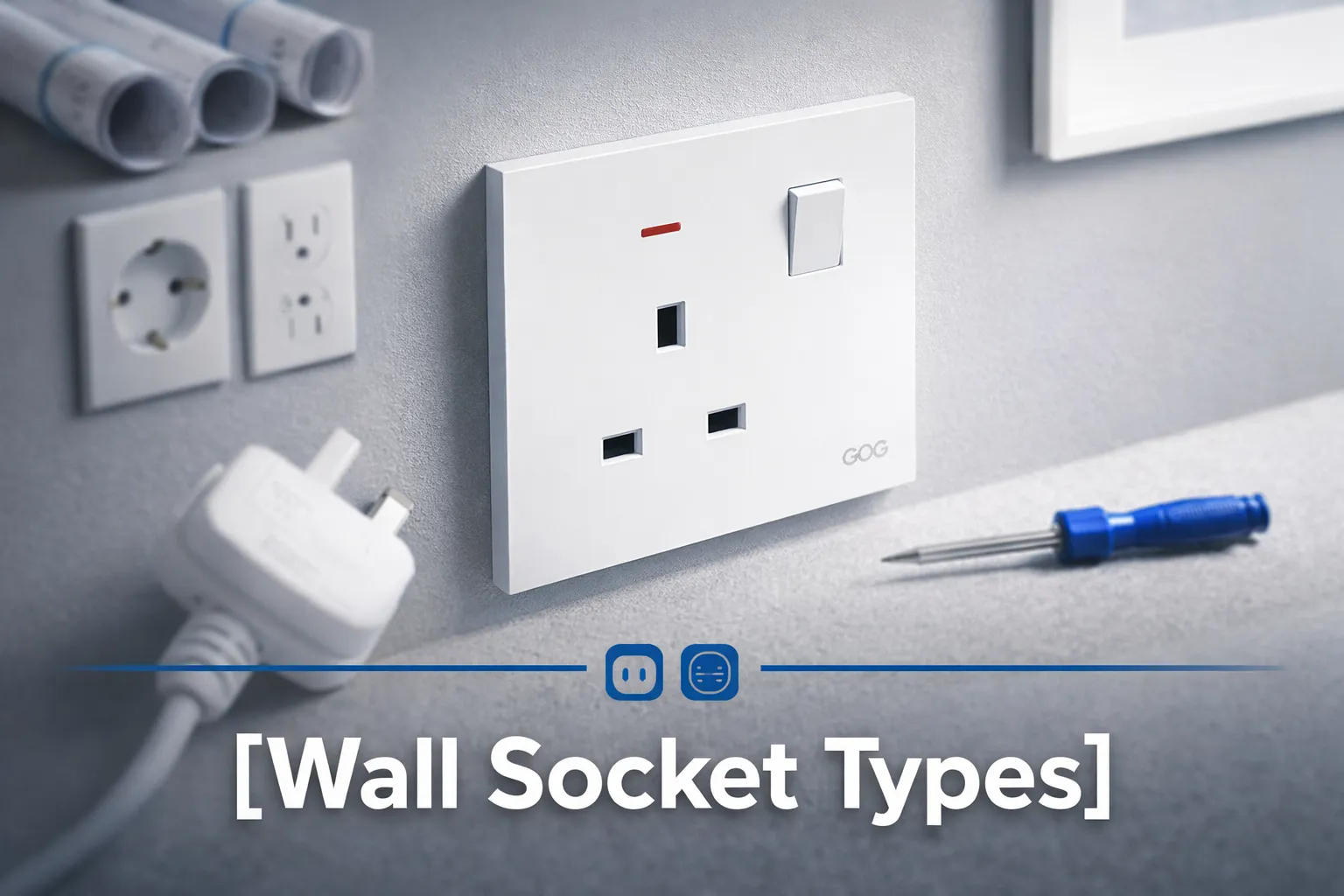
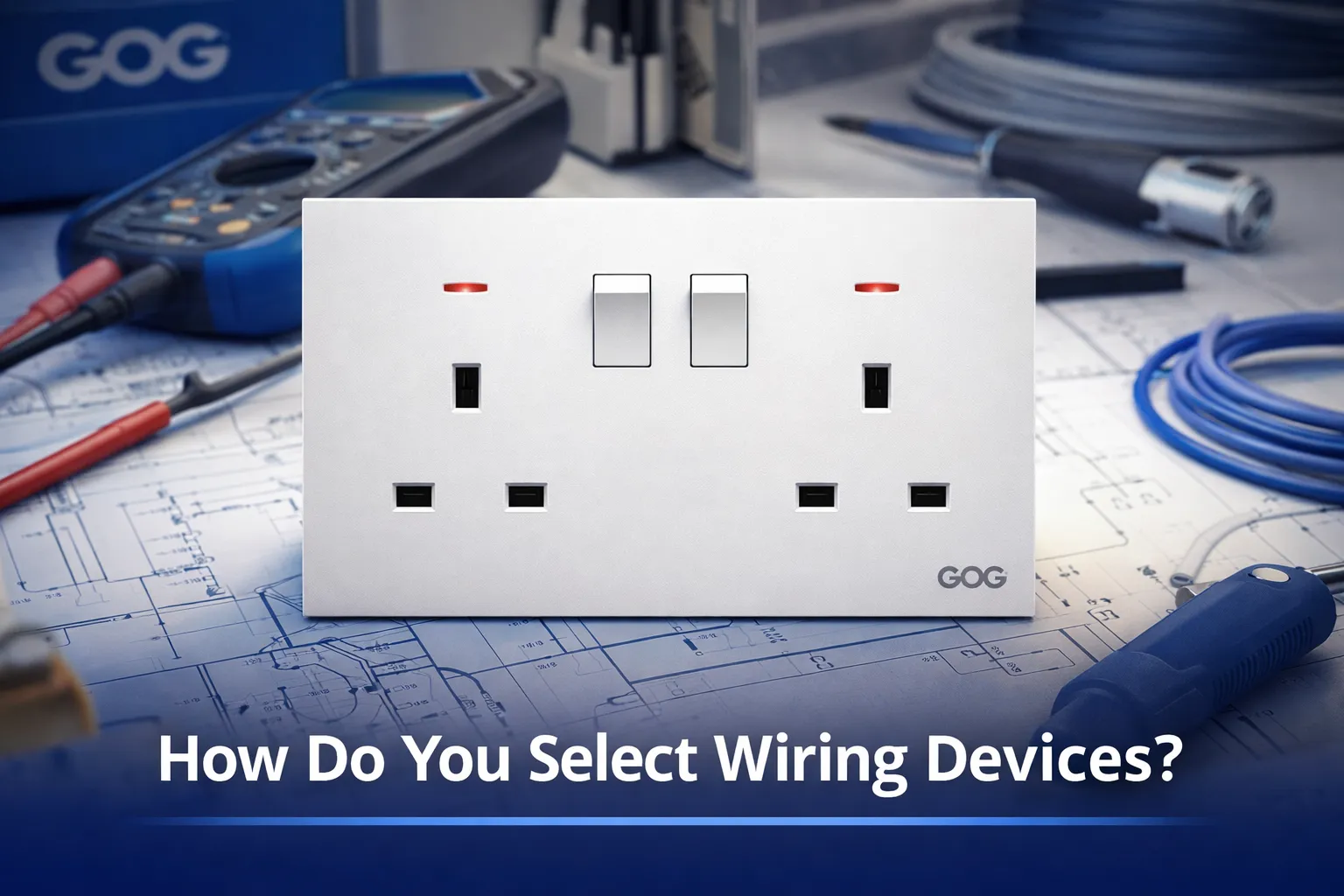
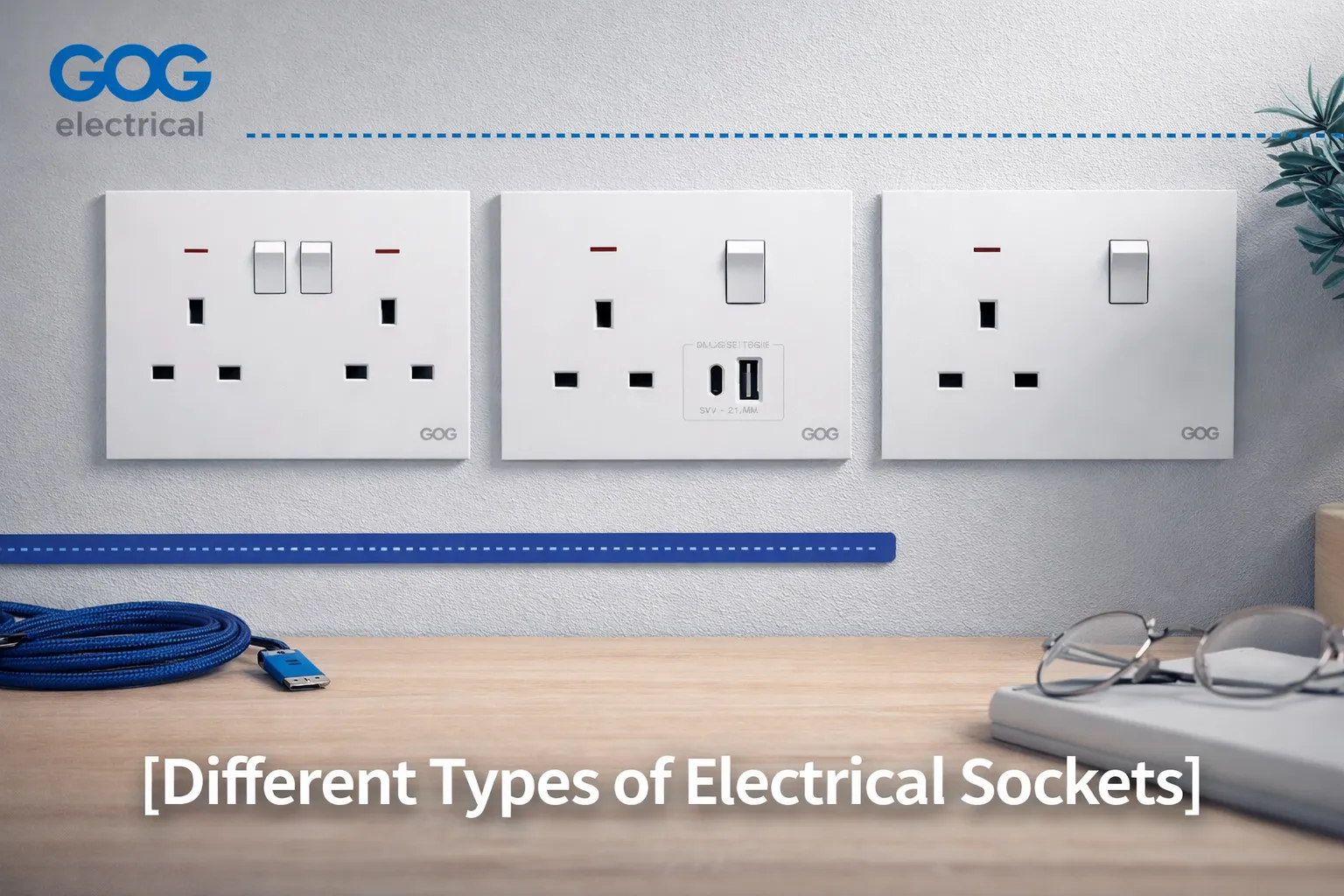
La norme BS 1363 mérite une mention spéciale car elle modifie complètement la manière d’acheter. Au Royaume-Uni, les prises sont commutées individuellement et équipées de volets de sécurité. Elles fonctionnent à 13 A, et chaque prise contient un fusible pour protéger son câble, et non l’alimentation électrique. En conséquence, les prises sont très volumineuses et les circuits en anneau peuvent être autorisés jusqu’à 32 A.
Si vous travaillez sur des installations pour le Royaume-Uni et le continent, vous devrez créer deux gammes de produits et nomenclatures distinctes. En fait, il n’existe pas de solution d’adaptation au niveau de l’installation. Le détail de construction derrière les types de prises murales utilisées au Royaume-Uni explique pourquoi l’agencement des volets et interrupteurs existe, et c’est la manière la plus rapide de comprendre pourquoi les appareils continentaux ne peuvent pas être substitués.
Les 10 marques européennes, comparées
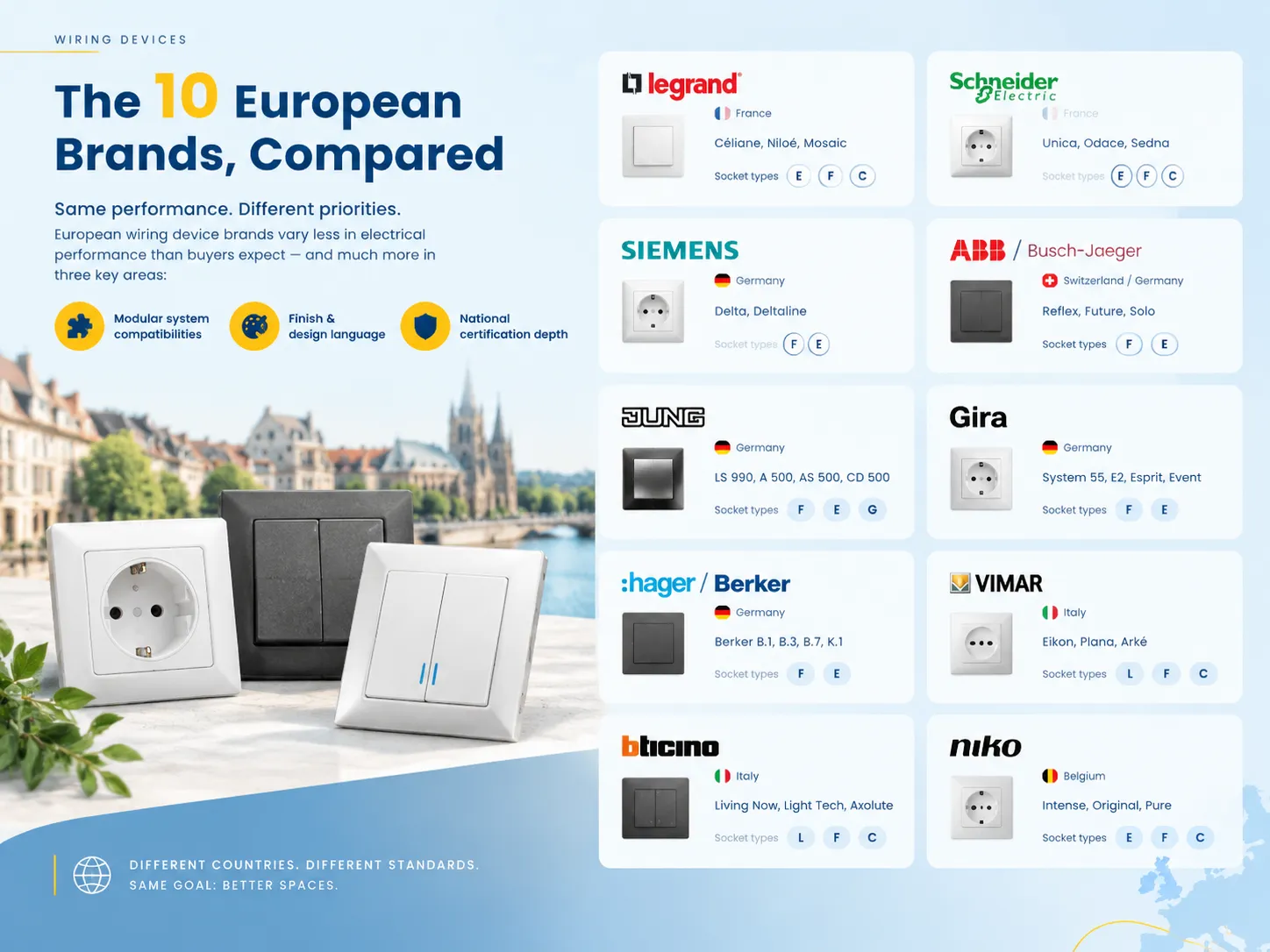
Les marques de cette catégorie diffèrent moins sur la performance électrique que les acheteurs ne le pensent, et beaucoup plus sur trois aspects : la compatibilité des systèmes modulaires, la finition et le langage design, ainsi que la profondeur des certifications nationales. Le paysage plus large des marques de dispositifs de câblage dans le monde inclut un ensemble différent de noms, car une marque leader en géométrie de prises européennes a souvent peu de présence dans les normes nord-américaines.
| Marque | Siège | Gammes principales | Types de prises | Prix typique par appareil |
|---|---|---|---|---|
| Legrand | Limoges, France | Céliane, Niloé, Mosaic | E, F, C | 8 €–25 € |
| Schneider Electric | Rueil-Malmaison, France | Unica, Odace, Sedna | E, F, C | 6 €–20 € |
| Siemens | Munich, Allemagne | Delta, Deltaline | F, E | 7 €–22 € |
| ABB / Busch-Jaeger | Zurich / Lüdenscheid | Busch-Jaeger Reflex, Future, Solo | F, E | 8 €–28 € |
| JUNG | Schalksmühle, Allemagne | LS 990, A 500, AS 500, CD 500 | F, E, G | 12 €–35 € |
| Gira | Radevormwald, Allemagne | System 55, E2, Esprit, Event | F, E | 12 €–35 € |
| Hager / Berker | Blieskastel, Germany | Berker B.1, B.3, B.7, K.1 | F, E | €7–€25 |
| Vimar | Marostica, Italy | Eikon, Plana, Arké | L, F, C | €5–€30 |
| BTicino | Milan, Italy | Living Now, Light Tech, Axolute | L, F, C | 8 €–25 € |
| Niko | Sint-Niklaas, Belgium | Intense, Original, Pure | E, F, C | 8 €–25 € |
Legrand is the leading player in the wiring devices market, so it is worth noting that two brands in this list belong to the same parent company as it competes in the professional arena with its products. What makes Legrand attractive is its versatility and diversity, a product line for every price category, excellent certification, and an impressive network of distributors across Europe. Céliane is the premium line, while Niloé represents the volume segment; Mosaic is a modular solution for commercial purposes. Legrand products can be found in French and Belgium buildings, medical institutions, educational and hospitality facilities.
With Unica and Odace being Legrand’s market rivals, Schneider Electric possesses the important benefits of having the whole-house electrical brand under its name. The company also supplies manufacturer’s wiring devices, which means that the contractor who purchases Schneider Electric panels or breakers should not look for any other supplier for wires; thus, the whole inventory can be bought at a discount price.
Siemens takes the engineering lead. Delta and Deltaline are straightforward and high-quality Schuko solutions, which also provide excellent documentation for the products. Siemens is a serious player both in the engineering field and building automation, and thus its devices can be easily integrated with building controls and KNX.
ABB is a nice combination of Swiss quality and German specification as ABB represents ABB products worldwide. Busch-Jaeger has been manufacturing wiring devices in Germany since 1879 and adds to ABB an opportunity of reaching German clients through high-quality products. The Reflex and Future lines are their main offerings for commercial specifications in Germany.
The family-owned firm JUNG has been operating in the electrical market since 1912. The headquarters of the company is located in Schalksmühle, and the workforce is composed of around 1700 employees. The company produces not only its well-known LS 990 range together with the Les Couleurs Le Corbusier. It would be better to describe JUNG as the high end of the electrical market since the devices produced by the company are known only for their looks. What’s worth mentioning, the company manufactures BS 1363 devices, that allows serving the customers of the UK and the European customers with one design.
Gira competes with JUNG directly in German specifications with an emphasis on design. The company was established in 1905 and now its office is situated in Radevormwald. The most remarkable product of the company is Gira System 55, a system of compatibility among more than 300 functions. It gives the possibility to select the appropriate frame according to the preferences of buyers and use the inserted device during the years.
Hager Group owns Berker as well, a manufacturer which operates in Schalksmühle, providing great opportunities for the group on the French and German residential and light commercial market. The ranges of the products produced by the company are well known and popular and cover various levels.
Vimar is an Italian specialist with its headquarters in Marostica, and in case your project requires Type L sockets, you definitely need to rely on this brand. Eikon is the exclusive range of the products produced by Vimar, and Plana represents a lot of production.
BTicino has been a part of Legrand since 1989, and Living Now enjoys great popularity in Italy, as the company produces high-quality products online. The company produces electronics for residential projects with the help of smart technology.
Niko is the leader of the market in Belgium with its headquarters located in Sint-Niklaas and the beginning of operations dating back to 1920. The products of Niko have become the standard on the market.
Smart Switches and Dimmers: The New Compatibility Problem
The most widespread specification flaw in 2026 is no longer the geometry of the socket but rather smart switches that cannot work with a load.
The efficacy of a smart switch depends heavily on the neutral wire situation. There is typically no neutral in the wall box used for lighting in most European installations regardless of their age, as the conventional mechanical switch simply cuts the live wire, thereby rendering the smart switch useless in many homes in Europe where re-wiring is impossible. Simply put, smart switches that use two wiring systems which keep the current constantly flowing produce flickering in the cases of LED lights and are unsuitable in some cases.
And the load plays a role as well; a dimmer with a capacity of 400 W does not mean that the same single dimmer can control 400 W of LED. This is because LED loads feature a different power factor and impulse effect, hence a dimmer that works well with 400W of halogen lights will probably cause buzzing or flashing with 60 W of LED lights.
Protocol choice is the third decision. Zigbee and Matter-over-Thread give better local control and mesh reliability; Wi-Fi is simpler but loads the access point. For a residential retrofit where the buyer wants app control plus voice assistant support, a device like this two-gang smart light switch with Tuya and Zigbee support is the pragmatic middle ground — Zigbee for reliability, Tuya for app and voice integration, and a two-gang form factor that matches what most European wall boxes actually contain.
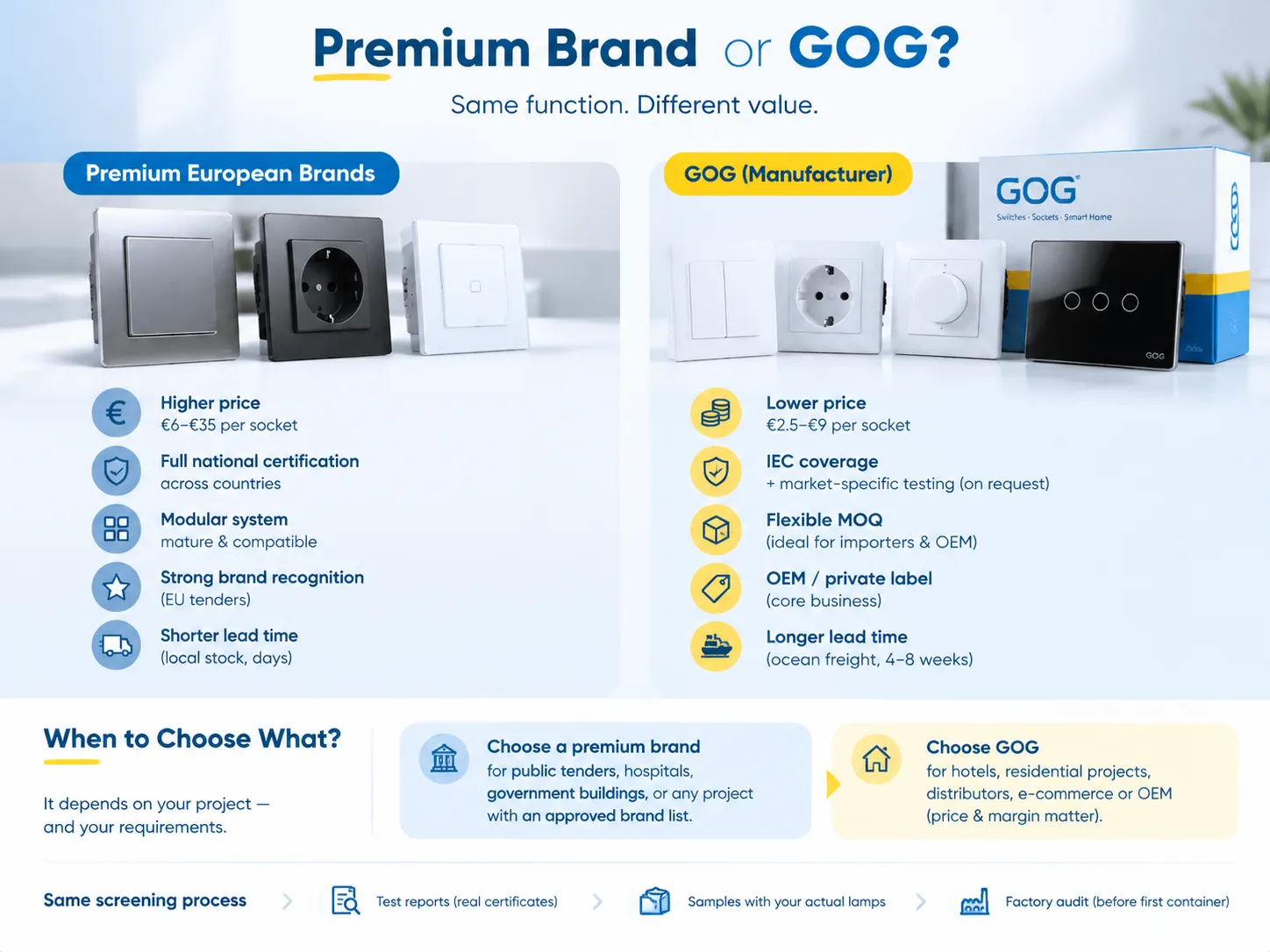
How to Choose Between a Premium Brand and a Manufacturer Like GOG
This is the most important decision impacting project budgeting, and it needs to be said as it is. Premium European brands don’t express a superior performance. Copper is copper and a waterproof 16 A plug remains a waterproof 16 A plug. What one pays for is a modular design, compliance with various local certification requirements, specific design language, and availability in local suppliers, as well as an option for the specifier not to justify the brand name in case it is mentioned in the tender.
| Facteur | Premium European brands | GOG |
|---|---|---|
| Price per socket, standard | €6–€35 | €2.5–€9 |
| Price per smart switch | €25–€80 | €6–€18 |
| Certification depth by country | Full national deviation coverage | IEC coverage, market-specific testing on request |
| Modular cross-range system | Yes, mature, decades of compatibility | Range-specific, not a century-old ecosystem |
| Finish and design options | Very wide, premium materials | Focused on high-volume finishes |
| OEM / private label | Rarely, and expensive | Core business |
| MOQ flexibility | Container quantities, rigid | Flexible, geared to growing importers |
| Brand recognition in EU tenders | Élevé | Low, and that is the honest limitation |
| Lead time | From local stock, days | Ocean freight, 4–8 weeks typical |
GOG manufactures switchboards, plug sockets, dimmer switches and smart switches with its own mouldie and has control of raw materials, which it sells wholesale, custom and OEM. The value proposition is simple: the same electrical functionality for about half the price and the ability to slap your logo on it. The only real drawback is the weak brand recognition and lack of a long European project history.
In practical terms, this means that if it is a public tender, a hospital, a government building or any other project where a list of approved brands is presented in a specification, premium brand should be purchased. If it is a hotel renovation, a residential project, a brand of the distributor, an online seller’s custom brand, or an OEM product needing to meet the price objective, sourcing must be done directly.
Whichever way you go, the screening process is the same, and how to select wiring devices for a project lays out the commercial tests — certified test reports rather than certificates of conformity, samples tested with the actual lamps you intend to use, and a factory audit before the first container rather than after the third.
Which Brand Fits Which Scenario
Once the marketing is pierced, choices will tend to be dictated by the type of build involved.
- When it comes to multi-family dwellings in Germany or Austria they tend to opt for Gira System 55 or JUNG LS 990. The modular approach pays off over the lifetime of the installation as functions can be shifted without changing the frames. The cost is substantial, and the buyers will approve.
- If we talk about multi-family dwelling in France or Belgium it is either Legrand Céliane, Niloé or Niko in Belgium. Being a wholesaler is what defines the schedule in this case.
- As far as Italian residential or hospitality market is concerned, the matter is about Vimar Eikon or BTicino Living Now, dictated by the need for Type L socket. No way around this one.
- When it comes to commercial offices and light industry, it is Schneider Unica or ABB Busch-Jaeger Reflex, or Hager/Berker on the list. It is usually the electrical contractor specifications that bring the clients’ specification.
- If we take healthcare and lab industry, we are talking about a premium brand where you can find the series of devices with documents that correspond to medical locations. Here, the premium pay for the traceability and other certifications.
- As for hotels and residential buildings, it is about the winning piece that was purchased. The volume is real and the finish is manageable.
FAQ
Are all European plug sockets the same?
It is not true, and considering them as such can lead to an expensive error. The sockets of mainland Europe are classified as Type E (French design, with earth pin protruding) or Type F (Schuko design, with earth clips on the side) and have a rating of 16 A / 250 V. Switzerland has installed Type J connectors, Denmark has Type K design, Italy has two types of Type L (10 A and 16 A), while UK and Ireland use Type G (13 A). The only way out of this situation is the CEE 7/7 adapter that can perfectly connect either Type E or Type F into a socket.
What plug adapters do I need for Europe?
For visitors from North America, Type C or Type F adapters can be utilized in most places in mainland Europe, Type G in UK and Ireland, Type J in Switzerland and Type L in Italy. Type C (Europlug) fits Type E and Type F sockets, as well as J, K and L sockets in many instances. Therefore, one Type C adapter is sufficient for a majority of locations. However, for professional installations, it is advisable to forget about adapters since they do not provide earth continuity, are not suitable for continuous loads of 16 A and cannot pass electrical safety inspection. Check whether sockets are suitable before installation.
Is Type C or type F used in Europe?
Both of the items are not interchangeable with each other. Type C stands for the plugs, which are also known as CEE 7/16. Type C refers to the “European two-pin plug” and is rated at 2.5 ampere and is non-earthed and is used for low-wattage appliances. While type F stands for sockets, technically known as CEE 7/4 or better known as Schuka sockets. The Type F sockets have carrying capacity of 16 ampere and are earthed via two side clips. Thus, there is a possibility for type C plug fitting into type F socket so this means that type F socket is used with type C plug in countries including Germany, Austria, Netherlands, and many of the countries in eastern Europe. Type E sockets are used in countries such as France, Belgium, Poland and Czech Republic which also allow the usage of Type C plug. When it comes to the use of any type of socket or plug people are suggested to use the type which belongs to that country.
What does an EU plug look like?
The European plug has a round shape with two cylindrical pins. This design is completely different than those plugs in North America and UK which have flat and rectangular blades respectively. The Europlug or Type C plug is equipped with two 4mm pins that remain 18.6-19 mm apart from each other with the energy requirements of 2.5 Amperes. The Schuko or Type F plug is thicker as compared to Type C plug with larger pin size measuring about 4.8 mm and 19 mm apart. In addition, this plug has metal clips on the top and bottom of the plug, which makes the plug capable of connection with the earth. The Type E plug is different from Types C and F plug as it has a tiny hole that is meant for the protruding earth pin. The CEE 7/7 hybrid plug has both the mentioned features.
Références
- IEC — IEC 60884-1 Plugs and Socket-Outlets for Household and Similar Purposes
- Legrand — Wiring Devices Range Documentation
- Schneider Electric — Unica and Odace Technical Catalogues
- JUNG — LS 990 and System Range Data
- Gira — System 55 Compatibility Documentation
- Busch-Jaeger — Reflex and Future Range Specifications
- Vimar — Eikon and Plana Technical Data
- BTicino — Living Now Range Information
- Niko — Belgian Wiring Devices Standards and Ranges
- Hager Group — Berker Range Portfolio
Conclusion
European plugs and sockets operate on the principle of common standards, dressed up in design terms. Each of the ten brands mentioned has complied with IEC 60884-1, and any differences come down to the standardisation depth, compliance range, quality of finishing, and distribution network. Getting the right type of plug is of utmost importance, since brand selection is only a commercial matter in this case.
There are several key messages to pay attention to. The fact is that C is a plug and F is a socket, so stop using them as interchangeable terms. Make sure you unconditionally apply CEE 7/7 mixed plugs in case you don’t know the destination country yet. Secondly, remember to discuss the smart switch’s requirement for neutral wires, as most of old European electrical boxes don’t have neutral wires at the switch. Finally, don’t forget that premium brands offer certification depth, compatibility within electrical ecosystems and tender reputation. Only in case your project requires any of the above, should you spend extra money on that.