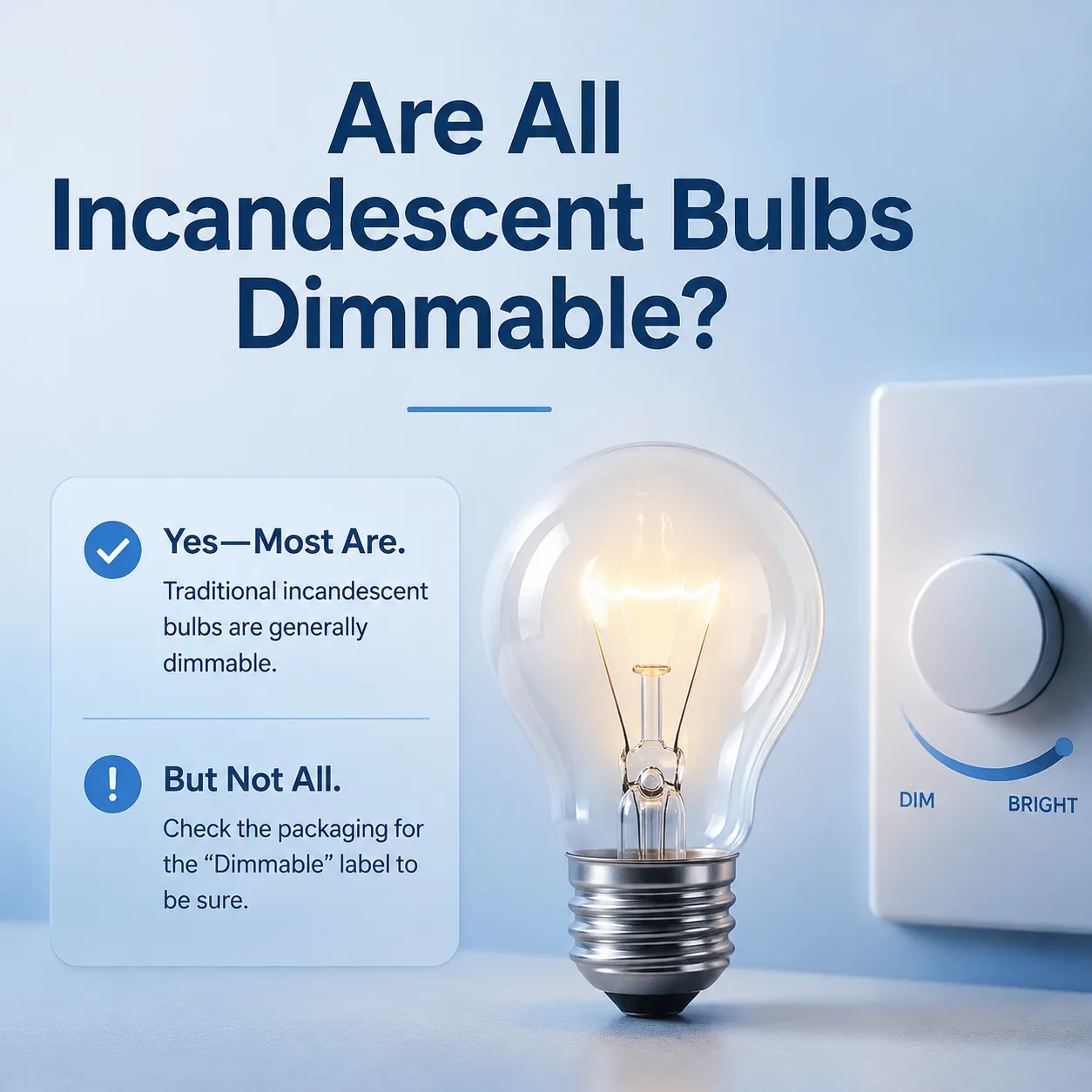
When a woman from Manchester decided to remove the unpleasant bright light from her dining room and replace it with a vintage filament bulb, she merely attached the bulb to her existing fixture and turned down the dimmer to the desired light intensity. The bulb actually worked without a delay, which technically shouldn’t seem striking. Her success was not a matter of pure luck, but instead a clever application of the laws of physics. As it turns out, the answer to the question whether incandescent bulbs are dimmable is simple: yes. Each and every standard incandescent bulb ever invented can be dimmed without any restrictions since it was designed to function that way. There is no need for additional equipment or compatibility tables since the phenomena of dimming of incandescent bulbs is a natural one, at least until one tries to use LED bulbs with an incandescent dimmer and faces problems with flickering and humming.
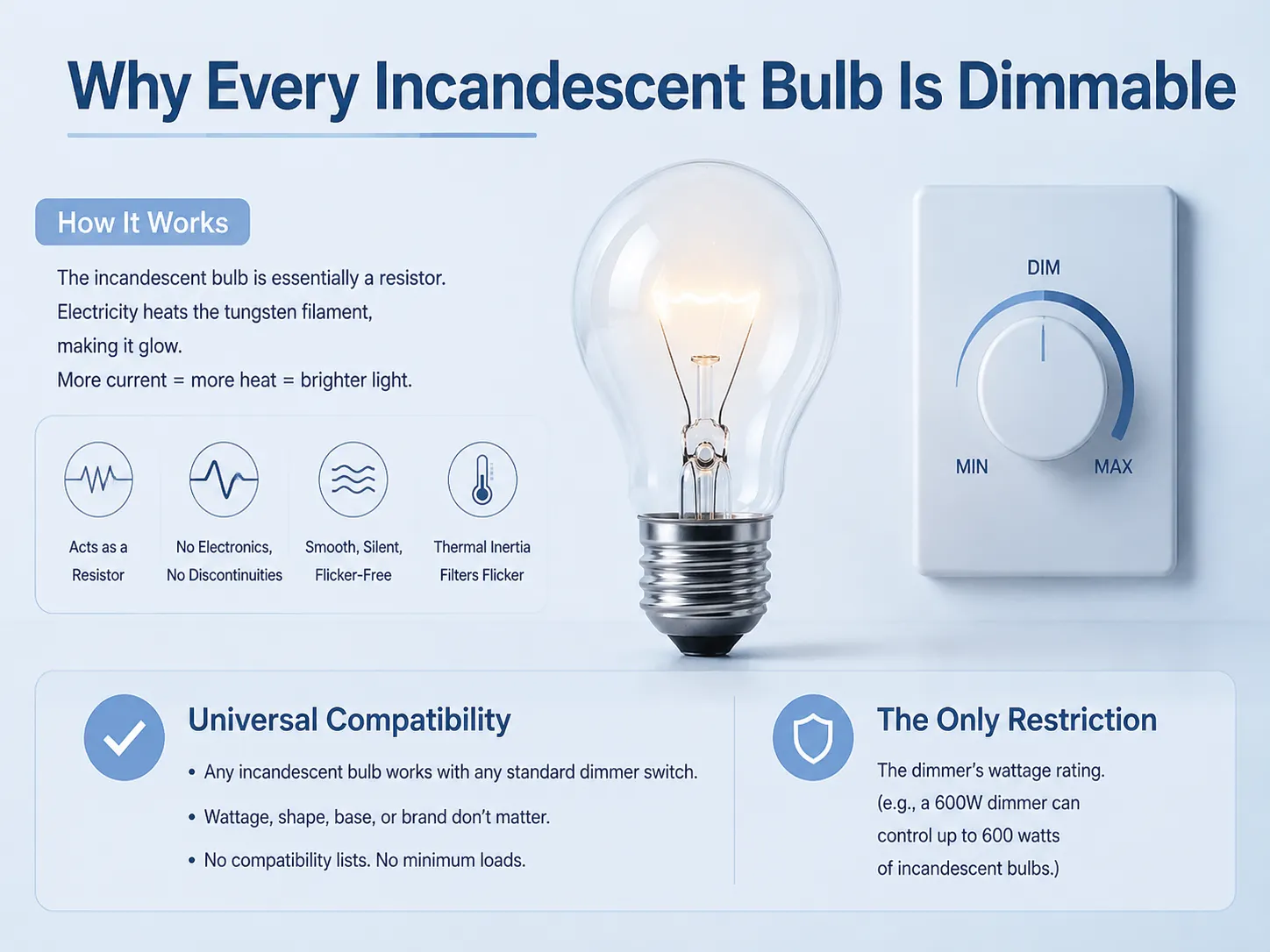
Why Every Incandescent Bulb Is Dimmable
The incandescent light bulb serves as a resistor. The thin tungsten filament being placed into inert gas filled glass bulb which glows with electricity passing through it. The larger the electrical current the greater the heater will be and the brighter filament will light. There is no circuitry or electronics in the bulb. Incandescent lamp uses electricity to produce the heat and light, and therefore, there are no discontinuities in the relationship between electric voltage and intensity of produced light. The process is smooth, silent and flicker-free as no elements inside the lamp cause disturbances in the waveform. The filament undergoes thermal inertia and takes some time to reach the desired temperature. In this way, flickering is not noticeable despite changes in the waveform of the electricity flowing through the filament. Charm of incandescent lamp is in the fact that it serves as a low-pass filter. The U.S. Department of Energy has been reporting about dimmability characteristics of incandescent light bulb for many years.
Any incandescent bulb can work with any standard dimmer switch. It does not matter about the wattage, shape, base, or brand of the light bulb. Compatibility lists do not have to be checked, and there are no minimum loads to consider. The only restriction is the wattage of the dimmer switch; a dimmer switch that is rated to handle 600 watts can control up to that amount of wattage in bulbs without blowing up.
The Limits of Incandescent Dimming: What Can Go Wrong
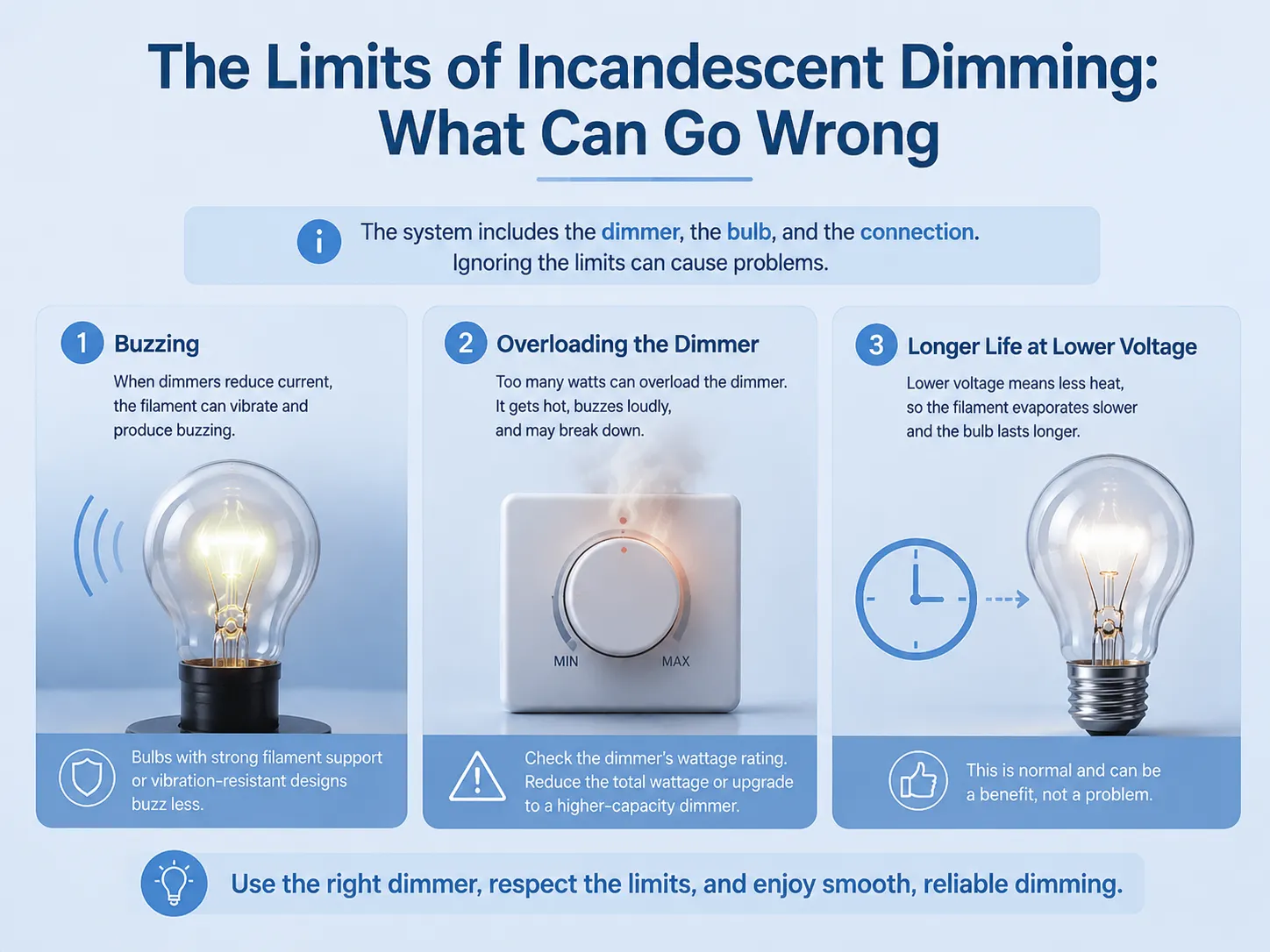
The light source itself is dimmable, although there are certain limitations pertaining to the complete system, which includes the dimmer, the bulb, and the connection. The most common problem that can arise when one ignores these limitations is buzzing. An incandescent bulb can emit noticeable sound in case of being installed in the dimmable connection set up. The buzzing is associated with the fact that when the dimmer controls reduce the current, it creates forces that cause the filament to vibrate and thus, produce sound. Bulbs that have reliable support for filament will buzz less.
Additionally, special bulbs resistant to vibration can help with buzzing, as they will produce less sound than the average bulb used in dimmable systems. However, producing sound is a normal characteristic of all incandescent bulbs and is not a sign of the lights being faulty. The second problem is overloading the dimmer. For instance, when people install 6 60-watt bulbs opposed to one 60-watt bulb in the average setup without checking the stated limits of the dimmer, it will eventually fail because the current will be too high.
The dimmer will get hot, start buzzing loudly, and finally break down. The people will only be able to solve this problem either by decreasing the total number of watts in the connected light or by changing the dimmer for the one meant for working with higher current. The third issue is that less voltage makes the bulbs last longer as they heat less thus filament bulb evaporates slower. It does not however make it a problem, rather it can only help people use lights for longer time.
The Real Challenge: Dimming LEDs, Not Incandescents
Dimming of incandescent bulbs is a straightforward process but dimming LED bulbs can be complex. LED bulb comes with an electronic driver which is essentially a switched mode power supply that transforms AC voltage into low voltage DC which is needed by the LED chips. The drive takes the chopped waveform from the dimmer and modifies its output based on the dimmer signal. In case the driver is unable to read the signal correctly, it creates flickering or buzzing lights instead of a normal dimming process. Our detailed guide on Restaure a energia, teste e ajuste o brilho mínimo explains how to match bulbs and dimmers for flicker‑free, reliable performance — and why the compatibility chart that was never needed for incandescents is essential for LEDs.
What About Specialty Incandescent Bulbs? Tiffany Lamps, Rough‑Service, and Halogen
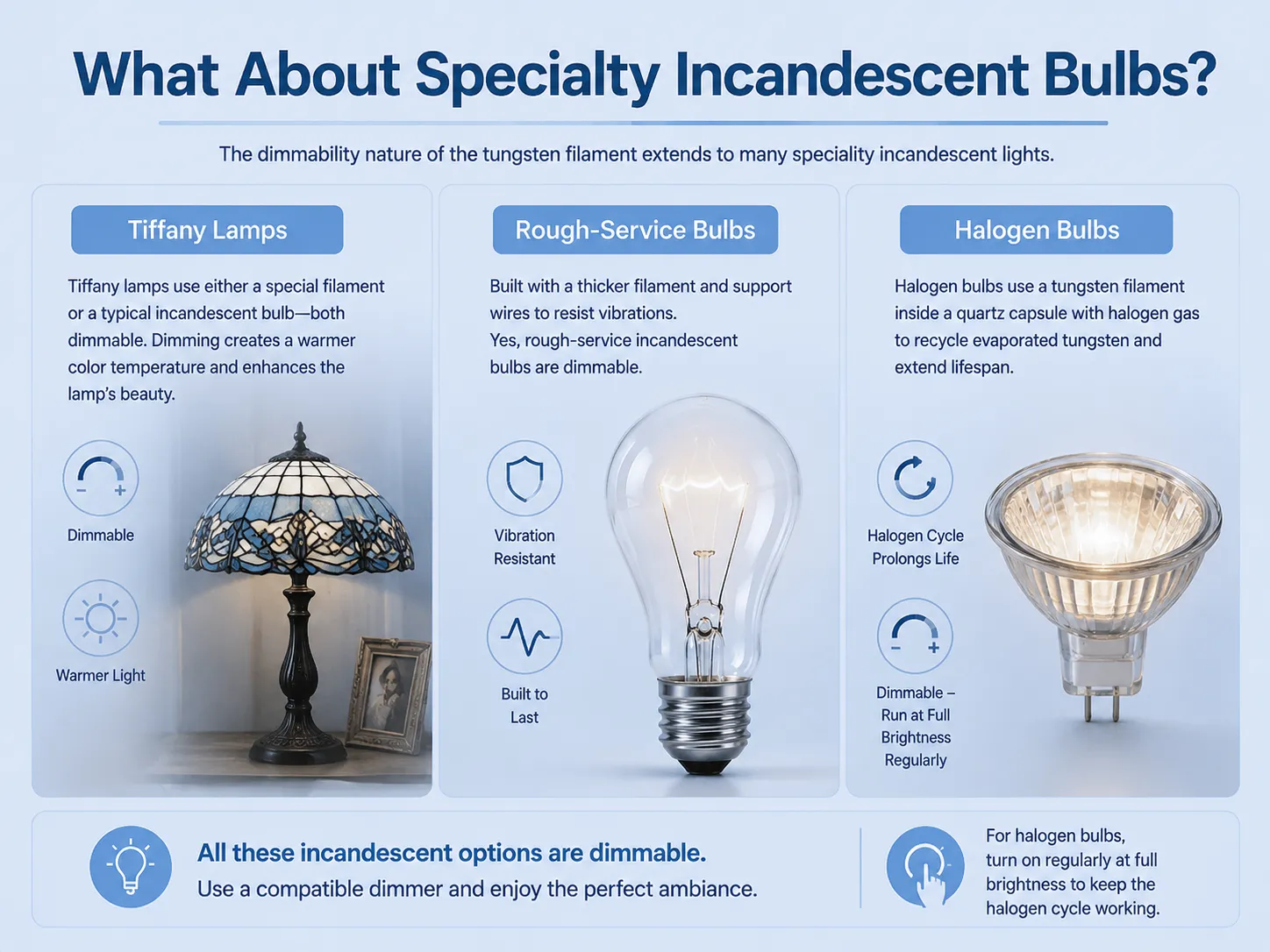
The dimmability nature of the tungsten filament can be seen in other forms of incandescent lights as well. A Tiffany lamp with both a stained glass shade and a decorative base contains either a special filament or a typical incandescent bulb. Both kinds of light lessening allows for dimming of the light cigarette holders. Dimmer is an effective electronic device to control the brightness of the light bulb fitted in a Tiffany lamp. Dimming will also result in ‘warmer’ color temperature, and thus, it will improve appearance of the lamp.
A rough-service incandescent is also dimmable. It has a thicker filament that can endure vibrations and supports wires to block vibrations as well. A halogen bulb is another form of incandescent light. It includes a filament made from a tungsten metal and is lit up inside a quartz container with halogen gas to recycle evaporated tungsten onto the filament to prolong its lifespan. Again, halogen bulb dimming does not differ from incandescent bulbs dimming, and you just need to remember to turn it on regularly at full brightness to make the halogen process possible.
How to Dim an Incandescent Bulb: The Choices You Have
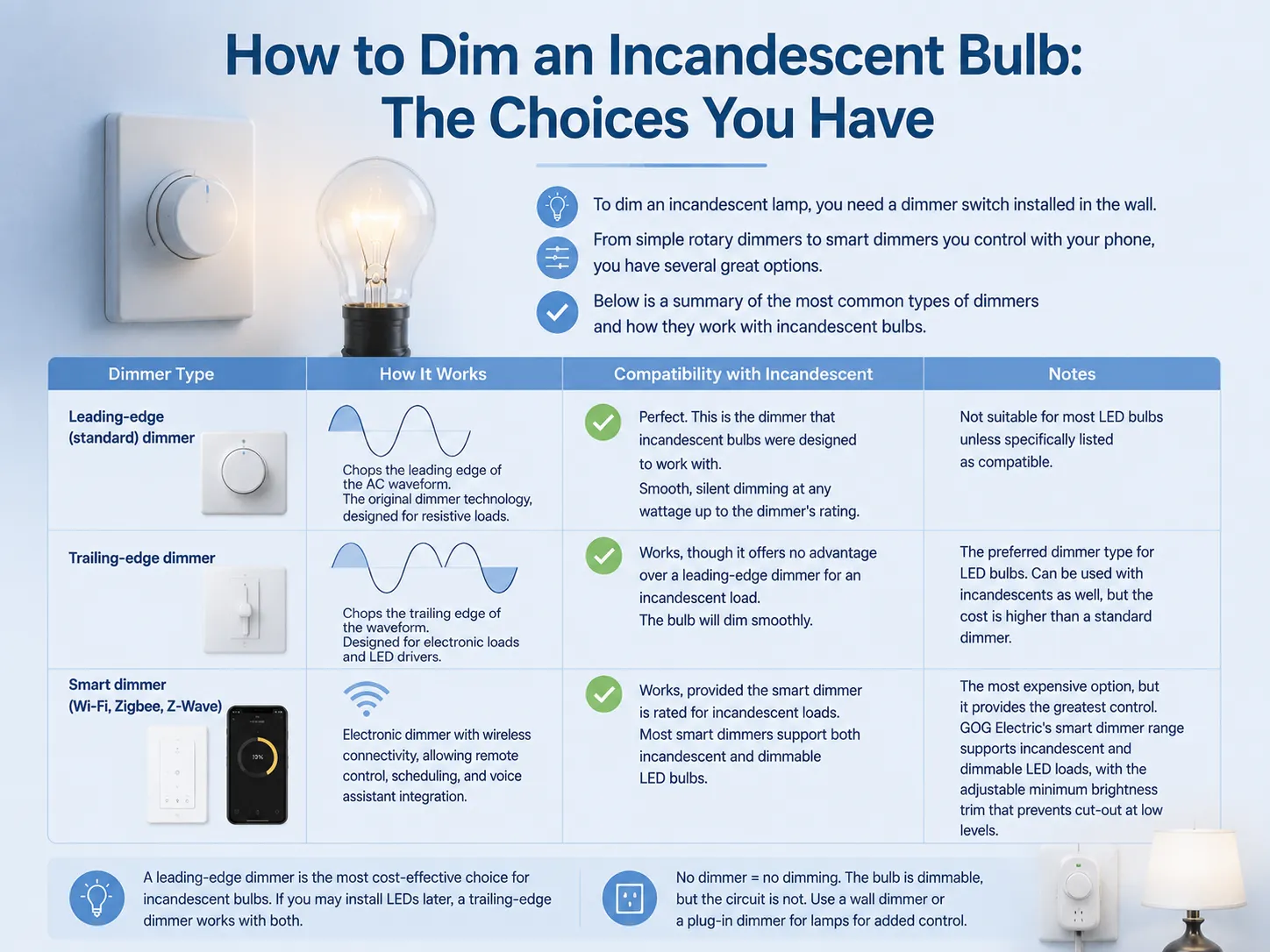
To dim an incandescent lamp, you need a dimmer switch installed in the wall. There are different types of dimmer switches; the simplest are rotary dimmers that have a knob that you have to turn, while there are also smart dimmers connected to your phone. The table below gives a summary of the most common types of dimmers and if these work with incandescent loads.
| Tipo de Dimmer | How It Works | Compatibility with Incandescent | Notes |
|---|---|---|---|
| Leading‑edge (standard) dimmer | Chops the leading edge of the AC waveform. The original dimmer technology, designed for resistive loads. | Perfect. This is the dimmer that incandescent bulbs were designed to work with. Smooth, silent dimming at any wattage up to the dimmer’s rating. | Not suitable for most LED bulbs unless specifically listed as compatible. |
| Trailing‑edge dimmer | Chops the trailing edge of the waveform. Designed for electronic loads and LED drivers. | Works, though it offers no advantage over a leading‑edge dimmer for an incandescent load. The bulb will dim smoothly. | The preferred dimmer type for LED bulbs. Can be used with incandescents as well, but the cost is higher than a standard dimmer. |
| Smart dimmer (Wi‑Fi, Zigbee, Z‑Wave) | Electronic dimmer with wireless connectivity, allowing remote control, scheduling, and voice assistant integration. | Works, provided the smart dimmer is rated for incandescent loads. Most smart dimmers support both incandescent and dimmable LED bulbs. | The most expensive option, but it provides the greatest control. GOG Electric’s smart dimmer range supports incandescent and dimmable LED loads, with the adjustable minimum brightness trim that prevents cut‑out at low levels. |
A leading-edge dimmer is the cost-effective method if you are planning to dim incandescent bulbs. In case you are considering installing LED bulbs at a later date, then using a trailing-edge dimmer that can work with both types of loads would be the better alternative. Moreover, if you use an incandescent bulb on a circuit without any dimmer, you will not be able to dim it. The bulb itself is dimmable, but the circuit is not. You can show the additional control by using the dimmer switch or alternatively use a plug-in dimmer for lamps. For a step‑by‑step guide on the installation process, our article on how to install a dimmer switch covers the wiring, the safety checks, and the compatibility verification.
Perguntas Frequentes
Can an incandescent bulb be dimmable?
That is correct. Every standard incandescent light bulb is intrinsically dimmable. The tungsten filament functions as an ordinary resistor and dimming the light with a dimmer switch leads to a gradual and noiseless decrease in brightness. This requires no special bulb or compatibility evaluation.
How to tell if an incandescent bulb is dimmable?
You have no requirement of verification. All types of incandescent bulbs irrespective of wattage, shape, or brand are suitable for dimming. Incandescent light bulbs do not contain any electronic components that can inhibit dimming. The only limitation for dimmer switch is its wattage capacity, which should be either equal to or more than total wattage of the light bulbs connected to the circuit.
What happens if you put a regular bulb in a dimmer switch?
An incandescent light bulb will dim safely and smoothly when used on a dimmer switch. However, a non-dimmable LED will flicker, buzz, overheat, and possibly fail with a dimmer switch. It’s important to know that non-dimmable LED lights must never be paired with a dimmer switch. Use only “dimmable” light bulbs on a dimmed circuit.
What bulb for a Tiffany lamp?
A Tiffany lamp looks great with a dimmable incandescent or decorative filament bulb that provides the stained glass with a warm and color-accurate illumination. A dimmable LED filament bulb is the new energy-efficient option that gives the same appearance as incandescent lighting. If a dimmer switch is being used, the bulb should be labeled ‘dimmable’. The nice warm light provided by dimmed incandescent or LED filament bulbs is the norm for Tiffany lamps and other lamps that use stained glass.
Referências
- U.S. Department of Energy — Incandescent Lighting and Dimming. Technical information on the inherent dimmability of incandescent lamps and the physics of filament dimming.
- Lutron Electronics — Dimmer Compatibility and Incandescent Dimming. Manufacturer of leading‑edge and trailing‑edge dimmers, with technical documentation on dimmer types and load compatibility.
- Leviton — Dimmer Switches for Incandescent and LED Loads. Manufacturer of residential dimmers, with guidance on matching the dimmer to the bulb type.
- Energy Star — LED and Incandescent Dimming Basics. Consumer guidance on dimming different bulb types and the importance of dimmer‑bulb compatibility.
Are all incandescent bulbs dimmable? Yes, every single one of them, and they always have been. A tungsten filament is a resistor, while a dimmer is a voltage reducer – together creating a combination that has been effective in electrical engineering for over a century. Nowadays it is a question of finding a suitable incandescent light bulb, as well as deciding whether to stick to the warm filament light or try an energy-efficient LED that requires a compatible dimmer. Whichever path you take, GOG Electric provides dimmers, both standard and smart, thus allowing you to manage the light regardless of the type of a light bulb.