السوق الأوروبية ليست موحدة، مما يظهر لأي شخص مسؤول عن التركيب الكهربائي عبر عدة حدود وطنية صعوبات اختيار عناصر الأسلاك الصحيحة للمشروع. على الرغم من أن ألمانيا تستخدم مقبس Schuko، إلا أن فرنسا تستخدم المقبس ذو الدبوس الأرضي القائم، ولا تزال إيطاليا تستخدم أنواع التوصيل القياسية 10 A و16 A. كما أن سويسرا والدنمارك اتبعتا طرقهما الخاصة بالكامل في هذا المجال.
تتحدث هذه النشرة عن أكبر عشر علامات تجارية تهيمن في هذا المجال، مزايا كل علامة تجارية، نطاقات أسعارها، والصناعات التي يمكن استخدام أجهزة الأسلاك من علامات تجارية محددة فيها. بعد ذلك، تشرح كيفية اختيار العلامة التجارية الأوروبية المتميزة بين المصنعين الآخرين، بما في ذلك GOG، وكيفية تجنب المشاكل المتعلقة بالتوافق التي يمكن أن تدمر حتى أفضل المشاريع.
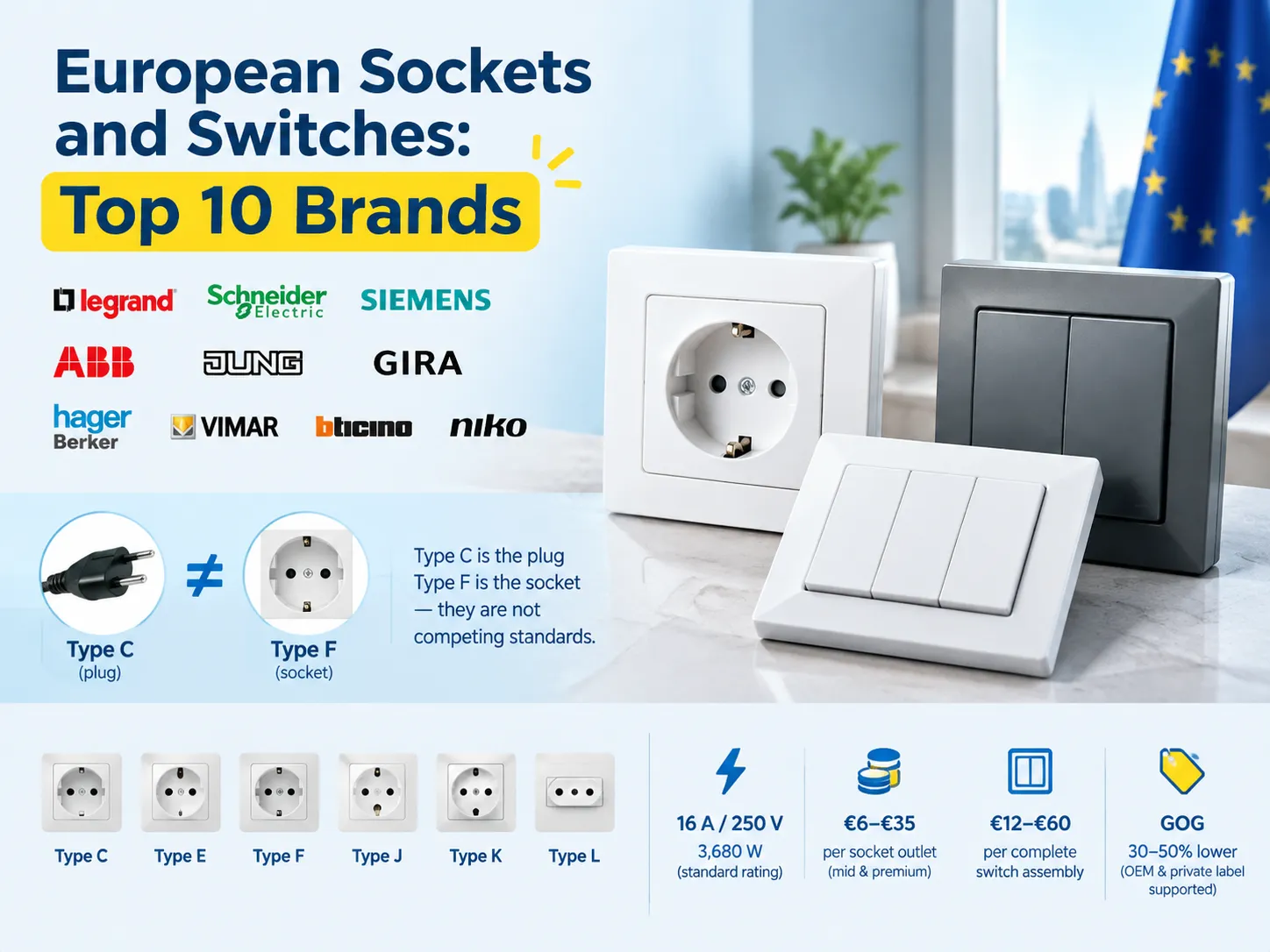
العلامات التجارية العشر الأكثر استخدامًا عندما يتعلق الأمر بتركيب المقابس والمفاتيح الأوروبية هي Legrand (فرنسا)، Schneider Electric (فرنسا)، Siemens (ألمانيا)، ABB Burners من خلال علامتها التجارية Busch-Jaeger (سويسرا/ألمانيا)، JUNG (ألمانيا)، Gira (ألمانيا)، Hager + Berker (ألمانيا ولوكسمبورغ)، Vimar (إيطاليا)، BTicino (إيطاليا) (وهي جزء من شركة Legrand) وNiko (بلجيكا). وهي مسؤولة عن مقابس Type C، Type E، Type F، Type J، Type K وType L، التي لها جهد قياسي مقدر 16A/250V و3680W في أوروبا. يمكن توقع دفع ما بين 6€ و35€ للمقابس المتوسطة إلى العالية المستوى و12€ إلى 60€ لمفتاح كامل من إحدى هذه العلامات التجارية الكبرى. من ناحية أخرى، تقدم GOG، وهي شركة تصنيع أقل شهرة، نماذج مماثلة بسعر أقل بحوالي 30-50% وتوفر دعم OEM بالإضافة إلى خيارات العلامة الخاصة. الجانب الحاسم الذي يجب تذكره قبل الشراء هو فهم أن Type C هو قابس بينما Type F هو مقبس ولا يمكنهما التنافس مع بعضهما البعض لأنهما نوعان مختلفان من المعايير.
Type C، Type E، Type F: ما تستخدمه أوروبا فعليًا
يمكن أن تؤدي التسمية الحالية إلى سوء فهم لأن أنواع القوابس وأنواع المقابس لا تتطابق مباشرة مع بعضها البعض. بالإضافة إلى ذلك، يحمل المقبس الفيزيائي المحدد 3 أسماء مختلفة اعتمادًا على هيئة التقييس المستخدمة.
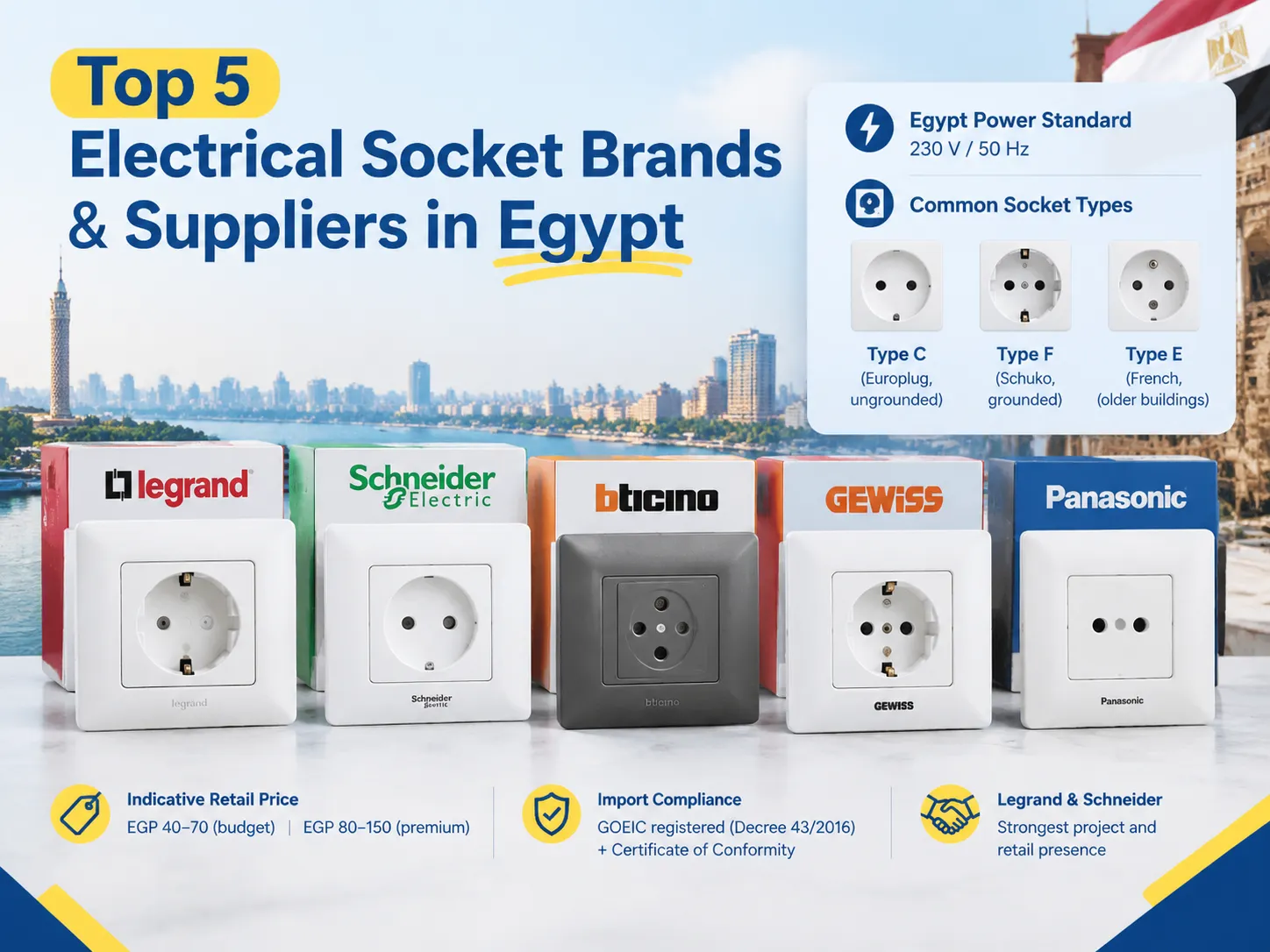
- Type C (CEE 7/16) المعروف باسم “Europlug.” هو اسم القابس ذو الدبوسين الذي يُستخدم في الأجهزة الإلكترونية الصغيرة، وأجهزة الحلاقة، والشواحن. يبلغ قطر الدبوس 4 مم والمسافة بين الدبابيس 18.6–19 مم. القابس لا يحتوي على اتصال أرضي، وهو مقبول فقط عند 2.5 A ويتناسب مع مقابس Type E وType F.
- Type E (CEE 7/6) يصف مقبسًا بدبوس أرضي ذكر بارز من الجانب الأمامي للمقبس معروف بتصنيفه عند 16 A. هذا المقبس مطلوب على نطاق واسع في دول مثل فرنسا، بلجيكا، بولندا، التشيك، وسلوفاكيا. وبالتالي، يحتوي Type E على خط تغذية 2.5 مم² يتصل بخزانة كهربائية مزودة بقاطع دائرة مصنف عند 16 A.
- النوع F (CEE 7/4)، مأخذ Schuko لا يحتوي على دبوس بل يحتوي بدلاً من ذلك على مشبكين للأرض موضوعين داخل تجويف المأخذ. مصنف عند 16 أمبير. يستخدم بشكل شائع في ألمانيا، النمسا، هولندا، إسبانيا، البرتغال، السويد، النرويج، فنلندا، اليونان، وجزء كبير من أوروبا الشرقية.
- لا تزال الأنواع B (سويسرا)، D (الدنمارك) وL (إيطاليا) مستخدمة. جانب وجود نوعي قابس L بتيار 10 أمبير و16 أمبير داخل نفس البلد يجعل حياة المخططين معقدة.
قطعة هندسية مفيدة قد عالجت الكثير من هذا: قابس CEE 7/7 الهجين. يحتوي هذا القابس على فتحة أرض من النوع E ومشابك أرض من النوع F وبالتالي يعمل مع كلا المأخذين. إذا كنت تشتري أجهزة لأوروبا ولا تعرف البلد النهائي، فيمكن أن يكون هذا القابس هو القابس القياسي. تفاصيل الأنواع المختلفة من المقابس الكهربائية المستخدمة حول العالم تستحق القراءة قبل أن تلتزم بقائمة المواد، لأن الخطأ يعني إعادة تصنيع دفعة.
المعيار ذي الصلة الذي يستند إليه كل شيء هو IEC 60884-1، مع انحرافاته الوطنية المختلفة مثل NF C 61-314 في فرنسا، DIN VDE 0620 في ألمانيا، CEI 23-50 في إيطاليا، SEV 1011 في سويسرا، وBS 1363 في المملكة المتحدة. ومع ذلك، لا يعني ذلك أن المنتج الذي يلتزم بـ IEC 60884-1 سيتوافق تلقائيًا مع الاختلافات الوطنية لبعض البلدان مثل ألمانيا أو إيطاليا.
استثناء المملكة المتحدة وأيرلندا
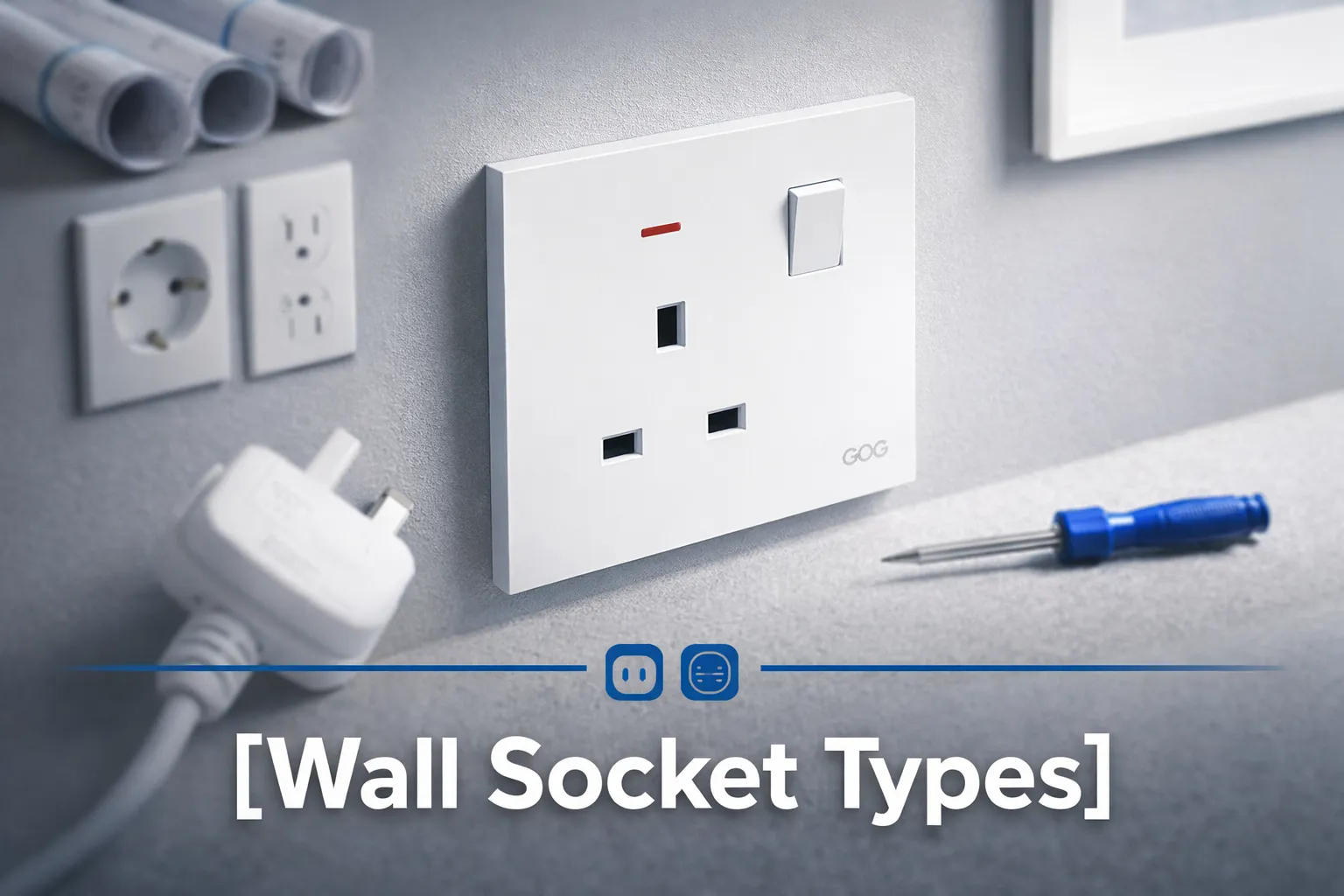
يستحق BS 1363 ذكرًا خاصًا لأنه يغير تمامًا كيفية الشراء. في المملكة المتحدة، يتم تشغيل وإيقاف المقابس بشكل فردي ومزودة بستائر. تعمل عند 13 أمبير، ويوجد في كل قابس فيوز لحماية السلك الخاص به، وليس مصدر الكهرباء. نتيجة لذلك، تكون المقابس كبيرة جدًا ويمكن السماح بدوائر حلقة بتيار 32 أمبير.
إذا كنت تعمل على تجهيزات لكل من المملكة المتحدة والبر الرئيسي، فسيتعين عليك إنشاء خطي إنتاج منفصلين وقوائم مواد منفصلة. في الواقع، لا يوجد حل تكييف يُستخدم على مستوى التركيب. تفاصيل البناء وراء أنواع المقابس الحائطية المستخدمة في المملكة المتحدة تشرح سبب وجود ترتيب الستائر والمفتاح، وهي أسرع طريقة لفهم سبب عدم إمكانية استبدال الأجهزة البرية.
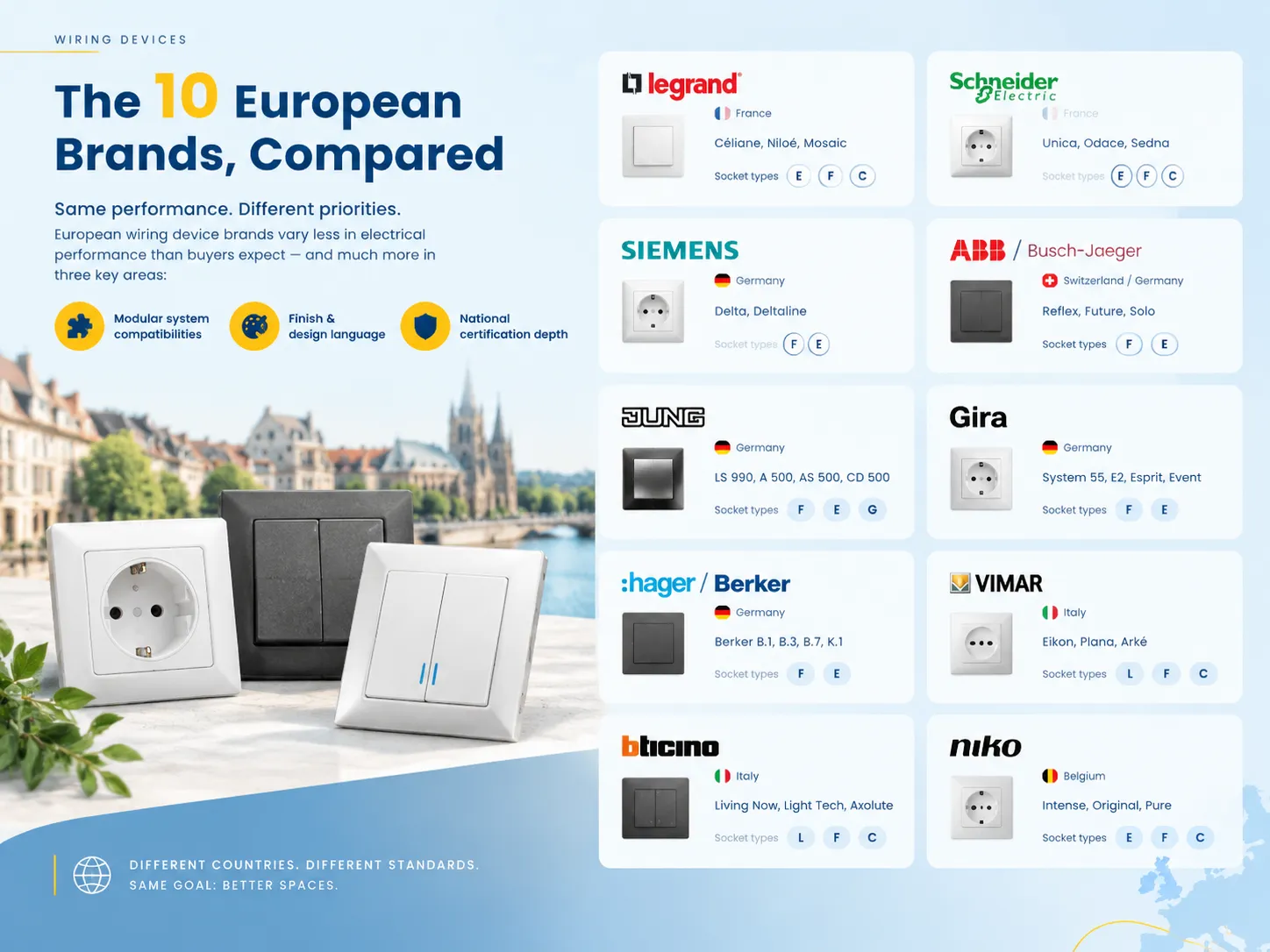
مقارنة بين 10 علامات تجارية أوروبية
تختلف العلامات التجارية في هذه الفئة أقل في الأداء الكهربائي مما يتوقعه المشترون، وأكثر في ثلاثة أشياء: توافق نظام الوحدات، التشطيب ولغة التصميم، وعمق الشهادات الوطنية. المشهد الأوسع لـ علامات أجهزة الأسلاك الكهربائية حول العالم يشمل مجموعة مختلفة من الأسماء مرة أخرى، لأن العلامة التجارية التي تتصدر في هندسة المقابس الأوروبية غالبًا ما تكون لها حضور ضئيل في معايير الأجهزة في أمريكا الشمالية.
| العلامة التجارية | المقر الرئيسي | النطاقات الأساسية | أنواع المقابس | السعر النموذجي لكل جهاز |
|---|---|---|---|---|
| ليجراند | ليموج، فرنسا | Céliane، Niloé، Mosaic | E، F، C | 8€–25€ |
| شنايدر إلكتريك | روييل-مالميزون، فرنسا | Unica، Odace، Sedna | E، F، C | 6€–20€ |
| سيمنز | ميونخ، ألمانيا | Delta، Deltaline | F، E | 7€–22€ |
| ABB / بوش-ياجر | زيورخ / لودنشايد | Busch-Jaeger Reflex، Future، Solo | F، E | 8€–28€ |
| جونغ | Schalksmühle، ألمانيا | LS 990، A 500، AS 500، CD 500 | F، E، G | 12€–35€ |
| جيرا | راديفورموالد، ألمانيا | System 55، E2، Esprit، Event | F، E | 12€–35€ |
| هاجر / بيركر | Blieskastel, Germany | Berker B.1, B.3, B.7, K.1 | F، E | €7–€25 |
| Vimar | Marostica, Italy | Eikon, Plana, Arké | L, F, C | €5–€30 |
| BTicino | Milan, Italy | Living Now, Light Tech, Axolute | L, F, C | 8€–25€ |
| Niko | Sint-Niklaas, Belgium | Intense, Original, Pure | E، F، C | 8€–25€ |
Legrand is the leading player in the wiring devices market, so it is worth noting that two brands in this list belong to the same parent company as it competes in the professional arena with its products. What makes Legrand attractive is its versatility and diversity, a product line for every price category, excellent certification, and an impressive network of distributors across Europe. Céliane is the premium line, while Niloé represents the volume segment; Mosaic is a modular solution for commercial purposes. Legrand products can be found in French and Belgium buildings, medical institutions, educational and hospitality facilities.
With Unica and Odace being Legrand’s market rivals, Schneider Electric possesses the important benefits of having the whole-house electrical brand under its name. The company also supplies manufacturer’s wiring devices, which means that the contractor who purchases Schneider Electric panels or breakers should not look for any other supplier for wires; thus, the whole inventory can be bought at a discount price.
Siemens takes the engineering lead. Delta and Deltaline are straightforward and high-quality Schuko solutions, which also provide excellent documentation for the products. Siemens is a serious player both in the engineering field and building automation, and thus its devices can be easily integrated with building controls and KNX.
ABB is a nice combination of Swiss quality and German specification as ABB represents ABB products worldwide. Busch-Jaeger has been manufacturing wiring devices in Germany since 1879 and adds to ABB an opportunity of reaching German clients through high-quality products. The Reflex and Future lines are their main offerings for commercial specifications in Germany.
The family-owned firm JUNG has been operating in the electrical market since 1912. The headquarters of the company is located in Schalksmühle, and the workforce is composed of around 1700 employees. The company produces not only its well-known LS 990 range together with the Les Couleurs Le Corbusier. It would be better to describe JUNG as the high end of the electrical market since the devices produced by the company are known only for their looks. What’s worth mentioning, the company manufactures BS 1363 devices, that allows serving the customers of the UK and the European customers with one design.
Gira competes with JUNG directly in German specifications with an emphasis on design. The company was established in 1905 and now its office is situated in Radevormwald. The most remarkable product of the company is Gira System 55, a system of compatibility among more than 300 functions. It gives the possibility to select the appropriate frame according to the preferences of buyers and use the inserted device during the years.
Hager Group owns Berker as well, a manufacturer which operates in Schalksmühle, providing great opportunities for the group on the French and German residential and light commercial market. The ranges of the products produced by the company are well known and popular and cover various levels.
Vimar is an Italian specialist with its headquarters in Marostica, and in case your project requires Type L sockets, you definitely need to rely on this brand. Eikon is the exclusive range of the products produced by Vimar, and Plana represents a lot of production.
BTicino has been a part of Legrand since 1989, and Living Now enjoys great popularity in Italy, as the company produces high-quality products online. The company produces electronics for residential projects with the help of smart technology.
Niko is the leader of the market in Belgium with its headquarters located in Sint-Niklaas and the beginning of operations dating back to 1920. The products of Niko have become the standard on the market.
Smart Switches and Dimmers: The New Compatibility Problem
The most widespread specification flaw in 2026 is no longer the geometry of the socket but rather smart switches that cannot work with a load.
The efficacy of a smart switch depends heavily on the neutral wire situation. There is typically no neutral in the wall box used for lighting in most European installations regardless of their age, as the conventional mechanical switch simply cuts the live wire, thereby rendering the smart switch useless in many homes in Europe where re-wiring is impossible. Simply put, smart switches that use two wiring systems which keep the current constantly flowing produce flickering in the cases of LED lights and are unsuitable in some cases.
And the load plays a role as well; a dimmer with a capacity of 400 W does not mean that the same single dimmer can control 400 W of LED. This is because LED loads feature a different power factor and impulse effect, hence a dimmer that works well with 400W of halogen lights will probably cause buzzing or flashing with 60 W of LED lights.
Protocol choice is the third decision. Zigbee and Matter-over-Thread give better local control and mesh reliability; Wi-Fi is simpler but loads the access point. For a residential retrofit where the buyer wants app control plus voice assistant support, a device like this two-gang smart light switch with Tuya and Zigbee support is the pragmatic middle ground — Zigbee for reliability, Tuya for app and voice integration, and a two-gang form factor that matches what most European wall boxes actually contain.
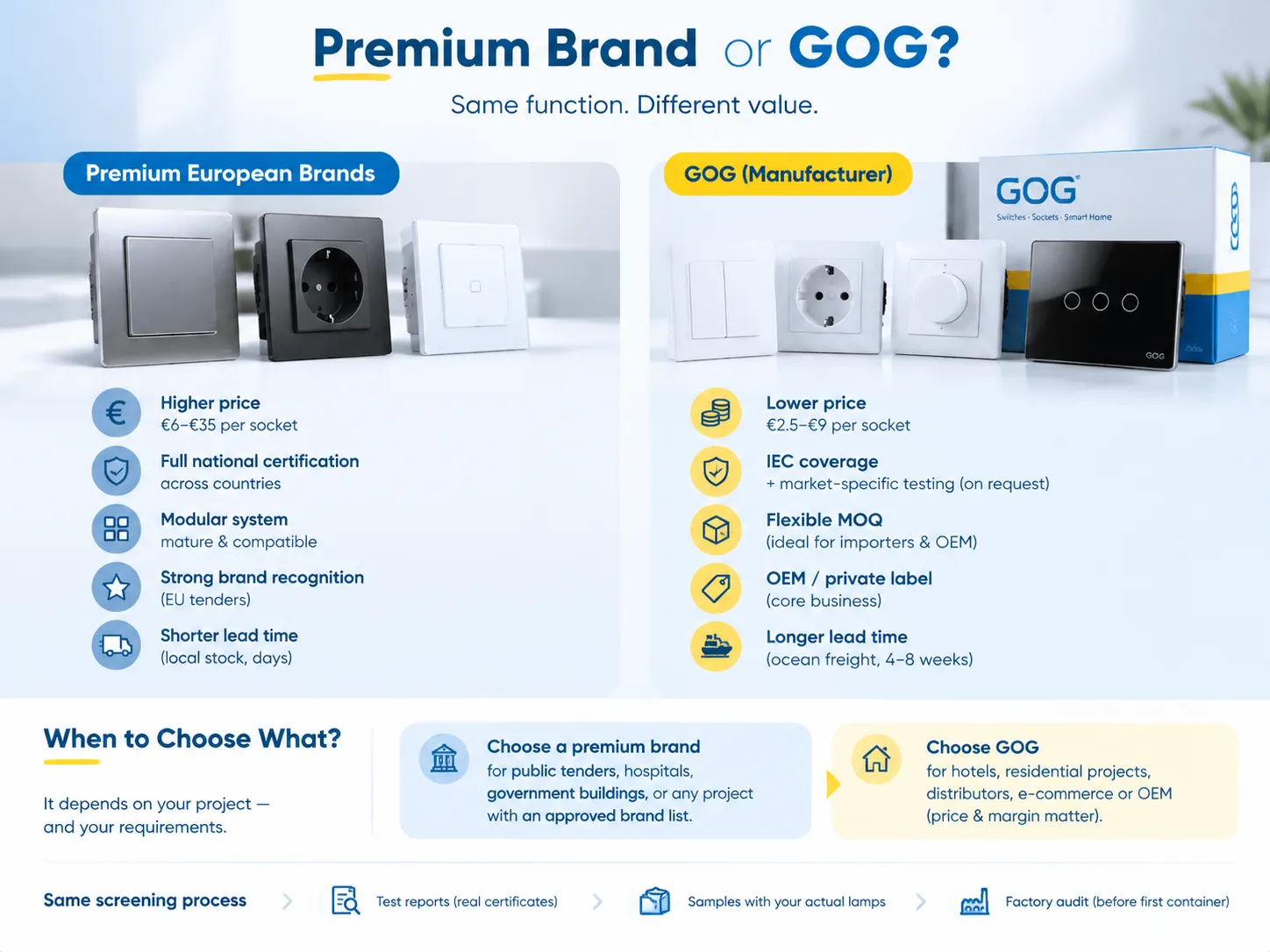
How to Choose Between a Premium Brand and a Manufacturer Like GOG
This is the most important decision impacting project budgeting, and it needs to be said as it is. Premium European brands don’t express a superior performance. Copper is copper and a waterproof 16 A plug remains a waterproof 16 A plug. What one pays for is a modular design, compliance with various local certification requirements, specific design language, and availability in local suppliers, as well as an option for the specifier not to justify the brand name in case it is mentioned in the tender.
| العامل | Premium European brands | جوج |
|---|---|---|
| Price per socket, standard | €6–€35 | €2.5–€9 |
| Price per smart switch | €25–€80 | €6–€18 |
| Certification depth by country | Full national deviation coverage | IEC coverage, market-specific testing on request |
| Modular cross-range system | Yes, mature, decades of compatibility | Range-specific, not a century-old ecosystem |
| Finish and design options | Very wide, premium materials | Focused on high-volume finishes |
| OEM / private label | Rarely, and expensive | Core business |
| MOQ flexibility | Container quantities, rigid | Flexible, geared to growing importers |
| Brand recognition in EU tenders | عالي | Low, and that is the honest limitation |
| Lead time | From local stock, days | Ocean freight, 4–8 weeks typical |
GOG manufactures switchboards, plug sockets, dimmer switches and smart switches with its own mouldie and has control of raw materials, which it sells wholesale, custom and OEM. The value proposition is simple: the same electrical functionality for about half the price and the ability to slap your logo on it. The only real drawback is the weak brand recognition and lack of a long European project history.
In practical terms, this means that if it is a public tender, a hospital, a government building or any other project where a list of approved brands is presented in a specification, premium brand should be purchased. If it is a hotel renovation, a residential project, a brand of the distributor, an online seller’s custom brand, or an OEM product needing to meet the price objective, sourcing must be done directly.
Whichever way you go, the screening process is the same, and how to select wiring devices for a project lays out the commercial tests — certified test reports rather than certificates of conformity, samples tested with the actual lamps you intend to use, and a factory audit before the first container rather than after the third.
Which Brand Fits Which Scenario
Once the marketing is pierced, choices will tend to be dictated by the type of build involved.
- When it comes to multi-family dwellings in Germany or Austria they tend to opt for Gira System 55 or JUNG LS 990. The modular approach pays off over the lifetime of the installation as functions can be shifted without changing the frames. The cost is substantial, and the buyers will approve.
- If we talk about multi-family dwelling in France or Belgium it is either Legrand Céliane, Niloé or Niko in Belgium. Being a wholesaler is what defines the schedule in this case.
- As far as Italian residential or hospitality market is concerned, the matter is about Vimar Eikon or BTicino Living Now, dictated by the need for Type L socket. No way around this one.
- When it comes to commercial offices and light industry, it is Schneider Unica or ABB Busch-Jaeger Reflex, or Hager/Berker on the list. It is usually the electrical contractor specifications that bring the clients’ specification.
- If we take healthcare and lab industry, we are talking about a premium brand where you can find the series of devices with documents that correspond to medical locations. Here, the premium pay for the traceability and other certifications.
- As for hotels and residential buildings, it is about the winning piece that was purchased. The volume is real and the finish is manageable.
الأسئلة المتكررة
Are all European plug sockets the same?
It is not true, and considering them as such can lead to an expensive error. The sockets of mainland Europe are classified as Type E (French design, with earth pin protruding) or Type F (Schuko design, with earth clips on the side) and have a rating of 16 A / 250 V. Switzerland has installed Type J connectors, Denmark has Type K design, Italy has two types of Type L (10 A and 16 A), while UK and Ireland use Type G (13 A). The only way out of this situation is the CEE 7/7 adapter that can perfectly connect either Type E or Type F into a socket.
What plug adapters do I need for Europe?
For visitors from North America, Type C or Type F adapters can be utilized in most places in mainland Europe, Type G in UK and Ireland, Type J in Switzerland and Type L in Italy. Type C (Europlug) fits Type E and Type F sockets, as well as J, K and L sockets in many instances. Therefore, one Type C adapter is sufficient for a majority of locations. However, for professional installations, it is advisable to forget about adapters since they do not provide earth continuity, are not suitable for continuous loads of 16 A and cannot pass electrical safety inspection. Check whether sockets are suitable before installation.
Is Type C or type F used in Europe?
Both of the items are not interchangeable with each other. Type C stands for the plugs, which are also known as CEE 7/16. Type C refers to the “European two-pin plug” and is rated at 2.5 ampere and is non-earthed and is used for low-wattage appliances. While type F stands for sockets, technically known as CEE 7/4 or better known as Schuka sockets. The Type F sockets have carrying capacity of 16 ampere and are earthed via two side clips. Thus, there is a possibility for type C plug fitting into type F socket so this means that type F socket is used with type C plug in countries including Germany, Austria, Netherlands, and many of the countries in eastern Europe. Type E sockets are used in countries such as France, Belgium, Poland and Czech Republic which also allow the usage of Type C plug. When it comes to the use of any type of socket or plug people are suggested to use the type which belongs to that country.
What does an EU plug look like?
The European plug has a round shape with two cylindrical pins. This design is completely different than those plugs in North America and UK which have flat and rectangular blades respectively. The Europlug or Type C plug is equipped with two 4mm pins that remain 18.6-19 mm apart from each other with the energy requirements of 2.5 Amperes. The Schuko or Type F plug is thicker as compared to Type C plug with larger pin size measuring about 4.8 mm and 19 mm apart. In addition, this plug has metal clips on the top and bottom of the plug, which makes the plug capable of connection with the earth. The Type E plug is different from Types C and F plug as it has a tiny hole that is meant for the protruding earth pin. The CEE 7/7 hybrid plug has both the mentioned features.
المراجع
- IEC — IEC 60884-1 Plugs and Socket-Outlets for Household and Similar Purposes
- Legrand — Wiring Devices Range Documentation
- Schneider Electric — Unica and Odace Technical Catalogues
- JUNG — LS 990 and System Range Data
- Gira — System 55 Compatibility Documentation
- Busch-Jaeger — Reflex and Future Range Specifications
- Vimar — Eikon and Plana Technical Data
- BTicino — Living Now Range Information
- Niko — Belgian Wiring Devices Standards and Ranges
- Hager Group — Berker Range Portfolio
الخاتمة
European plugs and sockets operate on the principle of common standards, dressed up in design terms. Each of the ten brands mentioned has complied with IEC 60884-1, and any differences come down to the standardisation depth, compliance range, quality of finishing, and distribution network. Getting the right type of plug is of utmost importance, since brand selection is only a commercial matter in this case.
There are several key messages to pay attention to. The fact is that C is a plug and F is a socket, so stop using them as interchangeable terms. Make sure you unconditionally apply CEE 7/7 mixed plugs in case you don’t know the destination country yet. Secondly, remember to discuss the smart switch’s requirement for neutral wires, as most of old European electrical boxes don’t have neutral wires at the switch. Finally, don’t forget that premium brands offer certification depth, compatibility within electrical ecosystems and tender reputation. Only in case your project requires any of the above, should you spend extra money on that.