

USA Electricity Plug Types & Power Sockets – Type A/B, Adapter Needed?
Traveling to the United States? The country uses a very specific electrical standard that differs from most of the world. This guide covers everything you need to know about the American electric plug socket, electricity plug types, and power outlets – including what plugs look like, voltage, frequency, and which adapter you need. We’ve also answered the most frequently asked questions about American power sockets and plugs.
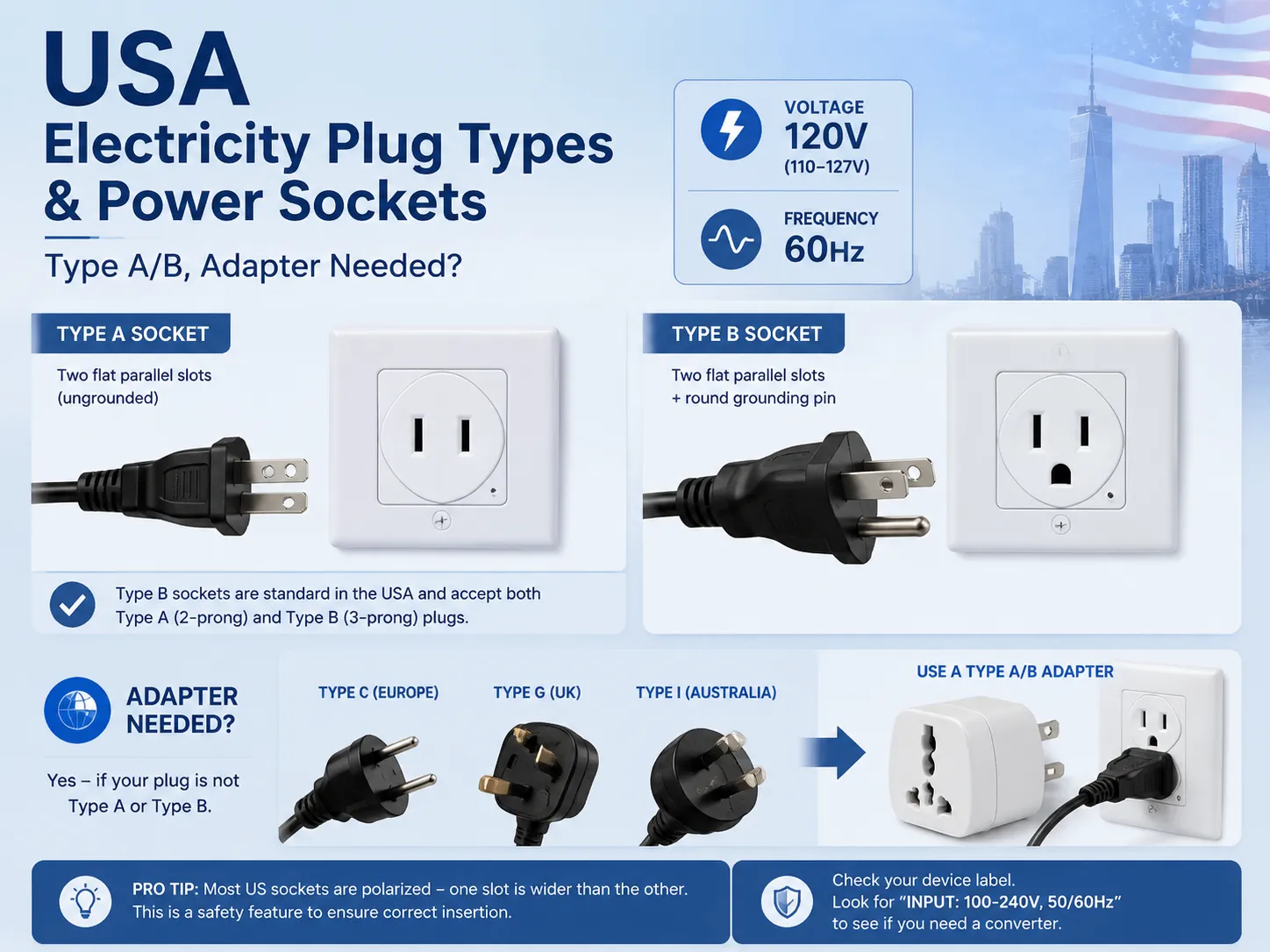
USA Electric Socket Type – What Standard?
The power outlets in the United States follow the North American configuration, which consists of both type A and type B. The same destination is applicable in some parts of America, Canada, and Mexico. The power outlets are fitted to accommodate plugs with flat parallel pins, contrary to the circular pins for Europe and rectangular pins used in Britain.
- Tipo A – a two flat pin plug socket without grounding. It has two vertical slots or one wider slot in case of polarized types. This is used usually for smaller devices as well as older constructions.
- Tipo B It consists of three prongs, two of which are flat (similar to Type A). It also comes with a round grounding pin. This is the type of outlet used in hotels.
The major portion of outlets used in the USA belongs to Type B category which makes them compatible with both Type A and Type B plugs. These outlets are generally positioned flatly against the wall and the voltage used is 120V (frequency 60Hz). US outlets differ from European Schuko outlets in that they are not set deep into the wall.
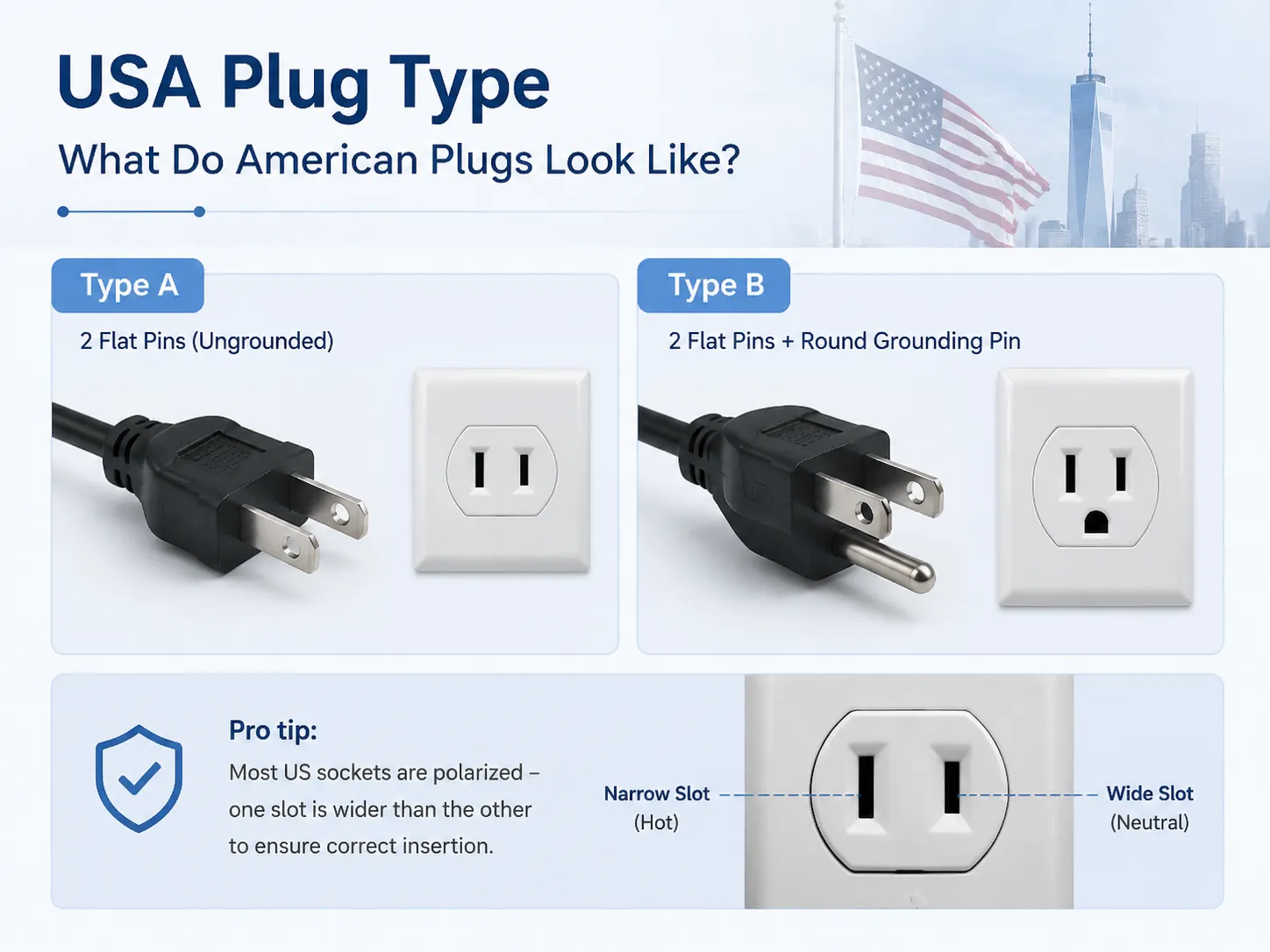
USA Plug Type – What Do American Plugs Look Like?
The power plug in the USA is recognised through its flat parallel pins, commonly including holes near the ends in order to grab the socket contacts. The two main types are:
- Type A plug Two flat pins that are parallel to each other (one is a bit broader in the polarized versions). There’s no grounding or earth pin. It’s typically used for unearthed gadgets such as mobile chargers, lamps, and other small electronic devices.
- Type B plug This is similar to Type A but has a round earth pin (which is slightly thicker and longer) located below the two flat pins. It can be used with grounded devices such as computers, kitchen appliances, and heavy appliances.
Your gadget with a European, UK, or Australian plug won’t be able to fit into a US outlet, and thus you will require an adapter. The US system is known as the “2-pin or 3-pin” plug depending on whether there is an earth pin available.
Consejo profesional: The majority of sockets in the USA are polarized in that one waste is wider than the other for the appropriate insertion. Although this is a security feature, many kinds of adapters do not have polarities so they can be used in any direction.
Voltage and Frequency in the USA
The electricity supplied in the US is 120 V (110‑127V) and has a frequency of 60 Hz. In contrast, most countries in Europe, including the UK, Australia, and most Asian countries, receive electricity at voltages of 230V and frequencies of 50Hz.
If you are traveling from a 230V country, your non‑dual‑voltage items require a step‑down converter. Most gadgets today such as phones and laptops fall into the dual‑voltage category. You only need a plug adapter to make them work. They normally have an inscription on them stating “INPUT: 100‑240V, 50/60Hz.”
In the case of devices that operate on 230V, such as electric toothbrushes, kettles, and hairdryers, a converter is imperative. Another option is to purchase a device for use with the US voltage upon arrival.
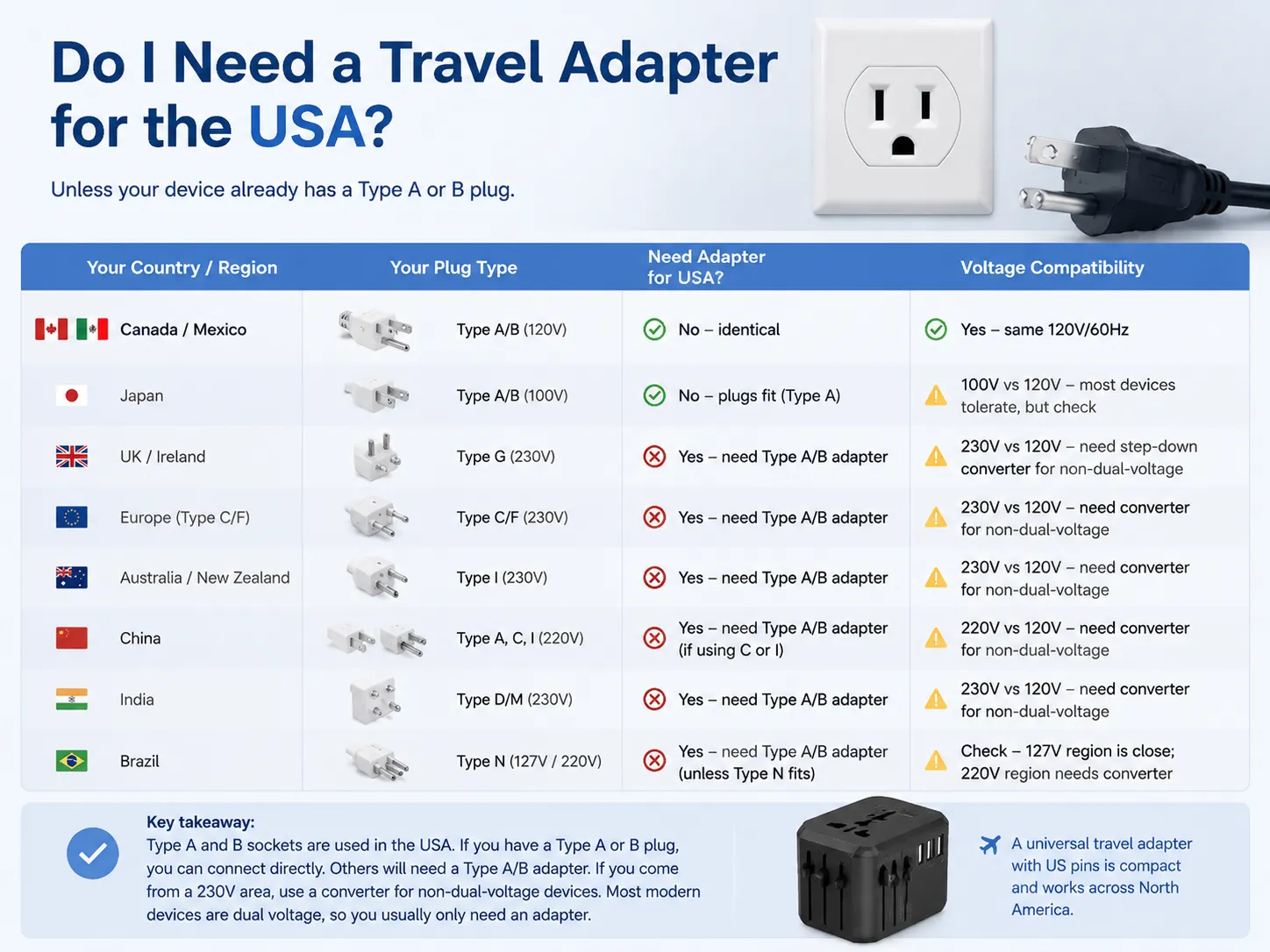
Do I Need a Travel Adapter for the USA?
Yes – unless your device already has a Type A or B plug. La tabla a continuación ofrece una visión rápida para viajeros de diferentes regiones.
| Tu País / Región | Tu Tipo de Enchufe | Need Adapter for USA? | Compatibilidad de Voltaje |
|---|---|---|---|
| Canada / Mexico | Tipo A/B (120V) | ❌ No – idéntico | ✅ Sí – mismo 120V/60Hz |
| Japón | Tipo A/B (100V) | ❌ No – plugs fit (Type A) | ⚠️ 100V vs 120V – la mayoría de dispositivos toleran, pero verifica |
| Reino Unido / Irlanda | Tipo G (230V) | ✅ Yes – need Type A/B adapter | ⚠️ 230V vs 120V – need step‑down converter for non‑dual‑voltage |
| Europa (Tipo C/F) | Tipo C/F (230V) | ✅ Yes – need Type A/B adapter | ⚠️ 230V vs 120V – need converter for non‑dual‑voltage |
| Australia / Nueva Zelanda | Tipo I (230V) | ✅ Yes – need Type A/B adapter | ⚠️ 230V vs 120V – need converter for non‑dual‑voltage |
| China | Tipo A, C, I (220V) | ✅ Yes – need Type A/B adapter (if using C or I) | ⚠️ 220V vs 120V – need converter for non‑dual‑voltage |
| India | Tipo D/M (230V) | ✅ Yes – need Type A/B adapter | ⚠️ 230V vs 120V – need converter for non‑dual‑voltage |
| Brasil | Tipo N (127V / 220V) | ✅ Yes – need Type A/B adapter (unless you have Type N that fits) | ⚠️ Check – if 127V region, voltage is close; if 220V, need converter |
Punto clave: Type A and B sockets are used in the USA. If you have a Type A or B plug, you can directly connect. Anyone else will have to use a Type A/B adapter. In terms of voltage, if you come from a 230V area, you must use a converter for non-dual-voltage devices. Most modern devices are dual voltage, therefore you only need an adapter.
It is advisable to have a universal travel adapter with US pins on your person, as it is compact and effective throughout the North American region.
Preguntas Frecuentes (FAQ)
What type of plug is used in the USA?
The United States utilizes Type A (two flattening pins, ungrounded) and Type B (two flattening pins along with round grounding pin) to meet its electrical needs.
Is the USA a 2‑pin or 3‑pin plug?
You can use either one. Type A has 2 pins (no earth) while Type B has 3 pins (with earth). Most devices use Type B for safety reasons; however, small devices work with Type A.
What is an electrical plug called in the USA?
In the common vernacular, these gadgets are known as “plug” or “power plug” in regular conversation while their counterpart socket is referred to as “outlet” or “wall outlet.” The proper terminology used in these instances would be NEMA 1-15 (an ungrounded device) and NEMA 5-15 (grounded device) plug and socket which are standards of the USA.
What does a plug look like in the USA?
An American power plug consists of two flat metal blades (either flat or round). The thickness of the blades is typically around 1.5 mm, while the length of the blades is usually about 15.9 mm, with one of the blades being wider (neutral) in polarized sockets. The color of the plug is typically black or white plastic, while the ends of the blades contain holes.
Can I use my European hair dryer in the USA?
A European hair dryer works at 230V. Using it at 120V will result in greatly reduced heating and air circulation ability – it will hardly work. Also, the plug won’t fit. Thus, a step‑up voltage converter (from 120V to 230V) is required along with a plug adapter. Most people purchase an inexpensive American dryer instead.
Are USB ports common in US hotels?
Indeed, nowadays in many hotels, USB type A and C are commonly offered. In budget hotels or motels, however, this may not be an available option. Therefore, bring your own charger, provided it has a type A or B plug.
Travel Tips for Using Electronics in the USA
- Pack a Type A/B adapter – essential unless you’re from Canada or Mexico.
- Verifique las etiquetas de voltaje – most devices are dual‑voltage, but always verify.
- Lleve un banco de energía – useful for long days exploring cities or national parks.
- Protección contra sobretensiones – The power system in the United States is normally consistent, yet, when it comes to delicate electronic equipment, it is advisable to invest into a compact protection device.
- Enchufes en hoteles – often near desks or bedside tables; an extension cord can be handy.
- Adaptador vs. convertidor – know the difference.
Resumen
The Type A and Type B plugs are used in the United States and have a voltage of 120 volts/60 hertz. People travelling from Canada, Mexico, and Japan can connect their devices into the Type A sockets directly. However, it must be remembered that people need a voltage converter. Those travelling from Europe and the UK, as well as other regions, will need either a Type A or Type B plug adapter and, if they have devices that are not dual-voltage, they will also require a voltage converter.