

Enchufes y Tomas de Corriente de Nicaragua
Si planea un viaje a Nicaragua, probablemente esté ansioso por saber si sus dispositivos electrónicos funcionarán una vez que llegue allí. En esta guía, explicaré todo lo que hay que saber sobre Nicaragua, desde los tipos de enchufes/tomas de corriente disponibles hasta el voltaje eléctrico utilizado en Nicaragua, la frecuencia utilizada en Nicaragua, además de si necesitará o no un adaptador de viaje o convertidor de voltaje durante su viaje a Nicaragua. Además, he incluido una sección de Preguntas Frecuentes que responderá muchas de las dudas que pueda tener.
Tipo de enchufe eléctrico en Nicaragua
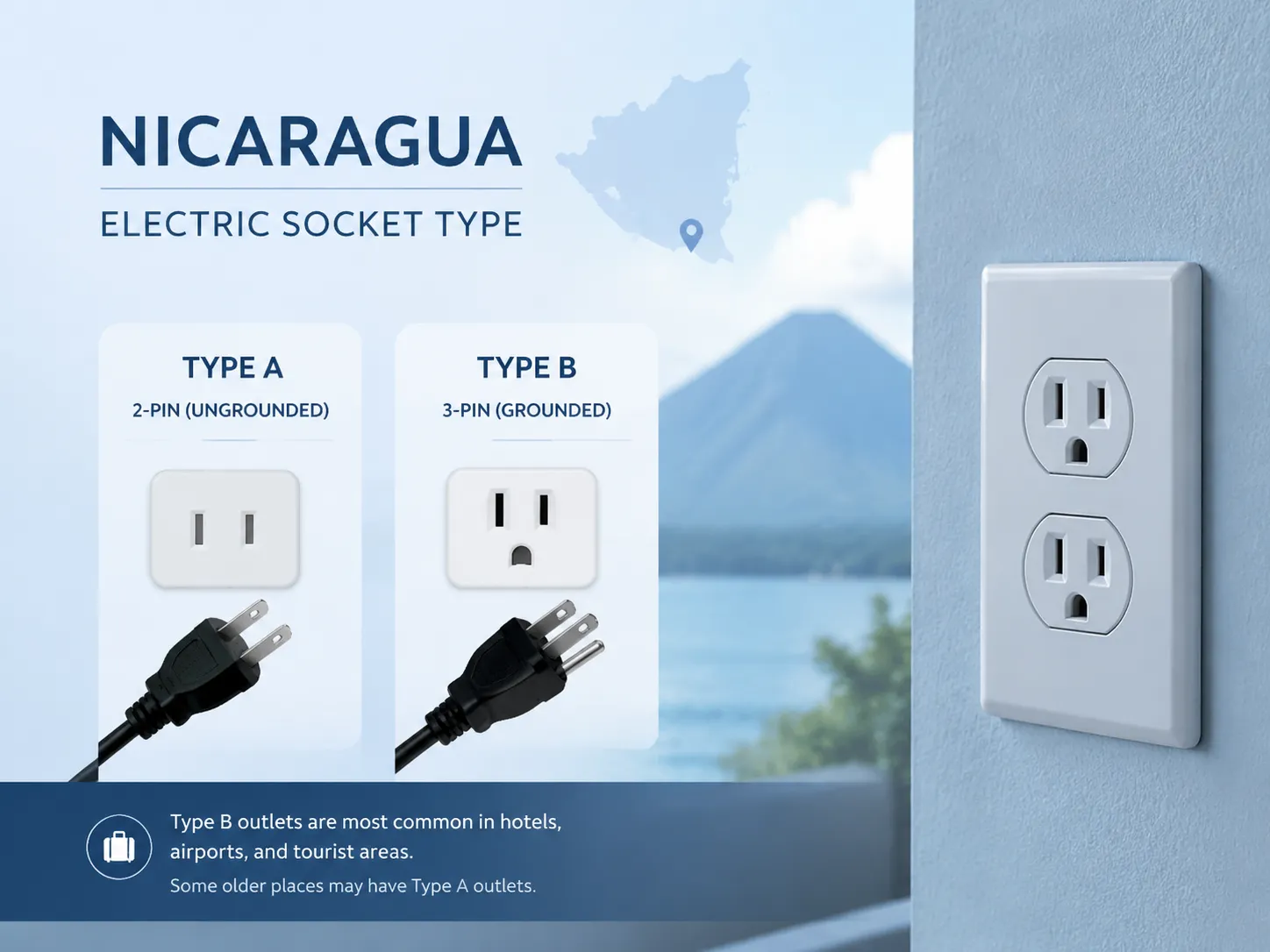
En Nicaragua, el enchufe típico de pared es un enchufe Tipo A o B, que se utiliza en casi todo Estados Unidos, Canadá y casi toda América Central.
- Tipo A – un enchufe de dos clavijas planas (sin conexión a tierra). Acepta enchufes con dos láminas paralelas planas.
- Tipo B – Un enchufe eléctrico de tres clavijas que consiste en dos conectores de lámina plana y un pin de tierra circular. Este es el estándar actual en construcciones más nuevas.
La mayoría de los espacios públicos, incluidos hoteles y aeropuertos, utilizan enchufes Tipo B en todo Nicaragua; sin embargo, algunos hoteles antiguos pueden usar enchufes Tipo A. Si tiene dispositivos que usan un enchufe con conexión a tierra (3 clavijas), querrá verificar si hay un enchufe compatible o llevar un adaptador. Hay muchos lugares donde ahora puede encontrar enchufes Tipo B, incluso en las zonas turísticas.
Nicaragua Plug Type
Los plug types used in Nicaragua are the same as those in North America:
- Enchufe Tipo A – dos clavijas planas paralelas, sin clavija de tierra.
- Enchufe Tipo B – dos clavijas planas paralelas más una clavija redonda de tierra.
Your device will not be able to plug into the socket in Nicaragua unless it has either a Type C (Europlug) or a Type G (UK) plug. Many modern laptops, phones, and chargers are actually dual voltage. So if your device is powered by 120/240 volts, you will simply need a basic travel plug adapter (that covers the difference in plug shapes) rather than a voltage converter.
Pro tip: Most USB charger/power adapters have worldwide compatibility in their voltage range (100 to 240 volts). Look for the label to confirm, if it says, 100 to 240 volts, 50 to 60 Hertz, then you should be good anywhere in the world.
Voltage and Frequency in Nicaragua
Nicaragua utilises a standard voltage of 120V with a frequency of 60Hz, which matches the voltage and frequency used in the USA, Canada and Japan (that is, except Japan has 100V).
If your appliances are designed for 220–240V (common in Europe, UK, Australia, etc.), you will need a voltage converter to avoid damage. Most modern electronics (smartphones, tablets, cameras, electric shavers) are dual‑voltage, but always double‑check the label before plugging in.
Do I Need a Travel Adapter for Nicaragua?
Depende de dónde vengas.
- ¿Desde EE. UU., Canadá, México o Japón? → No adapter needed. Your plugs will fit directly.
- From the UK, Europe, Australia, or most of Asia? → You’ll need a Type A/B plug adapter to physically connect your devices.
- From countries with 220–240V? → Check if your device is dual‑voltage. If not, bring a step‑down voltage converter (from 220V to 120V).
We recommend carrying a universal travel adapter that includes Type A/B, as it will also work in the USA, Canada, and most of Latin America – a great investment for frequent travelers.
Preguntas Frecuentes (FAQ)
What power outlet is used in Nicaragua?
In Nicaragua, type A and type B power outlets are available, which is the same as in North America (type A and type B). Now, type B power outlets (three-prong) are the most frequently used in Nicaragua.
Can I use my European plug in Nicaragua?
No; the European Styles C / E / F will not fit because of their round pins. You have to use a plug adapter to convert to Type A or Type B.
Is the voltage in Nicaragua the same as the US?
Yes – both use 120V at 60Hz. So American devices work perfectly without a converter.
Do I need a power converter for my hair dryer or straightener?
Most curling irons and hairdryers do not operate on dual voltage. If you take an appliance with a high wattage rating (for example 1500W) which is designed for 220V into the country, it will require a heavy duty step down transformer (converter). Without this, it is likely that the appliance will burn out. An inexpensive local appliance probably could work just as well.
Are USB wall chargers available in Nicaragua?
Although a lot of cafes and hotels will have USB ports for charging, it is still a good idea to bring your own dual USB charger that has type A and type B connectors.
Can I charge my laptop in Nicaragua?
Most laptop power bricks can run on 100-240V. Therefore, all that’s needed is a plug adapter, but make sure you check the input label of the brick first.
Is it safe to use power strips or surge protectors?
Using a power strip with surge protection is great if it has a 120V rating. Do not use a power strip rated at 220V without using a voltage converter.
Travel Tips for Using Electronics in Nicaragua
- Empaque un adaptador universal – it’s small, cheap, and covers you for all countries.
- Lleve un banco de energía – useful for long tours or areas with unstable power.
- Verifique su hotel – most mid‑range and upscale hotels have Type B sockets, but budget hostels may have older Type A.
- Voltage fluctuations Voltage can be reduced in rural settings; thus, sensitive electronic devices (e.g., CPAP devices) may benefit from voltage regulation devices.
- Emergency backup – keep a physical map and offline instructions in case your device runs out of battery.
Resumen
In conclusion, Nicaragua has Type A and B sockets, operating at 120 volts and 60 Hz. People traveling from North America will plug directly into these types of sockets. However, those not from North America will require an adapter. Always check your device’s voltage rating. If it states “dual-voltage”, you can travel with only an adapter. If you have high-wattage appliances (e.g., hairdryers), either bring a converter with you or purchase one when you arrive. Don’t let concerns about your electrical appliances detract from the fun of your trip to this wonderful country!
¡Buen viaje y feliz carga!