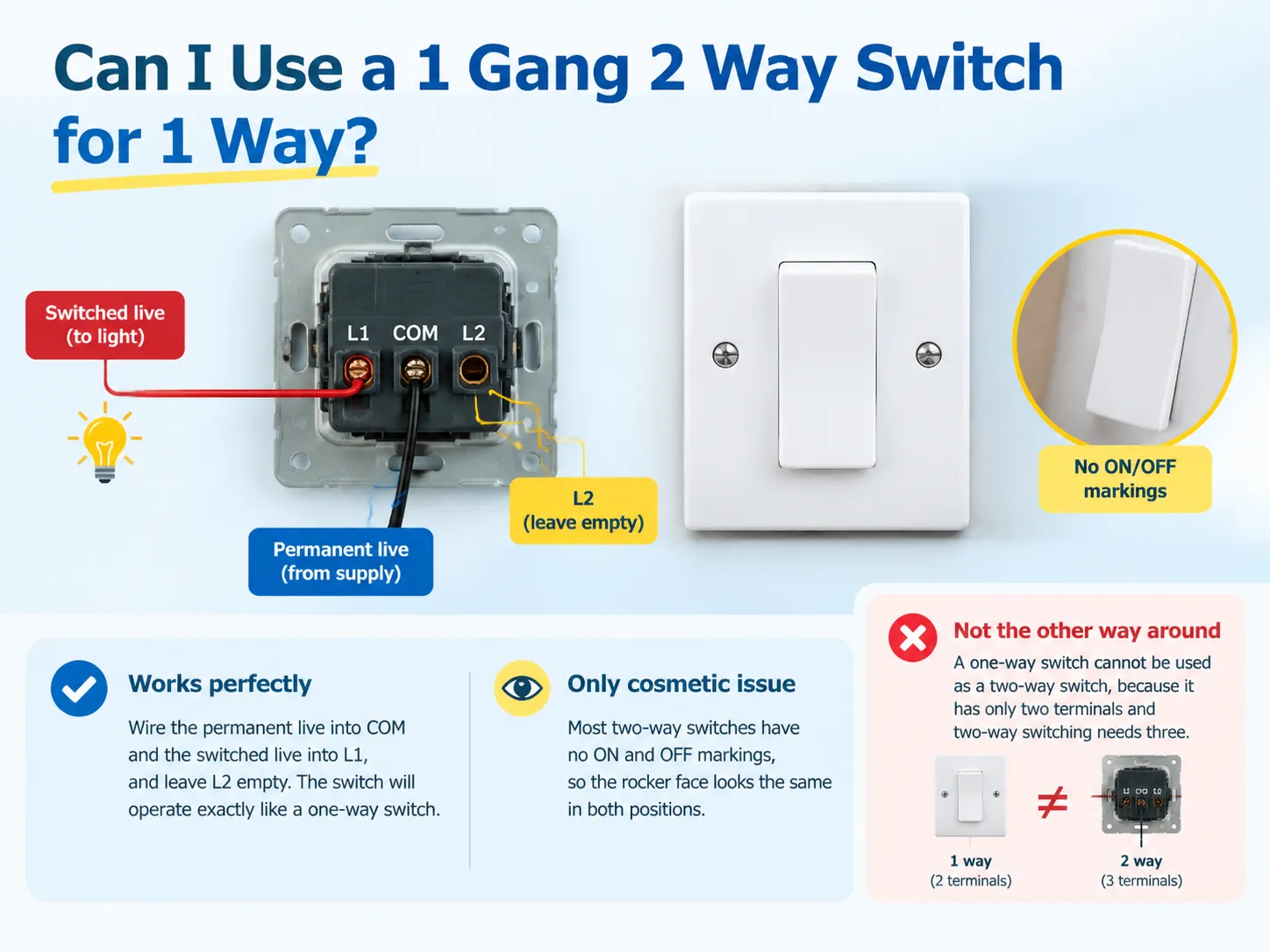
Usted adquirió un interruptor de dos vías, o tiene uno de su trabajo previo en un pasillo, y desea usarlo para controlar una luz simple que se pueda encender y apagar. El interruptor encaja en el lugar y los contactos son reconocibles, y lo único que queda es ver si el terminal extra tiene alguna importancia.
No la tiene. Un interruptor de dos vías incluye todo lo que se encuentra en un interruptor de una vía, más un terminal adicional que quedará sin usar.
En resumen, la respuesta es positiva: de hecho, un interruptor 1 gang 2 way puede usarse como un interruptor 1 way sin ningún problema. Debe conectar el vivo continuo a COM y el vivo conmutado a L1, dejando L2 sin conexión. En este caso, el interruptor funcionará igual que un interruptor de una vía. El único inconveniente aquí es uno relacionado con la apariencia: la mayoría de los interruptores 2 way se fabrican sin señales de ON y OFF, por lo que la cara basculante del interruptor se ve idéntica en dos posiciones.
Gang y Way Son Dos Cosas Diferentes
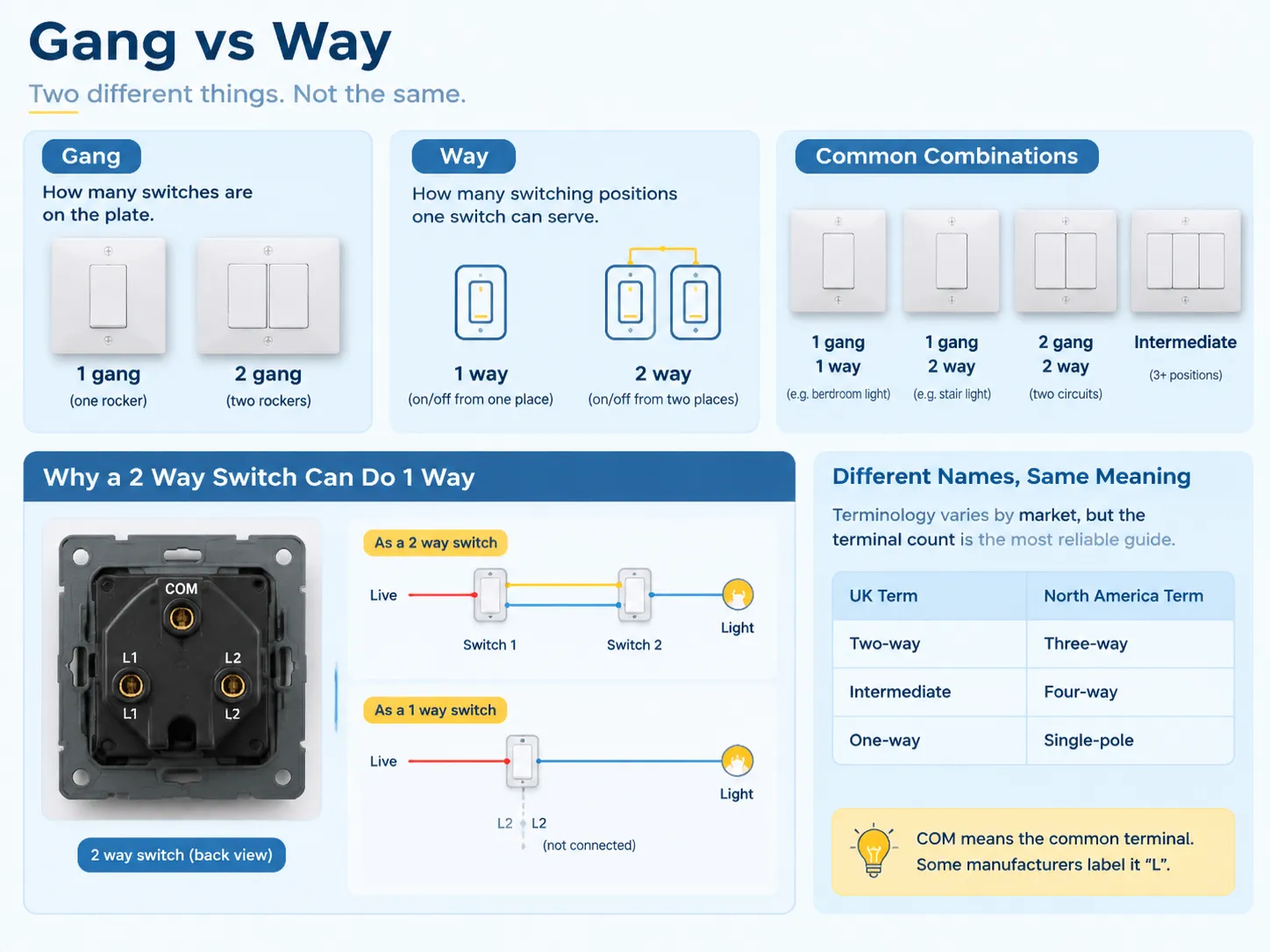
Casi toda la confusión en esta área proviene de tratar “gang” y “way” como si describieran la misma propiedad. Describen cosas perpendiculares.
| Término | Lo que cuenta | Ejemplo |
|---|---|---|
| Grupo | Cuántos interruptores hay en la placa | 1 gang = un basculante, 2 gang = dos basculantes uno al lado del otro |
| Camino | Cuántas posiciones de conmutación puede servir un interruptor | 1 way = encendido o apagado desde un lugar, 2 way = encendido o apagado desde dos lugares |
| 1 grupo 1 camino | Un interruptor, punto de control único | La luz estándar de dormitorio |
| 1 grupo 2 caminos | Un interruptor, capaz de función de conmutación | Una luz de escalera controlada desde arriba y abajo |
| 2 grupos 2 caminos | Dos interruptores de conmutación independientes | Dos circuitos de iluminación, cada uno con un segundo interruptor en otro lugar |
| Intermedio | Insertado entre dos interruptores de dos vías para tres o más posiciones | Un pasillo largo con un interruptor en cada extremo y uno en el medio |
Un interruptor de dos vías de un gang consiste en un solo basculante en una placa con el basculante funcionando como un mecanismo de conmutación. No hay alteración en la placa ni en los accesorios. El proceso de montaje es similar, la caja permanece sin cambios y la placa frontal mide lo mismo.
Peor aún, la terminología diferente también puede causar confusión para cualquiera que compre productos internacionalmente. Por ejemplo, el interruptor de dos vías en el Reino Unido se llama interruptor de tres vías en Norteamérica. De igual manera, un interruptor intermedio en el Reino Unido corresponde a un interruptor de cuatro vías en Norteamérica. Un interruptor de una vía en el lenguaje del Reino Unido se refiere a lo que se llama interruptor unipolar en la terminología norteamericana. Por lo tanto, si desea ordenar interruptores del catálogo de un país extranjero, el conteo de terminales es lo único en lo que puede confiar. Las convenciones de nombres y cómo se corresponden están explicadas en esta explicación de qué significan 1 gang, 2 gang y 3 gang.
Por qué un Interruptor 2 Way Puede Funcionar Como 1 Way
Revise el interruptor en la parte trasera. Como dispositivo de dos vías, tiene 3 terminales marcados COM, L1 y L2. El mecanismo consiste en un conmutador, donde COM se conecta a uno de L1 o L2 pero nunca a ambos al mismo tiempo. Así, al accionar la palanca, realiza la conexión de uno de los terminales a otro.
Este comportamiento es responsable de ambas aplicaciones del interruptor de dos vías.
Como interruptor de dos vías, el cable COM está conectado a una fase permanente mientras que L1 y L2 son conductores de paso que van a otro interruptor. Los dos interruptores forman un circuito ya que uno de ellos puede completar el circuito. Como interruptor de una vía, el cable COM sigue conectado a una fase permanente. Sin embargo, L1 ahora se conecta a un pin de fase conmutada para la luz y L2 queda efectivamente sin conexión. El conmutador sigue funcionando en este caso, pero debido a que una de las opciones está anulada, se convierte en un interruptor simple de hacer y romper.
No hay diferencia eléctrica entre el interruptor de dos vías y un interruptor de una vía que utiliza la misma construcción con uno de los contactos omitido y solo dos terminales conectados.
Qué significa COM en un interruptor, y por qué algunos fabricantes etiquetan el mismo terminal como L, es uno de los puntos más comunes de confusión, cubierto en esta explicación de qué es el terminal común en un interruptor de luz.
La única desventaja real: Sin marcado de ENCENDIDO y APAGADO
Un interruptor de una vía suele ser identificable. Tendrá un símbolo “I” y “O”, o la superficie del interruptor designará qué extremo indica la posición de “encendido”.
Con un interruptor de dos vías, no es necesario indicar marcas en él. Esto se debe a que el interruptor no tiene estados definidos; en circuitos de dos vías, la posición hacia arriba del interruptor no es necesariamente la posición de “encendido”. Por eso, los interruptores de dos vías pueden encontrarse con palancas en blanco o con las etiquetas 1 o 2.
Si el interruptor de dos vías se utiliza como interruptor de una vía, su funcionalidad permanece sin cambios; sin embargo, puede parecer extraño. El propietario del equipo ciertamente sabrá cuál posición es la de “encendido”, aunque no coincidirá con la estética del resto del equipo en la habitación.
Se pueden tomar las siguientes tres medidas para resolver la situación:
- Use un interruptor de una vía. Si el circuito es de una vía, es mejor comprar un interruptor que coincida con el diseño. Los interruptores de una vía son bastante económicos.
- Gire el mecanismo. Muchos sistemas modulares permiten girar el módulo del interruptor dentro de la placa, haciendo que la posición del interruptor sea correcta.
- Acéptelo. Si el equipo está instalado en un área no habitable, funcionará bien y el propietario no recordará el diseño en unos días.
Por qué un interruptor de una vía no puede funcionar como interruptor de dos vías
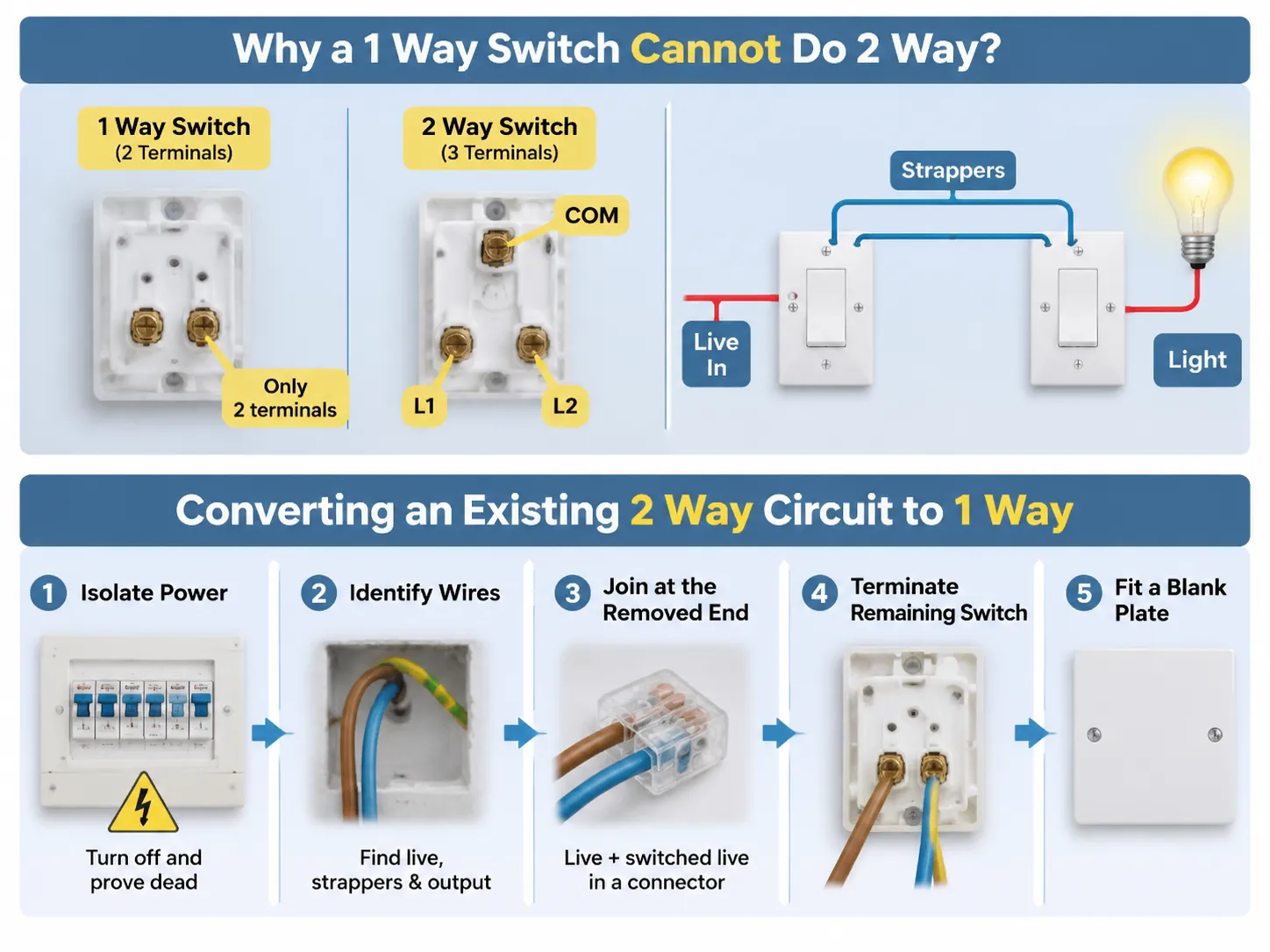
En este caso, debemos decir que no, y la situación que describimos arriba es básicamente la misma y debemos decir que es un contacto simple de hacer o romper. Internamente, un interruptor de una vía tiene solo dos terminales conectados entre sí. La operación de conmutación ocurre cuando los dos terminales están conectados entre sí o no conectados.
Por otro lado, en el caso de la conmutación de dos vías, necesitamos un interruptor conmutador en cada extremo del circuito. Hay dos conductores de puente entre los dos interruptores que completan el circuito cuando ambos interruptores seleccionan el mismo puente. Esa operación solo puede realizarse con un dispositivo de tres terminales en cada extremo, ya que la fase permanente entrante debe ir a uno de los dos conductores salientes.
En un interruptor unipolar, la falta del segundo terminal es una desventaja grave. Por lo tanto, siempre podemos incluir un unipolar en un circuito de dos vías, pero solo funcionaría como un interruptor de anulación y no hará que el sistema funcione correctamente. La lógica del conmutador de tres terminales, y su relación con el interruptor intermedio de cuatro terminales, se explica en esta comparación de conmutación de dos vías y tres vías.
Conversión de un circuito de 2 vías existente a 1 vía
Retirar un interruptor puede ser un trabajo efectivo, pero debe realizarse de la manera correcta.
- Deal with the consumer unit by isolating the electricity and checking that everything is dead. Most lighting circuits use 10 A or 6 A MCBs; thus, the circuit for the fixture that has just been switched off may be a different circuit.
- Determine which cable is the permanent live, which is the strapper and which is the switched live at the switch you’re using.
- Remove the second switch and remove its cable. The cable you removed connects the two switches. At the end where the cable was removed, you’re going to connect the permanent live with the switched live to provide current to the lamp.
- Terminate the working switch in a manner that the COM terminal gets constant live current and L1 takes the switched current to the fixture.
- If you kept the box, you’ll have to replace the switch with a blank cover; otherwise, you’ll have to take the box off and get the wires back in the wall if you do not need the room anymore. A blank cover is what most people do and is the most practical solution.
If the two-way circuit is made with three-core cable and the strapper can be easily identified, it’s easy to do. If two separate two-core cables were used, it would be impossible to tell which wire is which, and you may need to consult an expert. The wiring sequence for a switched lighting point is covered in this guide to wiring a light switch to UK conventions.
Double-Pole Switches on 1 Way Duty
A double-pole switch disconnects both the supply and neutral wires. It is used in places where isolation is needed, not regulation, for example, lighting located outside, shower pumps, or other devices that are meant to be switched off for maintenance.
In a single circuit, a double-pole switch only works if it is connected as a double-pole switch, meaning that one supply terminal handles the supply and one handles the neutral. Although, as noted, it may be allowed to use only one pole on the double-pole switch, it does not make sense to buy such a switch in the first place, otherwise, one terminal will stay useless.
Two things to keep in mind: a double-pole switch must be connected to the neutral in the location. Many circuit types do not have neutral conductors present as these circuit types usually have the neutral looping at the ceiling capping. Also, double-pole switches are typically deeper than normal switches and must be checked before buying.
Mixing Switches in a Multi-Gang Plate
In a two-gang plate, the two switches do not influence one another mechanically. One switch can be used in the one-way mode, while the other can either function in the two-way mode or in the one-way mode. The only restriction is physical, as certain modular ranges use a different module for a particular function, and the plate should be suitable for both types of modules.
Such flexibility makes modular ranges quite popular for retrofitting projects, as it is possible to create a plate consisting of a one-way module, another two-way module, and a dimmer module as needed, instead of making a complete change.The trade-offs of that system, including cost and availability, are worth understanding before committing to a whole house, as this comparison of gang switch configurations sets out.
What to Buy, and What to Check
- Ensure you verify the terminal count. A three terminal indicates that the switch can serve both functions, while if it features two terminals it can only serve the one function.
- Check the specification. 10AX is the normal specification for modern LED and fluorescent loads in the UK. Using a switch rated at 6A in a circuit with high inrush is a hazard that could trip the switch accidentally. The AX suffix suggests that the switch is rated for both capacitive and inductive loads rather than resistive loads only.
- Check the depth of the box. Two way and double pole mechanisms are generally thicker than the one way switches, so a 16mm box designed for the old switch might not accommodate the new one.
- Check the plate format. Having a two way switch in a one way position means there is a cosmetic mismatch which means trying to match up with what is already in the room will be more expensive that buying the correct switch for it.
- Avoid doing a very wrong thing: buying a two way switch simply because that is what you found at the store and then keeping terminal L2 connected to an unused wire. An unused terminal should not be connected to anything.
Preguntas frecuentes
Can you use a 2 gang 2-way switch for 1 way?
That is correct. Every gang operates as an independent changeover switch, making it possible to connect it as a one-way switch through COM and L1, leaving L2 vacant. You can use both gangs as one-way switches, or one of them as a one-way while the other as a two-way one at the same time. The only restriction is that you have spent money on a second switch that may not really be necessary.
How do I convert a 2-way switch to 1-way switching?
Disengage the switch and then determine the position of the permanent live and switched live wires. For the second switch being removed connect the permanent live directly to the switched live wire and install a maintenance free enclosure to serve the lamp with power. Finally disconnect the other switch and connect it to the existing switches COM to connect to the permanent live and L1 on the switched live wire. Finally, cover the hole with a cover plate.
Can I use a 1-way switch as a 2-way switch?
A single-pole switch contains only two terminals and cannot transmit the continuous incoming current either to one of the two-way switch strappers that two-way control at every end requires. If it is used in a two-way circuit, a switch will function by cutting off the working principle of the device.
Can I use a 2-pole switch for 1-way switching?
In addition to this, it is essential to remember that this point must also be separated. Run the hot wire through one end and the neutral through the other so that both connections would be opened. It is also important to have the neutral at the switch location which may not be possible with all lighting circuits and also the junction box should be big enough.
Referencias
- Socket Store — Can I Use a 2 Way Switch for 1 Way?
- Electrical Safety First — Electrical Safety Guidance for Householders
- Legrand — Wiring Device Terminal Configurations
- UL Solutions — General-Use Snap Switch Standards
- Hubbell — Switches and Wiring Accessories
Conclusión
By definition a one gang two way switch is a one way switch fitted with an extra contact and is no mark in “ON”. Connect COM and L1 and leave L2 unused; it will work just like one way switch.
The only rule that answers each incarnation of the problem is the terminal count. Three terminals make either one; two terminals can only perform one way task and one in a two way circuit gives you the light from one side and constant irritation from the other.