

Enchufes y Tomas de Corriente de Singapur – Tipo G, ¿Adaptador Necesario?
Singapur es una ciudad-estado moderna y eficiente, pero su sistema eléctrico sigue el estándar británico, no el estadounidense o europeo. Si planeas una visita, necesitarás entender el enchufe eléctrico de Singapur y el tipo de enchufe de Singapur para mantener tus dispositivos cargados. Esta guía cubre todo sobre el enchufe de pared que utiliza Singapur, la forma del enchufe de poder de Singapur, voltaje, frecuencia y qué adaptador necesitarás. También hemos respondido las preguntas más comunes de los viajeros sobre los enchufes de poder de Singapur.
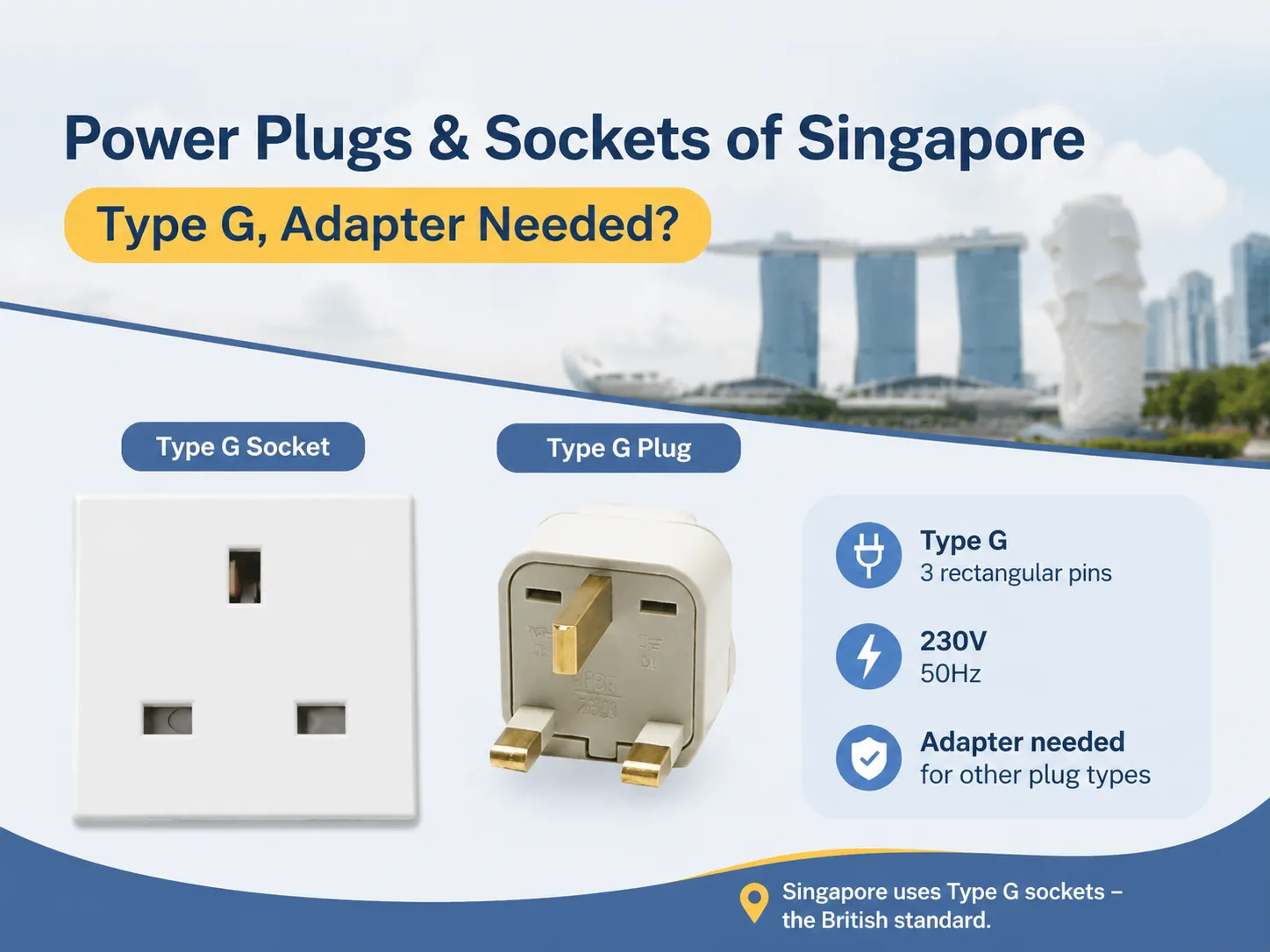
Enchufe eléctrico de Singapur – Estándar Tipo G
Solo hay un tipo de enchufe eléctrico que se puede usar en Singapur. Este es el enchufe Tipo G, que es similar al enchufe Tipo G del Reino Unido. Este enchufe tiene 3 pines rectangulares que están dispuestos en forma triangular. Tiene un fusible incorporado en el propio enchufe para proporcionar seguridad adicional. El enchufe consiste en un cuerpo rehundido que permite que el enchufe tenga un obturador que se abre solo cuando se inserta el pin de tierra, lo que significa que también es seguro para los niños.
- Enchufe Tipo G Hay tres aberturas que tienen forma rectangular, en este caso, una es de tierra (superior) tomada verticalmente, y las otras son horizontalmente que son neutro y vivo (inferior).
- La mayoría de los enchufes en Singapur son conmutados – tienen un interruptor de encendido/apagado para mayor seguridad.
- El enchufe tiene una clasificación de voltaje de 230V a 50Hz, con un fusible dentro del enchufe, generalmente clasificado en 3A, 5A o 13A, para proporcionar seguridad para el equipo.
En contraste con los Estados Unidos con sus enchufes planos, y Europa con enchufes redondeados, el enchufe de poder Tipo G solo se puede encontrar en el Reino Unido, Irlanda, Malasia, Hong Kong y Singapur. Los enchufes de los tipos A, B, C o F no existen en hoteles o hogares en Singapur, ya que el tipo G es el único enchufe utilizado.
Tipo de enchufe de Singapur – ¿Cómo se ve un enchufe de poder de Singapur?
A El enchufe de poder de Singapur es un Tipo G enchufe, que tiene estas características físicas:
- Tres pines rectangulares. El pin de tierra tiene una mayor longitud y grosor y sus parámetros son 4.0 mm y 22.7 mm, mientras que los pines vivo y neutro tienen el mismo grosor de 4.0 mm, pero su longitud solo es de 17.7 mm.
- Los pines están dispuestos en un triángulo: el pin de tierra en la parte superior, vivo y neutro en la parte inferior.
- Típicamente, la carcasa del enchufe tiene forma rectangular, que puede presentar un compartimento de fusible accesible en el lateral o debajo de él.
- Varios enchufes también vienen con una funda, lo que significa que la parte inferior de los pines está aislada para evitar la posibilidad de contacto involuntario.
En caso de que tengas un dispositivo que tenga un enchufe para EE. UU., Europa, Australia o Japón, este tipo de enchufe no se ajustará a un enchufe en Singapur. Necesitarás comprar un adaptador de enchufe para convertir el enchufe a Tipo G. Por otro lado, Singapur opera a 230V (como el Reino Unido y Europa), por lo que los dispositivos clasificados en 220-240V funcionarán bien en Singapur, pero siempre verifica las especificaciones mencionadas en el dispositivo.
Consejo profesional: En Singapur, los enchufes de corriente suelen estar ubicados hacia la parte inferior de la pared o a nivel del escritorio. Algunos hoteles ofrecen enchufes universales. Sin embargo, es una buena idea llevar un adaptador de corriente de tipo G.
Voltaje y Frecuencia en Singapur
Singapur utiliza un voltaje estándar de 230 V (con una tolerancia en el rango de 220-240 V) y una frecuencia de 50 Hz, al igual que el Reino Unido, Europa y Australia.
Si estás en América del Norte (120 voltios) o en Japón (100 voltios), tus aparatos que no son de voltaje dual no funcionarán si no tienes un convertidor de reducción (de 230 voltios a 120 voltios). La mayoría de la tecnología moderna (teléfonos, laptops, tabletas) es de voltaje dual (100 a 240 voltios, 50/60 Hertz) y funcionará solo con un adaptador. Verifica la etiqueta que dice “ENTRADA: 100-240 voltios, 50/60 Hertz”.
Necesitarás un transformador si estás tratando con dispositivos que requieren solo 120 V (como muchas afeitadoras eléctricas o secadores de pelo). En su lugar, muchos viajeros optan por un aparato barato encontrado localmente.
¿Necesito un adaptador de viaje para Singapur?
Sí, a menos que tu dispositivo ya tenga un enchufe de tipo G (como los de Reino Unido, Irlanda, Malasia o Hong Kong). La tabla a continuación ofrece una visión rápida para viajeros de diferentes regiones.
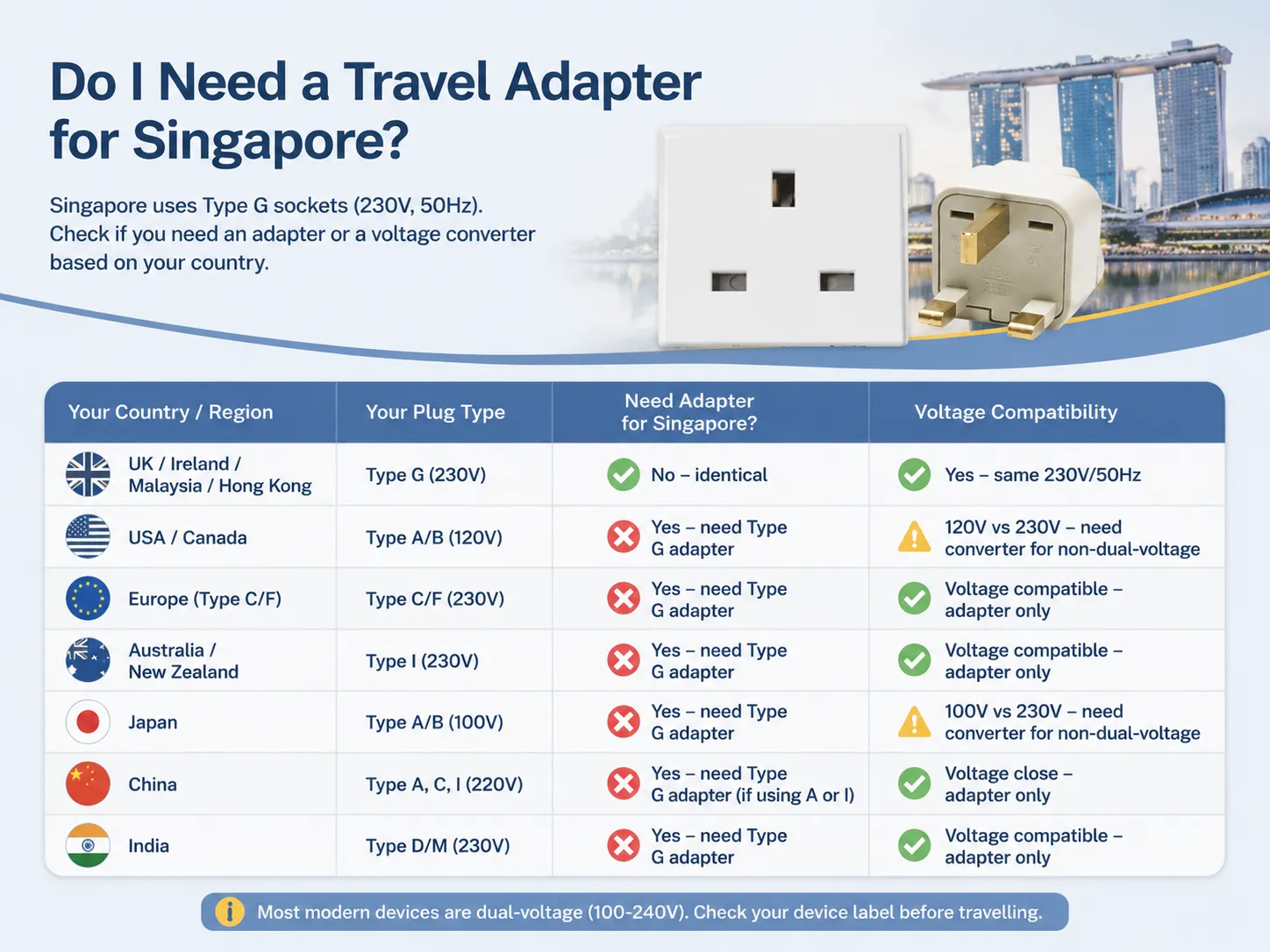
| Tu País / Región | Tu Tipo de Enchufe | ¿Necesito un adaptador para Singapur? | Compatibilidad de Voltaje |
|---|---|---|---|
| Reino Unido / Irlanda / Malasia / Hong Kong | Tipo G (230V) | ❌ No – idéntico | ✅ Sí – mismo 230V/50Hz |
| EE. UU. / Canadá | Tipo A/B (120V) | ✅ Sí – necesito adaptador de tipo G | ⚠️ 120V vs 230V – necesita convertidor para dispositivos no de doble voltaje |
| Europa (Tipo C/F) | Tipo C/F (230V) | ✅ Sí – necesito adaptador de tipo G | ✅ Voltaje compatible – solo adaptador |
| Australia / Nueva Zelanda | Tipo I (230V) | ✅ Sí – necesito adaptador de tipo G | ✅ Voltaje compatible – solo adaptador |
| Japón | Tipo A/B (100V) | ✅ Sí – necesito adaptador de tipo G | ⚠️ 100V vs 230V – necesita convertidor para dispositivos no de doble voltaje |
| China | Tipo A, C, I (220V) | ✅ Sí – necesito adaptador de tipo G (si uso A o I) | ✅ Voltaje cercano – solo adaptador |
| India | Tipo D/M (230V) | ✅ Sí – necesito adaptador de tipo G | ✅ Voltaje compatible – solo adaptador |
Punto clave: Los enchufes en Singapur son del tipo G. Si tu enchufe está clasificado para uso en el Reino Unido, puedes enchufarlo sin problemas. Todos los demás necesitan comprar un adaptador de enchufe de tipo G. En términos de voltaje, las personas que vienen de regiones de 230V solo necesitarán un adaptador, pero aquellos que vienen de regiones de 120V deben verificar que sus dispositivos eléctricos sean de voltaje dual.
Se recomienda tener un adaptador de viaje universal que tenga pines de tipo G. Es pequeño y se puede usar en el Reino Unido, Hong Kong y Malasia.
Preguntas Frecuentes (FAQ)
¿Qué enchufe se utiliza en Singapur?
Singapur adopta el enchufe rectangular de tres clavijas de tipo G, que se utiliza en países como el Reino Unido, Irlanda, Malasia y Hong Kong.
¿Necesito llevar un adaptador a Singapur?
Sí – excepto para aquellos dispositivos que están equipados con enchufes de tipo G basados en el Reino Unido o de otro tipo. Si vienes de países como EE. UU., Europa o Australia, necesitarás un adaptador de tipo G. La mayoría de los dispositivos en el mercado de electrónica moderna cuentan con soporte de voltaje dual, por lo que normalmente no necesitas lo que se llama un “convertidor de voltaje”, sino simplemente un adaptador.
¿Los enchufes de Singapur son los mismos que los del Reino Unido?
Sí, completamente. Singapur ha implementado el estándar eléctrico británico, tipo G. Las medidas específicas de voltaje, frecuencia y tipo de enchufe son las mismas.
¿Singapur tiene enchufes de EE. UU.?
No. En Singapur, no se utilizan enchufes de EE. UU. (tipo A/B). Aunque algunos hoteles pueden tener enchufes que aceptan enchufes de EE. UU., estos no son comunes en todo el país. Debes asegurarte de tener un adaptador de enchufe de tipo G a mano.
¿Es Singapur igual que el enchufe del Reino Unido?
Sí, exactamente igual. Ambos utilizan enchufes de tipo G con tres pines rectangulares.
¿Los enchufes de Singapur son los mismos que los de Australia?
No. En Australia, se utiliza el enchufe Tipo I (con tres pines planos en formación de V). Sin embargo, en Singapur, se usa el enchufe Tipo G (que consiste en tres pines rectangulares). Por lo tanto, no son intercambiables.
¿Los hoteles en Singapur tienen tomas de corriente universales?
Numerosos hoteles de presupuesto medio y de alta categoría en Singapur cuentan con tomas universales compatibles con enchufes de EE. UU., Reino Unido, Europa y Australia. Sin embargo, esto no es seguro, particularmente en el caso de hoteles económicos o propiedades más antiguas. Por lo tanto, es mejor llevar un adaptador Tipo G contigo.
¿Qué tipo de adaptador de enchufe necesito para Singapur?
Necesitarás un adaptador de enchufe Tipo G, que viene con un total de tres pines rectangulares dispuestos en forma triangular. La mayoría de los adaptadores de enchufe universales incluyen un adaptador Tipo G. Sin embargo, se recomienda elegir un adaptador de enchufe con un fusible que, aunque no es obligatorio, garantizará una mayor seguridad.
Consejos de viaje para usar dispositivos electrónicos en Singapur
- Empaque un adaptador de tipo G – es esencial a menos que tenga enchufes del Reino Unido.
- Verifique las etiquetas de voltaje – la mayoría de los dispositivos modernos son de doble voltaje, pero siempre verifique.
- Lleve un banco de energía – útil para largos días explorando la ciudad o usando su teléfono para navegación.
- Protección contra sobretensiones – la red eléctrica de Singapur es muy estable, pero un pequeño protector contra sobretensiones sigue siendo una buena idea.
- Enchufes en hoteles – a menudo cerca del escritorio o la cama; un cable de extensión puede ser útil.
- Adaptador vs. convertidor – recuerde: el adaptador cambia de forma; el convertidor cambia el voltaje.
Resumen
Las tomas de corriente en Singapur son de tipo G y operan a un voltaje de 230V y una frecuencia de 50 Hz; estas especificaciones son similares a las del Reino Unido. Por lo tanto, los viajeros que traen aparatos eléctricos del Reino Unido, Irlanda, Malasia o Hong Kong pueden conectarlos directamente a los enchufes de Singapur. Sin embargo, los viajeros que lleguen de EE. UU., Europa, Australia, Japón y otras partes del mundo tendrán que usar un adaptador y, para ciertos equipos no diseñados para voltaje dual, un convertidor de voltaje. La buena noticia es que una gran parte de la electrónica que se fabrica actualmente es de voltaje dual, lo que significa que en la mayoría de los casos, solo se requeriría un adaptador. En resumen, con la preparación adecuada, seguramente podrá mantenerse conectado mientras disfruta de Singapur.