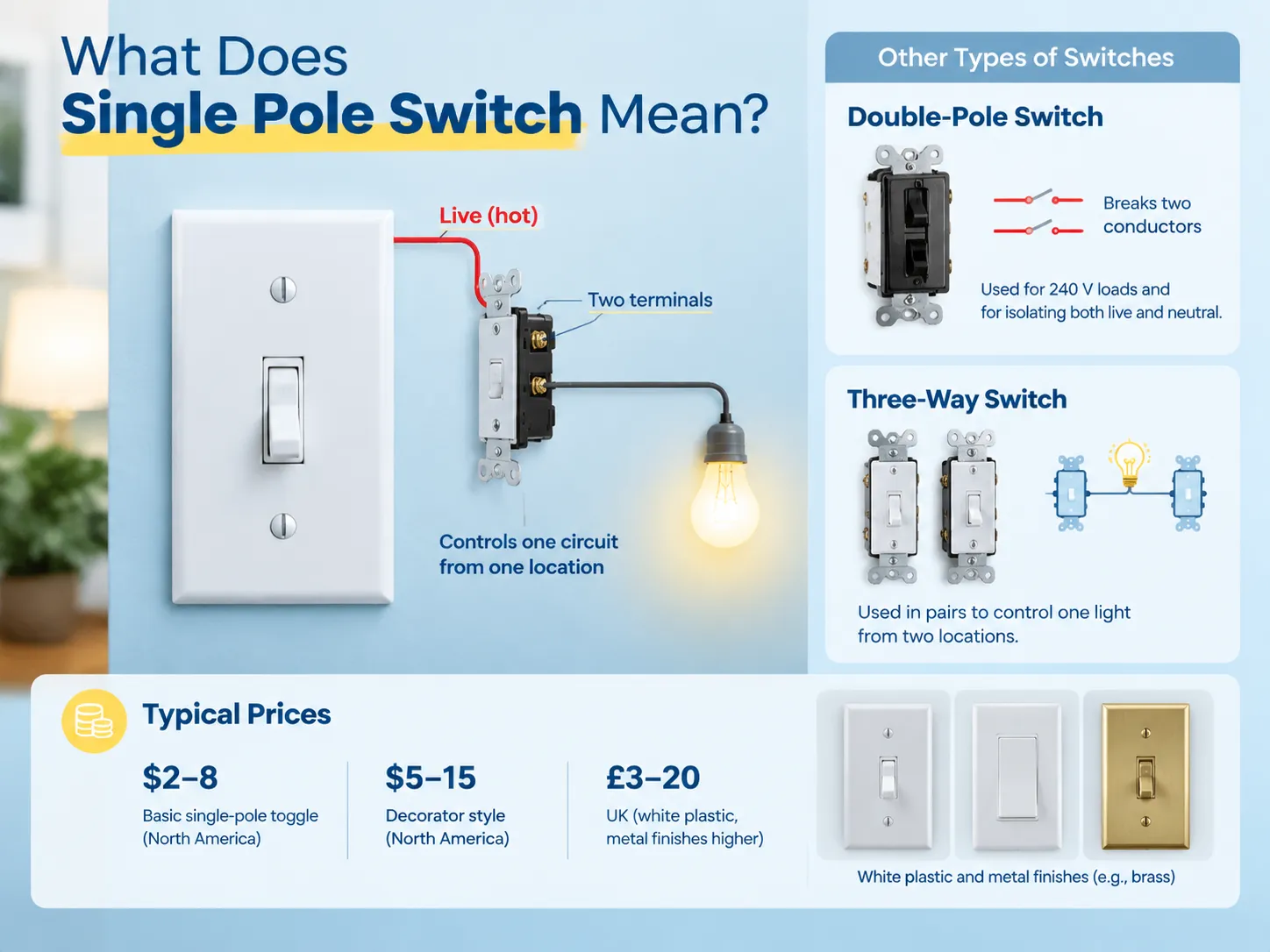
A visit to an electrical wholesaler reveals a variety of switches found in the store, including single pole switches, double pole switches, two-way switches, and intermediate switches. It is important to note that the terminology does not aim at promoting any of the products but indicates how many conductors are interrupted by a particular type of switch and its capacities, which will be discussed in detail below. The most frequently mentioned type of switch is the single pole switch, which represents the most common type of switch used for the purpose of turning lights on in the house. The current article is intended to provide information about what is a single pole switch, how it works and is used, how it can be wired, how it can be distinguished from other types of switches, and the cost of single pole switches.
A single-pole switch is intended for controlling just one circuit from one location through the breaking or making of a single conductor, which is usually the live or hot wire. It only works from one place and consists of two terminals. The expression “pole” refers to the number of circuits controlled by an appliance. Thus, two poles of a double-pole switch mean the same device can operate two conductors simultaneously; for example, the load of 240 volts can be dealt with and live and neutral wires can be disconnected. The third switch is known as one of the three switches used for controlling the same light but with the help of other switches from different locations.
What “Pole” Actually Means
The source of the confusion regarding switch terminology can be traced back to merely one term used in this case: pole. The pole does not refer to the physical post or terminal. Rather, it indicates the number of the separate paths for current that may be interrupted by the given device.
At the same time, single-pole switches have one switching pathway, meaning they are able to disconnect one conductor of one circuit. Thus, double-pole switches have two switching paths. They are able to disconnect two conductors. Triple-pole and four-pole switches can disconnect three circuits using their three or four switching paths.
That is the reason the term is widely used not only in relation to switches but also in connection with circuit breakers and relays.The tipos de interruptores de luz available for a project differ mainly in how many poles and how many operating positions they provide, and understanding that framework makes the whole catalogue legible.
How a Single-Pole Switch Works
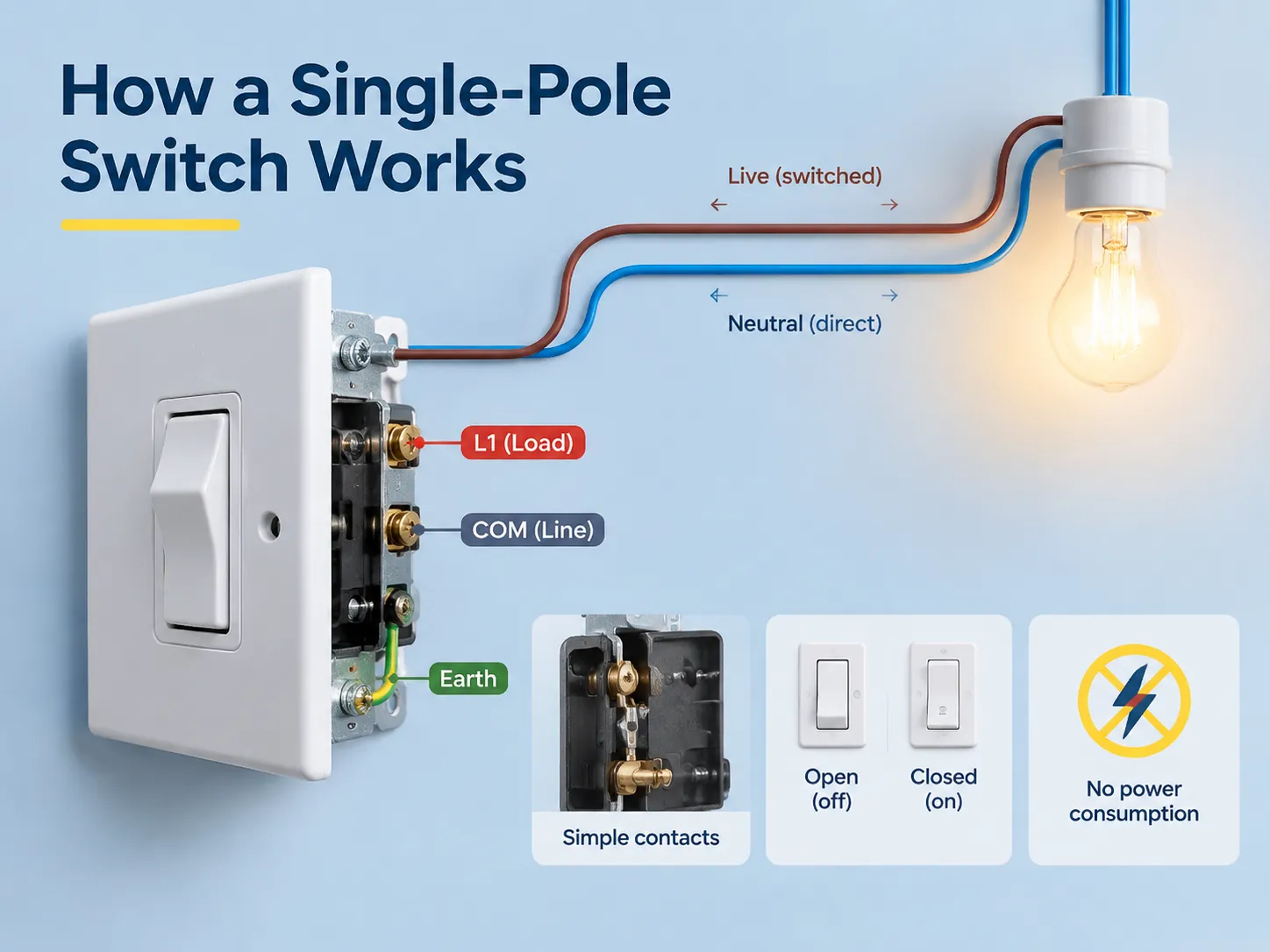
The rationale behind this device is very elementary, and due to this reason, it has remained unchanged for more than 100 years. Out of the power source, electricity enters a switch, goes through the switching apparatus, arrives at the output of the switch to the lighting fixture. The neutral goes straight to the lamp without passing through the switch at all. If the switch is off, there is a break in the circuit which stops the flow of electricity, and if the switch is on, there is completion of the circuit and the lighting lamp lights up. In the event the switch is turned off, this indicates that the circuit of the lamp was interrupted by the equipment and therefore the lamp can be replaced.
The working principle of the switch is pretty simple – two contacts are activated by a toggle, rocker, or push system. It has two active terminals – usually called COM and L1 or LINE and LOAD based on the company producing it. The switch as a product may also have a third terminal for grounding of the casing and cases with connection of the metal fixtures.The front part of a switch by an appearance does not differ but inside of it the connection of wires is made in such a way that it can be used as a simple or double switch.
What is worth underlining is that such device does not have any electronics. The standard single-pole switch consumes power and does not produce heat and due to that aspect, the device is very reliable because it will serve longer than the interior of the room. This is the reason why this device is still in use with a variety of modern gadgets and devices, and why many smart switches make use of the mechanical device too.
What It Looks Like
Single-pole switches have a few standard types, with the types being pole-count independent.
- Toggle: The traditional switch, which is the most widely used switch found in homes throughout North America. In this configuration, the switch is turned upward to turn it on and downward to turn it off; this has become so second nature that if a switch is installed upside down, it will serve as an indicator of poor installation.
- Rocker or decorator: This type of switch features a flat surface that has to be pushed in from the top and from the bottom. It has a wider face plate and allows one to operate the switch with an elbow, becoming the most commonly used type in new constructions.
- Push-button: This kind of switch is often found in older installations in the UK and Europe and is often used in industrial environments.
- Grid and modular: This type of switch functions as part of a modular system that allows using several devices in a single plate. With a modular system, one plate can also accommodate a switch, a socket, and a dimmer functioning together.
- Dimmer: This mechanism still uses single-pole functioning but has a changing output. It presents more compatibility issues compared to the other switches since it has to deal with LED loads.
The faceplates are generally described as one-gang, two-gang, three-gang, etc., depending on how many switches fit on each faceplate. For example, if a two-gang plate is equipped with two single-pole mechanisms, its functioning will be equivalent to that of two single-pole switches installed close to each other instead of being a double-pole switch mechanism. This is the most common source of confusion for users of the switches.
Where It Is Used
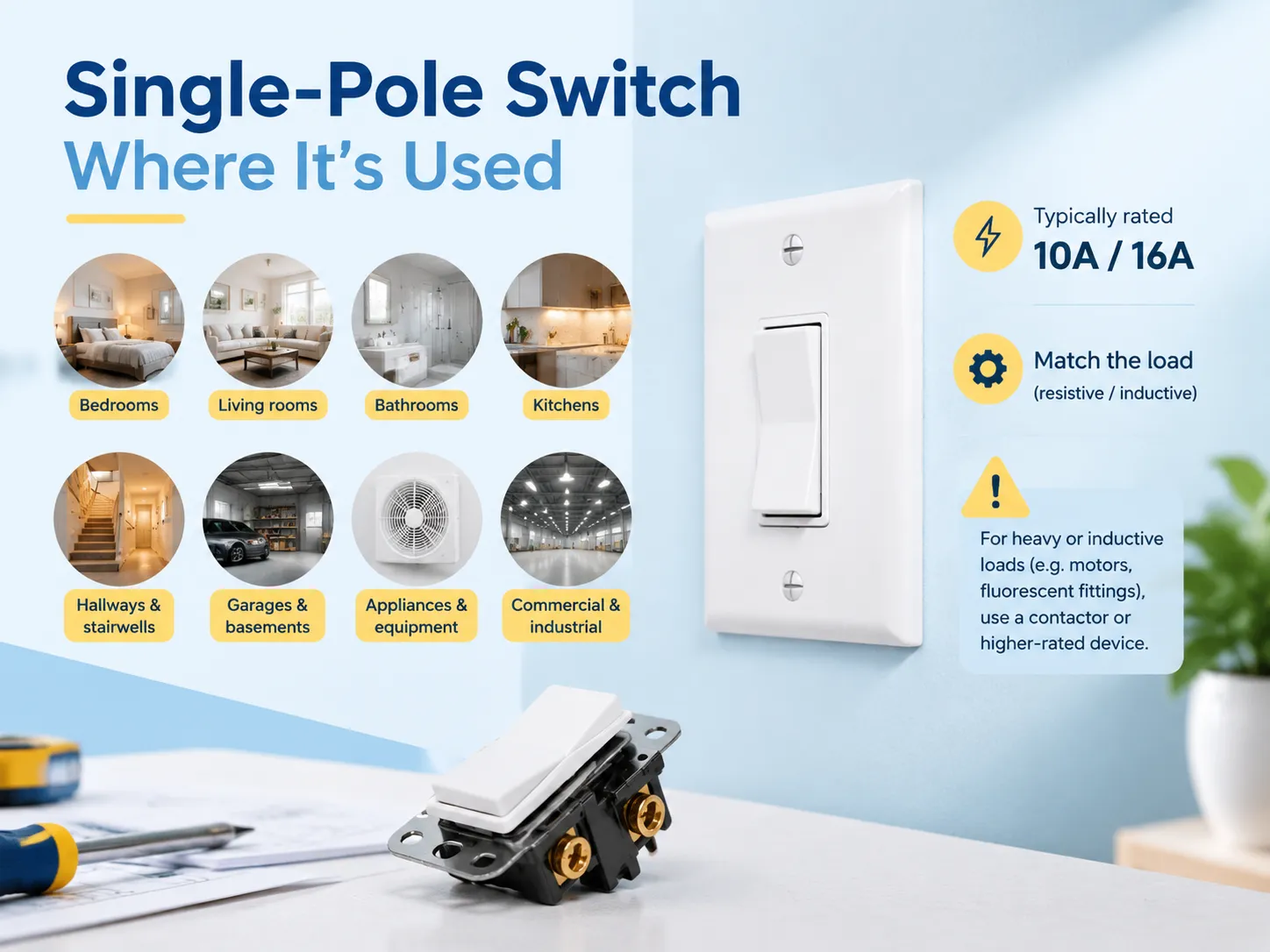
The single-pole switch is the standard choice when there is one light or one lighting system controlled from one location.
- This includes bedrooms, sitting rooms, and dining rooms where there is one entrance and one system.
- Bathrooms which often have the light controlled by a switch with an added fan, though in some cases it may be necessary to have a separate switch for the fan.
- Kitchens where usually there is one switch used to operate either the lights under the cabinets or ceiling lights.
- Hallways and staircases which have one entrance point; however, these areas can also have multiple switches to operate the lights from different locations.
- Utility areas that include garages, basements, and storerooms have one switch for the lighting used to illuminate any of these areas.
- And any equipment, such as fans, water pumps, or heating equipment that can also be controlled by a separate switch.
- On top of that, in industrial and commercial settings, together with a bank of switches, there can be hundreds of lights controlled by one switch.
The type of load is as important as the location. The single-pole switch has to be rated for a maximum load, which is usually either 10 A or 16 A depending on where it is used. Also, depending on the load type, the switch has to be rated for its type. It is not recommended to use the switch rated for a lighting load to switch on some heavy load like motor or fluorescent lamp. In case of switching a larger load, it is better to install a contractor switch.
How to Wire One
The installation of a single-pole switch might be a little quick for a skilled person to carry out the electrical work as the circuit has to be isolated and proved dead beforehand. Even though in most cases, homeowners can replace a switch in their households, it is forbidden to install new circuits.
- Need to isolate the circuit at the consumer unit or breaker panel and check the circuit’s deadness at the switch with the help of a circuit tester. The simple action of switching off the light is insufficient to ensure isolation.Guidance on the colour conventions that apply in different markets is set out in our guide to UK socket and wiring conventions.
- Confirm the status of all conductors. A standard switch circuit consists of a feed cable, a light cable, and an earth wire. Let’s point out that in the older version of the circuits, wire coloring may differ from the color codes common now.
- Feed wire must be connected to the COM terminal while switched wire goes to L1 terminal. In case of using a two-way switch, one terminal remains unconnected.
- The earth should be connected to the earth terminal and should go uninterrupted to the main supply. Make sure that all conductor wires are properly positioned so that the plate is even and the wires inside the plate are neither squeezed nor broken.
- Make sure that the switch works in both positions and the light turns on.
The wider sequence, including the tools, the safe isolation procedure, and what to do when the wiring is not what you expected, is covered step by step in our guide to reemplazar un interruptor de luz.
Single Pole vs Double Pole
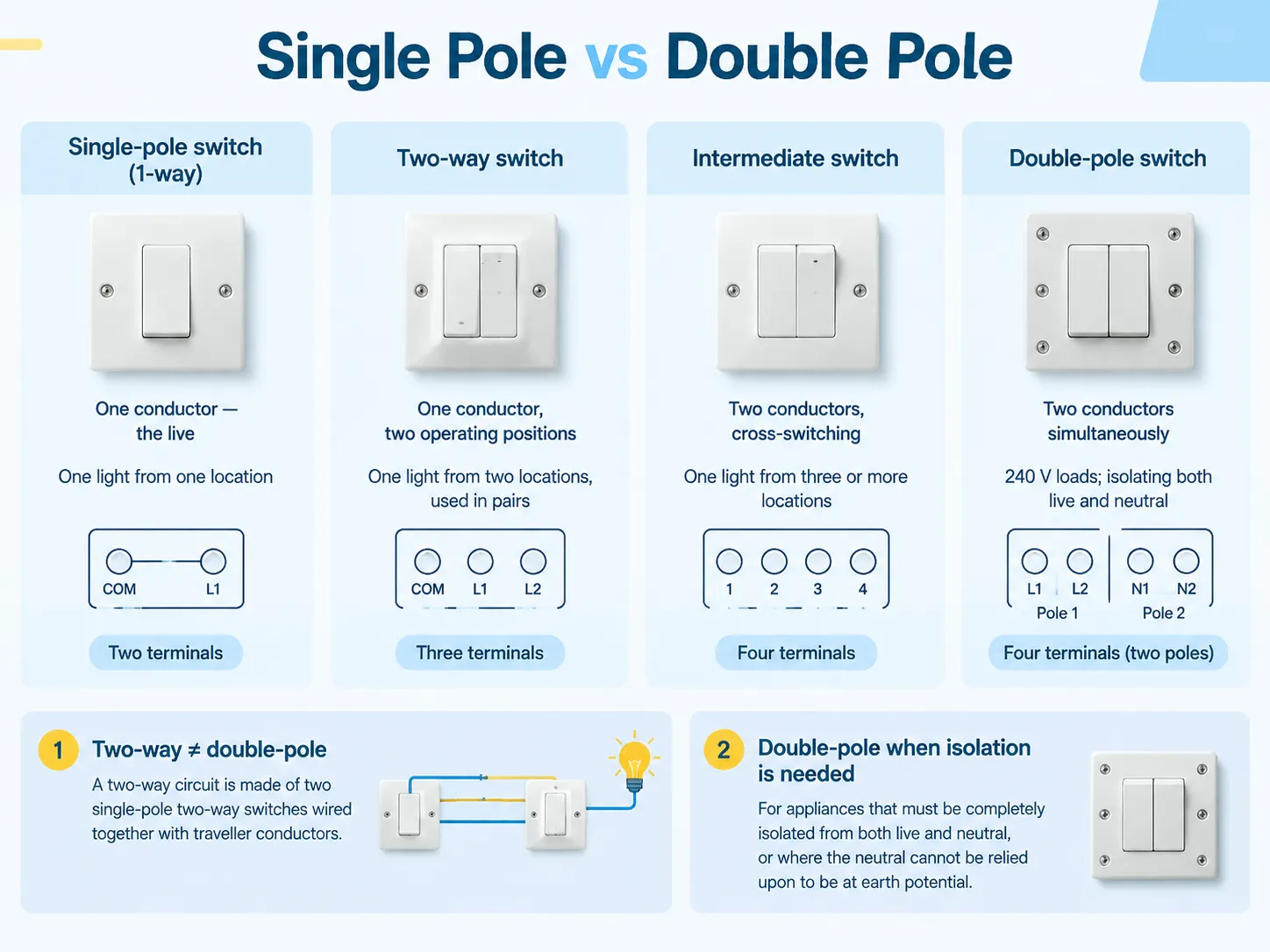
The difference can be seen more clearly through a table than through the text as the words are used differently when referring to switches and sockets.
| Dispositivo | What it switches | Uso típico | Measured between |
|---|---|---|---|
| Single-pole switch (1-way) | One conductor — the live | One light from one location | Two terminals (COM and L1) |
| Two-way switch | One conductor, two operating positions | One light from two locations, used in pairs | Three terminals (COM, L1, L2) |
| Intermediate switch | Two conductors, cross-switching | One light from three or more locations | Four terminals |
| Double-pole switch | Two conductors simultaneously | 240 V loads; isolating both live and neutral | Four terminals (two poles) |
Two practical points follow. The first is that all two-way circuits do not contain double-pole switches. They are made of two single-pole two-way switches connected by traveller wires, which confuses a lot of buyers. The second point is that there are cases when double-pole switching is mandatory or preferred for safety reasons rather than control reasons: for instance, an electric appliance that needs to be completely isolated from live and neutral wires or a circuit where the neutral wire cannot be assumed to be at earth potential. The family of switches available for each situation is surveyed in our overview of the four main types of light switch.
How to Tell If Your Switch Is Single Pole
Three methods, according to the degree of reliability.
- Check how many places operate the light. If just one location operates the lamp, then it is a single pole switch. If there are two switches regulating circuit then they are two-way switches. If there are three and more regulators, the circuit is very likely to have one intermediate switch.
- Pay attention to the terminals. First deactivate the circuit, then take the cover off. If there are two terminals – the switch is single-pole, three terminals – two-way switch, four terminals – possibly intermediate switch or double-pole switch, in this case just look at the terminals marking. Typically the double-pole switch markings consist of two separate groups showing that circuits really do consist of two poles.
- Check the rating and marking of the device. Usually, it is stamped on the body. For instance if there is single-pole switch which can work at the rating of 10 A and 16 A depending on the type used it means that the switch just behaves as it should.
A Note on Sockets
The terms are the same with plug sockets; the difference is important in the UK and many export countries.
Single-pole outlets control the live conductor; double-pole outlets control both the live and neutral conductors. The benefit of the double-pole switch in the outlet is that it provides better isolation. When switched off, neither of the conductors is live, and hence, the risk is minimized in the situations where an appliance is plugged in and worked upon or the polarity is uncertain. In the UK and abroad, a number of specification-based projects are now recommending the double-pole outlet as a standard in the list of requirements due to the above discussed fact.
Where the devices are being specified in volume — for a development, a hotel, or an export order — the selection criteria extend well beyond single or double pole to certification, contact materials, and the manufacturer’s quality system, which is the ground covered in our guide to wiring device brands and what separates them.
Prices and Brands
Switches are inexpensive devices where the difference in price between good quality and great quality switches is in a matter of a few dollars, which simplifies purchasing according to quality.
| Tipo | Indicative price | Notes |
|---|---|---|
| Basic single-pole toggle, North America | $2-8 | Builder grade; specification grade costs a little more |
| Decorator / rocker, North America | $5-15 | Wider plate; more robust mechanisms |
| Single-pole switch, UK white moulded | £3-20 | Price reflects brand and mechanism quality |
| Metal finish (brass, nickel, bronze) | £12-45+ | Plate cost dominates; mechanism often shared with cheaper lines |
| Smart single-pole switch | $20-60 / £25-70 | Adds neutral-wire and platform requirements |
When it comes to brands, there are typically two types: international brands that belong to global companies that have a wide range of certified products, like MK, Schneider Electric, Legrand, and Crabtree, which are known mostly in the UK and abroad; and Leviton, Lutron, Eaton, and Hubbell that operate in North America. The second type includes manufacturers that target the decorative aspects and not much else. In project work the most important aspect is not the brand name per se but evidence – meaning proof that this brand will provide the brands mentioned above.
Preguntas frecuentes
What is the difference between a single pole and double pole switch?
A single pole switch opens one conductor—the live—in one circuit so to control one light. A double pole switch opens two conductors at the same time so to control a 240 V load or to switch off both live and neutral at the same time. The physical difference is that there are two terminals instead of one, and the practical difference is that a double pole switch is more reliable for isolation purposes because both conductors can’t remain live when they are open.
How do I know if my switch is single pole?
To determine that, begin with the light that is controlled. If one switch controls the light from one place, it is definitely a single pole. If the light is controlled by two switches, it is a two-way switch; if it is controlled by three or more switches, then there is one intermediate switch in the circuit. To confirm, isolate the circuit, take off the plate and examine how many functional terminals there are, and if it is one then it is a single pole device.
What is the difference between single and double pole sockets?
On a socket, single pole means that it only controls the live wire while double pole means that it switches off the live wire as well as the neutral wire. Double pole sockets are better for specification as they provide complete isolation of the devices, which makes it safe in cases when the polarity cannot be guaranteed or when maintenance is performed on plugged appliances. In countries like the UK, they become more common in specifications or rules of the trades.
What is the difference between a single pole and a double pole relay?
The principle is the same for switches when applied to a control device. A single pole relay has one contact and can control only one circuit (it is a SPST or a SPDT relay). While a double pole relay has two contacts that are working independently (DPST or DPDT relay), it cannot be used in situations when two wires need to be controlled. However, the amout of poles does not affect the operation of the control part of the relay.
Can I use a single-pole switch for a 240 V appliance?
The answer is: no. A load of 240 volts requires two wires to work so both of them must be disconnected from the circuit for the device to be switched off. A single pole switch cannot turn off one wire, which creates a dangerous situation in both respects: from the safety point of view and from the point of view of compliance with regulations.
Referencias
- BSI — BS EN 60669 Series, Switches for Household and Similar Fixed Electrical Installations
- NFPA — National Electrical Code, Switching and Isolation Requirements
- International Electrotechnical Commission — IEC 60669 and IEC 61058 Switching Device Standards
- UL Solutions — UL 20 Snap Switches and General-Use Wiring Devices
Conclusión
One pole means one path of functioning, which implies one conductor being interrupted, one circuit being switched, and one working position. The importance of the word “one-pole” explains the possibility of combining it with the words like gang, way, and two pole. Knowing what the definition of those terms will simplify everything because gang is understood as the number of switching devices used for one surface; way is referred to the number of the places where a lamp can be operated from; pole indicates how many conductors are interrupted by the switch. The simplest switch is one-pole, which means that it interrupts only one conductor, two pole interrupt two and apply for 240V and having full voltage isolation, whereas a circuits two ways uses two one-pole switches (not needing to utilize the two-pole). The process of switch installations is rather simple and safe though it is required to turn off the electricity before the switching terminals are determined. The process of purchasing a switch is rather easy financially as well: if the specifications allow buying a cheap option, it is mentioned in the documentation.