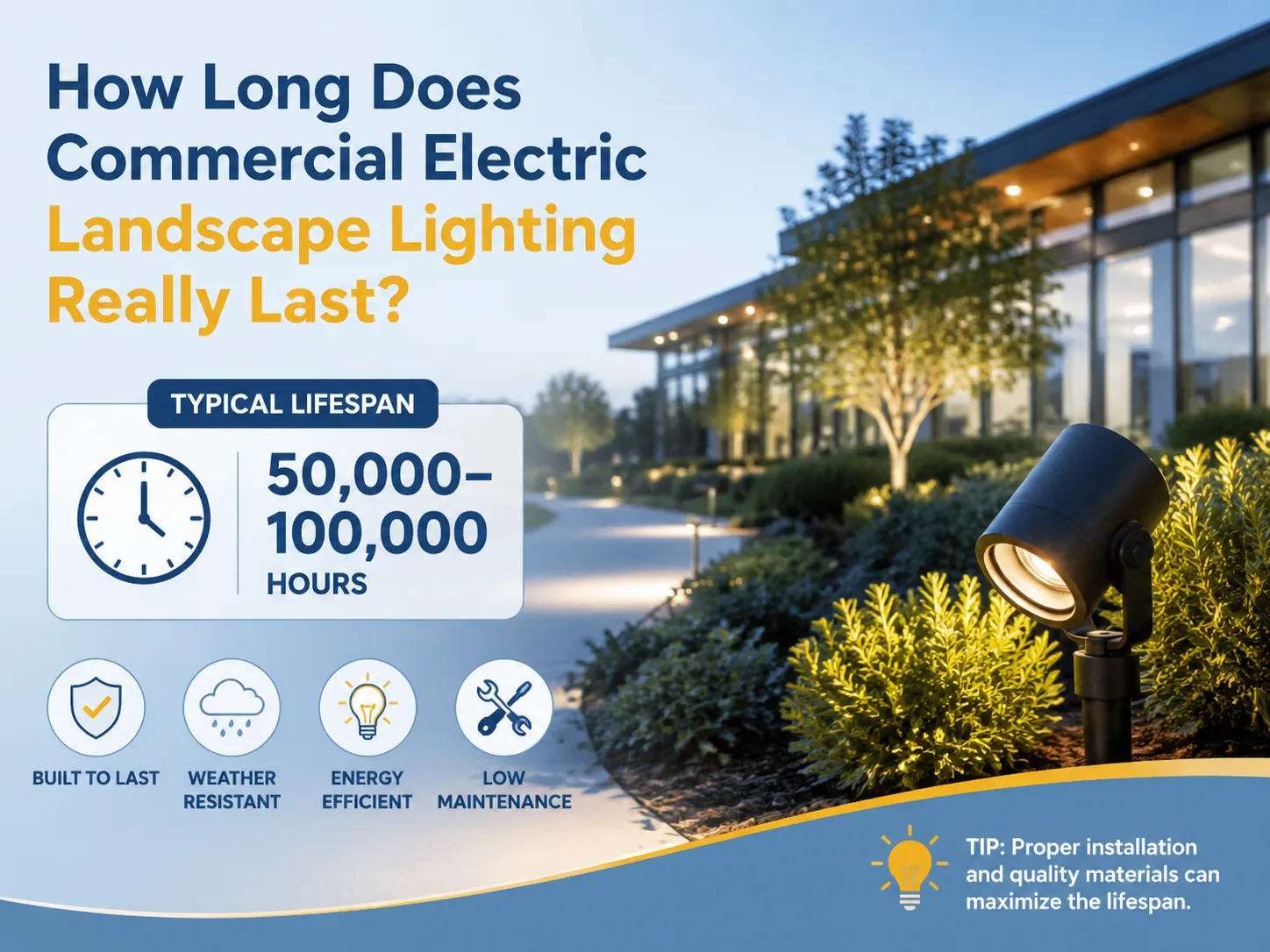
Lorsque vous estimez un projet d’éclairage paysager commercial – un paysage d’hôtel, un vignoble ou un centre commercial – on peut vous proposer une somme importante. Puis la question se pose : combien de temps les luminaires durent-ils vraiment ? La réponse marketing à cette question est “ 50 000 heures ”. Cependant, la véritable réponse est plus nuancée. Les éclairages commerciaux LED de haute qualité peuvent en réalité durer jusqu’à 25 000-50 000+ heures (environ 10-20 ans d’utilisation constante), tandis que les appareils bon marché avec les mêmes LED peuvent cesser de fonctionner après seulement 2-5 ans. Ce guide donne les chiffres réels, explique ce qui peut raccourcir la durée de vie, et montre comment acheter des appareils qui dureront.
Selon des études récentes, l’espérance de vie de l’éclairage paysager commercial LED varie entre 24 000 et 50 000 heures. Par exemple, avec 6-8 heures de fonctionnement quotidien, un appareil évalué pour 24 000 heures servira son propriétaire pendant environ 8-17 ans, et une lampe évaluée jusqu’à 50 000 heures peut durer 17-23 ans et plus. Bien sûr, il faut prendre en compte que la qualité de la lampe joue un rôle majeur. Ainsi, les luminaires haut de gamme avec des boîtiers en laiton/alu solides, une conception thermique appropriée et un indice de protection élevé (IP65+) sont connus pour durer 50 000 heures ou plus, tandis que les versions bas de gamme des grandes surfaces peuvent tomber en panne en seulement 2-5 ans.
La réponse claire : combien de temps durent-ils
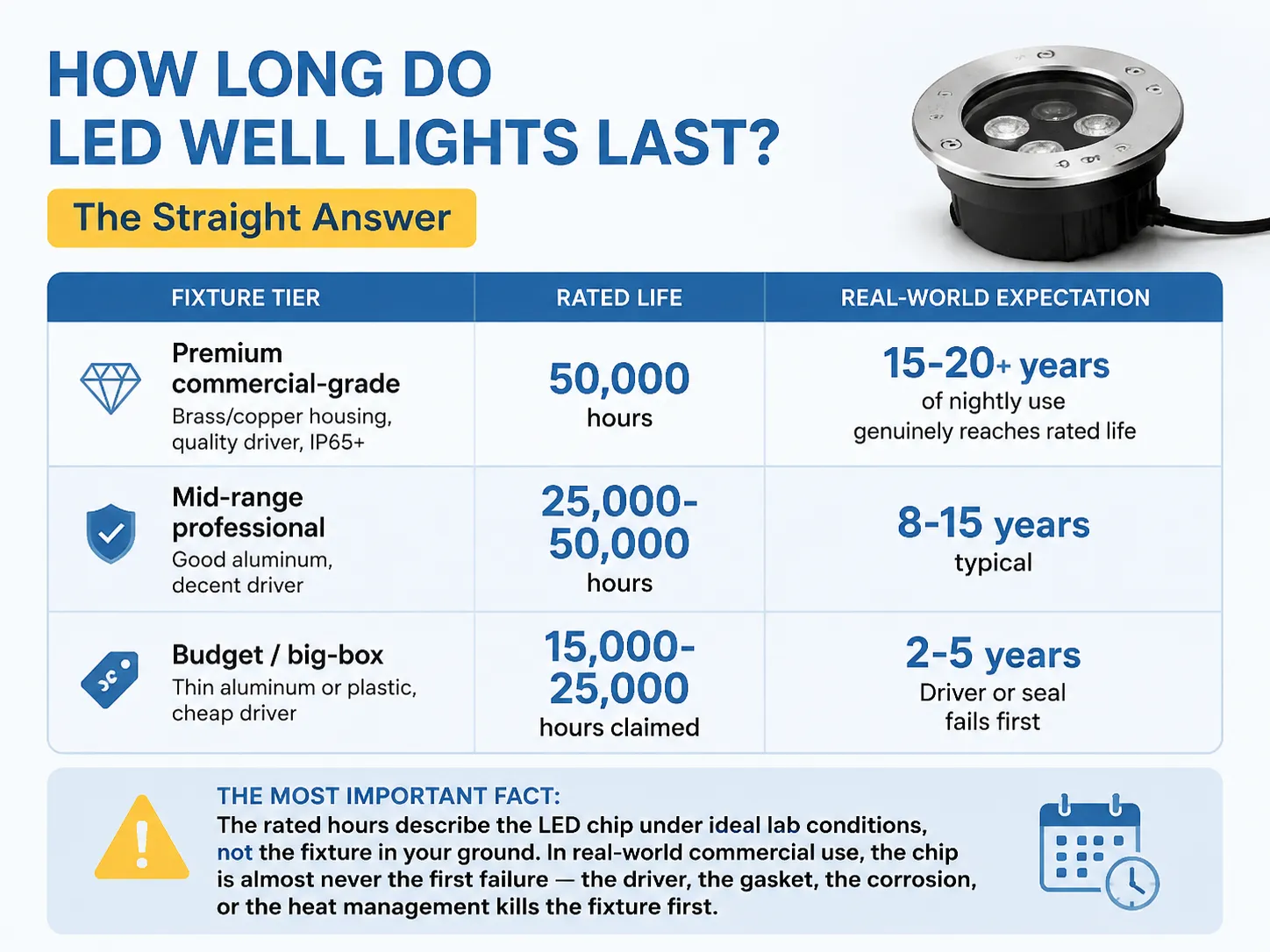
Voici la réponse honnête et complète dans un tableau :
| Niveau de l’appareil | Durée de vie nominale | Attente en conditions réelles |
|---|---|---|
| Commercial haut de gamme (boîtier en laiton/cuivre, driver de qualité, IP65+) | 50 000 heures | 15-20+ ans d’utilisation nocturne — atteint réellement la durée nominale |
| Professionnel milieu de gamme (bon aluminium, driver correct) | 25 000-50 000 heures | 8-15 ans typiques |
| Budget / grande distribution (aluminium fin ou plastique, driver bon marché) | 15 000-25 000 heures revendiquées | 2-5 ans — le driver ou le joint lâche en premier |
Le fait le plus important à retenir est que le nombre d’heures est attribué à la puce LED en conditions de laboratoire et non à la lampe telle qu’elle est utilisée en pratique. En pratique, la puce LED elle-même ne tombe généralement pas en panne en premier, car c’est habituellement causé par le driver, le joint, la corrosion ou le système de gestion thermique en premier lieu.
Ce que signifie réellement “ 50 000 heures ” (L70)
Les LED n’ont pas la même durée de vie que les ampoules conventionnelles. Elles commencent plutôt à diminuer dès leur fabrication. Ce déclin progressif est appelé dépréciation du flux lumineux, et une LED est considérée comme ayant atteint la fin de sa vie après avoir atteint le point L70, moment où la LED est capable d’émettre seulement 70 % de son flux lumineux initial. Bien que la lumière continue de fonctionner à ce niveau de luminosité, elle est considérée comme n’étant plus utile pour la plupart des usages.
- Selon le site du Département de l’Énergie des États-Unis, les LED blanches de haute qualité mettent 30 000-50 000 heures ou plus pour atteindre le stade de détérioration L70.
- Les systèmes commerciaux haut de gamme peuvent durer jusqu’à 100 000 heures avant d’atteindre L70.
- Cela peut être appelé le niveau de notation de la puce, tandis que le boîtier, les pilotes et les joints représentent des composants disparates ayant chacun leur propre variabilité de durée de vie.
Ainsi, bien que “ 50 000 heures ” signifie quelque chose, ce nombre répond en réalité à la question de savoir combien de temps la puce restera viable.
Conversion des heures en années d'utilisation réelle
L'éclairage paysager fonctionne généralement 6 à 10 heures par nuit, selon la saison et les réglages du minuteur. Voici la conversion :
| Heures nominales | 6 h/nuit | 8 h/nuit | 10 h/nuit |
|---|---|---|---|
| 15 000 heures | ~6,8 ans | ~5,1 ans | ~4,1 ans |
| 25 000 heures | ~11,4 ans | ~8,6 ans | ~6,8 ans |
| 35 000 heures | ~15,9 ans | ~12 ans | ~9,6 ans |
| 50 000 heures | ~22,8 ans | ~17,1 ans | ~13,7 ans |
| 100 000 heures | ~45,7 ans | ~34,3 ans | ~27,4 ans |
Ce ne sont que les maxima théoriques pour la puce. Les applications commerciales utilisent généralement des solutions pour des périodes plus longues que les habitations (par exemple, l’éclairage de sécurité du crépuscule à l’aube), ce qui réduit la durée de vie réelle en années calendaires, cependant, même 10 heures par nuit font du luminaire de 50 000 heures un produit de plus de 13 ans.
LED vs Incandescent, Halogène & CFL
Le contexte est essentiel — l’éclairage paysager LED est une amélioration majeure par rapport à ses prédécesseurs :
| Type d’ampoule | Durée de vie moyenne | Fréquence de remplacement (6 h/nuit) |
|---|---|---|
| Incandescent | 1 000-2 000 h | Tous les 6-18 mois |
| Halogène | 2 000-4 000 h | Tous les 1-3 ans |
| DEL | 8 000-10 000 h | Tous les 3-5 ans |
| LED | 25 000-50 000 h | Tous les 10-25 ans |
Les systèmes d’éclairage paysager LED commerciaux consomment 75 % d’énergie en moins que les ampoules à incandescence, selon le DOE, ce qui rend les systèmes LED plus efficaces que les sources lumineuses à incandescence similaires en termes de longévité et de coût.
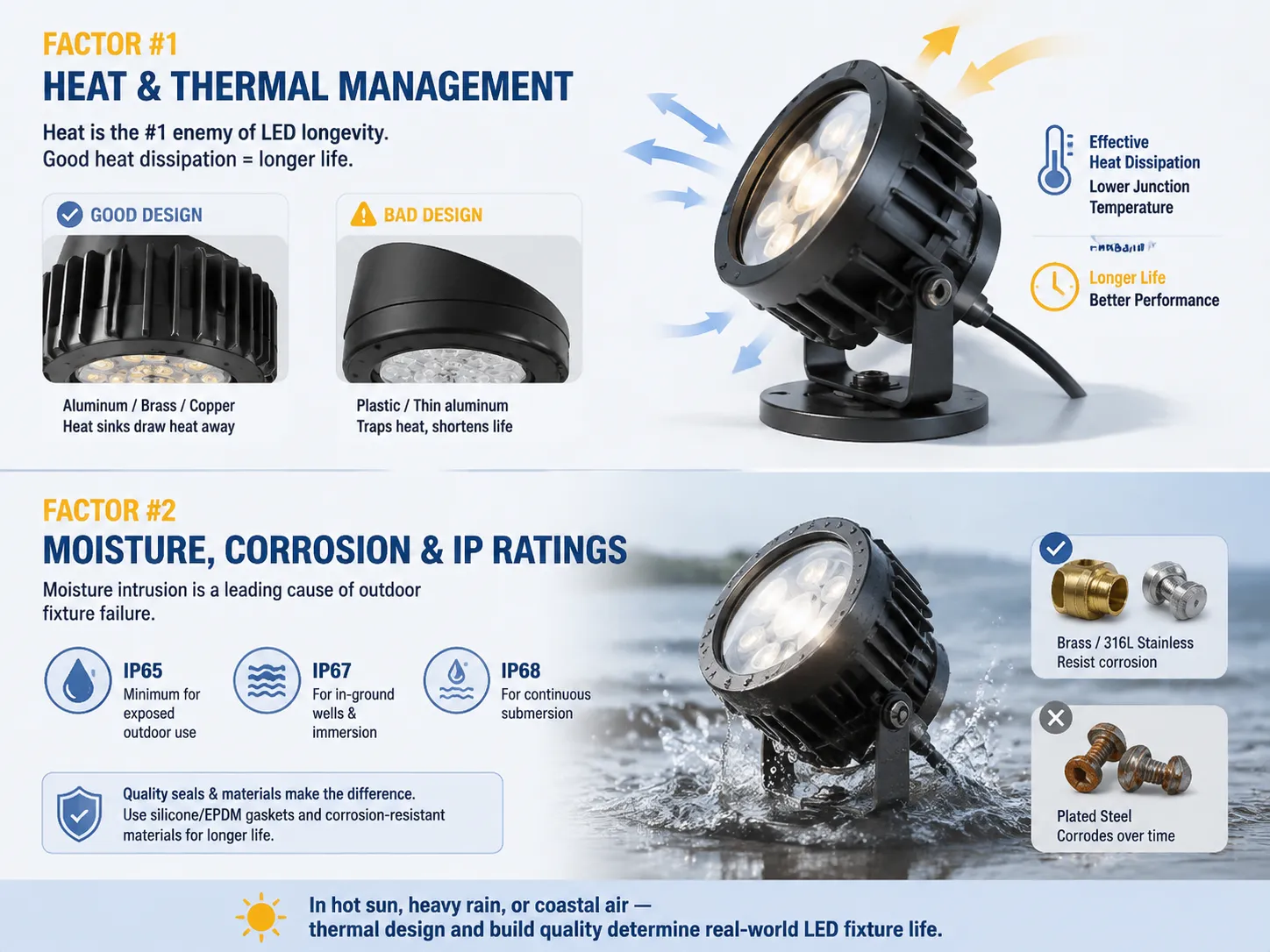
Facteur #1 : Gestion de la chaleur et thermique
La chaleur est le principal facteur de défaillance des LED. Si la chaleur produite lors de la conversion de l’électricité en lumière n’est pas dissipée, la LED fonctionnera très rapidement.
- Bon design : Les luminaires de haute qualité possèdent des dissipateurs thermiques et des boîtiers fabriqués avec des matériaux à haute conductivité thermique tels que le laiton, le cuivre ou l’aluminium.
- Mauvais design : Les boîtiers en plastique et en aluminium retiennent la chaleur, surtout en plein soleil et dans des espaces fermés.
- Réalité commerciale : Utilisées sur des toits chauds en Californie, des trottoirs en béton chaud ou dans des espaces fermés, les LED deviennent beaucoup plus chaudes qu’à 25 °C lors des tests en laboratoire, réduisant ainsi la longévité de la puce de moitié voire plus.
Lors de la comparaison de différents luminaires, assurez-vous de vérifier la conception du dissipateur thermique et le matériau du boîtier également.
Facteur #2 : Humidité, corrosion et indices IP
L’infiltration d’humidité est la deuxième cause la plus fréquente de défaillance des unités d’éclairage extérieures. Si l’eau de pluie pénètre par un joint usé ou une lentille cassée, elle commencera alors à corroder le pilote et le câblage — bien que la puce puisse encore fonctionner, l’unité ne le fera pas.
- Les indices IP indiquent les normes acceptables : IP65 est le minimum que toute lumière devrait atteindre ; IP67 convient aux lumières installées sous terre ; et IP68 est conçu pour fonctionner sous l’eau.
- Les indices IP sont sans objet si un modèle de lumière utilise des matériaux d’étanchéité de mauvaise qualité : les joints bon marché en caoutchouc peuvent perdre leur capacité d’étanchéité en quelques années sous l’effet des rayons UV et des intempéries. Les bons modèles utilisent de bons joints en silicone ou EPDM.
- Air salin : le problème est pertinent pour les emplacements proches du littoral ; tandis que le laiton et l’acier 316L résistent à la rouille, l’acier plaqué ne peut pas survivre dans de telles conditions.
Dans les climats humides, la durabilité du luminaire dépendra fortement de l’étanchéité ainsi que des matériaux utilisés dans la fabrication des produits plutôt que de la classification LED.
Facteur #3 : Le pilote LED et la qualité des composants
Le pilote LED (qui convertit la tension secteur en courant de fonctionnement utilisé par les LED) est la pièce qui tombe le plus souvent en panne dans les luminaires LED ; c’est aussi le composant le plus dégradé dans les produits à bas coût.
- Les drivers de qualité conformes aux fabricants établis peuvent fonctionner 30 000 à 50 000 heures et disposent d'une protection thermique et contre les surtensions.
- Le driver bon marché échouera en 2 à 5 ans et provoquera la défaillance complète de la lumière LED même si la puce LED elle-même reste intacte.
- La position du driver est importante en ce qui concerne la chaleur ; les drivers soumis à une forte chaleur tombent en panne plus rapidement, donc monter le driver à l'écart des lumières aide à prolonger sa durée de vie.
- Protection contre les surtensions : les pics dus à la foudre et autres événements sont des causes majeures de défaillance des drivers. Les luminaires de qualité disposent d'une protection contre les surtensions basée sur des MOV.
Vous devriez demander aux fournisseurs quel driver ils utilisent au lieu de vous fier aux marques LED pour la fiabilité.
Facteur #4 : Environnement, Tension & Utilisation
En plus de la chaleur et de l'humidité, la situation réelle évolue également.
- Variations de tension : les systèmes basse tension (12V/24V) sont affectés négativement lorsque les transformateurs sont trop faibles ou les câbles trop longs, car la sous-tension endommage les circuits du driver et la surtension détruit les puces. Ainsi, la taille appropriée du transformateur et des câbles est une décision importante pour la longévité.
- Heures de fonctionnement : plus le système fonctionne d'heures chaque nuit, plus vite le luminaire atteindra sa durée de vie. Par exemple, un luminaire dans une zone de sécurité de 10 heures par nuit s'usera deux fois plus vite qu'un dans une zone d'accentuation de 5 heures.
- L'environnement : températures élevées, cycles de basses températures, brouillard et UV impactent les joints et le plastique. Le gel du sol peut déplacer les luminaires encastrés et casser les connexions.
- Présence d'insectes et saleté : les insectes qui pénètrent dans le luminaire et la poussière qui recouvre la lentille créent un échauffement local et entraînent des défaillances prématurées.
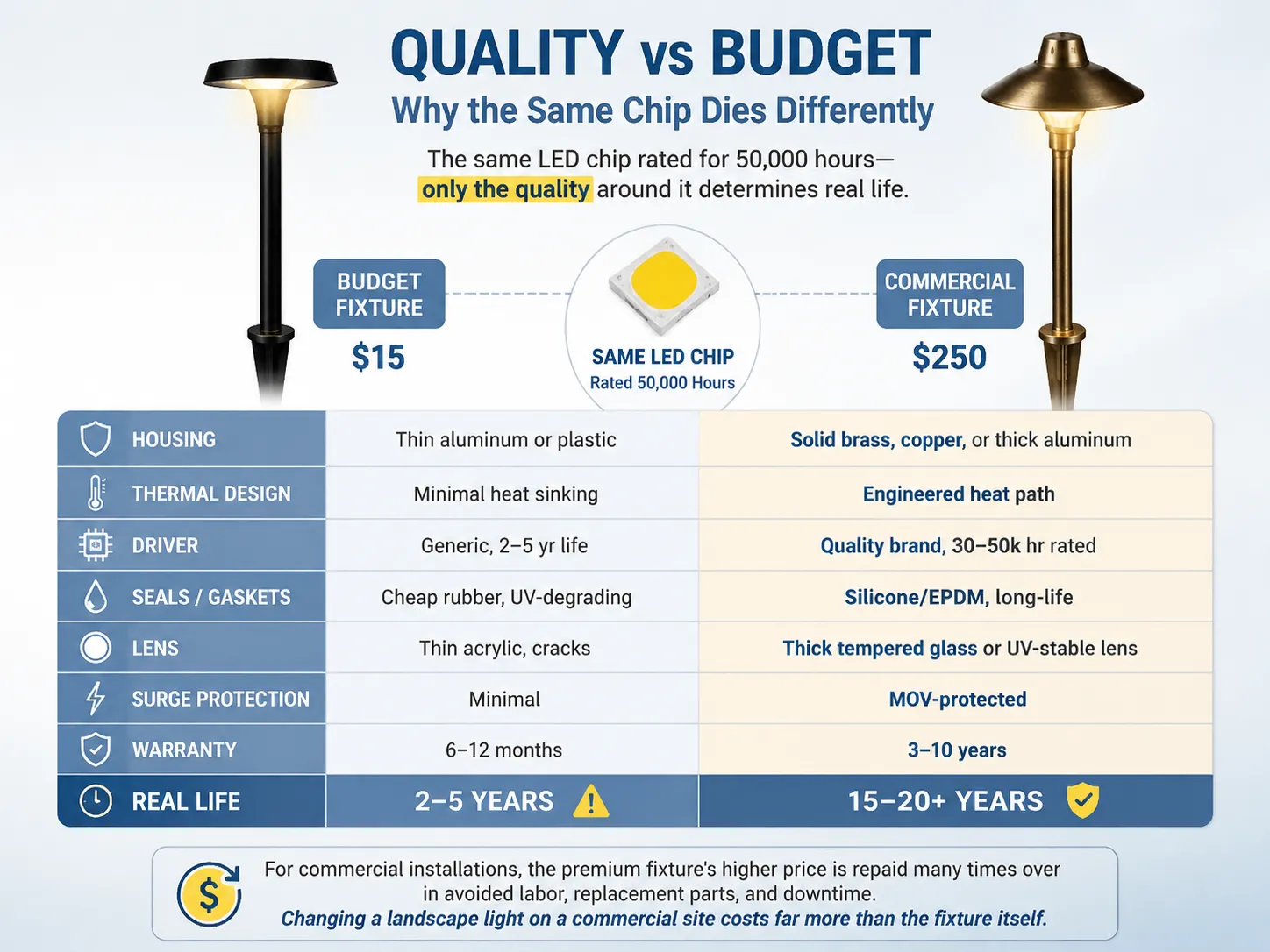
Qualité vs Budget : Pourquoi la même puce meurt différemment
La dure réalité de l'industrie : un projecteur $15 et un luminaire commercial en laiton $250 peuvent incorporer la même puce LED avec une spécification de 50 000 heures, cependant, un seul des deux produits atteindra ce chiffre. Ce qui diffère, ce sont tous les attributs entourant la puce :
| Composant | Luminaire Budget | Luminaire de qualité commerciale |
|---|---|---|
| Boîtier | Aluminium fin ou plastique | Laiton massif, cuivre ou aluminium épais |
| Conception thermique | Dissipation thermique minimale | Chemin thermique conçu |
| Pilote | Générique, durée de vie 2-5 ans | Marque de qualité, durée de vie évaluée à 30-50k heures |
| Joints/étanchéités | Caoutchouc bon marché, dégradation UV | Silicone/EPDM, longue durée de vie |
| Lentille | Acrylique fin, fissures | Verre trempé épais ou lentille stable aux UV |
| Protection contre les surtensions | Minimal | Protégé par MOV |
| Garantie | 6-12 mois | 3-10 ans |
| Durée de vie réelle | 2-5 ans | 15-20+ ans |
En termes d’applications commerciales, le prix plus élevé des luminaires premium rapporte bien plus que son coût par l’évitement de la main-d’œuvre, des pièces de rechange et de la perte de temps — il coûte beaucoup plus cher de remplacer un éclairage paysager sur un site commercial que le luminaire lui-même.
Comment acheter des luminaires durables
Avant de passer une commande pour un éclairage paysager commercial, il faut prêter attention aux points suivants :
- Matériau du boîtier : le boîtier doit être fabriqué à partir de matériaux de haute qualité tels que des plaques épaisses de laiton, cuivre ou aluminium – les luminaires en feuilles métalliques fines ou en plastique ne sont pas acceptables.
- Indice de protection IP : les exigences minimales pour l’indice IP des installations électriques extérieures sont IP65 ; pour les luminaires installés dans le sol, il doit être IP67, et pour les dispositifs d’éclairage submergés, égal à IP68.
- Pilote : le pilote doit être conçu pour supporter une opération nominale et une protection contre les surtensions, et être évalué pour au moins 30 000 heures de fonctionnement.
- Lentille : la lentille du dispositif d’éclairage doit être en verre trempé ou en matériaux stables aux UV.
- Indice L70 du dispositif d’éclairage : le nombre d’heures L70 doit être vérifié. Garantie offerte par le fabricant : la garantie sur les dispositifs électriques doit être d’au moins trois ans, tandis que les transformateurs doivent être couverts jusqu’à cinq ans ou plus.
- Possibilité de réparations : le pilote peut-il être remplacé sans remplacer l’ensemble du luminaire ?
- Évaluations du transformateur : le transformateur doit être évalué pour 75-80 % de sa capacité utilisée afin de prolonger sa durée de vie.
Maintenance & Garantie : prolonger la durée de vie réelle
Même les produits haut de gamme nécessitent une maintenance de base pour atteindre leur durée de vie prévue.
- Nettoyage des lentilles – les particules de saleté et les films réduisent le rendement et entraînent une accumulation de chaleur ; nettoyer les lentilles deux fois par an est un moyen peu coûteux de prévenir la surchauffe.
- Test annuel des joints et étanchéités – le remplacement des joints usés doit être effectué avant les fuites d’eau.
- Réaligner et tailler – en raison de la croissance des plantes autour des dispositifs, la dissipation thermique devient inefficace.
- Vérifier les connexions – la corrosion des connexions basse tension empêche le flux libre de l’électricité.
Coût total de possession
Les clients commerciaux doivent penser en termes de coût total de possession et non de prix unitaire :
- Luminaire économique : 15-30 € chacun, doit être remplacé tous les 2-5 ans, sans compter la main-d’œuvre pour creuser et installer – sur 15 ans, ils peuvent s’attendre à 3-7 remplacements et une main-d’œuvre continue.
- Luminaire commercial : 80-250 € chacun, une seule installation nécessaire pour 15-20 ans – sur 15 ans, il n’y a généralement pas de remplacements.
- Énergie : un luminaire LED utilise 6-10 W d’électricité contre 35-50 W pour un halogène – un système commercial avec 50 luminaires économise 75-90 % sur l’énergie d’éclairage, ce qui permet d’économiser des centaines d’euros chaque année.
Il ne fait aucun doute que les luminaires de haute qualité sont moins chers à long terme comparés à leurs alternatives bon marché. Et lorsque le contrôle intelligent prolonge l’utilité du système — programmation, scènes, extinction à distance — la réalité du câblage de ces contrôles compte aussi : nos guide des interrupteurs intelligents avec ou sans neutre et les dispositifs intelligents dans le gamme d’interrupteurs d’éclairage intelligents 2-gangs montrent ce qu’il faut prévoir avant la fermeture des tranchées.
Questions fréquemment posées
Quelle est la durée de vie de l’éclairage paysager basse tension ?
Les luminaires paysagers LED ont une durée de vie de 25 000 à 50 000 heures. Leur durée de vie est de 8 à 17 ans à raison de 6 heures de fonctionnement par jour et de 15 à 23 ans à 50 000 heures. Les résultats réels dépendent de la qualité du luminaire, car les luminaires haut de gamme sont véritablement capables de durer le temps indiqué sur l’étiquette, tandis que les produits moins chers ne durent généralement pas longtemps, leurs drivers et joints cédant. La durée de vie du transformateur est généralement de 10 à plus de 20 ans.
Les lumières paysagères grillent-elles ?
Typiquement, contrairement aux ampoules traditionnelles, l’éclairage paysager LED ne grille pas. Au lieu de cela, il s’estompe lentement au fil des années, descendant jusqu’au niveau L70, où seulement 70 % de leur luminosité originale est atteinte. La raison pour laquelle la plupart des éclairages LED échouent sur le terrain est due à certains facteurs comme la position des drivers, la chaleur, l’humidité ou la corrosion dans le câble ombilical, qui est la dernière particule lumineuse brillante à disparaître.
Les lumières paysagères consomment-elles beaucoup d’électricité ?
Absolument — l’éclairage paysager LED est extrêmement efficace. Un luminaire paysager LED conventionnel d’une puissance de 6 à 10 W utilise environ 75 à 90 % d’énergie en moins comparé à une lampe halogène de 35 à 50 W qu’il remplace. Cela signifie qu’une installation commerciale utilisant 50 lampes LED fonctionnant 6 heures par jour est estimée consommer seulement 2 à 3 kWh par jour, ce qui coûte généralement seulement quelques dollars par mois. Les LED basse tension sont déjà alimentées via le transformateur assurant un fonctionnement en 12 V/24 V.
Les lumières extérieures alimentées par batterie sont-elles efficaces ?
Bien que l’éclairage alimenté par batterie/solaire soit excellent en termes d’esthétique et d’installations dans des endroits où il ne serait pas faisable de tirer des câbles comme l’éclairage de chemin, les guirlandes lumineuses ou d’autres projets paysagers, lorsqu’il s’agit d’un projet professionnel sérieux nécessitant un éclairage fiable fonctionnant toute l’année, les systèmes d’éclairage LED basse tension câblés sont la meilleure solution. Avec eux, vous obtenez non seulement une luminosité constante mais aussi l’absence de besoin de changer les batteries, un contrôle idéal de la lumière et une longue durée de service avec une durée de vie de 25 000 à 50 000 heures. Les unités solaires classiques fonctionnent généralement seulement quelques années en fournissant une faible quantité de lumière.
Références
- Département de l'Énergie des États-Unis — Notions de base sur les LED et dépréciation du flux lumineux L70
- DOE — Faits sur l’éclairage LED et données sur les économies d’énergie
- Illuminating Engineering Society — Normes L70 et LM-80
- UL — Normes pour luminaires extérieurs (UL 1598, guide de classification IP)
- ENERGY STAR — Éclairage extérieur et spécifications d’efficacité
- IEC 60529 — Norme de classification IP (Protection contre l’intrusion)
Conclusion
Combien de temps dure alors l’éclairage paysager électrique commercial ? Les LED de qualité commerciale durent de 25 000 à 50 000 heures, soit environ 8 à 23 ans d’utilisation nocturne. Les luminaires de gamme économique équipés de la même puce durent de 2 à 5 ans. En général, ce n’est pas la puce qui tombe en panne en premier ; c’est plutôt la gestion de la chaleur, de l’eau, le système de contrôle et les matériaux utilisés pour la fabrication du luminaire qui déterminent sa durée de vie. Lors du choix d’un luminaire, il est important d’opter pour un luminaire en laiton/aluminium massif, classé au-dessus de IP65, équipé d’un driver de bonne qualité avec protection contre les surtensions, disposant d’une classification L70 et d’une garantie valable — ainsi vous économiserez sur les réparations.