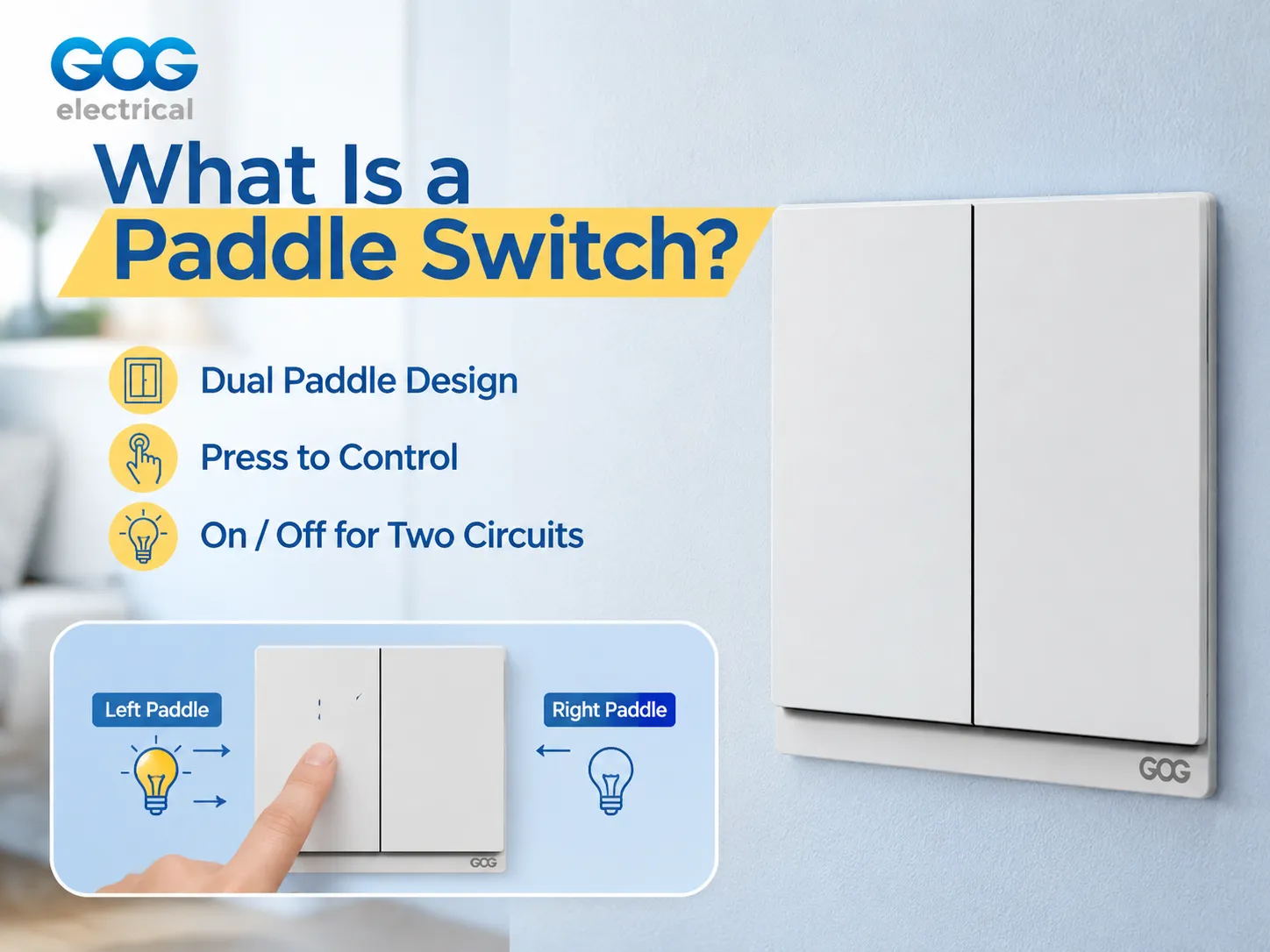
Si vous entrez dans une maison moderne, vous remarquerez une structure de design composée d'une forme rectangulaire qui fonctionne par basculement de l'interrupteur. Cet appareil est appelé par des noms tels que, interrupteurs à bascule, interrupteurs décorateurs, interrupteurs à palette, etc. Les interrupteurs à palette ont complètement remplacé les interrupteurs à levier conventionnels, en raison de leur facilité d'utilisation. Le guide décrit le fonctionnement des interrupteurs à palette, comment ils se distinguent par rapport à l'interrupteur à levier, combien de variétés d'interrupteurs à palette sont disponibles sur le marché aujourd'hui, comment ils peuvent être connectés, et comment choisir les bons parmi les types disponibles.
En bref, un interrupteur à palette est un type d'interrupteur d'éclairage qui possède une palette de forme rectangulaire au lieu d'un levier à bascule. Lorsque la palette est pressée, elle pivote sur un point d'articulation, ce qui déplace un bras à ressort créant ou interrompant le circuit. La palette reste dans la même position jusqu'à ce que quelqu'un la presse à nouveau. L'interrupteur à palette affiche le symbole “ I ” pour ON et “ O ” pour OFF. Les différents types d'interrupteurs à palette disponibles sur le marché sont les interrupteurs unipolaires, 3 voies et 4 voies, dont les coûts varient de $2 à $50 selon la qualité des interrupteurs.
Qu'est-ce qu'un interrupteur à palette ?
L'interrupteur à palette est un interrupteur mural qui possède une large surface plate appelée palette, qui est pressée pour allumer ou éteindre une lumière ou une autre charge. Beaucoup de personnes l'appellent interrupteur à bascule ou interrupteur décorateur d'après le style “ Decora ” d'interrupteur fabriqué par Leviton. Les termes sont interchangeables dans l'industrie :
- Interrupteur à palette – le nom générique pour l'interrupteur à bascule large.
- Interrupteur à bascule – désigne le même équipement, en raison de son action de basculement.
- Interrupteur Decora/interrupteur décorateur – le nom de la marque dérivé du type de plaque rectangulaire qui s'adapte aux plaques murales standard “ décorateur ”.
La différence entre la palette et l'ancien interrupteur à levier réside dans la surface. L'interrupteur à levier possède un petit levier qui est basculé vers le haut et vers le bas tandis que l'interrupteur à palette a une grande surface plate qui bascule.
À quoi ça ressemble : la face de style Decora
Les interrupteurs à palette courants apparaissent de la manière suivante :
- Une palette elle-même est large et rectangulaire, d'environ 3,2 cm de large et 1,9 cm de haut pour occuper la majorité de l'ouverture dans la plaque murale.
- Une plaque murale de forme rectangulaire est connue sous le nom de plaque “ décorateur ” car elle possède une grande palette rectangulaire plutôt qu'un levier rond.
- Les interrupteurs à palette affichent des symboles comme “ I ” et “ O ”, ou ont parfois une lumière indicatrice.
La taille de la plaque est standardisée afin que toute production d'interrupteur à palette par n'importe quelle marque s'adapte à la plaque décorateur. Par conséquent, cela revêt une grande importance pour une nouvelle construction car cela permet de mélanger différents interrupteurs, variateurs, ports USB et dispositifs intelligents sur une plaque assortie.
Comment fonctionne un interrupteur à palette
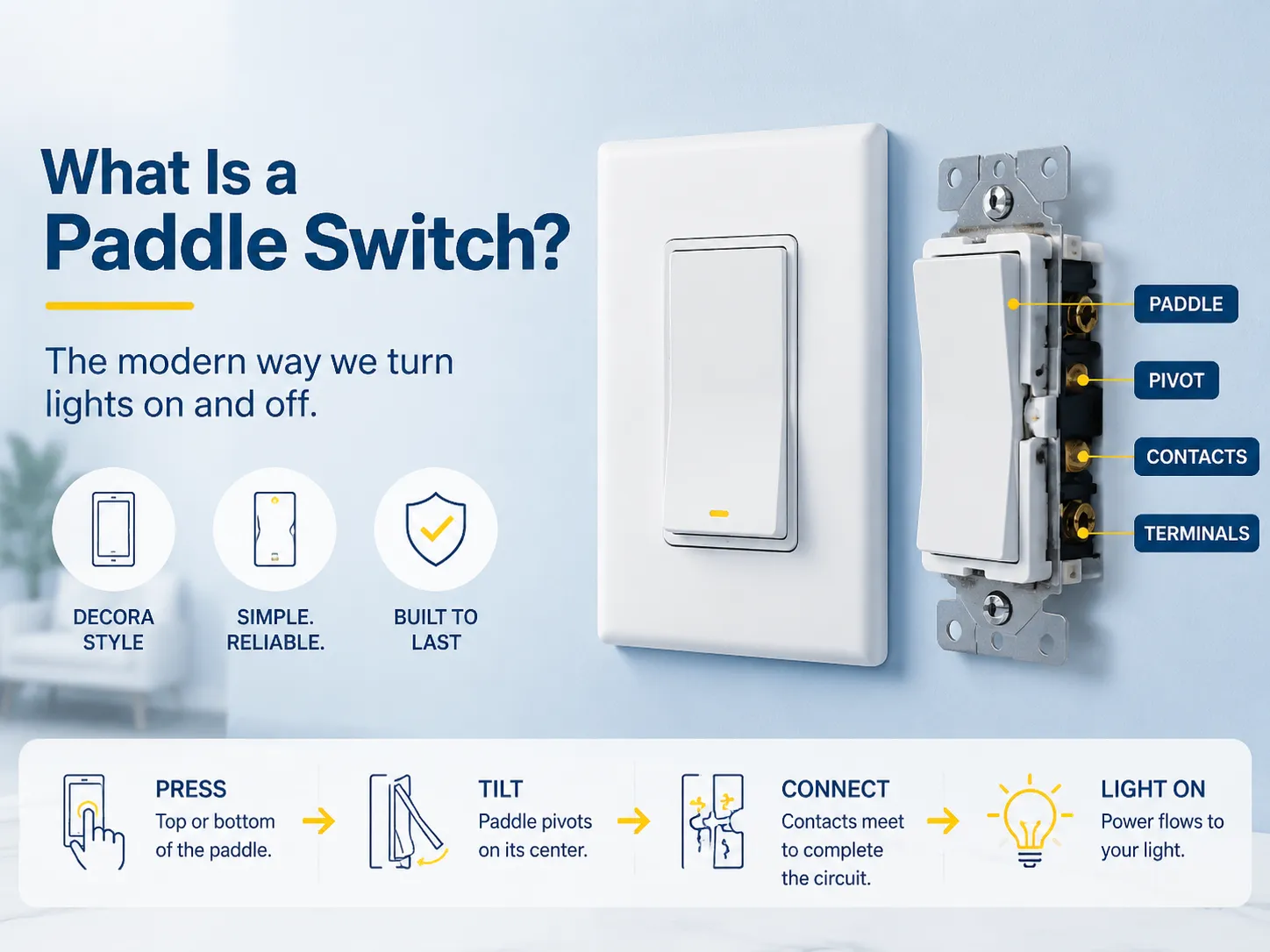
Il y a un mécanisme très simple enfermé dans le boîtier en plastique — c'est essentiellement une bascule qui fonctionne comme suit :
- Chaque fois que vous appuyez sur le bord supérieur de la palette, elle pivote autour du point d'appui au centre du boîtier.
- Le mouvement de pivotement provoque la poussée de l'actionneur interne ou, alternativement, le déplacement direct du bras de contact à ressort vers la borne fixe.
- Le contact mobile (un petit bouton en argent ou en alliage d'argent) exerce une pression contre la borne de contact fixe.
- À ce stade, le circuit est fermé et l'électricité passe de la borne d'alimentation à la borne de charge, faisant briller la lumière.
- La palette, grâce au ressort de verrouillage, peut maintenir sa position jusqu'à ce qu'elle soit pressée à nouveau (cela s'appelle un interrupteur à verrouillage/maintenu).
Lorsque l'autre extrémité de la palette est poussée, le processus s'inverse et le circuit s'ouvre. Le fait le plus important concernant ce mécanisme est qu'il a un déclic — au moment où le contact ouvre le circuit, il n'autorise pas d'arc électrique, ce qui fait que les interrupteurs à palette de haute qualité ont un fonctionnement très net et durent des années.
Palette vs Bascule : Les différences clés
| Caractéristique | Palette (Rocker) | Bascule (Levier traditionnel) |
|---|---|---|
| Surface de commande | Large palette plate | Petit levier saillant |
| Action | Appuyez sur une extrémité ; bascule | Basculer vers le haut/bas |
| Facilité d’utilisation | Facile — frapper avec la paume, le coude, le genou | Nécessite une précision des doigts |
| Apparence | Moderne, affleurant, lignes épurées | Traditionnel, saillant |
| Style de plaque | Ouverture rectangulaire “ décorateur ” | Découpe ronde pour bascule |
| Accessibilité | Mieux adapté pour une dextérité limitée | Plus difficile à utiliser d'une seule main en cas d'arthrite |
| Prix typique | $2-$8 basique | $2-$6 basique |
| Disponibilité | Domine la construction neuve | Courant dans les maisons anciennes, certains préfèrent l'esthétique |
En fin de compte, tout dépend de la préférence et de la facilité d'utilisation : les palettes sont plus faciles à utiliser et ont un aspect plus moderne ; les bascules ont un aspect et une sensation plus traditionnels que beaucoup apprécient. En termes de fonctionnement, les deux sont essentiellement identiques au niveau du circuit électrique interne — la différence réside dans leur utilisation et leur forme.
Types d'interrupteurs à palette
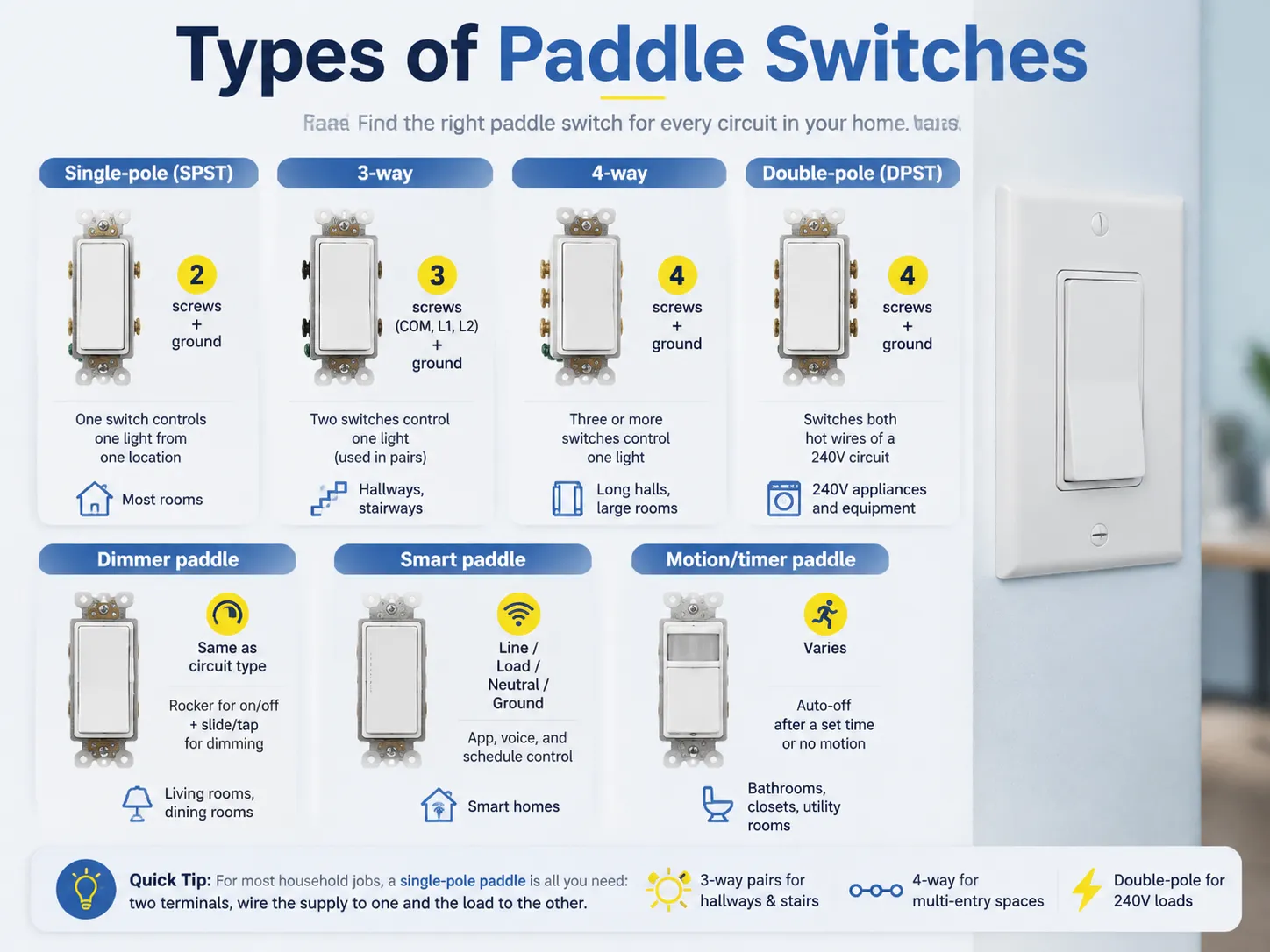
Les interrupteurs à palette couvrent tous les types de circuits que l'on trouve dans une maison. Les bornes indiquent lequel vous avez :
| Type | Bornes | Ce qu'il fait | Utilisation typique |
|---|---|---|---|
| Simple pôle (SPST) | 2 vis + terre | Un interrupteur commande une lumière depuis un seul emplacement | La plupart des pièces |
| Va-et-vient | 3 vis (COM, L1, L2) + terre | Deux interrupteurs commandent une lumière (utilisés par paires) | Couloirs, escaliers, pièces avec deux entrées |
| Interrupteur va-et-vient à 4 fils | 4 vis + terre | Trois interrupteurs ou plus commandent une lumière | Longs couloirs, grandes pièces |
| Double-pôle (DPST) | 4 vis + terre | Interrupteurs les deux fils sous tension d’un circuit 240V | Appareils et équipements 240V |
| Paddle variateur | Même type de circuit | Bascule pour marche/arrêt + glissière/touche pour variation | Salons, salles à manger |
| Paddle intelligent | Ligne/charge/neutre/terre | Contrôle par application, voix et programmation | Maisons intelligentes |
| Paddle détecteur/montre | Variable | Arrêt automatique après un temps défini ou absence de mouvement | Salles de bains, placards, buanderies |
La plupart des tâches domestiques nécessitent un interrupteur unipolaire : connectez l’électricité à une des deux bornes et les appareils à l’autre borne. Pour les couloirs et escaliers, les interrupteurs va-et-vient sont indiqués, tandis que les zones avec plusieurs entrées nécessitent des mécanismes à 4 fils, et les appareils 240V nécessitent des interrupteurs double-pôle.
Comment savoir si c’est marche ou arrêt ?
Sur un interrupteur paddle, il y a une norme inscrite sur la bascule : ‘I’ signifie MARCHE et ‘O’ signifie ARRÊT (symboles de puissance IEC 60417). Si vous appuyez sur le côté “I” de l’interrupteur, il s’allume ; si vous appuyez sur le côté “O”, il s’éteint.
- En interprétant les paddles sans étiquettes, le côté enfoncé indique la position MARCHE : si le bas de la bascule est enfoncé, l’interrupteur est en MARCHE.
- En plus des paddles avec marquages imprimés, il peut y avoir des paddles éclairés avec une lumière blanche indiquant l’état MARCHE ou ARRÊT. Dans ce cas, certaines lumières néon s’allument lorsque la bascule est en ARRÊT, il est donc très important de vérifier l’étiquette.
- Il est important de noter qu’il ne faut jamais faire d’hypothèses avec un interrupteur sans étiquette. Il est conseillé de vérifier l’état de la lampe ou du compteur et de couper l’alimentation avant de travailler sur la bascule.
Une astuce simple à retenir : grâce à la forme des lettres, vous pouvez rapidement vous souvenir que ‘I’ correspond à un circuit électrique fermé, tandis que ‘O’ signifie un circuit ouvert.
Comment câbler un interrupteur paddle
Câbler un interrupteur paddle unipolaire classique est une procédure simple mais assurez-vous des mesures de sécurité :
- D’abord, coupez l’alimentation au disjoncteur et vérifiez qu’elle est coupée avec un testeur de tension avant toute intervention.
- Identifiez le fil de ligne venant de la source d’alimentation et le fil de charge allant vers la lumière.
- Connectez le fil de ligne à une borne laiton et le fil de charge à l’autre borne respectivement. Le câblage n’a pas d’importance pour un interrupteur paddle SPST car il est symétrique.
- Connectez le fil de terre à la vis verte.
- Serrez les vis, placez les fils dans la boîte, et installez l’interrupteur sur la plaque.
- Dans le cas d'un interrupteur à bascule 3 voies, le fil commun doit être connecté à la borne COM et les deux autres fils voyageurs doivent aller respectivement à L1 et L2. Assurez-vous de connecter exactement de la même manière que l'ancien interrupteur avant de le remplacer. (Il est conseillé de prendre une photo du câblage précédent pour référence.) Dans le cas d'un interrupteur à bascule intelligent, vous aurez besoin d'un fil neutre allant à la boîte d'interrupteur, d'une boîte arrière plus profonde et de l'application pour interrupteur à bascule intelligent pour l'installation.
Pour les lecteurs du Royaume-Uni/UE : la logique est la même mais les couleurs sont différentes où le marron est la phase, le bleu est le neutre (lorsqu'il est commuté en phase), et le jaune-vert est la terre (COM=L1=L2).
Un interrupteur à bascule est-il un interrupteur de sécurité mort ?
Non, un interrupteur à bascule n'est pas le même qu'un interrupteur de sécurité mort. Ces deux interrupteurs ont le mot “ interrupteur ” dans leur nom, ce qui crée une confusion pour beaucoup de personnes. Cependant, ils sont fondamentalement différents.
| Caractéristique | Interrupteur à bascule | Interrupteur de sécurité mort |
|---|---|---|
| Type | Verrouillage (maintenu) | Momentané (retour par ressort) |
| État | Reste allumé/éteint jusqu'à ce qu'il soit pressé à nouveau | Actif uniquement lorsqu'il est pressé/maintenu |
| Utilisation typique | Éclairages, appareils, commande murale | Verrouillages de sécurité, machines (poignée de tondeuse, scies), commandes de treuil |
| Fonction de sécurité | Aucune intrinsèque | Arrête la machine lorsque l'opérateur lâche prise |
Un interrupteur de sécurité mort-man fonctionne comme un dispositif de sécurité conçu pour tomber en panne de manière sûre : lorsque l'opérateur cesse son action, l'appareil s'arrête également. Entre-temps, les interrupteurs à palette murale sont des types d'appareils destinés à la commodité — touchez-le une fois et il reste enfoncé.
Applications courantes et lieux d'utilisation
Les professionnels de la construction et de la rénovation ont choisi les interrupteurs à palette comme premier choix pour leur efficacité et leur apparence soignée :
- Interrupteurs muraux résidentiels – la norme dans la plupart des maisons modernes en Amérique du Nord, mais devenant une option fréquente dans d'autres régions du monde.
- Espaces commerciaux et bureaux – palettes de style design avec capteurs et minuteries dans les toilettes et les salles de conférence.
- Conception accessible – grandes palettes permettant une utilisation plus facile à une main.
- Hôtels et hôtellerie – plaques de palette soignées, disponibles avec charges USB et variateurs.
- Maisons intelligentes — interrupteurs à palette intelligents (Wi-Fi, Zigbee, Z-Wave) offrant contrôle par application et vocal tout en conservant la palette physique familière — comme le interrupteur d'éclairage intelligent Tuya/Zigbee 2-gangs, qui montre comment l'interface classique à bascule se transpose aux appareils connectés.
Marques, prix et spécifications
Les interrupteurs à palette sont des dispositifs peu coûteux et universellement disponibles :
| Type | Prix typique |
|---|---|
| Palette monopolaire basique | $2-$8 |
| Palette 3 voies / 4 voies | $3-$10 |
| Palette illuminée | $5-$12 |
| Variateur à palette | $15-$40 |
| Palette à détection de mouvement | $15-$35 |
| Palette intelligente (Wi-Fi/Zigbee) | $15-$50 |
Caractéristiques qui distinguent une bonne palette d'une bon marché :
- Marques de certification — par ex. UL/ETL (pour les États-Unis), ENEC/CE (pour l'UE), ou équivalent sur votre marché local.
- Contacts en alliage d'argent — Pas de cuivre nu ou d'acier qui provoquerait des arcs ou des piqûres.
- Cran ferme — doit produire un son clair lorsque la palette change d'état.
- Doit être classé pour la charge maximale — par exemple, 15A/120V ou 10A/250V.
- Bornes fiables — de type vis ou à connexion rapide pouvant saisir le fil solidement.
Parmi les grandes marques figurent des entreprises telles que Leviton (pionnier de Decora), Lutron (spécialisé dans les variateurs et palettes intelligentes), Eaton, Pass & Seymour (Legrand), Hubbell, ainsi que des marques discount comme BG, GE, TopGreener, ENERLITES, ainsi que des marques de technologie intelligente telles que TP-Link Kasa et Lutron Caseta. Pour les programmes OEM et de gros, des fabricants certifiés comme les principaux fabricants mondiaux de dispositifs de câblage fournissent des palettes de style décorateur sur les marchés.
Questions fréquemment posées
Que font les interrupteurs à palette ?
Un interrupteur à palette est un type d'interrupteur qui fonctionne en utilisant une palette. Appuyez sur la palette dans une direction pour allumer la lumière et dans la direction opposée pour l'éteindre. Un interrupteur à palette possède un mécanisme de verrouillage qui le maintient en position jusqu'à ce qu'il soit pressé à nouveau. Les interrupteurs à palette peuvent être transformés en minuteries, variateurs, détecteurs de mouvement et autres interrupteurs intelligents.
Quelles sont les différences entre un interrupteur à bascule et un interrupteur à palette ?
La distinction principale réside dans l'interface : un toggle possède un petit bouton qui peut être déplacé verticalement, tandis qu'un paddle a une large surface horizontale qui bascule d'avant en arrière. L'opérabilité des paddles est bien supérieure à celle des toggles car les paddles peuvent être actionnés avec la paume, le coude ou le genou ; de plus, ils ont un aspect plus moderne et correspondent aux plaques décoratives rectangulaires, tandis que les toggles ont un mécanisme bien connu et un mouvement physique de bascule. Le fonctionnement interne des deux types d'interrupteurs est le même : mêmes contacts et même type de circuit. Les paddles sont largement utilisés dans les maisons neuves ; les interrupteurs sont encore utilisés pour la rénovation.
Comment fonctionne un paddle switch ?
De la même manière qu'une balançoire fonctionne, un paddle switch fonctionne ; en appliquant une force à l'une des extrémités, le paddle bascule autour de son point de pivot central, faisant qu'un bras de contact contenant un ressort appuie contre la borne de contact, fermant ainsi le circuit. En poussant de l'autre côté, le contact s'éloigne de la borne et le circuit s'ouvre. Un ressort de retenue sécurise le paddle en place.
Un paddle switch est-il un interrupteur de sécurité mort-man ?
Un paddle switch est un interrupteur qui peut être verrouillé en position “ on ” ou “ off ” — il y restera jusqu'à ce qu'il soit pressé à nouveau. L'interrupteur de sécurité mort-man est un interrupteur momentané avec mécanisme à ressort, qui est en position “ active ” uniquement lorsque l'opérateur le pousse — arrêtant immédiatement la machine lorsqu'il est relâché (par exemple, opérateur de tondeuse ou de treuil). Bien que la fonction d“” interrupteur » soit la même dans les deux cas, les implications de leur application sont très différentes.
Références
- NFPA 70 — National Electrical Code (NEC), Article 404 Interrupteurs
- UL — UL 61058 Interrupteurs pour appareils / UL 20 Interrupteurs à usage général
- IEC 60669 — Interrupteurs pour installations électriques fixes domestiques et similaires
- Leviton — Gamme de produits Decora Paddle Switch
- Lutron — Produits Paddle Dimmer et Smart Switch
- ADA — Directives pour commandes opérables (accessibilité Rocker/Paddle)
Conclusion
Le paddle switch sert de version avancée de l'interrupteur mural : un large levier rectangulaire qui pivote pour interrompre ou compléter le circuit via un contact actionné par ressort. Une fois pressé, il se verrouille et reste en place — une pression pour allumer, une autre pour éteindre. Il est très pratique comparé aux toggles car ils ont un aspect plus propre lorsqu'ils sont montés sur des plaques murales décoratives, et les interrupteurs sont disponibles pour de nombreux types de circuits et diffèrent des interrupteurs qui sont simplement associés à des variateurs, détecteurs de mouvement et conceptions intelligentes. Le paddle switch est complètement différent de l'interrupteur de sécurité mort-man. Le câblage d'un paddle switch simple unipolaire prend peu de temps, mais lors de l'achat de l'interrupteur, vous devez prêter attention à sa certification, ses contacts en argent et son arrêt positif. Pour la famille plus large des types d'interrupteurs et la logique de câblage qui les sous-tend, nos guides sur le quatre types d’interrupteurs d’éclairage, remplacer un interrupteur d'éclairage, et le câblage des interrupteurs intelligents couvrent tout le reste que vous rencontrerez dans la boîte murale.