Après l'achat d'un variateur, vous vous demandez peut-être s'il peut être connecté à toutes les lumières de votre maison. La réponse est non, et tenter de le faire à tort peut entraîner des scintillements, des bourdonnements, voire endommager les unités d'éclairage. La bonne nouvelle est qu'une fois que vous savez quoi rechercher, il est facile de déterminer si vos lumières sont compatibles avec le variateur.
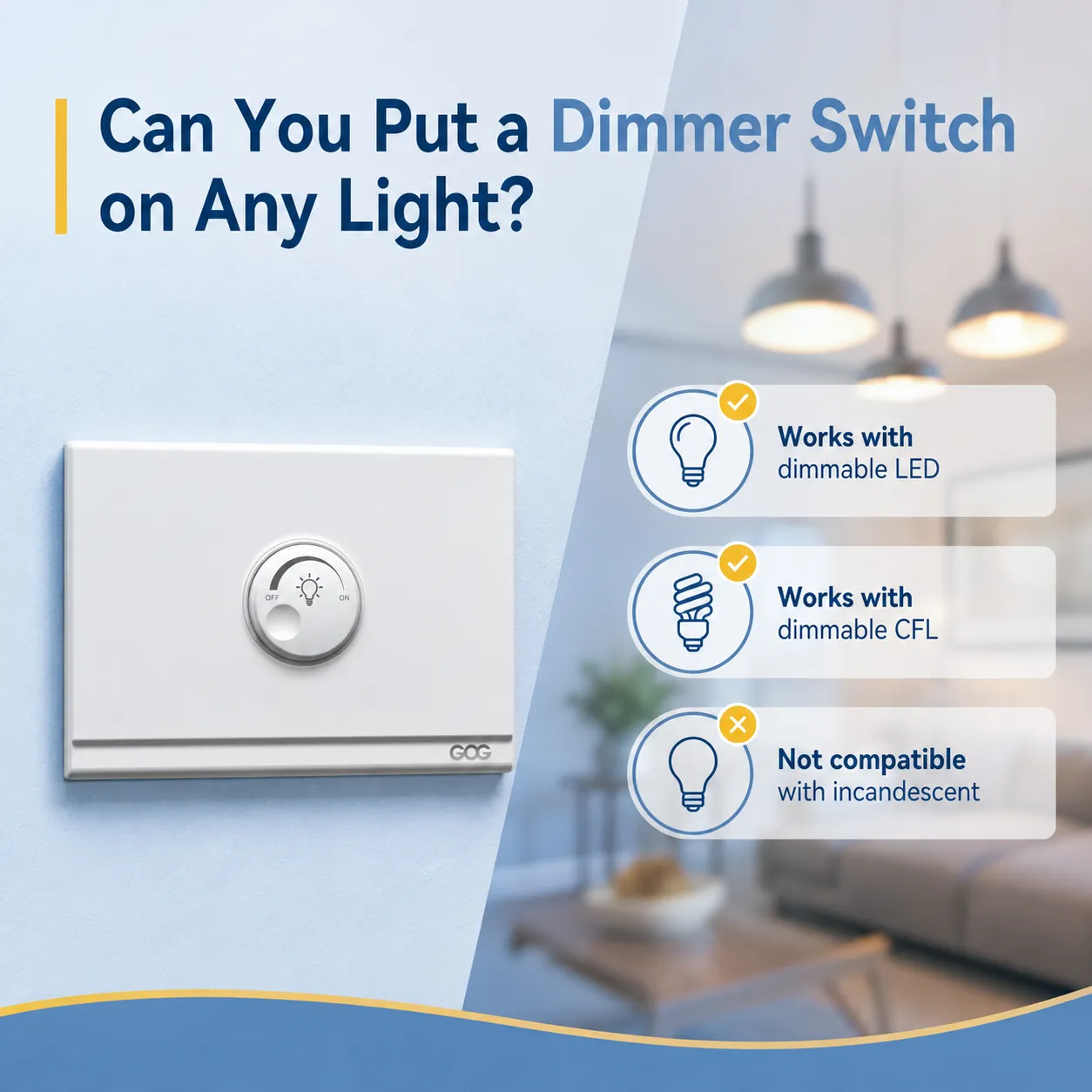
Réponse rapide : Il est impossible de graduer tous les types d'ampoules. Les ampoules à incandescence et halogènes peuvent être gradées. Pour les ampoules LED et CFL, il doit être indiqué si elles sont dimmables. Pour les ampoules fluorescentes, un ballast spécial doit être utilisé pour graduer les lumières. En cas d'utilisation d'ampoules intelligentes (par exemple, Philips Hue) avec gradation intégrée, il faut éviter le variateur mural et utiliser l'application à la place.
Quels types d'ampoules fonctionnent avec les interrupteurs variateurs ?
Toutes les ampoules ne sont pas compatibles avec les variateurs. Dans cet article, vous découvrirez les différents types de lumières que vous pouvez utiliser avec des interrupteurs variateurs.
Incandescence et Halogène : Universellement dimmables
Les ampoules comme les halogènes et les incandescentes peuvent facilement être gradées et fonctionnent avec presque tous les types de variateurs disponibles sur le marché. Ainsi, si vous avez des ampoules à incandescence, vous pouvez utiliser ces lumières avec des interrupteurs de gradation.
Les variateurs peuvent supporter une charge de 600 watts lorsqu'ils sont utilisés avec des ampoules à incandescence, ce qui signifie que vous pouvez utiliser entre six et dix ampoules à incandescence simultanément. Une mise en garde : vous devez toujours vérifier la puissance totale avant d'acheter des variateurs pour ces lumières. Notre guide sur si toutes les ampoules à incandescence sont dimmables couvre les détails.
Ampoules LED : uniquement si étiquetées “ dimmable ”
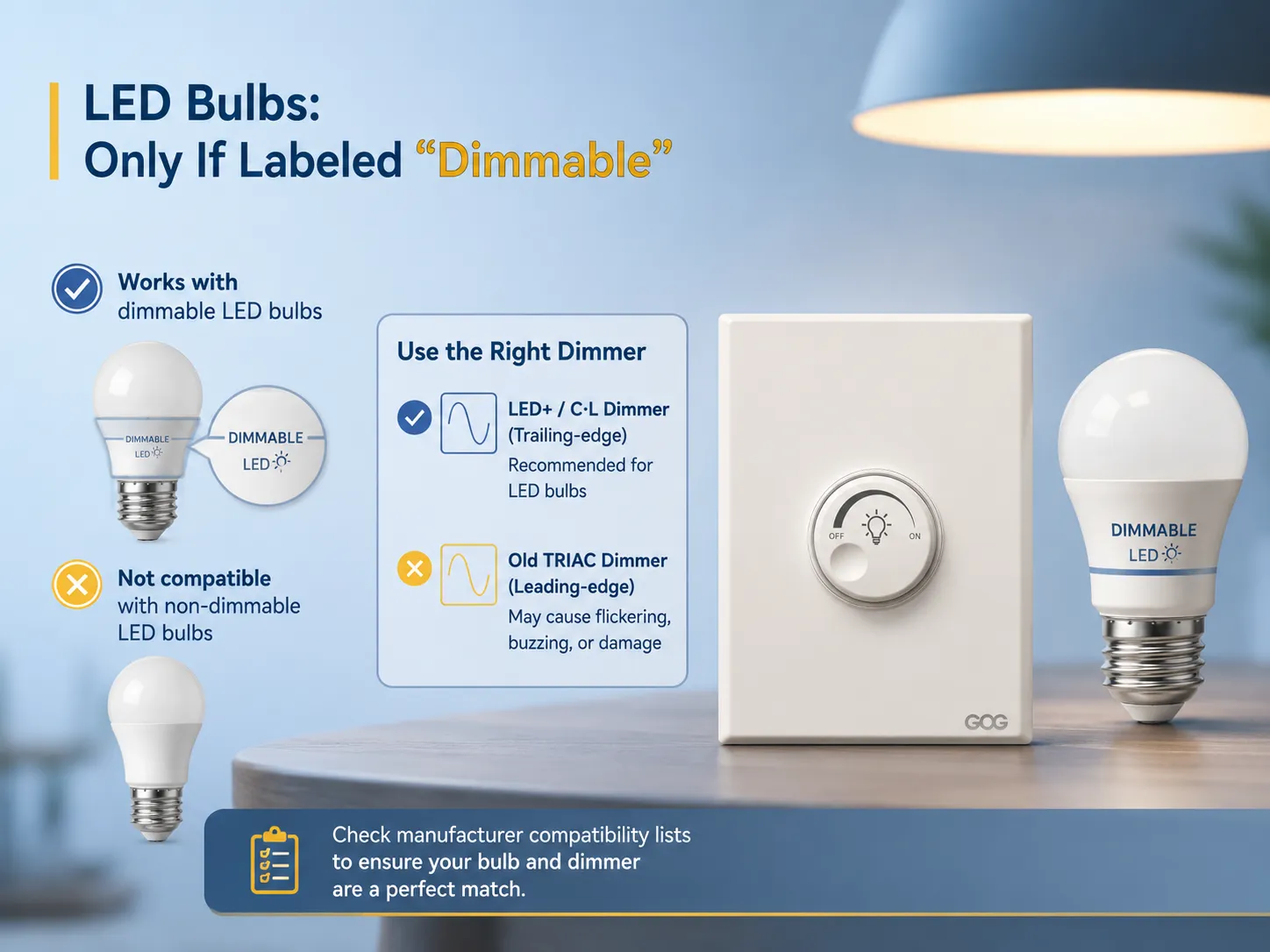
La majorité des utilisateurs rencontrent des difficultés dans ce processus. Les ampoules LED ne sont pas dimmables par nature. Seuls les luminaires marqués “ dimmable ” peuvent fonctionner avec un variateur. Utiliser une LED dimmable avec des variateurs standards peut provoquer un scintillement de l'ampoule et même la griller.
Les lumières LED dimmables existent, cependant, il est important de se rappeler que tous les variateurs ne sont pas compatibles avec elles. Les anciens variateurs basés sur TRIAC, également appelés variateurs à avance de phase, ont été conçus pour alimenter des lumières à incandescence et ne fonctionnent pas avec la faible consommation des ampoules LED. Les variateurs innovants compatibles avec les LED sont généralement appelés variateurs LED+ ou variateurs C·L. Pour une analyse complète, consultez notre guide de compatibilité des interrupteurs variateurs LED.
Philips Lighting et d'autres grands fabricants publient des listes de compatibilité des variateurs afin que vous puissiez vérifier qu'une paire ampoule-variateur spécifique a été testée ensemble. En cas de doute, consultez le site du fabricant avant d'acheter. Si vous êtes déjà en train de chercher le bon interrupteur, notre sélection de meilleur interrupteur gradateur pour lumières LED peut vous aider à affiner vos options.
Ampoules CFL : rarement dimmables dès la sortie de la boîte
Les ampoules fluorescentes compactes ordinaires (CFL) ne peuvent pas être facilement gradées. Bien que certains types de CFL soient dimmables, ils deviennent rares en raison de l'acceptation croissante des LED. Si vous avez des supports pour lampes CFL, vous pouvez également utiliser des ampoules LED puisqu'elles sont dimmables.
Luminaires à tubes fluorescents : Nécessitent un ballast dimmable
Les luminaires à tubes fluorescents (T8, T5, T12) peuvent être dimmés, mais uniquement si un ballast électronique dimmable est utilisé. Habituellement, les luminaires fluorescents pour usage personnel sont équipés de ballasts non dimmables. Bien qu'il soit possible de remplacer le ballast par un modèle dimmable, ce travail est souvent réalisé par un électricien utilisant une option de gradation adaptée aux systèmes fluorescents (généralement une gradation 0-10V).
Luminaires LED intégrés : Vérifiez le driver
Les luminaires tels que les plafonniers, les spots encastrés et les lampes LED sans possibilité de changer l’ampoule sont considérés comme dimmables uniquement si le driver de la lampe possède cette fonctionnalité. Pour en savoir plus sur cette caractéristique, consultez la fiche technique du produit ou recherchez “ dimmable ” dans la description. Si le driver ne permet pas la gradation, le luminaire complet doit être remplacé, car un variateur externe ne pourra pas résoudre le problème.
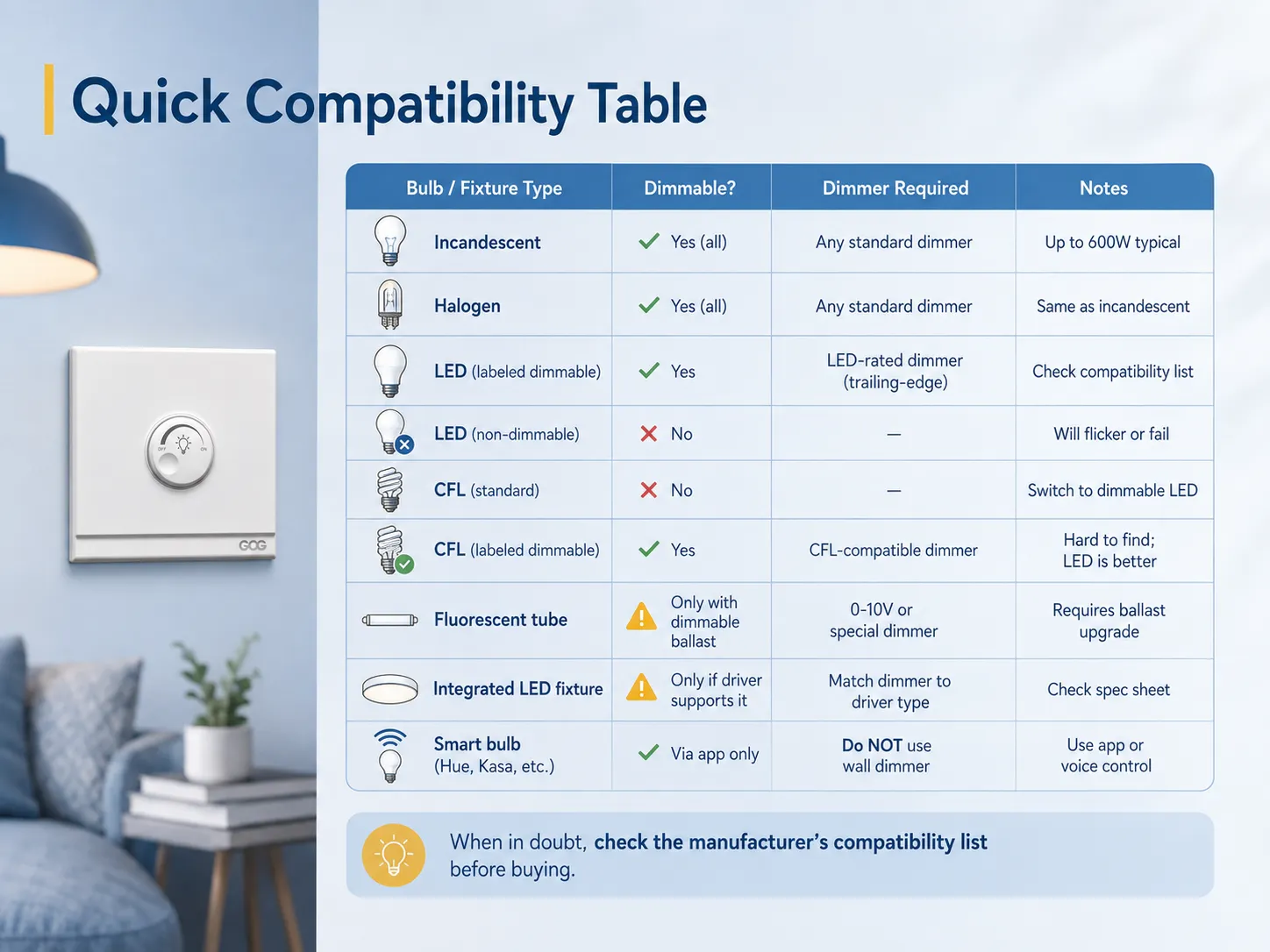
Tableau de compatibilité rapide
| Type d’ampoule / luminaire | Dimmable ? | Variateur requis | Notes |
|---|---|---|---|
| Incandescent | Oui (tous) | Tout variateur standard | Jusqu’à 600W typique |
| Halogène | Oui (tous) | Tout variateur standard | Même que l’incandescent |
| LED (étiquetée dimmable) | Oui | Variateur compatible LED (à coupure en fin de phase) | Vérifiez la liste de compatibilité |
| LED (non dimmable) | Non | — | Va scintiller ou ne pas fonctionner |
| CFL (standard) | Non | — | Passez à une LED dimmable |
| CFL (étiquetée dimmable) | Oui | Variateur compatible CFL | Difficile à trouver ; la LED est préférable |
| Tube fluorescent | Seulement avec ballast dimmable | Variateur 0-10V ou spécial | Nécessite une mise à niveau du ballast |
| Luminaire LED intégré | Seulement si le driver le supporte | Associer le variateur au type de driver | Vérifier la fiche technique |
| Ampoule intelligente (Hue, Kasa, etc.) | Via l’application uniquement | NE PAS utiliser de variateur mural | Utiliser l’application ou la commande vocale |
Quand vous ne pouvez pas installer un interrupteur variateur
Bien que les bonnes ampoules puissent être présentes, il existe des cas où l’installation d’un interrupteur variateur ne serait pas sûre ou pratique. Voici quelques situations dans lesquelles vous pourriez ne pas vouloir installer un interrupteur variateur.
Puissance totale faible
De nombreux variateurs (en particulier les plus anciens) nécessitent une charge suffisante pour permettre un fonctionnement efficace. Par exemple, si un circuit est équipé d’une ou deux petites LED seulement (comme 2 ampoules de 9W), il se peut que la charge sur le variateur ne soit pas suffisante pour assurer son bon fonctionnement. Vous pouvez alors constater un scintillement des lumières ou des allumages/extinctions à faible luminosité.
Les variateurs modernes compatibles avec les LED ne présentent pas ce problème car ils supportent des charges plus faibles (certains nécessitent seulement 3W), mais il faut toujours vérifier les spécifications. Si votre charge est inférieure à celle requise, essayez d’ajouter des ampoules supplémentaires dans le circuit ou trouvez un variateur compatible avec une charge LED plus faible.
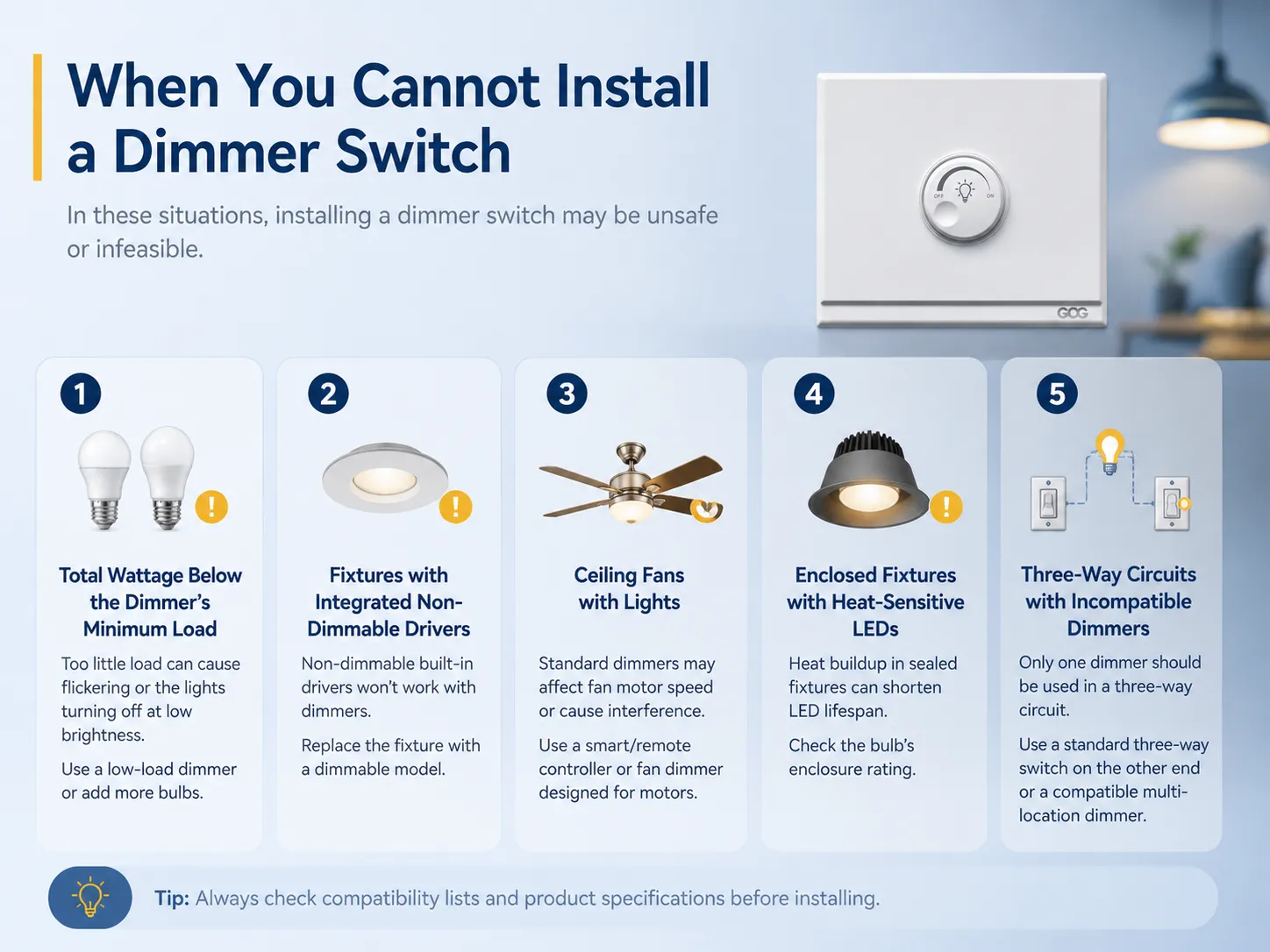
Appareils avec drivers non dimmables intégrés.
Certains appareils, notamment les spots encastrés, les éclairages sous comptoir et les rails d’éclairage, sont déjà équipés de drivers non dimmables. Quel que soit le variateur utilisé, vous ne pourrez pas varier l’intensité de ces appareils. La seule solution est de remplacer l’appareil par un modèle dimmable proposé.
Ventilateurs de plafond avec éclairage.
Les ventilateurs de plafond avec éclairage ne sont généralement pas dimmables avec des variateurs traditionnels. En effet, les moteurs du ventilateur et des luminaires sont interconnectés, ce qui empêche le bon fonctionnement des variateurs. Pour varier la lumière au-dessus du ventilateur, il faut utiliser une télécommande spéciale ou un dispositif intelligent pour ventilateur qui assure la connexion correcte des lumières et du ventilateur. Pour changer correctement la vitesse du ventilateur, il faut utiliser une télécommande spécialement conçue pour ventilateur.
Appareils fermés avec LED sensibles à la chaleur.
Certaines ampoules LED ne conviennent pas à une utilisation dans des appareils fermés. Leur utilisation avec des variateurs n’est pas interdite, mais cela peut aggraver l’accumulation de chaleur et réduire leur durée de vie. Il est important de vérifier la classification d’étanchéité de l’ampoule LED sélectionnée avant de l’utiliser dans une situation avec variateur.
Circuits à trois voies avec variateurs incompatibles.
En général, il est possible d’installer un seul variateur dans une configuration à trois voies contrôlée par 2 interrupteurs. L’interrupteur doit être un simple interrupteur 3 voies dans ce cas. Cependant, si vous utilisez 2 variateurs dans un tel circuit, vous pouvez rencontrer des problèmes d’interférences sauf si vous utilisez des variateurs multi-emplacements spéciaux, tels que le Lutron Maestro.
Types d’interrupteurs variateurs : rotatif, tactile, coulissant et intelligent
Choisir le bon style de variateur ne se limite pas à l’esthétique — différents types offrent différents niveaux de contrôle et de fonctionnalités. Si vous souhaitez un aperçu plus complet, notre guide sur types d’interrupteurs d’éclairage couvre toute la gamme d’options disponibles.
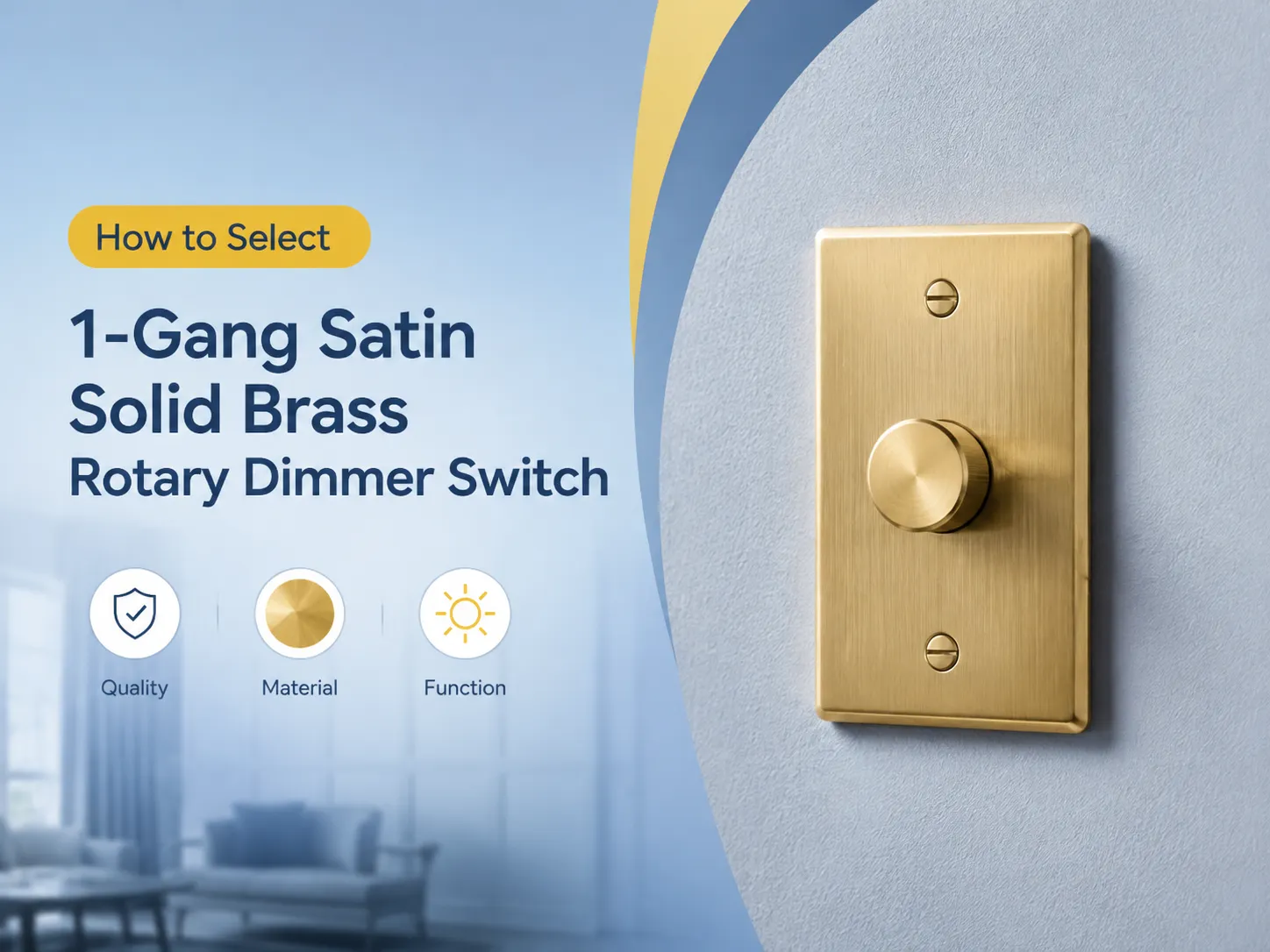
Variateurs rotatifs (bouton)
Le variateur rotatif traditionnel utilise un bouton rotatif pour modifier la luminosité de l’éclairage. Ce type est simple, fiable, et fonctionne avec de nombreuses catégories d’ampoules tant qu’elles sont compatibles LED. Certains variateurs rotatifs disposent d’une fonction poussoir marche/arrêt permettant au bouton de faire office d’interrupteur. Un bon exemple est le ELEGRP Digital Rotating Dimmer qui peut supporter une charge LED de 150W et une charge incandescente de 600W sans besoin de fil neutre.
Idéal pour une utilisation dans les chambres, salles à manger, et partout où une opération facile et intuitive est préférée.
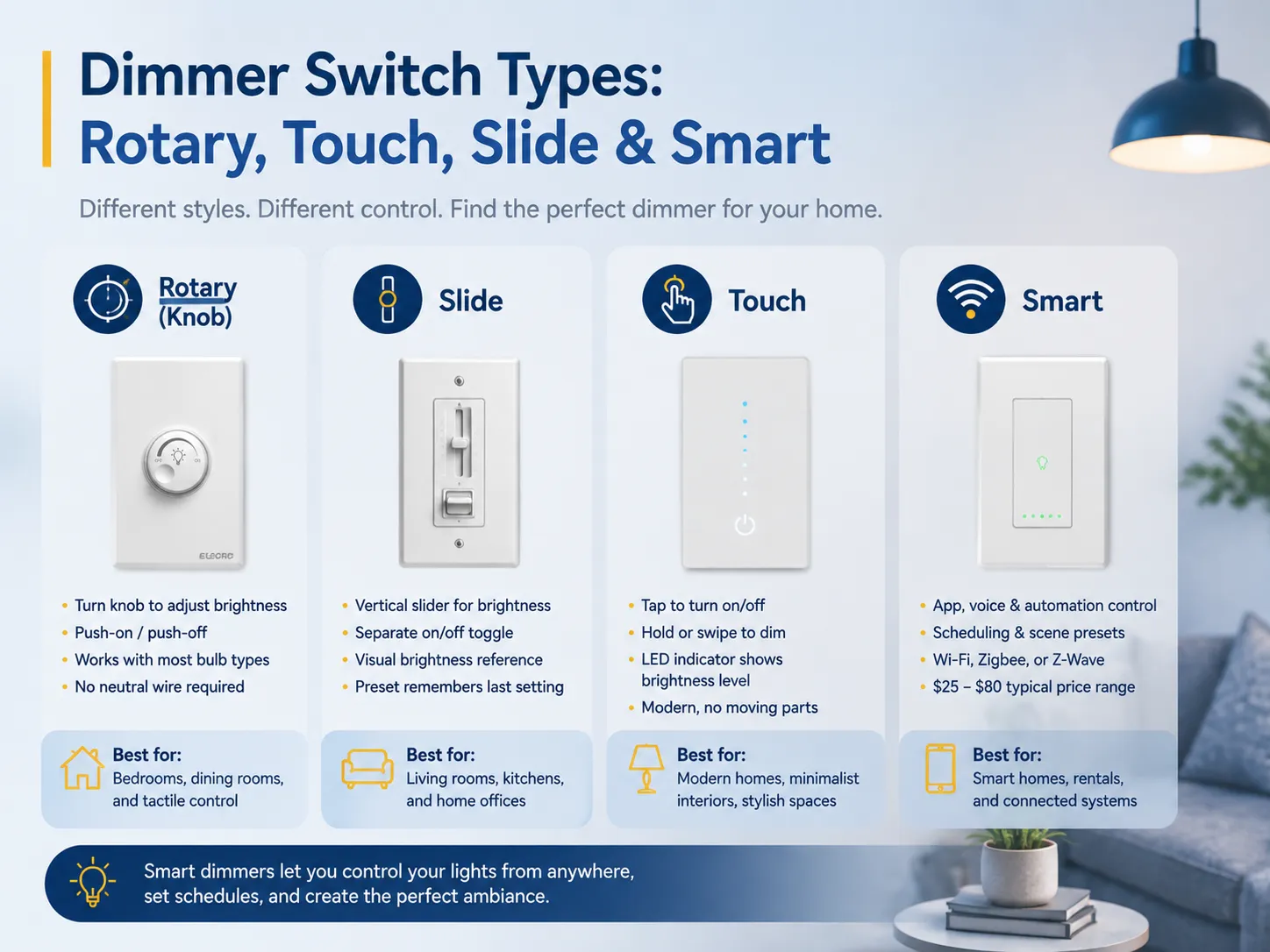
Variateurs à glissière
Les variateurs à commande utilisent un curseur vertical pour réguler la luminosité, associé à un interrupteur à bascule supplémentaire pour allumer/éteindre les lumières. Le fonctionnement est simple et offre une indication visuelle claire du niveau de luminosité. Plusieurs modèles sont équipés de préréglages nécessaires qui conservent les paramètres.
Idéal pour : Des lieux comme les salons, cuisines, et bureaux à domicile où l’éclairage change fréquemment.
Variateurs tactiles
Les variateurs tactiles sont une évolution des variateurs à glissière grâce à un design moderne et l’absence de pièces mobiles. Vous appuyez sur le bouton pour allumer/éteindre et maintenez pour ajuster les niveaux de luminosité. Avec de nombreux modèles dotés d’indicateurs de réglage de lumière, les variateurs tactiles gagnent en popularité dans les intérieurs modernes.
Idéal pour : Maisons élégantes, intérieurs minimalistes, et tout espace où l’esthétique est primordiale.
Variateurs intelligents
Les variateurs intelligents sont connectés à votre réseau domestique via Wi-Fi, Zigbee ou Z-Wave et peuvent être contrôlés via une application smartphone, un assistant vocal ou une automatisation. Parmi les variateurs intelligents les plus courants figurent Lutron Caséta, TP-Link Kasa, et Leviton Decora Smart. Le coût de ces variateurs intelligents varie de $25 à $80, selon les fonctionnalités offertes. Pour plus d’options produit, consultez notre sélection des meilleurs variateurs dans toutes les catégories.
Avantage principal : L’avantage des variateurs intelligents est que vous pouvez régler la lumière sans être à l’interrupteur. Ils peuvent être programmés pour s’allumer automatiquement à une heure donnée (exemple : les lumières peuvent être réglées pour s’allumer progressivement à 7h dans la chambre).
Idéal pour : Maisons équipées de technologie intelligente, appartements où vous souhaitez contrôler les lumières à distance, et ceux qui créent un système d’éclairage connecté.
| Type de variateur | Gamme de prix | Caractéristique clé | Meilleur pour |
|---|---|---|---|
| Rotatif (bouton) | $10–$25 | Contrôle simple et tactile | Chambres, salles à manger |
| Glissière | $15–$35 | Référence visuelle de la luminosité | Salons, cuisines |
| Tactile | $20–$45 | Design épuré, sans pièces mobiles | Intérieurs modernes |
| Intelligent (Wi-Fi/Zigbee) | $25–$80 | Contrôle par application + voix | Maisons intelligentes, automatisation |
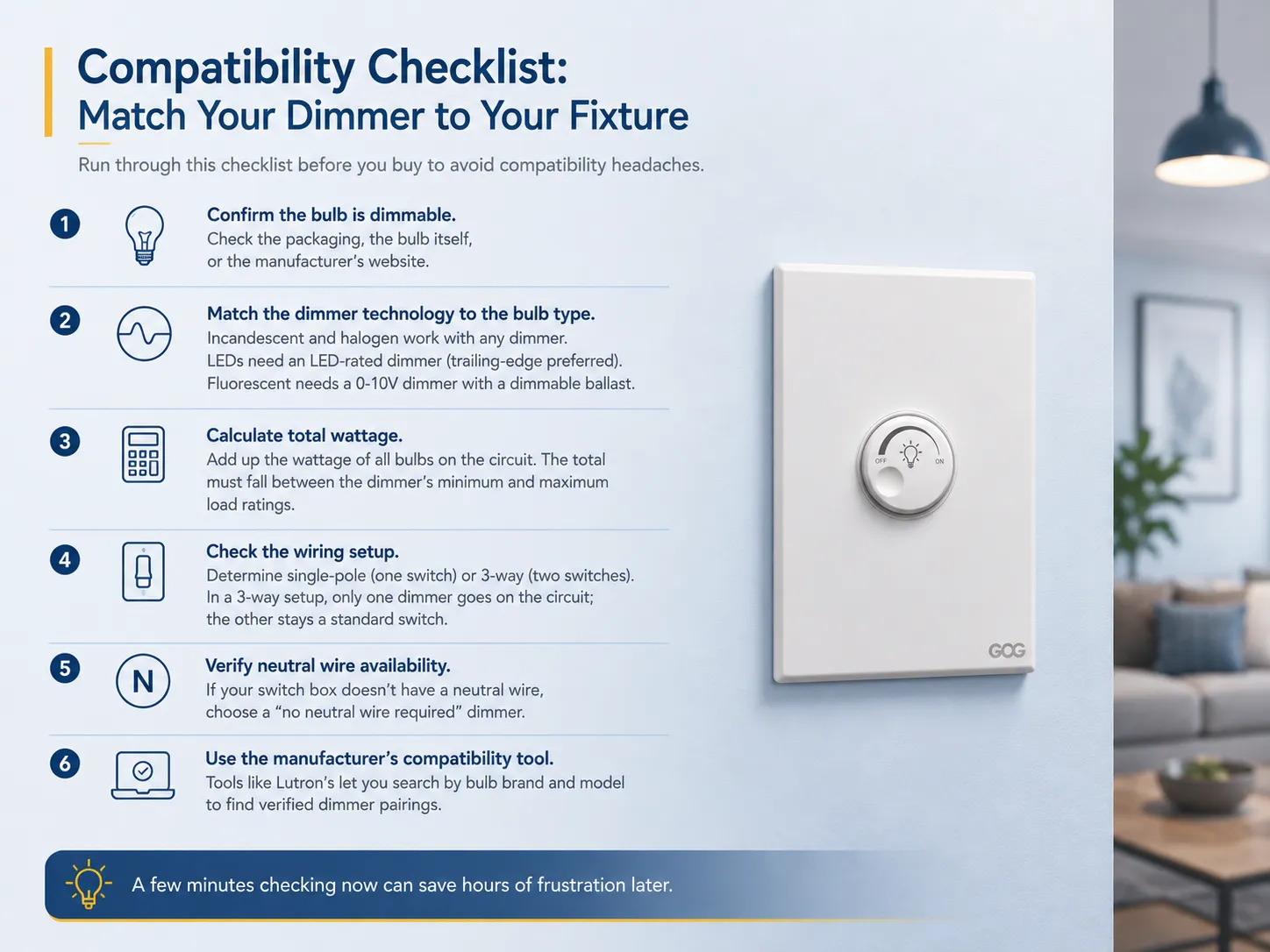
Liste de contrôle de compatibilité : Associez votre variateur à votre luminaire
Avant d’acheter un interrupteur variateur, passez en revue cette liste pour éviter les problèmes de compatibilité.
Assurez-vous que l’ampoule est conçue pour être dimmable. Consultez les informations sur l’emballage, l’ampoule elle-même ou la page web du fabricant. Si aucune de ces sources n’indique qu’elle est dimmable, vous pouvez supposer qu’elle ne l’est pas.
Utilisez une technologie de variateur adaptée au type d’ampoule. Vous pouvez utiliser tout type de dispositif de variation avec des ampoules à incandescence ou halogènes traditionnelles. Cependant, pour les ampoules LED, vous aurez besoin d’un variateur pour ampoules LED (de préférence de type à coupure en fin de phase), tandis que pour les ampoules fluorescentes, vous aurez besoin d’un variateur 0-10V compatible avec un ballast dimmable.
Trouvez la puissance totale. Calculez la puissance pour l’ensemble du circuit en additionnant la puissance de toutes les ampoules. Le total doit se situer dans la plage de la charge minimale et maximale du variateur. Par exemple, si vous avez 6 LED dimmables de neuf watts chacune, soit un total de 54 watts, vous aurez besoin d’un variateur évalué pour 54 watts pour LED, ce qui ne devrait pas poser de problème, car la majorité des variateurs LED ont une charge maximale de 150 watts.
Vérifiez comment le circuit électrique est câblé. Vérifiez si le circuit est unipolaire ou à 3 voies, et achetez le matériel de variation adapté à la configuration correcte. En cas d’installation à 3 voies, il n’y aura qu’un seul variateur par circuit, tandis que l’autre interrupteur reste un interrupteur standard.
Confirmez si un fil neutre est disponible. De nombreuses installations anciennes ne disposent pas d’un fil neutre dans la boîte d’interrupteur, et dans ce cas, il serait judicieux d’acheter un variateur sans fil neutre. La plupart des variateurs LED contemporains créés par des fabricants tels que Lutron, Leviton, ELEGRP, etc. offrent cette option.
Utilisez un outil de compatibilité fourni par le fabricant. Lutron propose un outil de compatibilité qui peut être utilisé pour rechercher par type et marque d’ampoule afin de trouver les variateurs appropriés. C’est la méthode la plus sûre pour garantir que le choix est correct.
Options de mise à niveau : rendre une lumière non dimmable dimmable
Si votre installation actuelle ne supporte pas la variation, vous avez plusieurs options de mise à niveau selon votre budget et votre aisance technique.
Option 1 : Remplacer les ampoules
La mise à niveau la plus simple et la moins coûteuse. Remplacez les ampoules LED ou CFL ordinaires par des ampoules LED dimmables (qui coûtent environ $2-$8 chacune) et installez un interrupteur variateur compatible avec l’ampoule LED ($15-$35). Coût total par luminaire : moins de $45. Cela peut être fait pour tout luminaire ordinaire avec des ampoules amovibles. Si vous avez déjà un variateur mais devez remplacer un ancien interrupteur variateur, le processus est simple.
Option 2 : Utiliser un variateur de lampe à brancher
L’option la plus simple pour graduer des lampes de l’un ou l’autre type est un variateur à brancher qui connecte la fiche de la lampe à la prise murale sans besoin de câblage compliqué. Le variateur à brancher Leviton modèle TBL03-10W est capable de graduer jusqu’à 300W pour les ampoules incandescentes et 150W pour les ampoules LED dimmables, et l’installation est facile et ne prend que quelques secondes. Assurez-vous simplement que votre lampe possède une ampoule dimmable.
Option 3 : Installer un système d’ampoules intelligentes
Si vous recherchez des options d’éclairage dimmables qui ne nécessitent pas d’interrupteur mural, les ampoules intelligentes sont la solution. Des produits tels que les ampoules intelligentes TP-Link Kasa offrent des fonctions de gradation allant de 1% à 100% via une application smartphone ou un assistant vocal. Il n’est pas nécessaire d’avoir un variateur puisque les ampoules intelligentes se connectent directement au Wi-Fi (TP-Link ne nécessite pas de hub contrairement aux ampoules Philips Hue Smart, qui requièrent un pont Hue). La société revendique des économies d’énergie d’environ 80% comparé à l’ampoule incandescente classique de 60W.
Veuillez noter qu’il n’est pas recommandé de combiner des ampoules intelligentes avec un variateur mural, car la gradation est effectuée par l’électronique interne de l’ampoule.
Option 4 : Remplacer le luminaire
Avec des luminaires LED intégrés équipés de drivers non dimmables, la seule option disponible est de remplacer entièrement le luminaire par un modèle avec un driver dimmable. Ce processus peut être assez coûteux (allant de $50 à $250 voire plus par luminaire) et peut également nécessiter l’intervention d’un électricien ; cependant, c’est la seule méthode permettant d’ajouter des capacités de gradation à un panneau LED scellé ou à un éclairage encastré contenant un driver intégré.
Option 5 : Mettre à niveau le ballast (fluorescent)
Si vous utilisez des tubes fluorescents, vous pouvez remplacer le ballast standard par un ballast dimmable et utiliser un variateur compatible 0-10V. Il s’agit d’un processus complexe nécessitant un électricien, mais qui vous offre un contrôle complet sur la gradation des tubes fluorescents dans votre garage, atelier ou poste de travail.
Les variateurs sont-ils adaptés aux installations domotiques ?
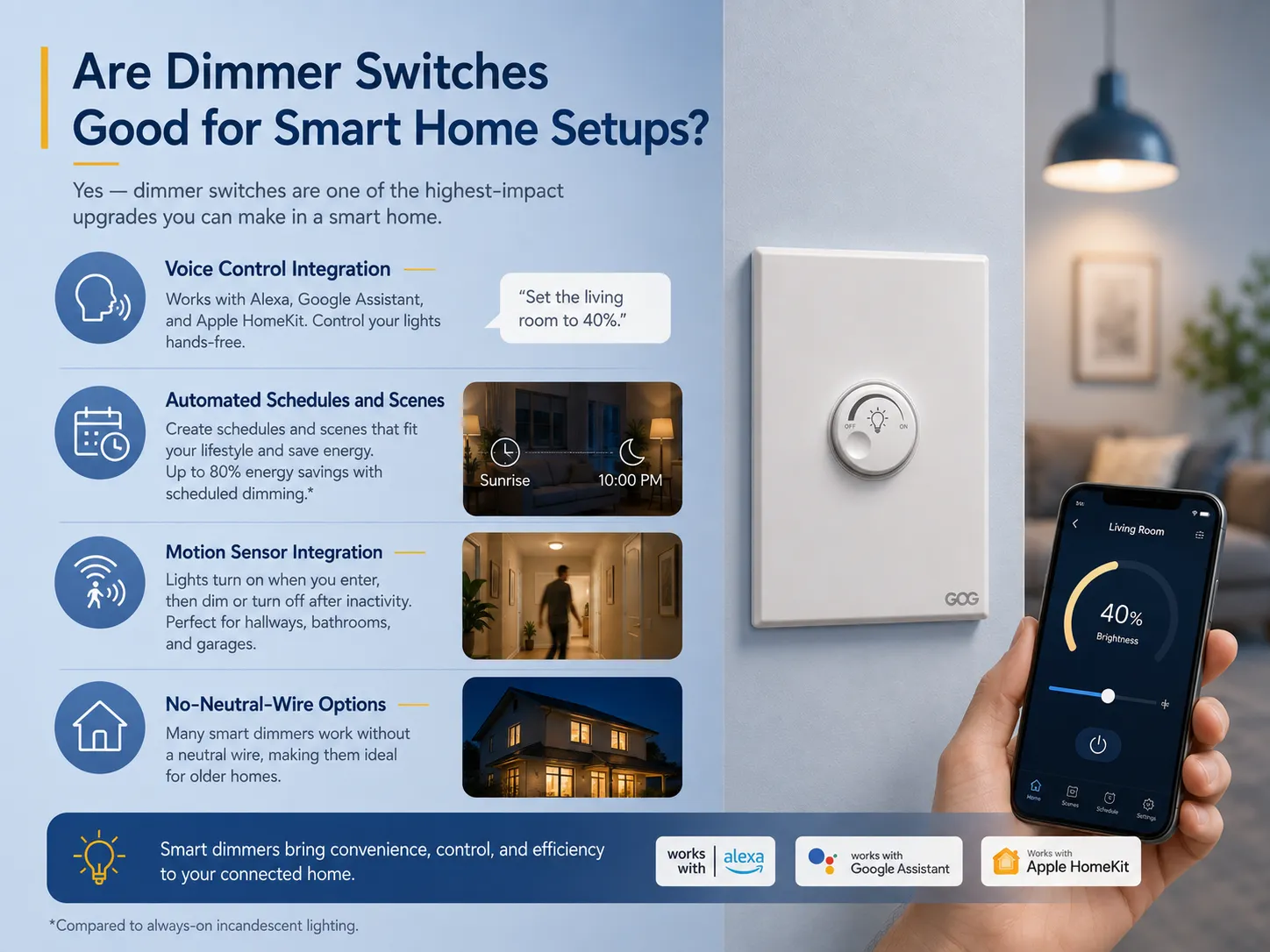
Oui — les variateurs sont l’une des améliorations les plus impactantes que vous puissiez réaliser dans une maison intelligente. Voici pourquoi. Si vous construisez une maison connectée de zéro, consulter les options d’un fabricant d’interrupteurs intelligents dédié peut vous donner une avance sur le matériel compatible.
Intégration du contrôle vocal
Les variateurs intelligents de marques telles que Lutron, TP-Link et Leviton peuvent être utilisés avec Amazon Alexa, Apple HomeKit et Google Assistant. En demandant simplement de ‘ régler la lumière du salon à 40% ’, les lumières s’ajustent instantanément sans avoir à utiliser d’application ou d’interrupteur.
Horaires et scènes automatisés
Les applications de variateurs intelligents permettent à l’utilisateur de définir des horaires (par exemple, les lumières peuvent devenir lumineuses au lever du soleil et être atténuées à 22h) et des scènes (par exemple, un réglage “ Soirée cinéma ” peut atténuer toutes les lumières du salon à 15%). Selon les données produit TP-Link, si la gradation est programmée, il peut y avoir jusqu’à 80% d’économies d’énergie par rapport à l’utilisation continue d’ampoules incandescentes.
Intégration de capteurs de mouvement
Certains variateurs intelligents sont équipés de capteurs de mouvement intégrés ou peuvent être combinés avec des capteurs supplémentaires. Lorsqu'une personne entre dans la pièce, les lumières s'allument, atteignant un certain niveau de luminosité, puis elles s'estompent ou s'éteignent après un certain temps d'inutilisation.
Options sans fil neutre
Plusieurs variateurs intelligents (comme les séries Lutron Caséta et TP-Link Kasa) fonctionnent sans besoin de fils neutres, ce qui permet leur utilisation dans des maisons anciennes où les fils neutres ne sont pas présents dans la boîte d'interrupteur. Cela les rend bien supérieurs aux interrupteurs intelligents conventionnels qui nécessitent un câblage neutre.
Compatibilité des plateformes
| Plateforme | Marques de variateurs compatibles |
|---|---|
| Amazon Alexa | Lutron Caséta, TP-Link Kasa, Leviton, GE |
| Google Assistant | Lutron Caséta, TP-Link Kasa, Leviton |
| Apple HomeKit | Lutron Caséta, Eve, Leviton Decora Smart |
| Samsung SmartThings | TP-Link Kasa, Leviton, Zooz |
| Matter (multi-plateforme) | Lutron Caséta (via hub), TP-Link Tapo |
Cependant, il convient de noter que les variateurs intelligents nécessitent un hub ou une connexion Wi-Fi pour fonctionner correctement. Ainsi, en cas de déconnexion internet, l’appareil ne fonctionnera pas à moins d’opter pour une version disposant de capacités de contrôle local (par exemple, Lutron Caséta utilise la radio Clear Connect qui ne dépend pas du Wi-Fi).
Meilleures pièces et applications pour les interrupteurs variateurs
L’interrupteur variateur est une fonctionnalité essentielle dans les pièces où les besoins d’éclairage changent considérablement à différents moments de la journée. Voici quelques pièces où les variateurs s’avèrent les plus utiles.
Salon : On peut augmenter la luminosité pour des activités comme la lecture ou le nettoyage et la diminuer pour se détendre ou regarder un film. Le salon est l’endroit le plus courant pour les variateurs.
Chambre : La réduction progressive de la luminosité la nuit est bénéfique pour l’hygiène du sommeil. Les interrupteurs variateurs intelligents peuvent créer des simulateurs de lever de soleil pour un réveil naturel.
Salle à manger : La capacité à créer une ambiance particulière rend les occasions comme dîner entre amis plus agréables. Le variateur permet de passer de 100 % à 50 % de luminosité en un rien de temps.
Cuisine : Lumineuse pendant la préparation des repas et tamisée lors des collations nocturnes. C’est particulièrement utile lorsqu’elle est intégrée avec des LED sous les armoires.
Bureau à domicile : Il peut aider à réduire les reflets sur l’écran lors des appels vidéo tout en permettant suffisamment de lumière pour travailler confortablement.
Salle de bain : Lumière douce pour les déplacements nocturnes sans que la pleine luminosité ne vous réveille.
Home cinéma : L’éclairage joue un rôle très important pour obtenir l’atmosphère souhaitée.
Erreurs courantes à éviter
- Utilisation de types d’ampoules différents dans un même circuit de variation. Différents types d’ampoules ont des propriétés électriques différentes. Les mélanger sur un même circuit peut entraîner des scintillements et une variation incohérente. Selon les directives de Lutron, certains variateurs peuvent fonctionner avec ce type de charge, mais il est préférable de rester sur le même type.
- Ne pas prendre en compte l’exigence de charge minimale. Si la puissance des LED est inférieure à celle requise (par exemple, vous avez une ampoule de 7W sur un variateur qui nécessite au moins 10W), le variateur ne fonctionnera pas correctement. Vérifiez les spécifications au début.
- Utilisation d’une ampoule intelligente avec un variateur mural. Les ampoules intelligentes (comme Philips Hue, TP-Link Kasa, Wyze) ont leur propre mécanisme de variation interne. Si vous les utilisez avec un variateur mural, cela provoquera une double variation de l’ampoule (ce qui peut entraîner des scintillements, des bourdonnements et même la destruction de l’ampoule).
- Surcharge du variateur. Mettre plusieurs ampoules sur un même circuit de variateur peut provoquer un incendie. Par exemple, un variateur de 600W peut supporter 10 ampoules de 60W, mais si vous passez à des LED de 9W, cela fonctionnera bien. Les problèmes de surcharge surviennent généralement lorsque l’on essaie de passer d’ampoules LED à des ampoules à incandescence de puissance plus élevée.
- Ne pas vérifier la compatibilité. Assurez-vous toujours que les ampoules et les variateurs que vous prévoyez d’utiliser ensemble sont compatibles. La plupart des grandes entreprises (Lutron, Leviton) fournissent ces informations sur leurs pages web.
Questions fréquemment posées
Quel sera le résultat si une lumière non gradable est installée avec un interrupteur variateur ?
Dans ce cas, la lumière clignotera généralement, bourdonnira ou s’éteindra sans avertissement. Avec le temps, la forme d’onde créée par le variateur peut endommager les composants internes de l’ampoule, entraînant une défaillance plus rapide à l’avenir. Il y a aussi une petite chance que le variateur surchauffe. Si l’un de ces symptômes apparaît, vous devez cesser d’utiliser le variateur et remplacer l’ampoule par une alternative dimmable.
Quelles sont les façons de déterminer si un luminaire particulier peut être gradé ?
Assurez-vous que l’emballage, la base de l’ampoule ou les informations produit sur le luminaire mentionnent sa nature dimmable. S’il n’y a aucune mention de la fonction dimmable, trouvez le numéro de modèle sur le site officiel du fabricant et vérifiez s’il est indiqué si la gradation est prise en charge par la lumière. S’il s’agit d’un luminaire intégré, les spécifications doivent mentionner si le composant interne est capable de gradation. Si aucune confirmation n’est trouvée, considérez qu’il n’est pas compatible avec les variateurs.
Les interrupteurs variateurs peuvent-ils être utilisés avec des lumières standard ?
Oui, ils peuvent être utilisés mais uniquement si l’ampoule installée est dimmable. Les lampes à incandescence et halogènes sont toujours dans la catégorie dimmable, donc toute lumière standard avec ce type d’ampoule peut être utilisée avec un variateur. Les luminaires LED peuvent avoir des lampes étiquetées dimmables et des interrupteurs variateurs conçus pour être utilisés avec des lumières LED. La capacité de gradation est déterminée par l’ampoule ou le pilote intégré, pas par le luminaire lui-même.
Comment savoir si un interrupteur peut être remplacé par un variateur ?
Trois points doivent être vérifiés. Premièrement, si l’ampoule est marquée dimmable, deuxièmement, si la puissance du circuit est dans les limites définies par le variateur, et troisièmement, si le schéma de câblage utilisé est compatible avec le variateur lui-même. Si toutes ces conditions sont remplies, l’installation est possible. S’il s’agit d’un luminaire intégré, il ne faut pas oublier le pilote.
Un interrupteur variateur est l’une des améliorations les plus pratiques que vous puissiez apporter à l’éclairage de votre maison — mais seulement lorsque la correspondance entre variateur, ampoule et luminaire est correcte. Les ampoules à incandescence et halogènes sont universellement compatibles. Les LED fonctionnent parfaitement avec les variateurs, mais uniquement lorsque l’ampoule est étiquetée dimmable et associée à un interrupteur compatible LED. Les CFL, tubes fluorescents et luminaires intégrés ont des exigences spécifiques qui nécessitent une vérification attentive avant l’installation.
Dans le cas où votre éclairage actuel ne dispose pas de fonctionnalités de gradation, la solution la plus économique serait l’échange des ampoules non dimmables contre des LED et l’installation d’un variateur, car cela coûte généralement moins cher que $45. Pour les utilisateurs souhaitant disposer de plus de fonctions qu’un simple variateur, il existe des variateurs intelligents produits par des entreprises telles que Lutron, TP-Link et Leviton, qui offrent des fonctionnalités supplémentaires permettant aux utilisateurs de contrôler les lumières par la voix, de programmer leur fonctionnement et même d’automatiser l’éclairage, sans nécessiter de fil neutre. Une fois que vous êtes prêt à acheter de nouveaux appareils, vous devriez réfléchir aux nombreux types d’interrupteurs disponibles et choisir les variateurs d’éclairage, prises et interrupteurs adaptés à vos locaux. GOG Electric est le fournisseur d’une grande variété de variateurs, interrupteurs et commandes intelligentes produits conformément à toutes les normes internationales de sécurité.