The worldwide market for electrical switches is less concentrated than many think, but much more fragmented than implied by the five top companies. Wires and switches as a product account for a significant amount of sold units, but at the same time the five biggest companies by revenue are the same old companies you are used to seeing on specification schedules. In this article you will learn who they are, what they are really good at, what the real cost of a switch is, what kind of certificates determine if a product can be used in construction, and where a medium manufacturer can be placed.
In fact, when it comes to the global market for electrical switches, it is far less concentrated than many people tend to believe and much more fragmented than the figures provided by five leading companies suggest. Wires and electrical switches are one of the most popular products from the sales perspective. Nevertheless, companies making the top five by revenue are the ones most people are acquainted with. Throughout the paper, you will find out the names of these five companies and what makes them the leaders of this industry, how much the cost of a switch really is and what certifications should be available for the product to be used in a construction.
How “Top” Is Measured
There are four different ways to rank and since they rarely match, this is why any discussion about the “top switch producer” leads to nowhere.The rankings go as follows:
- The revenue in the entire electrical line with which the industrial giants lead.
- The unit volume of wiring devices where mostly the Chinese and regional producers prevail.
- The specification presence depending on what consultant engineer writes in the drawings, which helps European companies with their subsidiaries to lead.
- The channel presence dependent on who the contractor can buy from on a Saturday morning, with favoring those who have the best distribution network.
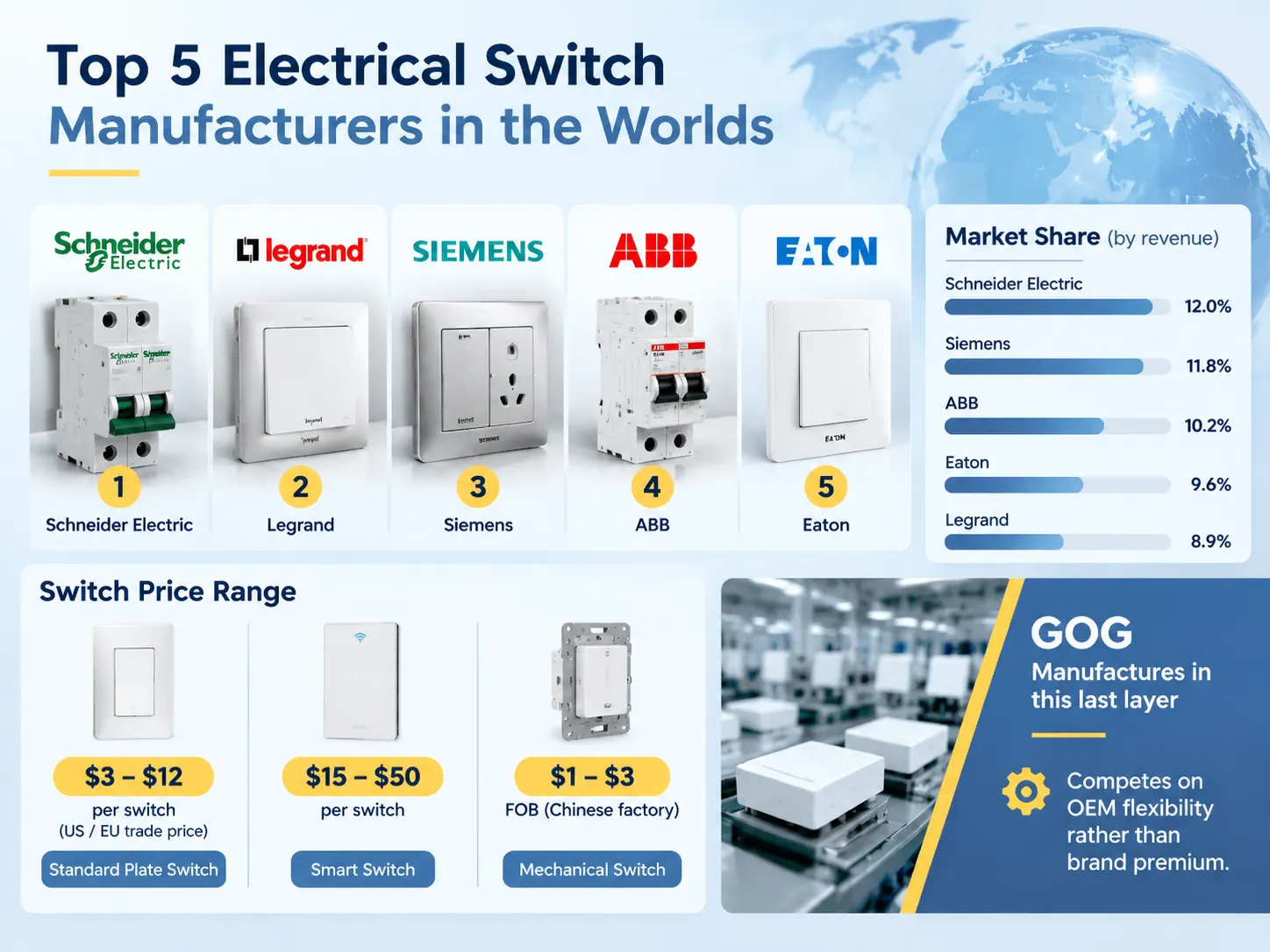
In this publication, the ranking is based on both the revenue and specification presence as a procurement engineer usually compares these two concepts. A trend behind this process should also be noted, namely, the number of the full-fledged circuit protection makers went down from 47 in 2015 to 23 in 2025, which share about 71% of sales worldwide.
The Top 5 Electric Brands
| # | Entreprise | Siège | Wiring device position | Typical trade price, standard switch |
|---|---|---|---|---|
| 1 | Schneider Electric | Rueil-Malmaison, France | Broadest global channel; Acti9 modular system; Wiser for smart | $6–$14 |
| 2 | Legrand | Limoges, France | Number two in wiring devices specifically; DX brand in Europe | $5–$12 |
| 3 | Siemens | Munich, Allemagne | SENTRON protection family; strong building automation integration | $6–$15 |
| 4 | ABB | Zurich, Switzerland | Industrial and commercial focus; S200/S800 breakers; relays | $6–$16 |
| 5 | Eaton | Dublin, Ireland | Dominant in North American residential via Cutler-Hammer | $4–$10 |
There are four noteworthy items in that list. Schneider Electric had total revenues close to $34.8 billion in 2025, with electrical distribution and building systems contributing to nearly one-third of the total revenues. The company has approximately 12.4% market share in the global miniature circuit breaker market, which is the largest in the sector. Legrand is the only real wiring devices company in the group with revenues of approximately $8.1 billion generated in electrical and digital building infrastructure, which is the reason why it is cited here despite being smaller than Siemens and ABB in overall terms. Siemens has overall revenues of around $72 billion and its share of revenues from building technologies is estimated at only around 8-10%, meaning that the company is mostly a very large entity with a small business in switching devices.
If you want the same comparison from the brand and channel side rather than the manufacturer side, it is worth reading alongside this overview of the leading wiring device brands worldwide, because a brand’s strength in a market is often a distributor relationship rather than a factory.
What Each One Is Actually Best At
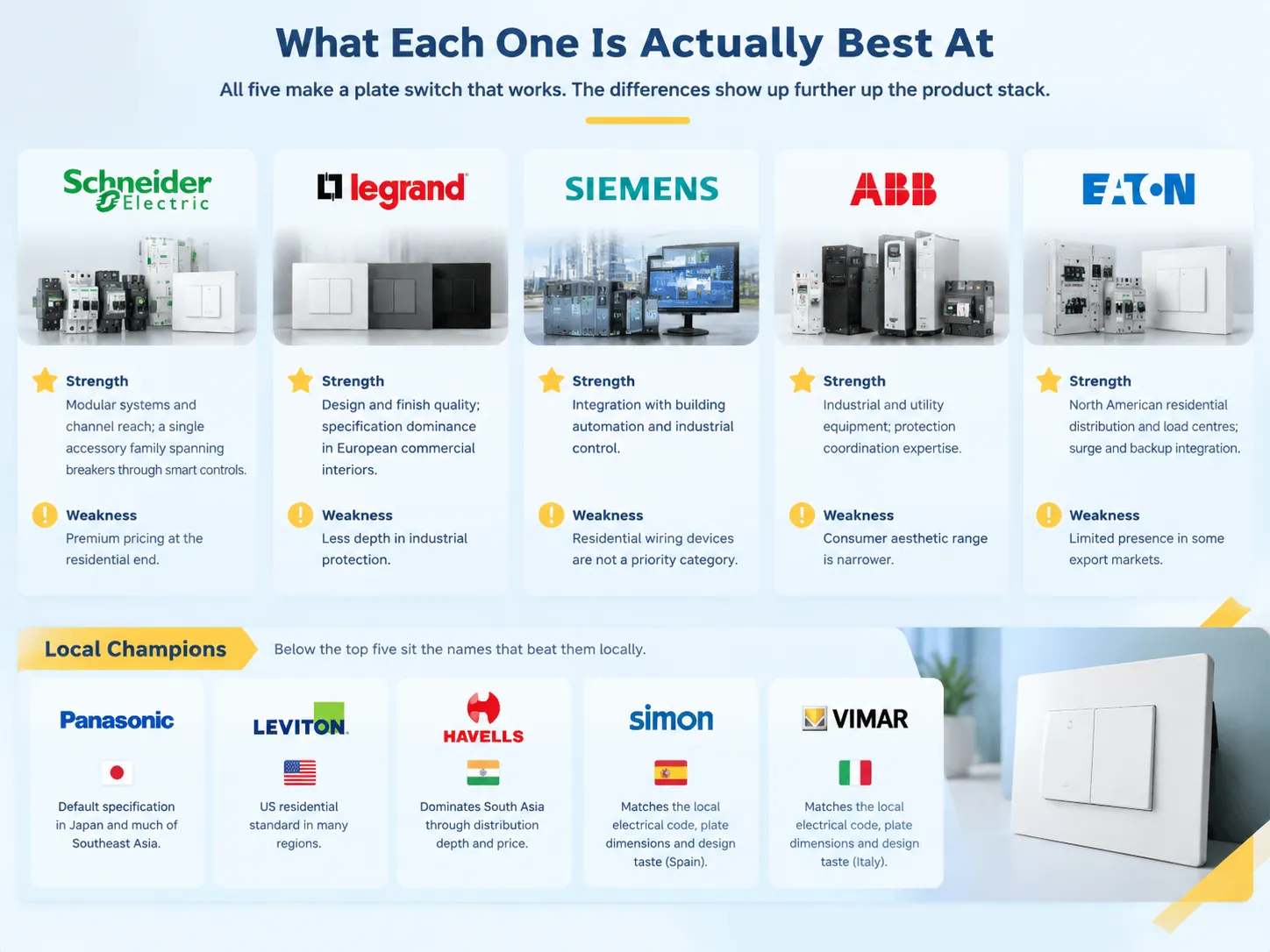
All five make a plate switch that works. The differences show up further up the product stack.
| Entreprise | Genuine strength | Where it is weakest |
|---|---|---|
| Schneider Electric | Modular systems and channel reach; a single accessory family spanning breakers through smart controls | Premium pricing at the residential end |
| Legrand | Design and finish quality; specification dominance in European commercial interiors | Less depth in industrial protection |
| Siemens | Integration with building automation and industrial control | Residential wiring devices are not a priority category |
| ABB | Industrial and utility equipment; protection coordination expertise | Consumer aesthetic range is narrower |
| Eaton | North American residential distribution and load centres; surge and backup integration | Limited presence in some export markets |
The five companies that have progressed to the top of the list have also got their local rivals. In Japan and several countries in Southeast Asia, Panasonic’s name is synonymous with electrical specifications. In the United States, Leviton is known as the preferred brand in homes. The South Asian market is dominated by Havells which has a revenue of approximately $1.8 billion. In terms of home market achievements, products of Simon in Spain and Vimar in Italy are quite similar. They have succeeded in routing the local electrical standards of the country along the norms of electrical plates and designs of plates.
Product Types They All Sell
The category is much broader than simply the light switch on the wall. A supplier who covers the entire list can serve a project. If a supplier covers only a portion of the range, a mixed specification has to be used.
- Plate switches – 1 to 6 gang, 1-way, 2-way and intermediate in sizes 10 A, 16 A, and 20 A.
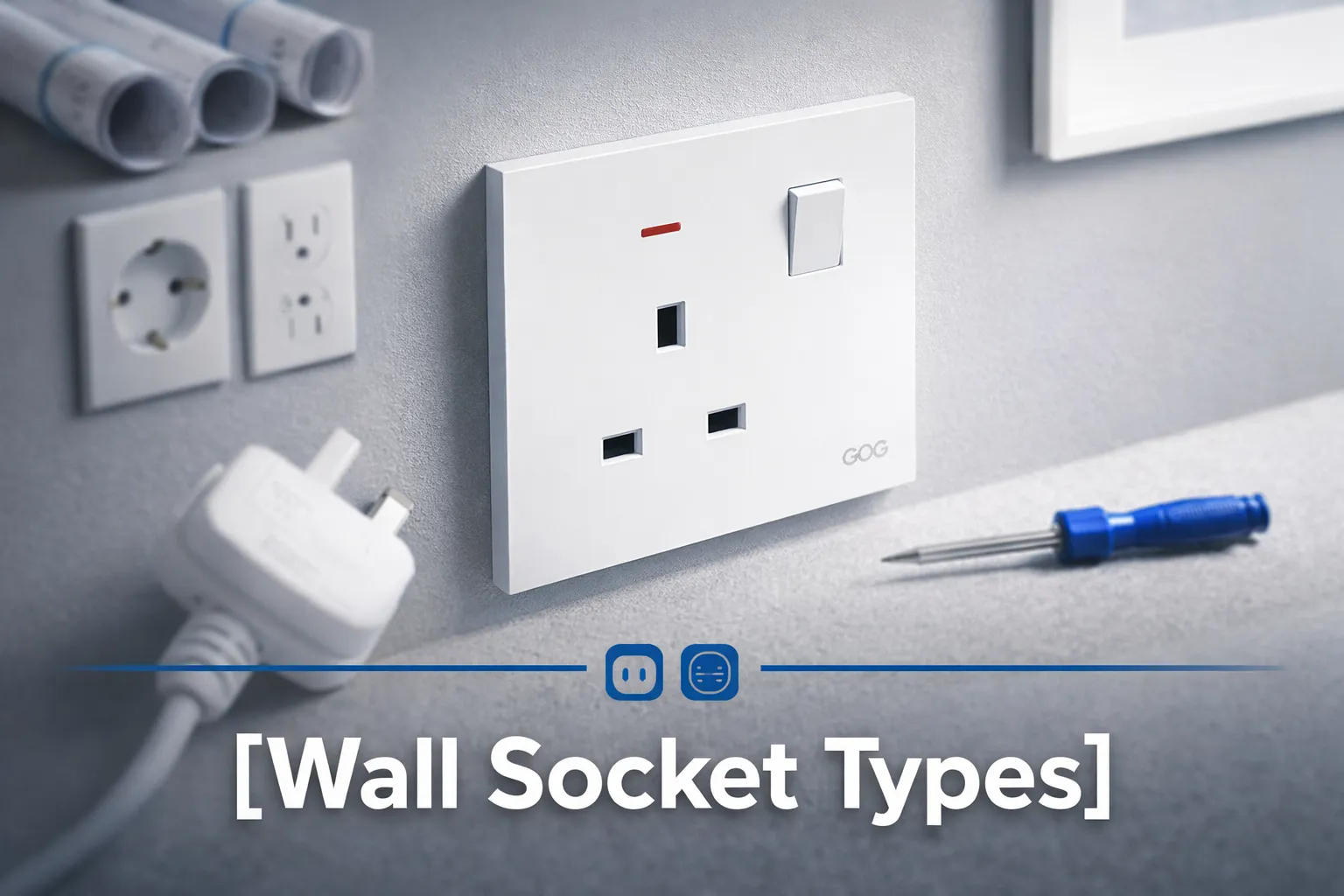
- Switched socket outlets – the combined feature of a switch and socket, which holds a major share of the market in the UK, Commonwealth, and much of the Middle East.
- Dimmer switches – leading-edge, trailing-edge, and universal dimming types with LED load that matters more than ‘wattage’ readings.
- Smart switches – Wi-Fi, Zigbee, Z-Wave, and Matter type of switches, with or without neutral.
- Fan speed regulators and motor proof switches – a completely different category from lighting switches and not interchangeable.
- Weatherproof and industrial switches – IP44 to IP66 category, available in metal or surface-mount for outdoors and industries.
- Modular and grid switches – common plates with interchangeable switches, sockets, and blank modules.
- Special categories – doorbell switches, key switches, shaver sockets, blank sockets, data outlets and TV outlets.
In the last three categories, the broadness of a supplier’s product range comes into play. Modular and grid systems allow the installer to assemble transformer, mains, data and unconnected circuits into a single plate which is a design concept that has been carried out once only and then endured for the next 20 years, and if the supplier’s catalogue makes the use of two plates necessary in what should be a two-channel system, they have failed the project regardless of the price. Fewer manufacturers cover the whole list than cover the first two or three items, and the narrower field is set out in this review of the top light switch manufacturers in the world.
Specifications Buyers Compare
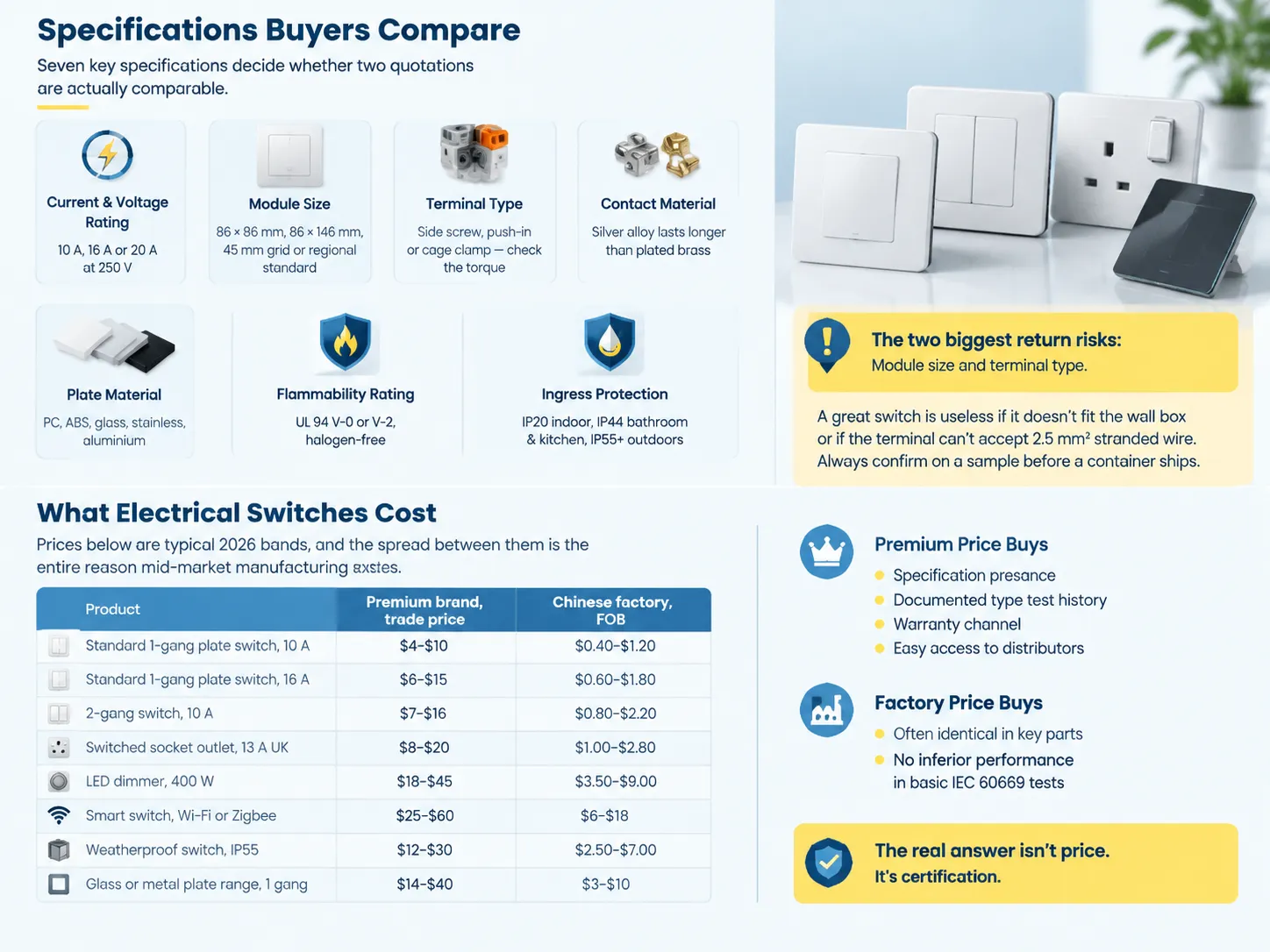
Once you have two quotations, seven specifications decide whether they are actually comparable.
| Spécification | Ce qu’il faut vérifier |
|---|---|
| Current and voltage rating | 10 A, 16 A or 20 A at 250 V — the rating must exceed the circuit it protects |
| Module size | Standard 86 × 86 mm, 86 × 146 mm, 45 mm grid, or the regional standard your walls use |
| Type de borne | Side screw, screwless push-in, or cage clamp — and the torque the manufacturer specifies |
| Contact material | Silver alloy contacts last far longer than plated brass; ask if it matters |
| Plate material | PC, ABS, glass, stainless, aluminium — which decides UV resistance and finish durability |
| Flammability rating | UL 94 V-0 or V-2, and whether the material is halogen-free |
| Protection contre les intrusions | IP20 indoor, IP44 for bathrooms and kitchens, IP55 or higher outdoors |
There are two particular factors that cause the most returns: the size of the module and the type of terminal. A switch that has an excellent mechanical function, but does not match the wall box type of the target market, becomes completely unusable, and it also applies to screwless push-in terminals that cannot be used with 2.5 mm stranded wire: if the terminal cannot accept it, the installer is left without an option.
What Electrical Switches Cost
Prices below are typical 2026 bands, and the spread between them is the entire reason mid-market manufacturing exists.
| Produit | Premium brand, trade price | Chinese factory, FOB |
|---|---|---|
| Standard 1-gang plate switch, 10 A | $4–$10 | $0.40–$1.20 |
| Standard 1-gang plate switch, 16 A | $6–$15 | $0.60–$1.80 |
| 2-gang switch, 10 A | $7–$16 | $0.80–$2.20 |
| Switched socket outlet, 13 A UK | $8–$20 | $1.00–$2.80 |
| LED dimmer, 400 W | $18–$45 | $3.50–$9.00 |
| Smart switch, Wi-Fi or Zigbee | $25–$60 | $6–$18 |
| Weatherproof switch, IP55 | $12–$30 | $2.50–$7.00 |
| Glass or metal plate range, 1 gang | $14–$40 | $3–$10 |
Although the gap seems huge, it certainly is real, though it is not an equivalent saving. The overpriced products have specifications like type testing process, warranty process, and the ability to walk into the distributor and buy one piece on a Tuesday. The factory product is often the same in the crucial parts and not any worse in terms of aspects evaluated by simple IEC 60669 test if the factory is legitimate and runs a reliable testing process. However, the above assumption is the central point of concern here, and it is validated by certification rather than by pricing.
Where the Volume Actually Comes From
It definitely deserves mention of the layer below the top five since it is a layer where switches will be manufactured the most.
The Chinese manufacturers output a staggering amount of wiring devices in terms of volume, but a large part of this production is done under private label projects for Western brands. Therefore the same factory could make a switch for $8 under one nameplate and $2 under another. In China, there are only a few companies that have established their own brands in an international market instead of staying anonymous contractors, and those are names to be noted by the distributor.The structure of that segment, including which brands are genuine manufacturers versus traders, is covered in this review of China’s top electrical export brands.
The consequence for a buyer is that “made in China” provides almost no useful information. What makes a difference is if the manufacturer has its own tools, if it has test equipment, and what its AQL is, as well as whether it can provide a certificate that a third party will recognize.
Certifications That Decide Whether You Can Specify It
Certification is the point where a mid-sized manufacturer either qualifies or fails. This is mostly done with four documents:
- EN 60669 / IEC 60669 – the product standard that defines how switches for domestic and similar permanent electrical installations must be made in Europe or Commonwealth countries.
- UL 20 – North America’s general-use switch certification that is needed for any switch used in a circuit either in the US or Canada.
- IECEE CB Scheme certificate – a simplified report accepted in all member countries, hence making cross-border specification possible and eliminating the need for separate certification in different markets.
- ISO 9001 at the production facility, thus eliminating the need to have a separate document confirming that the manufacturing is done under this standard.
Additionally, there are RoHS and REACH statements for the materials used, IP rating of the device provided by the test instead of drawing and UL 94 flammability standard for the polymer used in the body of the switch. This last one can be overlooked easily as it is one of the most difficult things to prove during fire investigation.
The CB Scheme certificate is the one that changes commercial conversations, because it removes the argument that an unknown brand cannot be qualified for a multi-country project. GOG’s own route through that process is documented in this announcement of the company’s IECEE CB Scheme certification, and it is the kind of evidence worth asking any manufacturer for before a first order.
Where GOG Sits
GOG produces switches, sockets, dimmers, and light control devices for OEM, private label, and project customers instead of battling Schneider or Legrand for consumer brand awareness. There are two fair sides to this positioning.
The good thing about it is manufacturing control. Since GOG owns the tools, moulds, and tests, a client can choose a shape of a plate, a kind of a terminal, a colour, a configuration of gangs, and a way of pack without dealing with tooling it out and thus paying because of that, but for the actual production cost itself. It is pretty simple mathematics on the 20,000 pieces of the order; the range may include plate switches, switched sockets, dimmers, USB sockets, waterproof devices, as well as decorative metal and glass ranges. The programme structure is set out on the lighting switch manufacturing page.
One more point of limitation is rather clear. Nobody would ever name GOG in specifications developed by consultants; when the name Schneider or Legrand is found, it will be those companies to comply with the specifications. GOG is present at projects designed as performance specifications (e.g. EN 60669 or UL 20, with the main characteristics, such as 10A or 16 A at 250 V, V-0, IP44, CB Scheme certificate) or private label projects where the name of the customer is written on the product.
FAQ
Who are the top switch manufacturers?
With respect to their revenue and specification presence, Schneider Electric, Legrand, Siemens, ABB and Eaton are recognized as the leaders in the electrical switch and wiring device sector, while Panasonic, Leviton, Havells, Simon and Vimar are noted leaders in their respective home regions. The segment specifically dealing with circuit protection shows Schneider Electric holding the largest market share of about 12.4%, Siemens with 11.8%, ABB with 10.2%, Eaton with 9.6%, and Legrand with 8.9%. The verdict on who is the real leader is contingent upon the aspects being evaluated i.e. whether it is revenue, volume of units sold, specification presence, or availability.
What are the best brands of electric switches?
When it comes to residential applications, the ideal brand is usually established based on compatibility with the wall box standard, the rules outlined by the country’s regulatory authority, and the different models available from distributors. This explains the presence of Legrand and Schneider in Europe, Eaton and Leviton in North America, Panasonic in Japan and Southeast Asia, and Havells in India. In the case of industrial applications, ABB and Siemens brands are preferred because of their approaches to protection and automation. In case of volume and OEM production, the physical item created by the eligible manufacturer from China will be compliant with the specifications, so its price will be lower than price of any competing brands.
Who are the top 5 network switch manufacturers?
In the case of residential lines, the brand is chosen according to the shape that corresponds to the standards of the applicable wall box, regulations of the local authority, the types of models manufactured by local distributors, etc. This explains the use of Legrand and Schneider companies in Europe, Eaton and Leviton in North America, Panasonic in Japan and Southeast Asia, and Havells in India. As for industrial lines, ABB and Siemens brands are on the top of the list due to their methods of enabling protection and automation. In return for the possibility of mass-production and OEM production, the consumer will receive the goods produced by qualified manufacturer in China that will fully comply with the regulations which allows the consumer to buy at lower prices compared to other brands.
Which company is best in switch?
When it comes to residential lines, the choice of brand is based on their compliance with the standard wall box type, the rules set by local authorities, and the types of goods manufactured by local distributors. This is why Legrand and Schneider brands are present in Europe, Eaton and Leviton brands operate in North America, Panasonic operates in Japan and the southern part of Asia, while Havells is used in India. In industrial lines, the brands that take the first place in this area are ABB and Siemens organizations for their methods of performing protection and automation. In return for the mass production and OEM production option offered by the making company, the consumer gets the products made by qualified producers in China, which fully comply with the regulations and allow the consumer to receive products at lower prices compared to other brands.
How much do electrical switches cost?
The cost of a regular 10 A plate switch is about $4–$10 when sold by leading brands but only $0.40–$1.20 when produced in some Chinese factory. The cost of a 16 A model is $6–$15 against $0.60–$1.80. The costs of a LED dimmer is $18–$45 and $3.50–$9 respectively. The cost of a smart switch ranges between $25 and $60 and only $6–$18 when manufactured in China. The IP55 weatherproof switch costs $12–$30 versus only $2.50–$7 from China. In other words, the difference in costs can be explained by the brand, extra costs, certification process and warranty channel.
How do I verify a switch manufacturer is genuine?
Request four documents: specifically the IEC 60669 or UL 20 test report for the product, the IECEE CB Scheme certificate in case of transnational specification issues, the ISO 9001 certificate with the scope statement with a showing of the product family, as well as AQL and the in-process testing regimen. Then request two product samples from two different production lots and analyze the comparisons in terminal torque, plate fit and switch feeling. A manufacturer who is able to answer the four questions is credible and a manufacturer who is not able to answer any of the questions is a trading company.
Références
- UL Standards & Engagement — UL 20, General-Use Snap Switches
- International Electrotechnical Commission — IEC 60669 series, switches for household and similar fixed electrical installations
- Schneider Electric — Acti9 modular distribution and wiring device range
- Legrand — electrical and digital building infrastructure
- ABB — electrification and installation products
Conclusion
There are five top companies that manufacture electrical switches which are Schneider Electric, Legrand, Siemens, ABB, and Eaton, but which is the best depends on the revenue, specifications, industrial applications, or availability of the brands. As we go further, we find regional leaders and below them, the Chinese companies that make most of the switches of the world.
Three considerations when sourcing switch products. It is necessary to compare switches using the same criteria, which are rating, dimensions, terminals used, materials used for contacts, material used for plates, fire resistance and IP. Make sure to get information about the time of die method or UL reports before asking for price quotes. Keep in mind that the difference between a $10 brand switch and a $1 factory switch is not the difference in quality, but the difference in brand, distribution, and documents.
Write the specifications of the certification instead of the specification found on the nameplate.