

Plugues e Tomadas de Energia do Mundo – Um Guia Completo País por País
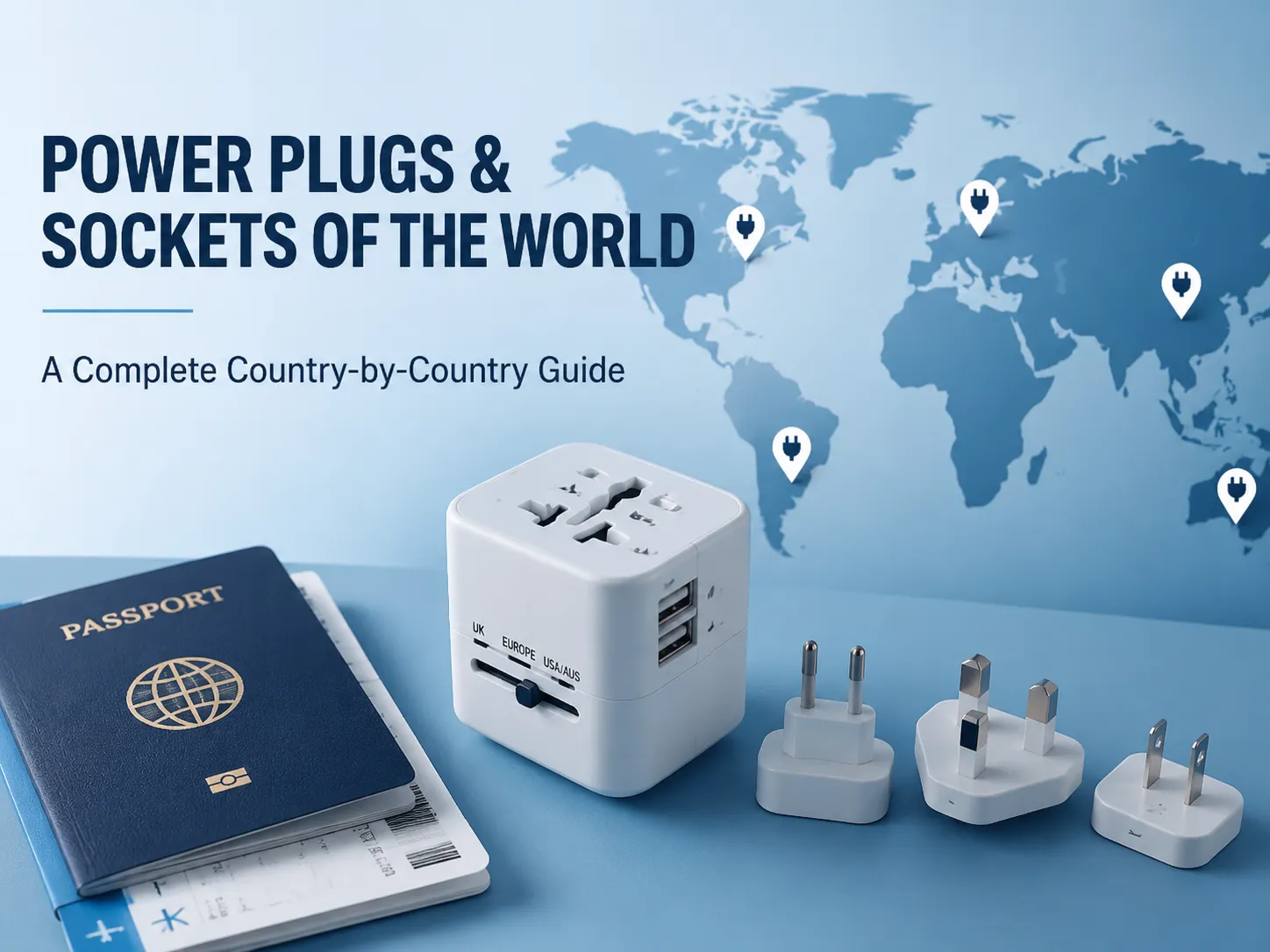
If you’ve ever gone outside of your native region and discovered that your charger does not fit into the wall socket, welcome to the club. Wall power receptacles, or as they are commonly known, electrical outlets, are very different around the world. This article will serve as an all-inclusive reference source for plug types, voltage and frequency specs and what type of adapters are needed for nearly any travel location that you may be heading to; either for work, pleasure or backpacking. This article should help to ensure that you remain charged regardless of where in the world you may be travelling.
Why Are Plug Sockets Different Around the World?
An understandable question is why we don’t have a common standard? Historical precedent, industrialization, and varying preference for safety in each country are a few of the factors that explain this problem. When electricity was invented, different countries each created their own plug and socket system based on the pattern developed in their respective regions. Some countries chose the round pin style from the United Kingdom (Type G), while other countries preferred the flat pin style developed in the United States (Type A/B). In addition, the majority of Europe chose the round pin style (Type C/F). Another difference relates to voltage, with the United States and parts of the Americas opting for 100 to 127 volts, and the majority of the remaining world opting for the more efficient transmission voltage (220 to 240 volts). The continuing differences became so deep-rooted that additional attempts to normalize them (for example, IEC 60906‑1) have experienced only partial success. Thus, in the foreseeable future, you will require a travel adapter for your devices to work in another country.
Global Power Plug & Socket Types
The International Electrotechnical Commission (IEC) has designated 15 principal plug/socket types that have been assigned letters (A to N), excluding letter I, for instance etc., based on electrical characteristics as shown in the table below, outlining some of the most common types and features.
| Tipo | Pins | Aterramento | Voltage Range | Common Regions |
|---|---|---|---|---|
| A | 2 flat parallel | No (ungrounded) | 100–127V | USA, Canada, Mexico, Japan |
| B | 2 flat + round earth | Sim | 100–127V | USA, Canada, Mexico, Japan (rare) |
| C | 2 round pins | Não | 220–240V | Europe (older), many parts of Asia, South America |
| D | 3 round pins (large earth) | Sim | 220–240V | India, Nepal, Namibia, Sri Lanka |
| E | 2 round pins + hole for earth | Yes (socket) | 220–240V | France, Belgium, Poland, Czechia, Slovakia |
| F | 2 round pins + side clips | Yes (clip) | 220–240V | Germany, Austria, Netherlands, Spain, Portugal, Scandinavia, most of Europe |
| G | 3 rectangular pins (fused) | Sim | 220–240V | UK, Ireland, Malta, Singapore, Hong Kong, Malaysia |
| H | 3 flat pins (V-shaped) | Sim | 220–240V | Israel, Palestine, Gaza |
| I | 3 flat pins (angled) | Sim | 220–240V (Australia 230V) | Australia, New Zealand, China, Argentina, Uruguay |
| J | 3 round pins (offset) | Sim | 220–240V | Switzerland, Liechtenstein |
| K | 3 round pins | Sim | 220–240V | Denmark, Greenland |
| L | 3 round pins (inline) | Sim | 220–240V | Italy, Chile, Libya, Ethiopia |
| M | 3 round pins (large) | Sim | 220–240V | South Africa, Swaziland, Lesotho |
| N | 3 round pins (Brazilian) | Sim | 127V / 220V | Brasil |
Country-by-Country Power Outlet Reference
Below is a handy reference table for travelers. It shows the plug type(s) used, voltage, frequência, and whether you need an adapter from the USA, Europe, or UK. Note that many countries accept multiple plug types due to mixed standards.
| Country | Plug Type(s) | Voltagem | Frequência | Adapter from USA? | Adapter from Europe? | Adapter from UK? |
|---|---|---|---|---|---|---|
| EUA | A/B | 120V | 60Hz | — | Sim | Sim |
| Canadá | A/B | 120V | 60Hz | Não | Sim | Sim |
| México | A/B | 127V | 60Hz | Não | Sim | Sim |
| Reino Unido | G | 230V | 50Hz | Sim | Sim | — |
| Irlanda | G | 230V | 50Hz | Sim | Sim | Não |
| França | E | 230V | 50Hz | Sim | — (if C/E/F) | Sim |
| Alemanha | F | 230V | 50Hz | Sim | No (if C/F) | Sim |
| Itália | L | 230V | 50Hz | Sim | Yes (adapter to L) | Sim |
| Espanha | F | 230V | 50Hz | Sim | No (if C/F) | Sim |
| Portugal | F (also C) | 230V | 50Hz | Sim | No (if C/F) | Sim |
| Países Baixos | F | 230V | 50Hz | Sim | No (if C/F) | Sim |
| Suíça | J | 230V | 50Hz | Sim | Yes (adapter to J) | Sim |
| Austrália | I | 230V | 50Hz | Sim | Sim | Sim |
| Nova Zelândia | I | 230V | 50Hz | Sim | Sim | Sim |
| Japão | A/B (sometimes unpolarized) | 100V | 50/60Hz | No (but check plug type) | Sim | Sim |
| China | A, C, I (varied) | 220V | 50Hz | Yes (adapter needed for most) | Maybe (if C) | Sim |
| Índia | D, M | 230V | 50Hz | Sim | Sim | Sim |
| Singapura | G | 230V | 50Hz | Sim | Sim | Não |
| Hong Kong | G | 220V | 50Hz | Sim | Sim | Não |
| Malásia | G | 240V | 50Hz | Sim | Sim | Não |
| Brasil | N (also C) | 127V / 220V | 60Hz | Sim | Yes (adapter to N) | Sim |
| África do Sul | M (also C) | 230V | 50Hz | Sim | Sim | Sim |
| Israel | H | 230V | 50Hz | Sim | Sim | Sim |
| Argentina | I (also C) | 220V | 50Hz | Sim | Sim | Sim |
Note: “Adapter needed” refers only to physical plug shape – voltage compatibility is separate. Always check your device’s voltage rating.
Do I Need a Travel Adapter for International Travel?
Almost always yes A Universal Travel Adapter is a Necessary Item.
unless you go to a Country that has the Same Plug type and Voltage as WHERE YOU Live. For Most travelers, a Universal Travel Adapter is a MUST HAVE. An Adapter ONLY Changes the Shape of the plug; it doesn’t Convert the voltage. Here’s Where the Next Question Comes In.
Do I Need a Power Converter for International Travel?
Depende dos seus dispositivos. A power converter (or voltage converter) converts power from 220-240V to 100-120V, or vice versa. If you need to use electric appliances with voltages other than that of the household supply, you will require a power converter.
- Your appliance is single‑voltage (e.g., 120V only) and you’re traveling to a 230V country.
- Bringing high wattage items such as hair dryers, curling wands and shavers that aren’t dual voltage.
Most modern electronic devices such as smartphones, tablets, laptops, camera chargers, and many electric toothbrushes use two types of power bricks/ plugs that can handle either 110 volts or 220 volts. If the label on the back of these devices states “INPUT: 100-240V, 50/60Hz”, then all you need is a plug adapter rather than a new power brick/plug assembly.
A Step down Converter is very heavy, so high-wattage appliances can be very pricey. Most people travelling will purchase inexpensive (cheap) local alternatives instead of buying a Step-down Converter.
What Is the Best Power Adapter for International Travel?
Depending on where you are traveling to , there are several adapters available but most of the time using a universal travel adapter will cover you on all the different styles of plugs (A, B, C, D, E, F, G, I, etc.). There are many things you should look for to determine the right adapter for you such as:
- Built‑in USB‑A and USB‑C ports – so you can charge devices directly without extra bricks.
- Safety shutters – to prevent accidental contact.
- Fuse protection – against power surges.
- Compact design – easy to pack.
Some well-known brand names are Anker PowerPort III, Zendure Passport and Epicka Universal Adapter, which typically include interchangeable plugs for various global regions. These will either click in or slide out for ease of use and portability.
While a basic Type C-F to G adapter would be fine for a short visit to one area (for example: Europe). Having a universal adapter will provide you with the most versatility on your future travels.
Which Countries Have Different Power Outlets?
Almost all countries are included in the answer. Only a few countries have the same type of plug and voltage. The following map shows how much of the world has already been connected with electricity:
- North America (USA, Canada, Mexico) – Types A/B, 120V/60Hz.
- Most of Europe – Types C/F/E (or L in Italy, J in Switzerland), 230V/50Hz.
- UK & Ireland – Type G, 230V/50Hz.
- Austrália & Nova Zelândia – Type I, 230V/50Hz.
- Índia – Types D/M, 230V/50Hz.
- Brasil – Type N, but also mixed voltages by region.
- Japão – Type A/B (but 100V, 50/60Hz).
- China – Types A, C, I, with 220V/50Hz.
- África do Sul – Type M, 230V/50Hz.
- Israel – Type H, 230V/50Hz.
Besides that, certain nations will have different categories (such as Argentina with 2 and Brazil based on 2). There are often two labels in some cases. Therefore, please verify the required documentation for your destination before proceeding with the document verification process.
Perguntas Frequentes (FAQ)
Why are plug sockets different around the world?
Historically, the variation in plugs was caused by each country’s individual development of their electrical standards. The countries all created their electrical standards according to their own local safety preferences, manufacturing capabilities and political choices. Attempts have been made at standardization (such as IEC 60906‑1), however, the process has gone slowly, resulting in over 15 plug types still in use today.
What is the best power adapter for international travel?
A universal travel adapter containing USB ports provides maximum versatility. The best universal travel adapters have to support all of the major plug types (A through G, I etc.), provide the proper safety certifications (CE, FCC) and they also feature a fuse. Brands such as Anker and Zendure, Epicka are all rated highly. If you travel frequently, then you should also look into purchasing a universal travel adapter that has replacement plugs instead of sliding pin types, which will be more durable.
Which countries have different power outlets?
Each nation has its unique version of electricity being supplied. Countries really differ in their voltage supply; they can be classified as low voltage (100-127V) or high voltage (220-240V). Electrical plugs are categorized into regions; however, there are also exceptions to this rule, such as Italy, which uses type L plugs, and Switzerland, which utilizes type J plugs, for example. Therefore, you should make sure to check the specifics of your travel destination before leaving home.
Do I need a power converter for international travel?
Only if your device is not dual‑voltage. If you look at the label on your appliance or charger and it says “Input: 100-240V, 50/60Hz,” you will need only a plug adapter to use it overseas. If your appliance or charger says “120V” only, you will need a step-down converter to use it overseas in 230V countries. For many travelers, especially those traveling with high wattage appliances such as hair dryers, it is too bulky to carry a heavy converter with them; they choose instead to buy an inexpensive, local alternative once they arrive at their destination.
Can I use my US hairdryer in Europe?
You can only use a US hairdryer in Europe if it has a dual-voltage switch, usually found as a small red switch near the handle. Most United States hairdryers work at 120 volts only, and will wear out or even cause fires when used with 230 volts, which is common in Europe unless you have a heavy duty transformer/converter to reduce the voltage. Therefore, it’s best to travel with a hairdryer that works in Europe or use the one that your hotel provides.
Is it safe to use a travel adapter with a power strip?
You should also verify that the power strip you purchase is appropriate for local power. Using a power strip rated at US 120V in countries that use 230V may cause the power strip to overheat. Make sure to check the power strip and do not exceed the wattage capacity. Most travelers also carry a compact, multiple outlet adapter with built-in USB ports to avoid having to take multiple chargers with them.
Final Tips for Global Travelers
- Always check your device labels – it takes 2 seconds and can save you from frying your electronics.
- Leve um adaptador universal – it’s small, affordable, and covers 99% of countries.
- Carry a power bank – especially if you rely heavily on your phone for maps and communication.
- Consider a multi‑port USB charger Instead of having a lot of individual charging devices, you can have an all-in-one charging solution with a universal plug that can charge up to four devices at the same time.
- Keep a paper backup – for critical information like hotel addresses and emergency contacts in case your phone dies.
Resumo
For all international travelers, it’s imperative to understand global plugs & sockets – as there are a variety of plugs/sockets from around the world and all have different voltage. However, even though this may seem like an overwhelming task, there is a travel adapter that works with multiple types of plugs and the vast majority of today’s electronics are also dual voltage so you can typically use them without having to buy a voltage converter.
Before you will be travelling, check to be sure what kind of electrical plugs and voltages your location offers. Having the proper power adapter along with some advance planning will keep your electronics powered up enabling you to enjoy the many sites you visit with no worries about electricity while on your journey. Happy travels and good luck exploring!
Last updated: June 2026. Plug standards occasionally change – always verify for your specific destination.