Dois recipientes circulares em uma prateleira podem parecer iguais por baixo, mas contêm quantidades completamente diferentes de cabo. É por isso que uma troca fácil de luminárias muitas vezes se torna uma visita adicional ao atacadista. O diâmetro aqui geralmente é o mesmo número, mas é a profundidade onde decisões importantes são tomadas. Compilamos uma lista dos tipos disponíveis de recipientes, suas capacidades conforme definido pelas regulamentações de preenchimento de caixas NEC, e como a situação é diferente no resto do mundo.
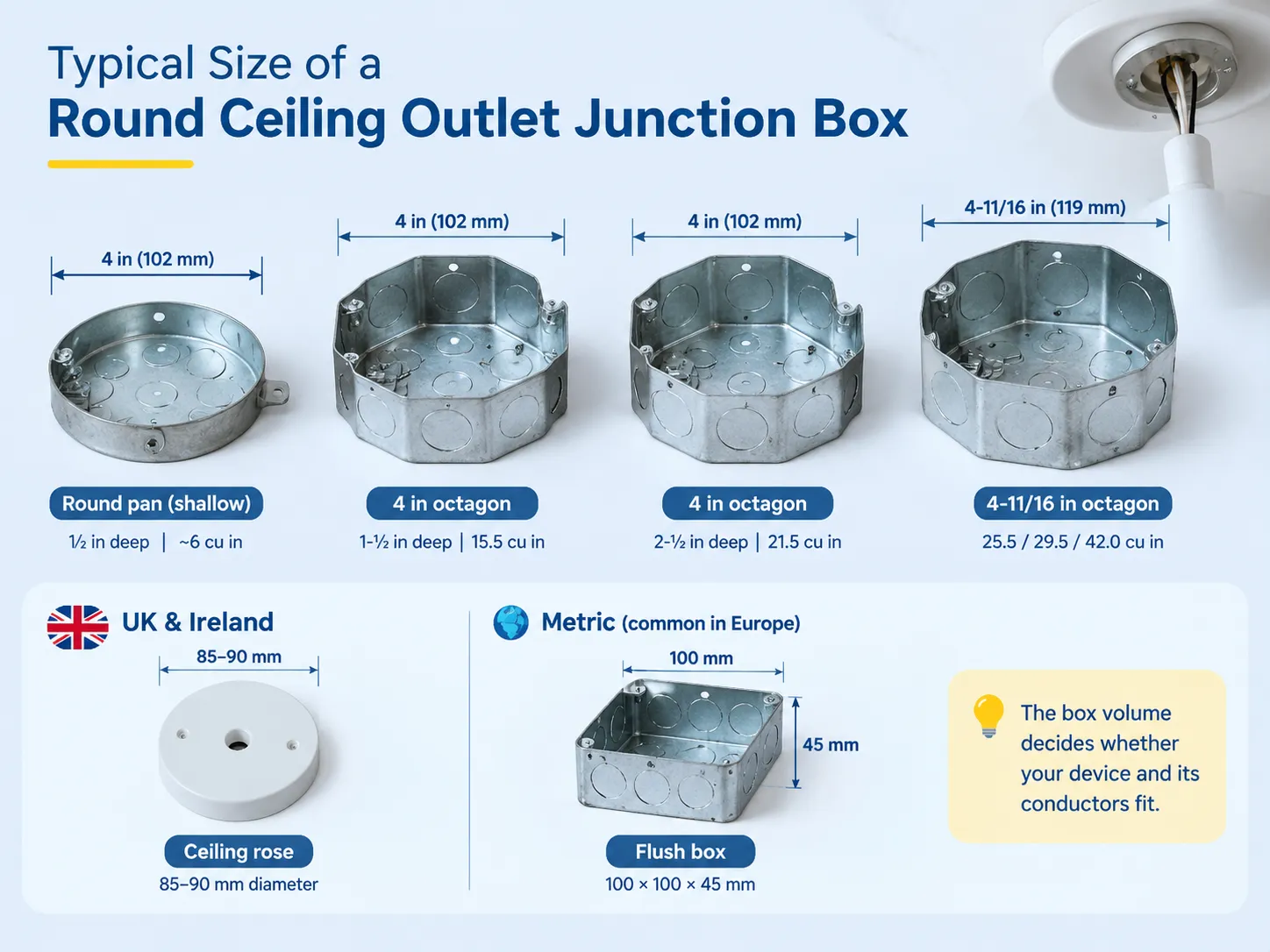
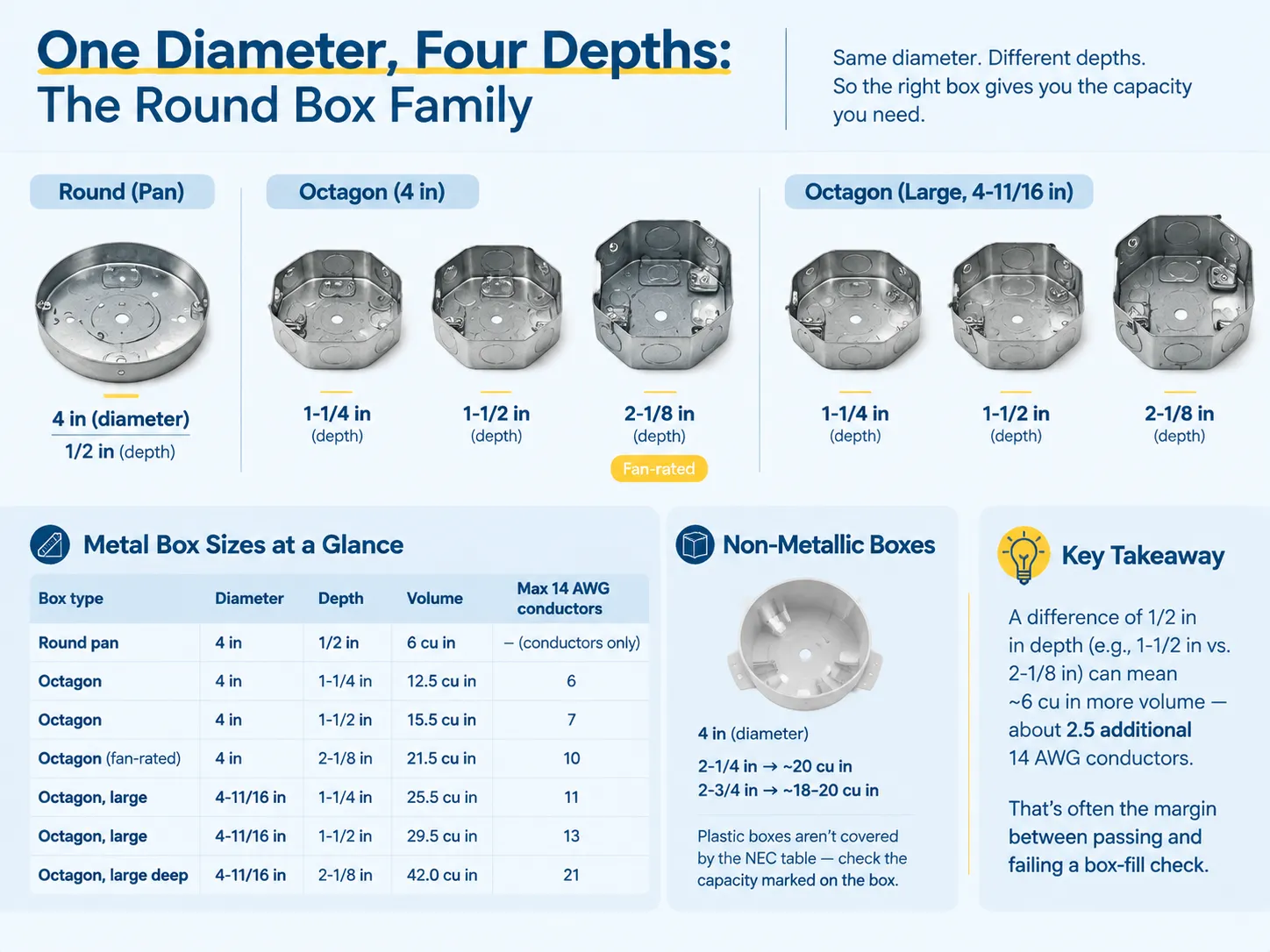
Para resumir, uma caixa de saída de teto redonda é tipicamente identificada pelo padrão norte-americano de 4” (10,2 cm) de diâmetro. No entanto, as variações em termos de profundidade e volume da caixa podem variar muito, com profundidades de 0,5” para a bandeja redonda de 4” (que tem um volume total de 6 in³) até 1,5” ou 2,125” (octógonos de 4”) para um volume de 15,5 in³ ou 21,5 in³, respectivamente. Uma caixa octogonal ainda maior de 4-11/16” (11,8 cm) tem um volume de 25,5, 29,5 ou 42,0 in³. Também estão disponíveis bandejas rasas de 3,5” (8,9 cm). No entanto, no Reino Unido e na Irlanda, a mesma coisa é chamada de ceiling rose, que tem diâmetro variando de 85-90 mm, ou caixa comum embutida medindo 100×100×45 mm.
Um diâmetro, quatro profundidades: a família de caixas redondas
As caixas de teto vêm em duas variedades e algumas profundidades variadas. Os tipos podem ser redondos (tipo bandeja ou caixa redonda com profundidade rasa) e octogonais (tipo octogonal, que é geralmente o que se refere quando as pessoas falam sobre caixas de teto redondas). Existem diâmetros em opções metálicas de 3-1/2 pol ou 4 pol para as bandejas, um diâmetro de 4 pol para os octógonos, e 4-11/16 pol para os tipos octogonais maiores usados em aplicações comerciais. Os próximos na linha são as caixas para ventiladores de teto e caixas para luminárias que têm diâmetros de 5 polegadas e 6 polegadas, respectivamente, pois pertencem a uma classificação diferente de produtos.
A profundidade é o que importa em termos de capacidade, conforme considerado na tabela NEC 314.16(A), e a diferença entre um octógono de 1-1/2 polegada e um de 2-1/8 polegada equivale a 6 polegadas cúbicas, que é a quantidade aproximada para acomodar 2,5 condutores 14 AWG a mais neles. Geralmente, essa é a diferença entre sucesso e falha em termos de verificação do preenchimento da caixa.
| Tipo de caixa | Diâmetro | Profundidade | Volume | Máx. condutores 14 AWG |
|---|---|---|---|---|
| Bandeja redonda | 4 pol (102 mm) | 1/2 pol (13 mm) | 6 pol³ | Apenas condutores, sem dispositivo |
| Octógono | 4 pol (102 mm) | 1-1/4 pol (32 mm) | 12,5 pol³ | 6 |
| Octógono | 4 pol (102 mm) | 1-1/2 pol (38 mm) | 15,5 pol³ | 7 |
| Octógono (classificado para ventilador) | 4 pol (102 mm) | 2-1/8 pol (54 mm) | 21,5 pol³ | 10 |
| Octógono, grande | 4-11/16 pol (119 mm) | 1-1/4 pol (32 mm) | 25,5 pol³ | 11 |
| Octógono, grande | 4-11/16 pol (119 mm) | 1-1/2 pol (38 mm) | 29,5 pol³ | 13 |
| Octógono, grande profundo | 4-11/16 pol (119 mm) | 2-1/8 pol (54 mm) | 42,0 pol³ | 21 |
Ao lado dessas caixas estão as não metálicas que têm números ligeiramente diferentes devido ao fato de serem moldadas em vez de estampadas. Por exemplo, uma caixa de teto não metálica de 4 de diâmetro com 2-1/4 de profundidade terá cerca de 20 polegadas cúbicas de volume, enquanto a que tem 2-3/4 de profundidade varia de cerca de 18 a 20 polegadas cúbicas, dependendo de como é moldada e se possui grampos embutidos. A tabela NEC não considera o uso de caixas plásticas, pois elas são obrigadas a ter sua capacidade escrita.
Por que caixas redondas e octogonais existem de fato
Uma caixa elétrica com formato retangular geralmente opera no teto, o que significa que o formato da caixa está mais relacionado ao design do dispositivo. Para uma luminária, uma caixa redonda ou octogonal fornece uma superfície uniforme para o dossel repousar. Ao usar uma caixa octogonal, a rotação do dossel é possível e ainda cobrirá a abertura da caixa. Outro benefício é o fato de que a caixa octogonal ou redonda possui parafusos de fixação 8-32 que são colocados no espaçamento padrão de 2-3/4 polegadas ou 3-1/2 polegadas, que podem ser encontrados em qualquer suporte de montagem para luminárias.
A forma octogonal tem uma vantagem adicional, pois ter lados planos permite knockouts que direcionam os fios na direção correta ao trabalhar com grade de teto. Isso significa que os fios podem entrar na caixa pelo lado mais apropriado sem criar tensão nos fios.
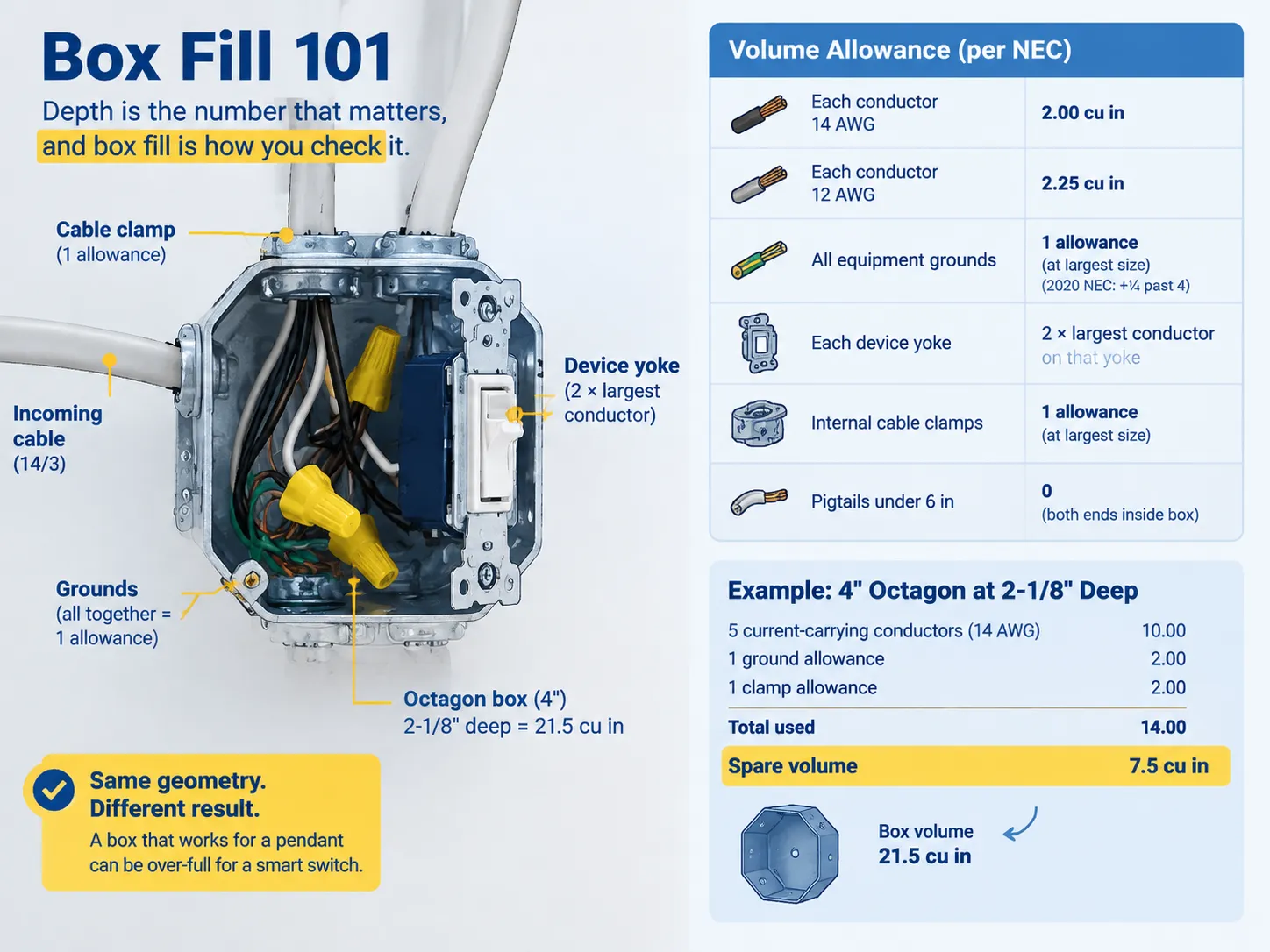
A profundidade é o número que importa, e o preenchimento da caixa é como você verifica isso.
Todos os fios, ao passarem pela caixa para conexões, emendas ou terminações, ocupam espaço. Além dos fios, dispositivos, aterramentos e dispositivos de fixação também utilizam espaço. Um dispositivo é contado pelo seu suporte (yoke) em vez do número de tomadas nele, então um duplex receptáculo elétrico é uma única permissão de dispositivo, não duas. De acordo com a Tabela 314.16(B), é necessário levar em conta que o fio 14 AWG ocupa 2,00 cu in, enquanto o 12 AWG ocupa 2,25 cu in. O suporte conta como dois fios do maior tamanho utilizado, todos os fios de aterramento juntos contam como um único fio, e dispositivos de fixação contam como outro.
Agora pegue uma caixa de teto real. Uma caixa octogonal de 4 pol por 2-1/8 pol tem um volume de 21,5 cu in. Com um cabo 14/3 entrando e apenas um cabo 14/2 saindo para um circuito de interruptor. Assim, você tem cinco condutores que conduzem corrente a 2,00 cada, um aterramento a 2,00 e um dispositivo de fixação a 2,00, totalizando 14 cu in, deixando 7,5 cu in livres. Mas e se você usar um fio 12 AWG e adicionar um dimmer no suporte? Então todo o volume disponível será usado muito rapidamente. Os mesmos cálculos adequados para um pendente podem não ser suficientes para um interruptor inteligente se a caixa se mostrar insuficiente para a fiação usada.
Bem ao lado dessa consideração está outra questão, referindo-se à próxima seção do vocabulário. O termo “gang” refere-se a dispositivos e não a aberturas, o que significa que mesmo que muitos fios sejam colocados na caixa, uma caixa com um dimmer já é contada como um gang.
| Item contado | Permissão de volume | Notes |
|---|---|---|
| Cada condutor 14 AWG | 2,00 cu in | Contado se termina ou emenda na caixa |
| Cada condutor 12 AWG | 2,25 cu in | Mesma regra, permissão maior |
| Todos os aterramentos de equipamentos | 1 permissão no maior tamanho | NEC 2020 e posteriores adicionam uma permissão adicional após quatro |
| Cada suporte de dispositivo | 2 × largest conductor on that yoke | A dimmer or GFCI counts as one yoke |
| Internal cable clamps | 1 permissão no maior tamanho | External connectors need no allowance |
| Pigtails under 6 in | 0 | Both ends inside the box |
Octagon, round or square: telling them apart on sight
Study the corners carefully. A true octagonal structure features eight straight edges and angular breaks in angles; however, a round shape is called a circle featuring a shallow flange for not having any flat edges; a square box has four corners and is usually of size 4 × 4 inches. The square shape is the one very often confused with ceiling box, and it should not be neglected because the volume of the 4-inch square box is equal to 30.3 cubic inches, which is actually one and half times bigger than in octagon with the same diameter and height.
The mounting hardware also makes the distinction clearer. The octagons and pans made for ceilings are supplied with brackets or captive nails for mounting onto a beam or between the beams. The square boxes are installed usually through the sides and are mostly used as junction boxes or junction device boxes along with the mud ring that is also the method of converting square box to round mounting point for the fixture in case of need.That is where the single-gang and multi-gang distinction starts to bite, because a two-gang ring will not fit a 4 in octagon no matter how the wiring is arranged.
Fixture-rated versus fan-rated: the weight numbers
The fixture box must be capable of supporting the weight, and there are weight ratings that apply as well. Standard ceiling light fixture pans and octagonal boxes are rated only to support a 50 lb (22.7 kg) load, and they are explicitly not designed for ceiling fan use unless labeled otherwise. A ceiling fan installation box is either securely fastened to a joist or securely mounted and rated for fan support, usually at a maximum weight of 35 lb (15.9 kg) for fan weight plus 50 lb for fixture weight.
This is one of the most common mistakes in ceiling work: putting a fan in a box that was designed for a light fixture. The box may look the same and be the same size, but its classification is not the same, and careful wiring does not make up for the fact that the support weight rating was never assigned to the box.
Outside North America: metric sizes and the ceiling rose
In the United Kingdom and Ireland, they utilize the same device known as a ceiling rose. The standard size of loop-in is 85 or 90 mm in diameter and is made of white plastic material. It is regulated by BS 67, which takes care of the arrangement mechanism of terminals and strain relief, and it is rated with a 6 A capacity at 250 V — a sum that is suitable for a domestic light circuit heavily served by LEDs. Decorative ceiling roses made of brass, chrome, or plaster come with diameter ranging from 150 mm to 250 mm and are selected based on design and appearance rather than capacity.
There is another family of boxes that are characterized as metric flush boxes. One of the European round boxes can be marked with 100 mm of diameter and depth measurement of 46 mm having ten entrances for 25 mm conduit and are labeled as complying with BS EN 60670-1 and BS EN 60670-22. Such square boxes usually measure 100 x 100 x 45 mm. It is the same constraint that shapes UK wall socket and switch plate formats, which are built to a shallow back profile precisely because the boxes behind them are shallow.
| Região | Typical part | Diameter / size | Profundidade | Norma |
|---|---|---|---|---|
| US / Canada | Octagon ceiling box | 4 pol (102 mm) | 1-1/2 in or 2-1/8 in | NEC 314.16, NEMA OS-1 |
| US / Canada | Non-metallic ceiling box | 4 pol (102 mm) | 2-1/4 in or 2-3/4 in | NEMA OS-2, marked capacity |
| Reino Unido / Irlanda | Loop-in ceiling rose | 85-90 mm | Approx. 25-30 mm | BS 67, 6 A / 250 V |
| Reino Unido / Irlanda | Decorative ceiling rose | 150-250 mm | Fixture-dependent | Angled as decorative |
| Europe | Round flush connection box | Ø 100 mm | 45-46 mm | BS EN 60670-1 / -22 |
Brands, and why the dimensions differ anyway
All companies that we are familiar with, RACO (Hubbell), Carlon (Thomas & Betts), Steel City (Eaton), Arlington, Appleton and Southwire are happy to provide dimensional data, and for the case of steel octagons their dimensions are virtually in line with the above table since this box must fit the standard fitting canopies. The exception is with the moulded boxes since a 4 inch PVC ceiling box developed by one company can have a volume of 20 cu in at a depth of 2.5 in while another will have volume of 18 cu in, where the variation will depend not on the standard, but on the thickness of the box walls, integral clamps and knockout count.
This is the reason why the marked capacity is more important than the nominal size, and that is the reason NEC 314.16(A) dictates the necessity for marking boxes of less than 100 cu in by their volume. If the marking has been covered with paint use measuring tools instead: the internal diameter, the internal depth to the back of box should be measured and then compared against the values published in the manufacturer’s catalog.
How to size the replacement before you buy
The best way of achieving a successful installation is to perform four measurements and then make one verification. Begin by measuring the hole opening at the ceiling. This will give you the required size diameter for the fixture canopy. Next, measure the depth of the hole, using either a ruler or a stiff piece of wire. Next, have a count of electrical conductors that are already exiting the junction box, along with the wire gauge. Lastly, check the volume or the catalog volume. Based on this information, you can decide if you are dealing with a light or a fan, and it is essential to know this, as the choice will depend on the device type rather than its size.
In case of replacing the shallow pan with one that requires increased space for wiring, a 4 in octagon at 2-1/8 in provides 21.5 cu in of space while preserving the standard fixture spacing. If more space is actually required, a 4-11/16 box with a plaster ring will do the job.
Why we care about box sizes when we make switches and sockets
An important context about the position of GOG. We produce wiring devices i.e. switches, sockets, dimmers and smart switches in wholesale and OEM quantities, but we don’t manufacture junction boxes. Nevertheless, we are interested in the dimensions of junction boxes, because the majority of complaints of installers refer not to the device malfunction, but to the fact that the device does not fit the box. Smart switches are deeper than mechanical ones, and the dimmers are deeper than smart switches as they have rather large heat sinks. A 12 AWG installation occupies the box space faster than a 14 AWG one.
Hence, when someone asks us which dimmer to choose for a room with shallow ceiling boxes, we begin the answer with the volume.Pick the enclosure first, then the device that fits it — the same order we would suggest when seleção de dispositivos de fiação across a whole building, where box depths are rarely uniform from floor to floor.
Perguntas Frequentes
What are the standard sizes for ceiling junction boxes?
The recognized standard for steel boxes is the 4 in round pan box that is half an inch deep (approximately equal to 6 cubic inches), the 4 in octagon box that can be 1-1/2 in, 2-1/8 in and finally, the 4-11/16 in octagon box which could have dimensions from 1-1/4 in, 1-1/2 in and then finally 2-1/8 in (having capacities of 25.5, 29.5 and 42.0 cubic inches) Non-metallic equivalents exist, which around 20 cubic inches in size while being 2-1/4 inch deep.
What is the diameter of a round junction box?
4 in (102 mm) is most frequently found in home and light commercial ceiling electromagnetic induction systems. Flattop lighting plates are also available in sizes of 3-1/2 in (89 mm). Larger commercial octagonal boxes measure 4-11/16 in (119 mm), while heavier installations can utilize boxes sized at 5 in and 6 in. The metric standard for circular boxes is Ø 100 mm.
What are the standard dimensions of a ceiling box?
The dimension corresponds to the product of diameter and depth, but depth would be variable. Thus, a 4 x 1.5″ octagon, a 4 x 2.125″ octagon, as well as a 4.6875 x 2.125″ octagon do exist to hold 15.5, 21.5, and 42.0 cubic inches correspondingly. Siempre provide both figures, because saying that it “is a 4 inches box” does not tell you how much wire it is able to hold.
Can you mount a ceiling fan in a round ceiling box?
Provided the rated box is used. Standard octagon boxes and the currently standard models are rated for fixtures up to 50 lbs (22.7 kg), which means they are not suitable for fan installations. The fan-rated boxes are designed to be braced and carry their own ratings for fans and fixtures, so be sure to check the labels first before attaching any ceiling fixture.
How do I find the volume if the box is not marked?
You can take a reading of the internal diameter and of the internal depth and then look this up in the manufacturer’s catalogue; it is the same 4 in diameter, which is present in several depths, and the volumes do not result from the measurements done from the outside. Non-metallic boxes are normally marked so a missing mark usually suggests paint, and then a quick scrape on the inside surface shows it usually.
Referências
- NFPA — NFPA 70 National Electrical Code, Article 314 Outlet, Device, Pull and Junction Boxes
- NEMA — OS-2 Nonmetallic Outlet Boxes, Device Boxes, Covers and Box Supports
- NEMA — OS-1 Sheet-Steel Outlet Boxes and Box Supports
- UL Solutions — UL 514A Metallic Outlet Boxes
- BSI — BS 67 Specification for ceiling roses
- Hubbell RACO — Steel boxes and covers catalogue data
- Carlon — Non-metallic box capacity tables
Conclusão
Regular round ceiling outlet boxes measure 4 inches in diameter and the key to this is their depth. Half Inch pan makes adjustments for only lighting fixtures and items of minor importance; 1 1/2 Inch octagon has volume of 15.5 cubic inches and is appropriate for pendant and downlight installations; standard octagon measuring 2 1/8 inches is good for 21.5 cubic inches and is usually applied when installing a fan and possibly any IoT-device and 4-11/16 boxes with a maximum volume of 42.0 cubic inches are needed when a ceiling outlet turns into a junction.Select a box to get started, determine the number of wires inside of it, state whether you have a fixture or a fan at hand and only then pick an appropriate box. Performing these steps in such order is the reason why some ceiling installations last not more than 20 minutes while others require three attempts.