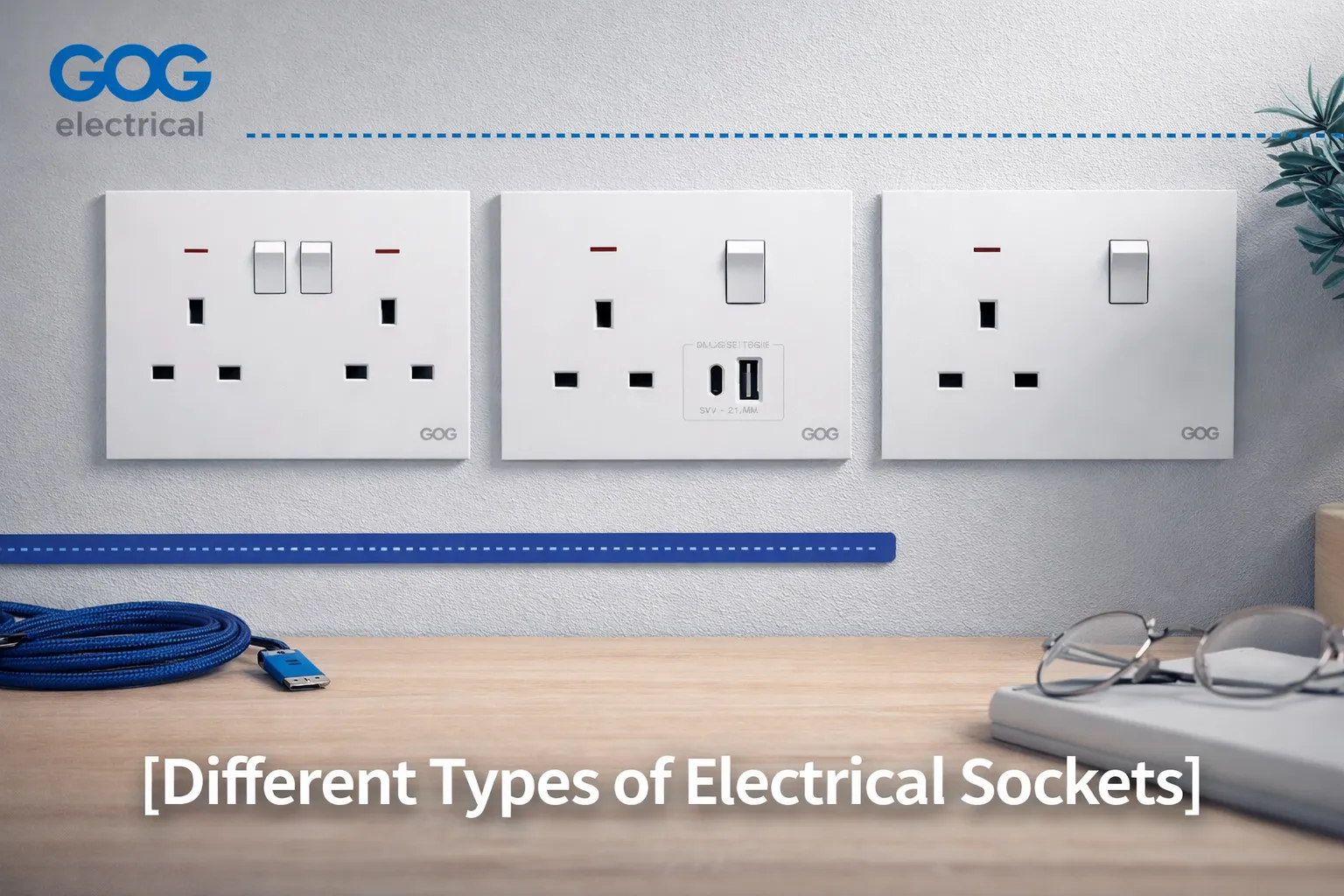
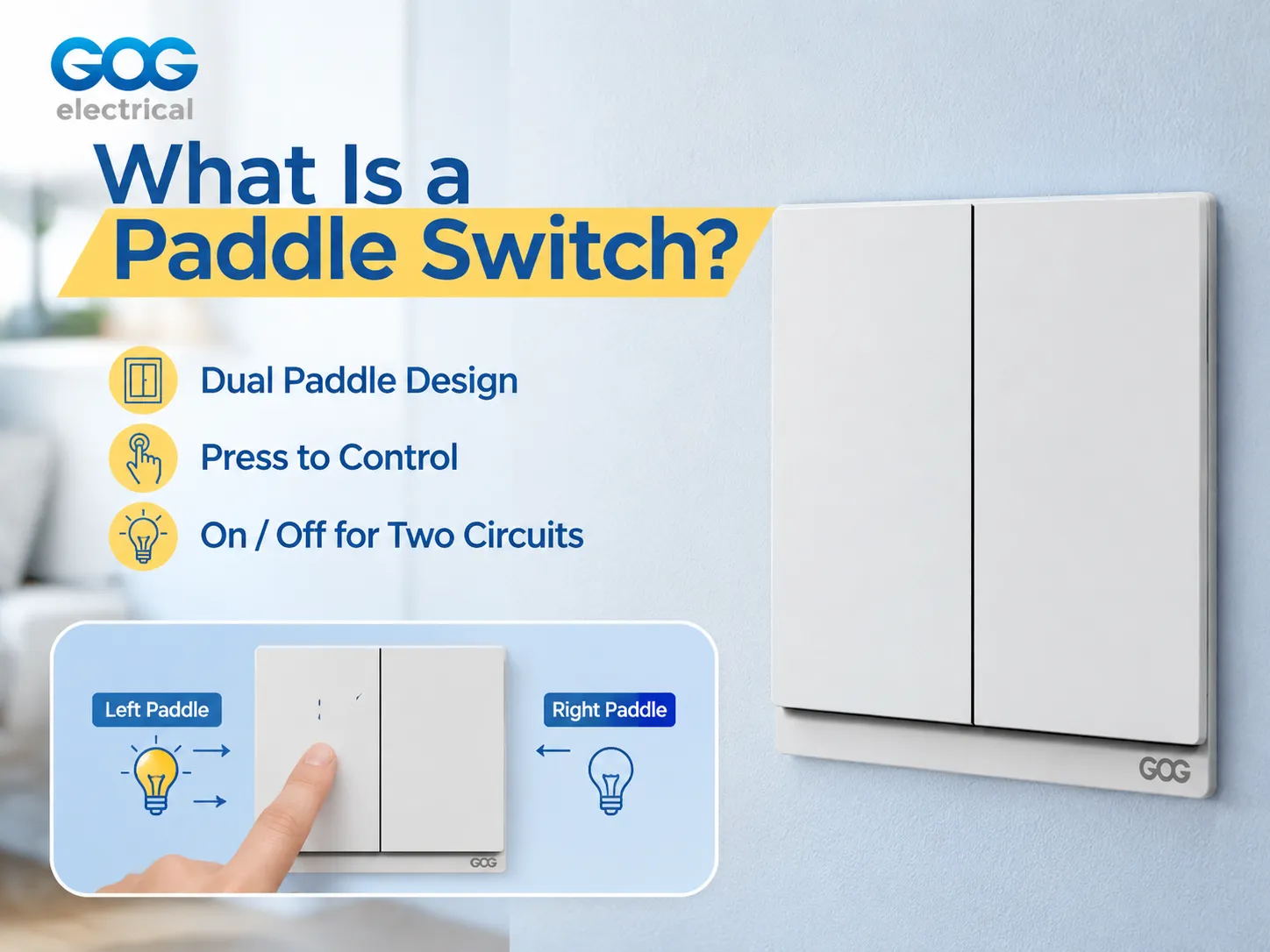
If you enter a modern home, you will notice a design structure made of a rectangular shape that operates on rocking of the switch. This device is called by names like, Rocker switches, Decorator switches, Paddle switches etc. Paddle switches have completely taken place of the conventional toggle switches, because of their ease of use. The guide describes the functioning of paddle switches, how it stands out in comparison to the toggle switch, how many varieties of paddle switches are available in the market today, how they can be connected, and how to choose the right ones among the available types.
In brief, a paddle switch is a type of light switch that has a rectangular-shaped paddle instead of a toggle lever. When the paddle is pressed, it rotates on a pivot point, which moves a spring-loaded arm either creating or breaking the circuit. The paddle will remain in the same position until someone comes to press it again. The paddle switch features the symbol “I” for ON and “O” for OFF. The various types of paddle switches available in the market are single-pole, 3-way, and 4-way switches, where the costs range from $2 to $50 depending on the quality of the switches.
Что такое Paddle Switch?
The paddle switch is a wall switch that has a wide, flat surface called the paddle, which is pressed to turn a light or other load on and off. Many people call it rocker switch or decorator switch after the “Decora” style of switch manufactured by Leviton. The terms are interchangeable in the industry:
- Paddle switch – the generic name for the wide rocker switch.
- Rocker switch – refers to the same equipment, due to its rocking action.
- Decora switch/decorator switch – the name of the brand derived from the rectangular plate type that fits the standard “decorator” wall plates.
How paddle is different from old toggle switch is in the surface. The toggle switch has a small lever that is switched up and down while the paddle switch has a large and flat surface that rocks.
What It Looks Like: The Decora-Style Face
Common paddle switches appear in the following manner:
- A paddle itself is wide and rectangular, approximately 1-1/4 inches wide and 3/4 inches tall to occupy a majority of the opening in the wall plate.
- One wall plate in a rectangular shape is known to be a “decorator” plate as it has a large rectangular rather than round toggle.
- Paddle switches display symbols like “I” and “O”, or sometimes have an indicator light.
The plate size is made standard so any production of paddle switch by any brand fits the decorator plate. Hence, it is of great significance for a new construction as it allows the mixing of different switches, dimmers, USB ports, and smart devices on a matching plate.
How a Paddle Switch Works
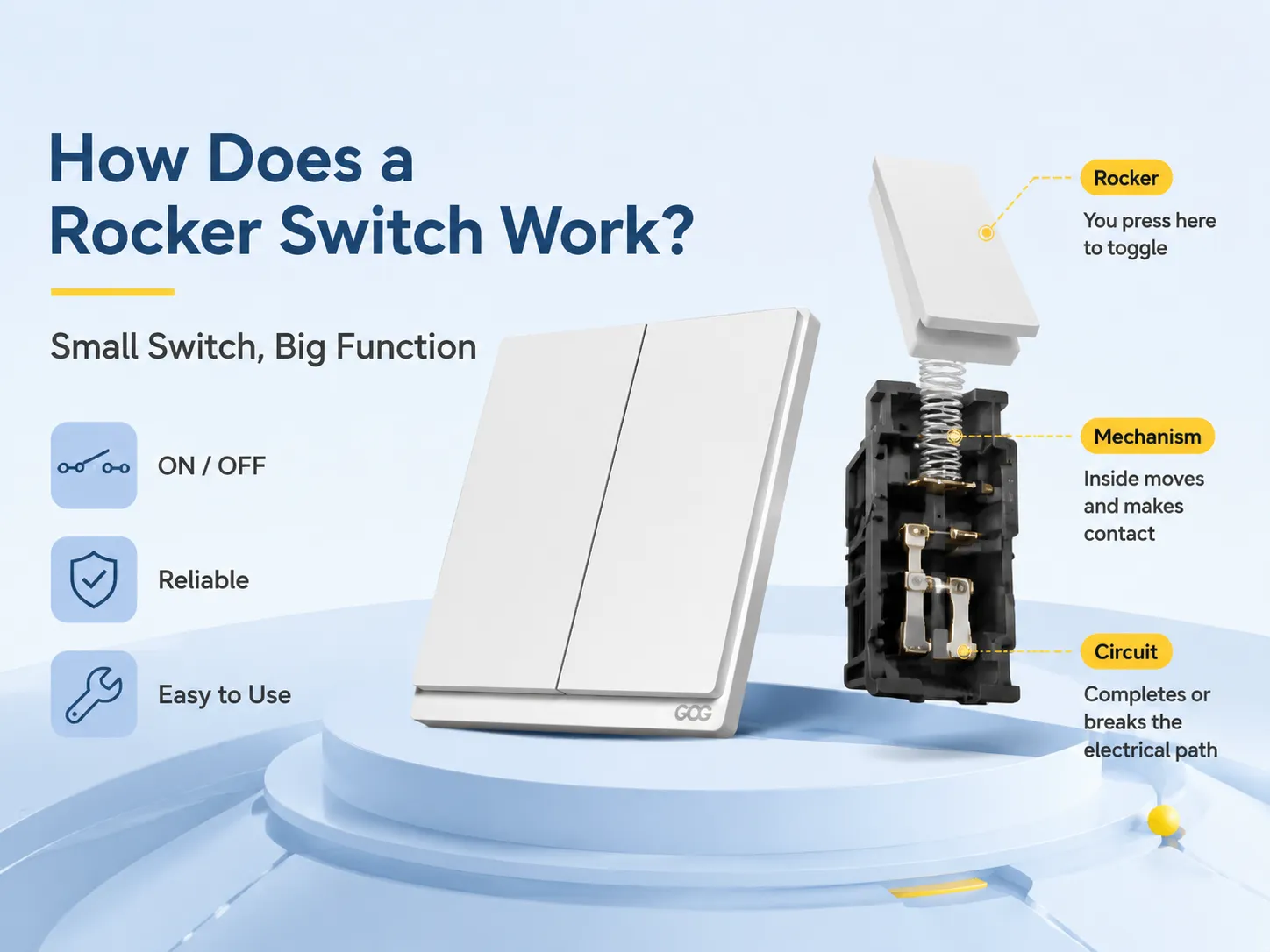
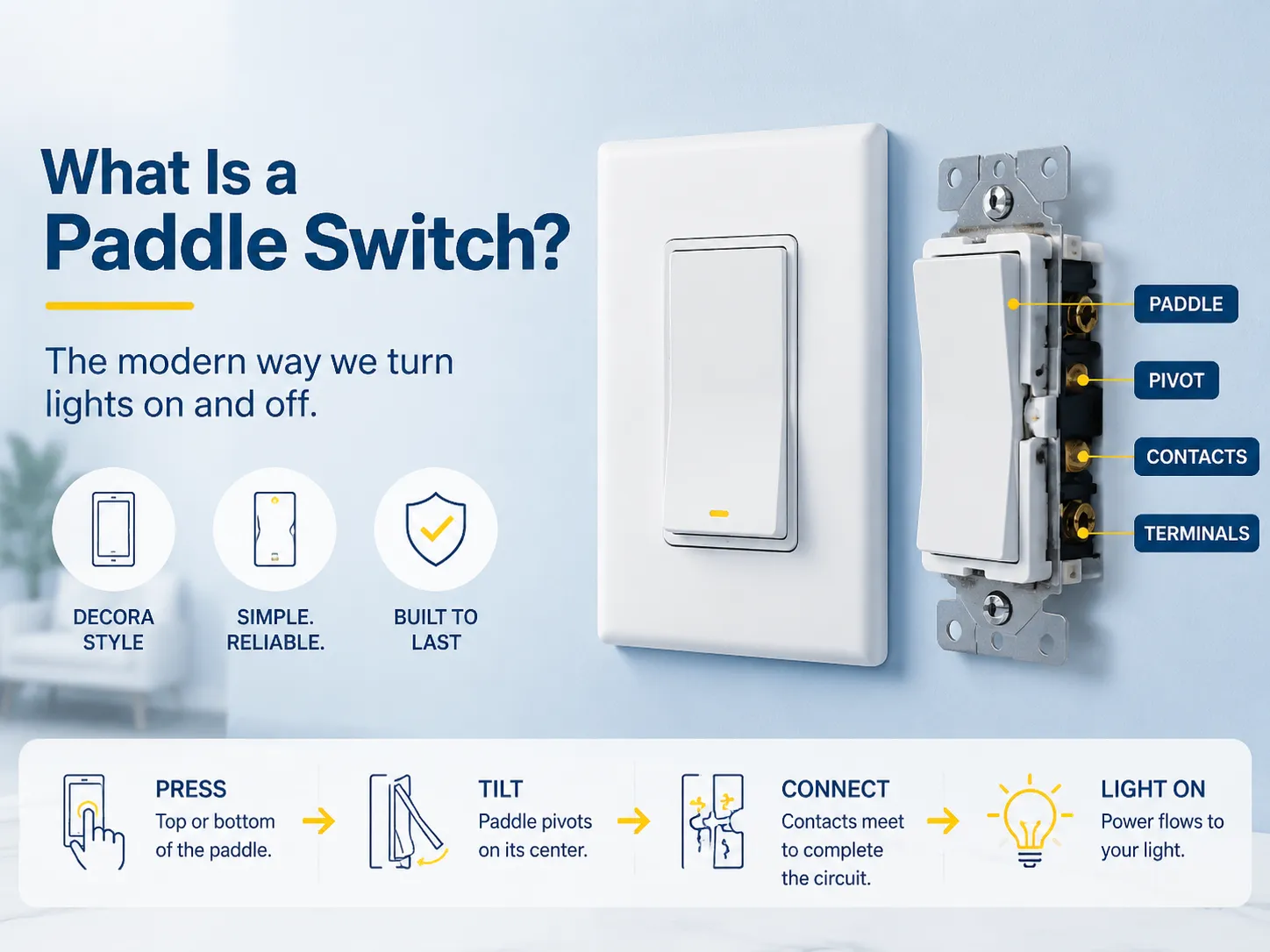
There is a very straightforward mechanism enclosed in the plastic casing — it is basically a seesaw that works as follows:
- Whenever you press the paddle’s upper edge, it pivots about the fulcrum at the center of the casing.
- The pivoting motion causes the internal actuator to be pushed, or alternatively, the spring-loaded contact arm to move directly towards the stationary terminal.
- The movable contact (a small silver or silver-alloy button) exerts pressure against the fixed contact terminal.
- At this stage, the circuit is closed and the electricity goes from the supply terminal to the load terminal making the light glow.
- The paddle, thanks to the detent spring, can hold its position until pressed again (this is called a latching/maintained switch).
When the other paddle’s end is pushed, the process goes backwards and the circuit is open. The most important fact about this mechanism is that it has a snap — the moment the contact opens the circuit, it doesn’t allow for electric arc, so that the high-quality paddle switches have very crisp functioning and serve for years.
Paddle vs Toggle: The Key Differences
| Характеристика | Paddle (Rocker) | Toggle (Traditional Lever) |
|---|---|---|
| Operating surface | Wide flat paddle | Small protruding lever |
| Action | Press one end; rocks | Flip up/down |
| Удобство использования | Easy — hit with palm, elbow, knee | Needs finger precision |
| Внешний вид | Modern, flush, clean lines | Traditional, protruding |
| Plate style | Rectangular “decorator” opening | Round toggle cutout |
| Accessibility | Better for limited dexterity | Harder to operate one-handed with arthritis |
| Typical price | $2-$8 basic | $2-$6 basic |
| Наличие | Dominates new construction | Common in older homes, some prefer the look |
Ultimately, it comes down to preference and ease of use: paddles are easier to use and look cooler; toggles have the more old-fashioned look and feel of switching in the way that many like. In terms of how they work, both are essentially the same with the internal electrical circuitry — the difference is in how they are used and their shape.
Types of Paddle Switches
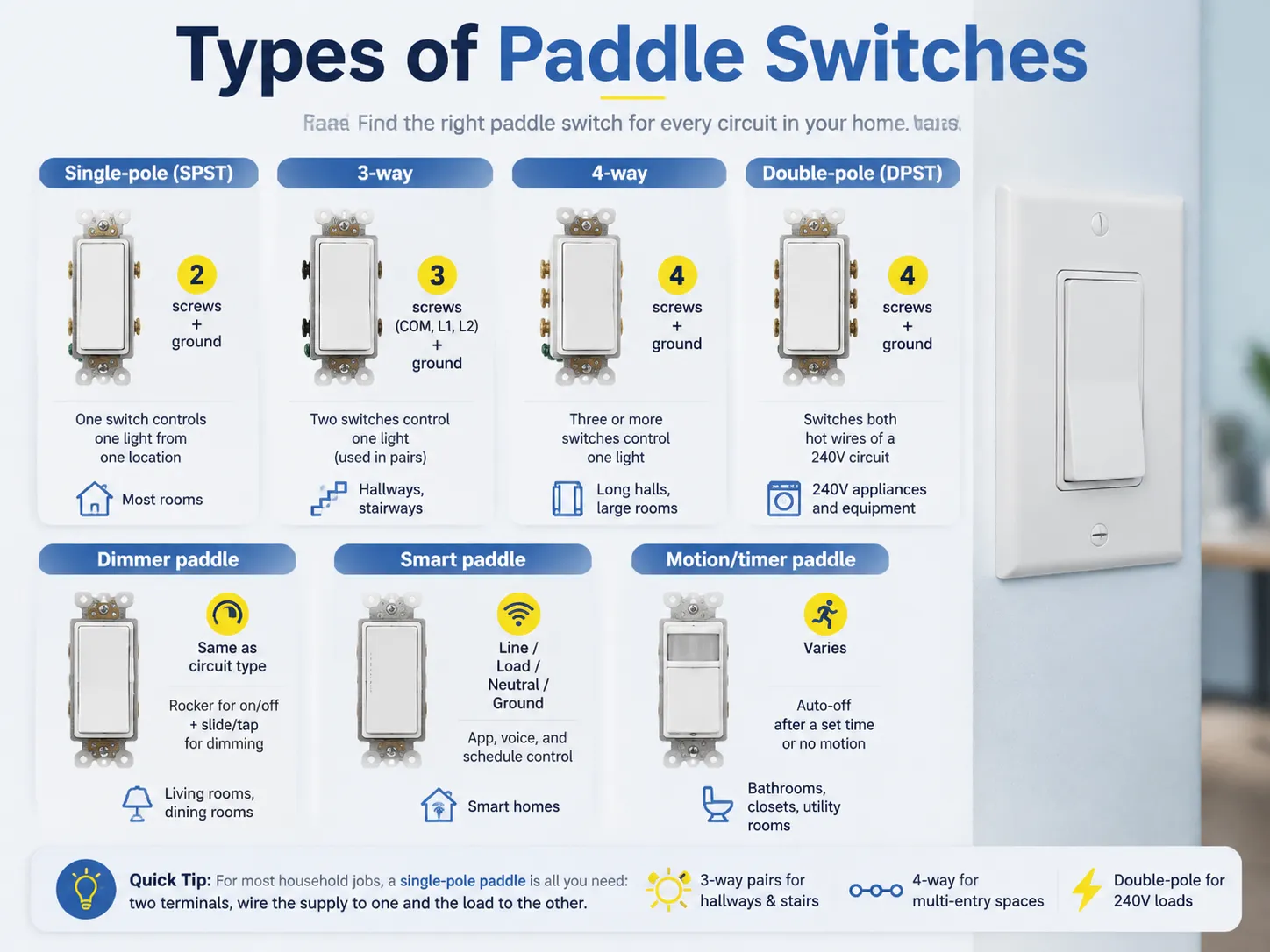
Paddle switches cover every circuit type you’d find in a home. The terminals tell you which one you have:
| Тип | Клеммы | Что оно делает | Типичное применение |
|---|---|---|---|
| Single-pole (SPST) | 2 screws + ground | One switch controls one light from one location | Most rooms |
| 3-way | 3 screws (COM, L1, L2) + ground | Two switches control one light (used in pairs) | Hallways, stairways, rooms with two entries |
| 4-way | 4 screws + ground | Three or more switches control one light | Long halls, large rooms |
| Double-pole (DPST) | 4 screws + ground | Switches both hot wires of a 240V circuit | 240V appliances and equipment |
| Dimmer paddle | Same as circuit type | Rocker for on/off + slide/tap for dimming | Living rooms, dining rooms |
| Smart paddle | Line/load/neutral/ground | App, voice, and schedule control | Smart homes |
| Motion/timer paddle | Varies | Auto-off after a set time or no motion | Bathrooms, closets, utility rooms |
Most home tasks require just a single-pole switch: connect the electricity to one of the two terminals and the devices to the other terminal. For hallways and staircases, 3-way switches are indicated, while areas with multiple entrances need 4-way mechanisms, and 240V devices need double-pole switches.
Which Way Is On and Off?
In a paddle switch, there is a standard that is written on the paddle: ‘I’ means ON and ‘O’ means OFF (IEC 60417 power symbols). If you press the “I” side of the switch down, it would turn ON; if you press the “O” side down it will turn OFF.
- Interpreting the paddles without any labels, the side that is pressed down indicates the ON position: if the bottom of the paddle is pressed down, the switch is ON.
- In addition to paddles with printed markings, there can also be illuminated paddles with a white light that indicates the ON and OFF state of the paddle. In this case, there can be some neon lights that turn ON when the paddle is OFF, so it is very important to check the label.
- It is important to note that you must never follow assumptions when dealing with a switch without any label. It is advisable to check the condition of the lamp or the meter and disconnect the power supply before working on the paddle.
A simple trick to remember: thanks to the way the letters look like, you will be able to quickly remember that ‘I’ refers to a closed electrical circuit, while ‘O’ means an open loop.
How to Wire a Paddle Switch
Wiring a regular single-pole paddle switch is a simple procedure but ensure safety measures:
- First, disconnect power at the breaker and ensure it is turned off using a voltage tester before doing anything.
- Identify the line run from the power source and the load run going to the light.
- Connect the line wire to one brass terminal and the load wire to the other terminal respectively. The wiring does not matter in the case of a SPST paddle switch since the wiring is symmetrical.
- Connect the ground wire to the green screw.
- Screw tight, put wires in the box, and install the switch to the plate.
- In case of a 3-way paddle, the common wire should connect to the COM terminal and the other two traveler wires go to L1 and L2 respectively. Make sure you connect exactly the same as the old switch before changing it. (It is advisable to click a picture of the previous wiring for reference.) In case of a smart paddle, you will need a neutral wire going to the switch box, a deeper back box, and smart paddle app for installation.
For readers from the UK/EU: the logic is the same but the colors are different where brown is live, blue is neutral (when switched live), and yellow-green is earth (COM=L1=L2).
Is a Paddle Switch a Deadman Switch?
No, a paddle switch is not the same as a deadman switch. Both of these switches have “switch” in their names which is a point of confusion for many people. However, they are fundamentally different.
| Характеристика | Paddle Switch | Deadman Switch |
|---|---|---|
| Тип | Latching (maintained) | Momentary (spring-return) |
| State | Stays on/off until pressed again | Active only while pressed/held |
| Typical use | Lights, appliances, wall control | Safety interlocks, machinery (lawnmower handle, saws), winch controls |
| Safety function | None inherent | Stops the machine when the operator lets go |
A deadman switch functions as a safety gadget that is intended to fail in a safe way: when the operator stops doing what he or she was doing, the device comes to a halt too. In the meantime, wall paddle switches are types of devices meant for convenience — touch it once and it holds down.
Common Applications & Where They’re Used
The professionals involved with construction and renovation have chosen paddle switches as their first choice for their efficiency and neat appearance:
- Residential wall switches – the norm in most modern homes in North America, but is becoming a frequent option in other parts of the world.
- Commercial and office spaces – designer-style paddles with sensors and timers in restrooms, and conference rooms.
- Accessible design – large blades allow for easier single-handed operation.
- Hotels and hospitality – neat paddle plates, available with USB charges and dimmers.
- Smart homes — smart paddle switches (Wi-Fi, Zigbee, Z-Wave) bring app and voice control while keeping the familiar physical paddle — like the 2-местный умный световой выключатель Tuya/Zigbee, which shows how the classic rocker interface carries into connected devices.
Brands, Prices & Specs
Paddle switches are inexpensive, universally available devices:
| Тип | Типичная цена |
|---|---|
| Basic single-pole paddle | $2-$8 |
| 3-way / 4-way paddle | $3-$10 |
| Illuminated paddle | $5-$12 |
| Paddle dimmer | $15-$40 |
| Motion-sensing paddle | $15-$35 |
| Smart paddle (Wi-Fi/Zigbee) | $15-$50 |
Features that make a good paddle different from a cheap one:
- Marks of credential — e.g. UL/ETL (for US), ENEC/CE (for EU), or equivalent in your local market.
- Contacts made of silver alloy — No bare copper or steel that would cause arc or pit formation.
- Firm detent — has to create a clear sound when the paddle shifts to a different state.
- Has to be rated for maximum load — for example, 15A/120V or 10A/250V.
- Reliable terminals — either screw type or quick-connect type which can grasp the wire securely.
Among the major brands are such companies as Leviton (pioneered Decora), Lutron (whose specialization is dimmer switches and smart paddles), Eaton, Pass & Seymour (Legrand), Hubbell, as well as discount brands such as BG, GE, TopGreener, ENERLITES, as well as smart technology brands such as TP-Link Kasa and Lutron Caseta. For OEM and wholesale programs, certified manufacturers like the global wiring device market’s top manufacturers supply decorator-style paddles across markets.
Часто задаваемые вопросы
What do paddle switches do?
A paddle switch is a type of switch that operates by using a paddle. Press the paddle in one direction to turn the light on and in the opposite direction to turn it off. A paddle switch has a locking mechanism that keeps it in position until it is pressed again. Paddle switches can be made into timers, dimmers, motion detectors, and other smart switches.
What are the differences between a toggle switch and a paddle switch?
The primary distinction is the interface: a toggle has a tiny knob that can be moved vertically, whereas a paddle has a wide horizontal surface that rocks backward and forward. Operability of paddles is much higher than that of toggles because paddles can be operated with palm, elbow or knee; also, they have a more modern look and correspond to rectangular decorative switch plates meanwhile toggles have a well-known mechanism and a physical toggle movement. The internal workings of both types of switches are the same: same contacts and circuit type. Paddles are widely used in newly-built houses; switches are still used for renovation.
How does a paddle switch work?
In the same way that a seesaw operates, a paddle switch operates; applying force to one of the ends rock the paddle about its central pivot point, making a contact arm containing a spring press against the contact terminal, thus closing the circuit. By pushing the other side, the contact moves away from the terminal and the circuit is opened. A detent spring secures the paddle in place.
Is a paddle switch a deadman switch?
A paddle switch is a switch that can be latched into the “on” or “off” position — it will remain there until repressed. The deadman switch is a momentary switch with spring mechanism, which is in the “active” position only when an operator pushes it — immediately stopping the machine when left to go (for example, operator of the mower or winch). Even though the function of “switch” is the same in both cases, the implications of their application are quite different.
Ссылки
- NFPA 70 — Национальный электротехнический кодекс (NEC), статья 404 Переключатели
- UL — UL 61058 Switches for Appliances / UL 20 General-Use Switches
- IEC 60669 — Switches for Household and Similar Fixed Electrical Installations
- Leviton — Decora Paddle Switch Product Line
- Lutron — Paddle Dimmer and Smart Switch Products
- ADA — Operable Controls Guidance (Rocker/Paddle Accessibility)
Заключение
The paddle switch serves as the advanced version of the wall switch: a broad rectangular lever that pivots to either stop or complete the circuit through a spring-operated contact. Once it’s pressed, it locks up and stays in place—one press is for turning on, another press for turning off. It is very convenient compared to toggles since they look cleaner when mounted on decorative wall plates, and the switches are available at many types of circuits and differ from the switches that just come with dimmers, motion sensors, and smart designs. The paddle switch is completely different from the deadman switch. The wiring of a simple single-pole paddle switch takes a little amount of time, but when buying the switch, you should pay attention to its certification, silver contacts, and positive stop.For the wider family of switch types and the wiring logic behind them, our guides to the типа световых выключателей, замене выключателя света, and the smart switch wiring requirements cover everything else you’ll meet at the wall box.