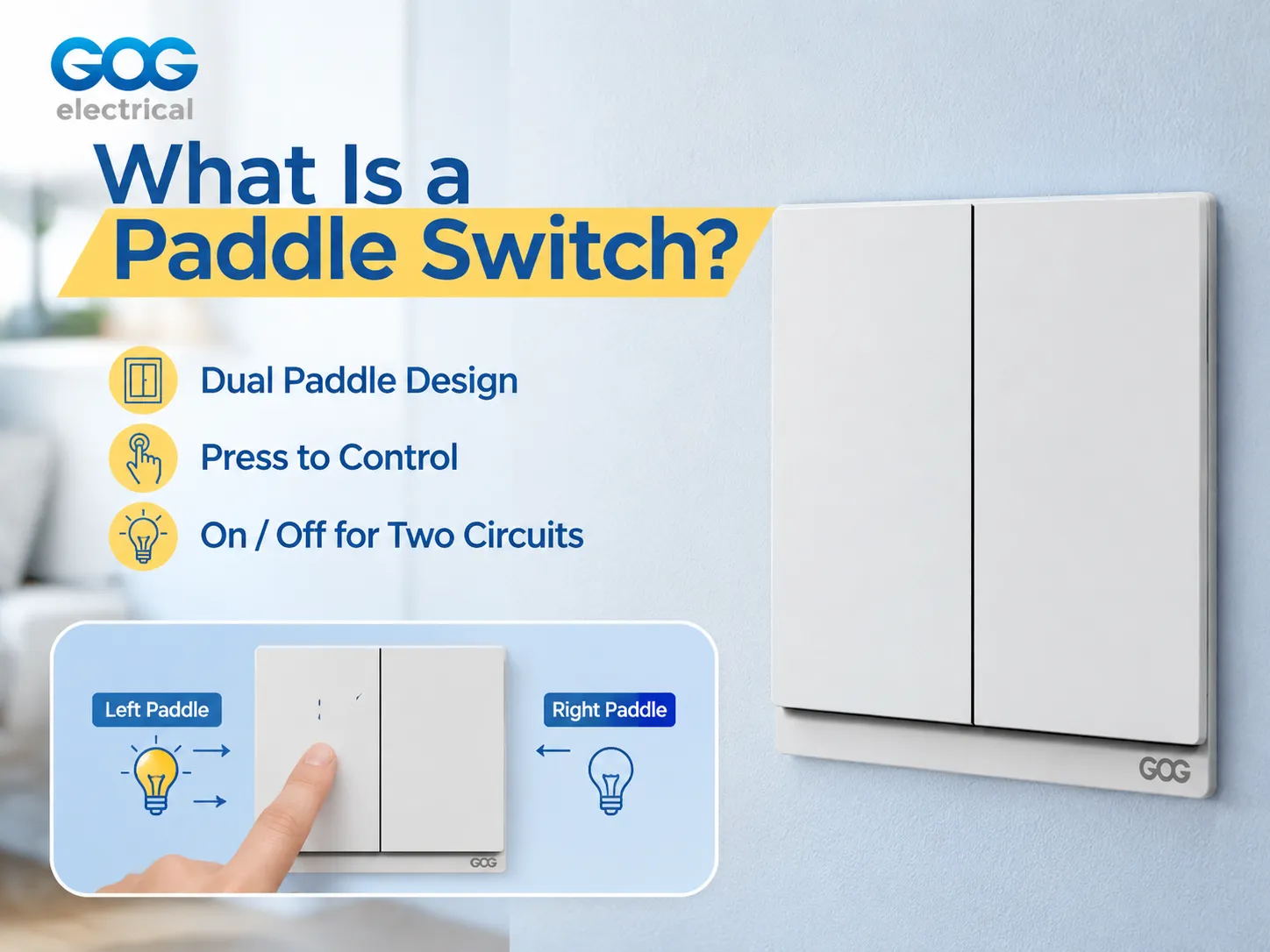
Si entras en una casa moderna, notarás una estructura de diseño hecha de una forma rectangular que funciona mediante el balanceo del switch. Este dispositivo es conocido por nombres como Rocker switches, Decorator switches, Paddle switches, etc. Los Paddle switches han reemplazado completamente a los interruptores de palanca convencionales debido a su facilidad de uso. La guía describe el funcionamiento de los paddle switches, cómo se destacan en comparación con el interruptor de palanca, cuántas variedades de paddle switches están disponibles en el mercado hoy en día, cómo pueden conectarse y cómo elegir los adecuados entre los tipos disponibles.
En resumen, un paddle switch es un tipo de interruptor de luz que tiene una paleta de forma rectangular en lugar de una palanca de palanca. Cuando se presiona la paleta, gira sobre un punto de pivote, lo que mueve un brazo con resorte que crea o rompe el circuito. La paleta permanecerá en la misma posición hasta que alguien la presione nuevamente. El paddle switch presenta el símbolo “I” para ENCENDIDO y “O” para APAGADO. Los diversos tipos de paddle switches disponibles en el mercado son interruptores unipolares, de 3 vías y de 4 vías, donde los costos varían desde $2 hasta $50 dependiendo de la calidad de los interruptores.
¿Qué es un interruptor de paleta?
El paddle switch es un interruptor de pared que tiene una superficie amplia y plana llamada paleta, que se presiona para encender o apagar una luz u otra carga. Muchas personas lo llaman rocker switch o decorator switch en referencia al estilo “Decora” de interruptor fabricado por Leviton. Los términos son intercambiables en la industria:
- Paddle switch – el nombre genérico para el rocker switch ancho.
- Rocker switch – se refiere al mismo equipo, debido a su acción de balanceo.
- Decora switch/decorator switch – el nombre de la marca derivado del tipo de placa rectangular que encaja en las placas de pared estándar “decorator”.
La diferencia entre la paleta y el interruptor de palanca antiguo está en la superficie. El interruptor de palanca tiene una pequeña palanca que se mueve hacia arriba y hacia abajo, mientras que el paddle switch tiene una superficie grande y plana que se balancea.
Cómo se ve: La cara estilo Decora
Los paddle switches comunes aparecen de la siguiente manera:
- La paleta en sí es ancha y rectangular, aproximadamente 1-1/4 pulgadas de ancho y 3/4 pulgadas de alto para ocupar la mayor parte de la abertura en la placa de pared.
- Una placa de pared en forma rectangular se conoce como placa “decorator” ya que tiene una palanca rectangular grande en lugar de redonda.
- Los paddle switches muestran símbolos como “I” y “O”, o a veces tienen una luz indicadora.
El tamaño de la placa es estándar para que cualquier producción de paddle switch de cualquier marca encaje en la placa decorator. Por lo tanto, es de gran importancia para una construcción nueva ya que permite mezclar diferentes interruptores, atenuadores, puertos USB y dispositivos inteligentes en una placa combinada.
Cómo funciona un Paddle Switch
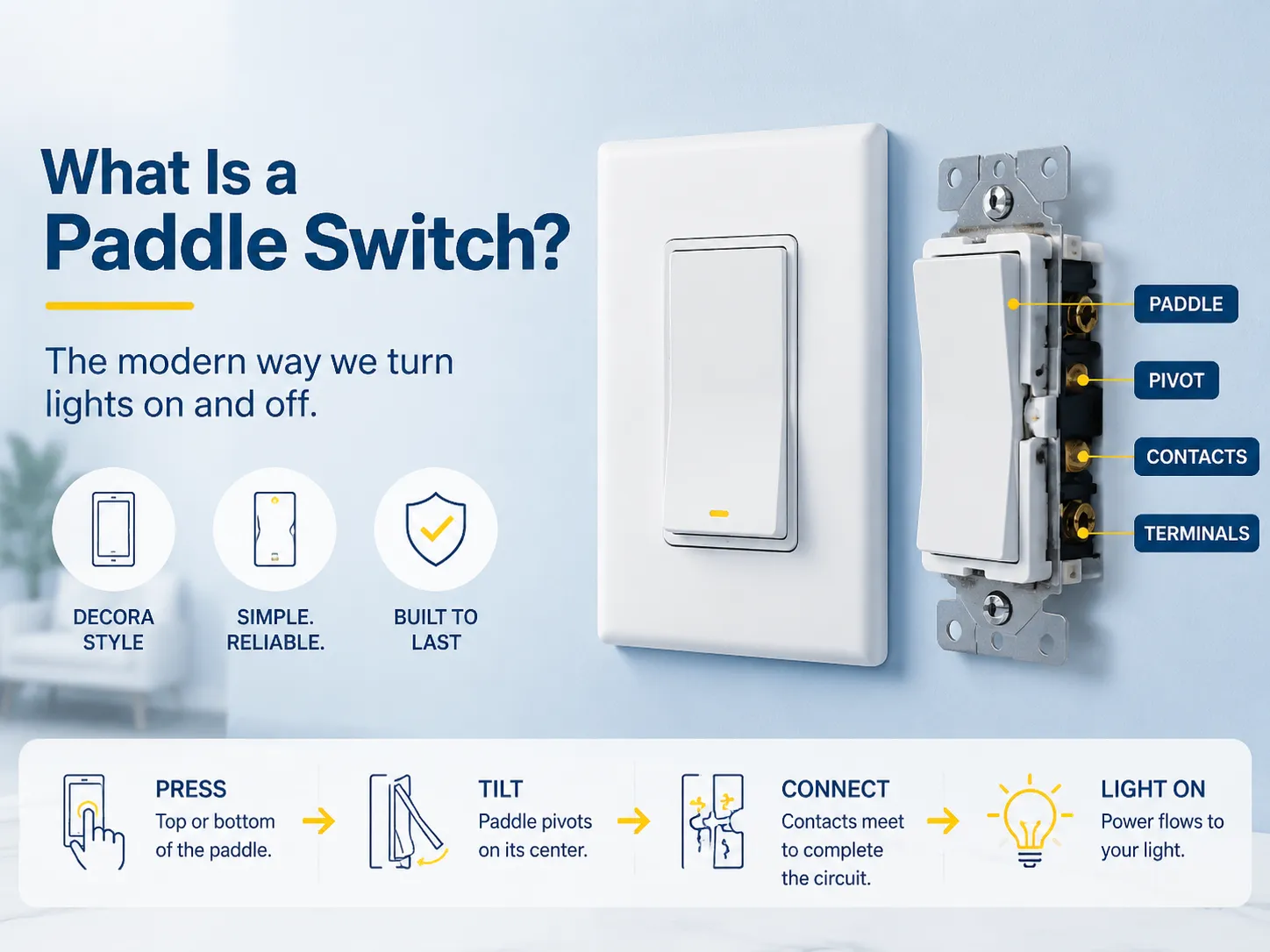
Hay un mecanismo muy sencillo encerrado en la carcasa de plástico — básicamente es un balancín que funciona de la siguiente manera:
- Cada vez que presionas el borde superior de la paleta, esta pivota sobre el fulcro en el centro de la carcasa.
- El movimiento de pivote hace que el actuador interno sea empujado, o alternativamente, que el brazo de contacto con resorte se mueva directamente hacia el terminal fijo.
- El contacto móvil (un pequeño botón de plata o aleación de plata) ejerce presión contra el terminal de contacto fijo.
- En esta etapa, el circuito se cierra y la electricidad va desde el terminal de suministro al terminal de carga haciendo que la luz se encienda.
- La paleta, gracias al resorte de retención, puede mantener su posición hasta que se presione nuevamente (esto se llama interruptor de enclavamiento/mantenido).
Cuando se presiona el otro extremo de la paleta, el proceso se invierte y el circuito se abre. El hecho más importante sobre este mecanismo es que tiene un clic — en el momento en que el contacto abre el circuito, no permite arco eléctrico, por lo que los interruptores de paleta de alta calidad tienen un funcionamiento muy nítido y duran años.
Paleta vs Palanca: Las Diferencias Clave
| Característica | Paleta (Rocker) | Palanca (Traditional Lever) |
|---|---|---|
| Superficie de operación | Paleta ancha y plana | Palanca pequeña y sobresaliente |
| Acción | Presionar un extremo; se balancea | Voltear hacia arriba/abajo |
| Facilidad de uso | Fácil — se puede accionar con la palma, el codo o la rodilla | Requiere precisión con el dedo |
| Apariencia | Moderno, empotrado, líneas limpias | Tradicional, sobresaliente |
| Estilo de placa | Apertura rectangular “decorativa” | Recorte redondo para palanca |
| Accesibilidad | Mejor para destreza limitada | Más difícil de operar con una mano en caso de artritis |
| Precio típico | $2-$8 básico | $2-$6 básico |
| Disponibilidad | Domina la construcción nueva | Común en casas antiguas, algunos prefieren su apariencia |
En última instancia, se reduce a la preferencia y facilidad de uso: las paletas son más fáciles de usar y tienen un aspecto más moderno; las palancas tienen un aspecto y sensación más tradicional que a muchos les gusta. En cuanto a su funcionamiento, ambos son esencialmente iguales en el circuito eléctrico interno — la diferencia está en cómo se usan y su forma.
Tipos de Interruptores de Paleta
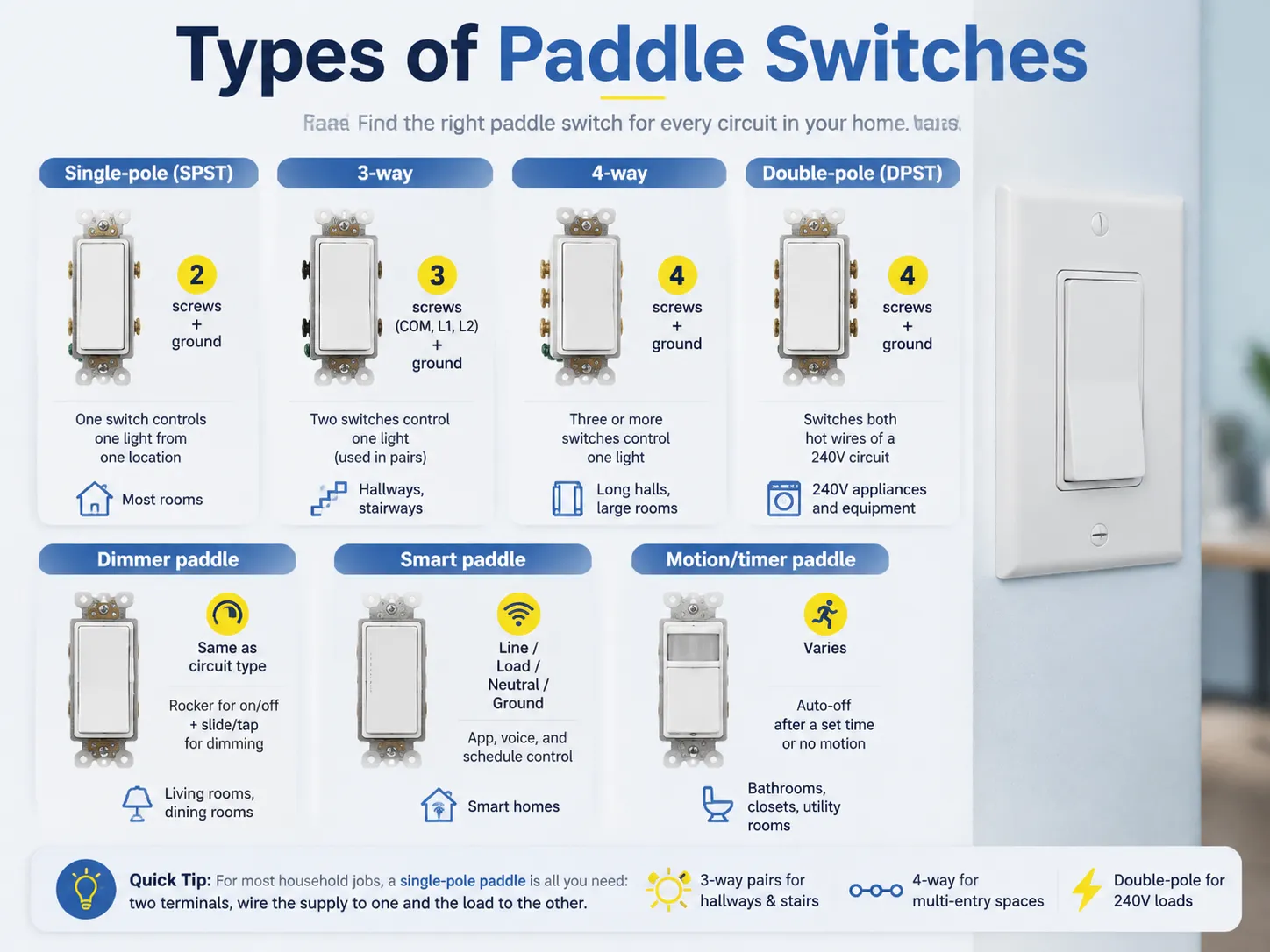
Los interruptores de paleta cubren todos los tipos de circuitos que encontrarías en un hogar. Los terminales indican cuál tienes:
| Tipo | Terminales | Qué hace | Uso típico |
|---|---|---|---|
| Unipolar (SPST) | 2 tornillos + tierra | Un interruptor controla una luz desde una ubicación | La mayoría de las habitaciones |
| 3 vías | 3 tornillos (COM, L1, L2) + tierra | Dos interruptores controlan una luz (usados en pares) | Pasillos, escaleras, habitaciones con dos entradas |
| 4 vías | 4 tornillos + tierra | Tres o más interruptores controlan una luz | Pasillos largos, habitaciones grandes |
| Doble polo (DPST) | 4 tornillos + tierra | Interrumpe ambos cables activos de un circuito de 240V | Aparatos y equipos de 240V |
| Paddle dimmer | Igual que el tipo de circuito | Rocker para encendido/apagado + deslizador/tap para atenuar | Salas de estar, comedores |
| Paddle inteligente | Línea/carga/neutral/tierra | Control por app, voz y programación | Hogares inteligentes |
| Paddle con sensor de movimiento/temporizador | Varía | Apagado automático después de un tiempo establecido o sin movimiento | Baños, armarios, cuartos de servicio |
La mayoría de las tareas domésticas requieren solo un interruptor unipolar: conecte la electricidad a uno de los dos terminales y los dispositivos al otro terminal. Para pasillos y escaleras, se indican interruptores de 3 vías, mientras que las áreas con múltiples entradas necesitan mecanismos de 4 vías, y los dispositivos de 240V requieren interruptores de doble polo.
¿Cuál es la posición de encendido y apagado?
En un interruptor paddle, hay un estándar que está escrito en el paddle: ‘I’ significa ENCENDIDO y ‘O’ significa APAGADO (símbolos de potencia IEC 60417). Si presiona el lado “I” del interruptor hacia abajo, se encenderá; si presiona el lado “O” hacia abajo, se apagará.
- Interpretando los paddles sin etiquetas, el lado que está presionado indica la posición ENCENDIDO: si la parte inferior del paddle está presionada, el interruptor está ENCENDIDO.
- Además de los paddles con marcas impresas, también puede haber paddles iluminados con una luz blanca que indica el estado ENCENDIDO y APAGADO del paddle. En este caso, puede haber algunas luces neón que se encienden cuando el paddle está APAGADO, por lo que es muy importante revisar la etiqueta.
- Es importante señalar que nunca debe seguir suposiciones al tratar con un interruptor sin etiqueta. Se recomienda verificar el estado de la lámpara o el medidor y desconectar la alimentación antes de trabajar en el paddle.
Un truco simple para recordar: gracias a la forma de las letras, podrá recordar rápidamente que ‘I’ se refiere a un circuito eléctrico cerrado, mientras que ‘O’ significa un circuito abierto.
Cómo cablear un interruptor paddle
Cablear un interruptor paddle unipolar regular es un procedimiento simple, pero asegure las medidas de seguridad:
- Primero, desconecte la energía en el interruptor automático y asegúrese de que esté apagado usando un probador de voltaje antes de hacer cualquier cosa.
- Identifique el cable de línea proveniente de la fuente de energía y el cable de carga que va a la luz.
- Conecte el cable de línea a un terminal de latón y el cable de carga al otro terminal respectivamente. El cableado no importa en el caso de un interruptor paddle SPST ya que el cableado es simétrico.
- Conecte el cable de tierra al tornillo verde.
- Apriete los tornillos, coloque los cables en la caja e instale el interruptor en la placa.
- En el caso de un paddle de 3 vías, el cable común debe conectarse al terminal COM y los otros dos cables viajeros van a L1 y L2 respectivamente. Asegúrese de conectar exactamente igual que el interruptor antiguo antes de cambiarlo. (Se recomienda tomar una foto del cableado anterior como referencia.) En el caso de un paddle inteligente, necesitará un cable neutro que vaya a la caja del interruptor, una caja trasera más profunda y la aplicación del paddle inteligente para la instalación.
Para lectores del Reino Unido/UE: la lógica es la misma pero los colores son diferentes, donde marrón es vivo, azul es neutro (cuando está vivo conmutado), y amarillo-verde es tierra (COM=L1=L2).
¿Es un Paddle Switch un Deadman Switch?
No, un paddle switch no es lo mismo que un deadman switch. Ambos interruptores tienen “switch” en sus nombres, lo que genera confusión para muchas personas. Sin embargo, son fundamentalmente diferentes.
| Característica | Interruptor de paleta | Interruptor de hombre muerto |
|---|---|---|
| Tipo | Retenedor (mantenido) | Momentáneo (retorno por resorte) |
| Estado | Permanece encendido/apagado hasta que se presiona nuevamente | Activo solo mientras se presiona/mantiene |
| Uso típico | Luces, electrodomésticos, control de pared | Bloqueos de seguridad, maquinaria (manillar de cortacésped, sierras), controles de cabrestante |
| Función de seguridad | Ninguna inherente | Detiene la máquina cuando el operador suelta |
Un interruptor de hombre muerto funciona como un dispositivo de seguridad que está diseñado para fallar de manera segura: cuando el operador deja de hacer lo que estaba haciendo, el dispositivo también se detiene. Mientras tanto, los interruptores de paleta de pared son tipos de dispositivos diseñados para conveniencia: tóquelo una vez y se mantiene presionado.
Aplicaciones comunes y dónde se usan
Los profesionales involucrados en la construcción y renovación han elegido los interruptores de paleta como su primera opción por su eficiencia y apariencia ordenada:
- Interruptores de pared residenciales: la norma en la mayoría de los hogares modernos en Norteamérica, pero se está convirtiendo en una opción frecuente en otras partes del mundo.
- Espacios comerciales y oficinas: paletas de estilo diseñador con sensores y temporizadores en baños y salas de conferencias.
- Diseño accesible: paletas grandes que permiten una operación más fácil con una sola mano.
- Hoteles y hospitalidad: placas de paleta ordenadas, disponibles con cargadores USB y reguladores de intensidad.
- Hogares inteligentes: interruptores de paleta inteligentes (Wi-Fi, Zigbee, Z-Wave) que ofrecen control por aplicación y voz mientras mantienen la paleta física familiar, como el interruptor inteligente de luz Tuya/Zigbee de 2 módulos, que muestra cómo la interfaz clásica de balancín se traslada a dispositivos conectados.
Marcas, precios y especificaciones
Los interruptores de paleta son dispositivos económicos y universalmente disponibles:
| Tipo | Precio típico |
|---|---|
| Paleta básica unipolar | $2-$8 |
| Paleta de 3 vías / 4 vías | $3-$10 |
| Paleta iluminada | $5-$12 |
| Regulador de paleta | $15-$40 |
| Paleta con sensor de movimiento | $15-$35 |
| Paleta inteligente (Wi-Fi/Zigbee) | $15-$50 |
Características que hacen que una buena paleta sea diferente de una barata:
- Marcas de certificación — por ejemplo, UL/ETL (para EE. UU.), ENEC/CE (para UE), o equivalente en su mercado local.
- Contactos hechos de aleación de plata — sin cobre o acero desnudo que pueda causar formación de arco o picaduras.
- Tope firme — debe crear un sonido claro cuando la paleta cambia a un estado diferente.
- Debe estar clasificado para la carga máxima — por ejemplo, 15A/120V o 10A/250V.
- Terminales confiables — ya sea tipo tornillo o tipo de conexión rápida que pueda sujetar el cable de forma segura.
Entre las principales marcas se encuentran empresas como Leviton (pionero de Decora), Lutron (especializado en reguladores y paletas inteligentes), Eaton, Pass & Seymour (Legrand), Hubbell, así como marcas de descuento como BG, GE, TopGreener, ENERLITES, además de marcas de tecnología inteligente como TP-Link Kasa y Lutron Caseta. Para programas OEM y mayoristas, fabricantes certificados como los principales fabricantes globales del mercado de dispositivos de cableado suministran paletas de estilo decorativo en todos los mercados.
Preguntas frecuentes
¿Qué hacen los interruptores de paleta?
Un interruptor de paleta es un tipo de interruptor que funciona usando una paleta. Presione la paleta en una dirección para encender la luz y en la dirección opuesta para apagarla. Un interruptor de paleta tiene un mecanismo de bloqueo que lo mantiene en posición hasta que se presiona nuevamente. Los interruptores de paleta pueden convertirse en temporizadores, reguladores, detectores de movimiento y otros interruptores inteligentes.
¿Cuáles son las diferencias entre un interruptor de palanca y un interruptor de paleta?
La distinción principal es la interfaz: un toggle tiene una pequeña perilla que se puede mover verticalmente, mientras que un paddle tiene una amplia superficie horizontal que se balancea hacia adelante y hacia atrás. La operabilidad de los paddles es mucho mayor que la de los toggles porque los paddles pueden ser operados con la palma, el codo o la rodilla; además, tienen un aspecto más moderno y corresponden a placas decorativas rectangulares para interruptores, mientras que los toggles tienen un mecanismo conocido y un movimiento físico de palanca. El funcionamiento interno de ambos tipos de interruptores es el mismo: mismos contactos y tipo de circuito. Los paddles se usan ampliamente en casas de nueva construcción; los interruptores todavía se usan para renovaciones.
¿Cómo funciona un paddle switch?
De la misma manera que funciona un balancín, un paddle switch opera; al aplicar fuerza en uno de los extremos, el paddle se balancea alrededor de su punto de pivote central, haciendo que un brazo de contacto que contiene un resorte presione contra el terminal de contacto, cerrando así el circuito. Al empujar el otro lado, el contacto se aleja del terminal y el circuito se abre. Un resorte de retención asegura el paddle en su lugar.
¿Es un paddle switch un interruptor de hombre muerto?
Un paddle switch es un interruptor que puede quedar bloqueado en la posición “on” o “off” — permanecerá allí hasta que se presione nuevamente. El interruptor de hombre muerto es un interruptor momentáneo con mecanismo de resorte, que está en la posición “activo” solo cuando un operador lo presiona — deteniendo inmediatamente la máquina cuando se suelta (por ejemplo, operador de la cortadora o cabrestante). Aunque la función de “interruptor” es la misma en ambos casos, las implicaciones de su aplicación son bastante diferentes.
Referencias
- NFPA 70 — Código Eléctrico Nacional (NEC), Artículo 404 Interruptores
- UL — UL 61058 Interruptores para Electrodomésticos / UL 20 Interruptores de Uso General
- IEC 60669 — Interruptores para Instalaciones Eléctricas Fijas Domésticas y Similares
- Leviton — Línea de Productos Decora Paddle Switch
- Lutron — Productos Paddle Dimmer y Smart Switch
- ADA — Guía de Controles Operables (Accesibilidad Rocker/Paddle)
Conclusión
El paddle switch sirve como la versión avanzada del interruptor de pared: una palanca rectangular ancha que pivota para detener o completar el circuito a través de un contacto operado por resorte. Una vez presionado, se bloquea y permanece en su lugar—una presión para encender, otra para apagar. Es muy conveniente comparado con los toggles ya que lucen más limpios cuando se montan en placas decorativas de pared, y los interruptores están disponibles en muchos tipos de circuitos y difieren de los interruptores que solo vienen con atenuadores, sensores de movimiento y diseños inteligentes. El paddle switch es completamente diferente del interruptor de hombre muerto. El cableado de un paddle switch simple de un solo polo toma poco tiempo, pero al comprar el interruptor, debe prestar atención a su certificación, contactos de plata y tope positivo. Para la familia más amplia de tipos de interruptores y la lógica de cableado detrás de ellos, nuestras guías sobre el cuatro tipos de interruptores de luz, reemplazar un interruptor de luz, y el requisitos de cableado para smart switch cubren todo lo demás que encontrará en la caja de pared.