Новый тип гостиничных номеров открывается включением настенной панели, которая действует как выключатель включения и выключения комнаты. Аналогично, включая и выключая шкаф, оснащённый подсветкой, вы открываете кухонный шкаф. Каждый раз, садясь в автомобиль, вы нажимаете кнопку на панели управления, которая является кнопкой активации внутреннего освещения автомобиля. Таким образом, все эти примеры показывают, что сенсорные выключатели могут использоваться вместо механических выключателей без ведома потребителей. Когда мы говорим о сенсорных выключателях, мы охватываем множество устройств в определении сенсорных выключателей. Не все устройства, работающие по принципу касания, можно классифицировать как сенсорные выключатели. Это связано с тем, что некоторые устройства работают на принципах ёмкостных датчиков, в то время как другие устройства соответствуют базовой механике, имея механические выключатели под стеклянной поверхностью. Следовательно, принципы работы ёмкостных датчиков отличаются от принципов функционирования других устройств. Поэтому необходимо знать, какой тип устройства покупается.
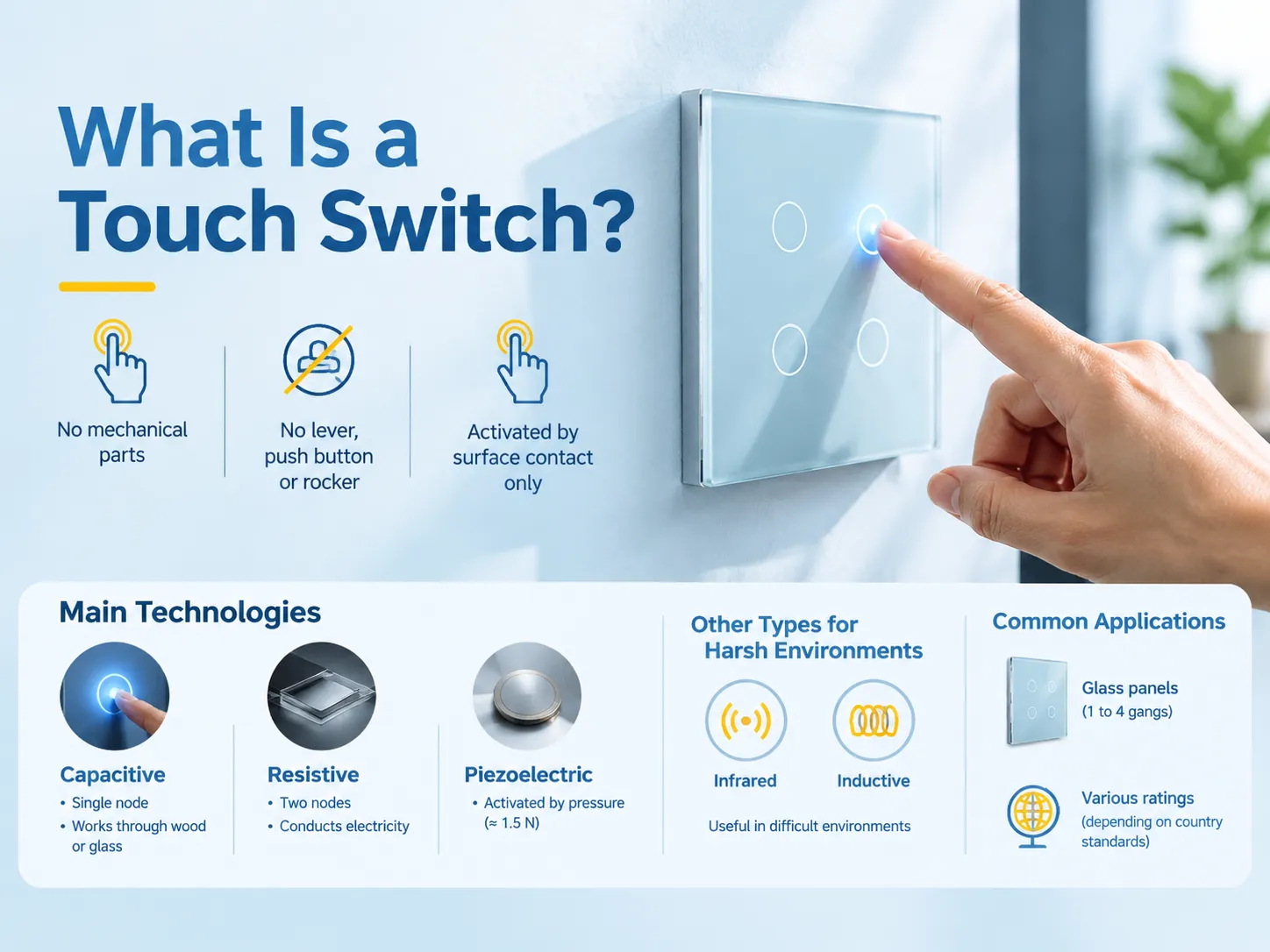
Термин сенсорный выключатель относится к оборудованию, не имеющему механических частей для его включения, так как оно работает через применение электрического контакта и, следовательно, не управляется с помощью рычага, кнопки или клавиши, а только через контакт, расположенный на внешней поверхности устройства. Сенсорные выключатели можно классифицировать на три основные категории в зависимости от технологии: ёмкостные (включаются при прикосновении пальца, имеют одну точку контакта и способны работать через дерево или стекло), резистивные (используются в выключателях с двумя точками контакта и способны проводить электричество) и пьезоэлектрические (используются в выключателях, изготовленных с применением пьезоэлектрического материала под давлением около 1,5 Н). Также следует упомянуть, что инфракрасные и индуктивные выключатели могут применяться в сложных условиях эксплуатации. В общем, сенсорные выключатели чаще всего относятся к ёмкостному типу и могут применяться на стеклянных панелях с одним до четырёх модулей. Кроме того, сенсорные выключатели имеют различные технические характеристики в зависимости от стандартов, принятых в разных странах.
Где вы уже встречали сенсорные выключатели
Технология сенсорного переключения была изобретена давно, раньше, чем думает большинство людей. Технология сенсорного переключения работает на принципе, что заряд указывает на изменение ёмкости объекта, который приблизился к электроду. Таким образом, самая простая форма технологии сенсорного переключения может быть найдена в “сенсорной лампе”, способной изменять яркость трижды в зависимости от касания ножного переключателя.
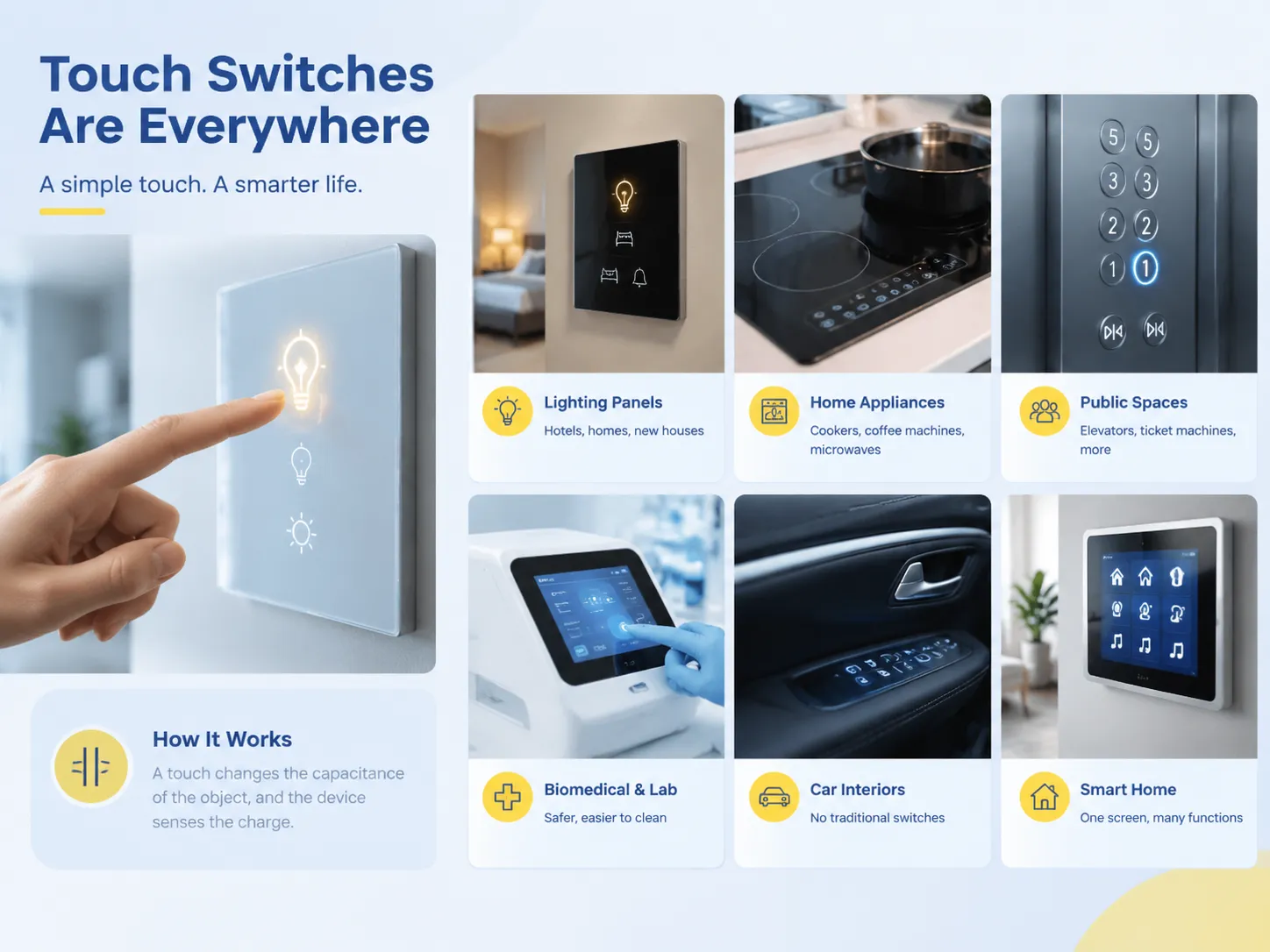
Технология сенсорного переключения была внедрена в различные устройства, такие как:
- Панели освещения в отелях, жилых помещениях и недавно построенных домах, которые обычно изготовлены из стекла и имеют иконки, светящиеся из фона.
- Бытовые приборы, индукционные плиты, кофемашины и микроволновые печи современного типа, которые легче чистить благодаря плоской поверхности по сравнению с ручками.
- Пульты управления лифтами, билетные автоматы и другие общественные приборы, где герметичные поверхности помогают противостоять как вандализму, так и химической очистке.
- Биомедицинские и лабораторные приборы, где отсутствие зазоров облегчает контроль за инфекциями.
- Интерьеры автомобилей, где технология сенсорных переключателей заменила традиционные выключатели на дверных панелях и потолочных консолях.
- Панели управления умным домом, где стеклянный экран также может служить управляющим устройством для различных функций.
Наблюдается тенденция использования технологии сенсорных переключателей в местах, где чистота поверхности или легкость её очистки важнее, чем тактильная обратная связь, обеспечиваемая механическими переключателями.
Что на самом деле делает сенсорный переключатель
Сенсорный переключатель по сути выполняет ту же функцию, что и механический переключатель, помогая открывать или закрывать цепи. По функциональности между ними нет сходства.
- Механический переключатель состоит из исполнительного элемента, пружины и подвижного контакта. Пользователь нажимает на исполнительный элемент, тем самым замыкая или размыкая контакты. Пользователь слышит и ощущает щелчок, который сообщает ему об успешном выполнении операции.
- Сенсорный переключатель — это тип переключателя без исполнительного элемента. Принцип работы сенсорной кнопки заключается в том, что схема обнаружения контролирует необходимую поверхность. Когда поверхность стимулируется, генерируется сигнал, приводящий в действие переключающее реле, триак или твердотельный переключатель.
Это приводит к трем объективным результатам:
| Свойство | Механический переключатель | Сенсорный переключатель |
|---|---|---|
| Подвижные части | Да — исполнительный элемент, контакты, пружина | Отсутствуют в истинных ёмкостных или пьезо конструкциях |
| Обратная связь | Тактильная и звуковая, присущая механизму | Должна быть предусмотрена — светодиод, подсветка, звуковой сигнал |
| Потребление энергии | Отсутствует; чисто механический | Небольшой ток покоя для схемы обнаружения |
| Легкость очистки поверхности | Щели вокруг исполнительного элемента собирают грязь | Заподлицо и герметично; легко протирается |
| Износ механизма | Механический износ контактов и пружины | Старение электроники; царапины на поверхности |
| Работа в перчатках | Всегда работает | Зависит от технологии и толщины перчаток |
| Риск случайного срабатывания | Низкий | Выше — могут срабатывать от домашних животных, рукавов, брызг |
Этот момент с током покоя важнее, чем кажется. Сенсорный переключатель — это электронное устройство, и в большинстве случаев он требует наличия как фазного, так и нейтрального проводов, которые всегда под напряжением в монтажной коробке. В старой электропроводке, где к выключателю подведён только фазный провод, что характерно для британских и некоторых континентальных установок, может потребоваться прокладка нейтрального провода для сенсорного переключателя или использование конструкции “без нейтрали”, которая получает питание от нагрузки. Указанный аспект является очень важным фактором при установке, который хороший поставщик обязательно проверит в первую очередь.
Как работают сенсорные переключатели
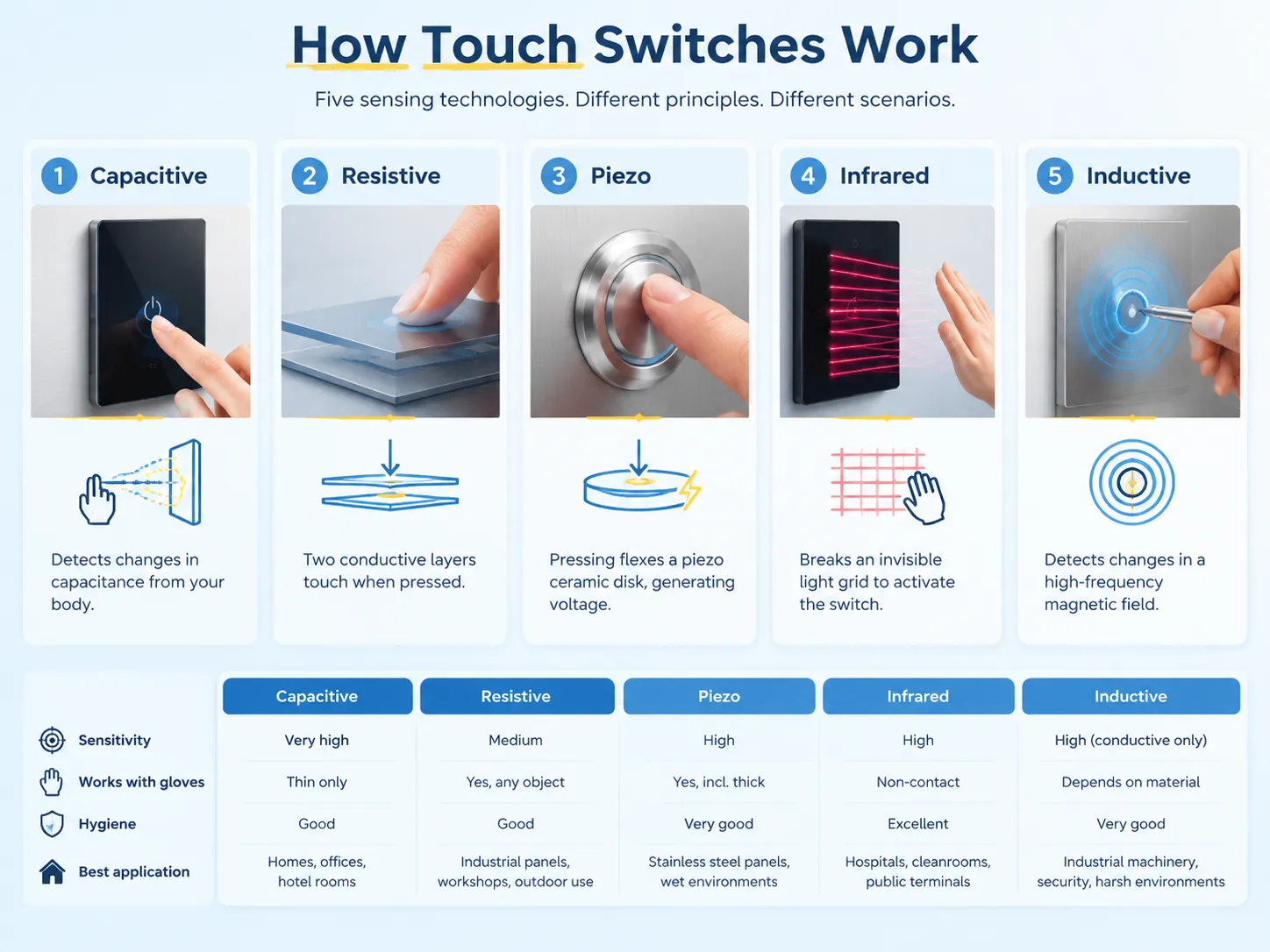
Существует пять различных типов технологий сенсорного обнаружения, и хотя они функционируют по-разному, обычно выбирается неправильная технология для предполагаемой среды.
- Емкостные сенсорные выключатели являются самой популярной технологией, используемой в домах и офисах. Этот тип выключателя состоит из малой электроды, которая размещается за крышкой и постоянно заряжается и разряжается для определения емкости. Из-за того, что средний человек обладает достаточной емкостью тела, чтобы при контакте с электродом изменить показания достаточно для замыкания цепи, у этой технологии есть некоторые преимущества. Главное из них — размер электрода скрыт за непроводящей панелью, поэтому сенсорная поверхность может быть выполнена из пластика, стекла, камня, дерева и т.д. Концепция собственной емкости означает использование одного электрода, тогда как взаимная (или проекционная) емкость предполагает использование пары из двух электродов, что способствует большей компактности и лучшему различению соседних выключателей, но при этом возникает дополнительный шум. Емкостные выключатели активируются даже при ношении тонких перчаток, в то время как влияние влаги, пыли и других факторов очень значимо.
- Резистивные сенсорные выключатели являются более простыми и традиционными устройствами. Они состоят из двух слоев проводящего материала, разделенных небольшим зазором. Когда поверхность выключателя нажимается, два слоя соприкасаются, и сопротивление увеличивается, на основании чего цепь обнаруживает нажатие. Поскольку этот тип выключателя основан на давлении, а не на емкости тела пользователя, он работает с любым объектом. Однако проблема в том, что выключатель должен быть нажат существенно, и из-за нескольких движущихся механических частей устройство становится громоздким. Резистивные сенсорные выключатели используются в промышленности, мастерских и на открытом воздухе, но не в домашних условиях.
- Пьезо сенсорные выключатели работают с использованием пьезоэлектрического керамического диска, который изгибается при нажатии, генерируя напряжение. Преимущества пьезо выключателей включают возможность работы через любой материал, включая толстые перчатки или металлические поверхности, надежность и отсутствие механических частей. Пьезо выключатели несколько дороже емкостных, но используются в ситуациях, где такая премия оправдана.
- Инфракрасные сенсорные выключатели создают сетку невидимых световых лучей с помощью светодиодов и фотодетекторов, при разрыве которой происходит активация устройства. Таким образом, инфракрасные выключатели достаточно гигиеничны и подходят для различных целей, но подвержены влиянию света, пыли и влажности.
- Индуктивные выключатели генерируют высокочастотное электромагнитное поле и обнаруживают изменения в поле при попадании в него любого проводящего объекта. Этот тип выключателей устойчив к ложным срабатываниям и влажности, но активируются только проводящими объектами.
| Технология | Чувствительность | Работает в перчатках | Гигиена | Лучшее применение |
|---|---|---|---|---|
| Ёмкостный | Очень высокая | Только тонкий | Хорошо | Дома, офисы, гостиничные номера, умные панели |
| Резистивный | Средний | Да, любой объект | Хорошо | Промышленные панели, мастерские, уличное использование |
| Пьезо | Высокий | Да, в том числе толстые | Очень хорошо | Панели из нержавеющей стали, влажные и промышленные условия |
| Инфракрасный | Высокий | Бесконтактный | Отлично | Больницы, чистые помещения, общественные терминалы |
| Индуктивный | Высокая, только проводящие | Зависит от материала | Очень хорошо | Промышленное оборудование, безопасность, суровые условия |
Основные типы сенсорных выключателей
При переходе от технологии сенсоров к продуктам типы меняются еще раз. Это те типы сенсорных выключателей, о которых на самом деле принимаются решения.
- Настенный сенсорный выключатель (выключатель света): ёмкостная панель из стекла или акрила, заменяющая стандартный выключатель освещения, с выбором от 1 до 4 клавиш. Может быть однополюсным для одного светильника, двухпозиционным устройством, позволяющим управлять светом из двух точек, и промежуточным выключателем, необходимым при наличии трех и более точек управления светом. Это определение сенсорного выключателя по мнению многих специалистов.
- Сенсорный диммер: выключатель такой же, как обычный, но обеспечивает комбинацию функций — включение и выключение света короткими касаниями и регулировку яркости с помощью длительных касаний, при этом диммер может позволять выполнять скользящие жесты по поверхности устройства. Единственная проблема этого устройства — необходимость подключения к нагрузке, предназначенной для диммирования, то есть к диммируемым LED-драйверам или другим аналогичным устройствам вместо обычных ламп.
- Сенсорный выключатель розетки (электрической розетки): такие устройства обычно имеют розетку с сенсорным выключателем вместо обычного и могут быть оснащены зарядными портами USB или USB-C. Распространенный пример таких устройств — гостиничные номера, где используются как обычные, так и сенсорные розетки, включая USB-порты.
- Умная сенсорная панель: умная сенсорная панель — это сенсорный выключатель с поддержкой Wi-Fi, Zigbee, Bluetooth или Z-Wave, управляемый с помощью специализированных приложений и голосовых ассистентов. В некоторых случаях такие продукты могут заменить несколько выключателей, работающих совместно.
- Сенсорный дверной звонок и сигнальные выключатели: продукт может использоваться для сигнализации и среди своих функций работает как кнопка.
- Промышленные и панельные сенсорные переключатели: Такие устройства включают пьезоэлектрические устройства, индуктивные или инфракрасные переключатели, используемые для управления оборудованием.
В то же время важно избавиться от заблуждения, которое есть у многих людей относительно четырёх стандартных типов переключателей. Они классифицируются по функциям, а не по внешнему виду. Первый тип — однополюсный, предназначенный для управления одним светильником из одного положения. Затем идёт трёхпозиционный переключатель, который можно использовать для управления одним светильником из двух точек. Далее идёт четырёхпозиционная система управления, работающая с двумя трёхпозиционными переключателями, позволяющая управлять светом из трёх и более точек. Наконец, последний стандартный переключатель — двухполюсный, который позволяет работать с двумя проводами одновременно, что в основном актуально для мощных приборов, таких как, например, водонагреватели. Однако все эти функции могут выполняться как механическими, так и сенсорными переключателями, и поэтому, спрашивая кого-либо о типе переключателя, всегда следует уточнять, какой тип переключателя им нужен в соответствии с их требованиями. Для более подробного разбора механических и функциональных особенностей полезным будет это руководство по четырёх типах выключателей света перед тем, как вы что-либо закажете.
Сенсорные переключатели против механических переключателей
Выбор между сенсорным и традиционным переключателем не является простым. Его пригодность зависит от самого помещения, поэтому дать однозначный ответ на этот вопрос бессмысленно.
Сенсорные переключатели имеют множество преимуществ с точки зрения внешнего вида, чистоты и возможности интеграции с другими устройствами. Сенсорные переключатели из стеклянной панели не содержат деталей, которые нужно чистить, что значительно упрощает процесс их обслуживания. Они выглядят как часть дизайна, а не как функциональный элемент. Они могут иметь различные опции, такие как индикаторы ночного освещения и диммеры, и выполнять те же функции, что и обычные переключатели. Кроме того, сенсорные переключатели не имеют движущихся частей, которые могут ломаться или загрязняться.
Механические переключатели, с другой стороны, обеспечивают уверенность в работе. Рычаги этих переключателей движутся, обеспечивая звуковую и тактильную обратную связь. Их легко использовать в любых условиях, и для их работы не требуется электрическая энергия. Более того, они очень недорогие. Если вам интересен механизм работы, это объяснение как работает качающийся переключатель является хорошим кратким чтением и полезным контрастом по сравнению с ёмкостной панелью без движущихся частей.
Наиболее распространённое практическое разделение, которому следуют большинство специалистов, основано на помещении использования. Сенсорные переключатели должны устанавливаться там, где важна поверхность и функция: спальни, гостиные, гостиничные номера, зоны приёма, кухни и места, которые нужно протирать. Механические переключатели остаются там, где важна надёжность и использование происходит автоматически: коридоры, служебные помещения, подсобки, гаражи, мастерские и везде, где посетители могут приходить с влажными руками или в перчатках.
Как они выглядят: дизайн лицевой панели и форматы
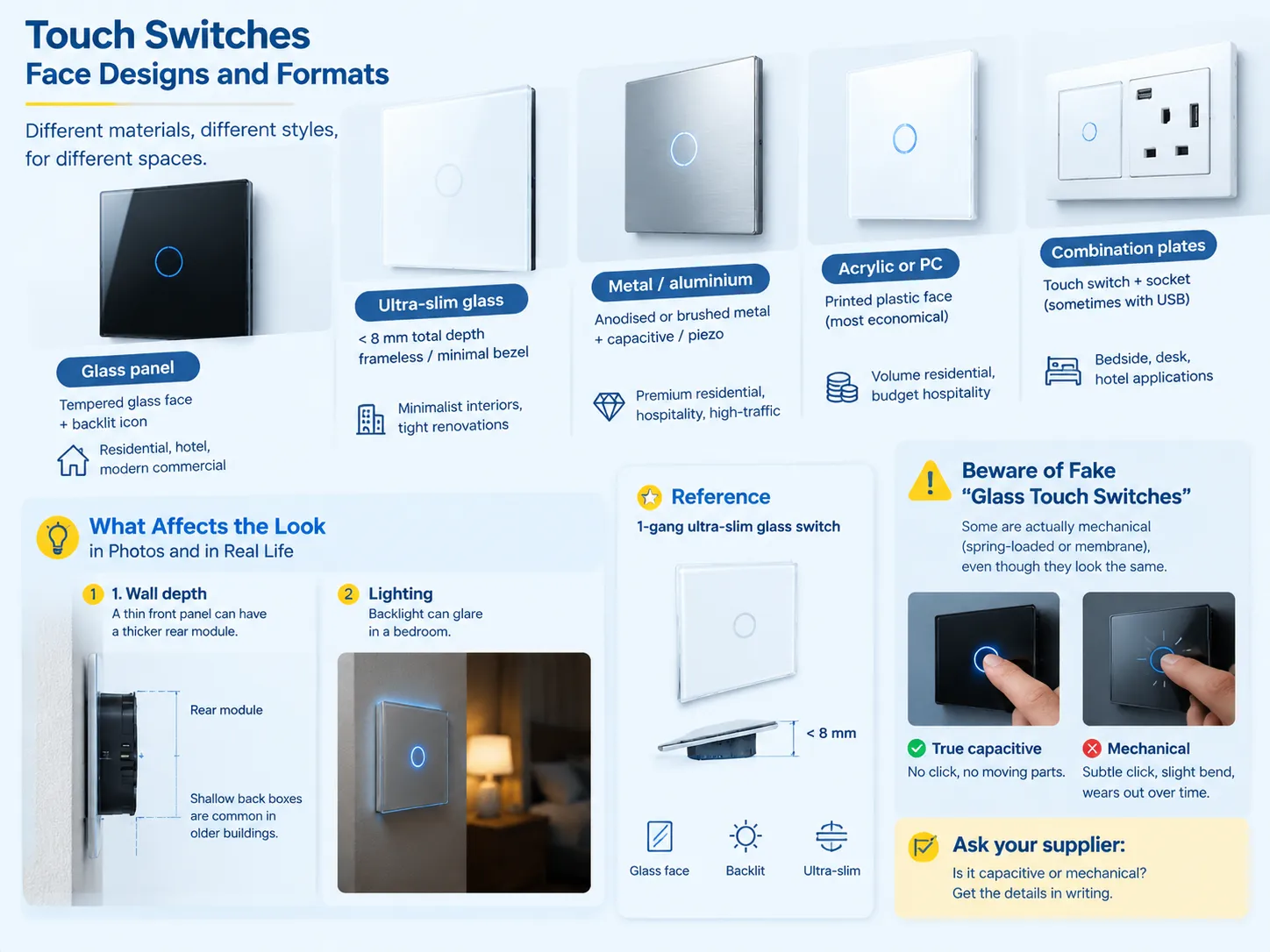
Сенсорные выключатели в основном являются дизайнерским продуктом, так как именно этот эффект в наибольшей степени влияет на ценовое разнообразие. Рынок состоит из пяти основных семейств.
| Дизайн лицевой панели | Описание | Типичное использование |
|---|---|---|
| Стеклянная панель | Закалённое стекло лицевой панели над ёмкостным датчиком; подсвечиваемая иконка или символ | Жилые помещения, гостиницы, современная коммерческая недвижимость |
| Ultra-slim glass | Thin profile — often under 8 mm total depth — frameless or minimal bezel | Minimalist interiors, renovation where depth is tight |
| Metal / aluminium | Anodised or brushed metal faceplate with piezo or capacitive sensing | Premium residential, hospitality, high-traffic commercial |
| Acrylic or PC | Printed plastic face, most economical option | Volume residential, budget hospitality, retrofit |
| Combination plates | Touch switch and socket on one plate; sometimes with USB charging | Bedside, desk and hotel applications |
There are two aspects that determine if a panel appears nice in a photo and nice in reality. The first aspect is the wall depth; a very thin front panel can have a fairly thick rear module, and shallow back boxes are typical for older buildings. Another aspect is the lighting; the backlight can glare in a bedroom. If you want to see how these variables come together in a specific product, a 1-gang ultra-slim glass wall switch is a fair reference point for what the current generation of residential panels looks like in terms of profile, face material and backlighting.
One piece of advice that can prevent returns is the fact that some so-called “glass touch switches” are not true touch-sensitive units. A considerable of many inexpensive switches are actually based on mechanical switching technology — commonly a spring-loaded rocker or a membrane — placed underneath the glass or acrylic cover. They may appear exactly the same in pictures. But while being used they make a subtle click, the face material bends minimally under the finger touch, and eventually these switches wear out like mechanical ones. If you care about having a switch with truly no moving parts, just ask the supplier whether the switch is of the capacitive or mechanical type and ask for the details in written form. If a supplier cannot answer these questions, he should be excluded from your selection list.
Do Standards Differ by Country?
Yes, it is often the case that a lot of international purchases end up failing at this point. A touch switch that is entirely okay in one country may not be acceptable in another, irrespective of the touch technology itself.
| Рынок | Key standards | What it means in practice |
|---|---|---|
| Соединенные Штаты | UL 20 (general-use snap switches), NEMA WD-1 and WD-6, NEC requirements | 120 V nominal; wall-box dimensions differ from UK/EU; UL listing usually required by inspectors |
| Канада | CSA C22.2 series, cUL listing | Similar to the US but a separate certification mark |
| Великобритания | BS EN 60669 (switches), BS 1363 (plugs and sockets), Building Regulations Part M for accessibility | 230 V nominal; 86 × 86 mm plate is the de facto standard; Part M sets mounting heights for accessibility |
| Европейский Союз | IEC/EN 60669-1, EN 60669-2-1 for electronic switches, CE marking, RoHS and REACH | 230 V nominal; multiple national plate sizes and socket types still in use |
| Австралия и Новая Зеландия | AS/NZS 3133 (approval and test specification for switches) | 230–240 V; different plate dimensions again, and a distinct socket (Type I) |
| Китай | GB 16915.1, CCC certification | 220 V nominal; 86 × 86 mm plate |
There are four most prominent differences. The most apparent difference is voltage, since operating a 120 V item in a 230 V circuit is a potential source of danger and not simply a minor inconvenience. The items may vary as for their plate sizes, since a device intended for the European market will not fit a US wall box without some form of adapter. The type of plug needs to be considered as well – the combination of the plug and the socket may not be standardized if the type of plug differs, which is true for many countries – A and B in the US, G in the UK, C and F in Europe, I in Australia, China, Argentina, and so on. Also, various standards and certifications are a topic for discussion: UL in the US, CSA in Canada, CE in Europe, UKCA in the United Kingdom, SAA in Australia, CCC in China, etc.
Everything said above suggests that decision makers should start with the market and then move to the product in question. In case a supplier wants to know the country where the product will be used, it means that they know what they are talking about.
Who Makes Touch Switches: Brands and What They’re Good At
The market can be segmented into four categories with each group competing differently. The figures below represent some of the average price ranges and positioning within the segment instead of actual quotes.
| Group | Примеры | Преимущества | Typical price band | Main applications |
|---|---|---|---|---|
| Global electrical majors | Legrand, Schneider Electric, ABB, Siemens, Eaton, Leviton, Hubbell | Full wiring-device ecosystems, deep certification coverage, specification support, huge distribution | Premium to mid — £25–120 per plate | Commercial, hospitality, institutional, large residential |
| Specialist designer brands | Hamilton Litestat, Forbes & Lomax, Varilight, MK Electric | Decorative finishes, bespoke plate sizes, UK-register aesthetics, strong trade recognition | Premium — £40–150+ | High-end residential, heritage and hospitality projects |
| Value and trade brands | BG Electrical, Click Scolmore, Hager | Good compliance at accessible prices, wide trade availability, reliable supply | Value — £8–25 per plate | Residential, rental, volume new-build |
| Smart home specialists | Lutron, Philips Hue ecosystem, TP-Link Kasa, Aqara, Tuya-based brands | App, voice and scene control, ecosystem integration, wireless retrofit | £15–60 per plate | Smart homes, retrofit, connected apartments |
| Export manufacturers | GOG and comparable OEM/ODM producers | Full range manufacture across glass, slim and combination series; private-label and OEM programmes; multi-market certification support | Factory-direct, well below branded retail | Distributor and own-brand programmes, projects, export markets |
The export manufacturer group is one of the most underrated by customers and deserves some mention. The companies from this segment do not compete on the basis of being recognized by the consumers but rather on their depth of the range, their ability to tool, their consistency and their capability to be certified for different markets simultaneously. Thus, when it comes to cable design, GOG is one of the manufacturers abiding by the different socket and switch series — glass wall switches of slim and extra-slim designs made in 1-, 2-, 3-, and 4-gang forms, as well as a glass combined switch- and socket plate complying with UK, European, Italian, and Thai sockets, 45-amp double pole switches, doorbells, and USB-C sockets, which makes it distinct from a designer manufacturer focusing on the single aesthetic. In terms of the value for the distributor trying to create his/her portfolio or for the project in need of buying the sockets and switches from a single source, this wide range is extremely useful, but, when it comes to the home-owner wanting to have a single beautiful plate, it does not possess the same value.
Where a brand’s strength genuinely lies is often visible in how it handles the trade rather than in its catalogue. If you want a sense of how the manufacturing side of this market is structured — who makes what, and how the UK supply chain is organised — this overview of wall switch and socket factories serving the UK market is a useful orientation before you start contacting suppliers.
There is one important caveat on brand and place of manufacture: almost all wall switches and sockets in the world are produced in China, irrespective of the brand of the company on the label of the switch, even when it is an item sold through one of the well known European manufacturers. Hence, it is important to note that origin is not the determining factor when talking about quality of the product.
Price Ranges and What Drives Them
There are three primary factors contributing to the price of a touch switch. They are sensing technology, the profile and materials of the face, and the certification coverage.
- The first factor, sensing technology, is the most important one. A real capacitive sensing circuit costs more than the spring operated full plastic face. In this way, cheap alternatives gain a lot of savings, and this is the reason why two faces may seem identical yet differ drastically in price. Piezo is more costly than capacitive; infrared and magnetic technology are the most expensive types of sensing technology.
- The second factor is the materials and profile of the face. Whereas tempered glass with laser engraving and backlight provides quite expensive solutions, using print in acrylic face is less costly. Besides that, ultra-thin profiles imply that the design is more complicated and requires more money. Metal face is more expensive than acrylic as well.
- The third factor is efficiency of obtaining certifi9cates. The products that have a certificate of one market are cheaper than the same products having a certificate of 3 markets. The tests if the product complies with the requirement fo the markets take a lot of time and money. It is more cost-efficient to obtain a certificate of one market, and then after numerous compliance procedures obtain the certificate of other markets.
Some rough estimates may help you understand how much you should be prepared for when buying a plate – the cost of basic acrylic products starts from a couple of pounds, the price of glass products will be from a modest five pounds to about 25 pounds for branded products, smart plates from 15 to 60 pounds, and international branded products with the metal and glass surface will require investments from 25 to 120 pounds, designer plates will cost more than 40 pounds. The prices offered directly by manufacturers are less than the retail ones, however, it goes about volumes rather than one product only.What actually drives the number at the low end is easier to understand once you look at how glass switch pricing breaks down — face material, sensing type, gang count, backlight and certification are the visible variables, and the sensing circuit is the one that’s usually hidden.
Where Touch Switches Get Used
Applications map fairly cleanly onto the technology’s strengths and weaknesses.
| Применение | Why touch fits | Preferred technology |
|---|---|---|
| Residential bedrooms and living rooms | Appearance, dimming, night indicators, easy cleaning | Capacitive glass |
| Hotel guest rooms | Scene control, backlit icons for guests in the dark, high-end impression, robust against repeated use | Capacitive glass, often with combination socket plates |
| Кухни | Wipeable flush surface, resistance to grease and frequent cleaning | Capacitive glass, or piezo under stainless |
| Offices and conference rooms | Scene and zone control, integration with building management | Capacitive or smart panels |
| Hospitals and clinics | Infection control — sealed surfaces with no crevices to harbour organisms | Infrared for non-contact; piezo under metal for gloved use |
| Cleanrooms and laboratories | Non-contact operation, resistance to chemical cleaning | Infrared, inductive |
| Public restrooms and terminals | Vandal resistance, hygienic non-contact operation | Инфракрасный |
| Industrial machinery and panels | Dust, moisture, vibration and glove use rule out capacitive | Piezo, inductive, resistive |
| Wet or outdoor locations | Sealed surface, no actuator gap for water ingress | Piezo under metal, with an appropriately IP-rated enclosure |
It can be observed that there is a discrepancy between domestic wants and industrial demands. Domestic needs are related to appearance and sensitivity hence requiring capacitive technology; but industrial requirements for immunity against false triggers and waterproofing would make capacitive technology inappropriate. Between these two extremes lies hospitality with its needs very similar to domestic needs but with extra rigidity and interface capabilities.
The Honest Downsides
Touch switches do not possess superior characteristics as compared to mechanical ones. The trade-offs need to be mentioed openly.
- Accidental triggering. A capacitive surface can be activated by an animal walking by, a sleeve of clothing, spillage, or even by cleaning cloths. A mechanical switch and an intention must be present to activate them.
- Wet hands and gloves. The capacitive technology does not have the same performance as a standard stove. The resistive and piezoelectric technologies can overcome this problem, though.
- No tactile feedback. There is no certainty whether the switch worked. Feedback has to be built in with the help of LED signals or audio signals, and low-cost panels are often unsuccessful in doing that.
- Need for a neutral wire. Most devices are designed to require a permanent live and neutral wire.
- Ongoing power consumption. There will be current running through the device. At times it is virtually nothing compared to the overall project.
- Fragility of the device. Glass is more resistant to scratching as compared to plastic, but it can break due to pinching or heavy pressure during installation.
- Not easy replacement. Compatibility problems with dimming and usage limitations due to load and drivers mean that touch dimmers may be unsuitable for the already installed bundle of lamps.
- Failure of electronic devices. The switch will stop functioning in case of the operation of the sensing circuit. As for mechanical switches, they usually fail gradually.
- Cost matters. The original capacitive panel with additional certificates is expensive compared with mechanical switches and fake glass panels.
How to Choose
The selection of most devices comes down to five questions.
- Which voltage and country? This dictates the rating, weight, type of socket and certification of the device; make sure you answer this first before looking at anything else.
- Will it be used in a dry or wet environment? Wet, outdoor and industrial applications will rule out capacitive sensing and move towards piezo, inductive or even resistive techniques.
- Will the device be operated with bare hands or gloves? Average room temperature and using bare hands means capacitive. If using gloves, it has to be piezo. Clinical non-contact operation means infrared.
- Does the junction box contain a neutral wire? If not, you will need a special no-neutral design or additional wiring. Check that beforehand.
- Do you require dimming, scene control, or app control? Each one creates new conditions – dimmable loads, hub, network or other systems making it important to make the decision about the panel in advance, since it is the least expensive mistake here.
Last item to check with the supplier is whether the panel has a real touch sensing system or a mechanical one behind the glass.
Часто задаваемые вопросы
What are the disadvantages of touch switches?
The main drawbacks are false activation caused by pets, liquids or clothes, reduced sensitivity when using thick gloves or dry skin, lack of physical feedback (so some sort of signal must be provided for confirmation), requirement of a neutral wire at the switch location in most designs, small amount of continuous standby current, and failure mode where the dead sensing circuit leads to a complete failure of the switch instead of gradual degradation. Additionally, there’s a cost factor: a cheap capacitive switch is more expensive than a regular mechanical switch or an imitation of a glass switch with a spring inside.
What does “touch switch” mean?
Touch switches are actuators without any moving parts in their structure. Rather than using levers or push buttons to switch on or off, the switch occurs so when there is a change in capacitance as a result of touching the switch or the impact of pressure between the two conductive plates or even a voltage produced by bending the piezo ceramic element. Because of the absence of any switching elements, the outer shell can be unbreakable and flat which is what makes these switches popular for usage in kitchens or hospitals.
Are touch switches good?
Their effectiveness varies depending on different situations, which is why the right answer is “it depends on the room.” Touch switches are definitely better when aesthetic value, cleanability and installation are crucial, such as in bedrooms, hotels, kitchens, receptionists’ areas and any other places that are washed frequently. However, they are not the best option whenever unthinking reliability is needed, like in hallways, utility rooms and workshops, as well as the places where people operate switches with wet or gloved hands. Good quality capacitive touch switches using true capacitive technology can be good products, while glass panel mechanical switches would not. Therefore, the technology is more important than the brand.
What are the four types of switches?
In relation to the functions of electricity, the commonly used types of switches are single-pole (it controls one light), three-way (it controls one light at two locations), four-way (it controls one light at three locations or more, due to it being used together with two other switches) and double pole switches (it controls two electrical wires together in a single circuit). In relation to the form of the switch, the commonly used switches are toggle switches, rocker switches, push-button switches and slide switches.
Ссылки
- Международная электротехническая комиссия — IEC 60669 series for switches for household and similar fixed electrical installations
- BSI Standards — BS EN 60669 and BS 1363 standards for UK switches and socket outlets
- IECEE — international certification scheme covering electrical accessories
- UL Solutions — UL 20 and related certification for wiring devices in North America
- ISO — quality and environmental management system standards for manufacturers
- Electrical Safety First — UK consumer safety guidance on sockets, switches and RCDs
Заключение
Touch switches have a number of advantages, but the main advantage of touch switches is that they do not feature moving components. The working of touch switches depends on how they react to finger touches as well as whether they are designed for use by people wearing gloves or operating in dry facilities.
There are three key features that can help distinguish a good touch switch from a bad one. To start with, you will need to conduct a thorough search for all brands of touch switches and their ratings according to size, design and certification. Secondly, you should investigate the technologies used to manufacture touch switches, whether it is capacitively charged technology, piezoelectric technology or anything else (for example, inductive). Thirdly, it is necessary to find out whether or not touch switches are able to work in humid atmospheres. For instance, whether a capacitive touch switch will work in a humid environment, what types of technology are able to operate properly under humidity or vibration as well as whether or not they are real touch switches. If they don’t fulfill any of the above stated criteria, then touch switches will be able to work in practice, though the user would not be able to explain why his or her bathroom light can switch on and off randomly.