يفتح النوع الجديد من غرف الفنادق عن طريق تشغيل لوحة الحائط، التي تعمل كمفتاح تشغيل وإيقاف للغرفة. بنفس الطريقة، عند تشغيل وإيقاف الخزانة التي تستخدم أضواء الخزانة، تفتح خزانة المطبخ. كلما جلست في سيارة، تضغط على زر لوحة التحكم، وهو زر تفعيل الضوء الداخلي للمركبة. وهكذا، تظهر كل هذه الحالات أن مفاتيح اللمس يمكن استخدامها بدلاً من المفاتيح الميكانيكية دون علم المستهلكين. عندما نتحدث عن مفاتيح اللمس، نغطي العديد من الأجهزة في تعريف مفاتيح اللمس. ليست كل الأجهزة التي تعمل باللمس يمكن تصنيفها كمفاتيح لمس. ويرجع ذلك إلى أن بعض الأجهزة تعمل على مبادئ حساسات السعة، بينما تلتزم بعض الأجهزة الأخرى بالميكانيكا الأساسية بوجود مفاتيح ميكانيكية تحت سطح الزجاج. لذلك، تختلف مبادئ عمل حساسات السعة عن مبادئ عمل الأجهزة الأخرى. ومن ثم، من الضروري معرفة نوع الجهاز الذي يتم شراؤه.
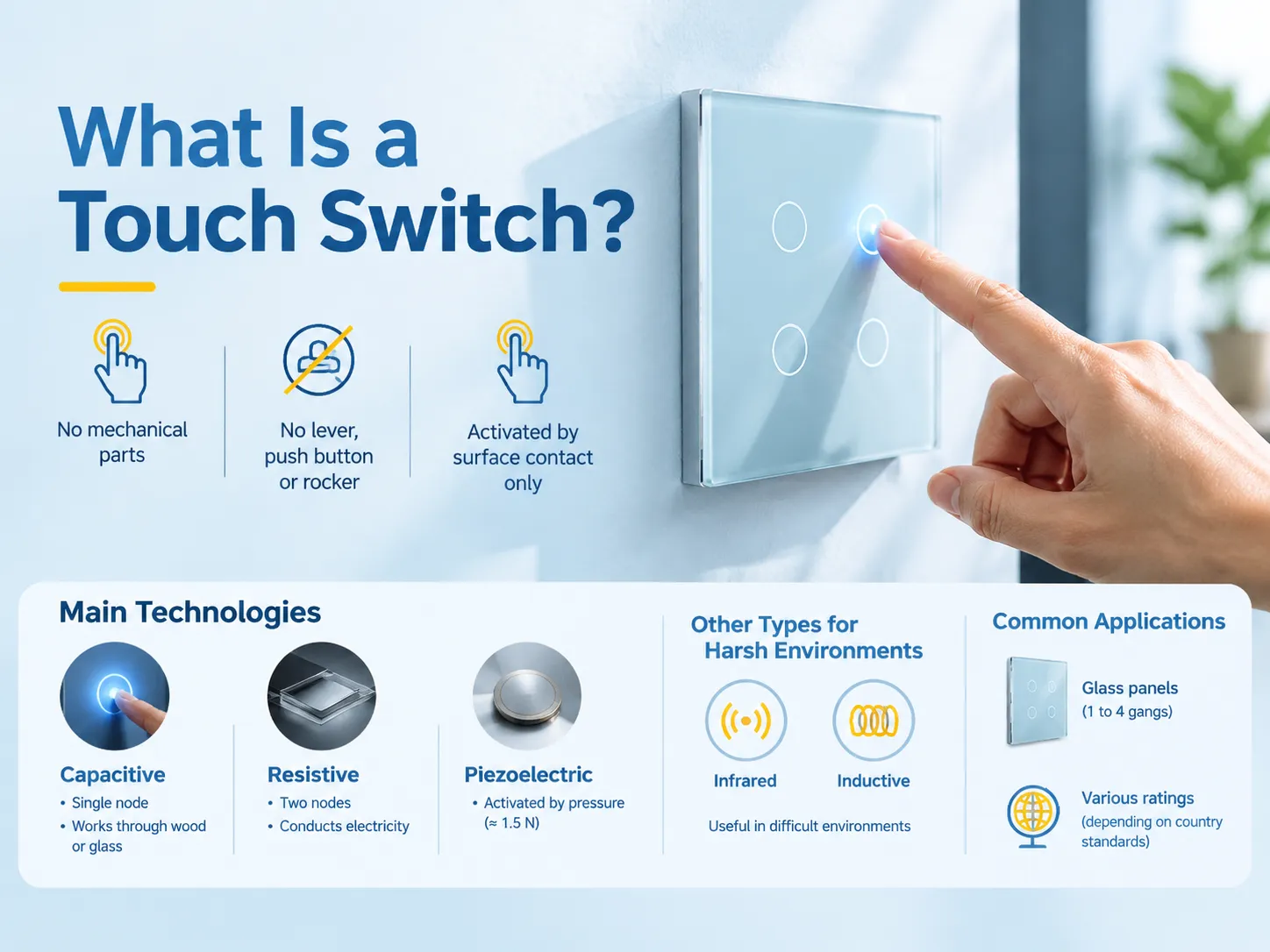
يشير مصطلح مفتاح اللمس إلى المعدات التي لا تحتوي على أي أجزاء ميكانيكية لتشغيلها، حيث تعمل من خلال تطبيق الاتصال الكهربائي وبالتالي لا يتم تشغيلها باستخدام رافعة أو زر ضغط أو مفتاح هزاز، بل فقط من خلال اللمس الموجود على السطح الخارجي للجهاز. يمكن تصنيف مفاتيح اللمس إلى ثلاث فئات رئيسية بناءً على تقنيتها: السعوية (حيث يتم تفعيل المفتاح من خلال وجود إصبع يلمس المفتاح، وله عقدة واحدة، وقادر على العمل من خلال الخشب أو الزجاج)، المقاومة (تستخدم في المفاتيح التي تحتوي على عقدتين وقادرة على توصيل الكهرباء)، والبيزوالكهربائية (تستخدم في المفاتيح المصنوعة بتطبيق مادة بيزوالكهربائية تحت ضغط حوالي 1.5 نيوتن). كما يجب الإشارة إلى أن المفاتيح تحت الحمراء والحثية يمكن استخدامها في مواجهة البيئات الصعبة. بشكل عام، تعتبر مفاتيح اللمس في الغالب من النوع السعوي ويمكن تطبيقها على لوحات زجاجية من واحد إلى أربعة مجموعات. بالإضافة إلى ذلك، تمتلك مفاتيح اللمس تقييمات مختلفة حسب المعايير المعتمدة في الدول المختلفة.
حيث التقيت بالفعل بمفاتيح اللمس
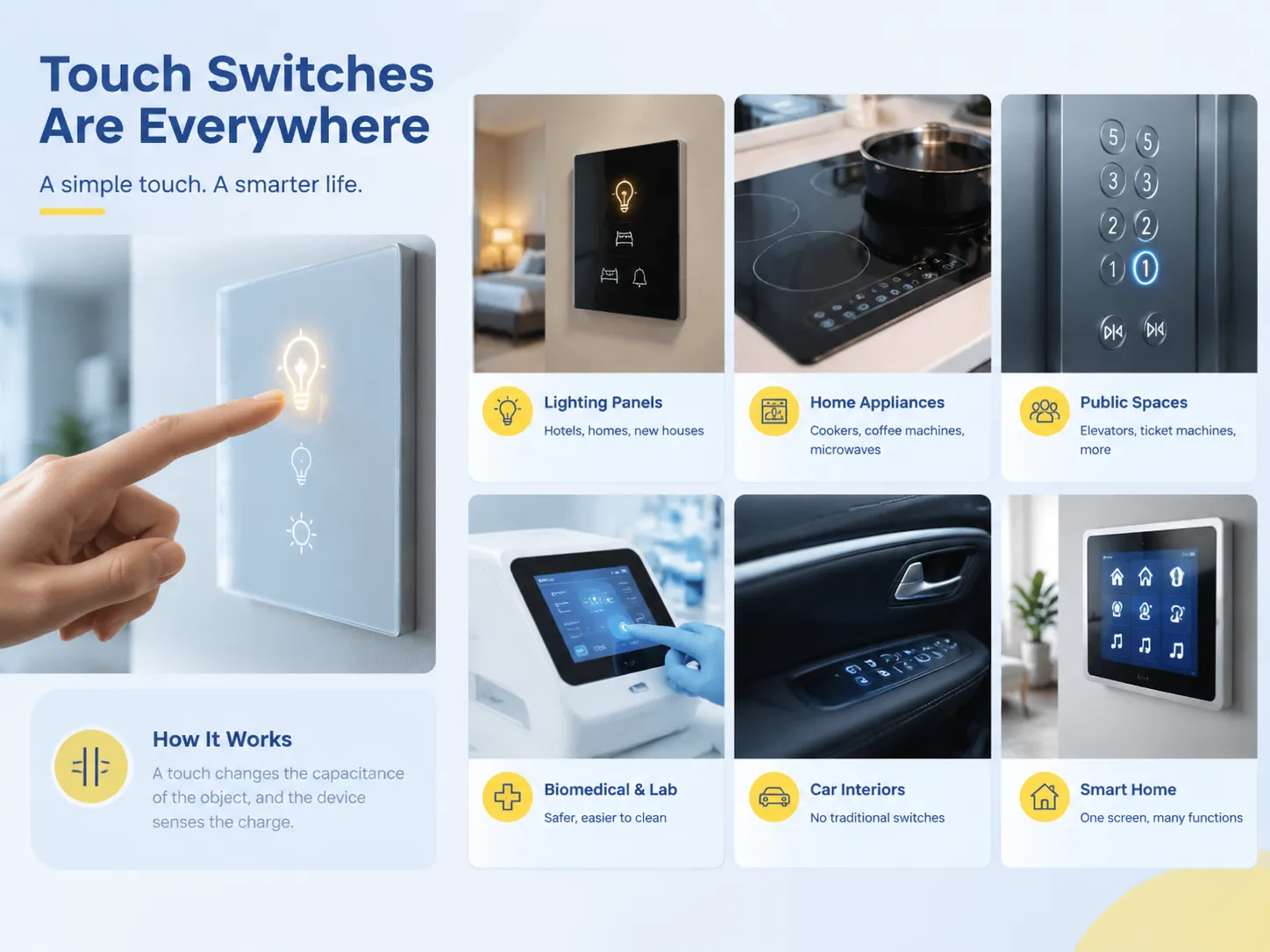
تم اختراع تقنية مفاتيح اللمس منذ زمن بعيد، أبكر مما يعتقد معظم الناس. تعمل تقنية مفاتيح اللمس على مبدأ أن الشحنة تشير إلى تغير في السعة الكهربائية للجسم الذي اقترب من القطب الكهربائي. وبالتالي، يمكن العثور على أبسط أشكال تقنية مفاتيح اللمس في “مصباح اللمس”، القادر على تغيير السطوع ثلاث مرات اعتمادًا على لمس مفتاح القدم.
تم تطبيق تقنية مفاتيح اللمس في أجهزة مختلفة، مثل:
- لوحات الإضاءة في الفنادق والأماكن السكنية والمنازل التي تم بناؤها حديثًا، والتي عادةً ما تكون مصنوعة من الزجاج وتتميز بأيقونات تتوهج من الخلفية.
- الأجهزة المنزلية، وأفران الحث، وآلات القهوة، وأفران الميكروويف من النوع الحديث، والتي تكون أسهل في التنظيف لكونها مسطحة مقارنة بالمقابض.
- أجهزة التحكم عن بعد للمصاعد، وآلات بيع التذاكر، وغيرها من الأجهزة العامة، حيث تساعد الأسطح المختومة على مقاومة التخريب والتنظيف الكيميائي.
- الأجهزة الطبية والمخبرية، حيث يسهل التحكم في العدوى بسبب غياب الفجوات.
- داخل السيارات، حيث أزالت تقنية التبديل باللمس المفاتيح التقليدية من لوحات الأبواب ووحدات التحكم العلوية.
- لوحات التحكم في المنازل الذكية، حيث قد تخدم الشاشة الزجاجية أيضًا كجهاز تحكم لوظائف متعددة.
هناك ميل لاستخدام تقنية التبديل باللمس في الأماكن التي تكون فيها نظافة السطح أو سهولة تنظيفه أهم من ميزة رد الفعل اللمسي التي توفرها المفاتيح الميكانيكية.
ما الذي يفعله مفتاح اللمس فعليًا
يقوم مفتاح اللمس بدور مماثل للمفتاح الميكانيكي، حيث يساعد في فتح أو إغلاق الدوائر. من حيث الوظيفة، لا يوجد تشابه بينهما.
- يتكون المفتاح الميكانيكي من مشغل، ونابض، وجهة اتصال متحركة. يضغط المستخدم على المشغل، مما يجعل جهات الاتصال تلتقي أو تنفصل. يسمع المستخدم ويشعر بنقرة تدل على نجاح العملية.
- مفتاح اللمس هو نوع من المفاتيح لا يحتوي على مشغل. مبدأ عمل زر اللمس هو أن دائرة استشعار تراقب السطح المطلوب. عند تحفيز السطح، يتم إنتاج إشارة تؤدي إلى تشغيل مرحل التبديل أو الترياك أو المفتاح الحالة الصلبة.
يؤدي ذلك إلى ثلاثة نتائج موضوعية:
| الخاصية | المفتاح الميكانيكي | مفتاح اللمس |
|---|---|---|
| الأجزاء المتحركة | نعم — مشغل، جهات اتصال، نابض | لا يوجد في تصميم سعوي حقيقي أو بيزو |
| رد الفعل | لمسي وسمعي، متأصل في الآلية | يجب تصميمه — LED، إضاءة خلفية، صفير |
| متطلبات الطاقة | لا شيء؛ ميكانيكي بحت | تيار ثابت صغير لدائرة الاستشعار |
| سهولة تنظيف السطح | الشقوق حول المشغل تجمع الأوساخ | مسطح ومختوم؛ يُمسح نظيفًا |
| آلية التآكل | تآكل ميكانيكي للجهات والنوابض | شيخوخة إلكترونية؛ خدوش على السطح |
| التشغيل بالقفازات | يعمل دائمًا | يعتمد على التقنية وسماكة القفاز |
| خطر التفعيل العرضي | منخفض | أعلى — قد تفعله الحيوانات الأليفة، الأكمام، الرشاشات |
هذه النقطة المتعلقة بالكهرباء الثابتة أكثر أهمية مما تبدو عليه. مفتاح اللمس هو جهاز إلكتروني ويتطلب وجود سلكي فاز ونيوترال دائمين في صندوق المفتاح في معظم الحالات. في التمديدات الكهربائية القديمة حيث يُجلب السلك الحي فقط إلى المفتاح، كما هو شائع في التركيبات البريطانية وبعض التركيبات القارية، قد يكون من الضروري استخدام سلك نيوترال للمفتاح اللمسي أو تصميم “بدون نيوترال” يحصل على طاقته من الحمل. هذا الجانب المذكور أعلاه هو عامل مهم جدًا في التركيب، والذي سيتحقق منه المورد الجيد أولاً.
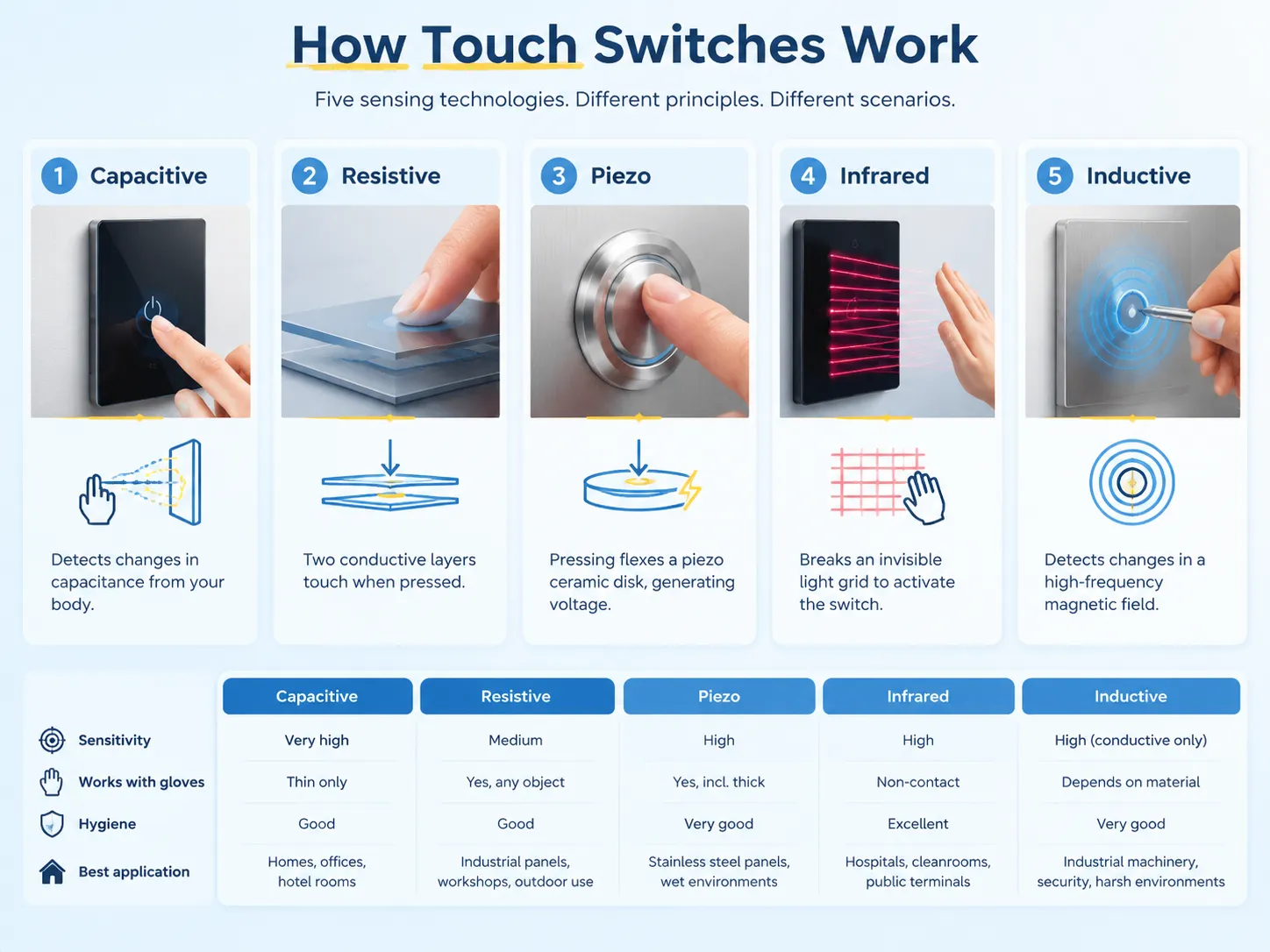
كيف تعمل مفاتيح اللمس
هناك خمسة أنواع مختلفة من تقنيات الاستشعار المتاحة، وعلى الرغم من أنها تعمل بطرق مختلفة جدًا، إلا أنه من الشائع اختيار التقنية الخاطئة للبيئة المقصودة.
- مفاتيح اللمس السعوية هي التقنية الأكثر شيوعًا المستخدمة في المنازل والمكاتب. يتكون هذا النوع من المفتاح من قطب كهربائي صغير، يوضع خلف الغطاء ويشحن ويفرغ باستمرار لتحديد السعة الكهربائية. نظرًا لأن الشخص العادي يحمل سعة كافية لجسمه ليجعل الاتصال مع القطب ويغير القراءة بما يكفي لإغلاق الدائرة، هناك بعض المزايا لهذه التقنية. الميزة الرئيسية هي أن حجم القطب مخفي خلف لوحة غير موصلة، وبالتالي يمكن صنع سطح اللمس من البلاستيك أو الزجاج أو الحجر أو الخشب، إلخ. مفهوم السعة الذاتية يعني استخدام قطب كهربائي واحد، في حين أن السعة المتبادلة (أو السعة المتوقعة) تتضمن استخدام زوج من القطبين، مما يساهم في المزيد من التماسك والتمييز الأفضل بين المفاتيح المجاورة، لكن يحدث ضجيج إضافي أثناء هذه العملية. يتم تنشيط مفاتيح اللمس السعوية حتى عند ارتداء قفازات رقيقة، بينما يكون تأثير الرطوبة والغبار وعوامل أخرى كبيرًا جدًا.
- مفاتيح اللمس المقاومة هي أجهزة أبسط وأكثر تقليدية. تتكون من طبقتين من مادة موصلة مفصولتين بفجوة صغيرة. عند الضغط على سطح المفتاح، تلمس الطبقتان بعضهما البعض، وتزداد المقاومة، بناءً على ذلك تكتشف الدائرة الضغط. نظرًا لأن هذا النوع من المفاتيح يعتمد على الضغط بدلاً من سعة جسم المستخدم، فإنه يعمل جيدًا مع أي جسم. ومع ذلك، المشكلة هي أنه يجب الضغط على المفتاح بشكل كبير، وبسبب وجود عدة أجزاء ميكانيكية متحركة، يصبح الجهاز ضخمًا. توجد مفاتيح اللمس المقاومة في الصناعة وورش العمل والأماكن الخارجية ولكن ليس في البيئات المنزلية.
- تعمل مفاتيح اللمس البيزو باستخدام قرص سيراميكي بيزوالكهربائي، الذي ينثني عند الضغط عليه، مولدًا جهدًا كهربائيًا. The advantages of piezo switches include the ability to work through any material, including thick gloves or metal surfaces, reliability, and absence of mechanical parts. Piezo switches are somewhat more expensive than capacitive ones but are used in situations where such a premium is justified.
- Infrared touch switches generate a grid of invisible light beams with the help of LEDs and photodetectors, where breaking of the grid results in activation of the device. Thus, infrared switches are quite hygienic and suitable for various purposes but prone to influence from light, dust, and humidity.
- Inductive switches generate high-frequency electromagnetic field and detect changes in the field when any conductive object enters it. This type of switches is resistant to false triggering and humidity, but only conductive objects activate switches.
| Technology | Sensitivity | Works with gloves | Hygiene | أفضل تطبيق |
|---|---|---|---|---|
| Capacitive | Very high | Thin only | جيد | Homes, offices, hotel rooms, smart panels |
| Resistive | متوسط | Yes, any object | جيد | Industrial panels, workshops, outdoor use |
| Piezo | عالي | Yes, incl. thick | جيد جدًا | Stainless steel panels, wet and industrial environments |
| Infrared | عالي | Non-contact | ممتاز | Hospitals, cleanrooms, public terminals |
| Inductive | High, conductive only | Depends on material | جيد جدًا | Industrial machinery, security, harsh environments |
The Main Types of Touch Switch
When the transition is made from the sensing technology to products, the types change once more. These are the types of touch switches that someone will actually be making decisions about.
- Wall touch switch (light switch): A capacitive panel made of either glass or acrylic that substitutes a standard lighting switch, selecting from 1 to 4 gangs. These can be a single-pole for a single light, a two-way device that lets users operate the light from two points, and an intermediate switch that is needed when there are three or more sites to operate the light from. This is the definition of the touch switch according to many people.
- Touch dimmer: The switch is the same as a regular switch but provides a combination of functions, namely turning the lights on and off by making short taps and adjusting brightness, i.e. using long taps, while the dimmer can even allow users to make sliding gestures along the surface of the product. The only problem with this device is that it has to be connected to a light load designed for dimming, i.e., to dimmable LED drivers or other similar devices instead of regular bulbs.
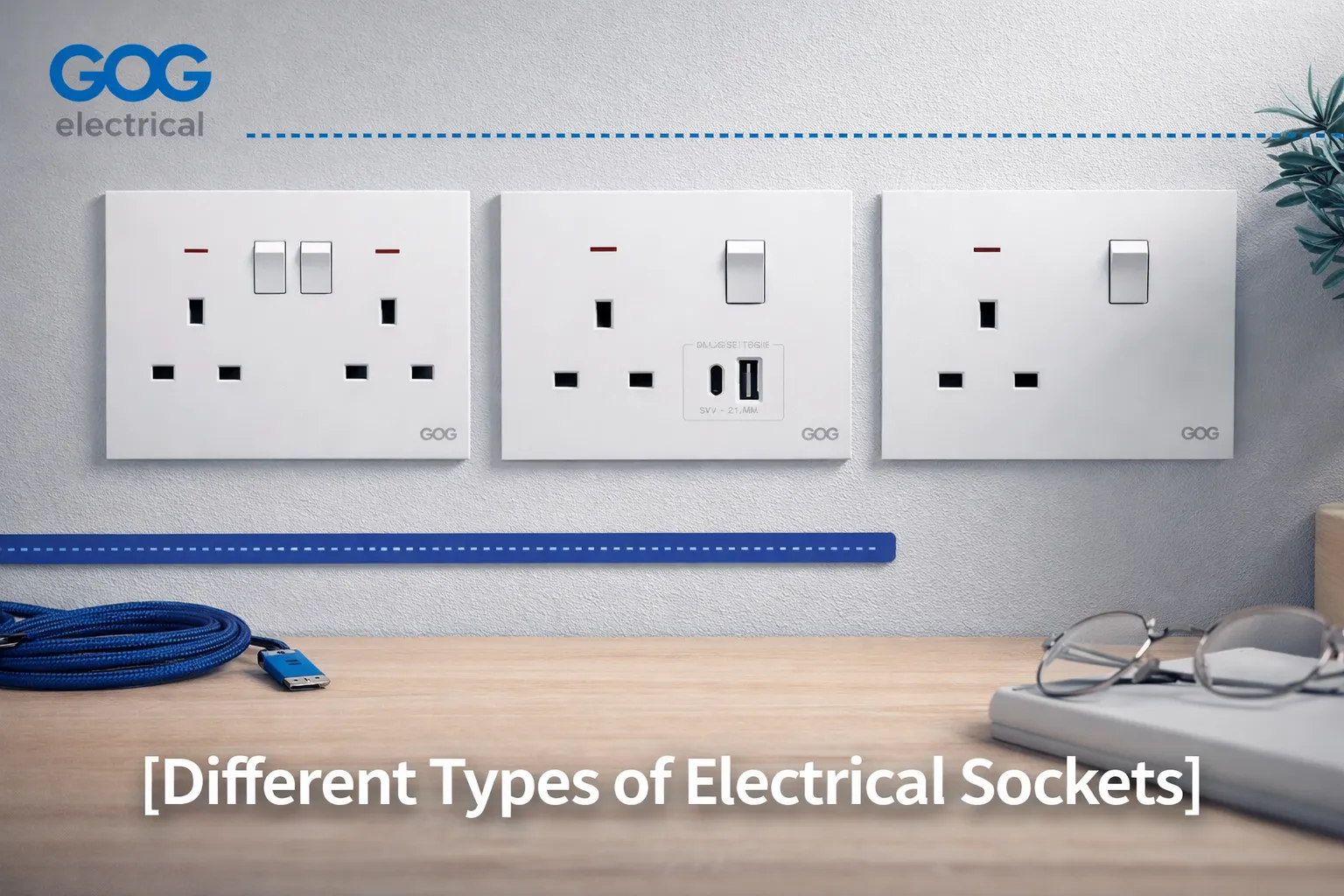
- Touch socket (outlet) switch: Such types of devices usually have a socket equipped with a touch-sensitive switch instead of a usual one and are combined with charging ports in USB or USB-C mode. The common example of such devices can be found in hotel rooms where both regular and touch sockets are used together, including USB ports.
- Smart touch panel: Smart touch panel refers to touch-switch equipped with Wi-Fi, Zigbee, Bluetooth, or Z-Wave technology and operated with help of dedicated applications and voice assistance devices. Also, in certain cases, these products can replace several switches that work together.
- Touch doorbell and signaling switches: The product can be used for signaling purposes and among its features operates as a push button.
- Industrial and panel mount touch switch: Such devices include piezoelectric devices, inductive or infrared switches used for the operation of equipment.
At the same time, it is important to get rid of a misconception that a lot of people have regarding the four standard types of switches. They are classified according to their functions but not according to their appearance. The first type is Single-pole, which is designed to operate one light from one position. Then comes Three-way switch, which can be used to run the same light from two points. Next goes four-way operating system that works with two three-way switches in order to allow operating the light from three or more spots. Finally, the last standard switch is a double-pole one, which allows working with two wires at the same time, which is mainly relevant for high-power appliances, such as, for example, water heaters. However, all these functions can be executed using either mechanical switch or touch-type switches, and this is why asking someone about a type of switch one should always clarify what type of switch they need according to their requirements. For the mechanical-versus-function breakdown in more detail, this guide to الأنواع الأربعة لمفاتيح الإضاءة is a useful reference before you order anything.
Touch Switches vs Mechanical Switches
The choice of a touch switch or a traditional one is not easy. Its suitability depends on the room itself, meaning that it is pointless to give a definite answer to the question.
Touch switches have many advantages in terms of their appearance, cleanliness, and ability to integrate with other devices. Touch switches made of a glass panel do not consist of any parts that would need cleaning, which makes the process of their cleaning very easy. They look like a part of the design rather than a functional element. They can have various options such as nightlight indicators and dimmers and can perform the same functions as regular switches. In addition, touch switches do not have moving parts that could break down or get dirty.
Mechanical switches, on the other hand, can ensure certainty. Levers of these switches move, thus providing sound and tactile feedback. They are easy to use in any conditions and do not require electric power for their operation. Moreover, they are very cheap, too. If you want the mechanics of how that actuation works, this explanation of how a rocker switch works is a good short read, and it’s a useful contrast to a capacitive panel with no moving parts at all.
The most common practical divisions that most specifiers follow is based on the room of usage. Touch switches has to be placed where the surface is most important and the function is intentional: bedrooms, living rooms, hotel rooms, reception areas, kitchen, and places that need to be wiped. Mechanical switches remain where reliability is important and use is automatic: corridors, back of house areas, utility room, garages, workshops, and anywhere visitors may come with wet hands or gloves.
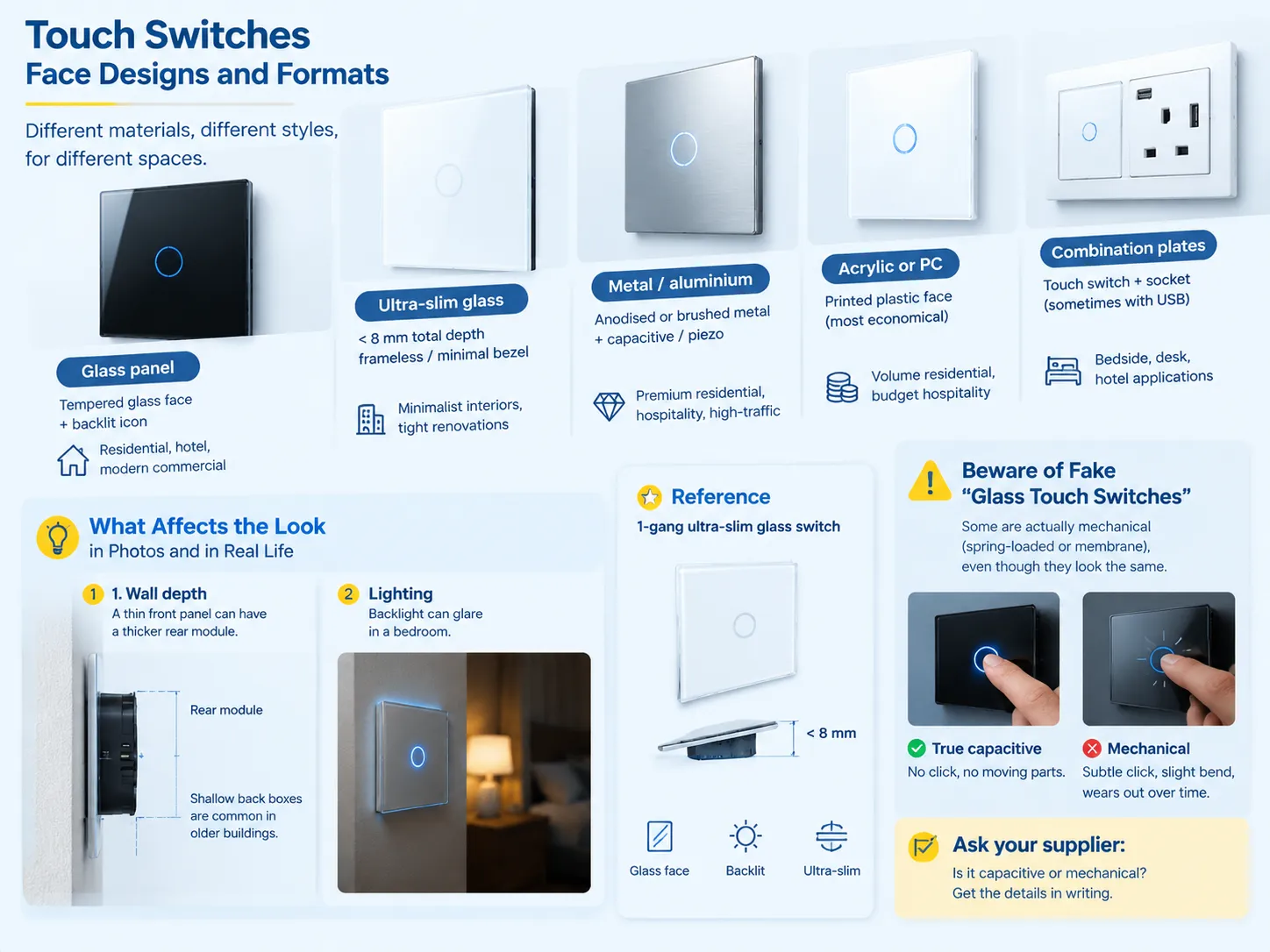
What They Look Like: Face Designs and Formats
Touch switches are mainly a design product, as this effect is most responsible for the price variation. The market is comprised of five main families.
| Face design | الوصف | الاستخدام النموذجي |
|---|---|---|
| Glass panel | Tempered glass face over a capacitive sensor; backlit icon or symbol | Residential, hotel, modern commercial |
| Ultra-slim glass | Thin profile — often under 8 mm total depth — frameless or minimal bezel | Minimalist interiors, renovation where depth is tight |
| Metal / aluminium | Anodised or brushed metal faceplate with piezo or capacitive sensing | Premium residential, hospitality, high-traffic commercial |
| Acrylic or PC | Printed plastic face, most economical option | Volume residential, budget hospitality, retrofit |
| Combination plates | Touch switch and socket on one plate; sometimes with USB charging | Bedside, desk and hotel applications |
There are two aspects that determine if a panel appears nice in a photo and nice in reality. The first aspect is the wall depth; a very thin front panel can have a fairly thick rear module, and shallow back boxes are typical for older buildings. Another aspect is the lighting; the backlight can glare in a bedroom. If you want to see how these variables come together in a specific product, a 1-gang ultra-slim glass wall switch is a fair reference point for what the current generation of residential panels looks like in terms of profile, face material and backlighting.
One piece of advice that can prevent returns is the fact that some so-called “glass touch switches” are not true touch-sensitive units. A considerable of many inexpensive switches are actually based on mechanical switching technology — commonly a spring-loaded rocker or a membrane — placed underneath the glass or acrylic cover. They may appear exactly the same in pictures. But while being used they make a subtle click, the face material bends minimally under the finger touch, and eventually these switches wear out like mechanical ones. If you care about having a switch with truly no moving parts, just ask the supplier whether the switch is of the capacitive or mechanical type and ask for the details in written form. If a supplier cannot answer these questions, he should be excluded from your selection list.
Do Standards Differ by Country?
Yes, it is often the case that a lot of international purchases end up failing at this point. A touch switch that is entirely okay in one country may not be acceptable in another, irrespective of the touch technology itself.
| سوق | Key standards | What it means in practice |
|---|---|---|
| الولايات المتحدة | UL 20 (general-use snap switches), NEMA WD-1 and WD-6, NEC requirements | 120 V nominal; wall-box dimensions differ from UK/EU; UL listing usually required by inspectors |
| كندا | CSA C22.2 series, cUL listing | Similar to the US but a separate certification mark |
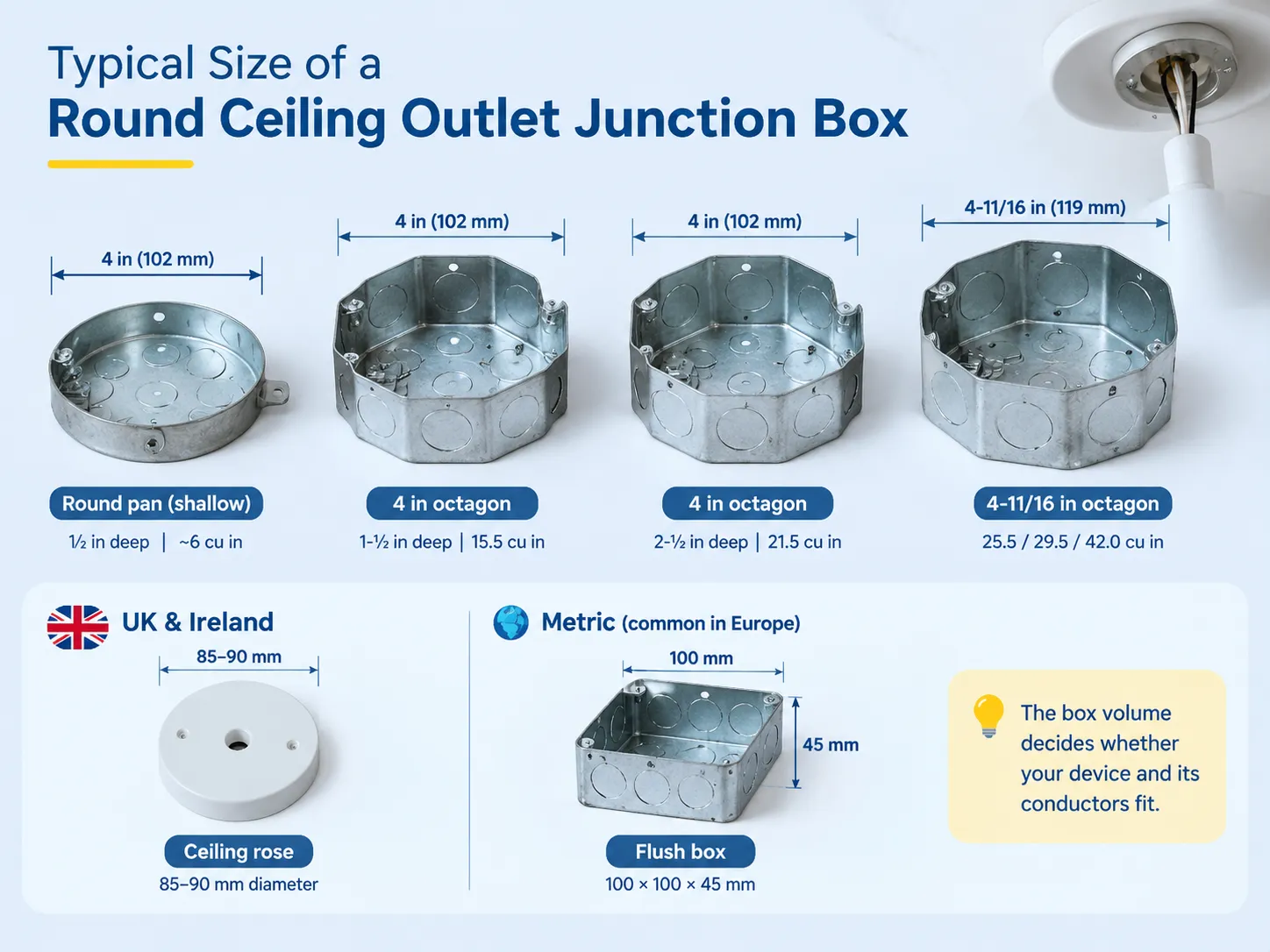
| المملكة المتحدة | BS EN 60669 (switches), BS 1363 (plugs and sockets), Building Regulations Part M for accessibility | 230 V nominal; 86 × 86 mm plate is the de facto standard; Part M sets mounting heights for accessibility |
| الاتحاد الأوروبي | IEC/EN 60669-1, EN 60669-2-1 for electronic switches, CE marking, RoHS and REACH | 230 V nominal; multiple national plate sizes and socket types still in use |
| Australia and New Zealand | AS/NZS 3133 (approval and test specification for switches) | 230–240 V; different plate dimensions again, and a distinct socket (Type I) |
| الصين | GB 16915.1, CCC certification | 220 V nominal; 86 × 86 mm plate |
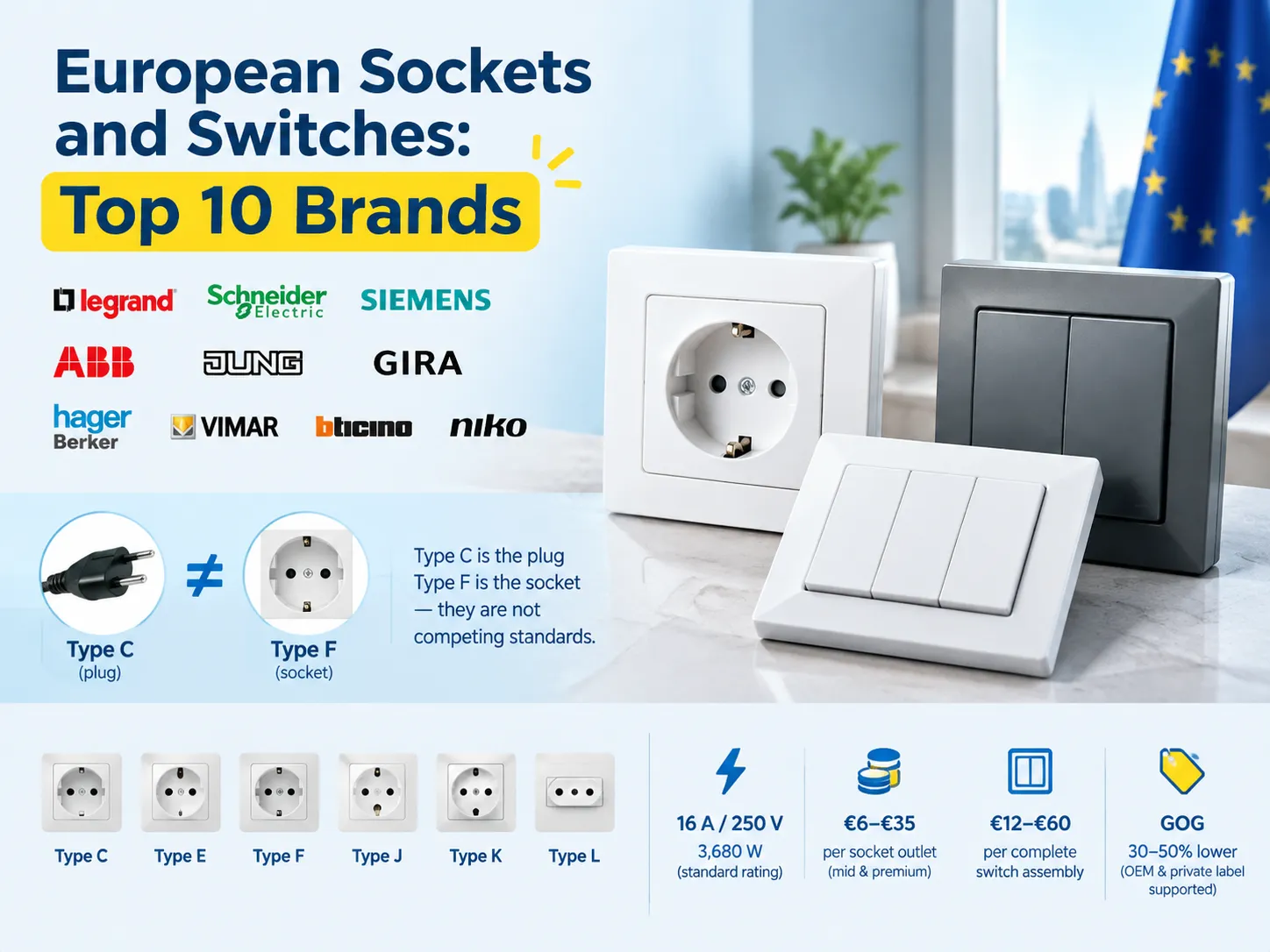
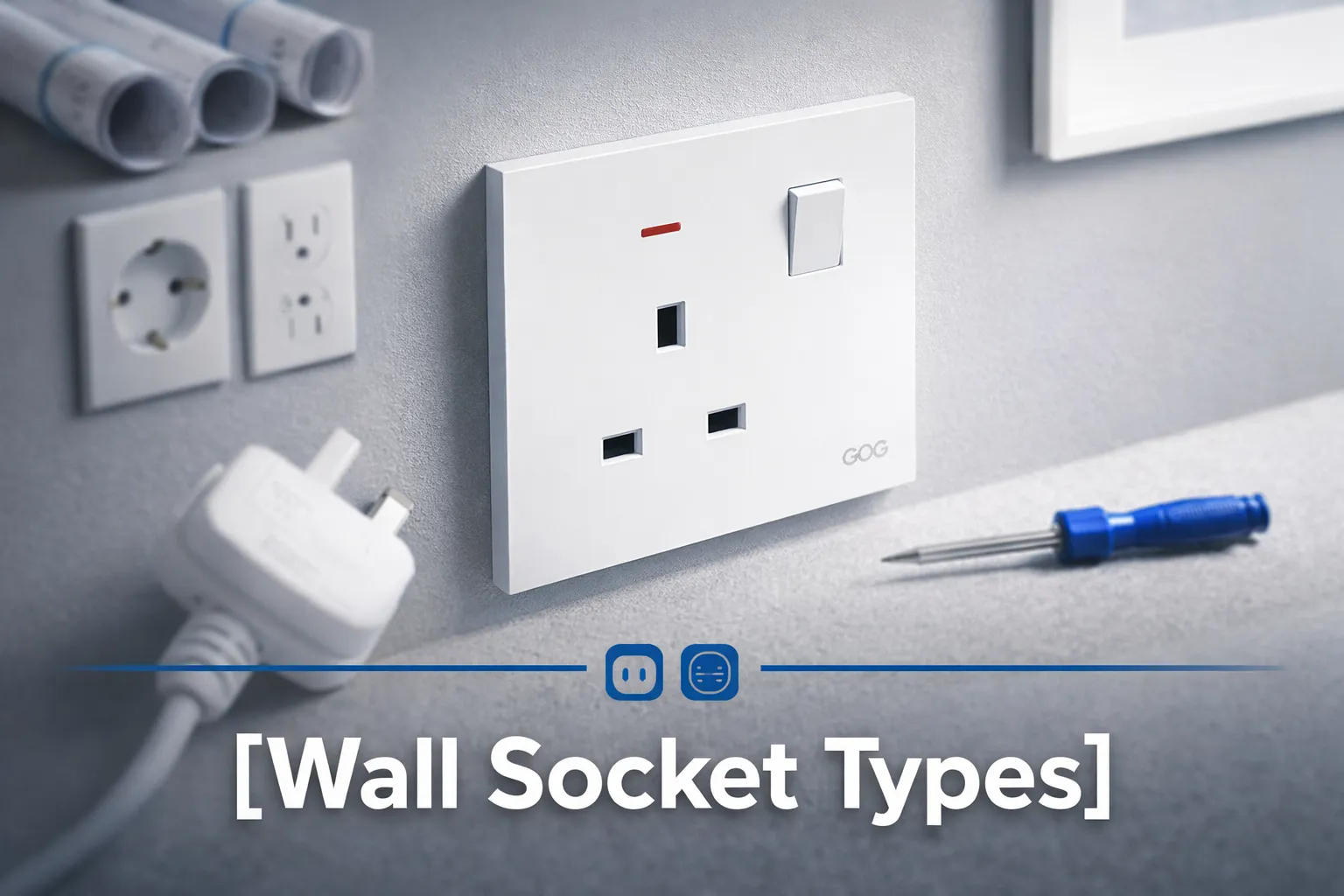
There are four most prominent differences. The most apparent difference is voltage, since operating a 120 V item in a 230 V circuit is a potential source of danger and not simply a minor inconvenience. The items may vary as for their plate sizes, since a device intended for the European market will not fit a US wall box without some form of adapter. The type of plug needs to be considered as well – the combination of the plug and the socket may not be standardized if the type of plug differs, which is true for many countries – A and B in the US, G in the UK, C and F in Europe, I in Australia, China, Argentina, and so on. Also, various standards and certifications are a topic for discussion: UL in the US, CSA in Canada, CE in Europe, UKCA in the United Kingdom, SAA in Australia, CCC in China, etc.
Everything said above suggests that decision makers should start with the market and then move to the product in question. In case a supplier wants to know the country where the product will be used, it means that they know what they are talking about.
Who Makes Touch Switches: Brands and What They’re Good At
The market can be segmented into four categories with each group competing differently. The figures below represent some of the average price ranges and positioning within the segment instead of actual quotes.
| Group | أمثلة | نقاط القوة | Typical price band | Main applications |
|---|---|---|---|---|
| Global electrical majors | Legrand, Schneider Electric, ABB, Siemens, Eaton, Leviton, Hubbell | Full wiring-device ecosystems, deep certification coverage, specification support, huge distribution | Premium to mid — £25–120 per plate | Commercial, hospitality, institutional, large residential |
| Specialist designer brands | Hamilton Litestat, Forbes & Lomax, Varilight, MK Electric | Decorative finishes, bespoke plate sizes, UK-register aesthetics, strong trade recognition | Premium — £40–150+ | High-end residential, heritage and hospitality projects |
| Value and trade brands | BG Electrical, Click Scolmore, Hager | Good compliance at accessible prices, wide trade availability, reliable supply | Value — £8–25 per plate | Residential, rental, volume new-build |
| Smart home specialists | Lutron, Philips Hue ecosystem, TP-Link Kasa, Aqara, Tuya-based brands | App, voice and scene control, ecosystem integration, wireless retrofit | £15–60 per plate | Smart homes, retrofit, connected apartments |
| Export manufacturers | GOG and comparable OEM/ODM producers | Full range manufacture across glass, slim and combination series; private-label and OEM programmes; multi-market certification support | Factory-direct, well below branded retail | Distributor and own-brand programmes, projects, export markets |
The export manufacturer group is one of the most underrated by customers and deserves some mention. The companies from this segment do not compete on the basis of being recognized by the consumers but rather on their depth of the range, their ability to tool, their consistency and their capability to be certified for different markets simultaneously. Thus, when it comes to cable design, GOG is one of the manufacturers abiding by the different socket and switch series — glass wall switches of slim and extra-slim designs made in 1-, 2-, 3-, and 4-gang forms, as well as a glass combined switch- and socket plate complying with UK, European, Italian, and Thai sockets, 45-amp double pole switches, doorbells, and USB-C sockets, which makes it distinct from a designer manufacturer focusing on the single aesthetic. In terms of the value for the distributor trying to create his/her portfolio or for the project in need of buying the sockets and switches from a single source, this wide range is extremely useful, but, when it comes to the home-owner wanting to have a single beautiful plate, it does not possess the same value.
Where a brand’s strength genuinely lies is often visible in how it handles the trade rather than in its catalogue. If you want a sense of how the manufacturing side of this market is structured — who makes what, and how the UK supply chain is organised — this overview of wall switch and socket factories serving the UK market is a useful orientation before you start contacting suppliers.
There is one important caveat on brand and place of manufacture: almost all wall switches and sockets in the world are produced in China, irrespective of the brand of the company on the label of the switch, even when it is an item sold through one of the well known European manufacturers. Hence, it is important to note that origin is not the determining factor when talking about quality of the product.
Price Ranges and What Drives Them
There are three primary factors contributing to the price of a touch switch. They are sensing technology, the profile and materials of the face, and the certification coverage.
- The first factor, sensing technology, is the most important one. A real capacitive sensing circuit costs more than the spring operated full plastic face. In this way, cheap alternatives gain a lot of savings, and this is the reason why two faces may seem identical yet differ drastically in price. Piezo is more costly than capacitive; infrared and magnetic technology are the most expensive types of sensing technology.
- The second factor is the materials and profile of the face. Whereas tempered glass with laser engraving and backlight provides quite expensive solutions, using print in acrylic face is less costly. Besides that, ultra-thin profiles imply that the design is more complicated and requires more money. Metal face is more expensive than acrylic as well.
- The third factor is efficiency of obtaining certifi9cates. The products that have a certificate of one market are cheaper than the same products having a certificate of 3 markets. The tests if the product complies with the requirement fo the markets take a lot of time and money. It is more cost-efficient to obtain a certificate of one market, and then after numerous compliance procedures obtain the certificate of other markets.
Some rough estimates may help you understand how much you should be prepared for when buying a plate – the cost of basic acrylic products starts from a couple of pounds, the price of glass products will be from a modest five pounds to about 25 pounds for branded products, smart plates from 15 to 60 pounds, and international branded products with the metal and glass surface will require investments from 25 to 120 pounds, designer plates will cost more than 40 pounds. The prices offered directly by manufacturers are less than the retail ones, however, it goes about volumes rather than one product only.What actually drives the number at the low end is easier to understand once you look at how glass switch pricing breaks down — face material, sensing type, gang count, backlight and certification are the visible variables, and the sensing circuit is the one that’s usually hidden.
Where Touch Switches Get Used
Applications map fairly cleanly onto the technology’s strengths and weaknesses.
| التطبيق | Why touch fits | Preferred technology |
|---|---|---|
| Residential bedrooms and living rooms | Appearance, dimming, night indicators, easy cleaning | Capacitive glass |
| Hotel guest rooms | Scene control, backlit icons for guests in the dark, high-end impression, robust against repeated use | Capacitive glass, often with combination socket plates |
| المطابخ | Wipeable flush surface, resistance to grease and frequent cleaning | Capacitive glass, or piezo under stainless |
| Offices and conference rooms | Scene and zone control, integration with building management | Capacitive or smart panels |
| Hospitals and clinics | Infection control — sealed surfaces with no crevices to harbour organisms | Infrared for non-contact; piezo under metal for gloved use |
| Cleanrooms and laboratories | Non-contact operation, resistance to chemical cleaning | Infrared, inductive |
| Public restrooms and terminals | Vandal resistance, hygienic non-contact operation | Infrared |
| Industrial machinery and panels | Dust, moisture, vibration and glove use rule out capacitive | Piezo, inductive, resistive |
| Wet or outdoor locations | Sealed surface, no actuator gap for water ingress | Piezo under metal, with an appropriately IP-rated enclosure |
It can be observed that there is a discrepancy between domestic wants and industrial demands. Domestic needs are related to appearance and sensitivity hence requiring capacitive technology; but industrial requirements for immunity against false triggers and waterproofing would make capacitive technology inappropriate. Between these two extremes lies hospitality with its needs very similar to domestic needs but with extra rigidity and interface capabilities.
The Honest Downsides
Touch switches do not possess superior characteristics as compared to mechanical ones. The trade-offs need to be mentioed openly.
- Accidental triggering. A capacitive surface can be activated by an animal walking by, a sleeve of clothing, spillage, or even by cleaning cloths. A mechanical switch and an intention must be present to activate them.
- Wet hands and gloves. The capacitive technology does not have the same performance as a standard stove. The resistive and piezoelectric technologies can overcome this problem, though.
- No tactile feedback. There is no certainty whether the switch worked. Feedback has to be built in with the help of LED signals or audio signals, and low-cost panels are often unsuccessful in doing that.
- Need for a neutral wire. Most devices are designed to require a permanent live and neutral wire.
- Ongoing power consumption. There will be current running through the device. At times it is virtually nothing compared to the overall project.
- Fragility of the device. Glass is more resistant to scratching as compared to plastic, but it can break due to pinching or heavy pressure during installation.
- Not easy replacement. Compatibility problems with dimming and usage limitations due to load and drivers mean that touch dimmers may be unsuitable for the already installed bundle of lamps.
- Failure of electronic devices. The switch will stop functioning in case of the operation of the sensing circuit. As for mechanical switches, they usually fail gradually.
- Cost matters. The original capacitive panel with additional certificates is expensive compared with mechanical switches and fake glass panels.
How to Choose
The selection of most devices comes down to five questions.
- Which voltage and country? This dictates the rating, weight, type of socket and certification of the device; make sure you answer this first before looking at anything else.
- Will it be used in a dry or wet environment? Wet, outdoor and industrial applications will rule out capacitive sensing and move towards piezo, inductive or even resistive techniques.
- Will the device be operated with bare hands or gloves? Average room temperature and using bare hands means capacitive. If using gloves, it has to be piezo. Clinical non-contact operation means infrared.
- Does the junction box contain a neutral wire? If not, you will need a special no-neutral design or additional wiring. Check that beforehand.
- Do you require dimming, scene control, or app control? Each one creates new conditions – dimmable loads, hub, network or other systems making it important to make the decision about the panel in advance, since it is the least expensive mistake here.
Last item to check with the supplier is whether the panel has a real touch sensing system or a mechanical one behind the glass.
الأسئلة المتكررة
What are the disadvantages of touch switches?
The main drawbacks are false activation caused by pets, liquids or clothes, reduced sensitivity when using thick gloves or dry skin, lack of physical feedback (so some sort of signal must be provided for confirmation), requirement of a neutral wire at the switch location in most designs, small amount of continuous standby current, and failure mode where the dead sensing circuit leads to a complete failure of the switch instead of gradual degradation. Additionally, there’s a cost factor: a cheap capacitive switch is more expensive than a regular mechanical switch or an imitation of a glass switch with a spring inside.
What does “touch switch” mean?
Touch switches are actuators without any moving parts in their structure. Rather than using levers or push buttons to switch on or off, the switch occurs so when there is a change in capacitance as a result of touching the switch or the impact of pressure between the two conductive plates or even a voltage produced by bending the piezo ceramic element. Because of the absence of any switching elements, the outer shell can be unbreakable and flat which is what makes these switches popular for usage in kitchens or hospitals.
Are touch switches good?
Their effectiveness varies depending on different situations, which is why the right answer is “it depends on the room.” Touch switches are definitely better when aesthetic value, cleanability and installation are crucial, such as in bedrooms, hotels, kitchens, receptionists’ areas and any other places that are washed frequently. However, they are not the best option whenever unthinking reliability is needed, like in hallways, utility rooms and workshops, as well as the places where people operate switches with wet or gloved hands. Good quality capacitive touch switches using true capacitive technology can be good products, while glass panel mechanical switches would not. Therefore, the technology is more important than the brand.
What are the four types of switches?
In relation to the functions of electricity, the commonly used types of switches are single-pole (it controls one light), three-way (it controls one light at two locations), four-way (it controls one light at three locations or more, due to it being used together with two other switches) and double pole switches (it controls two electrical wires together in a single circuit). In relation to the form of the switch, the commonly used switches are toggle switches, rocker switches, push-button switches and slide switches.
المراجع
- اللجنة الدولية للكهرباء الفنية — IEC 60669 series for switches for household and similar fixed electrical installations
- BSI Standards — BS EN 60669 and BS 1363 standards for UK switches and socket outlets
- IECEE — international certification scheme covering electrical accessories
- حلول UL — UL 20 and related certification for wiring devices in North America
- ISO — quality and environmental management system standards for manufacturers
- Electrical Safety First — UK consumer safety guidance on sockets, switches and RCDs
الخاتمة
Touch switches have a number of advantages, but the main advantage of touch switches is that they do not feature moving components. The working of touch switches depends on how they react to finger touches as well as whether they are designed for use by people wearing gloves or operating in dry facilities.
There are three key features that can help distinguish a good touch switch from a bad one. To start with, you will need to conduct a thorough search for all brands of touch switches and their ratings according to size, design and certification. Secondly, you should investigate the technologies used to manufacture touch switches, whether it is capacitively charged technology, piezoelectric technology or anything else (for example, inductive). Thirdly, it is necessary to find out whether or not touch switches are able to work in humid atmospheres. For instance, whether a capacitive touch switch will work in a humid environment, what types of technology are able to operate properly under humidity or vibration as well as whether or not they are real touch switches. If they don’t fulfill any of the above stated criteria, then touch switches will be able to work in practice, though the user would not be able to explain why his or her bathroom light can switch on and off randomly.