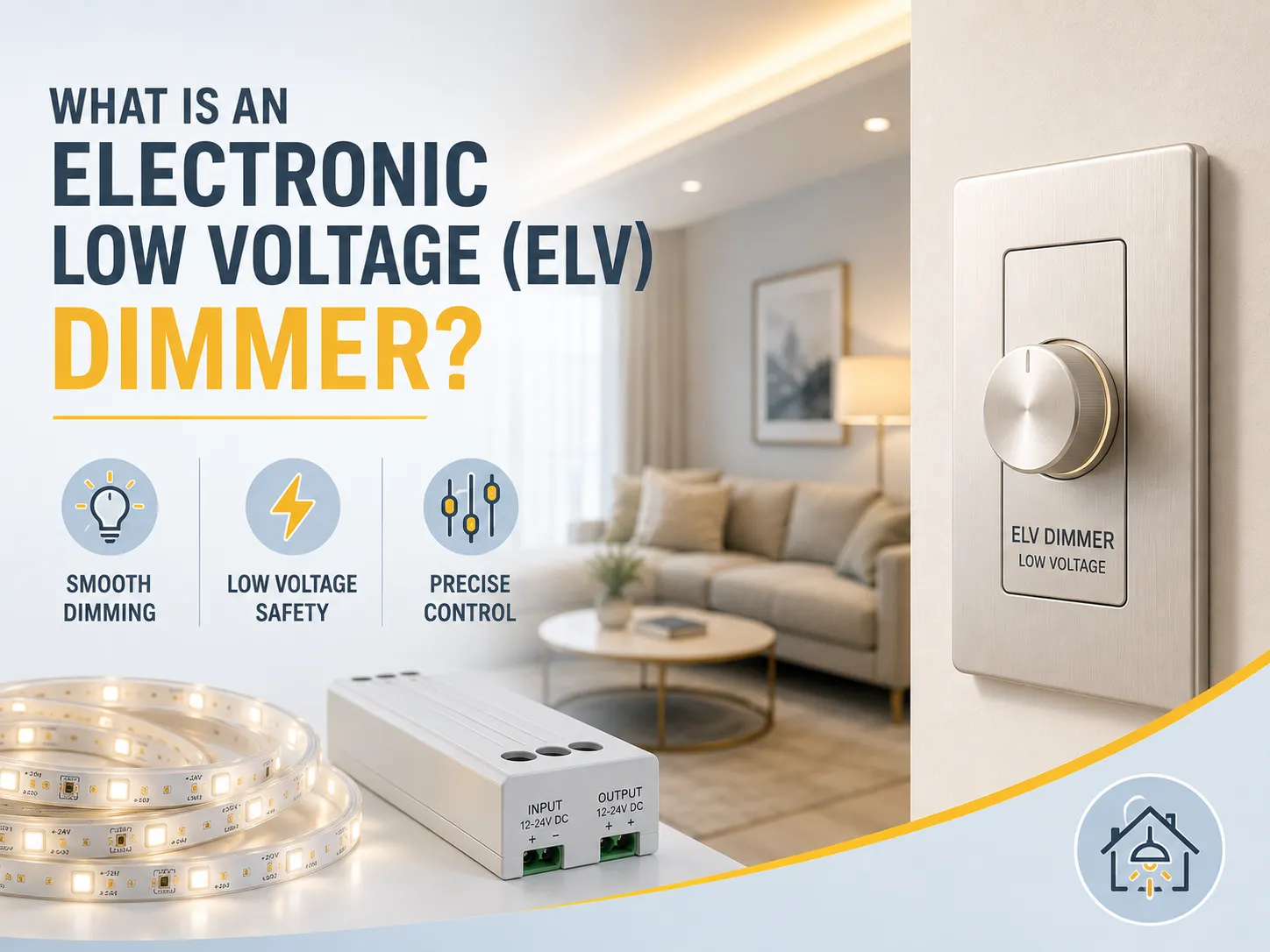
If your lights are utilizing low voltage transformers — the M16 12V downlights that have been widespread in ceilings for decades — or if your LED lights are buzzing or flickering or not dimming under 30%, then you should have encountered the term “electronic low voltage” on your dimmer box and wondered what it means. An ELV dimmer, an electronic low voltage dimmer, is a new type of dimmer that operates using trailing edge switching instead of the traditional leading edge method of dimming that most people grew up with. While ELV dimmers were originally designed to dim electronic low voltage transformers, they turned out to be very effective for dimming LEDs too because their dimming method works better with LED drivers as opposed to the leading edge technology used in the older dimmers.
In this guide, you will learn everything about the ELV dimming, how it works, what makes it more expensive than the older technology, whether it works for LED bulbs, what is the difference between CL and ELV dimmers, is the ELV really better than the usual CFL/LED compatible dimmers, and what are the brands and products worth buying with regard to ELVs.
Brief explanation: An electronic low-voltage (ELV) dimmer, also known as a trailing-edge dimmer, slices off the tail of each half-cycle rather than its start, which gives noise-free, smooth dimming with less electrical noise compared to leading-edge dimmers. Originally developed for controlling electronic low-voltage transformers (12V MR16 fixtures), currently, this kind of wall dimming technology is the high-quality dimming solution for LED bulbs and drivers with the maximum smooth dimming up to 5%. Key information: ELV dimmers require the neutral wire in the box since they are 3-wire devices, they are more costly than standard dimmers and they are not interchangeable with leading-edge dimmers: ELV transformator has to be dimmed by ELV dimmer and vice versa.
What Is an Electronic Low Voltage Dimmer?
An ELV (electronic low voltage) dimmer is a wall dimmer that transforms low voltage lighting through an electronic transformer, usually in the form of low voltage 12V MR16 halogen lamps or LEDs. The word “electronic” stands for the type of transformer for which it was made; it is made for electronic switch mode transformers and not magnetic low voltage transformers which use different types of dimmers called MLV dimmers.
The term ELV seems to be confusing since it refers to the type of dimming used, since electronic transformers needed a dimmer that would switch very well at a very high rate of switching frequency. Today, ELV dimmers can refer to dimmers regardless of the kind of load connected to it, and this is why that term has been used together with dimmable LED circuits that do not have transformers.
How ELV Dimming Works: Leading Edge vs Trailing Edge
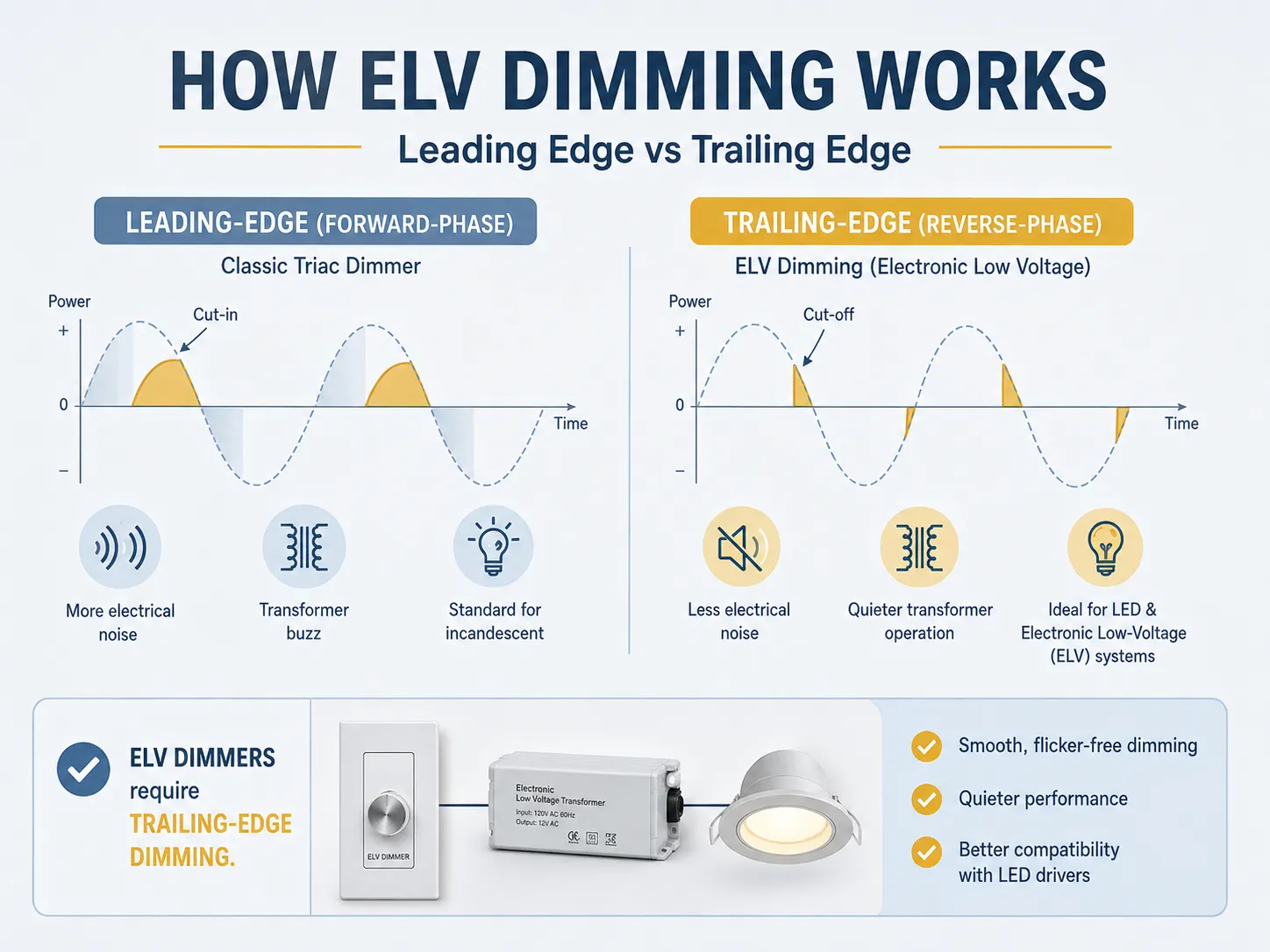
All AC dimmers use the same operation principle – they cut the sine wave, turning off the power supply intermittently and making the light dim. The only thing that differs is the exact point of cutting.
- Leading edge (also called forward phase) dimming is the multi-circuit dimmer – the switch is activated in the middle of a half cycle of AC signal and later is kept in the ON position for the remaining time. Due to a quick and strong switching, it creates electric noise and coil buzzing. This dimming method is used in incandescent dimmers as well as in most of those called “CFL/LED compatible” and actually in most dimming devices today.
- Trailing edge (reverse phase) dimming is the technique called ELV. The switch turns on the electronic circuit at the very beginning of the half cycle and shuts it down halfway through. Here the main difference is that the current is interrupted when it goes down to zero instead of being on abruptly. Thus, this method allows less electric noise as well as quieter functioning of transformers and smaller impact on LED drivers. That is why ELV dimmers are much quieter and smoother in operation.
ELV transformers are compatible only with the trailing edge dimming, as they cannot be dimmed properly and quietly by leading edge dimmers. This is due to the fact that ELV dimmers should be always traced before purchasing any dimming device.
Key Features and Characteristics
- Trailing-edge / reverse-phase switching is the technical feature par excellence; dimming using this technology is quiet and relatively noiseless.
- Use of neutral wire — ELV dimmers are three-wire devices, which means that electrical neutral needs to be there in junction box; retrofitting projects may require new wires to be pulled.
- Dimming effect down to 5% on everything in use.
- Showing less electrical noise and RFI.
- Longevity of the driver/transformer is increasing — with less stress for the load because of gentler switching.
- The technology is more expensive — ELV dimmers are around 2 to 4 times more expensive than standard leading-edge dimmers, ELV transformers being more expensive than magnetic transformers.
- Single-pole and three-way configurations offered.
What Can You Use It For?
The areas where ELV dimmers are commonly used and where they can be additionally utilized:
- Electronic low-voltage transformers (for 12V MR16 halogen/LED) — this is the oldest and most common application, as ELV is mandatory for dimming devices so that dimming is done correctly and silently.
- Dimmable LED drivers and bulbs — a lot of LED drivers mention “ELV” or “trailing edge” for compatibility, and ELV dimmers are the most silent and stable when operating with such devices.
- Dimmable CFLs — this works with fewer models of CFLs that can function in the trailing edge mode.
- Incandescent/halogen line voltage bulbs — ELV works perfectly fine here as well, but for this load, a regular dimmer will do the job much cheaper.
- Architectural and low-voltage landscape lighting — electronic drivers lend themselves very well to the ELV’s quiet operation.
What it does not work with: magnetic transformers (such systems require MLV dimmers) and non-dimmable LEDs (nobody can put in these lamps) and standard resistors where budget dimmers will work as well.
Can ELV Dimmers Be Used with LED Lights?
Indeed, this is one of the greatest reasons to purchase any. Dimmable LEDs and LED drivers conforming to the ELV standard will dim properly with ELV dimmers, mostly down to as low as 5%, without any flickering or buzzing, as long as the load capacity of the dimmer matches the given LED light (check the wattage of the LED light that the dimmer is designed for; be aware that this number is usually much lower than the incandescent rating, e.g. – a 300W ELV dimmer will be designed for 150-300W LEDs). The only hard rule here is: the LED light needs to be dimmable and should be approved by the dimmer manufacturer if such information is available. Any non-dimmable LED light will flicker or buzz when connected to any dimmer and may be damaged. If you are mixing LED circuits with existing dimmers, our LED dimmer compatibility guide covers exactly how to match bulbs, drivers, and dimmers, and the benefits of dimming article explains why the extra compatibility work is worth it.
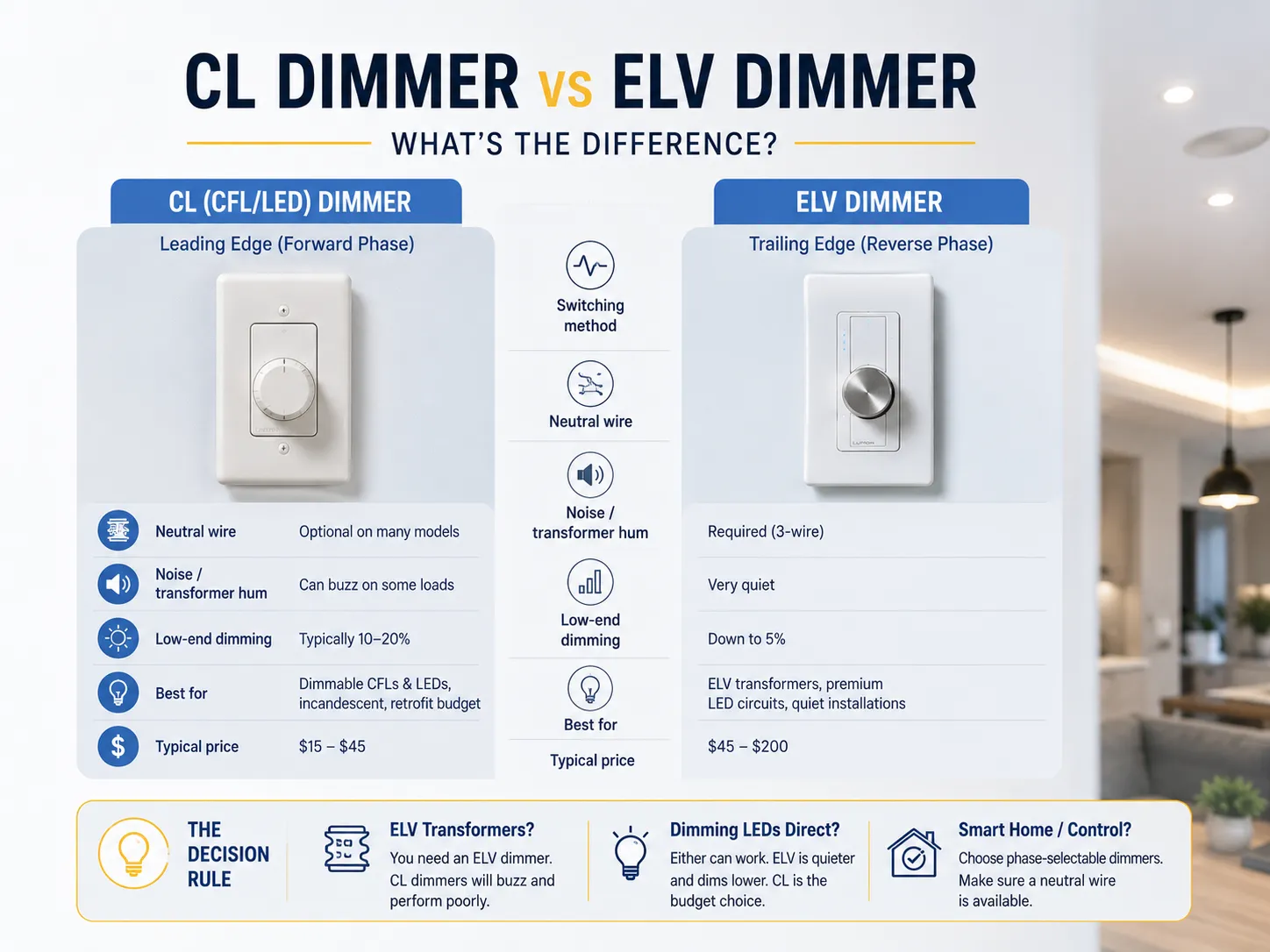
CL Dimmer vs ELV Dimmer: What’s the Difference?
CL dimmers (sometimes referred to as “CFL/LED-compatible” or “universal dimmers”) are modern dimmers which have undergone a re-engineering process that has made it possible to adjust their low end as well as improving their components, so CL dimmers can dim CFLs and LEDs without excessive flickering. They are the dominant solution to “my LEDs flicker”. In contrast, ELV dimmers are older devices that work based on a different principle of operation. Here is how the two types of dimmers differ in practice:
| Feature | CL (CFL/LED) Dimmer | ELV Dimmer |
|---|---|---|
| Switching method | Leading edge (forward phase) | Trailing edge (reverse phase) |
| Neutral wire | Optional on many models | Required (3-wire) |
| Noise / transformer hum | Can buzz on some loads | Very quiet |
| Low-end dimming | Typically 10-20% | Down to 5% |
| Best for | Dimmable CFLs and LEDs, incandescent, retrofit budget | ELV transformers, premium LED circuits, quiet installations |
| Typical price | $15-45 | $45-200 |
Guidelines for making a decision – If your fixtures operate on low-voltage transformers, you will need to obtain an ELV dimmer, as a CL dimmer will cause buzzing and other problems in operation. If you are directly dimming LEDs, both devices will do the job, although ELV devices cause deeper dimming and operate more noiselessly. CL devices are the less expensive option of the two. In smart home and other control systems, new dimmers can have a phase selection feature (they can be set to either backward or forward phase). It means that only one device can be used for both systems, however, the availability of the neutral wire in the wallbox must be confirmed.
Are ELV Dimmers Better Than Standard CFL/LED-Compatible Dimmers?
Yes, for most installations utilizing LED bulbs, ELV dimmers have been determined to work better. The improvements ELV dimmers have over regular dimmers is not purely marketing hype; in fact, the advantages offered by ELV dimmers can be quantified: they have a lower minimum dimming range (5% compared to the 10% – 20% typical of regular dimmers), they are quieter, they impose less strain on the LED driver, and they ensure that the dimming process does not produce flickering or popping noises during startup that usually associates itself with regular dimmers. This explains the fact that ELV dimmers are specified on regular basis for demanding lighting applications such as media rooms, architectural lighting, and circadian schedule lighting.
However, purchasing ELV dimmers comes with certain exceptions, such as the fact that they are pricier and require a neutral wire, not to mention the fact that not all LED bulbs are compatible with trailing-edge dimming technology. Hence, if you are working with a tight budget, have only 2-wire boxes, or your LED bulbs are functioning reasonably fine on regular CL dimmers, switching to ELV technology may not be necessary. However, if you are building or rewiring a building and hope to make your LED lighting dimmer behave appropriately, ELV dimmers are the better choice.For the broader dimming-control picture — including why neutral availability decides your whole dimmer strategy — see our guides on top-rated smart switches and how to replace a light switch safely.
Recommended Brands and Price Ranges
Lutron and Leviton are two brands associated with this category of products. Lutron, the trendsetter as far as ELV dimming is concerned, and Leviton’s rate of developments in this area. Manufacturers such as Legrand and LiteTouch and Hunt are also part of compatibility providers for architectural systems with ELV/universal dimmers. The end-user pricing for these products typically ranges as follows (from $45):
| Brand / Model | Type | Typical Price |
|---|---|---|
| Lutron Skylark SELV-300P / SELV-303P | ELV, slider, single-pole/3-way, 300W | $45-55 |
| Lutron Skylark Contour CTRP-253P | ELV, rocker + slider, 250W | ~$60 |
| Lutron Diva DVELV-300P / DVELV-303P | ELV, rocker, single-pole/3-way, 300W | $80-100 |
| Lutron Maestro MAELV-600 | ELV, preset, 600W | $110-150 |
| Lutron Nova NTELV-600 | ELV, designer, 600W | $150-200 |
| Lutron Vierti VTELV-600 | ELV, multi-location, 600W | $180-200 |
| Leviton Decora Smart ELV/LED (D2ELV) | Smart, phase-selectable, Wi-Fi, ELV 600VA | ~$77 |
Prices vary due to features of the product; for example, Lutron’s entry-level slider ELV dimmers cost around $45 while smart phase-selectable ones cost anywhere between $77 and $100. Depending on the applicability of the devices — $45-60 level makes sense to go for Lutron Skylark ELV models if the plan is to provide a home solution with a few circuits using either MR16 or LED lights; more advanced devices produced by Lutron’s Maestro/Nova lines or Leviton smart units would be justified for whole home application and providing a better customer experience.
Installation Notes: The Neutral Wire Requirement
The most common misunderstanding encountered during ELV implementation is putting it together with having a neutral wire available. There are three wires in ELV installation: hot wire, load wire and neutral wire. In the case a the house has relatively new wiring the neutral wire already exists and installation process becomes truly simple. The steps include switching off power supply, connecting wires to the appropriate ports and adjusting the settings in case the dimmer is phase-selectable. This is exactly the scenario covered in depth in our neutral vs non-neutral smart switch guide — check the box before you buy, not after.
Frequently Asked Questions
Is ELV dimming the same as triac?
No – These two methods of dimming are polar opposites. Triac dimming uses leading-edge (or forward-phase) technology where electricity comes on abruptly partway through each half cycle, resulting in electrical noise and buzzing with transformers and LED drivers. ELV dimming uses trailing-edge (or reverse-phase) technology where electricity starts at the beginning of the cycle, which means it turns off before the end of the cycle and helps produce silent, smooth dimming. ELV transformers must be operated with trailing-edge type dimmers since they will buzz and perform poorly with triac dimmers.
Do I need an ELV dimmer?
If you have lighting powered by electronic low-voltage transformers like 12V MR16 fixtures, you need to use ELV dimmers since the fixtures will not dim properly when used with a regular dimmer. Additionally, you should consider getting an ELV dimmer if you are using dimmable LED circuits and want a low level of dimming (even down to 5%) and no flicker or buzz — ELV dimmers are ideal for LEDs but cost more. If you are already satisfied with the dimming quality of incandescent lamps that work on CL dimmers, there is no need to upgrade to ELV dimmers.
What is the difference between an ELV dimmer and an LED dimmer?
The term “LED dimmer” is a marketing term rather than a technology term as most dimmers that can be used with LED lighting use leading-edge (triac) technology and even have a low-end trim feature (CL dimmers). On the other hand, an ELV dimmer is a particular example of a special trailing-edge technology that functions better with a number of LED drivers thus producing lower minimum dim (quieter operation of drivers) while stressing them fewer. However, ELV dimmers require neutral wire installation and cost more than LED dimmers. Some of modern dimmers can be used in both modes and can handle both LED and ELV loads.
Can you put a dimmer on low-voltage lighting?
Yes, it is essential to pick the dimmer switch that matches the type of transformer used. If the electronic low-voltage transformer is used, an ELV (trailing-edge) dimmer will be needed; if a magnetic low-voltage transformer is used, the dimmer that is mostly used today is MLV dimmer which is usually heavy-duty leading-edge type one. If the wrong dimmer is used for low-voltage lighting, buzzing, flickering and poor dimming range may occur.
References
- Liton Lighting — Dimming facts for LED products (ELV/MLV technical white paper)
- Liton — ELV dimmer history, wiring, and factory-qualified dimmer list with prices
- Leviton Decora Smart ELV/LED phase-selectable dimmer — specs and price
- Lutron Skylark Contour ELV dimmer — product data and price
- Lutron Skylark SELV-303P ELV dimmer — specs and price
Conclusion
The electronic low voltage dimmer is an unsung hero in the dimming industry. It has trailing-edge technology that operates cooler, quieter, and smoother than the old triac technology. This dimming solution was specifically designed to work with electronic transformers that are used to operate low voltage lights; thus it has become the best type of dimmer for dimming LEDs. The construction of the electronic low voltage dimmer has its drawbacks. It is expensive and needs a neutral wire for its use, but if you have electronic transformers, LED circuits, or just looking for “no flickering, no buzzing and dimming to 5%” solution, you will find the electronic low voltage dimmer to be the perfect match. Whether you choose Lutron or Leviton electronic low voltage dimmers, ranging from $45 Skylark to smart phaseselectable units costing less than $100, make sure you pick the model that is compatible with your transformer and confirm the LED is dimmable.