Everybody has heard of this acronym known as GFCI, yet not many people understand what it actually means and does. According to professionals, electricians use this phrase freely and inspectors quote it in their reports, and the uninitiated just nod along. The reason for that lies in the fact that two different words are used to denote the same gadget, both of which do not provide much insights into what the device actually does and how it works.
In this article, we will start by clarifying what the term stands for, and only then move on to such important details of the device as the criteria that make the device special, as well as the places it will need to be installed according to the building codes, the differences between GFCI and other devices like GFI, AFCI and RCD, and the average costs of the device in the year 2026.
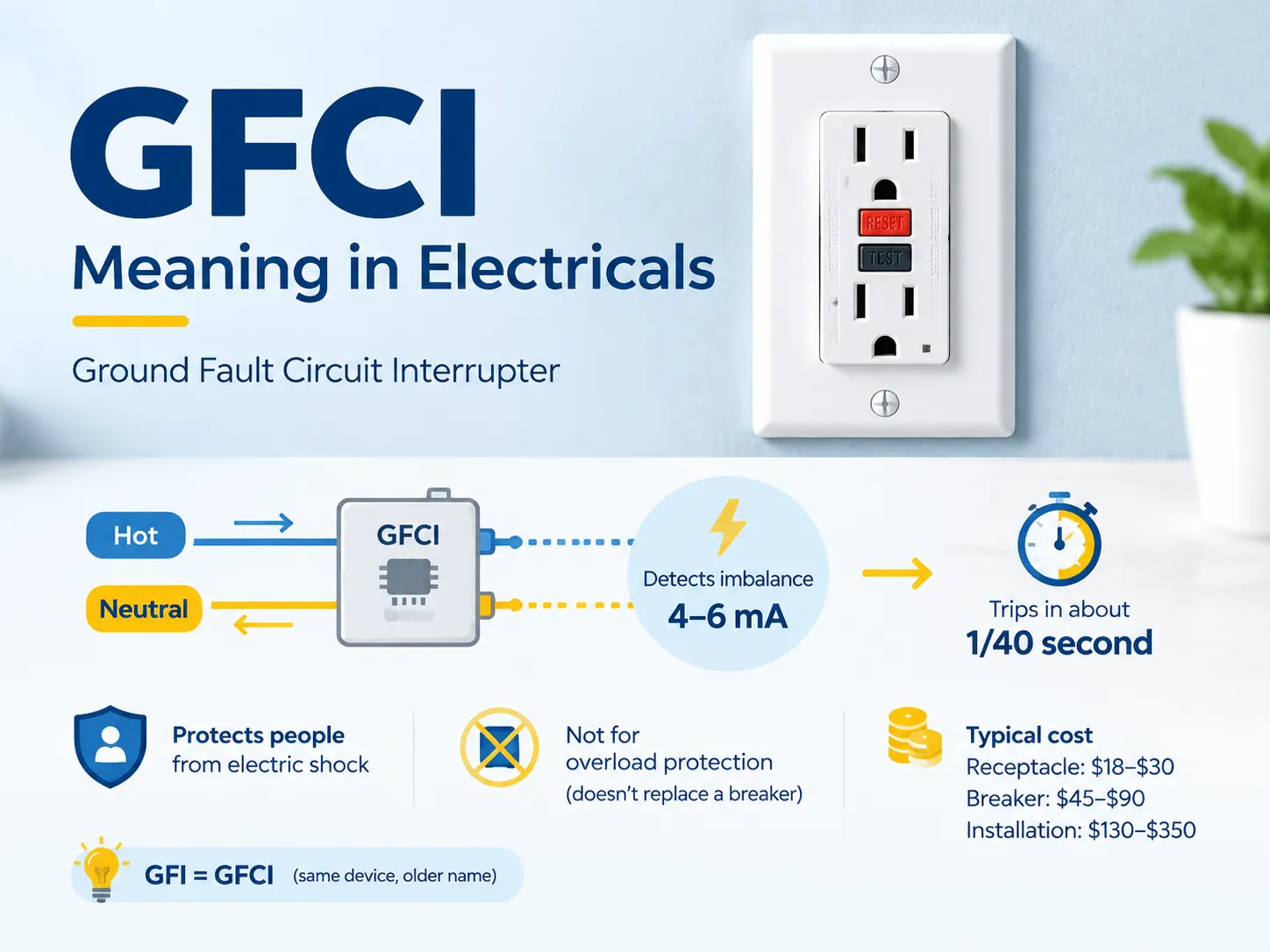
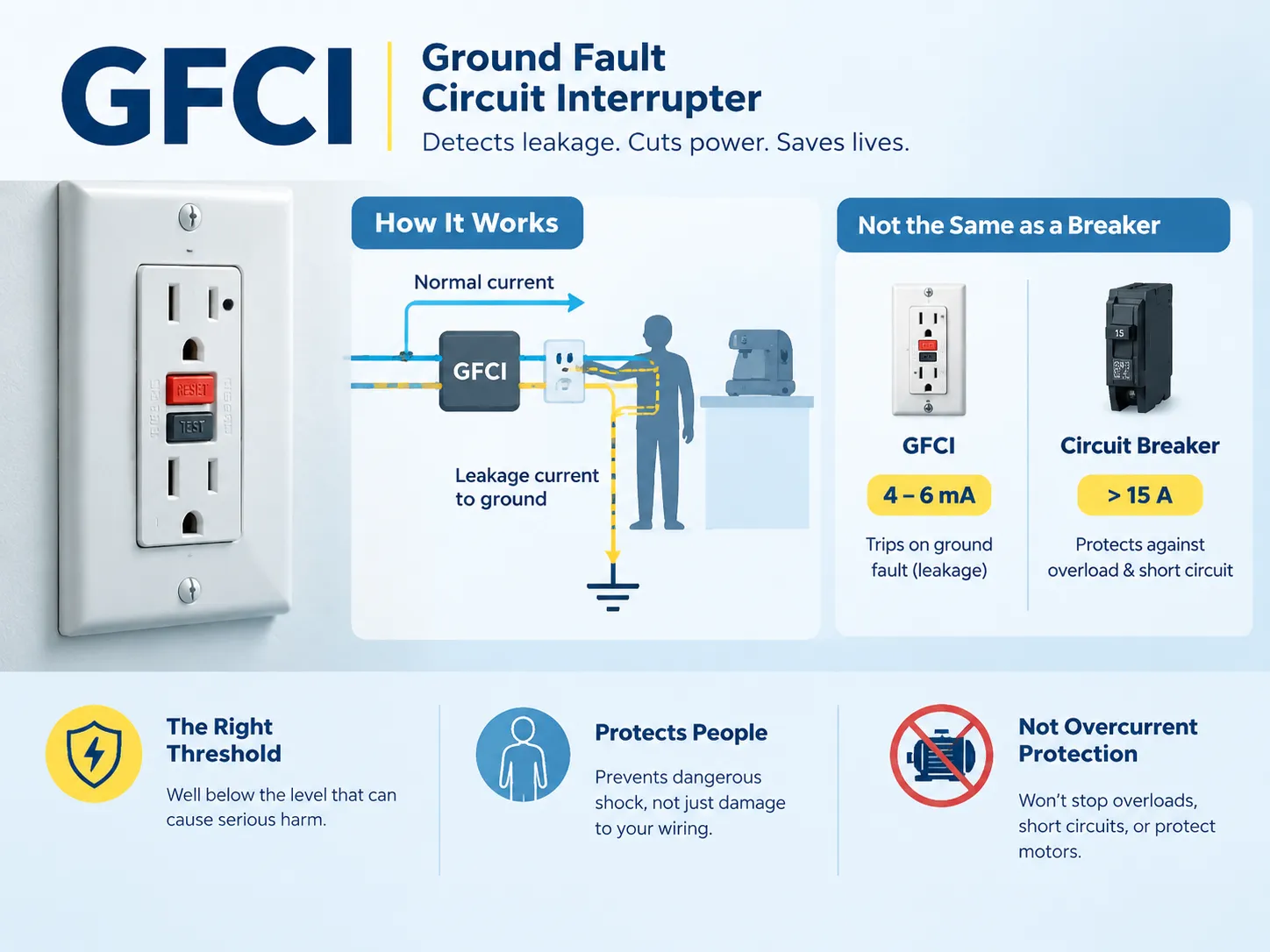
GFCI is short for Ground Fault Circuit Interrupter. This device is meant for safety because it keeps track of the difference between the amount of electricity that travels out on the hot wire and coming back along the neutral wire. When the difference approaches around 4 to 6 milliamps, the GFCI opens the circuit in about 1/40 steel, which is how fast it reacts to the difference in the currents. Unlike circuit breakers that protect equipment from overloads, GFCIs protect people from electric shocks. The price of a GFCI outlet is $18–$30 and GFCI breaker is $45–$90; the cost of a GFCI installation is $130–$350. GFI is synonymous with GFCI as it refers to the same type of device but has a slightly shorter name.
GFCI Meaning in Electrical: The Full Form, Plainly
The GFCI’s name is a descriptive one; it gives us three ideas from its three parts. “Ground fault” means that the current is doing strange things, like going into the ground through a person, going into the ground through a water pool, or going into the ground through a broken conductor that touches a metallic body that is grounded. The verb “to interrupt” refers to switching the circuit off. The device could be called simply “circuit interrupter,” for that is what it does. Hence, GFCI is the device that feels the current flowing where it should not flow and cuts the power off before it kills someone.
A GFCI is special in its design because of the level of current it reacts to. Regular breakers act at the level of 15 A, with this value being enough to protect a 14 AWG conductor. GFCIs operate at a level of 4-6 mA of leakage current, which corresponds to one four-hundredth of the current needed for a small breaker to work. The reason for such a difference is as follows: the amount of current in the range of 10-30 mA going through the human body would cause continuous muscle contraction and even ventricular fibrillation. 50 mA can kill a person immediately. GFCIs operate at the much safer levels of leakage current so that a person receiving an electric shock will not die.
One last important thing should be remembered about GFCIs: these devices do not act as overcurrent protection devices. Thus, GFCIs do not protect wires from overloading; they do not stop short circuits and do not protect motors from drawing too much current. Rather, GFCIs detect the leakage signature preceding an electric shock, which is a completely different way of failure.
How a GFCI Actually Works
Each ground fault circuit interrupter (GFCI) contains a small device called a current transformer through which both the hot and neutral wires pass. Under normal conditions, the amount of current that is sent out on the hot wire equals the amount of current that is returned via the neutral wire, rendering the magnetic fields created by both wires in the transformer cancel each other out, and therefore no current is detected. This is the principle behind the operation of a GFCI.
As soon as some current leaks into the ground through the body, water, or damaged insulation, the current sent out differs from the current being returned via the neutral wire. This causes current to flow through the coil, which produces a measurable signal that can be compared to the trip threshold. If the signal exceeds a certain limit, then a solenoid will operate, which will open the hot and neutral contacts. In case of a GFCI breaker, the sensing element receives the same signal and operates the breaker mechanism. Unlike a fuse, the trip of the circuit does not happen automatically and permits resetting of the device, which is necessary after the electric shock takes place.
This design has two important implications. First, ground fault circuit interrupters can detect electric current that goes through a human body even in cases when that person is not grounded at all. This is because a person standing on a wet floor in rubber shoes and touching the live wire does not create an electric short circuit, but a GFCI notices that. The second implication is that ground fault circuit interrupters do not require the equipment ground to work. This is the reason why they can be installed on old two-wire circuits.That last point carries a caveat that matters, and it is worth reading up on how receptacle devices are constructed and what each wiring terminal on one actually does before you decide a GFCI is a shortcut past rewiring a house.
Another aspect that the sensing design clarifies is nuisance tripping. Due to the very low threshold, any device that emits more than the given leakage amount would immediately trip the GFCI even where there is no fault detected at all. This isn’t a defect but rather the functioning of the device in its normal way.
Where the Code Requires GFCI Protection
According to Article 210 of the National Electrical Code, GFCI requirements have been in place since GFCI devices were first required for outdoor receptacles in 1971. Regulatory specifications for GFCI devices continued to expand in the following years. As such, GFCI devices were also mandated for bathrooms in 1975, then garages in 1978, and so on until the present day. If you have been working from any version of the code previously, you might be missing some locations in your information.
The NEC has been updated again in its 2023 edition, which now requires GFCI protection for all 125 V-250 V receptacles acknowledged in the 50 A category. This includes all receptacles being used in dwelling unit locations, of which we can mention bathrooms, garages and other buildings as well as outdoor receptacles, crawl spaces, basements, kitchen areas, boathouses, as well as anything positioned indoors that is within six feet from a bathtub or shower, as well as wet locations indoors as well as laundries. The expansion to 250 V receptacles is the change that catches people out, because it means that from now on and after 240 V outlets in garages, and outdoors need GFCI protection.
As for commercial receptacles, we are referring to section NEC 210.8(B) and all user occupancies, which have to do with the aforementioned commercial kitchen areas where receptacles are not included into appliances because of their nature, rooftop settings, as well as the outdoor settings depending on the said receptacles.
| Location | 210.8(A) Dwellings | 210.8(B) Non-Dwellings | Notes |
|---|---|---|---|
| Bathrooms | All receptacles | All receptacles | Whole room, not just near the sink |
| Kitchens | Kitchen areas | Commercial kitchens | Not required for receptacles integral to an appliance |
| Garages / service bays | Yes | Yes | Garage door opener receptacle exception was removed in the 2020 edition |
| Outdoors | All receptacles | All receptacles | Use weather-resistant (WR) devices |
| Laundry areas | Yes (added 2023) | — | All receptacles in the laundry space |
| Basements / crawl spaces | Yes | Crawl spaces at or below grade | Coverage widened in 2023 |
| Within 6 ft of a sink | Yes | Yes | Measured from the sink’s outer edge |
| Rooftops | — | All receptacles | Common correction on commercial jobs |
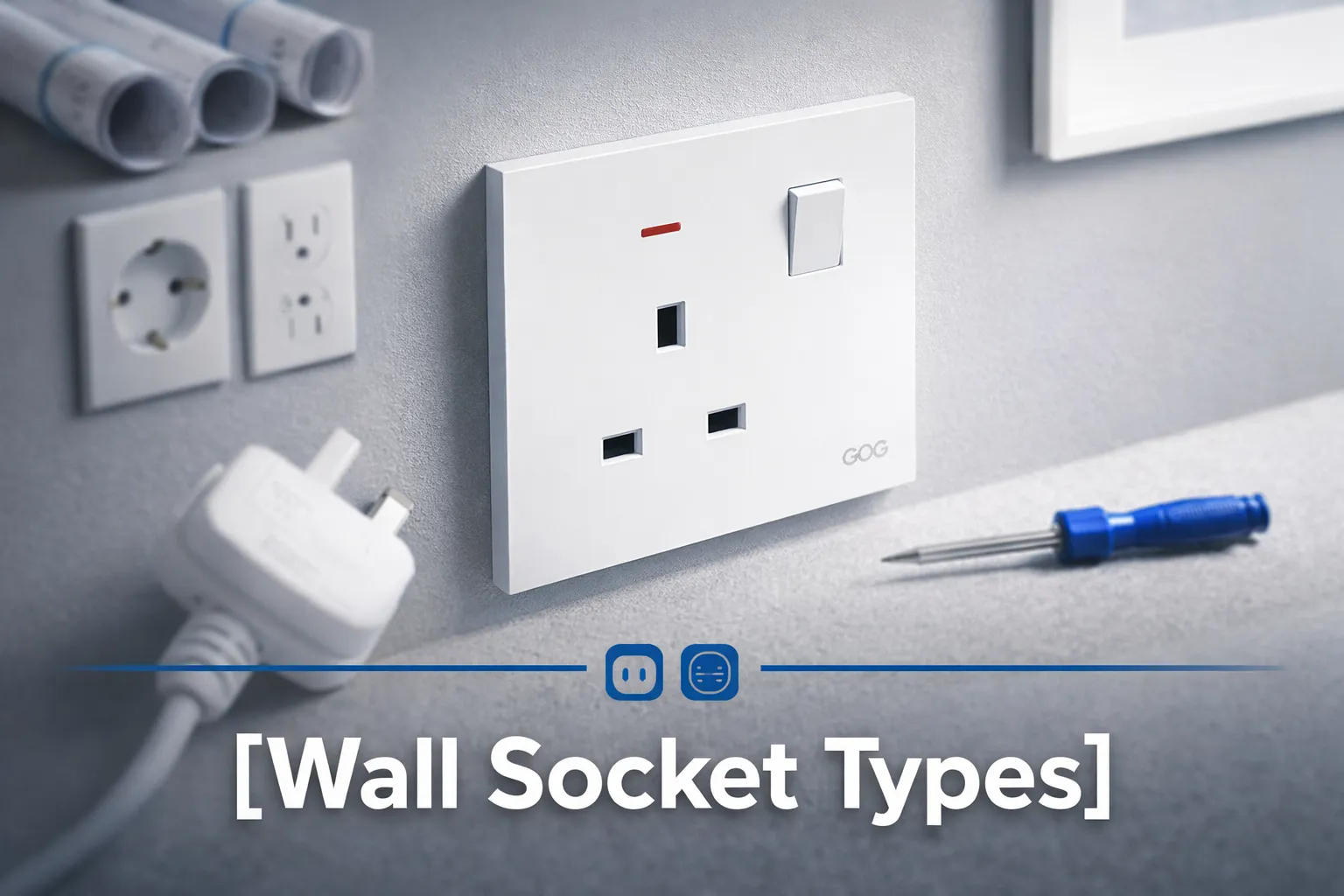
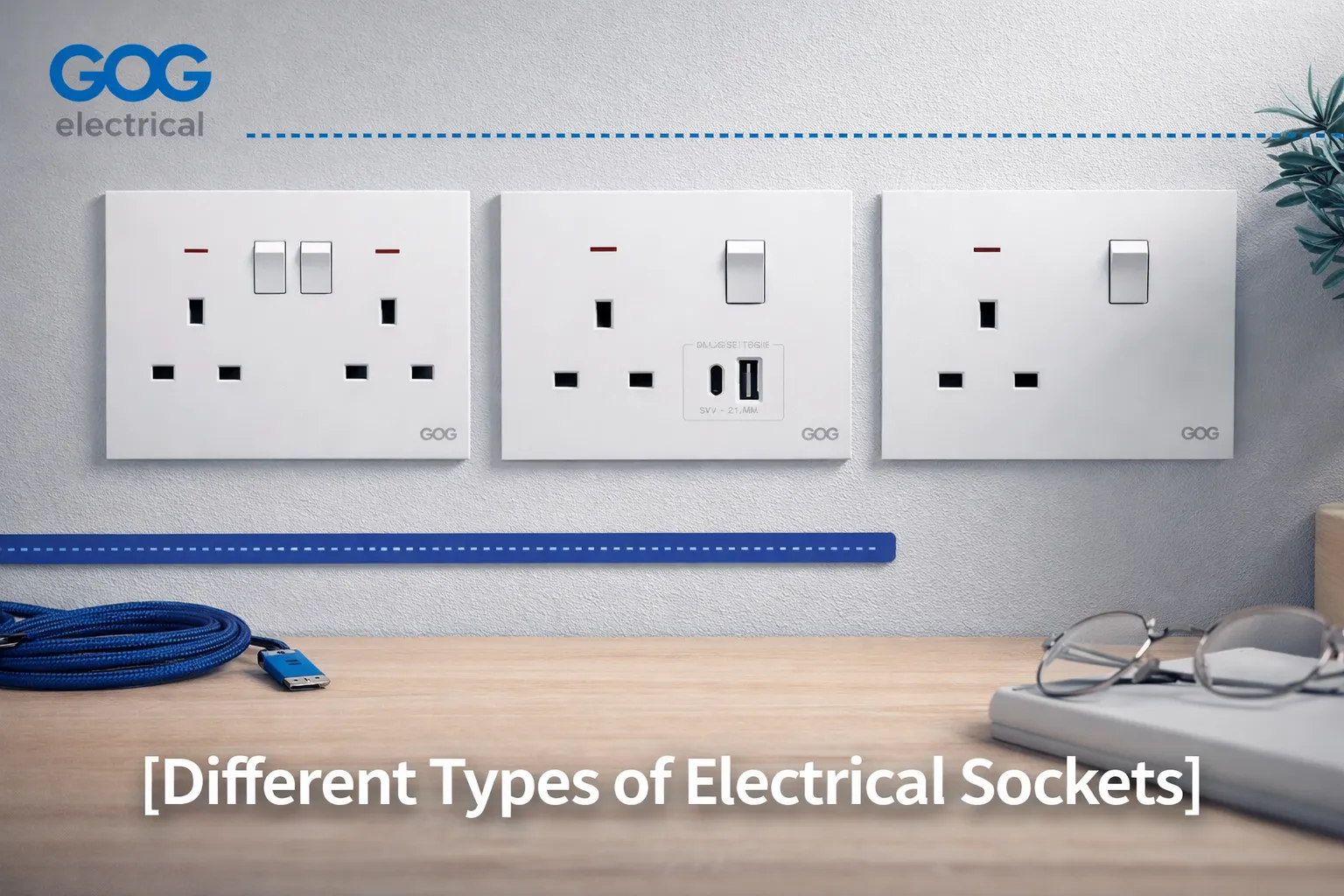
Many people overlook an important idea: Adoption. NEC is a good guide. It is only applicable if a jurisdiction adopts it. States we have around use the most outputs of editions ranging from 2020 to 2023. Where you want to mention something as required or not required based on some authority, check the edition of NEC your jurisdiction has distilled. If you are sourcing devices for a project rather than inspecting one, the same caution applies to the hardware — matching device type to the socket configuration in use is its own discipline, and our reference on the different socket types used around the world and where each one applies is a useful check before you place an order.
GFCI vs GFI vs AFCI vs RCD: Clearing Up the Four Names
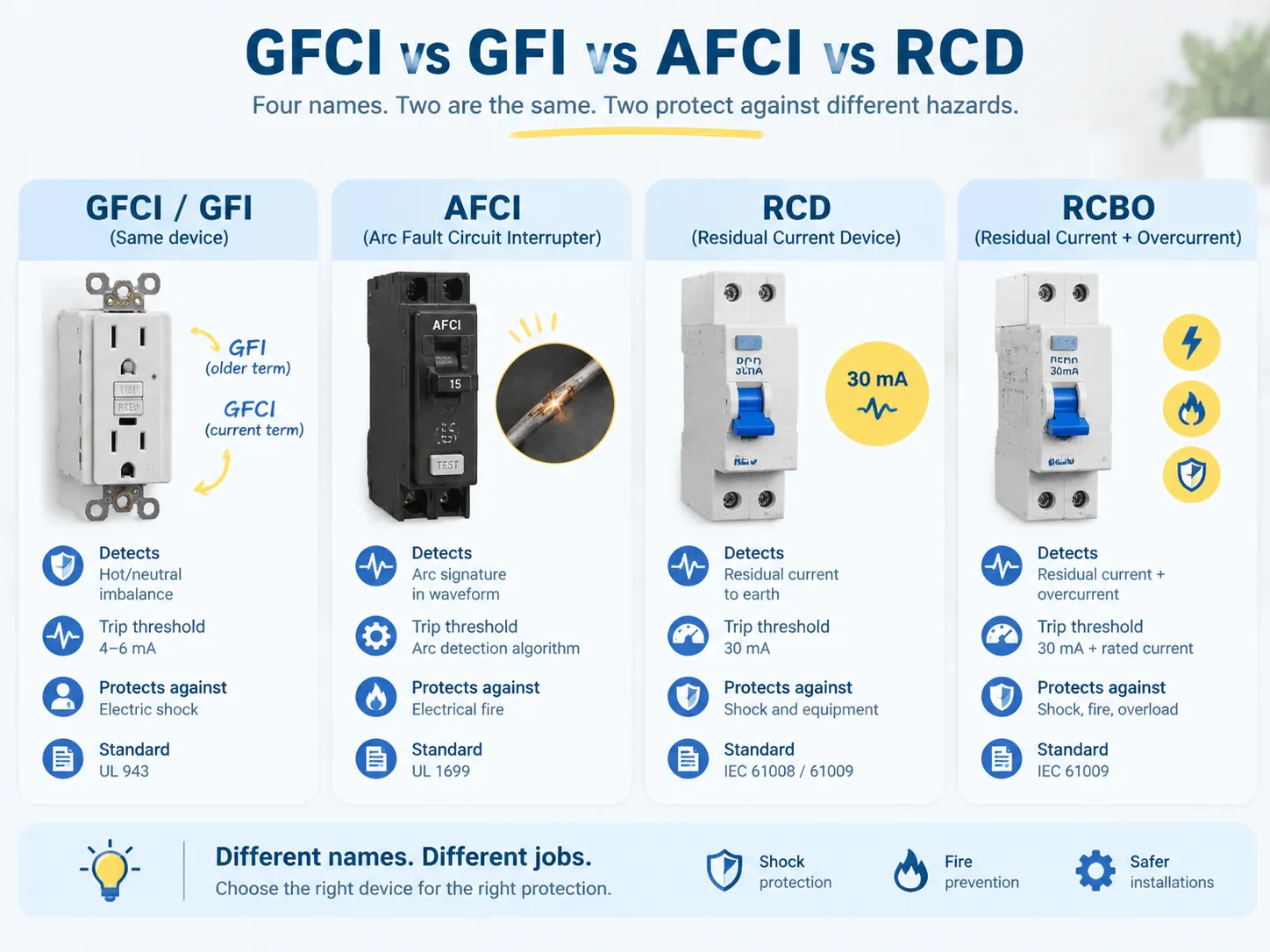
There are four terms here. Two of them mean the same thing, while the other two prevent completely different things. If you can clear out this confusion in thirty seconds, it will save you from a lot of misunderstandings.
In fact, GFCI and GFI mean the same device. GFI stands for Ground Fault Interrupter while GFCI represents Ground Fault Circuit Interrupter. The difference in the spelling of the two acronyms occurred because the first abbreviation came into use first and has appeared as the name of the devices over the years. So, for instance, you may find the product manufactured by Leviton or Eaton featuring GFI in its name and Ground Fault Circuit Interrupter given in the details of the device packaging. There is no difference between the two in terms of function, standard, or certification. The fact that someone might say that GFI is a simplified version of GFCI is because of the product packaging rather than the engineering side of the matter.
As for AFCI, it represents another type of device. Arc Fault Circuit Interrupter is designed for detecting a dangerous arc. By this, I mean the detection of the signature generated by the arc due to reasons in appliances that may be broken. Unlike GFCI, it cannot prevent the electric shock. It only provides the necessary protection against the fire hazard. The AFCI device functions in the same way as GFCI does, which means that dual-function circuits are more efficient than first high-frequency devices.
The international alternative to GFCI is RCD. Nearly all countries except for North America apply Residual Current Devices. The fact is that RCD is controlled by IEC61008 and IEC61009 standards, whereas it has a standard level of sensitivity of around 30 mA. For a fuller picture of how those market differences play out in practice, how UK and US electrical systems compare on voltage, frequency and protection strategy is worth a read before you specify.
| Device | Detects | Trip Threshold | Protects Against | Standard |
|---|---|---|---|---|
| GFCI | Hot/neutral current imbalance | 4–6 mA | Electric shock | UL 943 |
| GFI | Same device | 4–6 mA | Electric shock | UL 943 |
| AFCI | Arc signature in waveform | Arc detection algorithm | Electrical fire | UL 1699 |
| RCD (30 mA) | Residual current to earth | 30 mA | Shock and equipment | IEC 61008 / 61009 |
| RCBO | Residual current + overcurrent | 30 mA + rated current | Shock, fire, overload | IEC 61009 |
Where a GFCI Belongs and Where It Does Not
On one hand, code provides basic minimum requirements in terms of safety provisions. On the other hand, practical expertise tells you in which situations you would need to go beyond the code, and where doing so creates more problems than solutions.
You may want to consider installing GFCI protection regardless of whether you are required to do so or not: any receptacle that is in close proximity to aquarium, or humidifiers/dehumidifiers, but especially in old homes because a GFCI works on ungrounded circuits as it can detect leakage without any ground path and can be fitted into place in twenty minutes per location. Of course, it is not an alternative to rewiring and must be properly labeled for future reference.
There are also cases when having a dedicated circuit for a piece of large equipment presents a problem because this is the best example of a case where a person fights the equipment instead of trying to understand it.
What GFCI Devices Cost
While machinery costs little, the labour involved is expensive. This fact should dictate how you organize the job since labour costs are calculated on a per visit basis and not on the per device basis. Therefore it makes no sense to do the job one device at a time.
| Item | Typical Price | Notes |
|---|---|---|
| Standard 15 A or 20 A GFCI receptacle | $18–$30 | Tamper-resistant versions add a few dollars |
| Tamper-resistant (TR) GFCI receptacle | $20–$35 | Required in dwelling units per NEC 406.12 |
| Weather-resistant (WR) GFCI receptacle | $25–$45 | Marked WR; required outdoors per NEC 406.9 |
| GFCI circuit breaker, 15–50 A | $45–$90 | Protects the whole circuit; needs panel space |
| Dual-function AFCI/GFCI breaker | $50–$110 | Covers two code requirements in one pole space |
| Professional installation, per device | $130–$350 | Roughly 1–2 hours; panel work costs more |
| Whole-house retrofit, 8–12 locations | $900–$2,500 | Batch the work to amortise the visit |
There truly is a pricing gap between brands, which is not terribly large, as it depends mostly on trip speed, light indication behavior, and the presence of test function. New GFCIs have to test themselves at regular intervals and signal their failure instead of just sitting there in dead silence, which is a function I wouldn’t overlook. If you are comparing device ranges at the supplier level rather than the retail shelf, how the major wiring-device brands position themselves on quality, price and market gives you a reasonable map of who sits where. Brands differ far more on decorative plates and finish options than on the protection electronics inside, which is worth remembering when someone tries to sell you a premium GFCI on safety grounds.
It is important to mention GOG’s position in the context of installations involving wiring devices. GOG develops various types of switches and sockets, which are partially visible when a circuit has been wired, and it sells those products to distributed network operators and OEM clients. Below protective devices lies the GFCI that has a special category as per the certifications. When it comes to North American projects, the correct approach is to buy the GFCI from a UL 943 manufacturer and the various socket outlets, plates, and switches from the manufacturer that provides the most acceptably fast lead times and consistency.
Installation and Maintenance Notes That Save Callbacks
Most issues concerning GFCIs do not occur due to device breakdowns. Instances of GFCIs malfunctioning can often be traced back to sloppy installation or lack of proper testing. There are five guidelines one needs to remember in order to avoid unnecessary nuisance tripping.
Keep GFCIs from daisy chaining. Installing a GFCI downstream from another unit means both units are dealing with the very same circuit so that if any of them trips, the other one may go off as well or partially reset. There should be at least one GFCI installed per circuit so that following its LOAD terminals you can connect regular outlets.
Check that you are connecting loads and line wires correctly. If you connect the wires incorrectly GFCI does not get damaged anywhere but it does not provide any protection either. Check your sockets with a plug-in device connected to the SUSPECTED socket, not just at the GFCI itself.If you are not confident reading the terminal markings, the same discipline applies as when wiring any device, and how to evaluate wiring devices on rating, listing and build quality covers the checks that keep you from installing something that will not hold up.
Tag the outlets that are protected. A tiny sticker that says “GFCI protected,” is a good way to let the next person know who doesn’t have to look around for the source of the nuisance. This is especially beneficial in case the GFCI has been placed upstream somewhere in the bathroom but is protecting the receptacle located in the hallway
Use weather-resistant devices outside, in an appropriate enclosure. It should be noted that just by calling a GACFI a weather-resistant device does not make it waterproof. It requires an in-use (bubble) cover if something is plugged in continuously and must be mounted in such a way as to avoid water pooling on the face. Most GFCIs outside fail not because of electronics but due to water ingress.
Perform manual testing each month. All you have to do is to press the TEST button and check that the device does trip and the downstream receptacles are dead, and then you press the RESET button. With the self-checking feature being available now you still cannot depend on the test made by the device. Making a manual test once a month is a good practice.
Frequently Asked Questions
What should not be plugged into a GFCI?
While there is no particular appliance designated to be installed on a GFCI receptacle according to the American electrical code, there is, instead, a practical list of appliances that, either because of their design or due to being old, cause frequent tripping of GFCIs by leaking electricity of more than 4-6mA. For example, refrigerators and freezers have always been on the list of “culprits” but dehumidifiers, sump pumps, treadmills and machinery with larger engines, high inrush laser printers and fluoros with old ballasts follow them close. It is interesting to note that the NEC has given a special consideration to the problem of the sump pump in the basement by allowing it to be plugged directly into the outlet without using GFCI. It would be good not to fight against GFCIs by removing them but to search for the leaking appliance by using a clamp meter on its cord.
What does a GFI outlet look like?
A GFI outlet appears to have two rectangular buttons, labelled TEST and RESET, usually with a small indicator light nearby. Most GFI outlets are of the standard duplex design and fit into a normal wall plate. However, decorator style GFI outlets are also popular and feature a wide rectangular opening and wider face. You can identify 20 A outlets by the T-shape in the left slot since 15A outlets have a square shaped slot. If you try to insert a probe into a tamper-resistant outlet, you will notice that there is a spring mechanism behind the openings. Furthermore, some outdoor GFI outlets have the WR inscription to show they are weather rated and come with a foam gasket. Most modern GFI outlets will show an indicator light to let you know that the protection is functioning. However, various brands of GFI outlets behave differently.
What does GFI mean in a text message?
There is not a fixed connotation for the phrase in question; in fact, the context dictates it. When texting casually, the phrase is most often read as a shorthand approval, but used more infrequesntly in British casual language where it can mean something more elaborate. Knowing this meaning is important if you’d like to use the phrase in a company of your English coworkers. In case of a group chat about DIY repair and electrical works, it will usually mean ‘device’. The only meaning that you shouldn’t take for granted is its technical usage: in case you are discussing the electrical project and someone uses the abbreviation, they can be referring to ground fault interrupter. What to do if one meaning does not suit your interpretation? In this case, just ask your colleague.
What does GFI stand for in government?
The term “government” does not have a singular interpretation since different agencies equate the abbreviation with various meanings. The term “government furnished information” is generally accepted in military procurement and defense contracting to mean that the term refers to the information that the government provides to any contractor in accordance with the Defense Industrial Base voluntary cyber security program, including cyber threat and security assurance practices (see 32 CFR 236.2). The same abbreviation has been used in DFARS 252.227-7023, which specifies what kind of restrictions apply to the confidential status of GFI information shared with an individual contractor, and you may have encountered different definitions like GFP that stands for Government Furnished Property. However, this abbreviation can mean different things depending on the organization that uses it such as when state, local, and federal authorities use GFI in relation to items related to general fund and grant funding instruments. In this case, the readers should check the definitions section of the document in order to see what this abbreviation actually means in a specific document.
References
- NFPA — NFPA 70 National Electrical Code, Article 210.8 GFCI protection
- UL Solutions — UL 943, Ground-Fault Circuit-Interrupters
- UL Solutions — UL 1699, Arc-Fault Circuit-Interrupters
- International Electrotechnical Commission — IEC 61008 and IEC 61009, residual current devices
- OSHA — Electrical safety standards and ground-fault protection requirements
- eCFR — 32 CFR Part 236, definition of Government Furnished Information (GFI)
Conclusion
GFCI stands for Ground Fault Circuit Interrupter, and one important figure you should remember is 4 to 6 milliamps — the insignificant imbalance that makes it trip and the reason why it helps save lives when circuit breakers can’t do anything at all. GFI is the same device under its older title, AFCI is the device that protects from fire as opposed to shock while an RCD quite likely performs a similar kind of action but at much less sensitive 30-mA threshold. It is the four titles that constitute 90% of confusion about the device.
There are two things I would do. First, if your home was built before the concept of grounding appeared, it is senseless to start rewiring — GFCIs should be installed for wet installations before the rewiring but the prices should be compared prior to the start of work; GFCI can work on a circuit without grounding. Second, if you have GFCIs that keep tripping, do not think of them as of a problem. A device tripping at 4mA just plays its role, and the only interesting thing is which device leaks current. 10 seconds a month on the TEST button is everything that is needed.