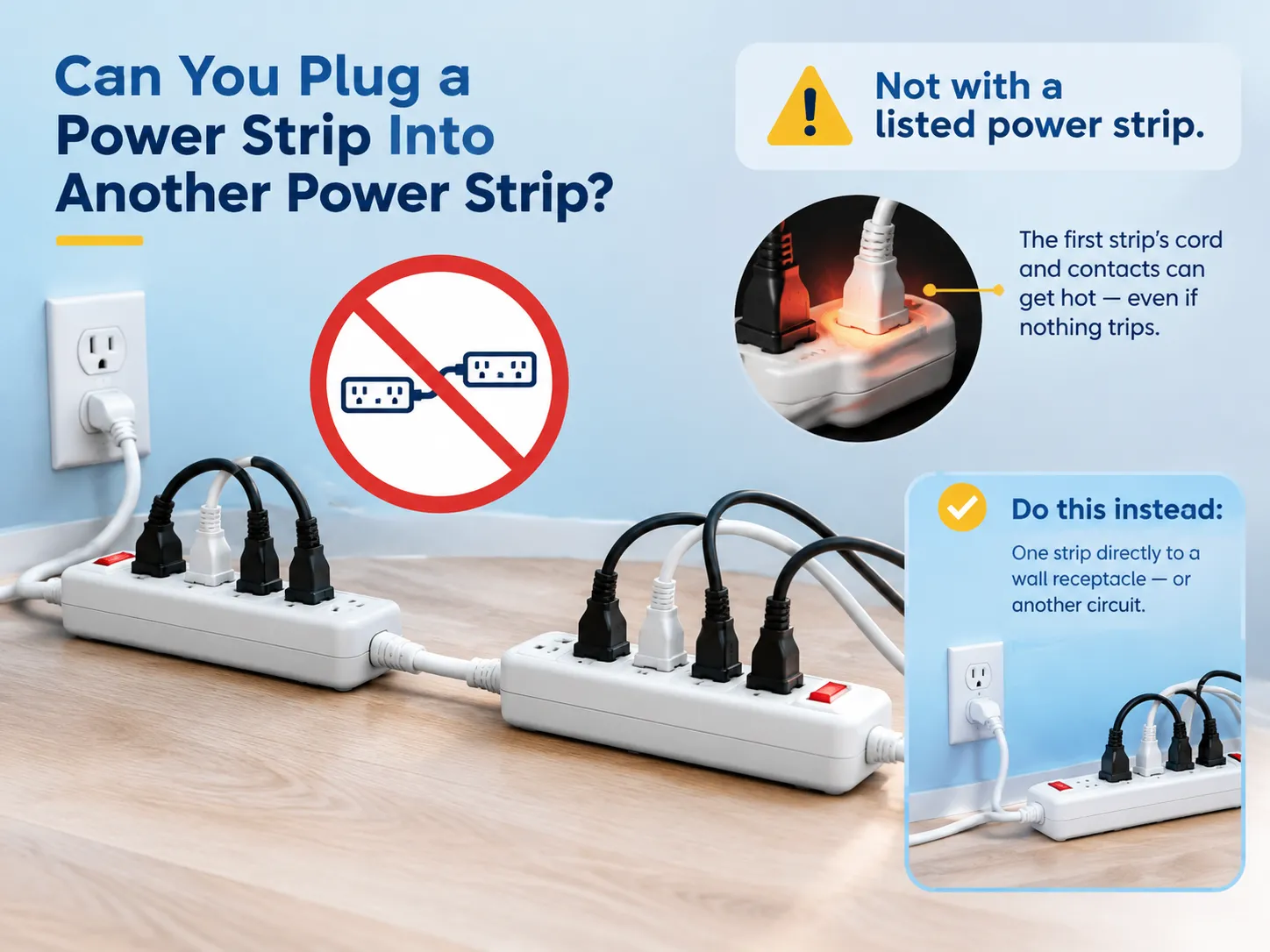
Every office has experienced this scenario: a power strip is plugged into one power strip, leading back to some place where it powers a device such as a printer connected to it. Despite working, producing no sparks and keeping a circuit breaker from tripping, it leads to a constant inquiry about the wisdom of using power strips in the cited way. This article will explain what regulations say regarding the use of power strips in this way, why it is not the way most people think it is, what one is allowed to plug into a power strip, and how to go about the situation if there are no available sockets in the office.
Briefly stated, the answer is that using a listed power strip for the job does not work. UL 1363 mentions that a relocatable power tap which is connected through a cord is not made to connect. Furthermore, OSHA goes by what is indicated in 29 CFR 1910.303(b)(2).The appearance is good because the breaker on the wall has been installed based on circuit specifications and not those of the strip, so the breaker does not get opened until the cord and the connection of the first strip get heated.
What “Daisy Chaining” Actually Means
The technical term for a power strip is a relocatable power tap, also referred to as RPT in UL 1363 terminology. Daisy chaining means plugging a power strip into another power strip, as well as an extension cord going into a power strip or a power strip going into an extension cord for the same outcome. In the industry, if there are different types of devices, it is called a mixed chain.
In everyday language, it refers to as “piggybacking”.
There is no discrimination made between the above classifications in codes. A chain is a chain in every case.
What the Standards Say, in Order of Force
There are four documents that deal with this matter, and they are mutually reinforcing. If there is only one document you should remember, it is the first one:
UL 1363, Section 1.7. This standard states, in no uncertain terms, that the relocatable power tap (RPT) is not intended to be used with another RPT. This is reiterated in the UL White Book under the category of relocatable power taps, which specifies that RPTs should be connected to a fixed receptacle and not used in series with other RPTs or extension cords.
OSHA 29 CFR 1910.303(b)(2). This regulation states: “Listed or labeled equipment shall be installed and used in accordance with any instructions included in the listing or labeling.” Since every listed strip has instructions prohibiting the connection of strips in series, daisy chaining is in violation of this regulation. OSHA created an even sharper interpretation with the help of a letter outlining its position on relocatable power taps, establishing that UL-listed RPTs must only be connected to fixed branch circuit receptacles.
NFPA 1, Chapter 11. In the Fire Code, there is also a direct mention of RPTs. They should have polarization, grounding, overcurrent protection, be listed, be connected to a fixed receptacle, and the cords should not be run behind walls, ceilings, or floors, under doors or flooring.
NEC 400.12. Flexible cords and cables cannot replace the fixed wiring of a building. Therefore, a long daisy chain using cords running across the room is completely illegal.
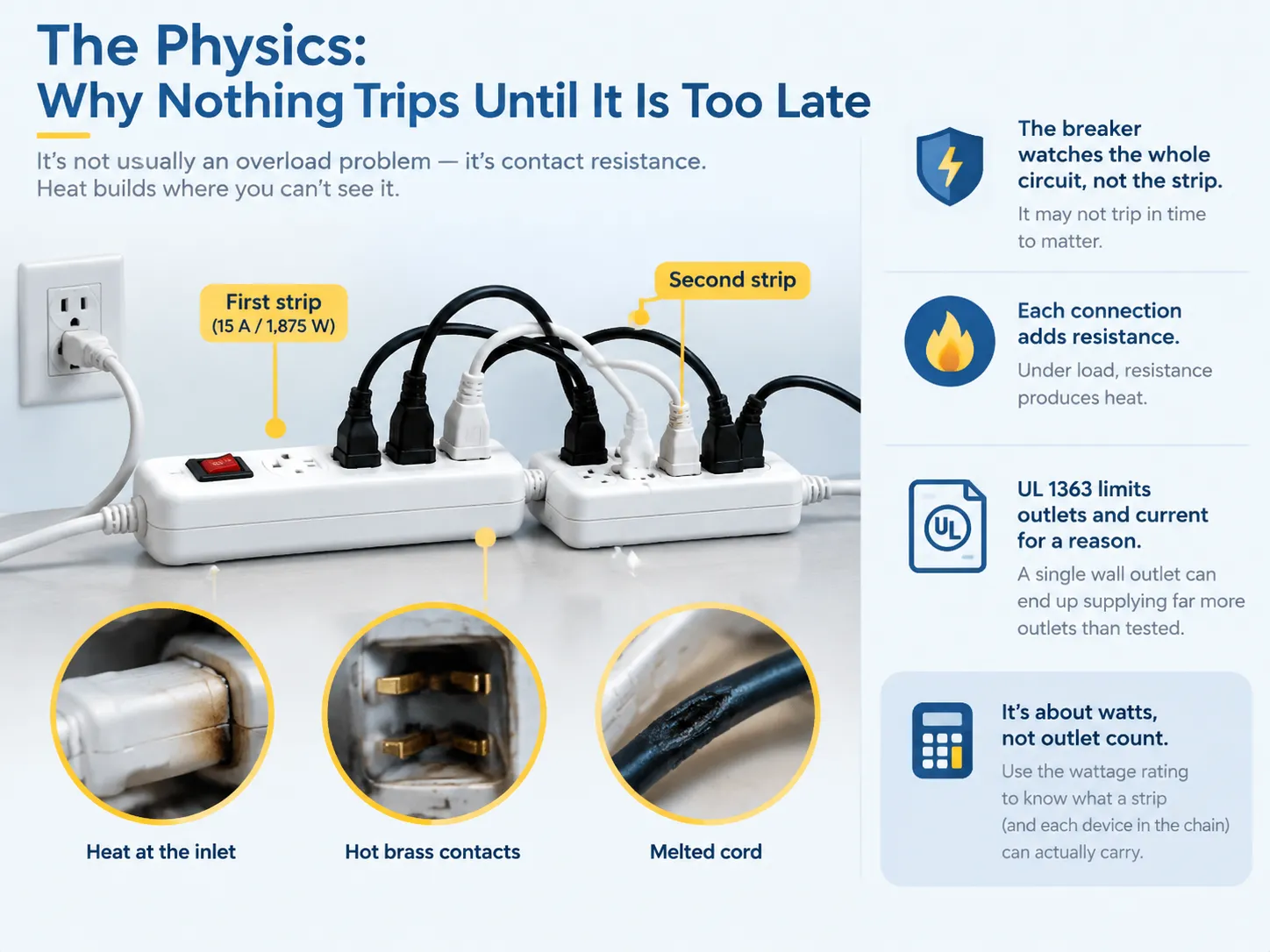
The Physics: Why Nothing Trips Until It Is Too Late
The concept of daisy chaining is very misleading. People think that the fault lies in the circuit being overloaded and that a circuit breaker will protect them. But this is likely not the case.
Typically, a US branch circuit can handle 15A or 20 A. A power strip that has undergone testing is probably rated for 15 A at 125 volts for a total of 1,875 W. However, this rating applies to the entire strip: the cord and the internal wiring of the power strip. When you connect yet another strip to the first one, the load on the first circuit seems to be larger than what can be detected by the circuit breaker.
The process that leads to this phenomenon is called increasing contact resistance. The plug-and-receptacle connection in the added device increases resistance, which in turn generates heat. You will be surprised to know that the heat is built up at the invisible stage of the process: the one that takes place inside the initial power strip’s inlet. The same situation happens at the contacts. This heat would lead to melting of cords and damaging of receptacles instead of triggering the circuit breaker.
That is why the arithmetic matters more than the appearance. Working out what a strip can actually carry comes down to watts, not outlet count, and the same math used for how many watts a single outlet can handle applies to every device in the chain.
When It Is Technically Fine, and Why That Is Still the Wrong Answer
Some will argue that having two power strips that supply a laptop, a computer monitor and a phone charger should not have any impact on the electric system since their total power consumption should not exceed 200 W but that argument is irrelevant. Essentially, code regulations are written for a scenario involving maximum loads and the listing does not provide any exceptions for small loads. Therefore, a chain that can be considered safe can stop being safe as soon as a heater gets plugged into it without re-checking the power strip.
There is also an insurance aspect here since UL listing and OSHA requirements are the standard of comparison used by most of the insurance companies and fire department when investigating fires caused by daisy chains in homes or establishments.
What You Can Safely Plug Into One Strip
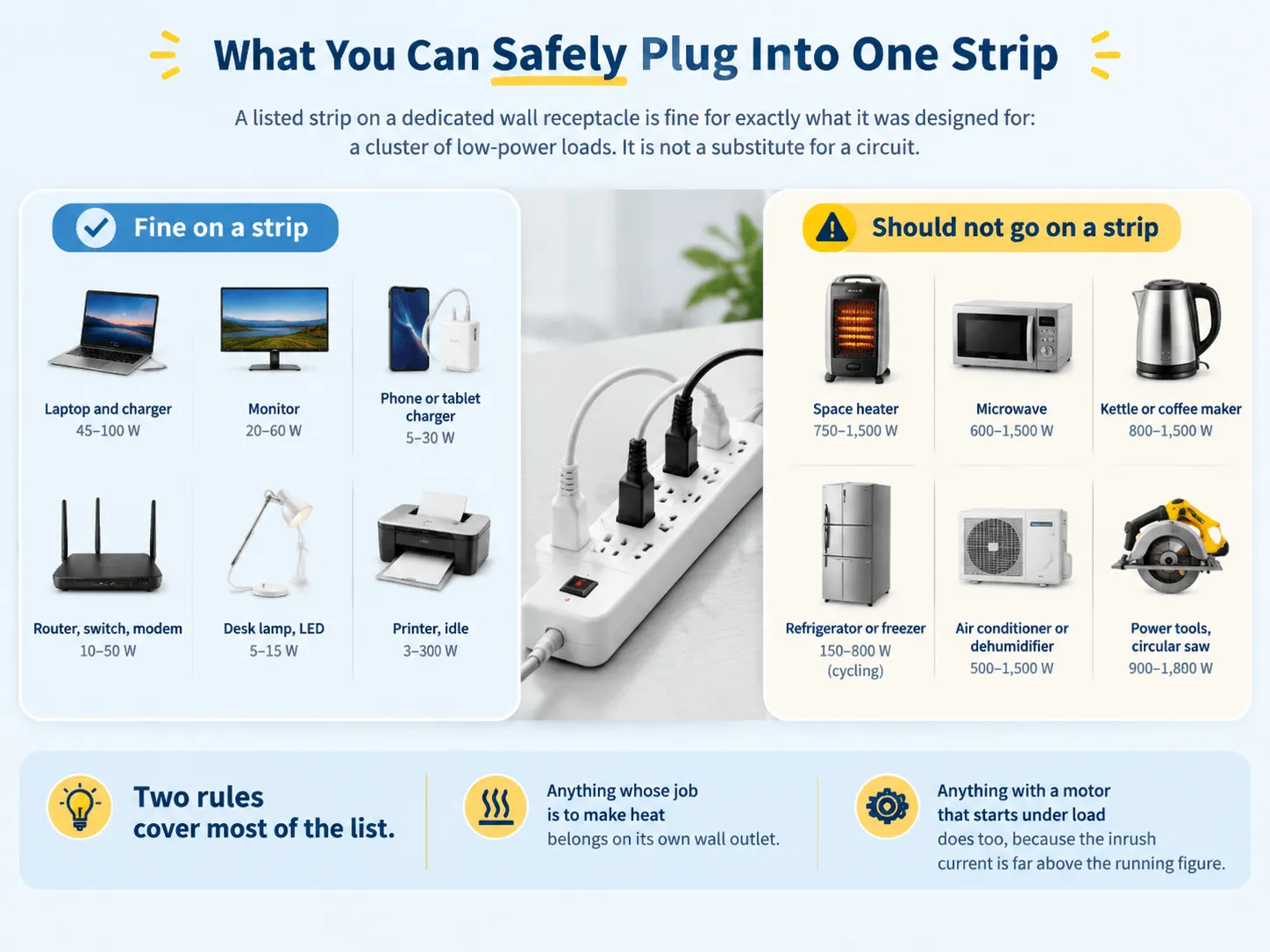
A listed strip on a dedicated wall receptacle is fine for exactly what it was designed for: a cluster of low-power loads. It is not a substitute for a circuit.
| Fine on a strip | Draw | Should not go on a strip | Draw |
|---|---|---|---|
| Laptop and charger | 45–100 W | Space heater | 750–1,500 W |
| Monitor | 20–60 W | Microwave | 600–1,500 W |
| Phone or tablet charger | 5–30 W | Kettle or coffee maker | 800–1,500 W |
| Router, switch, modem | 10–50 W | Refrigerator or freezer | 150–800 W cycling |
| Desk lamp, LED | 5–15 W | Air conditioner or dehumidifier | 500–1,500 W |
| Printer, idle | 3–30 W | Power tools, circular saw | 900–1,800 W |
Most of the reminder can be governed by two principles. Any equipment which generates heat should be plugged in an isolated outlet. The same as with a device that initiates its work under load thanks to the inrush current being higher than the operational amount.
What a Power Strip Is Actually Rated For
Prior to making a purchase, it is important to look at three figures indicated on the label: the amp rating, wire gauge, and joule rating.
A strip rated for 15A/1875W with a 14AWG wire is the standard US requirement, and it is the wire gauge that provides the true limit; 14AWG copper is good for 15A, 16AWG for 13A, and thus if the strip specifies 15A on a 16AWG wire, it exaggerates. Strips that do not possess an internal circuit breaker do not provide any safety measure beyond that offered by the branch circuit breaker. Surge protection joule rating indicates how much energy is absorbed by the metal oxide varistor before it malfunctions; a varistor that absorbed its joule rating is inoperative and will not provide indication of that failure.
GOG builds in this category as a wiring-device manufacturer rather than a consumer brand, producing switched sockets, extension sockets and the receptacles they plug into for OEM and private-label programs. The range and the OEM terms are set out on the socket manufacturing page.
Better Answers Than a Second Strip
If one strip does not suffice, consider the items mentioned below, which resolve the situation at its source instead of piling the devices on themselves.
- Get a longer strip. One 10- or 15-foot strip can take over for a whole chain of power strips and put the entire load on the one cord.
- Use a second wall outlet circuit. It is common to find outlets at the opposite wall of the room on a different breaker. This will ensure that both circuits can handle the load of a high-current-consuming desktop.
- Install additional outlets. A circuit’s output limits the number of outlets it can support, and that is how many it can run.
- Use a rack PDU. When dealing with racks, rack-mount PDUs are the solution when power strips simply cannot work.
- Use a UPS with enough outlets for the workstation. It combines a battery backup and a surge protector in the single listed unit.
US, UK and EU Strips Are Not Interchangeable
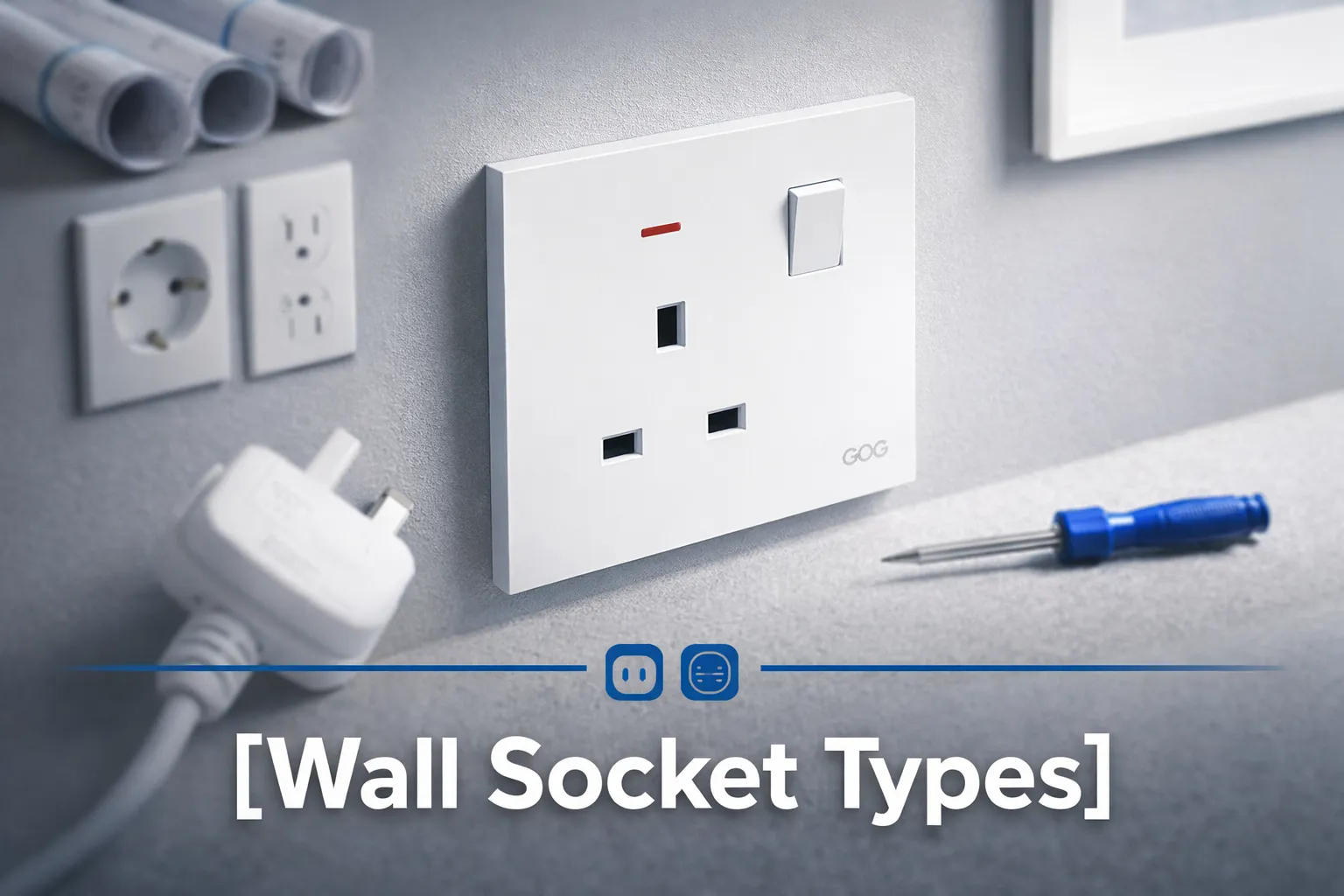
The daisy-chain concept is worldwide, but ratings are. This poses a threat to people buying online. The standard US strip is rated at 15 A and 125 V. In the UK, BS 1363 specifies 15 A and the strip is often included with a fuse also rated at 15 A. The European strip uses type F or Schuko plug; its rating is 16 A at 230 V and is usually not interrupted by any switches or circuit breakers. All British plugs are also fused.
Connecting a strip with the market where it will be used has a great value. If a 15 A US circuit is connected to a 16 A European strip using an adapter, the strip is rated higher than the fuse or circuit protection upstream of it.
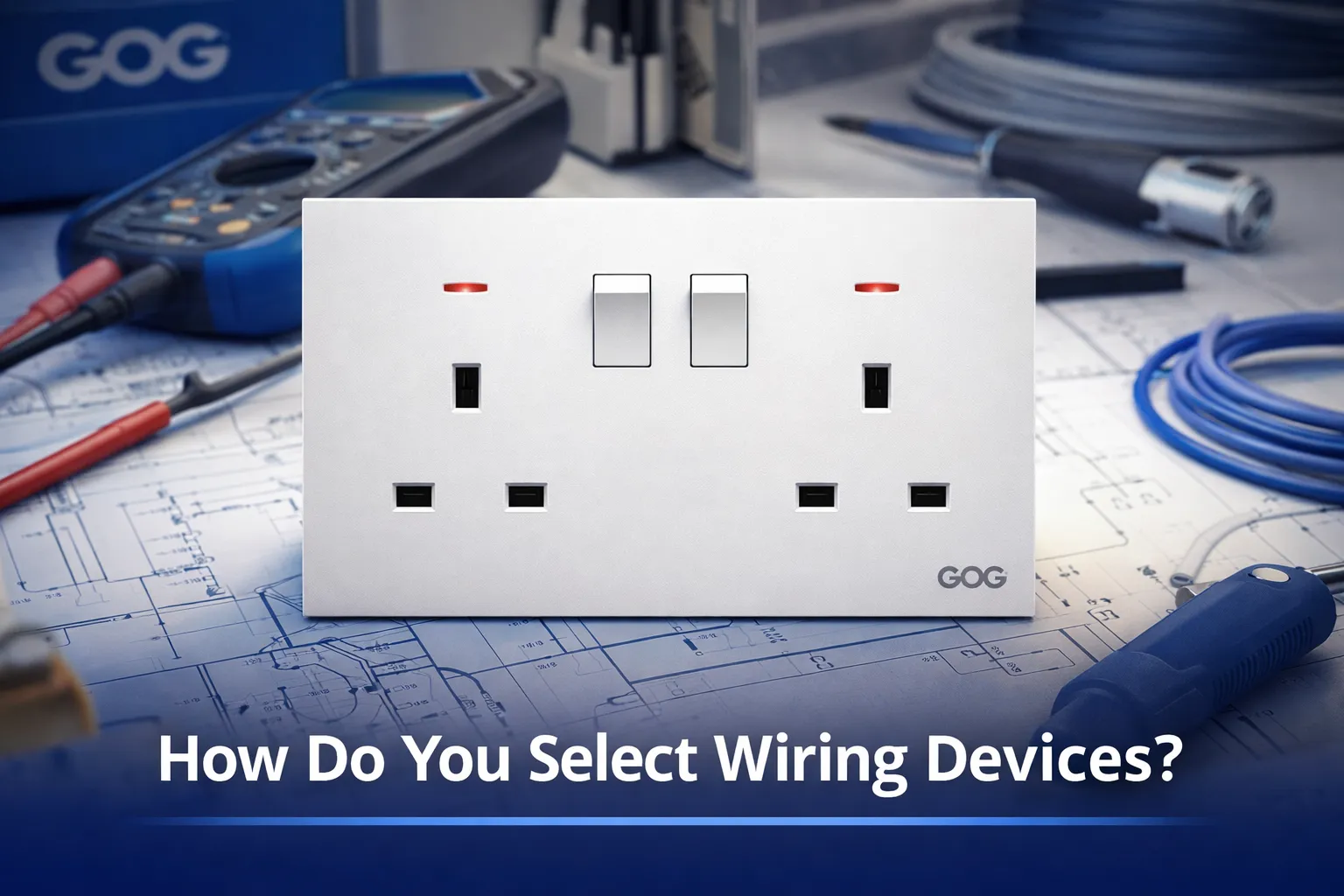
For UK and Ireland installations, a fused British Standard extension socket such as this 4-way BS extension socket with USB-C keeps the protection where the standard expects it, with the fuse in the plug rather than in the strip. In North America the same logic points to a strip with a 15 A / 125 V rating, a 14 AWG cord and its own integral breaker.
FAQ
Can you connect a power strip to another power strip?
Certainly, not when dealing with a product that has received certification. The specifications of UL 1363, particularly Section 1.7, indicate that a relocatable power tap which is dependent on a cord is not supposed to be linked with another relocatable power tap using a cord, and this guideline has also been confirmed by the UL White Book. The guideline by UL has been implemented by OSHA through the enactment of 29 CFR 1910.303(b)(2), which obligates the use of equipment that has a listing according to its listing guidelines.
Is it okay to plug a power strip into a power strip?
In this case, one should keep in mind that the problem of circuit protection is not limited to the prospect of branch circuit breaker malfunctioning because the reality of the situation is that protection never kicks in until the condition becomes dangerous. Recent connections only intensify resistance, with the first power strip’s wires and contacts baring the responsibility for all devices connected downstream since they are exposed to the total current supplied to the circuit with the circuit breaker only breaking down if a single circuit has overloaded.
What should you never plug into a power strip?
Any device that produces heat or comes close to the maximum capacity of the outlet: space heaters, kettles, coffee machines, microwaves, toasters, hair dryers, irons, and portable air conditioners. Be careful with heavy-duty motor devices that switch on while loaded, like circular saws and big compressors. These loads need separate dedicated outlets.
Is it okay to connect one power strip to another so you have enough outlets, or to make it long enough to reach your plug?
Regardless of the intention, the rule remains the same. If you seek to have additional plugs, buy either an extension cord of adequate rating or a long plug strip since using an extension cord together with a plug strip will result in a series connection which is against the rules. The solutions to having more plugs are additional outlets, another circuit, or a rack power distribution unit. Plug strips help create many outlets but do nothing in terms of power rating increase, which is the entire issue.
Do surge protectors make daisy chaining safe?
No. A surge protector is still an RPT under UL 1363 and therefore, the limitation on the listing remains the same. Even worse, if two surge protectors are connected together, the clamping behavior will be randomized, and no additional protection will be given, since the second device has nothing to protect that the first does not protect.
References
- OSHA — Compliance requirements for relocatable power taps or “power strips” (Standard Interpretation)
- UL Standards & Engagement — UL 1363, Relocatable Power Taps
- NFPA — NFPA 1 Fire Code (Chapter 11, relocatable power taps)
- Interpower — Not Safe: Daisy Chaining Power Strips
- AZoM — Is Daisy Chaining Power Strips Safe?
Conclusion
The regulations regarding power strips, which were created to allow the devices to be marketed in the first place, do not allow connecting one power strip to another due to the fact that even though the wall switches help with the circuit control, there is still heat in the first strip wires and contacts which does not have any supervision whatsoever.
As for the practical considerations, it is recommended to opt for either another longer strip or replace the cord with the one of the necessary specifications in order to get rid of any challenges. Besides, it is important to move the power-consuming loads from the power strip before getting connected to it. Finally, when buying a product check the amperage, the wire size and whether the strip is supplied with the required breaker for proper functionality and get the idea of the capacity far better than by counting the sockets mentioned on the box.