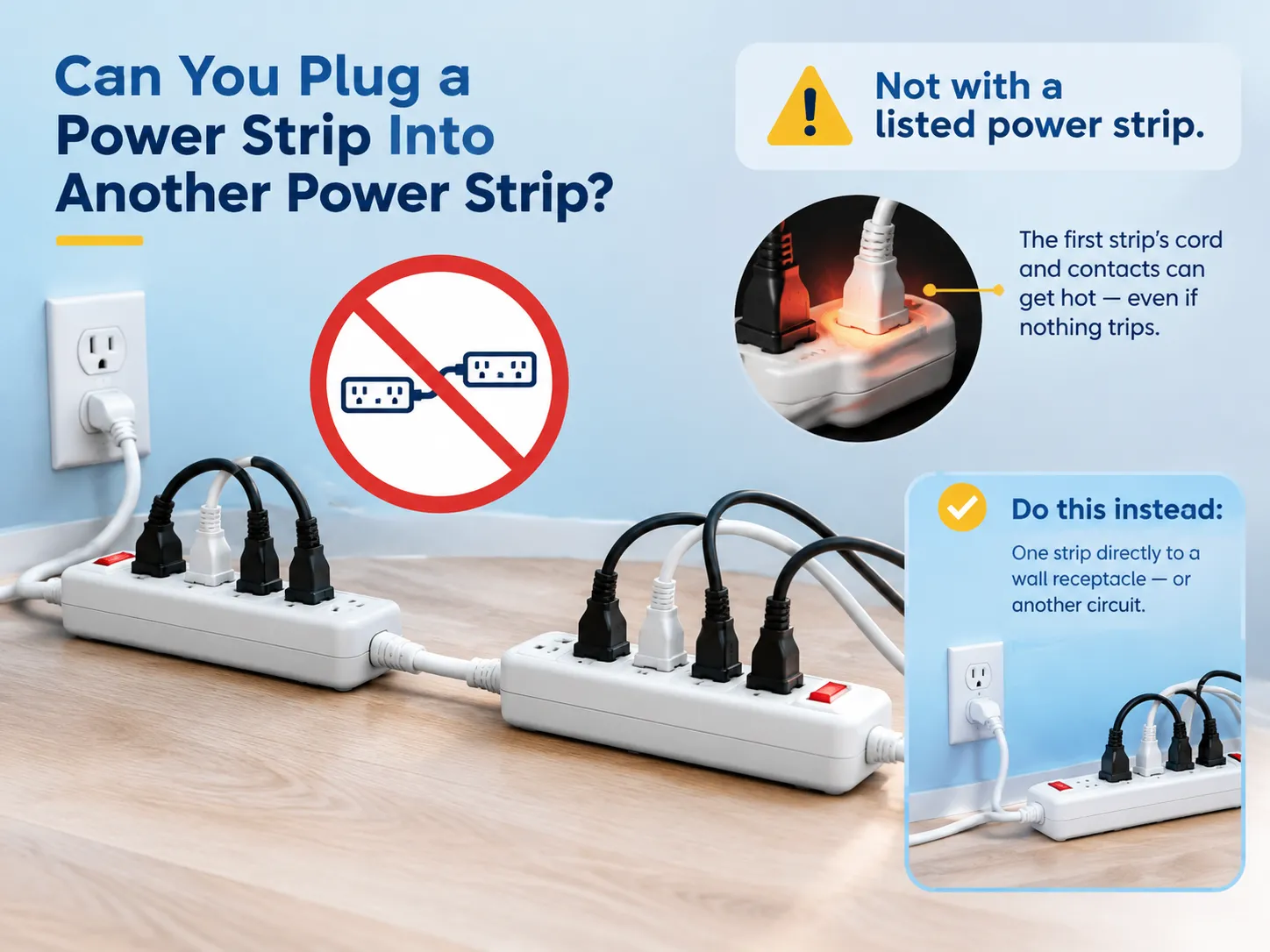
Todo escritório já passou por este cenário: uma régua de energia está conectada a outra régua de energia, que por sua vez está ligada a algum lugar onde alimenta um dispositivo, como uma impressora conectada a ela. Apesar de funcionar, não produzir faíscas e evitar que o disjuntor desarme, isso gera uma constante dúvida sobre a sabedoria de usar réguas de energia da forma citada. Este artigo explicará o que as normas dizem sobre o uso de réguas de energia dessa maneira, por que não é como a maioria das pessoas pensa, o que é permitido conectar em uma régua de energia e como proceder se não houver tomadas disponíveis no escritório.
Resumidamente, a resposta é que usar uma régua de energia listada para essa função não funciona. A UL 1363 menciona que um tapete de energia relocável conectado por meio de um cabo não é feito para ser conectado em série. Além disso, a OSHA segue o que está indicado no 29 CFR 1910.303(b)(2). A aparência é boa porque o disjuntor na parede foi instalado com base nas especificações do circuito e não nas da régua, então o disjuntor não desarma até que o cabo e a conexão da primeira régua aqueçam.
O que “Daisy Chaining” Realmente Significa
O termo técnico para régua de energia é tapete de energia relocável, também referido como RPT na terminologia UL 1363. Daisy chaining significa conectar uma régua de energia em outra régua de energia, assim como um cabo de extensão conectado a uma régua de energia ou uma régua de energia conectada a um cabo de extensão para o mesmo resultado. Na indústria, se houver diferentes tipos de dispositivos, isso é chamado de cadeia mista.
Na linguagem cotidiana, refere-se como “piggybacking”.
Não há discriminação entre as classificações acima nos códigos. Uma cadeia é uma cadeia em todos os casos.
O que as Normas Dizem, em Ordem de Força
Existem quatro documentos que tratam deste assunto, e eles se reforçam mutuamente. Se houver apenas um documento para lembrar, é o primeiro:
UL 1363, Seção 1.7. Esta norma afirma, sem dúvidas, que o tapete de energia relocável (RPT) não deve ser usado com outro RPT. Isso é reiterado no UL White Book na categoria de tapetes de energia relocáveis, que especifica que os RPTs devem ser conectados a um receptáculo fixo e não usados em série com outros RPTs ou cabos de extensão.
OSHA 29 CFR 1910.303(b)(2). Esta regulamentação afirma: “Equipamentos listados ou rotulados devem ser instalados e usados de acordo com quaisquer instruções incluídas na listagem ou rotulagem.” Como toda régua listada possui instruções proibindo a conexão em série, o daisy chaining viola esta regulamentação. A OSHA criou uma interpretação ainda mais rigorosa com a ajuda de uma carta que esclarece sua posição sobre tapetes de energia relocáveis, estabelecendo que RPTs listados pela UL devem ser conectados apenas a receptáculos fixos de circuitos ramificados.
NFPA 1, Capítulo 11. No Código de Incêndio, há também uma menção direta aos RPTs. Eles devem ter polarização, aterramento, proteção contra sobrecorrente, ser listados, estar conectados a um receptáculo fixo, e os cabos não devem ser passados por trás de paredes, tetos ou pisos, sob portas ou revestimentos.
NEC 400.12. Cabos e fios flexíveis não podem substituir a fiação fixa de um edifício. Portanto, uma longa cadeia em série usando cabos atravessando a sala é completamente ilegal.
A Física: Por Que Nada Desarma Até Ser Tarde Demais
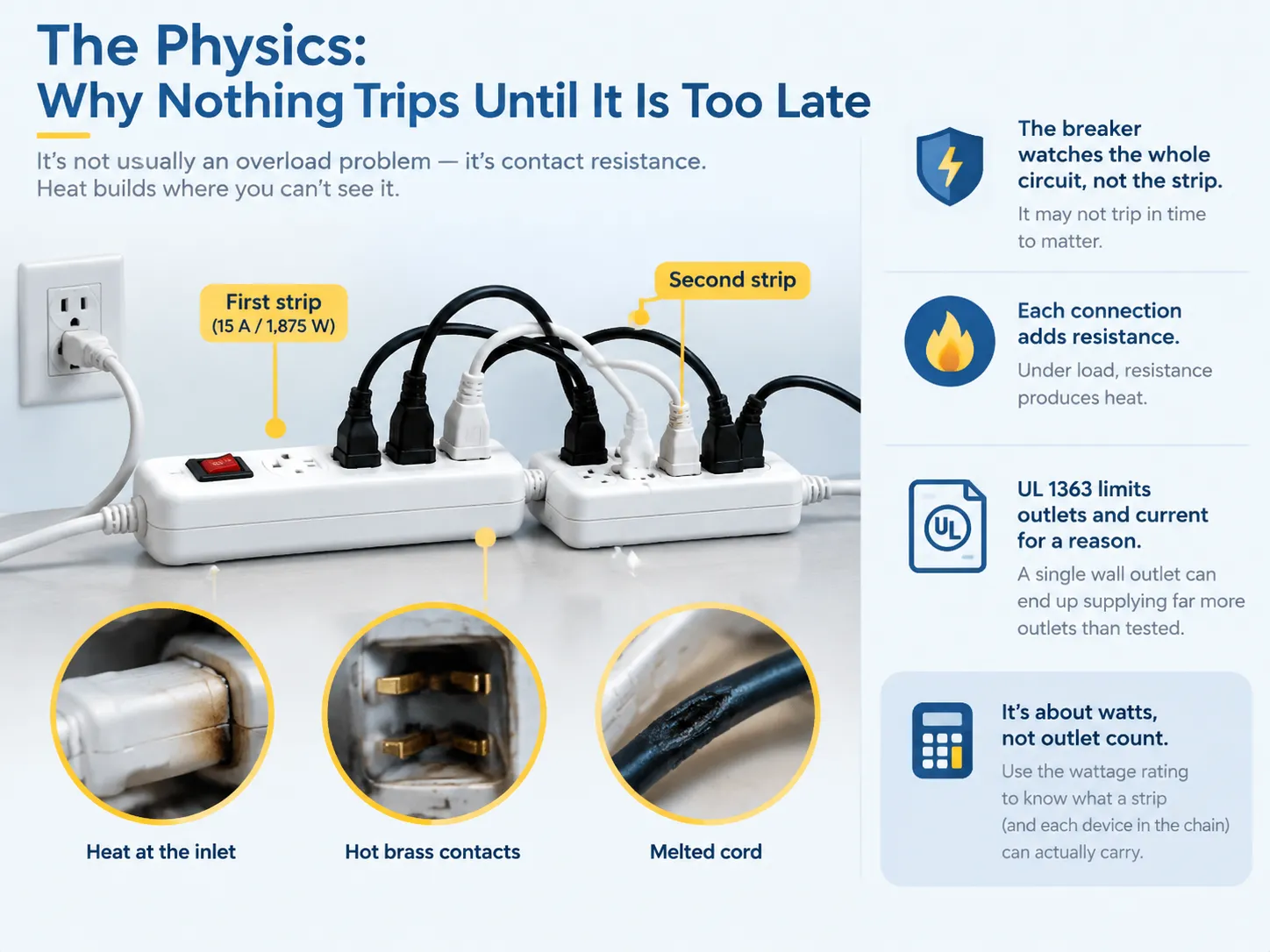
O conceito de cadeia em série é muito enganoso. As pessoas pensam que a falha está no circuito sobrecarregado e que um disjuntor os protegerá. Mas isso provavelmente não é o caso.
Normalmente, um circuito ramal nos EUA pode suportar 15A ou 20A. Uma régua de energia que passou por testes provavelmente é classificada para 15 A a 125 volts, totalizando 1.875 W. No entanto, essa classificação se aplica à régua inteira: o cabo e a fiação interna da régua. Quando você conecta outra régua à primeira, a carga no primeiro circuito parece ser maior do que o que o disjuntor pode detectar.
O processo que leva a esse fenômeno é chamado aumento da resistência de contato. A conexão plugue-receptáculo no dispositivo adicionado aumenta a resistência, o que gera calor. Você ficará surpreso ao saber que o calor se acumula na fase invisível do processo: aquela que ocorre dentro da entrada da régua inicial. A mesma situação acontece nos contatos. Esse calor levaria ao derretimento dos cabos e danos nos receptáculos em vez de disparar o disjuntor.
É por isso que a aritmética importa mais do que a aparência. Calcular o que uma régua pode realmente suportar se resume a watts, não à contagem de tomadas, e a mesma matemática usada para quantos watts uma única tomada pode suportar se aplica a cada dispositivo na cadeia.
Quando É Tecnicamente Aceitável, e Por Que Ainda Assim É a Resposta Errada
Alguns argumentarão que ter duas réguas de energia que alimentam um laptop, um monitor de computador e um carregador de telefone não deve impactar o sistema elétrico, já que o consumo total de energia não deve exceder 200 W, mas esse argumento é irrelevante. Essencialmente, os regulamentos do código são escritos para um cenário envolvendo cargas máximas e a listagem não prevê exceções para cargas pequenas. Portanto, uma cadeia que pode ser considerada segura pode deixar de ser segura assim que um aquecedor for conectado sem reavaliar a régua.
Há também um aspecto de seguro aqui, já que a listagem UL e os requisitos OSHA são o padrão de comparação usado pela maioria das seguradoras e dos corpos de bombeiros ao investigar incêndios causados por cadeias em série em residências ou estabelecimentos.
O Que Você Pode Conectar Com Segurança em Uma Régua
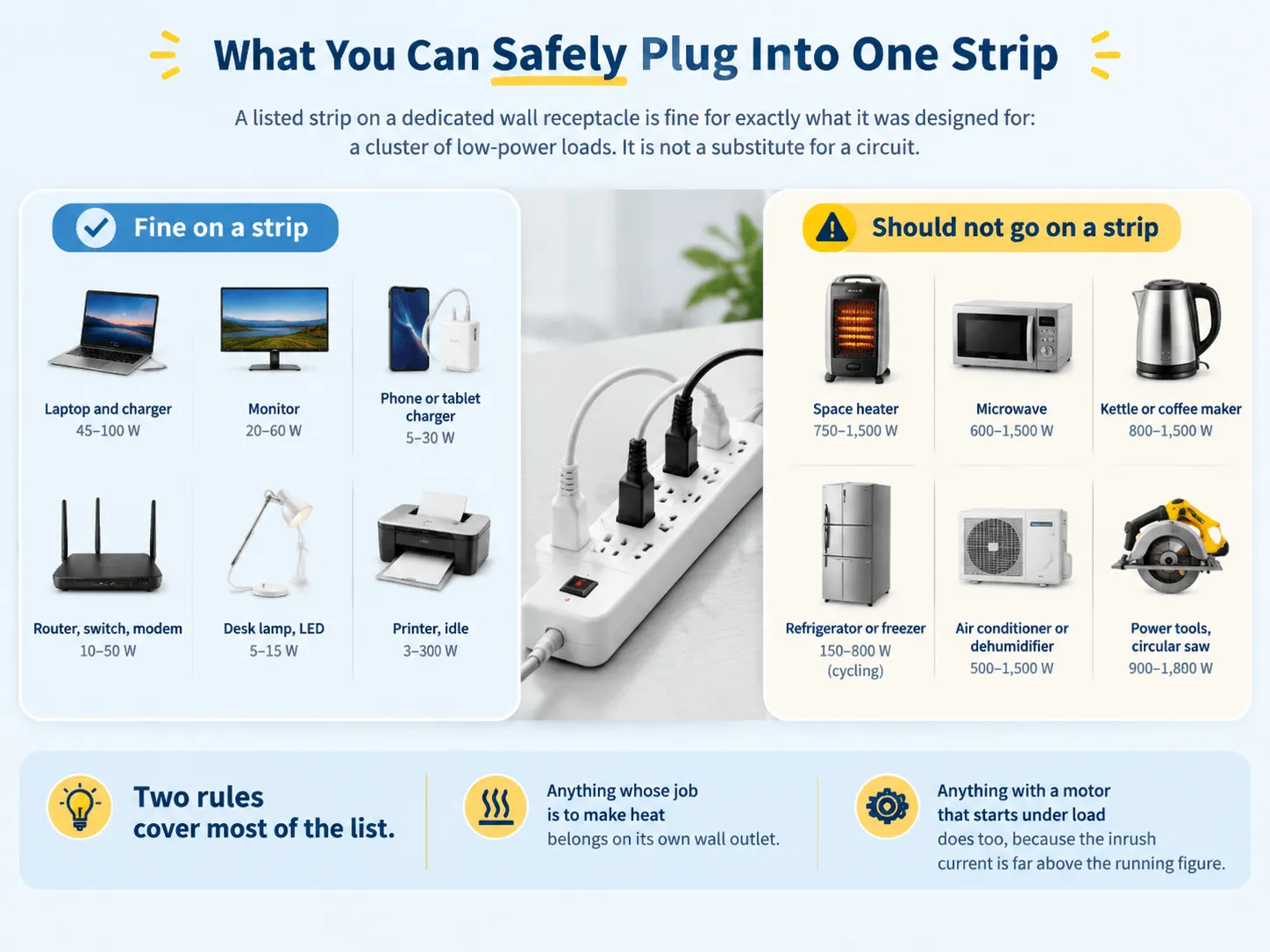
Uma régua listada em um receptáculo de parede dedicado é adequada exatamente para o que foi projetada: um conjunto de cargas de baixa potência. Não é um substituto para um circuito.
| Adequado em uma régua | Desenho | Não deve ser conectado em uma régua | Desenho |
|---|---|---|---|
| Laptop e carregador | 45–100 W | Aquecedor de ambiente | 750–1.500 W |
| Monitor | 20–60 W | Micro-ondas | 600–1.500 W |
| Carregador de telefone ou tablet | 5–30 W | Chaleira ou cafeteira | 800–1.500 W |
| Roteador, switch, modem | 10–50 W | Refrigerador ou freezer | 150–800 W em ciclo |
| Lâmpada de mesa, LED | 5–15 W | Ar condicionado ou desumidificador | 500–1.500 W |
| Impressora, em espera | 3–30 W | Ferramentas elétricas, serra circular | 900–1.800 W |
A maior parte do restante pode ser regida por dois princípios. Qualquer equipamento que gere calor deve ser conectado a uma tomada isolada. O mesmo vale para um dispositivo que inicia seu funcionamento sob carga devido à corrente de partida ser maior que a corrente operacional.
Para que uma régua de energia é realmente classificada
Prior to making a purchase, it is important to look at three figures indicated on the label: the amp rating, wire gauge, and joule rating.
A strip rated for 15A/1875W with a 14AWG wire is the standard US requirement, and it is the wire gauge that provides the true limit; 14AWG copper is good for 15A, 16AWG for 13A, and thus if the strip specifies 15A on a 16AWG wire, it exaggerates. Strips that do not possess an internal circuit breaker do not provide any safety measure beyond that offered by the branch circuit breaker. Surge protection joule rating indicates how much energy is absorbed by the metal oxide varistor before it malfunctions; a varistor that absorbed its joule rating is inoperative and will not provide indication of that failure.
GOG builds in this category as a wiring-device manufacturer rather than a consumer brand, producing switched sockets, extension sockets and the receptacles they plug into for OEM and private-label programs. The range and the OEM terms are set out on the socket manufacturing page.
Better Answers Than a Second Strip
If one strip does not suffice, consider the items mentioned below, which resolve the situation at its source instead of piling the devices on themselves.
- Get a longer strip. One 10- or 15-foot strip can take over for a whole chain of power strips and put the entire load on the one cord.
- Use a second wall outlet circuit. It is common to find outlets at the opposite wall of the room on a different breaker. This will ensure that both circuits can handle the load of a high-current-consuming desktop.
- Install additional outlets. A circuit’s output limits the number of outlets it can support, and that is how many it can run.
- Use a rack PDU. When dealing with racks, rack-mount PDUs are the solution when power strips simply cannot work.
- Use a UPS with enough outlets for the workstation. It combines a battery backup and a surge protector in the single listed unit.
US, UK and EU Strips Are Not Interchangeable
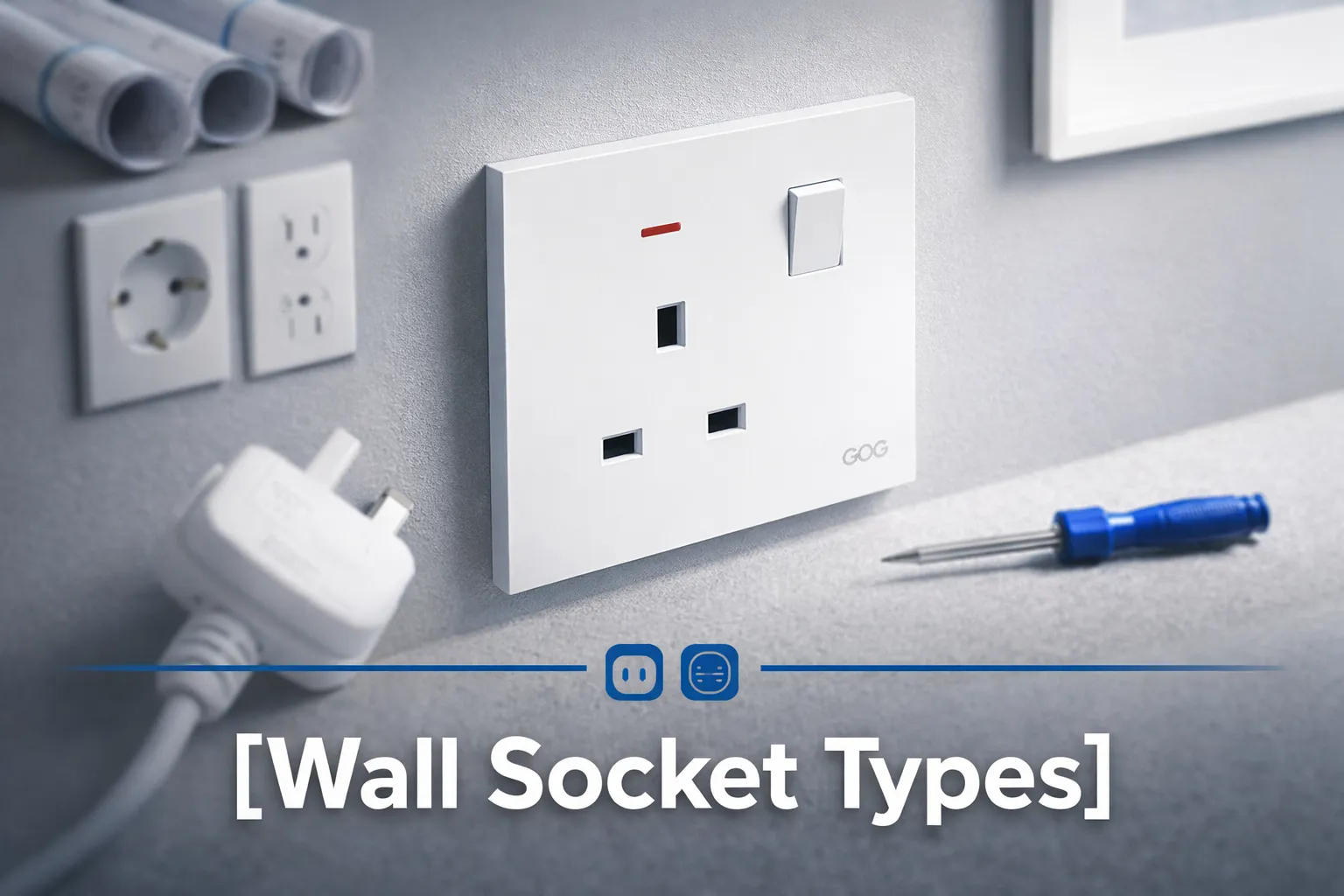
The daisy-chain concept is worldwide, but ratings are. This poses a threat to people buying online. The standard US strip is rated at 15 A and 125 V. In the UK, BS 1363 specifies 15 A and the strip is often included with a fuse also rated at 15 A. The European strip uses type F or Schuko plug; its rating is 16 A at 230 V and is usually not interrupted by any switches or circuit breakers. All British plugs are also fused.
Connecting a strip with the market where it will be used has a great value. If a 15 A US circuit is connected to a 16 A European strip using an adapter, the strip is rated higher than the fuse or circuit protection upstream of it.
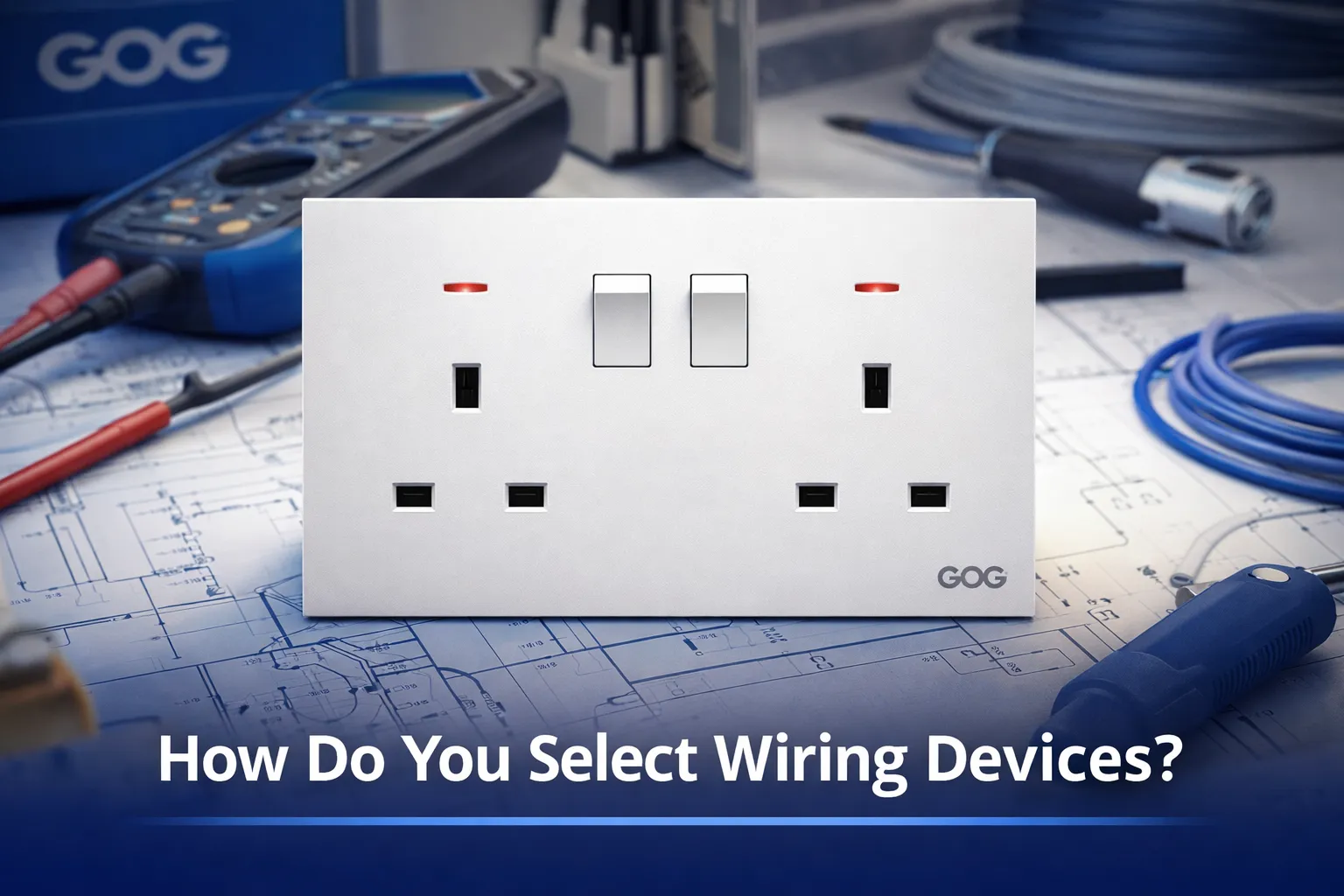
For UK and Ireland installations, a fused British Standard extension socket such as this 4-way BS extension socket with USB-C keeps the protection where the standard expects it, with the fuse in the plug rather than in the strip. In North America the same logic points to a strip with a 15 A / 125 V rating, a 14 AWG cord and its own integral breaker.
Perguntas Frequentes
Can you connect a power strip to another power strip?
Certainly, not when dealing with a product that has received certification. The specifications of UL 1363, particularly Section 1.7, indicate that a relocatable power tap which is dependent on a cord is not supposed to be linked with another relocatable power tap using a cord, and this guideline has also been confirmed by the UL White Book. The guideline by UL has been implemented by OSHA through the enactment of 29 CFR 1910.303(b)(2), which obligates the use of equipment that has a listing according to its listing guidelines.
Is it okay to plug a power strip into a power strip?
In this case, one should keep in mind that the problem of circuit protection is not limited to the prospect of branch circuit breaker malfunctioning because the reality of the situation is that protection never kicks in until the condition becomes dangerous. Recent connections only intensify resistance, with the first power strip’s wires and contacts baring the responsibility for all devices connected downstream since they are exposed to the total current supplied to the circuit with the circuit breaker only breaking down if a single circuit has overloaded.
O que você nunca deve conectar a uma régua de energia?
Any device that produces heat or comes close to the maximum capacity of the outlet: space heaters, kettles, coffee machines, microwaves, toasters, hair dryers, irons, and portable air conditioners. Be careful with heavy-duty motor devices that switch on while loaded, like circular saws and big compressors. These loads need separate dedicated outlets.
Is it okay to connect one power strip to another so you have enough outlets, or to make it long enough to reach your plug?
Regardless of the intention, the rule remains the same. If you seek to have additional plugs, buy either an extension cord of adequate rating or a long plug strip since using an extension cord together with a plug strip will result in a series connection which is against the rules. The solutions to having more plugs are additional outlets, another circuit, or a rack power distribution unit. Plug strips help create many outlets but do nothing in terms of power rating increase, which is the entire issue.
Do surge protectors make daisy chaining safe?
No. A surge protector is still an RPT under UL 1363 and therefore, the limitation on the listing remains the same. Even worse, if two surge protectors are connected together, the clamping behavior will be randomized, and no additional protection will be given, since the second device has nothing to protect that the first does not protect.
Referências
- OSHA — Compliance requirements for relocatable power taps or “power strips” (Standard Interpretation)
- UL Standards & Engagement — UL 1363, Relocatable Power Taps
- NFPA — NFPA 1 Fire Code (Chapter 11, relocatable power taps)
- Interpower — Not Safe: Daisy Chaining Power Strips
- AZoM — Is Daisy Chaining Power Strips Safe?
Conclusão
The regulations regarding power strips, which were created to allow the devices to be marketed in the first place, do not allow connecting one power strip to another due to the fact that even though the wall switches help with the circuit control, there is still heat in the first strip wires and contacts which does not have any supervision whatsoever.
As for the practical considerations, it is recommended to opt for either another longer strip or replace the cord with the one of the necessary specifications in order to get rid of any challenges. Besides, it is important to move the power-consuming loads from the power strip before getting connected to it. Finally, when buying a product check the amperage, the wire size and whether the strip is supplied with the required breaker for proper functionality and get the idea of the capacity far better than by counting the sockets mentioned on the box.