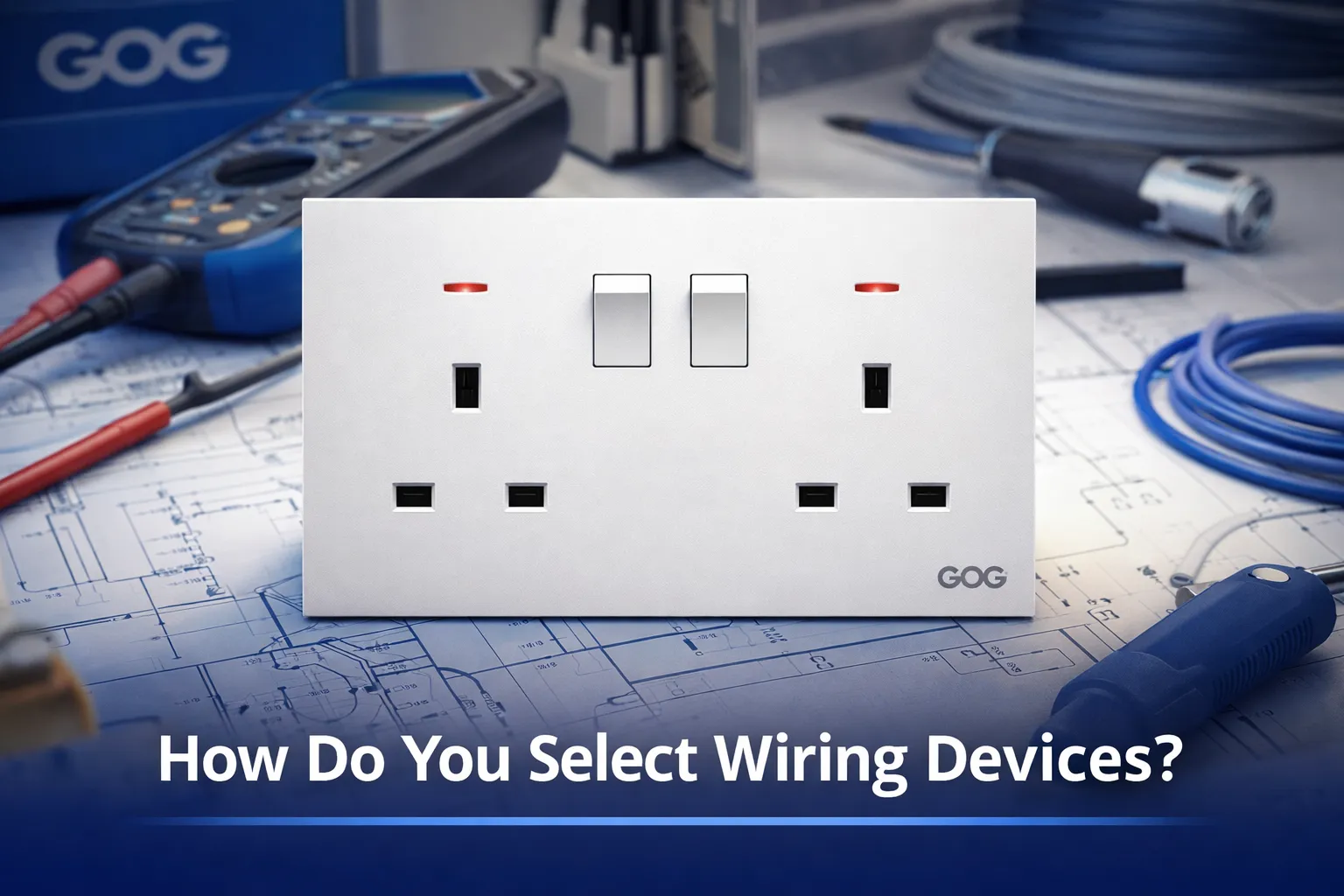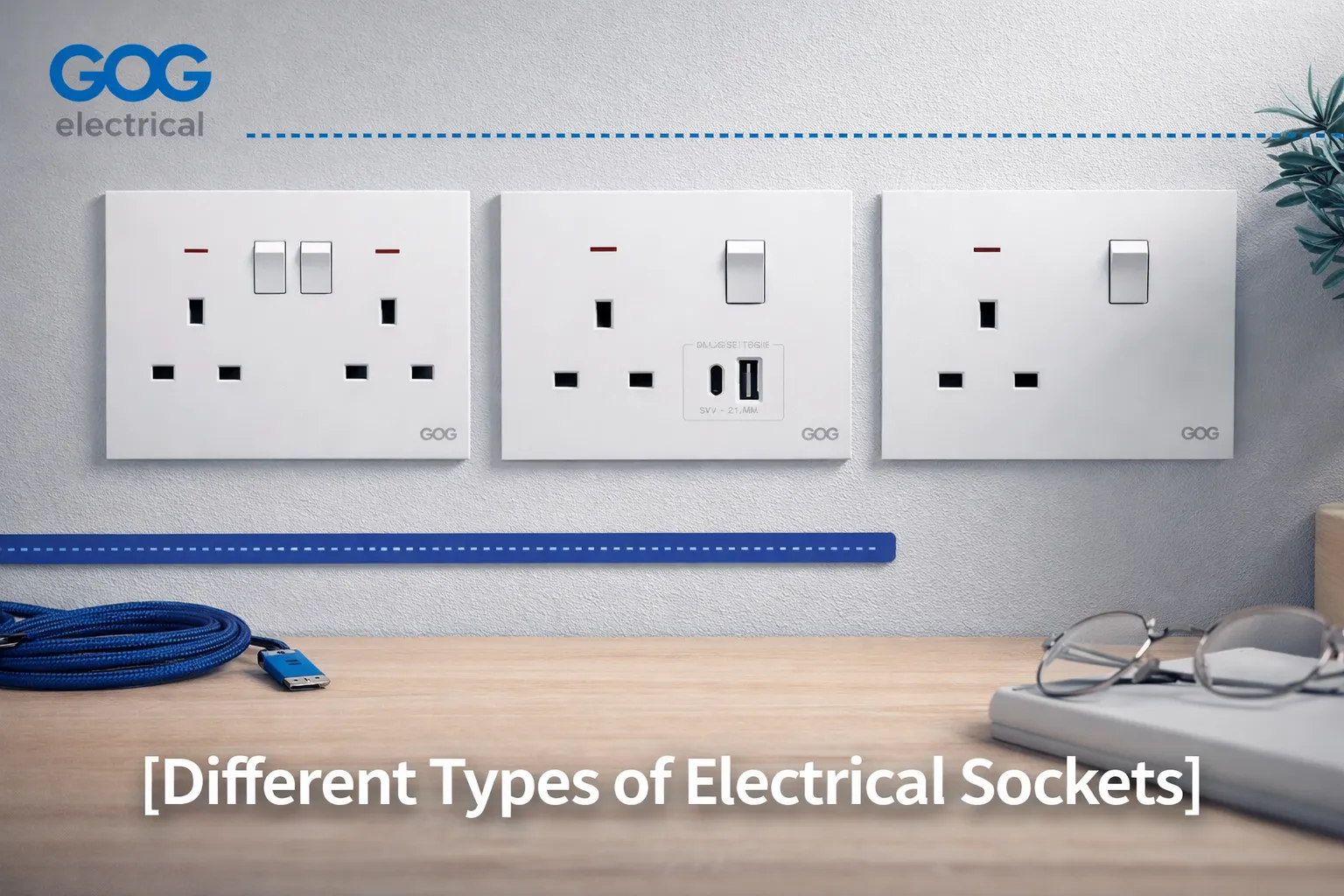
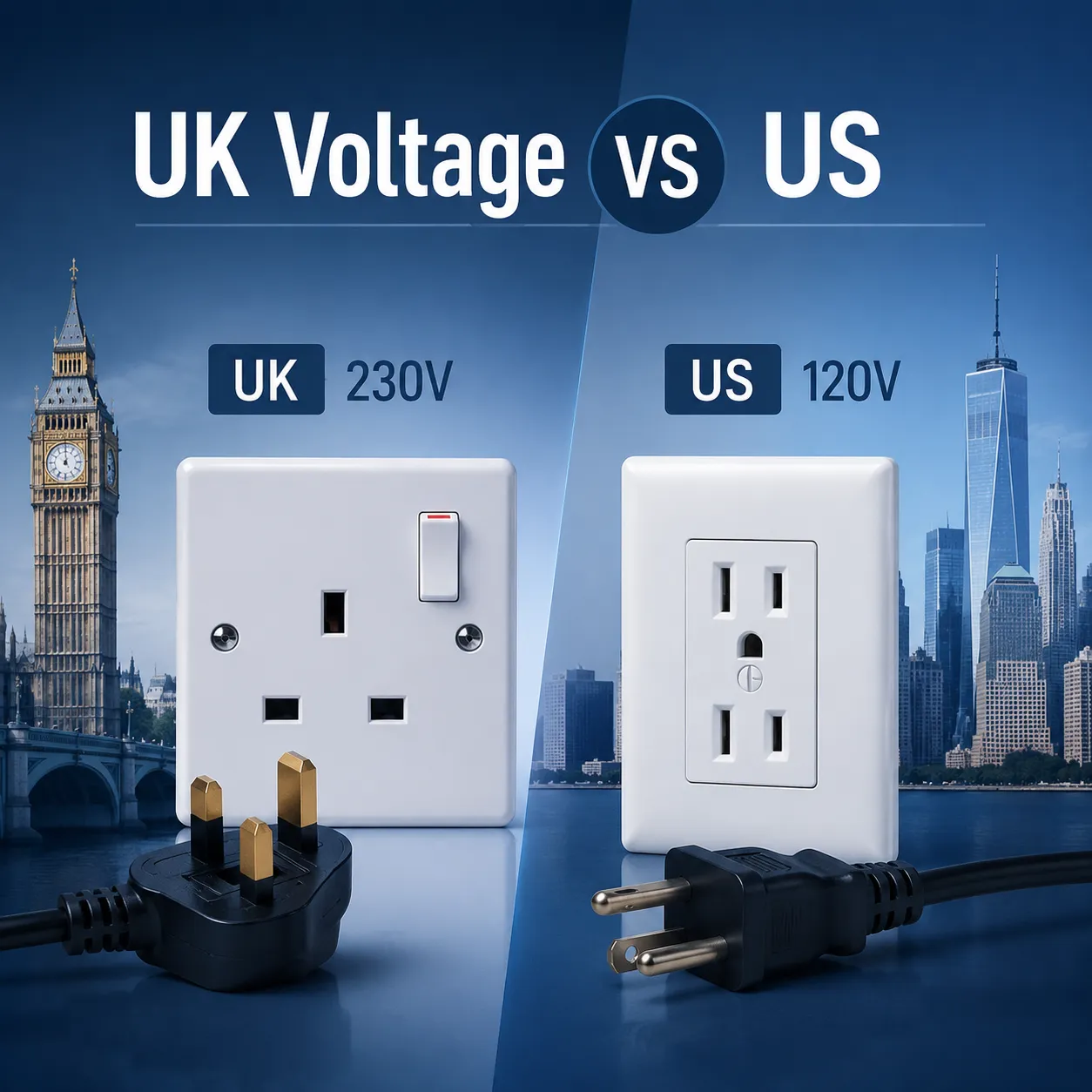
A student from California comes to a university in London, connects her US hairdryer to an English plug with a simple travel adapter and switches it on. The hairdryer works for a while, stops with an engine-like roar and finally dies with some sparks. The plug fits properly and is inserted correctly, but the problem lies in the fact that the electricity supply voltage is twice what the hairdryer was designed for. It can be easily concluded that understanding the difference between the UK and US voltage standards is not an abstract concept but is extremely important.
The Numbers: 230V vs. 120V
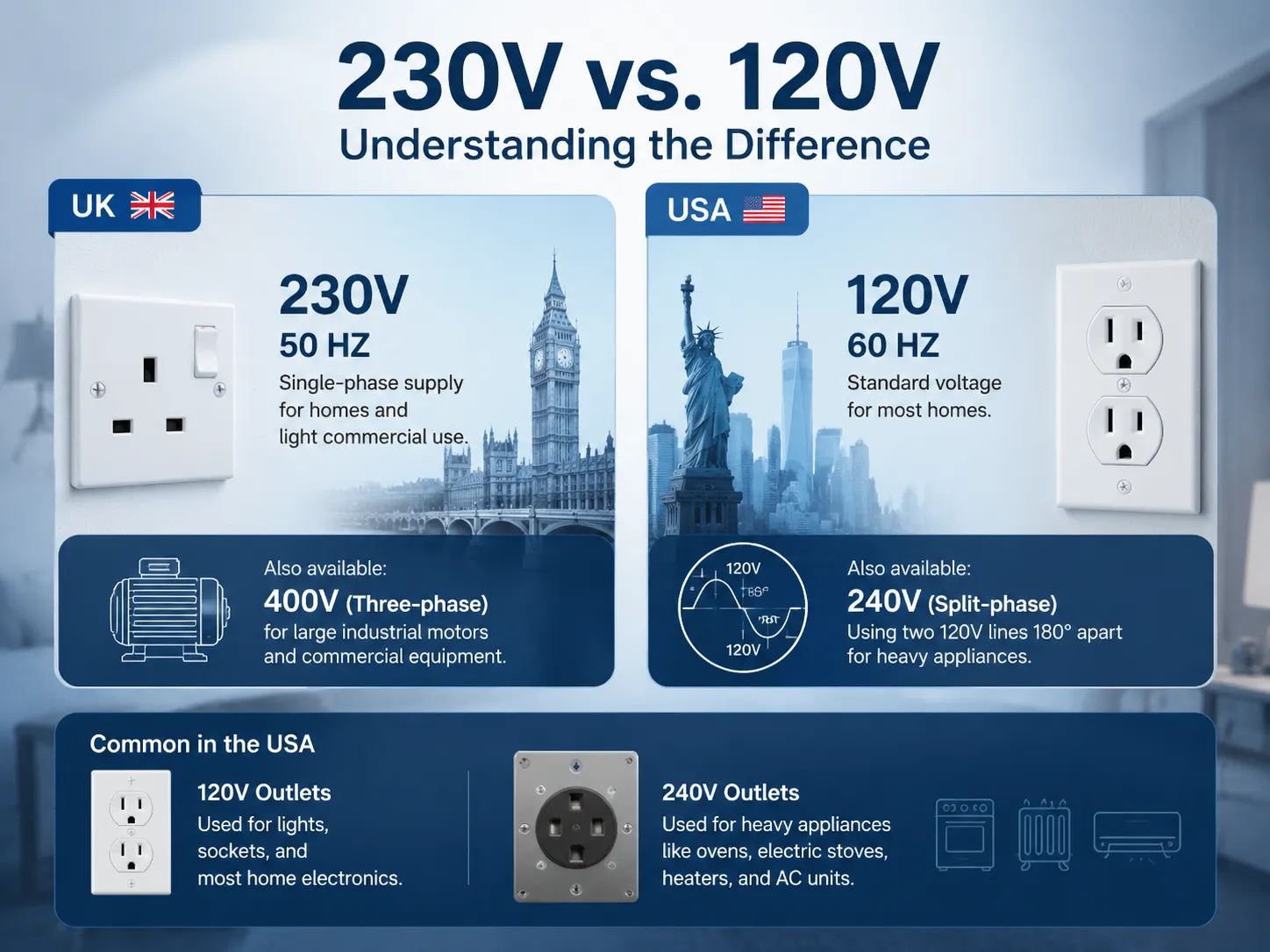
In terms of nominal voltage and frequency supply, the UK uses a single-phase supply of 50 Hertz, 230 volts for home and light commercial use. Meanwhile, the United States uses a voltage of 120 volts and frequency of 60 Hertz. Voltage refers to the measure of the difference in potential between the live wire and the neutral wire in a socket. The frequency refers to the number of times per second the alternating current changes direction.
There are other voltages that exist in these systems. In the UK, for example, there is the possibility of getting a three-phase supply of 400 volts to large industrial motors and for commercial-grade equipment in the kitchen from the distribution line. In the US, single family homes get the split-phase supply of 240 volts using two 120-volt terminals separated by 180 degrees. This voltage is useful in generating 120 volts for lights and sockets in the house and 240 volts for heavy electrical equipment such as electric stoves, heaters and air conditioning units. In the US, standard household outlet is 120 volts while the outlet used for the oven or the power tools is 240 volts.
Plugs and Sockets: The Physical Barrier
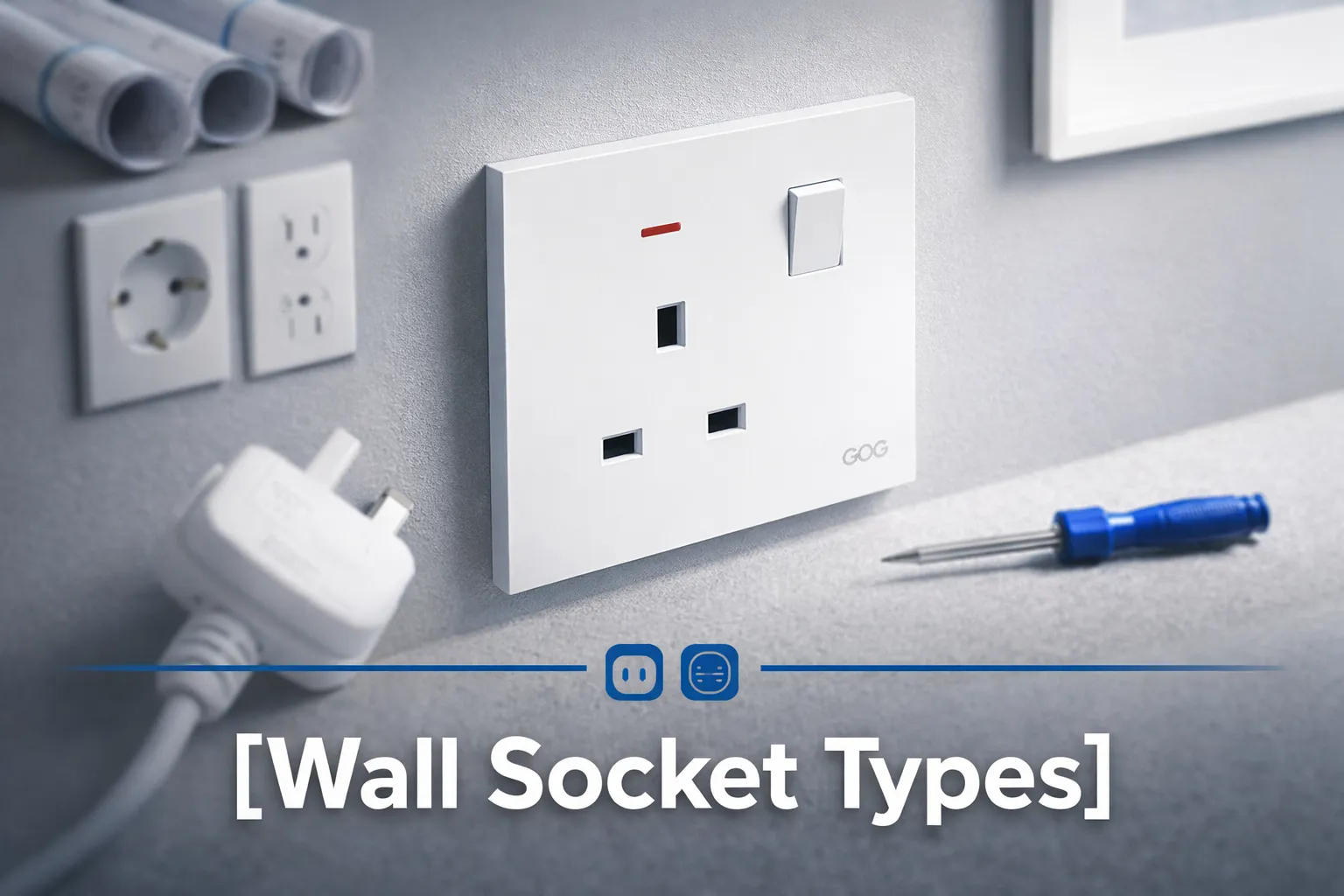
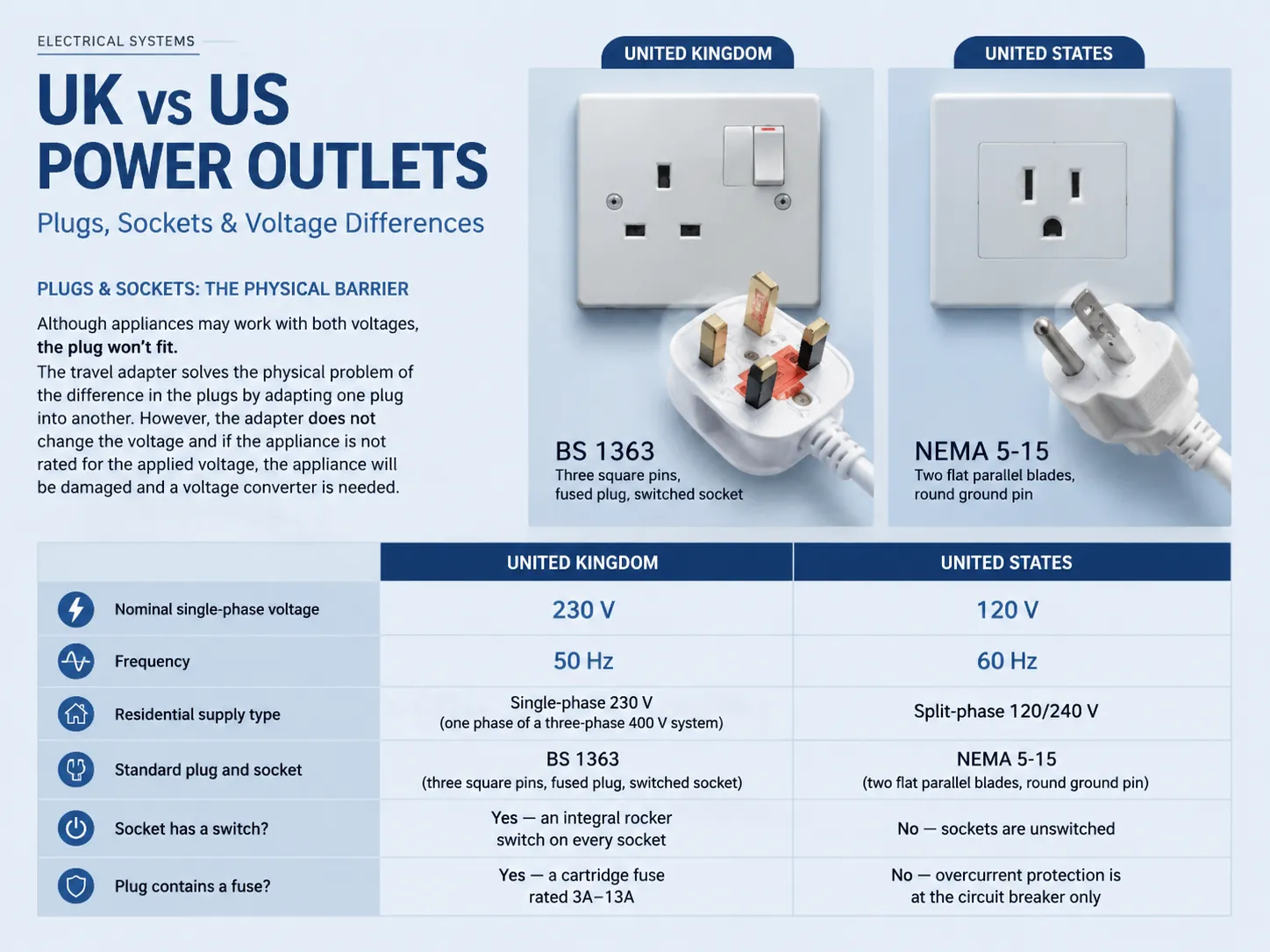
Although appliances may work with both voltages, the plug won’t fit. In the UK, the BS 1363 plug is used which is a large square plug with three pins and an earth pin. The US uses the NEMA series of plugs, with the most commonly used plug being the NEMA 5-15 which has two flat pins and a round pin for grounding. The travel adapter solves the physical problem of the difference in the plugs by adapting one plug into another. However, the adapter does not change the voltage and if the appliance is not rated for the applied voltage, the appliance will be damaged and a voltage converter is needed.
| Characteristic | United Kingdom | United States |
|---|---|---|
| Nominal single‑phase voltage | 230 V | 120 V |
| Frequency | 50 Hz | 60 Hz |
| Residential supply type | Single‑phase 230 V (one phase of a three‑phase 400 V system) | Split‑phase 120/240 V |
| Standard plug and socket | BS 1363 (three square pins, fused plug, switched socket) | NEMA 5‑15 (two flat parallel blades, round ground pin) |
| Socket has a switch? | Yes — an integral rocker switch on every socket | No — sockets are unswitched |
| Plug contains a fuse? | Yes — a cartridge fuse rated 3A–13A | No — overcurrent protection is at the circuit breaker only |
Why the Two Systems Developed Differently
Historically, the voltage split bears the character of accident rather than a deliberate choice. Initially, during the era of widespread electrification at the end of the 19th and early 20th centuries, there was no globally accepted voltage standard. Interestingly, electricity systems created by Thomas Edison in the USA worked at 110 volts, having been preserved during the transition from direct current to alternating current when 110 volts maintained its position as the most popular voltage value. Along with the introduction of the use of alternating current, the voltage established itself keeping the big number of installations in lighting systems and electrical appliances. In the UK and in Europe, the post-war reconstruction brought about the power of standardization through the introduction of voltage suitable for a higher amount of current allowing for greater efficiency in the reconstruction process. The next values were established by Germany that went with 220 volts as well as the UK using 240 volts voltage. In 1990, the European Union reconciled all the parties concerned with the introduction of a voltage of 230 volts agreed upon by the UK and continental Europe. The change was mainly the administration play, although the average number of volts delivered to homes was close to 240 volts. The only change was a nameplate that still reads “230V” on the applications sold into the EU territory.
Three‑Phase vs. Single‑Phase: What Reaches the Home
In the two nations, the electricity generated at the plant is three-phase – three different currents, which are 120 degrees away from each other. The voltage is high in the transmission lines connecting the generation facility with the destination. The power received at the substation of the region will be reduced to the low voltage supply.
In terms of electrical supply, the typical residential street in the UK has 400 volts delivered through three phases. Each home gets its power from one of three phases and a neutral phase, producing a single-phase delivery of 230 volts. Larger homes may receive power through three-phase connections. Today, the electricity supply system in America differs considerably. Here, a single-phase transformer created a secondary tap that generates 240 volts. Each home is then supplied with two legs of 120 volts with one of them acting as neutral. As a result, an electrical panel in the US has two bus bars each producing 120 volts while being connected by means of a double-pole breaker for 240 volts. Again, a UK panel only has one bus bar producing 230 volts.
What This Means for Your Devices
The voltage difference is particularly significant for devices that contain motors, heaters, and transformers. These devices include hair dryers, curling irons, power tools, kitchen mixers, kettles, and some older audio equipments. Thus, it can be seen that if a heater designed for 120 volts is connected to a 230-volt plug, it will consume almost twice the current for which it was designed to work and will catch fire quite quickly. If a motor designed for 120 volts operates at a frequency of 60 Hz, it would run extremely fast and hot at 230 volts, even if the frequency remains constant.
Modern electronic gadgets — phone chargers, laptops, and the majority of current consumer electronic devices — have been created in such a way as to function with multiple voltage levels. Generally, voltage input is equal to 100-240 volt and frequency 50 or 60 key hertz. It is possible to find this information on the power supply or charger’s label. For instance, if one reads ‘Input 100-240 volt, 50/60 Hz’, one can use the device both in the US or UK without changing the voltage as long as the adapter is properly installed. The creation of new power electronics was a tremendous achievement because it enabled people to use transformers which can operate with any voltage.
What to Do Before You Plug Anything In
Before connecting an appliance in a country with a different voltage, the procedure is methodical and takes seconds. Read the label on the device or its power supply. Look for the input voltage specification. If it says “100–240V” and “50/60Hz,” the device is universal — use a plug adapter, and you are done. If it says “120V” only, or “230V” only, the device is single‑voltage, and connecting it to the wrong voltage will damage it. In that case, a voltage converter is required. For a high‑wattage heating appliance, a heavy‑duty step‑down transformer rated for the appliance’s wattage is necessary, and for most travellers, the easier and cheaper path is to leave the single‑voltage appliance at home and purchase a dual‑voltage replacement.
For the homeowner or contractor specifying electrical equipment that will be used across borders, GOG Electric manufactures wiring devices — switches, sockets, and smart home products — that are built to the specific voltage and safety standards of the market they serve. A UK‑market socket is rated for 230 volts, incorporates a rocker switch as required by BS 1363, and is tested to that standard. A US‑market receptacle is rated for 125 volts, meets the NEMA configuration, and is listed to UL 498. The two are not interchangeable, and they are not intended to be. Using a socket rated for one voltage in the other market is both a code violation and a safety hazard. For those needing a deeper understanding of the modern outlets available in the North American market, our guide on the best electrical outlets and switches for modern homes covers the options from basic to smart and USB‑integrated.
Frequently Asked Questions
Is the UK 110V or 220V?
The voltage in mode in the UK is 230 volts. It is necessary to mention that earlier, the rate was 240 volts. Nevertheless, the voltage was harmonised in 1995 with that of the rest of Europe and remained at 230 volts. Nevertheless, in practice, the voltage for UK residences is still at 240 volts, which is as per the regulations.
Can I use US 120V in the UK?
The only condition is the product should be rated as “100-240 volts, 50/60 Hz”. If the label mentions “120 Volts” only, plugging the device to a UK socket of capacity above 230 volts will not only damage the device beyond repair but also be a safety hazard as it is likely to catch fire.
Why is the UK 240V and the US 110V?
The difference in voltage systems is the result of their history. When electric installations began in America, voltages of 110 volts were already in use. After World War II, in Europe, voltages were switched to higher values to allow more electric current to flow in copper wires. There is no evidence that one technology is safer or more efficient when constructing a home.
Why did the UK change from 240V to 230V?
In 1995, the voltage level in the United Kingdom was modified from 240V to 230V as part of the European Union’s harmonization initiative. This change was mostly a formal adjustment; in practice, household electricity delivery remained at a level of approximately 240 volts, which is within the acceptable tolerance defined for the 230-volt standard. Ultimately, the aim of this initiative was to reach one nominal voltage for the whole EU.
References
- International Electrotechnical Commission (IEC) — World Plugs and Voltages. The global standard‑setting body for electrical voltages, frequencies, and plug types.
- U.S. Department of Energy — Appliance Energy Use and Voltage Compatibility. Information on voltage ratings, universal power supplies, and the energy implications of global voltage standards.
- WorldStandards.eu — Electricity by Country. A reference for voltages, frequencies, and plug types around the world.
- BSI Group — BS 1363 Standard for UK Plugs and Sockets. The British standard defining the 230‑volt fused plug and switched socket system.
The difference between UK voltage and US voltage — 230 volts and 120 volts — is not a curiosity. It is the single most important number on the appliance label when that appliance crosses an ocean. A modern phone charger will shrug it off. A vintage turntable or a favourite hairdryer will not. Knowing which is which, reading the label, and matching the device to the local supply before it touches the socket is a habit that protects the appliance, the home, and the traveller. GOG Electric builds its wiring devices to the exact voltage and safety standards of each market — because the socket on the wall must be as ready for the voltage it carries as the appliance plugged into it.