El mercado mundial de interruptores eléctricos está menos concentrado de lo que muchos piensan, pero mucho más fragmentado de lo que implican las cinco principales empresas. Los cables e interruptores como producto representan una cantidad significativa de unidades vendidas, pero al mismo tiempo las cinco empresas más grandes por ingresos son las mismas de siempre que está acostumbrado a ver en los cronogramas de especificaciones. En este artículo aprenderá quiénes son, en qué son realmente buenos, cuál es el costo real de un interruptor, qué tipo de certificados determinan si un producto puede usarse en construcción y dónde puede ubicarse un fabricante mediano.
De hecho, cuando se trata del mercado global de interruptores eléctricos, está mucho menos concentrado de lo que muchas personas tienden a creer y mucho más fragmentado de lo que sugieren las cifras proporcionadas por cinco empresas líderes. Los cables y los interruptores eléctricos son uno de los productos más populares desde la perspectiva de ventas. Sin embargo, las empresas que conforman el top cinco por ingresos son las que la mayoría conoce. A lo largo del documento, descubrirá los nombres de estas cinco empresas y qué las convierte en líderes de esta industria, cuánto cuesta realmente un interruptor y qué certificaciones deben estar disponibles para que el producto se utilice en una construcción.
Cómo se mide el “Top”
Hay cuatro formas diferentes de clasificar y dado que rara vez coinciden, por eso cualquier discusión sobre el “principal productor de interruptores” no lleva a ninguna parte. Las clasificaciones son las siguientes:
- Los ingresos en toda la línea eléctrica con la que lideran los gigantes industriales.
- El volumen unitario de dispositivos de cableado donde predominan principalmente los productores chinos y regionales.
- La presencia en especificaciones dependiendo de lo que el ingeniero consultor escriba en los planos, lo que ayuda a las empresas europeas con sus subsidiarias a liderar.
- La presencia en el canal dependiendo de quién puede comprar el contratista un sábado por la mañana, favoreciendo a quienes tienen la mejor red de distribución.
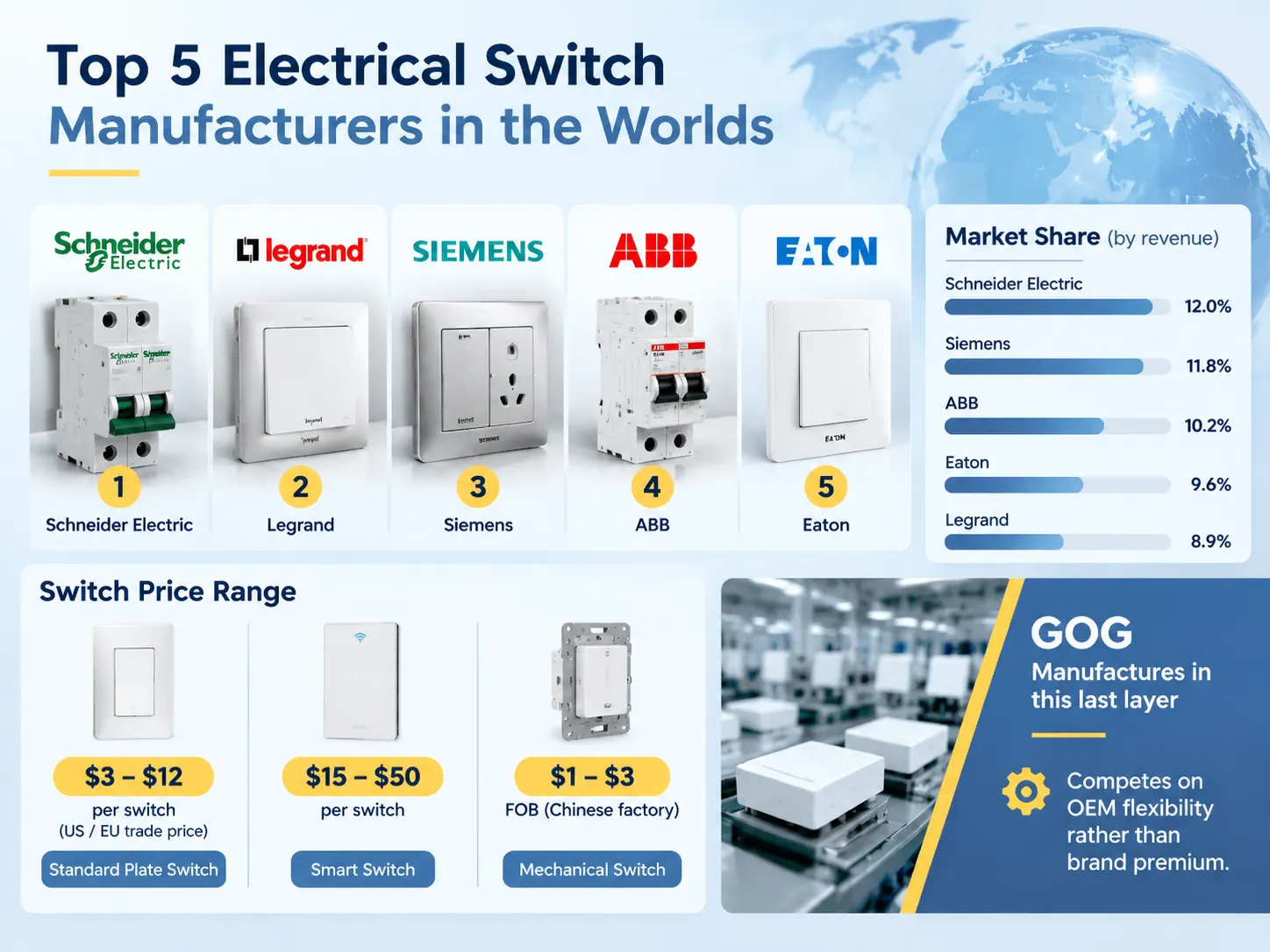
En esta publicación, la clasificación se basa tanto en los ingresos como en la presencia en especificaciones, ya que un ingeniero de compras suele comparar estos dos conceptos. También debe notarse una tendencia detrás de este proceso, a saber, que el número de fabricantes completos de protección de circuitos disminuyó de 47 en 2015 a 23 en 2025, que comparten alrededor de 71% de ventas a nivel mundial.
Las 5 principales marcas eléctricas
| # | Empresa | Sede | Posición en dispositivos de cableado | Precio comercial típico, interruptor estándar |
|---|---|---|---|---|
| 1 | Schneider Electric | Rueil-Malmaison, Francia | Canal global más amplio; sistema modular Acti9; Wiser para smart | $6–$14 |
| 2 | Legrand | Limoges, Francia | Número dos en dispositivos de cableado específicamente; marca DX en Europa | $5–$12 |
| 3 | Siemens | Múnich, Alemania | Familia de protección SENTRON; fuerte integración en automatización de edificios | $6–$15 |
| 4 | ABB | Zurich, Suiza | Enfoque industrial y comercial; interruptores S200/S800; relés | $6–$16 |
| 5 | Eaton | Dublín, Irlanda | Dominante en residencial norteamericano a través de Cutler-Hammer | $4–$10 |
Hay cuatro elementos notables en esa lista. Schneider Electric tuvo ingresos totales cercanos a $34.8 mil millones en 2025, con la distribución eléctrica y los sistemas de edificios contribuyendo a casi un tercio de los ingresos totales. La empresa tiene aproximadamente un 12.4% de cuota de mercado en el mercado global de interruptores automáticos miniatura, que es el más grande del sector. Legrand es la única empresa real de dispositivos de cableado en el grupo con ingresos de aproximadamente $8.1 mil millones generados en infraestructura eléctrica y digital de edificios, razón por la cual se menciona aquí a pesar de ser más pequeña que Siemens y ABB en términos generales. Siemens tiene ingresos totales de alrededor de $72 mil millones y su participación en ingresos de tecnologías para edificios se estima en solo alrededor del 8-10%, lo que significa que la empresa es principalmente una entidad muy grande con un pequeño negocio en dispositivos de conmutación.
Si desea la misma comparación desde el lado de la marca y el canal en lugar del lado del fabricante, vale la pena leer junto con esta visión general de las principales marcas de dispositivos de cableado a nivel mundial, porque la fortaleza de una marca en un mercado suele ser una relación con el distribuidor más que con la fábrica.
En qué es realmente mejor cada uno
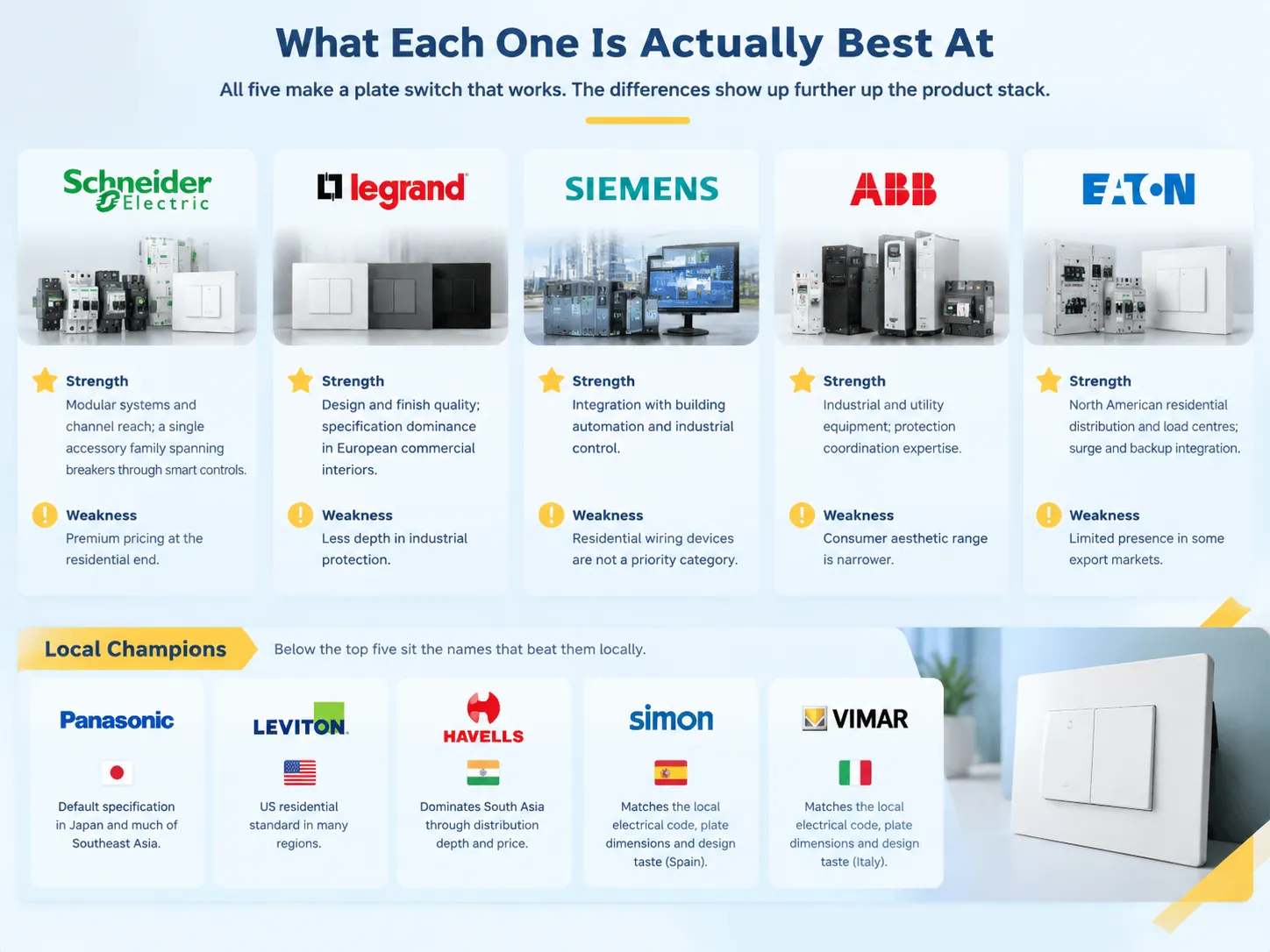
Los cinco fabrican un interruptor de placa que funciona. Las diferencias aparecen más arriba en la gama de productos.
| Empresa | Fortaleza genuina | Donde es más débil |
|---|---|---|
| Schneider Electric | Sistemas modulares y alcance del canal; una sola familia de accesorios que abarca desde interruptores automáticos hasta controles inteligentes | Precios premium en el segmento residencial |
| Legrand | Calidad de diseño y acabado; dominio en especificaciones en interiores comerciales europeos | Menor profundidad en protección industrial |
| Siemens | Integración con automatización de edificios y control industrial | Los dispositivos de cableado residencial no son una categoría prioritaria |
| ABB | Equipos industriales y de servicios públicos; experiencia en coordinación de protección | Gama estética para consumidores más limitada |
| Eaton | Distribución residencial en Norteamérica y centros de carga; integración de protección contra sobretensiones y respaldo | Presencia limitada en algunos mercados de exportación |
Las cinco empresas que han llegado a la cima de la lista también tienen sus rivales locales. En Japón y varios países del sudeste asiático, el nombre de Panasonic es sinónimo de especificaciones eléctricas. En Estados Unidos, Leviton es conocida como la marca preferida en hogares. El mercado del sur de Asia está dominado por Havells, que tiene ingresos de aproximadamente $1.8 mil millones. En términos de logros en el mercado local, los productos de Simon en España y Vimar en Italia son bastante similares. Han logrado adaptar las normas eléctricas locales del país a las normas de placas eléctricas y diseños de placas.
Tipos de productos que todos venden
La categoría es mucho más amplia que simplemente el interruptor de luz en la pared. Un proveedor que cubre toda la lista puede atender un proyecto. Si un proveedor cubre solo una parte del rango, se debe usar una especificación mixta.
- Interruptores de placa – de 1 a 6 módulos, unipolares, bipolares e intermedios en tamaños de 10 A, 16 A y 20 A.
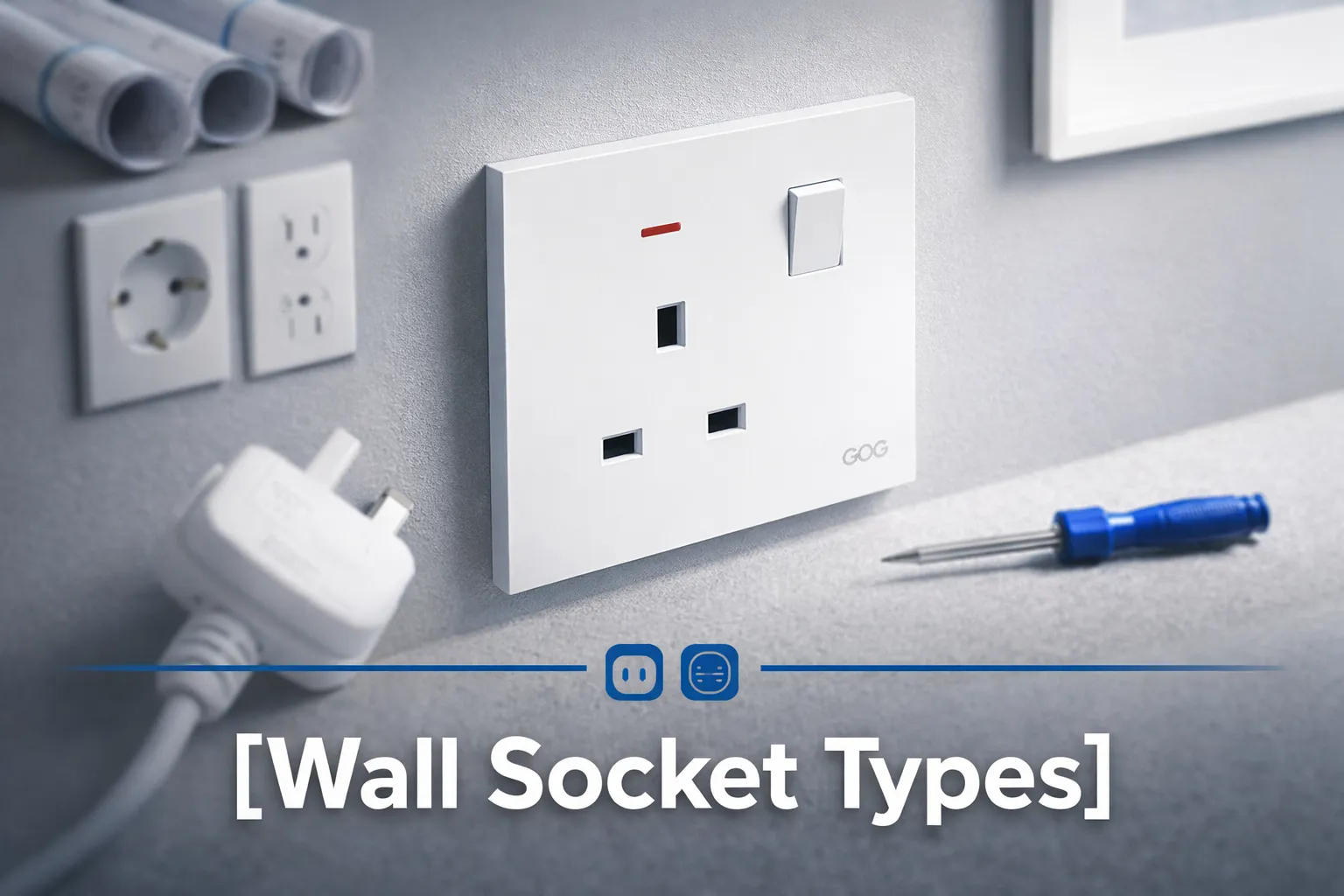
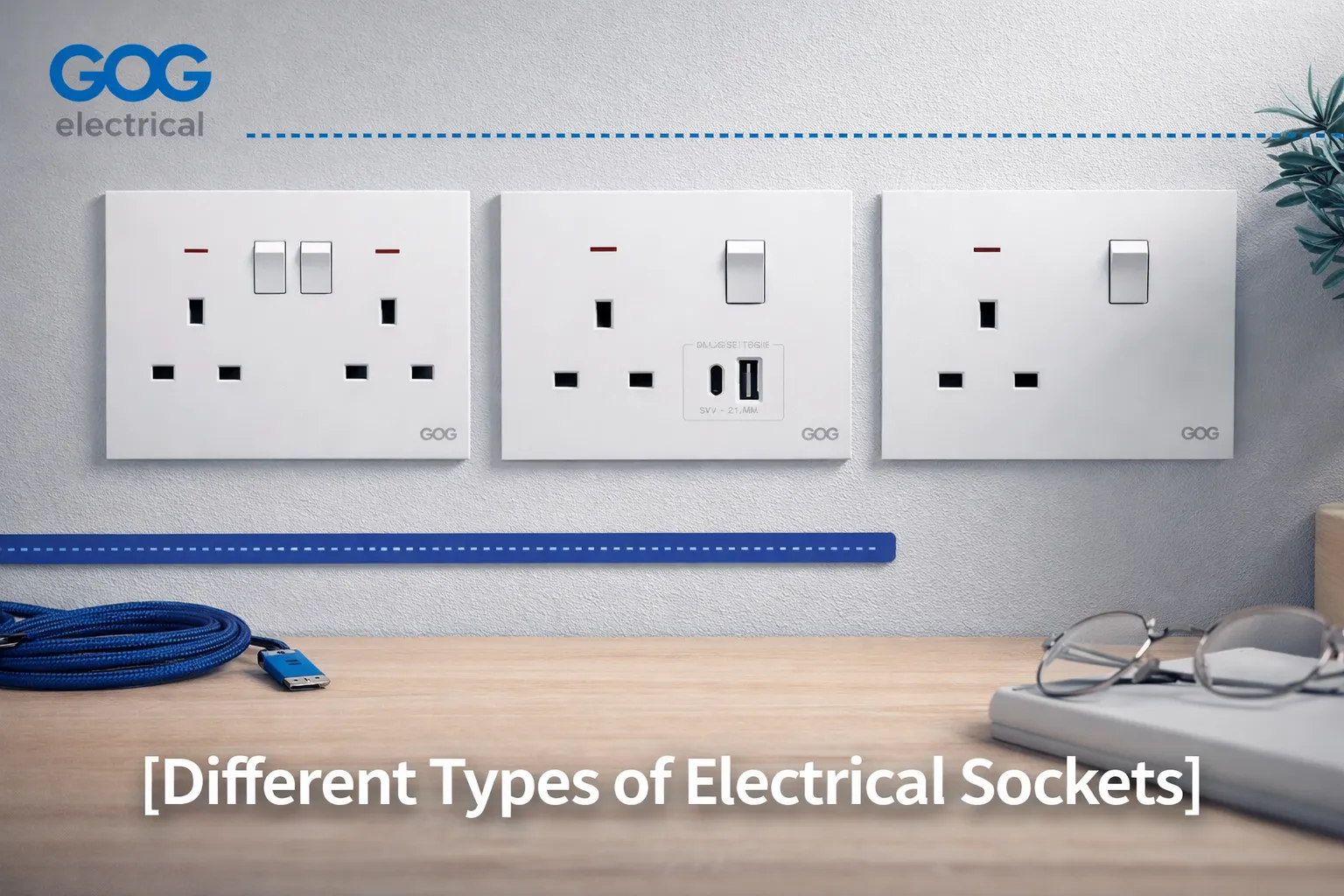
- Tomas de corriente con interruptor – la característica combinada de un interruptor y una toma de corriente, que tiene una gran cuota del mercado en el Reino Unido, la Commonwealth y gran parte del Medio Oriente.
- Interruptores reguladores – tipos de regulación de borde ascendente, borde descendente y universal con carga LED que importa más que las lecturas de ‘vatios’.
- Interruptores inteligentes – interruptores tipo Wi-Fi, Zigbee, Z-Wave y Matter, con o sin neutro.
- Reguladores de velocidad para ventiladores e interruptores para motores – una categoría completamente diferente de los interruptores de iluminación y no intercambiables.
- Interruptores resistentes a la intemperie e industriales – categoría IP44 a IP66, disponibles en metal o para montaje superficial para exteriores e industrias.
- Modular and grid switches – common plates with interchangeable switches, sockets, and blank modules.
- Special categories – doorbell switches, key switches, shaver sockets, blank sockets, data outlets and TV outlets.
In the last three categories, the broadness of a supplier’s product range comes into play. Modular and grid systems allow the installer to assemble transformer, mains, data and unconnected circuits into a single plate which is a design concept that has been carried out once only and then endured for the next 20 years, and if the supplier’s catalogue makes the use of two plates necessary in what should be a two-channel system, they have failed the project regardless of the price. Fewer manufacturers cover the whole list than cover the first two or three items, and the narrower field is set out in this review of the top light switch manufacturers in the world.
Specifications Buyers Compare
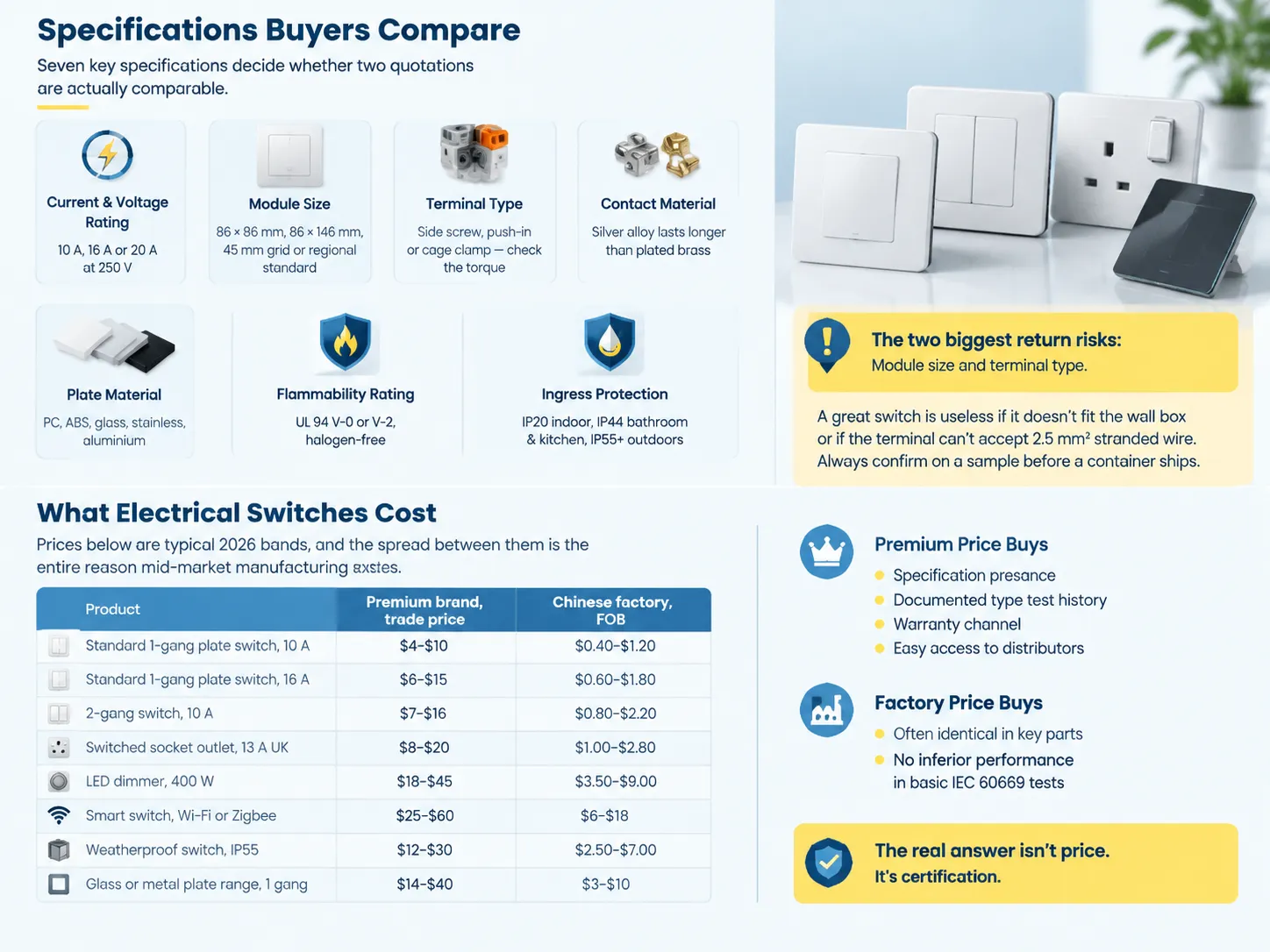
Once you have two quotations, seven specifications decide whether they are actually comparable.
| Especificación | Qué verificar |
|---|---|
| Current and voltage rating | 10 A, 16 A or 20 A at 250 V — the rating must exceed the circuit it protects |
| Module size | Standard 86 × 86 mm, 86 × 146 mm, 45 mm grid, or the regional standard your walls use |
| Tipo de terminal | Side screw, screwless push-in, or cage clamp — and the torque the manufacturer specifies |
| Contact material | Silver alloy contacts last far longer than plated brass; ask if it matters |
| Plate material | PC, ABS, glass, stainless, aluminium — which decides UV resistance and finish durability |
| Flammability rating | UL 94 V-0 or V-2, and whether the material is halogen-free |
| Protección contra ingreso | IP20 indoor, IP44 for bathrooms and kitchens, IP55 or higher outdoors |
There are two particular factors that cause the most returns: the size of the module and the type of terminal. A switch that has an excellent mechanical function, but does not match the wall box type of the target market, becomes completely unusable, and it also applies to screwless push-in terminals that cannot be used with 2.5 mm stranded wire: if the terminal cannot accept it, the installer is left without an option.
What Electrical Switches Cost
Prices below are typical 2026 bands, and the spread between them is the entire reason mid-market manufacturing exists.
| Producto | Premium brand, trade price | Chinese factory, FOB |
|---|---|---|
| Standard 1-gang plate switch, 10 A | $4–$10 | $0.40–$1.20 |
| Standard 1-gang plate switch, 16 A | $6–$15 | $0.60–$1.80 |
| 2-gang switch, 10 A | $7–$16 | $0.80–$2.20 |
| Switched socket outlet, 13 A UK | $8–$20 | $1.00–$2.80 |
| LED dimmer, 400 W | $18–$45 | $3.50–$9.00 |
| Smart switch, Wi-Fi or Zigbee | $25–$60 | $6–$18 |
| Weatherproof switch, IP55 | $12–$30 | $2.50–$7.00 |
| Glass or metal plate range, 1 gang | $14–$40 | $3–$10 |
Although the gap seems huge, it certainly is real, though it is not an equivalent saving. The overpriced products have specifications like type testing process, warranty process, and the ability to walk into the distributor and buy one piece on a Tuesday. The factory product is often the same in the crucial parts and not any worse in terms of aspects evaluated by simple IEC 60669 test if the factory is legitimate and runs a reliable testing process. However, the above assumption is the central point of concern here, and it is validated by certification rather than by pricing.
Where the Volume Actually Comes From
It definitely deserves mention of the layer below the top five since it is a layer where switches will be manufactured the most.
The Chinese manufacturers output a staggering amount of wiring devices in terms of volume, but a large part of this production is done under private label projects for Western brands. Therefore the same factory could make a switch for $8 under one nameplate and $2 under another. In China, there are only a few companies that have established their own brands in an international market instead of staying anonymous contractors, and those are names to be noted by the distributor.The structure of that segment, including which brands are genuine manufacturers versus traders, is covered in this review of China’s top electrical export brands.
The consequence for a buyer is that “made in China” provides almost no useful information. What makes a difference is if the manufacturer has its own tools, if it has test equipment, and what its AQL is, as well as whether it can provide a certificate that a third party will recognize.
Certifications That Decide Whether You Can Specify It
Certification is the point where a mid-sized manufacturer either qualifies or fails. This is mostly done with four documents:
- EN 60669 / IEC 60669 – the product standard that defines how switches for domestic and similar permanent electrical installations must be made in Europe or Commonwealth countries.
- UL 20 – North America’s general-use switch certification that is needed for any switch used in a circuit either in the US or Canada.
- IECEE CB Scheme certificate – a simplified report accepted in all member countries, hence making cross-border specification possible and eliminating the need for separate certification in different markets.
- ISO 9001 at the production facility, thus eliminating the need to have a separate document confirming that the manufacturing is done under this standard.
Additionally, there are RoHS and REACH statements for the materials used, IP rating of the device provided by the test instead of drawing and UL 94 flammability standard for the polymer used in the body of the switch. This last one can be overlooked easily as it is one of the most difficult things to prove during fire investigation.
The CB Scheme certificate is the one that changes commercial conversations, because it removes the argument that an unknown brand cannot be qualified for a multi-country project. GOG’s own route through that process is documented in this announcement of the company’s IECEE CB Scheme certification, and it is the kind of evidence worth asking any manufacturer for before a first order.
Where GOG Sits
GOG produces switches, sockets, dimmers, and light control devices for OEM, private label, and project customers instead of battling Schneider or Legrand for consumer brand awareness. There are two fair sides to this positioning.
The good thing about it is manufacturing control. Since GOG owns the tools, moulds, and tests, a client can choose a shape of a plate, a kind of a terminal, a colour, a configuration of gangs, and a way of pack without dealing with tooling it out and thus paying because of that, but for the actual production cost itself. It is pretty simple mathematics on the 20,000 pieces of the order; the range may include plate switches, switched sockets, dimmers, USB sockets, waterproof devices, as well as decorative metal and glass ranges. The programme structure is set out on the lighting switch manufacturing page.
One more point of limitation is rather clear. Nobody would ever name GOG in specifications developed by consultants; when the name Schneider or Legrand is found, it will be those companies to comply with the specifications. GOG is present at projects designed as performance specifications (e.g. EN 60669 or UL 20, with the main characteristics, such as 10A or 16 A at 250 V, V-0, IP44, CB Scheme certificate) or private label projects where the name of the customer is written on the product.
Preguntas frecuentes
Who are the top switch manufacturers?
With respect to their revenue and specification presence, Schneider Electric, Legrand, Siemens, ABB and Eaton are recognized as the leaders in the electrical switch and wiring device sector, while Panasonic, Leviton, Havells, Simon and Vimar are noted leaders in their respective home regions. The segment specifically dealing with circuit protection shows Schneider Electric holding the largest market share of about 12.4%, Siemens with 11.8%, ABB with 10.2%, Eaton with 9.6%, and Legrand with 8.9%. The verdict on who is the real leader is contingent upon the aspects being evaluated i.e. whether it is revenue, volume of units sold, specification presence, or availability.
What are the best brands of electric switches?
When it comes to residential applications, the ideal brand is usually established based on compatibility with the wall box standard, the rules outlined by the country’s regulatory authority, and the different models available from distributors. This explains the presence of Legrand and Schneider in Europe, Eaton and Leviton in North America, Panasonic in Japan and Southeast Asia, and Havells in India. In the case of industrial applications, ABB and Siemens brands are preferred because of their approaches to protection and automation. In case of volume and OEM production, the physical item created by the eligible manufacturer from China will be compliant with the specifications, so its price will be lower than price of any competing brands.
Who are the top 5 network switch manufacturers?
In the case of residential lines, the brand is chosen according to the shape that corresponds to the standards of the applicable wall box, regulations of the local authority, the types of models manufactured by local distributors, etc. This explains the use of Legrand and Schneider companies in Europe, Eaton and Leviton in North America, Panasonic in Japan and Southeast Asia, and Havells in India. As for industrial lines, ABB and Siemens brands are on the top of the list due to their methods of enabling protection and automation. In return for the possibility of mass-production and OEM production, the consumer will receive the goods produced by qualified manufacturer in China that will fully comply with the regulations which allows the consumer to buy at lower prices compared to other brands.
Which company is best in switch?
When it comes to residential lines, the choice of brand is based on their compliance with the standard wall box type, the rules set by local authorities, and the types of goods manufactured by local distributors. This is why Legrand and Schneider brands are present in Europe, Eaton and Leviton brands operate in North America, Panasonic operates in Japan and the southern part of Asia, while Havells is used in India. In industrial lines, the brands that take the first place in this area are ABB and Siemens organizations for their methods of performing protection and automation. In return for the mass production and OEM production option offered by the making company, the consumer gets the products made by qualified producers in China, which fully comply with the regulations and allow the consumer to receive products at lower prices compared to other brands.
How much do electrical switches cost?
The cost of a regular 10 A plate switch is about $4–$10 when sold by leading brands but only $0.40–$1.20 when produced in some Chinese factory. The cost of a 16 A model is $6–$15 against $0.60–$1.80. The costs of a LED dimmer is $18–$45 and $3.50–$9 respectively. The cost of a smart switch ranges between $25 and $60 and only $6–$18 when manufactured in China. The IP55 weatherproof switch costs $12–$30 versus only $2.50–$7 from China. In other words, the difference in costs can be explained by the brand, extra costs, certification process and warranty channel.
How do I verify a switch manufacturer is genuine?
Request four documents: specifically the IEC 60669 or UL 20 test report for the product, the IECEE CB Scheme certificate in case of transnational specification issues, the ISO 9001 certificate with the scope statement with a showing of the product family, as well as AQL and the in-process testing regimen. Then request two product samples from two different production lots and analyze the comparisons in terminal torque, plate fit and switch feeling. A manufacturer who is able to answer the four questions is credible and a manufacturer who is not able to answer any of the questions is a trading company.
Referencias
- UL Standards & Engagement — UL 20, General-Use Snap Switches
- International Electrotechnical Commission — IEC 60669 series, switches for household and similar fixed electrical installations
- Schneider Electric — Acti9 modular distribution and wiring device range
- Legrand — electrical and digital building infrastructure
- ABB — electrification and installation products
Conclusión
There are five top companies that manufacture electrical switches which are Schneider Electric, Legrand, Siemens, ABB, and Eaton, but which is the best depends on the revenue, specifications, industrial applications, or availability of the brands. As we go further, we find regional leaders and below them, the Chinese companies that make most of the switches of the world.
Three considerations when sourcing switch products. It is necessary to compare switches using the same criteria, which are rating, dimensions, terminals used, materials used for contacts, material used for plates, fire resistance and IP. Make sure to get information about the time of die method or UL reports before asking for price quotes. Keep in mind that the difference between a $10 brand switch and a $1 factory switch is not the difference in quality, but the difference in brand, distribution, and documents.
Write the specifications of the certification instead of the specification found on the nameplate.