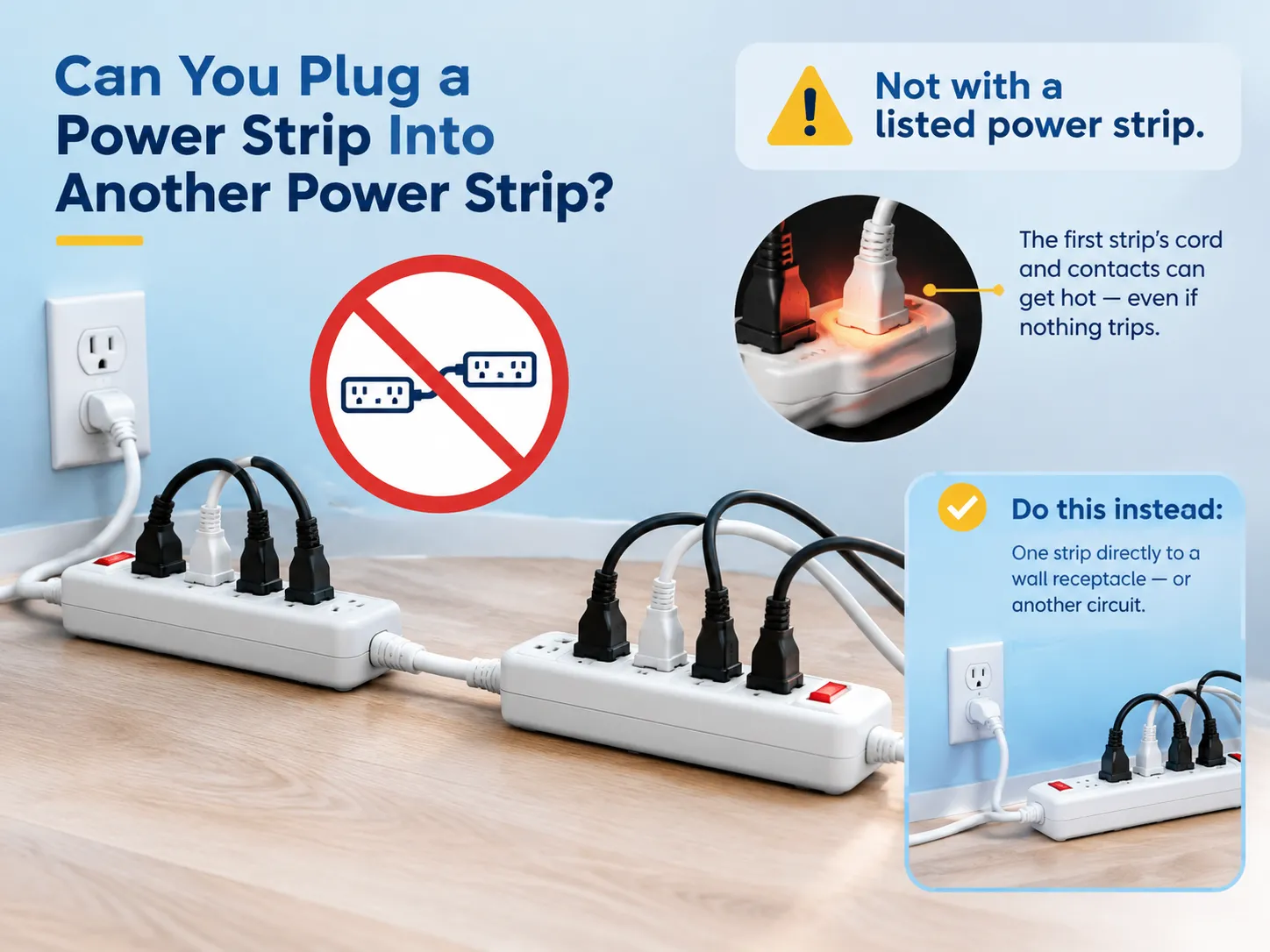
Chaque bureau a déjà vécu ce scénario : une multiprise est branchée sur une autre multiprise, qui elle-même alimente un appareil tel qu'une imprimante. Bien que cela fonctionne, sans étincelles et sans déclencher le disjoncteur, cela suscite constamment des interrogations sur la pertinence d’utiliser les multiprises de cette manière. Cet article expliquera ce que les réglementations disent concernant l’utilisation des multiprises ainsi, pourquoi ce n’est pas ce que la plupart des gens pensent, ce que l’on est autorisé à brancher sur une multiprise, et comment gérer la situation s’il n’y a pas de prises disponibles dans le bureau.
En résumé, la réponse est que l’utilisation d’une multiprise homologuée pour cette tâche ne fonctionne pas. UL 1363 mentionne qu’un répartiteur d’alimentation déplaçable connecté par un cordon n’est pas conçu pour être connecté en série. De plus, l’OSHA se réfère à ce qui est indiqué dans 29 CFR 1910.303(b)(2). L’apparence est bonne car le disjoncteur mural a été installé selon les spécifications du circuit et non celles de la multiprise, donc le disjoncteur ne se déclenche pas tant que le cordon et la connexion de la première multiprise ne chauffent pas.
Ce que signifie réellement le “ Daisy Chaining ”
Le terme technique pour une multiprise est « relocatable power tap », également appelé RPT dans la terminologie UL 1363. Le « daisy chaining » signifie brancher une multiprise sur une autre multiprise, ainsi qu’un cordon d’extension branché sur une multiprise ou une multiprise branchée sur un cordon d’extension pour le même résultat. Dans l’industrie, s’il y a différents types d’appareils, on parle de chaîne mixte.
Dans le langage courant, cela s’appelle “ piggybacking ”.
Il n’y a aucune distinction faite entre ces classifications dans les codes. Une chaîne reste une chaîne dans tous les cas.
Ce que disent les normes, par ordre de force
Quatre documents traitent de cette question, et ils se renforcent mutuellement. S’il n’y a qu’un seul document à retenir, c’est le premier :
UL 1363, Section 1.7. Cette norme stipule, sans ambiguïté, que le répartiteur d’alimentation déplaçable (RPT) n’est pas destiné à être utilisé avec un autre RPT. Cela est réitéré dans le UL White Book sous la catégorie des répartiteurs d’alimentation déplaçables, qui précise que les RPT doivent être connectés à une prise fixe et ne pas être utilisés en série avec d’autres RPT ou cordons d’extension.
OSHA 29 CFR 1910.303(b)(2). Ce règlement stipule : “ Les équipements listés ou étiquetés doivent être installés et utilisés conformément aux instructions incluses dans la liste ou l’étiquetage. ” Puisque chaque multiprise homologuée comporte des instructions interdisant la connexion en série, le daisy chaining viole ce règlement. L’OSHA a même précisé sa position avec une lettre clarifiant que les RPT homologués UL doivent uniquement être connectés à des prises de circuit fixe.
NFPA 1, Chapitre 11. Dans le Code de prévention des incendies, il y a également une mention directe des RPT. Ils doivent avoir une polarisation, une mise à la terre, une protection contre les surintensités, être listés, être connectés à une prise fixe, et les cordons ne doivent pas être passés derrière les murs, plafonds ou planchers, sous les portes ou les revêtements de sol.
NEC 400.12. Les cordons et câbles flexibles ne peuvent pas remplacer le câblage fixe d’un bâtiment. Par conséquent, une longue chaîne en guirlande utilisant des cordons traversant la pièce est totalement illégale.
La physique : pourquoi rien ne déclenche avant qu’il ne soit trop tard
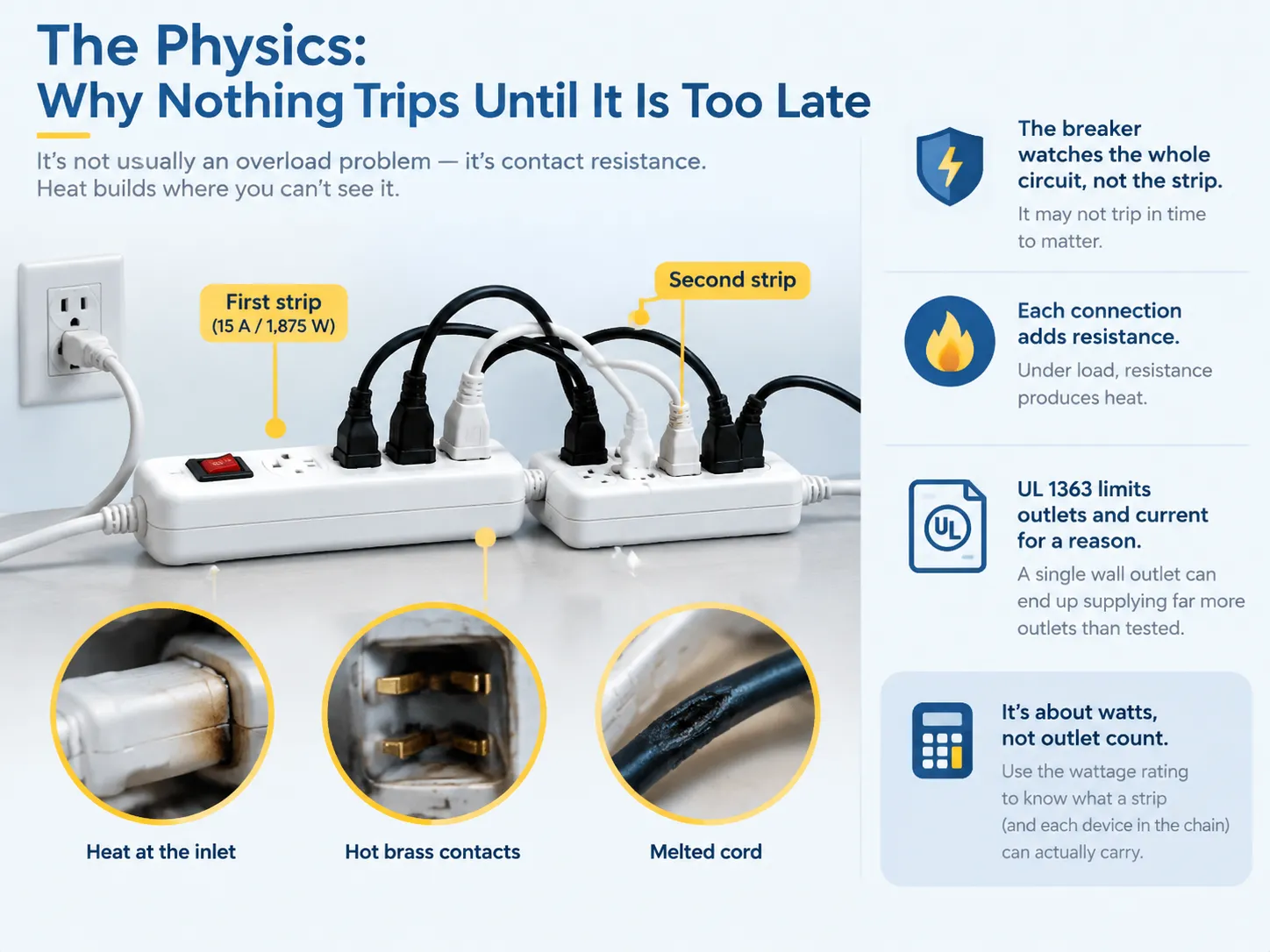
Le concept de guirlande est très trompeur. Les gens pensent que la faute vient d’une surcharge du circuit et qu’un disjoncteur les protégera. Mais ce n’est probablement pas le cas.
Typiquement, un circuit dérivé américain peut supporter 15 A ou 20 A. Une multiprise ayant subi des tests est probablement évaluée pour 15 A à 125 volts pour un total de 1 875 W. Cependant, cette évaluation s’applique à l’ensemble de la multiprise : le cordon et le câblage interne de la multiprise. Lorsque vous connectez une autre multiprise à la première, la charge sur le premier circuit semble plus importante que ce que le disjoncteur peut détecter.
Le processus qui conduit à ce phénomène s’appelle l’augmentation de la résistance de contact. La connexion prise-réceptacle dans l’appareil ajouté augmente la résistance, ce qui génère à son tour de la chaleur. Vous serez surpris de savoir que la chaleur s’accumule à l’étape invisible du processus : celle qui se déroule à l’intérieur de l’entrée de la multiprise initiale. La même situation se produit aux contacts. Cette chaleur entraînerait la fusion des cordons et l’endommagement des réceptacles au lieu de déclencher le disjoncteur.
C’est pourquoi l’arithmétique compte plus que l’apparence. Déterminer ce qu’une multiprise peut réellement supporter revient à calculer en watts, pas en nombre de prises, et la même mathématique utilisée pour combien de watts une seule prise peut supporter s’applique à chaque appareil dans la chaîne.
Quand c’est techniquement acceptable, et pourquoi c’est quand même la mauvaise réponse
Certains soutiendront que deux multiprises alimentant un ordinateur portable, un moniteur d’ordinateur et un chargeur de téléphone ne devraient pas avoir d’impact sur le système électrique puisque leur consommation totale ne devrait pas dépasser 200 W, mais cet argument est hors sujet. Essentiellement, les réglementations du code sont écrites pour un scénario impliquant des charges maximales et la liste ne prévoit aucune exception pour les petites charges. Par conséquent, une chaîne considérée comme sûre peut cesser de l’être dès qu’un chauffage y est branché sans recontrôler la multiprise.
Il y a aussi un aspect assurance ici puisque la certification UL et les exigences OSHA sont la norme de comparaison utilisée par la plupart des compagnies d’assurance et des services d’incendie lors d’enquêtes sur des incendies causés par des guirlandes dans des maisons ou établissements.
Ce que vous pouvez brancher en toute sécurité sur une multiprise
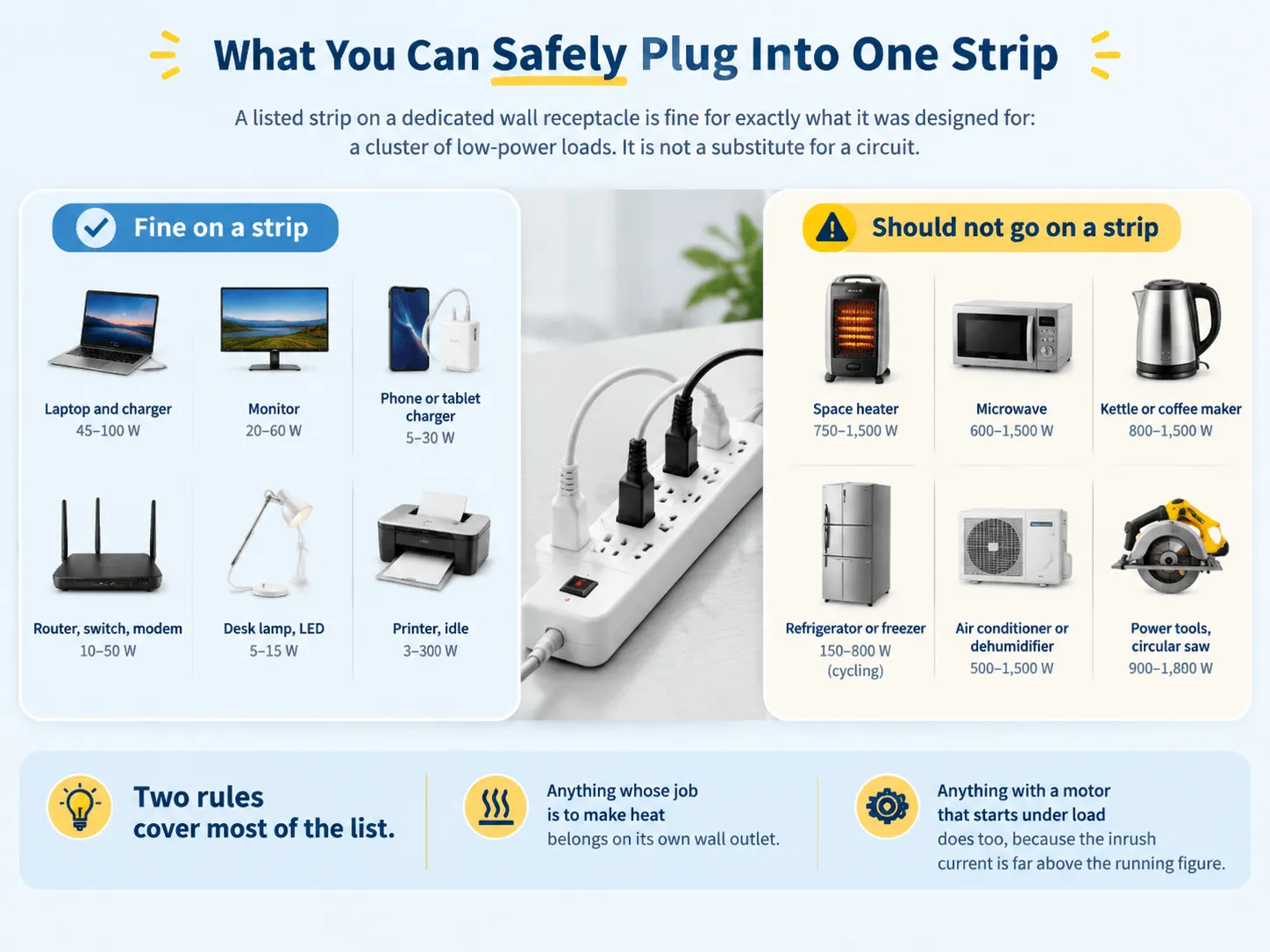
Une multiprise listée sur une prise murale dédiée est adaptée exactement à ce pour quoi elle a été conçue : un groupe de charges à faible puissance. Ce n’est pas un substitut à un circuit.
| Acceptable sur une multiprise | Consommation | Ne doit pas être branché sur une multiprise | Consommation |
|---|---|---|---|
| Ordinateur portable et chargeur | 45–100 W | Chauffage d’appoint | 750–1 500 W |
| Moniteur | 20–60 W | Micro-ondes | 600–1 500 W |
| Chargeur de téléphone ou tablette | 5–30 W | Bouilloire ou cafetière | 800–1 500 W |
| Routeur, switch, modem | 10–50 W | Réfrigérateur ou congélateur | 150–800 W en cycle |
| Lampe de bureau, LED | 5–15 W | Climatiseur ou déshumidificateur | 500–1 500 W |
| Imprimante, en veille | 3–30 W | Outils électriques, scie circulaire | 900–1 800 W |
La plupart du reste peut être régie par deux principes. Tout équipement générant de la chaleur doit être branché sur une prise isolée. Il en va de même pour un appareil qui démarre son fonctionnement sous charge grâce à un courant d’appel supérieur à la valeur opérationnelle.
Ce pour quoi une multiprise est réellement conçue
Prior to making a purchase, it is important to look at three figures indicated on the label: the amp rating, wire gauge, and joule rating.
A strip rated for 15A/1875W with a 14AWG wire is the standard US requirement, and it is the wire gauge that provides the true limit; 14AWG copper is good for 15A, 16AWG for 13A, and thus if the strip specifies 15A on a 16AWG wire, it exaggerates. Strips that do not possess an internal circuit breaker do not provide any safety measure beyond that offered by the branch circuit breaker. Surge protection joule rating indicates how much energy is absorbed by the metal oxide varistor before it malfunctions; a varistor that absorbed its joule rating is inoperative and will not provide indication of that failure.
GOG builds in this category as a wiring-device manufacturer rather than a consumer brand, producing switched sockets, extension sockets and the receptacles they plug into for OEM and private-label programs. The range and the OEM terms are set out on the socket manufacturing page.
Better Answers Than a Second Strip
If one strip does not suffice, consider the items mentioned below, which resolve the situation at its source instead of piling the devices on themselves.
- Get a longer strip. One 10- or 15-foot strip can take over for a whole chain of power strips and put the entire load on the one cord.
- Use a second wall outlet circuit. It is common to find outlets at the opposite wall of the room on a different breaker. This will ensure that both circuits can handle the load of a high-current-consuming desktop.
- Install additional outlets. A circuit’s output limits the number of outlets it can support, and that is how many it can run.
- Use a rack PDU. When dealing with racks, rack-mount PDUs are the solution when power strips simply cannot work.
- Use a UPS with enough outlets for the workstation. It combines a battery backup and a surge protector in the single listed unit.
US, UK and EU Strips Are Not Interchangeable
The daisy-chain concept is worldwide, but ratings are. This poses a threat to people buying online. The standard US strip is rated at 15 A and 125 V. In the UK, BS 1363 specifies 15 A and the strip is often included with a fuse also rated at 15 A. The European strip uses type F or Schuko plug; its rating is 16 A at 230 V and is usually not interrupted by any switches or circuit breakers. All British plugs are also fused.
Connecting a strip with the market where it will be used has a great value. If a 15 A US circuit is connected to a 16 A European strip using an adapter, the strip is rated higher than the fuse or circuit protection upstream of it.
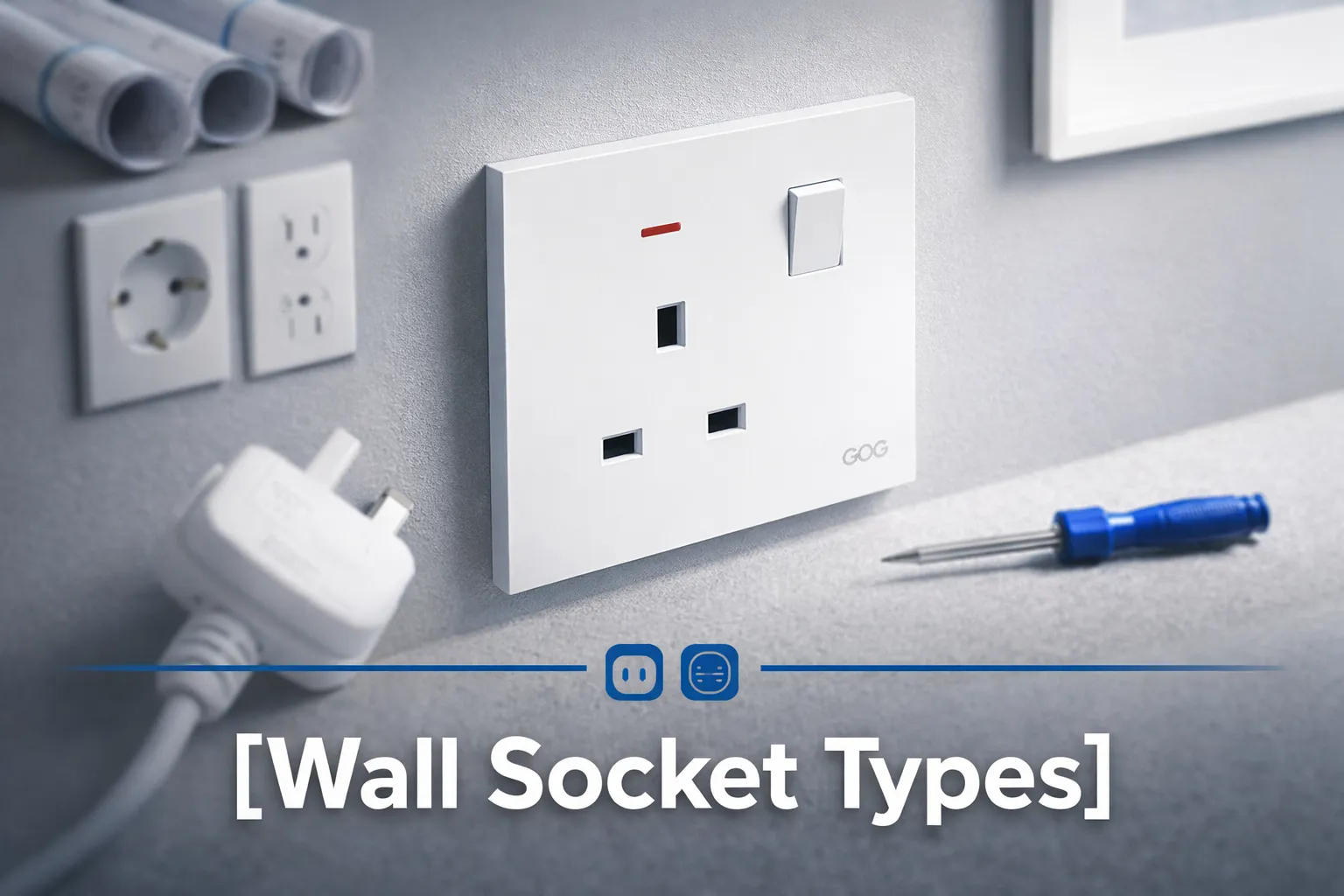
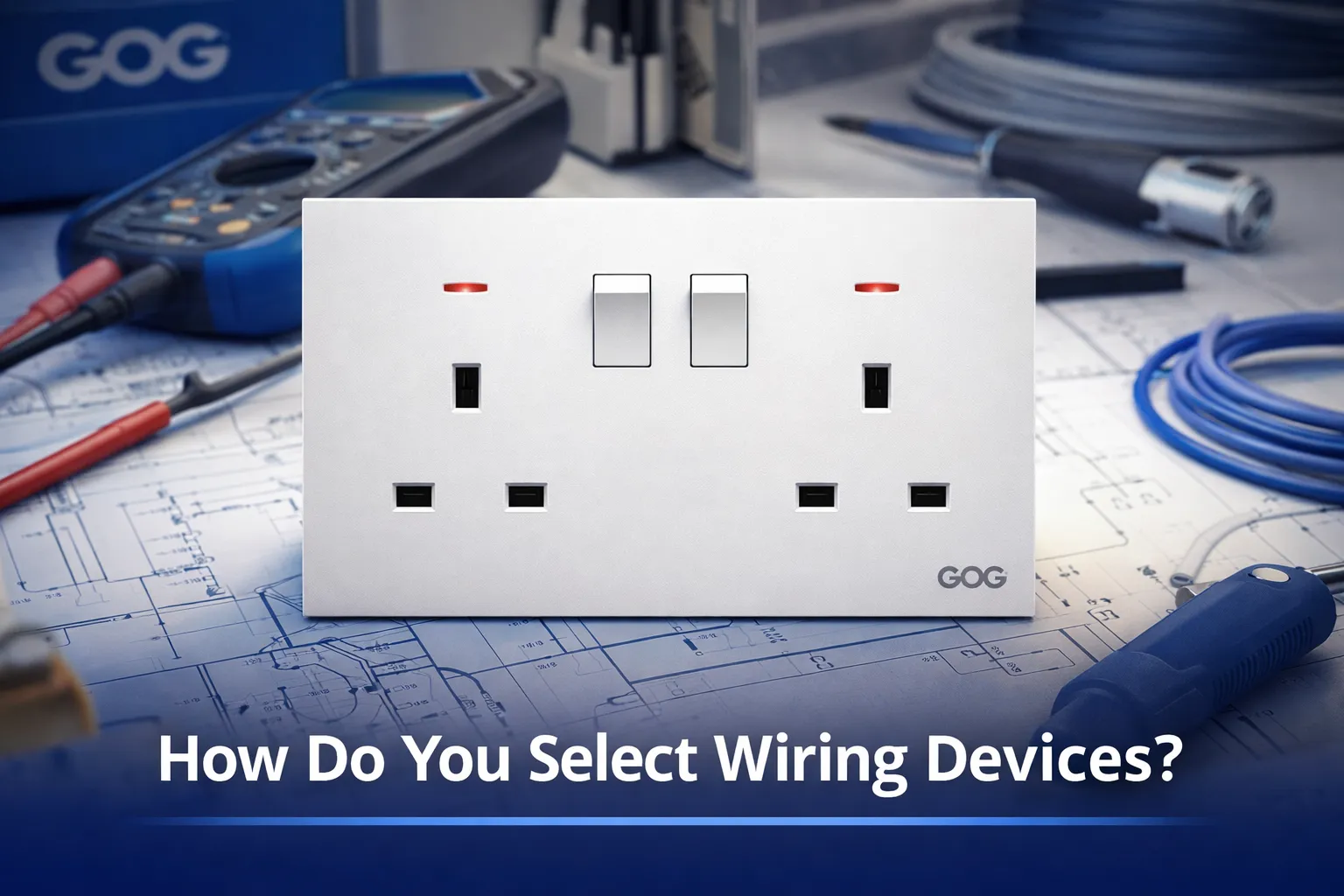
For UK and Ireland installations, a fused British Standard extension socket such as this 4-way BS extension socket with USB-C keeps the protection where the standard expects it, with the fuse in the plug rather than in the strip. In North America the same logic points to a strip with a 15 A / 125 V rating, a 14 AWG cord and its own integral breaker.
FAQ
Can you connect a power strip to another power strip?
Certainly, not when dealing with a product that has received certification. The specifications of UL 1363, particularly Section 1.7, indicate that a relocatable power tap which is dependent on a cord is not supposed to be linked with another relocatable power tap using a cord, and this guideline has also been confirmed by the UL White Book. The guideline by UL has been implemented by OSHA through the enactment of 29 CFR 1910.303(b)(2), which obligates the use of equipment that has a listing according to its listing guidelines.
Is it okay to plug a power strip into a power strip?
In this case, one should keep in mind that the problem of circuit protection is not limited to the prospect of branch circuit breaker malfunctioning because the reality of the situation is that protection never kicks in until the condition becomes dangerous. Recent connections only intensify resistance, with the first power strip’s wires and contacts baring the responsibility for all devices connected downstream since they are exposed to the total current supplied to the circuit with the circuit breaker only breaking down if a single circuit has overloaded.
Que ne faut-il jamais brancher sur une multiprise ?
Any device that produces heat or comes close to the maximum capacity of the outlet: space heaters, kettles, coffee machines, microwaves, toasters, hair dryers, irons, and portable air conditioners. Be careful with heavy-duty motor devices that switch on while loaded, like circular saws and big compressors. These loads need separate dedicated outlets.
Is it okay to connect one power strip to another so you have enough outlets, or to make it long enough to reach your plug?
Regardless of the intention, the rule remains the same. If you seek to have additional plugs, buy either an extension cord of adequate rating or a long plug strip since using an extension cord together with a plug strip will result in a series connection which is against the rules. The solutions to having more plugs are additional outlets, another circuit, or a rack power distribution unit. Plug strips help create many outlets but do nothing in terms of power rating increase, which is the entire issue.
Do surge protectors make daisy chaining safe?
No. A surge protector is still an RPT under UL 1363 and therefore, the limitation on the listing remains the same. Even worse, if two surge protectors are connected together, the clamping behavior will be randomized, and no additional protection will be given, since the second device has nothing to protect that the first does not protect.
Références
- OSHA — Compliance requirements for relocatable power taps or “power strips” (Standard Interpretation)
- UL Standards & Engagement — UL 1363, Relocatable Power Taps
- NFPA — NFPA 1 Fire Code (Chapter 11, relocatable power taps)
- Interpower — Not Safe: Daisy Chaining Power Strips
- AZoM — Is Daisy Chaining Power Strips Safe?
Conclusion
The regulations regarding power strips, which were created to allow the devices to be marketed in the first place, do not allow connecting one power strip to another due to the fact that even though the wall switches help with the circuit control, there is still heat in the first strip wires and contacts which does not have any supervision whatsoever.
As for the practical considerations, it is recommended to opt for either another longer strip or replace the cord with the one of the necessary specifications in order to get rid of any challenges. Besides, it is important to move the power-consuming loads from the power strip before getting connected to it. Finally, when buying a product check the amperage, the wire size and whether the strip is supplied with the required breaker for proper functionality and get the idea of the capacity far better than by counting the sockets mentioned on the box.