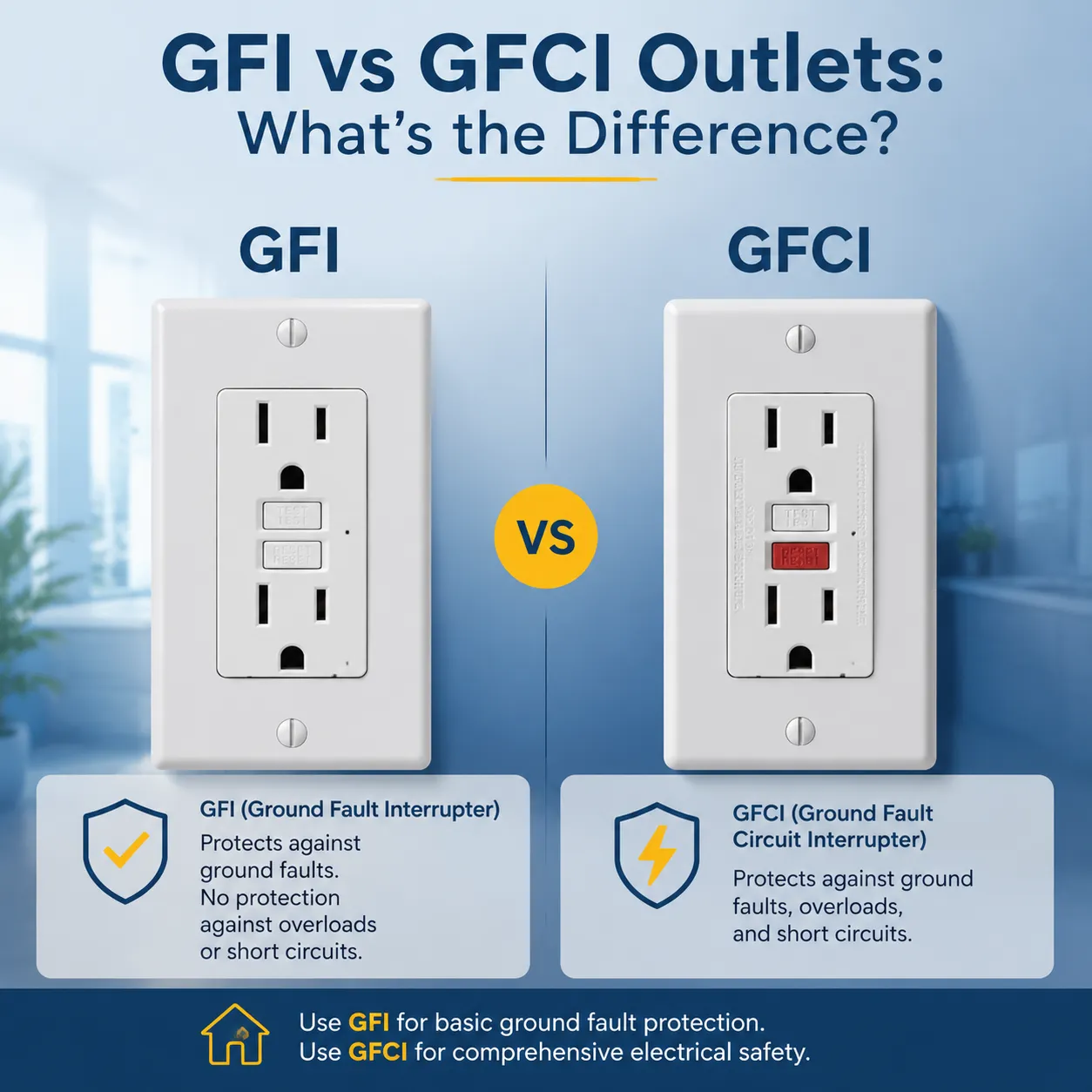
Un propriétaire en Floride est entré dans un magasin de fournitures électriques et a demandé une “prise GFI” pour sa salle de bain. Le vendeur lui a remis une boîte étiquetée GFCI. Le propriétaire était confus car son électricien lui avait dit d'acheter un GFI, mais ici il avait un GFCI. Les deux termes étaient-ils identiques ? Quel appareil était meilleur ? Et avait-il reçu le mauvais produit ? Le vendeur a expliqué ce que chaque électricien sait mais que très peu de propriétaires réalisent — que GFI et GFCI font en réalité référence au même appareil. Les deux termes désignent la même technologie de protection contre les défauts de terre, le même mécanisme de détection et la même fonction salvatrice. La seule différence est le nom sur la boîte et cette différence a plus à voir avec l'histoire et le marketing qu'avec la technologie elle-même. Savoir pourquoi il y a deux noms différents pour l'appareil et quand cette distinction est importante à demander à l'électricien est un petit morceau de culture informationnelle qui peut éviter les malentendus chez le fournisseur.
Résumé : GFI ou Interrupteur de Défaut de Terre et GFCI qui est Interrupteur de Circuit de Défaut de Terre sont des dispositifs de protection qui fonctionnent de la même manière. Les deux sont conçus pour détecter les défauts de terre, ce qui signifie que le courant s'écoule vers le sol à travers une personne ou de l'eau. Il interrompra le circuit en quelques millisecondes afin de prévenir les chocs électriques. Le terme GFCI est celui utilisé dans le Code Électrique National et dans les spécifications du fabricant ainsi que sur le dispositif lui-même. Le terme GFI est simplement la version abrégée. Il n'y a aucune différence dans le fonctionnement, le câblage ou la performance de l'appareil désigné comme GFI et celui appelé GFCI. En d'autres termes, les deux sont identiques et offrent la même protection contre les défauts de terre de 5 milliampères. En d'autres termes, quelle que soit la prise que vous achèterez, que ce soit un GFI ou un GFCI avec la fonction de bouton TEST et RESET, soyez assuré des normes qui doivent être respectées dans les salles de bains, cuisines, garages, etc.
Ce que GFI et GFCI signifient réellement — et pourquoi les deux noms existent
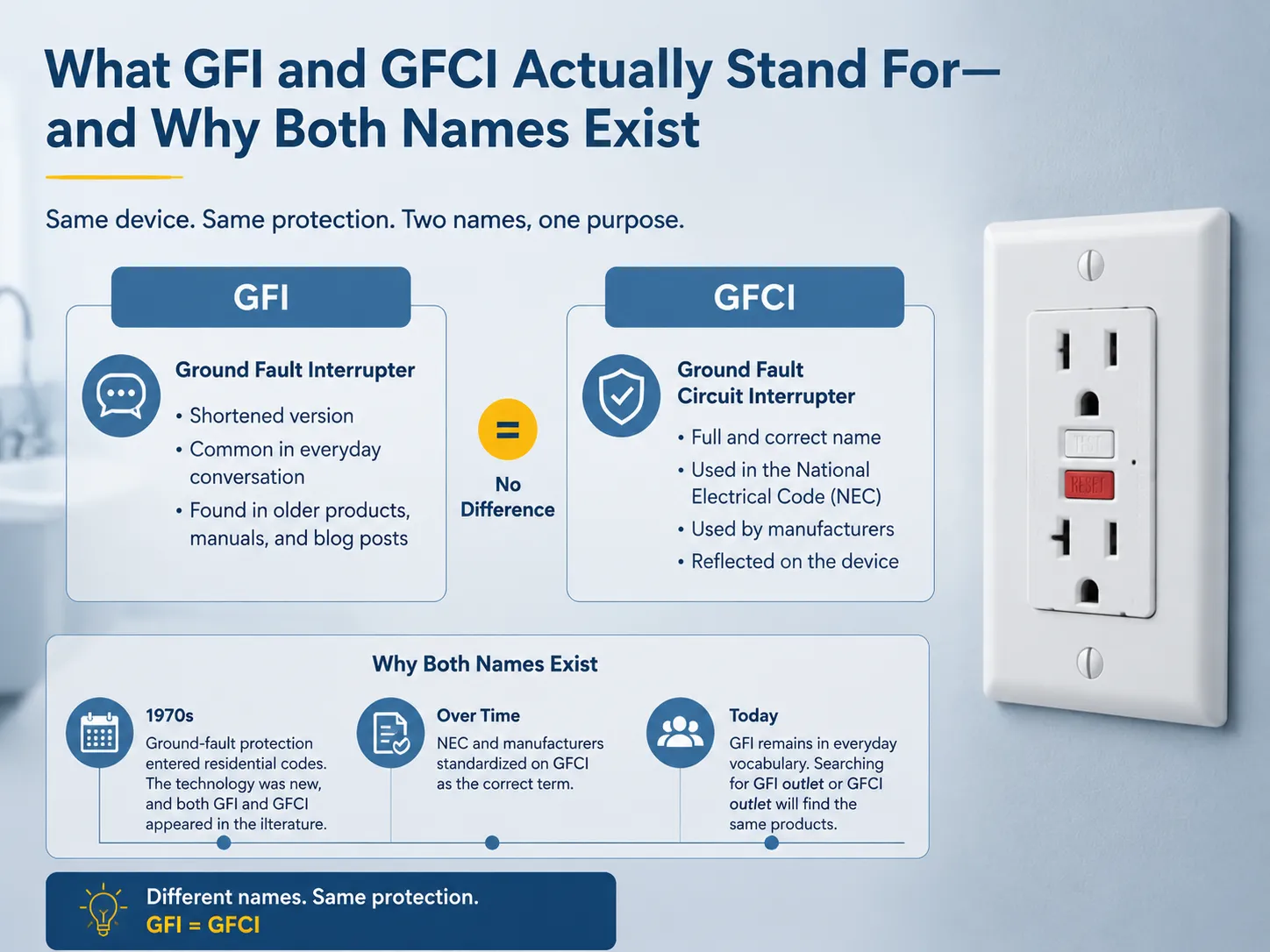
Disjoncteur différentiel (GFCI) Ce terme désigne l'Interrupteur de Circuit de Défaut de Terre, qui représente le nom complet et correct de l'instrument lui-même. Ce terme peut être trouvé dans le Code Électrique National (NEC) établi par l'Association Nationale de Protection Contre les Incendies (NFPA), dans les instructions d'installation de tout fabricant, et également sur l'instrument lui-même. Le terme circuit utilisé dans le nom est crucial ; puisque le dispositif interrompt le circuit complet lorsqu'il identifie un défaut de terre, et non seulement une partie de celui-ci. GFI signifie Interrupteur de Défaut de Terre, qui est une version abrégée du nom. Le terme GFI est souvent utilisé dans la conversation, car les électriciens préfèrent dire ce mot plutôt que GFCI en raison du fait qu'il est une syllabe plus court. Le terme est également utilisé pour les produits plus anciens et est présent dans les manuels ainsi que sur divers blogs. Cependant, il n'y a aucune différence entre les dispositifs appelés GFI et GFCI.
Qu'est-ce qui explique l'utilisation duale du nom ? La raison est historique et pratique. Lorsque la protection contre les défauts de terre a été intégrée pour la première fois dans les codes électriques résidentiels dans les années 1970, la technologie était peu familière et le nom était encore en évolution. À cette époque, à la fois GFI et GFCI apparaissaient dans la littérature. Au fil du temps, cependant, le NEC, avec les fabricants, a convenu d'utiliser GFCI comme terme correct. Néanmoins, GFI était déjà présent dans le vocabulaire quotidien des électriciens et y est resté. Par conséquent, aujourd'hui, tout propriétaire cherchant un GFI outlet ou un GFCI outlet en ligne pourra trouver les mêmes produits.
La seule distinction étroite : GFCI Breaker vs. GFCI Receptacle
Parfois, la confusion entre GFI et GFCI est rendue plus complexe par une distinction qui est liée mais implique autre chose : la distinction entre les disjoncteurs GFCI et les prises GFCI. Certaines personnes utilisent le terme GFI pour décrire un disjoncteur GFCI trouvé dans un panneau électrique et le terme GFCI pour décrire la prise GFCI trouvée sur un mur. Ce n'est pas une utilisation standard des termes. Dans les deux cas, les termes GFCI ou GFI sont également corrects légalement. Un disjoncteur GFCI est installé dans le panneau de service et offre une protection contre les défauts de terre à tous les appareils alimentés par ce circuit particulier. Il ne peut être réinitialisé que dans le panneau. La prise GFCI, en revanche, est installée dans une boîte murale et fournit une protection contre les défauts de terre à ce point particulier et aux points câblés en aval des bornes LOAD. Elle peut également être réinitialisée en appuyant sur le bouton RESET situé sur la prise. Tant le disjoncteur que la prise détecteront le même défaut de terre au même seuil de 5 mA et interrompront l'alimentation du circuit presque instantanément. La seule différence entre eux est liée à leur emplacement et au circuit de dérivation qu'ils protègent. Notre guide détaillé sur le différence entre les réceptacles GFCI et les réceptacles ordinaires couvre à la fois les types de prises et de disjoncteurs, leurs exigences d'installation et leurs applications respectives. Pour une comparaison complète du disjoncteur GFCI et de la prise GFCI — installation, protection, coût et commodité — notre article sur les différences entre les disjoncteurs GFCI et les prises GFCI fournit une analyse détaillée, côte à côte.
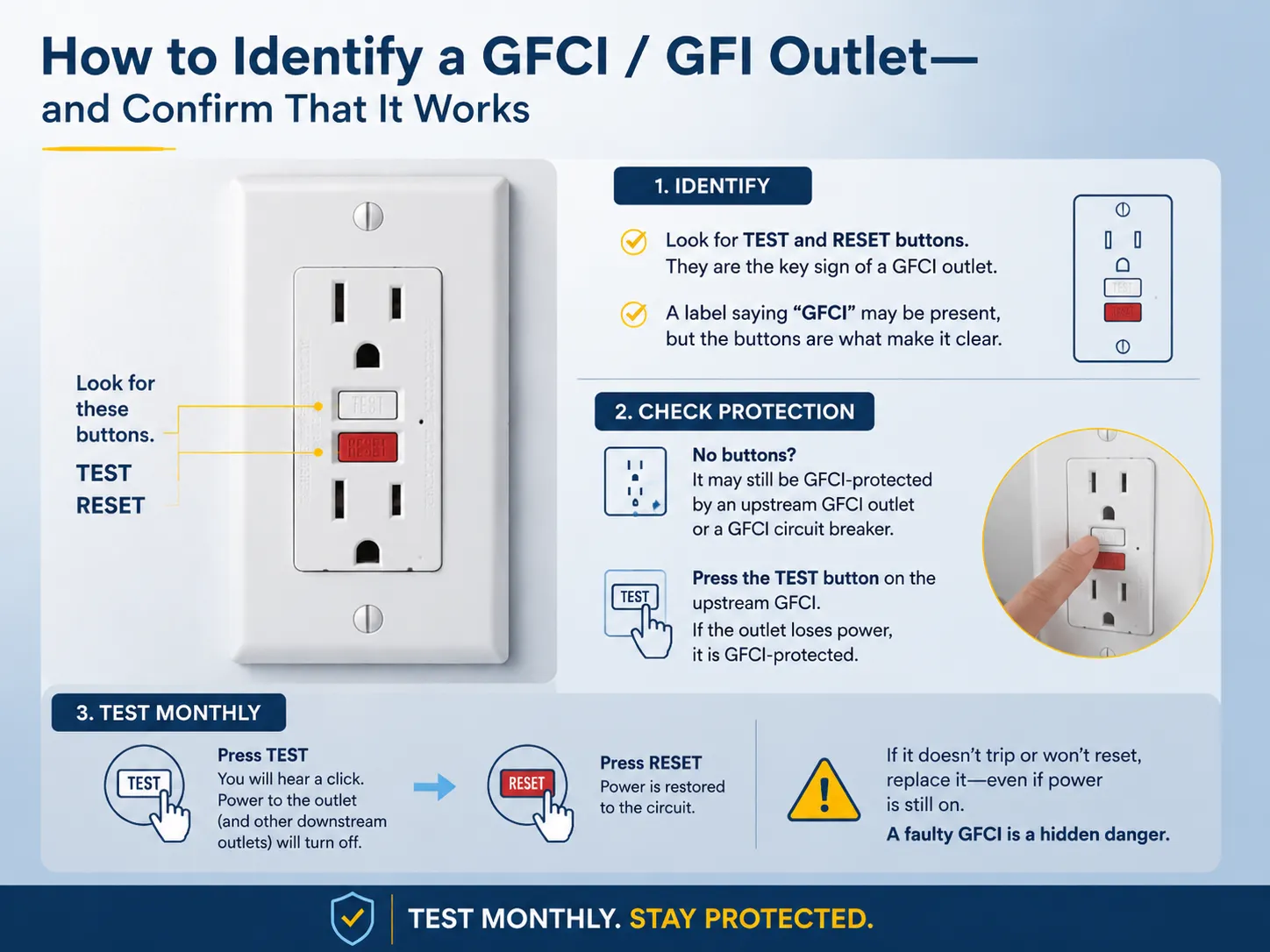
Comment identifier une prise GFCI / GFI — et confirmer qu'elle fonctionne
Trouver une prise GFCI prend un instant. Regardez la face de la prise. S'il y a deux boutons là — TEST et RESET — alors c'est une prise GFCI. Les boutons indiquent que la prise est une prise GFCI. De plus, il peut y avoir une étiquette indiquant “GFCI” quelque part sur le corps de l'appareil, mais ce sont les boutons qui rendent l'identification évidente. S'il n'y a pas de boutons TEST et RESET, cela ne signifie pas que la prise ne peut pas être protégée par un GFCI : elle peut être câblée en aval d'une prise GFCI, ou utiliser un disjoncteur GFCI en amont, mais alors elle n'est pas un GFCI à elle seule. Il est également possible de déterminer si la prise a une protection GFCI si vous pouvez appuyer sur le bouton TEST du GFCI reconnu situé en amont. Si la prise que vous inspectez perd de l'alimentation, elle est protégée par un GFCI.
Le Code Électrique National et les fabricants de GFCI exigent un test mensuel des GFCI utilisant le bouton TEST. Appuyer sur TEST produira un bruit de clic et déconnectera l'alimentation de la prise GFCI et de toutes les autres prises en amont ; appuyer sur RESET rétablira l'alimentation du circuit. Un GFCI qui ne se déclenche pas lorsque TEST est pressé ou qui ne se réinitialise pas doit être remplacé, même s'il fournit toujours de l'alimentation. Un GFCI qui fournit encore de l'alimentation représente un danger caché, c'est pourquoi il est si important d'utiliser fréquemment le bouton TEST.
Quel est le coût d'une prise GFCI / GFI et comment choisir la bonne
Le prix d'une prise GFCI, qu'elle soit appelée “GFI” ou “GFCI”, varie en fonction de la marque, du type et de la capacité en ampères de la prise. Une prise GFCI résistante aux manipulations de 15 ampères se vend entre $10 et $20. Le modèle de 20 ampères coûte entre $15 et $25. Les GFCI résistants aux intempéries pour une utilisation en extérieur coûteraient entre $15 et $30. Un GFCI avec ports de charge USB-C serait au prix de $25 à $50. Un GFCI AFCI coûterait environ $30 à $60. Un disjoncteur GFCI est vendu entre $40 et $80. La différence de prix entre un GFCI de base et une bonne prise résistante aux manipulations non-GFCI ($2 à $5) fait que la protection contre les défauts de terre coûte quelques dollars supplémentaires afin que vous puissiez avoir un appareil pour vous protéger des chocs électriques. GOG Electric fabrique des prises GFCI en versions de 15 et 20 ampères avec des volets résistants aux manipulations, des finitions blanches et décoratives, et avec des boutons TEST et RESET que toutes les prises GFCI ont en standard. Pour la gamme complète de types de prises et leurs applications dans chaque pièce, notre aperçu de la meilleures prises et interrupteurs pour les maisons modernes couvre la sélection complète des standards aux intelligents.
Questions fréquemment posées
Peut-on mettre un GFI sur n'importe quelle prise ?
Un réceptacle GFI/GFCI peut être installé dans n'importe quel circuit de dérivation de 120 volts, évalué à 15 ou 20 ampères avec un fil de terre (ou il peut être installé avec un disjoncteur GFCI, auquel cas il n'y aura pas besoin d'un autre réceptacle GFCI). Le réceptacle GFCI lui-même doit être placé dans une boîte de profondeur appropriée, et les câbles doivent être connectés aux connecteurs LINE pour la connexion d'alimentation, ainsi qu'aux connecteurs LOAD si vous souhaitez avoir une protection située en bas.
Qu'est-ce qui ne doit pas être branché sur une prise GFCI ?
En général, des appareils comme les réfrigérateurs, les congélateurs, les pompes de puisard et les pompes de relevage des eaux usées ne sont pas recommandés pour la protection GFCI car cela peut se déclencher sans être remarqué et entraîner des incidents comme la détérioration des aliments ou des inondations dans le sous-sol. Dans le cas où la zone exige une protection GFCI, comme dans un garage ou un sous-sol non fini, il est préférable d'obtenir un GFCI avec alarme pour détecter les déclenchements ou un GFCI avec une prise unique pour une machine particulière afin que cela n'affecte pas les autres en cas de déclenchement.
Que se passe-t-il si vous mettez un GFI sur un disjoncteur GFCI ?
Installer une prise GFI/GFCI sur un circuit qui est déjà sous la protection d'un disjoncteur GFCI crée une situation où la protection est essentiellement redondante. En cas de survenance d'un défaut à la terre, l'un ou l'autre des deux dispositifs peut se déclencher en premier. La redondance n'est pas dangereuse et ne viole pas le NEC, mais peut compliquer le dépannage.
Les salles de bains ont-elles besoin de GFCI ou de GFI ?
Les salles de bains sont une zone protégée par GFCI, que ce soit avec un disjoncteur GFCI, un réceptacle GFCI, ou un réceptacle GFCI en aval connecté. Le Code national de l'électricité a rendu obligatoire la protection GFCI dans les salles de bains depuis 1975. Le Code peut utiliser le terme GFCI dans sa définition, mais un dispositif appelé GFI peut également être utilisé.
Références
- Association nationale de protection contre l'incendie (NFPA) — Article 210.8 du NEC. L'article de code spécifique qui exige la protection GFCI pour le personnel dans les salles de bains, cuisines, garages, extérieurs, vides sanitaires et buanderies.
- Fondation internationale pour la sécurité électrique (ESFI) — Protection et test GFCI. Conseils aux consommateurs et aux professionnels sur le rôle des GFCI dans la prévention des électrocutions et l'importance des tests mensuels.
- Leviton — GFCI Receptacles et disjoncteurs. Fabricant de réceptacles GFCI résidentiels et de disjoncteurs, avec des conseils d'installation et des spécifications de produit pour toutes les applications.
- Eaton — Dispositifs de protection GFCI et à double fonction. Fabricant de réceptacles GFCI, de disjoncteurs GFCI et de dispositifs à double fonction AFCI/GFCI pour des installations résidentielles et commerciales.
La différence entre un GFI et un GFCI est une différence de trois lettres — “C-I-R” — qui décrivent le même appareil, la même protection, et la même fonction salvatrice. La prise sur le mur avec deux boutons marqués TEST et RESET est un interrupteur de circuit à défaut de terre, que la boîte l'appelle un GFI, un GFCI, ou simplement une “prise à défaut de terre.” Ce qui importe, ce n'est pas le nom sur l'emballage mais l'appareil à l'intérieur : le toroïde de détection qui compare le courant sortant et le courant revenant, le circuit électronique qui détecte un déséquilibre de 5 milliampères, et le relais qui se déclenche en une fraction de seconde pour déconnecter l'alimentation avant que le courant n'atteigne un niveau qui pourrait arrêter un cœur. Les prises GFCI de GOG Electric — étiquetées GFCI, répondant aux exigences du NEC, et testées selon les normes UL qui régissent leur performance — fournissent cette protection dans chaque salle de bain, cuisine, garage, et prise extérieure que le code exige.