Le terme fait référence à l'extrémité d'un cordon de lampe, d'un chargeur de notebook, d'un ventilateur de bureau, d'un téléviseur et environ quatre milliards d'articles. Presque personne n'y prête attention, il n'est donc pas surprenant que très peu de personnes puissent expliquer ce que signifient les lettres ou pourquoi une broche est plus large que l'autre. L'importance des informations concernant l'écart devient évidente lorsqu'un cordon doit être remplacé, que l'équipement doit être adapté à l'exportation et lorsqu'une prise semble chauffée et qu'il faut déterminer si cela est normal.
La section suivante contient les informations pour ceux qui ont besoin de plus qu'un simple aperçu du sujet.
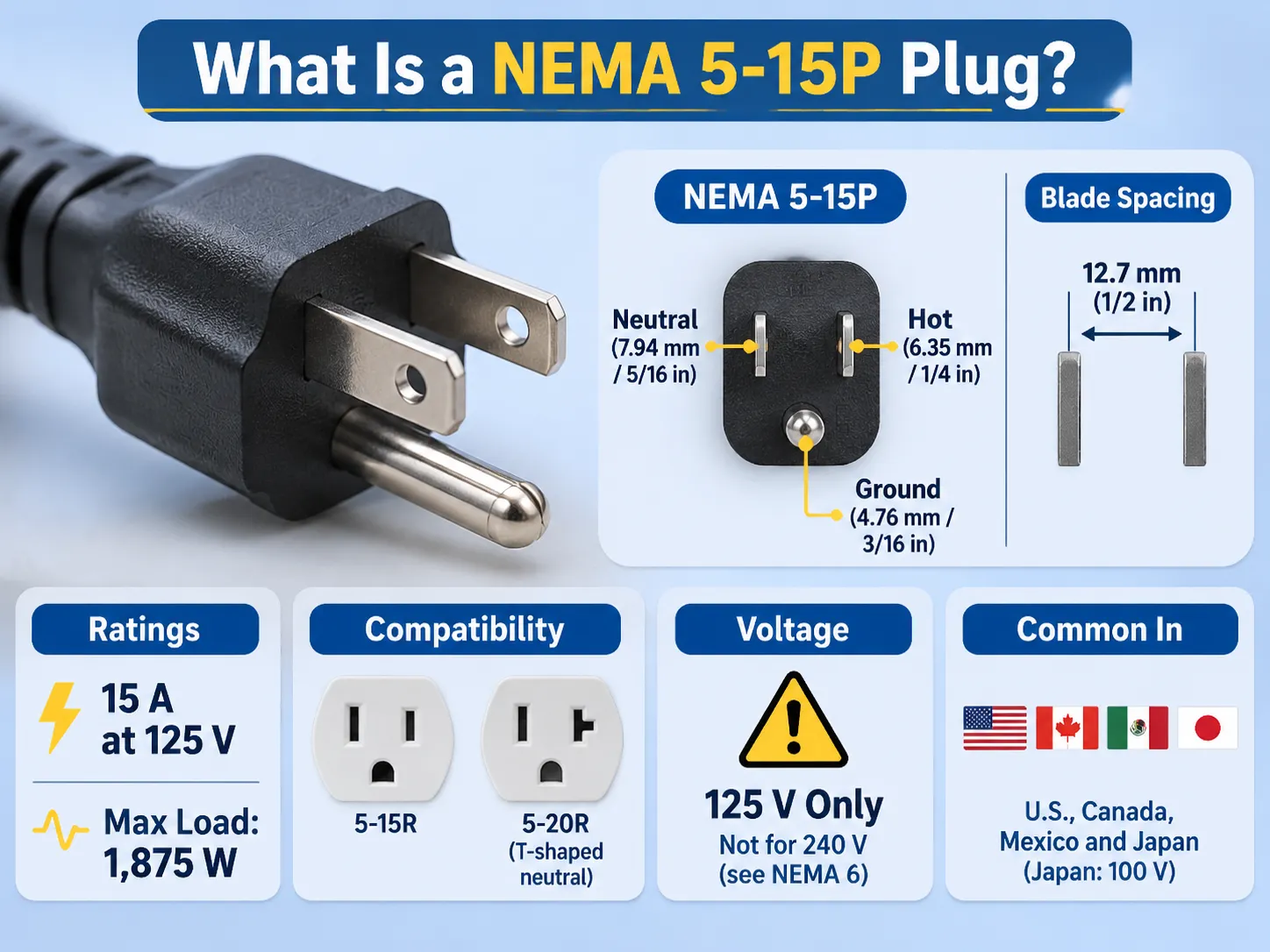
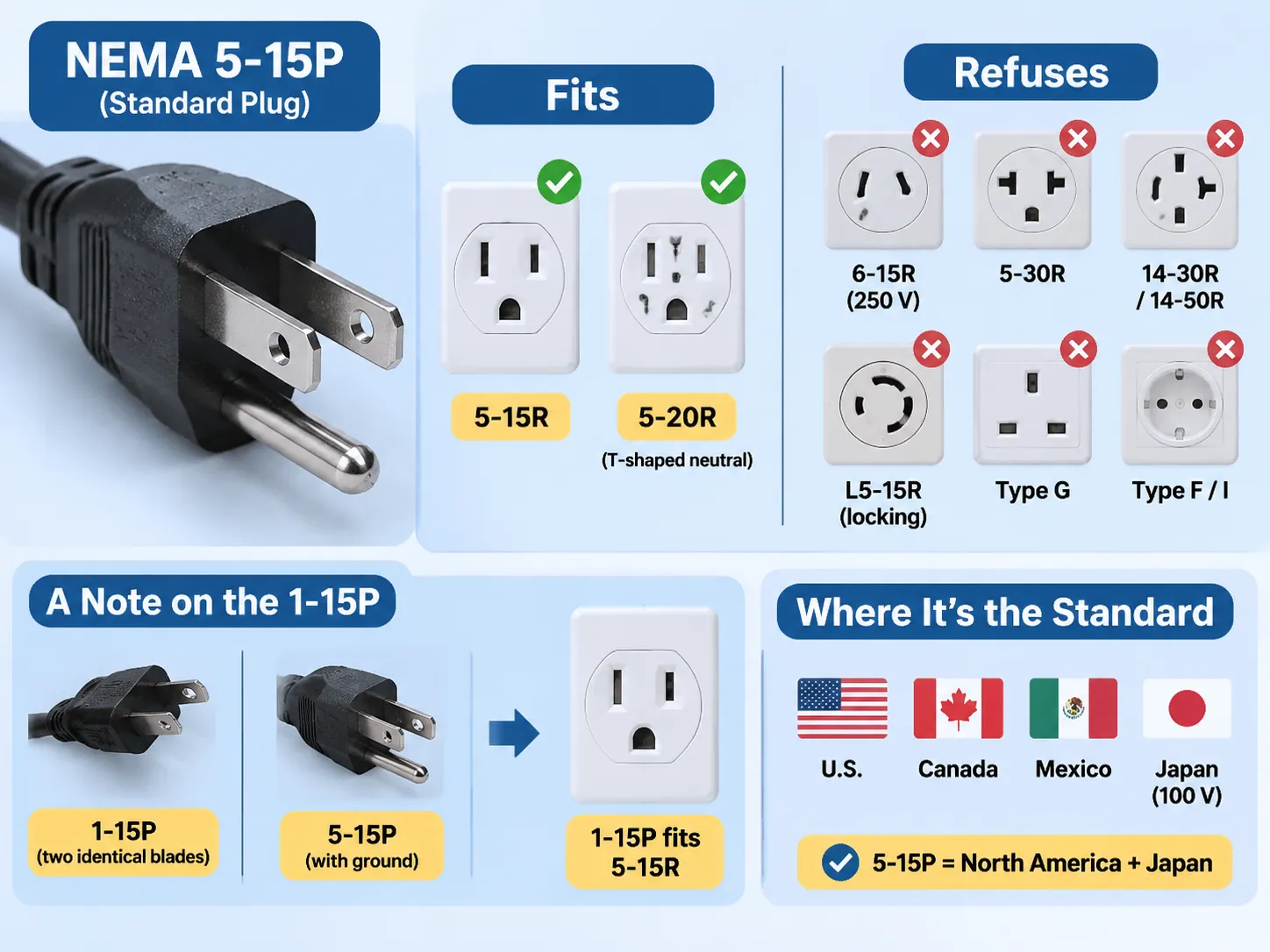
Réponse courte : Le NEMA 5-15P est la prise nord-américaine couramment utilisée avec trois broches et une capacité nominale de 15 A à 125 V. Les deux broches sont plates et parallèles et une broche est une broche de terre. Le NEMA 5-15P est conçu selon les normes ANSI/NEMA WD-6 et est approuvé par UL 498. Il peut être inséré dans une prise NEMA 5-15R et convient également à une prise NEMA 5-20R car les prises NEMA 5-15P et NEMA 5-20R ont des formes différentes pour les emplacements des broches. La broche phase du NEMA 5-15P mesure 6,35 mm de large et la broche neutre 7,94 mm de large, ce qui permet de l'insérer dans la prise dans une seule direction. La distance entre les deux broches est de 12,7 mm et le diamètre de la broche de terre est de 4,76 mm. Le NEMA 5-15P peut supporter une charge maximale de 1875 W et fonctionne à 125 V. Le NEMA 5-15P ne peut pas être utilisé pour des circuits 240 V, mais une prise complètement différente de la série NEMA 6 est conçue à cet effet.
Ce que le nom encode réellement
Les noms des différents connecteurs utilisés par la NEMA suivent un système organisé, ce qui les rend faciles à mémoriser. Les trois premiers chiffres avant le tiret sont composés de trois informations : le numéro de série, le nombre de contacts et le nombre de fils. Le chiffre après le tiret indique la capacité en ampères. Enfin, la lettre à la fin informe si le connecteur est une prise ou un réceptacle.
Par exemple, le 5-15P désigne un article de la série 5 qui est évalué à 125 V et possède deux contacts et trois fils. Entre autres, il comprend deux conducteurs ainsi qu'un fil de terre et a une capacité de 15 ampères. Le réceptacle 5-15R est identique à la prise 5-15P à la différence que le 5-15R est un réceptacle. De la même manière, si l'utilisateur choisit de brancher la version L5-15P connue pour être verrouillable, il n'aura pas de problème à utiliser la prise. Bien que les deux types de connecteurs aient les mêmes capacités en ampères, il est important de noter que le L5-15P est différent du 5-15P en termes de structure.
Malheureusement, les gens ont tendance à confondre les numéros de série. Le 5 correspond à 125 volts tandis que le 6 appartient à 250 volts. Un connecteur avec le code 6-15P peut facilement être confondu avec un 5-15P, mais ne s'insérera pas dans un 5-15R en raison de la forme différente. L'ensemble complet des configurations est défini dans ANSI/NEMA WD-6, et le aperçu des types de prises électriques est utile pour placer le 5-15 aux côtés des familles non nord-américaines.
À quoi ressemble un NEMA 5-15P, au millimètre près
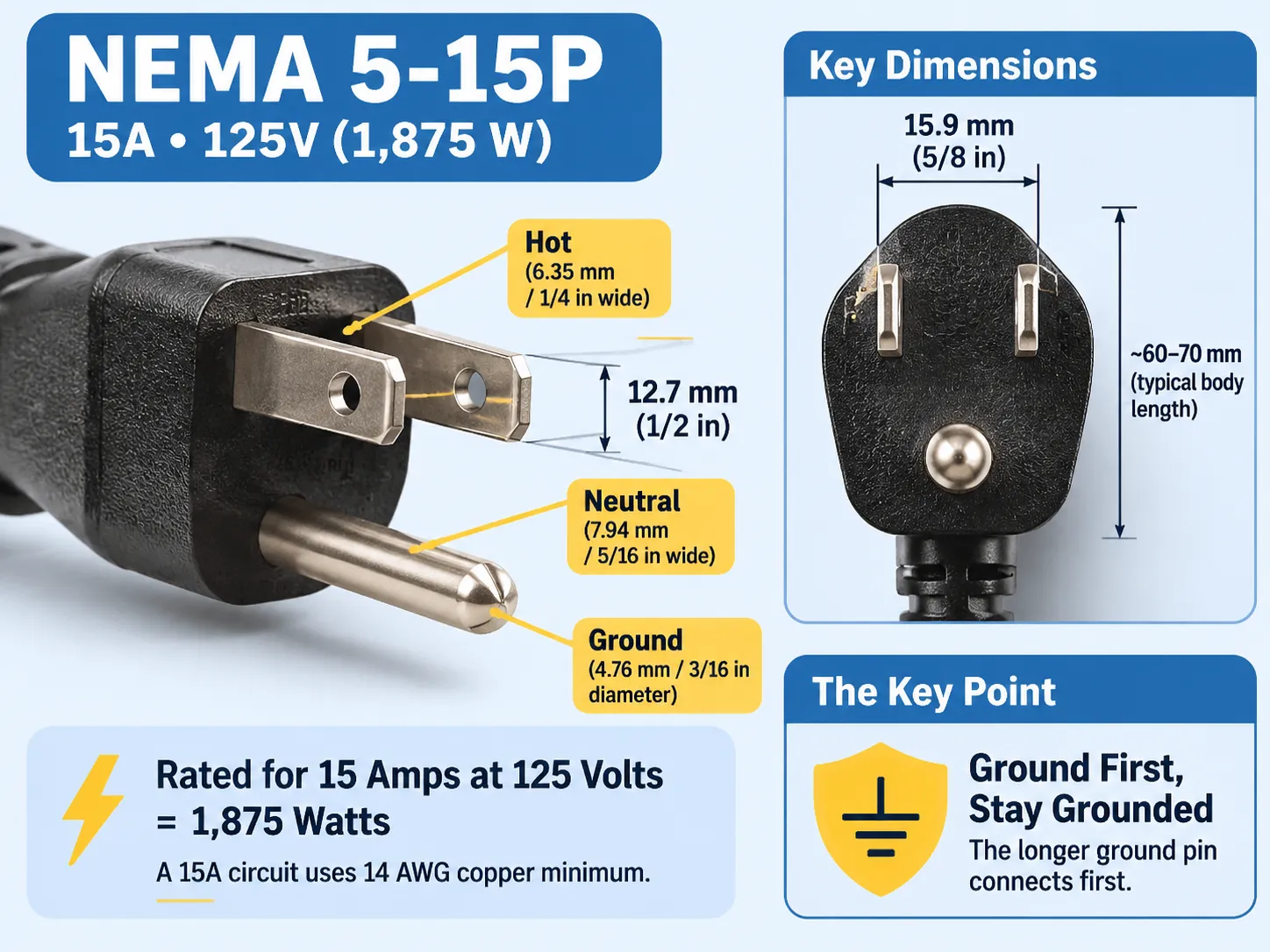
Il y a trois conducteurs et trois composants métalliques exposés. Deux lames plates sont disposées de la même manière et une broche ronde est située en dessous d’elles. La broche ronde est plus longue que les lames de telle sorte qu’elle établit le contact avant les lames. Ainsi, le but de la broche de terre plus longue est de garantir que l’équipement est mis à la terre avant que l’alimentation ne soit activée, et reste mis à la terre jusqu’à après la coupure de l’alimentation.
| Caractéristique | Dimensions | Pourquoi cette taille |
|---|---|---|
| Largeur de la lame chaude | 6,35 mm (1/4 in) | Lame standard, s’adapte à la fente étroite |
| Largeur de la lame neutre | 7,94 mm (5/16 in) | Lame plus large impose une orientation d’insertion unique |
| Centres des lames | 12,7 mm (1/2 in) | Fixe la géométrie pour qu’aucune autre série ne puisse s’adapter |
| Longueur de la lame | 15,9 mm (5/8 in) nominale | Surface de contact plus profondeur d’engagement |
| Diamètre de la broche de terre | 4,76 mm (3/16 in) | Broche ronde, plus longue que les lames |
| Longueur typique du corps | 60 à 70 mm | Boîtier pour la prise de câble et les terminaisons |
Sur certains types de fiches, une petite ouverture peut être trouvée près de l’extrémité de chaque lame terminale. Cette ouverture est un artefact du processus de fabrication ; cependant, elle est utile et donc conservée. L’ouverture peut être utilisée pour verrouiller la fiche. De plus, plusieurs conceptions de réceptacles utilisent cette ouverture pour un loquet. Bien que sa présence ne soit pas obligatoire, sa taille est fixée en cas de présence.
Ce pour quoi il est classé, et ce que cela signifie en watts
Quinze ampères à 125 volts donnent 1 875 watts et c’est la limite pour tout ce qui est sur un 5-15P. Les limites pour le circuit sont dans le disjoncteur, mais pas dans la fiche. Dans le cas d’un circuit dérivé de 15 A, s’il y a une fiche dans une situation normale, le point de rupture pour le circuit est de 15 A. Chaque fiche doit être ajustée au point de rupture, sinon, si vous connectez un 5-15P dans un circuit de 20 A, la fiche deviendra le maillon faible à l’endroit où elle est branchée.
La puissance d’un câble dépend du circuit et non de la fiche. Pour un circuit de 15 A, il est nécessaire d’avoir un fil 14 AWG et pour un circuit de 20 A, c’est du 12 AWG. Une fiche conçue pour 5-15P avec un fil 16 AWG est parfaitement adaptée, car l’appareil qu’elle alimente est limité. Cependant, il est incorrect d’avoir une fiche 5-15P montée sur un cordon avec un fil de calibre correspondant à un circuit de 15 A en raison de la présence d’un réceptacle 15 A.
L’importance de la tension utilisée doit être mentionnée ici car elle cause beaucoup de confusion. La tension nominale est de 120 V mais les normes ANSI C84.1 fournissent une plage en régime permanent d’environ 114 V à 126 V. Les plaques signalétiques des appareils mentionnant 115 V et 110 V ne parlent pas des fiches mais signifient la capacité de l’appareil pour la tension à utiliser.
Polarisation : pourquoi la lame neutre est plus large
La lame neutre plus large ne représente aucun défaut de fabrication. Sa fonction est de s’assurer que l’interrupteur interne de l’appareil interrompt le fil chaud au lieu du fil neutre.
Considérez ce qui se passerait en l'absence de cela. Si la prise pouvait être insérée dans les deux sens, alors dans la moitié des cas, l'interrupteur interne serait relié au neutre. L'interruption du fil neutre coupe le flux de courant, ce qui crée l'illusion que l'appareil est éteint alors que le câblage est toujours sous tension à 120 V par rapport à la terre. Cela met en danger toute personne réparant l'appareil et touchant l'un des fils endommagés, qui pourrait devenir partie intégrante du circuit. La polarisation signifie que l'interrupteur contrôle uniquement le fil chaud et que l'appareil est effectivement éteint lorsqu'il est déconnecté de la ligne électrique.
C'est pourquoi l'adaptateur frauduleux qui contourne la broche de terre et la polarisation n'est pas seulement une violation des réglementations, mais un réel danger car il supprime deux niveaux de protection. La même logique explique pourquoi un prise murale endommagée avec une fente neutre fissurée ou lâche doit être remplacée, et non tolérée : une fente usée laisse la prise s'incliner et compromet la géométrie qui maintient la polarité correcte.
À quelle prise il s'adapte, et laquelle il refuse
Le 5-15P est en effet capable de s'adapter à son homologue 5-15R ainsi qu'au 5-20R, puisque la prise 20 ampères possède une fente neutre en forme de T qui peut accueillir à la fois le neutre large du 5-15 et le neutre horizontal du 5-20. Mais la compatibilité ne fonctionne que dans un sens. La prise 5-20P avec son neutre horizontal ne peut pas s'adapter au 5-15R.
La compatibilité échoue pour beaucoup d'autres, ce qui aide à comprendre le concept. Par exemple, une prise de type 6-15R ne convient pas car elle nécessite 250 V. Le 5-30R ne l'acceptera pas non plus car l'espacement des broches est différent. De même, les prises 14-30R ou 14-50R ne conviennent pas. En outre, une prise verrouillable de type L5-15R, ainsi que les types G, F et I fonctionnent de la même manière, ce qui explique entièrement l'existence des adaptateurs de voyage.
La confusion commence généralement avec la prise bipolaire 1-15P qui possède deux broches identiques comme sa version originale sans broche de terre. Le 1-15P s'adapte au 5-15R en raison de la largeur de la fente neutre, mais l'inverse n'est pas vrai ici. Cependant, si vous envisagez de remplacer une prise normale par une 5-15R équivalente avec protection GFCI, le problème peut être traité séparément en ce qui concerne la prise.
Où le NEMA 5-15P est la prise standard
Les États-Unis sont certainement la première pensée qui vient à l'esprit, tandis que le Canada suit également le même système, à savoir CSA C22.2 No. 42, ce qui explique pourquoi vous pouvez utiliser un appareil acheté à Toronto sans problème à Buffalo. Le Mexique suit le même modèle sous NMX-J-163-ANCE, et le guide des prises électriques canadiennes couvre les détails de ce marché, y compris les variantes 5-20 utilisées dans les cuisines.
Japan offers an intriguing example. Both 100 V and 50 or 60 Hz (depending on the region) employ the same two-bladed design, and ungrounded 1-15 plugs can be found throughout Japanese houses, with the grounded 5-15 plug appearing only where necessary. Although a robust, 5-15P plug can fit into a grounded outlet in Japan, only a third of the power rating of a resistive load will be attained as a result of voltage issues. As a result, there may be a problem with motor speed and overheating. It is not a plug issue; it is only a question of voltage and plugs, as such questions must be answered separately.
In addition to Japan, some parts of Central America, the Caribbean, Colombia, Peru, Taiwan, and the Philippines have a mixture of plugs, with 5-15 sockets and plugs being used along with other types of plugs.
The Other NEMA Plugs People Confuse It With
Four examples explain the majority of practical situations.
- 1-15P. The plug has two blades, does not have a ground and is not polarized, amperage of 15 A at a voltage of 125 V. It is the plug for double-insulated cords and old lamps. It can fit into the 5-15R; the other plug cannot fit into the 1-15R plug.
- 5-20P. The same voltage of 125 V and higher amperage of 20 A with an additional neutral horizontal pin. It cannot fit into a 5-15R plug, while a 5-15P plug can fit a 5-20R socket. It is often seen in kitchens and workshops fitted with 20-ampere circuits.
- 6-15P. The plug comprises two blades as well as grounding and works at voltage of 250 V and 15 A. The specially designed plug can only fit into the right receptacle. The most common applications for this plug are air conditioners and other electrical devices which require 240 V.
- G type and F type plugs. The British rectangular plug and the European type Schuko plug. These two plugs have different configurations, different voltages and cannot be used together. In Britain, a plug with 13 A rating has a voltage of 250 V, while the other plug has a rating of 16 A at 250 V and requires a different socket.
Why Plugs Fail, and the Arithmetic Behind a Hot Prong
The contact resistance of a clean brass blade placed in a receptacle wiper is around 0.005 ohms and thus insignificant. Once the blade has bent, oxidized, or the wiper spring has worn out, the same contact can show resistance up to 0.5 ohms without changing its physical aspect.
Once 12.5 A is passing in each case, the difference in the heat dispersion is noticeable. 0.005 ohms mean that heat is 12.5 squared times 0.005 or 0.78 W that is harmlessly dispersed in brass. 0.5 ohms mean that heat would be concentrated at 78 W on the area smaller than a postage stamp inside an insulated plastic body. The body starts getting soft at more than 70 °C, the wiper loses spring force, resistance increases, and the process goes out of control which leads to scorching of the plug face and blackening of the receptacle.
The practical test does not cost anything: after the operation of the heavy appliance for twenty minutes, touch the plug with a hand. If it is warm, everything is fine. If it is hot, it means that there is a failure in the process that should be repaired not by pushing the plug stronger but by fixing the receptacle or the cord end. The contacts of the blades become corroded and discolored while the contact area is diminishing and need replacing.
Variants Worth Knowing: Hospital Grade, Watertight and Right Angle
Plugs and sockets used in hospitals are designed to comply with more stringent criteria than the industry standard for reliability against mechanical failure and grounding failure. The major difference in the specifications is in the retention force and ground contact integrity. The specification for medical plugs is of vital importance, as a plug that disconnects from a medical device would fall under a different category of failure from a lamp that goes out.
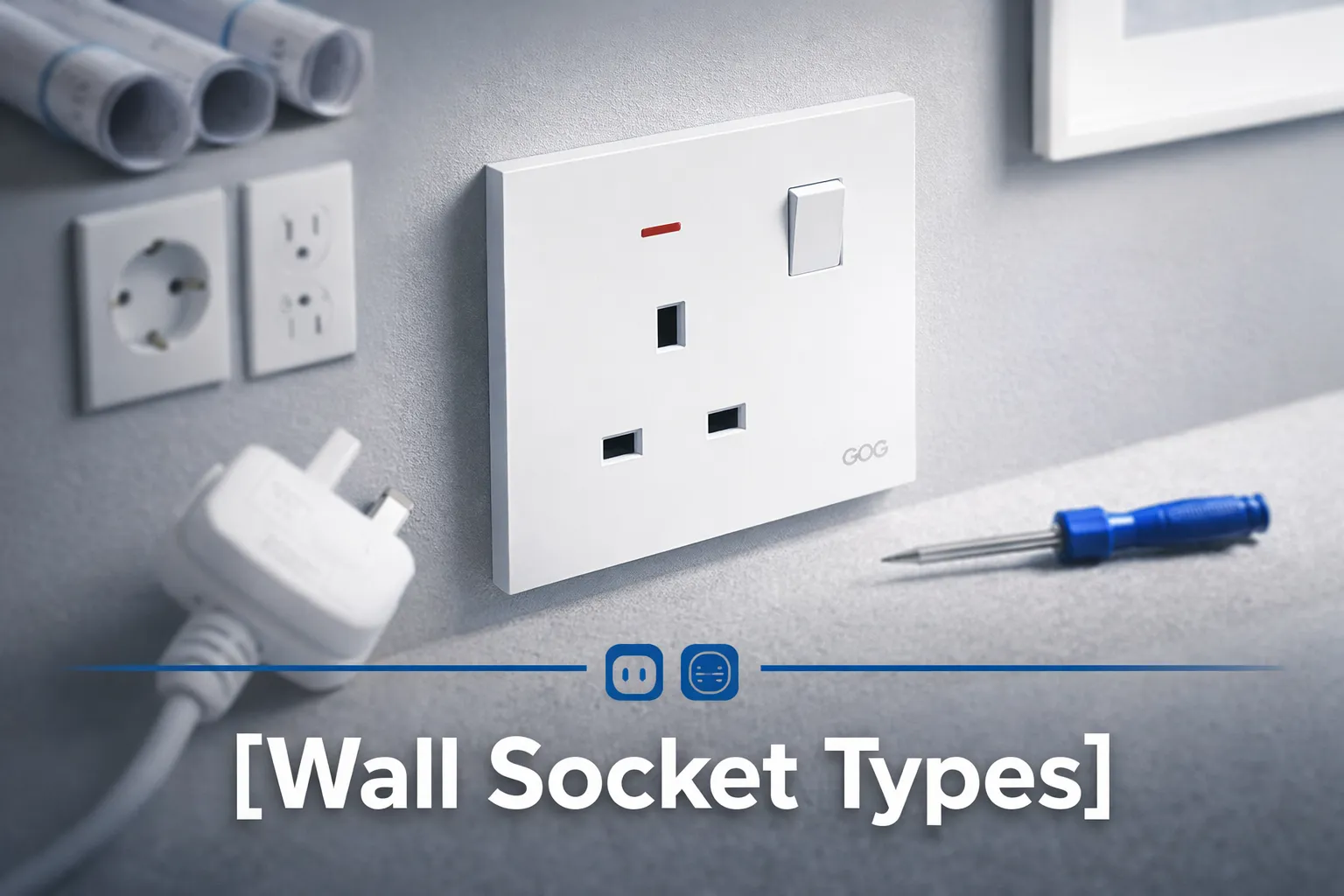
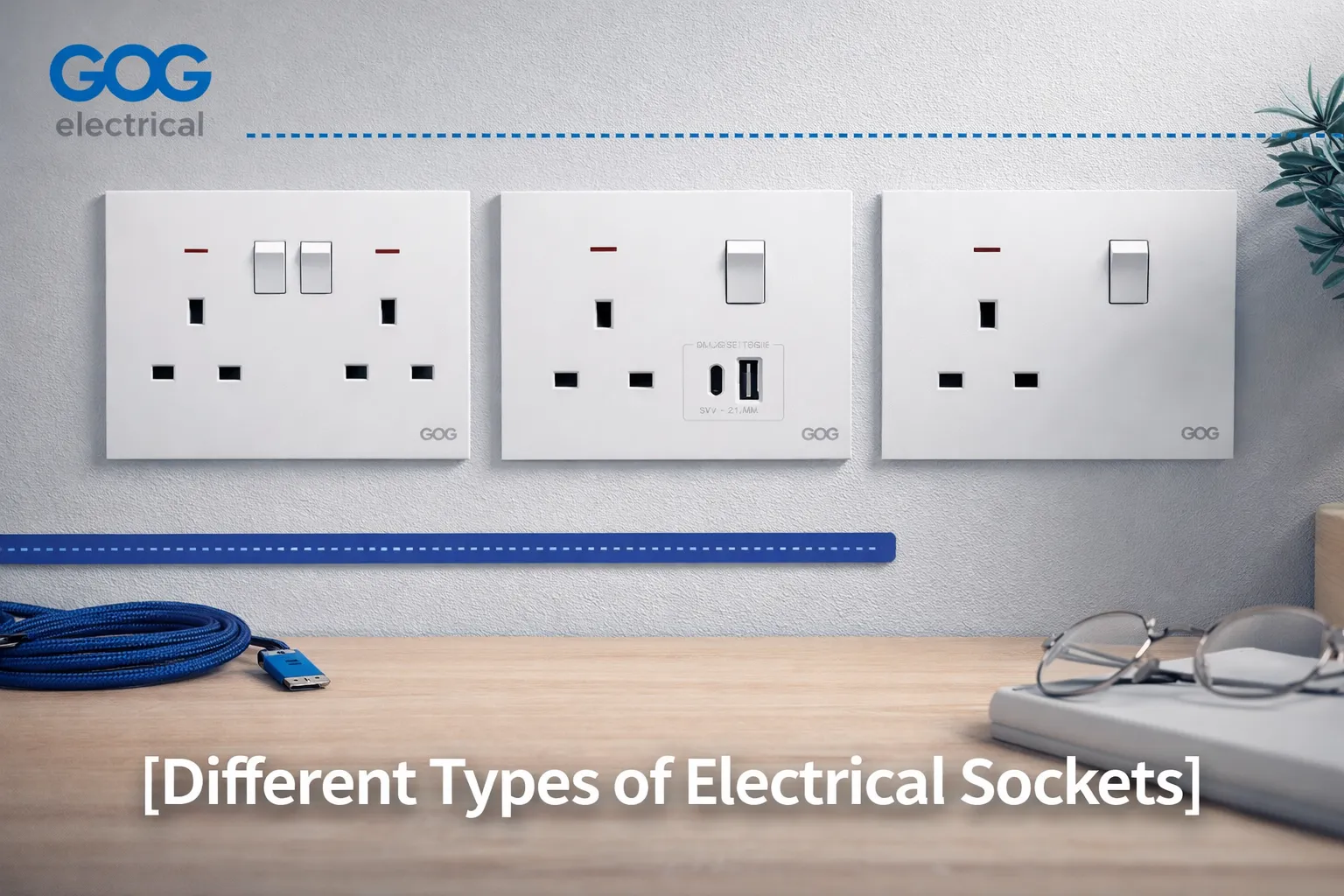
Water-resistant plugs are made to meet IP55 or higher standards as a result of utilizing a body with gasket and a cord entry and equipped with a matching firewall on the corresponding socket.The plug alone does nothing; both halves have to be the watertight type. A US three-pin socket in a switched plate assembly shows the receptacle side of the same standard in a residential format.
In instances where you have furniture items and televisions mounted on walls and in cases where you have limited clearance, both right-angle and low-profile plugs are available. The electrical rating stays the same; the only difference is the strain relief direction. You would want to specify these types of plugs if the cable is to be run flat against a wall, and people are often caught unaware until they try to move the furniture.
What to Check Before You Buy or Specify
In the case of an Original Equipment Manufacturer purchasing cord sets, there are five distinguishing features that set apart a compliant product from a convincing imitative product. The product marking must carry a proof marking from an established testing laboratory that is searchable with a testing laboratory’s file number. The dimensions of the blades must adhere to the WD-6 tolerances, which are precise enough to allow for minor errors in stamping. The cord grip should prevent the wire sheath from being pulled out of the plug during testing, compared to the terminals being pulled out. The terminal screws must be made with plated brass, which is necessary instead of using zinc-plated steel. Finally,the housing of the cord set must carry a flame rating, which is normally classified as UL 94 V-2 at the very minimum.
For the case of a product specifying receptacles there are also five comparable characteristics needed: interrupting capacity of the circuit, terminal capacity for wire gauge, mounting configuration, and whether or not a tamper resistant shut-off has to be used, which is now mandatory in every state for residential projects.
We build the plates and socket assemblies around these devices, not the plugs themselves, and the electrical socket manufacturing range covers the market-specific configurations that go with them: US, UK, European, Australian and the regional variants in between. If a project needs one plate standard across several markets with the correct device behind each, that is the conversation worth having before the drawings are frozen.
FAQ
Is NEMA 5-15P a normal plug?
Yes. It is the commonplace three-prong plug that can be found on virtually all household appliances, lamps, chargers and power strips in the USA and Canada. The terminology is technical but the object is well-known: two flat prongs and a round grounding pin, rated for 15 A at 125 V. If you see a plug that has three prongs with the two flat ones being parallel and the round one under them, it is surely a 5-15P.
Is NEMA 5-15R standard?
The 15 A receptacle is common in North American homes and light commercial buildings. It can be used for either the 5-15P or also for the older version of the receptacle without the ground, called the 1-15P. The 5-20R will accept the 5-15P plug because of the T-shaped neutral opening, which explains why the 20 A kitchen circuit can also be used with standard appliances. New electrical installations in almost all jurisdictions require that these receptacles have tamper-resistant shutters.
What does a NEMA 5-15 plug look like?
The two flat metal plates are positioned parallel at a distance of 12.7 mm from each other and a round pin is located at their centre slightly extending ahead of them. The right plate is the neutral one and is visibly wider than the left plate. The body is made of plastic, which is commonly between 60-70 mm long. The wire goes into the body through the strain relief point. Some plates have a tiny hole in the tip. The plug has no shield or a round body and there is no fuse, hence for the person accustomed to the British or the European plugs it is a very easy task to distinguish this type of plug.
Can NEMA 5-15 handle 240 V?
No, the 5 series is rated 125 volts and has a physical key that prohibits it from being plugged into a 250 volts outlet. The proper connectors for plugging in a 240-volt appliance in North America are in the 6 series (e.g., 6-15P or 6-20P), along with connectors from the 14 series for devices that use both 120-240 volt appliances. Using a 5-15 device with 240 volts creates the possibility of fire or electric shock, as well as damaging any appliance plugged in on the other end of the circuit.
Will a 5-15P fit a 5-20R outlet?
Yes. The 20 A socket contains a T-shaped neutral slot which allows for the insertion of the neutral blade of a 5-15P or 5-20P plug. However, the other way around is not true since a 5-20P cannot fit into a 5-15R socket. This one-way compatability is designed so that a 20 A device cannot work in a circuit rated for 15 A.
What is the difference between NEMA 5-15P and 1-15P?
The 1-15P consists of two matching blades and does not have a ground pin. It is also not polarised. The 5-15P has received a pin for grounding and a wider blade slot for neutral. It is thus both creating a fault path and ensuring that the polarity is correct. 1-15P devices can be used with 5-15R as the neutral slot is wide enough for both blades to fit into. However, the reverse is not true when 5-15P tries to fit the ungrounded 1-15R. Ungrounded sockets are not used anymore and GFCI protected sockets have replaced them.
Références
- NEMA — ANSI/NEMA WD-6 Wiring Devices Dimensional Specifications
- Leviton — Straight Blade Plugs and Receptacles
- Hubbell — Wiring Device Configurations and Ratings
- Interpower — North American Cord Sets and Plug Standards
- UL Solutions — UL 498 Attachment Plugs and Receptacles
Conclusion
The design known as the 5-15P serves three functions simultaneously. It transmits 15A of current, connects the appliance to ground, and prevents incorrect orientation and insertion. This is the main reason why we cannot substitute an imitation or copy whose appearance is correct, but whose dimensions differ from these described above.
Most reported problems related to the 5-15P do not concern electricity, but rather mechanical failures like a bent blade, wear of the wiper or burning marks. Please remember that when such a problem occurs, it is enough to change the element instead of the whole appliance. Moreover, it is always necessary to make sure that the socket of your destination country is of the required design before making the mould, as there are design differences between models and various types of adaptors.