El término se refiere al extremo de un cable de lámpara, cargador de notebook, ventilador de escritorio, televisor y alrededor de cuatro mil millones de artículos. Casi nadie lo piensa, por lo que no es sorprendente que muy pocas personas puedan decir qué significan las letras o por qué una clavija es más ancha que la otra. La importancia de la información sobre la separación se vuelve evidente cuando se debe reemplazar un cable, adaptar el equipo para exportación y cuando un enchufe parece estar caliente y se necesita determinar si es normal.
La siguiente sección contiene la información para quienes necesitan más que solo una visión general breve del tema.
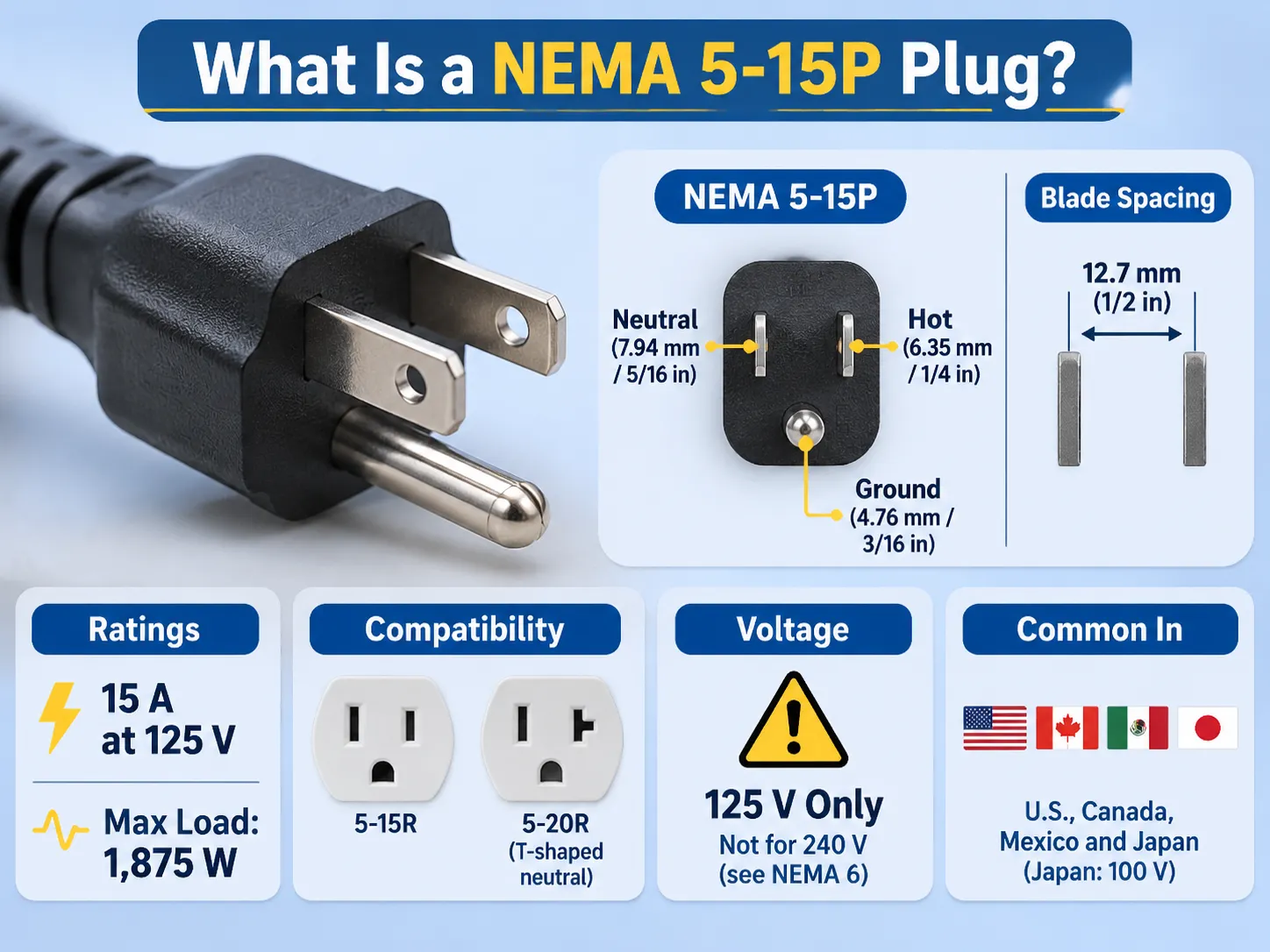
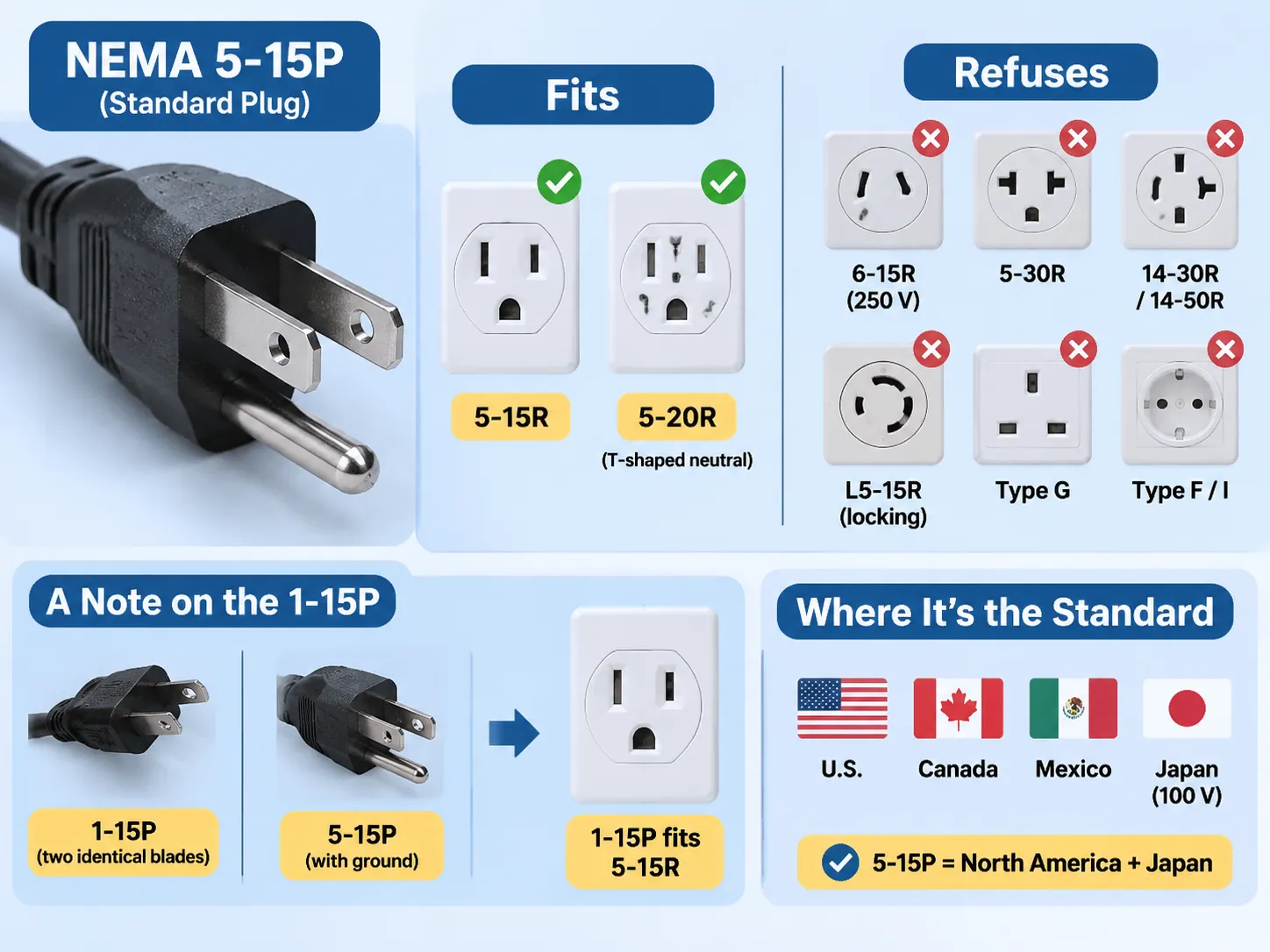
Respuesta corta: NEMA 5-15P es el enchufe comúnmente utilizado en Norteamérica con tres pines y clasificado para 15 A a 125 V. Los dos pines son planos y paralelos y uno es el pin de tierra. NEMA 5-15P está diseñado según las normas ANSI/NEMA WD-6 y está aprobado por UL 498. Puede conectarse en un tomacorriente NEMA 5-15R y también es compatible con el tomacorriente NEMA 5-20R porque tanto los enchufes NEMA 5-15P como NEMA 5-20R tienen formas diferentes para las ranuras de los pines. El pin activo de NEMA 5-15P tiene un ancho de 6.35 mm y el pin neutro tiene un ancho de 7.94 mm, de modo que solo puede insertarse en una dirección. La distancia entre los dos pines es de 12.7 mm y el diámetro del pin de tierra es de 4.76 mm. NEMA 5-15P puede manejar una carga máxima de 1875 W y opera a 125 V. NEMA 5-15P no puede usarse en circuitos de 240 V, pero un enchufe completamente diferente de la serie NEMA 6 está diseñado para ese propósito.
Lo que realmente codifica el nombre
Los nombres de los diversos conectores usados por NEMA siguen un sistema organizado, lo que facilita recordarlos. Los primeros tres dígitos antes del guion están compuestos por tres piezas de información: el número de serie, el número de contactos y el número de cables. El número después del guion indica la clasificación en amperios. Finalmente, la letra al final informa si el conector es un enchufe o un receptáculo.
Por ejemplo, 5-15P denota un artículo de la serie 5 que está clasificado para 125 V y tiene dos contactos y tres cables. Entre otras cosas, incluye dos conductores junto con el cable de tierra y tiene una clasificación de 15 amperios. El receptáculo 5-15R es igual que el enchufe 5-15P con la diferencia de que el 5-15R es un receptáculo. De la misma manera, si el usuario elige conectar la versión L5-15P, que es conocida por ser bloqueable, no tendrá problemas al usar el enchufe. Aunque ambos tipos de conectores tienen las mismas clasificaciones de amperaje, es importante notar que el L5-15P es diferente del 5-15P en términos de estructura.
Desafortunadamente, las personas tienden a confundir los números de serie. El 5 corresponde a 125 voltios mientras que el 6 pertenece a 250 voltios. Un conector con el código 6-15P puede confundirse fácilmente con un 5-15P, pero no encajará en un 5-15R debido a la forma diferente. El conjunto completo de configuraciones está definido en ANSI/NEMA WD-6, y el resumen de tipos de tomacorrientes eléctricos es útil para colocar el 5-15 junto a las familias no norteamericanas.
Cómo es un NEMA 5-15P, hasta el milímetro
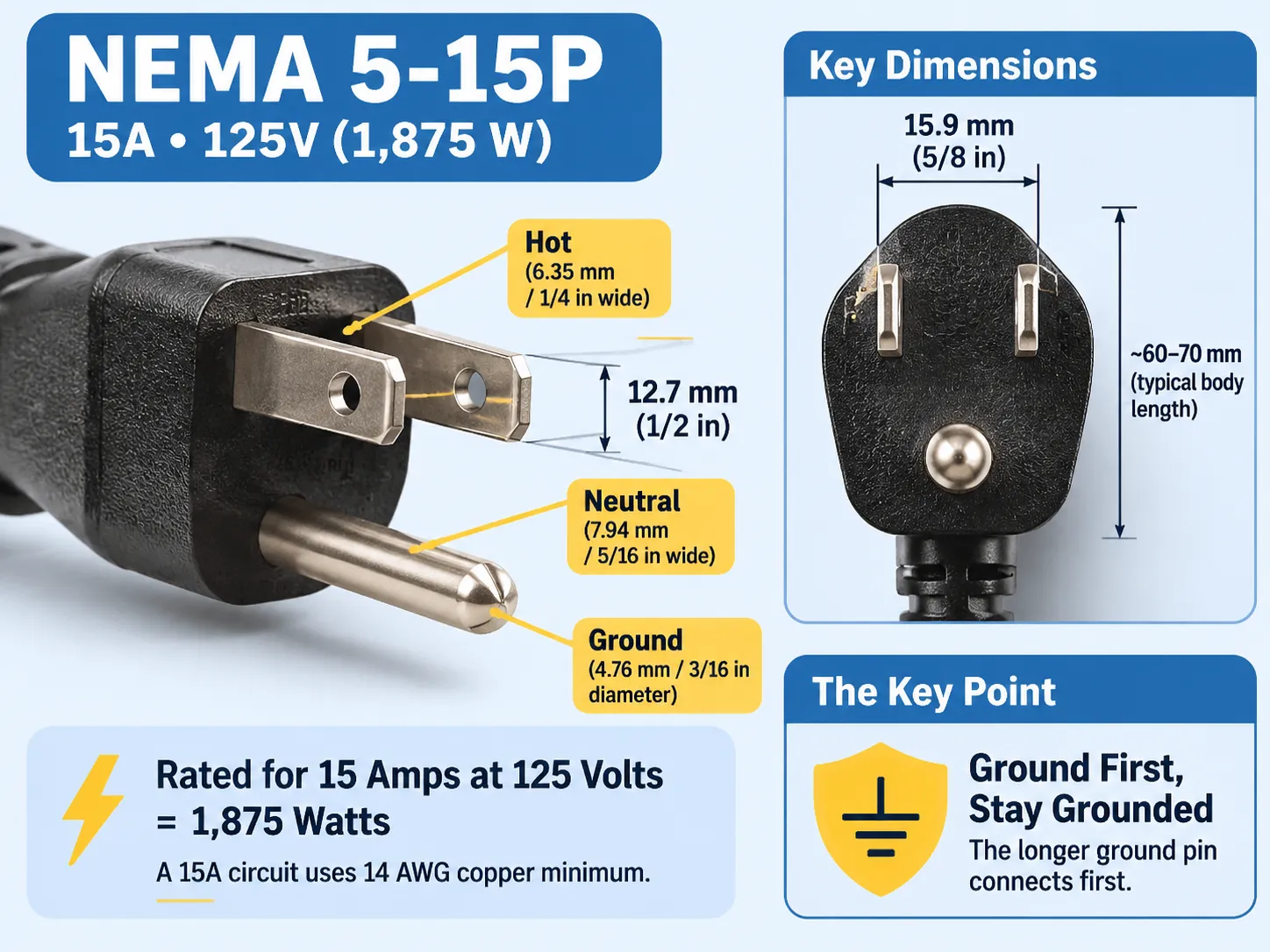
Hay tres conductores y tres componentes metálicos expuestos. Dos hojas planas están dispuestas de la misma manera y un pin redondo se encuentra debajo de ellas. El pin redondo es más largo que las hojas de tal manera que hace contacto antes que las hojas. Por lo tanto, el propósito del pin de tierra más largo es asegurar que el equipo esté conectado a tierra antes de que se encienda la energía, y permanezca conectado a tierra hasta después de que se desconecte la energía.
| Característica | Dimensiones | Por qué tiene ese tamaño |
|---|---|---|
| Ancho de la hoja caliente | 35 mm (1/4 pulg) | Hoja estándar, se acopla con la ranura estrecha |
| Ancho de la hoja neutra | 94 mm (5/16 pulg) | Hoja más ancha que fuerza una orientación de inserción |
| Centros de las hojas | 7 mm (1/2 pulg) | Fija la geometría para que ninguna otra serie encaje |
| Longitud de la hoja | 9 mm (5/8 pulg) nominal | Área de contacto más profundidad de acoplamiento |
| Diámetro del pin de tierra | 76 mm (3/16 pulg) | Pin redondo, más largo que las hojas |
| Longitud típica del cuerpo | 60 a 70 mm | Carcasa para la sujeción del cable y terminaciones |
En ciertos tipos de enchufes, se puede encontrar una pequeña abertura cerca del extremo de cada hoja terminal. Esta abertura es un artefacto del proceso de fabricación; sin embargo, es útil y por lo tanto se conserva. La abertura puede usarse para bloquear el enchufe. Además, varios diseños de receptáculos utilizan la abertura para un pestillo. Aunque su presencia no es obligatoria, su tamaño está fijado en caso de que esté presente.
Para qué está clasificado y qué significa eso en vatios
Quince amperios a 125 voltios dan 1,875 vatios y esa es la limitación para cualquier cosa en un 5-15P. Los límites para el circuito están en el interruptor, pero no en el enchufe. En el caso de un circuito derivado de 15 A, si hay un enchufe en una situación normal, el punto de ruptura para el circuito es 15 A. Cada enchufe debe ajustarse al punto de ruptura, de lo contrario, si conecta un 5-15P en un circuito de 20 A, el enchufe se convertirá en el eslabón más débil donde esté conectado.
La potencia de un cable depende del circuito y no del enchufe. Para un circuito de 15 A es necesario tener cable 14 AWG y para un circuito de 20 A es 12 AWG. Un enchufe diseñado para 5-15P con un cable 16 AWG es completamente adecuado, ya que el aparato que alimenta está limitado. Sin embargo, es incorrecto tener un enchufe 5-15P instalado en un cable que tiene un calibre de cable como el de un circuito de 15 A debido a la presencia de un receptáculo de 15 A.
Aquí es necesario mencionar la importancia del voltaje utilizado porque causa mucha confusión. El voltaje nominal es 120 V pero las normas ANSI C84.1 proporcionan un rango en estado estable de aproximadamente 114 V a 126 V. Las placas de los aparatos que mencionan 115 V y 110 V no hablan de enchufes sino que se refieren a la capacidad del aparato para el voltaje a utilizar.
Polarización: por qué la hoja neutra es más ancha
La hoja neutra más ancha no representa ningún defecto de fabricación. Su función es asegurarse de que el interruptor interno del aparato interrumpa el cable caliente en lugar del cable neutro.
Considere lo que ocurriría en ausencia de eso. Si el enchufe pudiera insertarse en ambas direcciones, entonces en la mitad de los casos el interruptor interno estaría conectado al neutro. El interruptor del cable neutro interrumpe el flujo de corriente, lo que crea la ilusión de que el aparato está apagado mientras el cableado sigue energizado a 120V con respecto a tierra. Esto pone en riesgo a cualquiera que repare el aparato y toque alguno de los cables dañados de convertirse en parte del circuito. La polarización significa que el interruptor controla solo el cable activo y el aparato realmente se apaga cuando se desconecta de la línea de alimentación.
Por eso el adaptador trampa que omite el pin de tierra y la polarización no solo es una violación de las normativas, sino un peligro real ya que elimina dos niveles de protección. La misma lógica explica por qué un enchufe de pared dañado con una ranura neutra agrietada o floja debe ser reemplazado, no tolerado: una ranura desgastada permite que el enchufe quede en ángulo y anula la geometría que mantiene la polaridad correcta.
A qué receptáculo se ajusta y a cuál se niega
El 5-15P es de hecho capaz de ajustarse a su compañero 5-15R y también al 5-20R, ya que el receptáculo de 20 amperios tiene la ranura neutra en forma de T que puede acomodar tanto el neutro ancho del 5-15 como el horizontal del 5-20. Pero la compatibilidad solo funciona en un sentido. El enchufe 5-20P con su neutro horizontal no puede ajustarse al 5-15R.
La compatibilidad falla para muchos otros, y esto ayuda a entender el concepto. Por ejemplo, un receptáculo tipo 6-15R no encaja porque necesita 250V. El 5-30R tampoco lo aceptará ya que la separación de sus clavijas es diferente. De manera similar, el receptáculo 14-30R o 14-50R no lo hará. Además, un receptáculo con bloqueo tipo L5-15R, y los tipos G, F e I funcionan igual y esta es la razón completa de los adaptadores de viaje.
La confusión generalmente comienza con el enchufe de dos clavijas 1-15P que tiene dos clavijas idénticas como su versión original sin pin de tierra. El 1-15P encaja en el 5-15R debido al ancho de la ranura neutra, pero lo contrario no aplica aquí. Sin embargo, en caso de que pretenda reemplazar un receptáculo normal por un 5-15R equivalente con protección GFCI, el problema puede tratarse por separado respecto al enchufe.
Donde el NEMA 5-15P es el enchufe estándar
Estados Unidos ciertamente es el primer pensamiento que viene a la mente, mientras que Canadá también sigue el mismo sistema, a saber CSA C22.2 No. 42, por lo que puede usar un dispositivo comprado en Toronto sin problemas en Buffalo. México sigue el mismo patrón bajo NMX-J-163-ANCE, y el tipo de enchufe eléctrico canadiense guía cubre los detalles de ese mercado incluyendo las variantes 5-20 usadas en cocinas.
Japón ofrece un ejemplo intrigante. Tanto 100 V como 50 o 60 Hz (dependiendo de la región) emplean el mismo diseño de dos clavijas, y los enchufes sin conexión a tierra 1-15 se pueden encontrar en toda las casas japonesas, mientras que el enchufe con conexión a tierra 5-15 aparece solo donde es necesario. Aunque un enchufe robusto 5-15P puede encajar en una toma con conexión a tierra en Japón, solo se alcanzará un tercio de la potencia nominal de una carga resistiva debido a problemas de voltaje. Como resultado, puede haber un problema con la velocidad del motor y el sobrecalentamiento. No es un problema del enchufe; es solo una cuestión de voltaje y enchufes, ya que tales preguntas deben responderse por separado.
In addition to Japan, some parts of Central America, the Caribbean, Colombia, Peru, Taiwan, and the Philippines have a mixture of plugs, with 5-15 sockets and plugs being used along with other types of plugs.
The Other NEMA Plugs People Confuse It With
Four examples explain the majority of practical situations.
- 1-15P. The plug has two blades, does not have a ground and is not polarized, amperage of 15 A at a voltage of 125 V. It is the plug for double-insulated cords and old lamps. It can fit into the 5-15R; the other plug cannot fit into the 1-15R plug.
- 5-20P. The same voltage of 125 V and higher amperage of 20 A with an additional neutral horizontal pin. It cannot fit into a 5-15R plug, while a 5-15P plug can fit a 5-20R socket. It is often seen in kitchens and workshops fitted with 20-ampere circuits.
- 6-15P. The plug comprises two blades as well as grounding and works at voltage of 250 V and 15 A. The specially designed plug can only fit into the right receptacle. The most common applications for this plug are air conditioners and other electrical devices which require 240 V.
- G type and F type plugs. The British rectangular plug and the European type Schuko plug. These two plugs have different configurations, different voltages and cannot be used together. In Britain, a plug with 13 A rating has a voltage of 250 V, while the other plug has a rating of 16 A at 250 V and requires a different socket.
Why Plugs Fail, and the Arithmetic Behind a Hot Prong
The contact resistance of a clean brass blade placed in a receptacle wiper is around 0.005 ohms and thus insignificant. Once the blade has bent, oxidized, or the wiper spring has worn out, the same contact can show resistance up to 0.5 ohms without changing its physical aspect.
Once 12.5 A is passing in each case, the difference in the heat dispersion is noticeable. 0.005 ohms mean that heat is 12.5 squared times 0.005 or 0.78 W that is harmlessly dispersed in brass. 0.5 ohms mean that heat would be concentrated at 78 W on the area smaller than a postage stamp inside an insulated plastic body. The body starts getting soft at more than 70 °C, the wiper loses spring force, resistance increases, and the process goes out of control which leads to scorching of the plug face and blackening of the receptacle.
The practical test does not cost anything: after the operation of the heavy appliance for twenty minutes, touch the plug with a hand. If it is warm, everything is fine. If it is hot, it means that there is a failure in the process that should be repaired not by pushing the plug stronger but by fixing the receptacle or the cord end. The contacts of the blades become corroded and discolored while the contact area is diminishing and need replacing.
Variants Worth Knowing: Hospital Grade, Watertight and Right Angle
Plugs and sockets used in hospitals are designed to comply with more stringent criteria than the industry standard for reliability against mechanical failure and grounding failure. The major difference in the specifications is in the retention force and ground contact integrity. The specification for medical plugs is of vital importance, as a plug that disconnects from a medical device would fall under a different category of failure from a lamp that goes out.
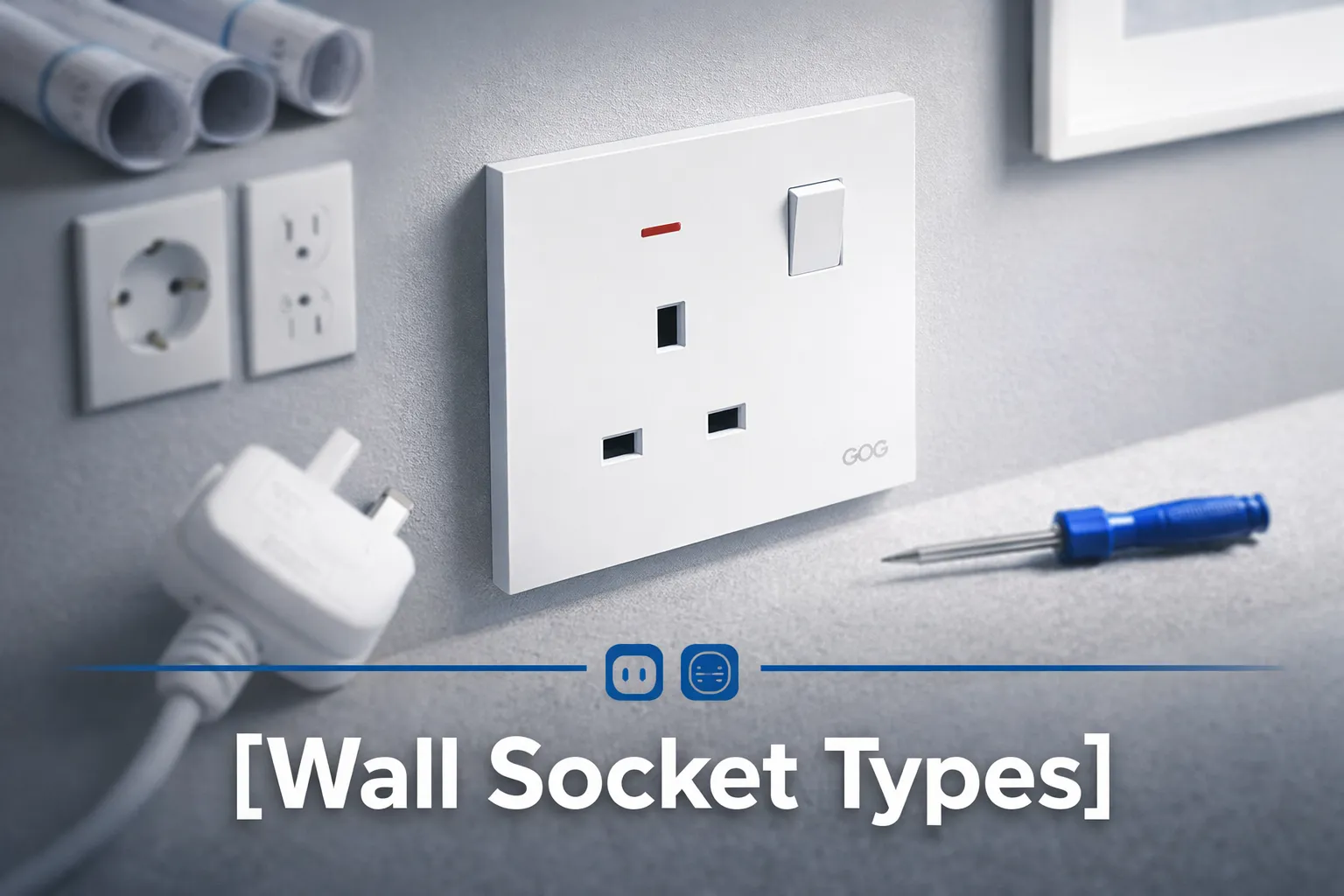
Water-resistant plugs are made to meet IP55 or higher standards as a result of utilizing a body with gasket and a cord entry and equipped with a matching firewall on the corresponding socket.The plug alone does nothing; both halves have to be the watertight type. A US three-pin socket in a switched plate assembly shows the receptacle side of the same standard in a residential format.
In instances where you have furniture items and televisions mounted on walls and in cases where you have limited clearance, both right-angle and low-profile plugs are available. The electrical rating stays the same; the only difference is the strain relief direction. You would want to specify these types of plugs if the cable is to be run flat against a wall, and people are often caught unaware until they try to move the furniture.
What to Check Before You Buy or Specify
In the case of an Original Equipment Manufacturer purchasing cord sets, there are five distinguishing features that set apart a compliant product from a convincing imitative product. The product marking must carry a proof marking from an established testing laboratory that is searchable with a testing laboratory’s file number. The dimensions of the blades must adhere to the WD-6 tolerances, which are precise enough to allow for minor errors in stamping. The cord grip should prevent the wire sheath from being pulled out of the plug during testing, compared to the terminals being pulled out. The terminal screws must be made with plated brass, which is necessary instead of using zinc-plated steel. Finally,the housing of the cord set must carry a flame rating, which is normally classified as UL 94 V-2 at the very minimum.
For the case of a product specifying receptacles there are also five comparable characteristics needed: interrupting capacity of the circuit, terminal capacity for wire gauge, mounting configuration, and whether or not a tamper resistant shut-off has to be used, which is now mandatory in every state for residential projects.
We build the plates and socket assemblies around these devices, not the plugs themselves, and the electrical socket manufacturing range covers the market-specific configurations that go with them: US, UK, European, Australian and the regional variants in between. If a project needs one plate standard across several markets with the correct device behind each, that is the conversation worth having before the drawings are frozen.
Preguntas frecuentes
Is NEMA 5-15P a normal plug?
Yes. It is the commonplace three-prong plug that can be found on virtually all household appliances, lamps, chargers and power strips in the USA and Canada. The terminology is technical but the object is well-known: two flat prongs and a round grounding pin, rated for 15 A at 125 V. If you see a plug that has three prongs with the two flat ones being parallel and the round one under them, it is surely a 5-15P.
Is NEMA 5-15R standard?
The 15 A receptacle is common in North American homes and light commercial buildings. It can be used for either the 5-15P or also for the older version of the receptacle without the ground, called the 1-15P. The 5-20R will accept the 5-15P plug because of the T-shaped neutral opening, which explains why the 20 A kitchen circuit can also be used with standard appliances. New electrical installations in almost all jurisdictions require that these receptacles have tamper-resistant shutters.
What does a NEMA 5-15 plug look like?
The two flat metal plates are positioned parallel at a distance of 12.7 mm from each other and a round pin is located at their centre slightly extending ahead of them. The right plate is the neutral one and is visibly wider than the left plate. The body is made of plastic, which is commonly between 60-70 mm long. The wire goes into the body through the strain relief point. Some plates have a tiny hole in the tip. The plug has no shield or a round body and there is no fuse, hence for the person accustomed to the British or the European plugs it is a very easy task to distinguish this type of plug.
Can NEMA 5-15 handle 240 V?
No, the 5 series is rated 125 volts and has a physical key that prohibits it from being plugged into a 250 volts outlet. The proper connectors for plugging in a 240-volt appliance in North America are in the 6 series (e.g., 6-15P or 6-20P), along with connectors from the 14 series for devices that use both 120-240 volt appliances. Using a 5-15 device with 240 volts creates the possibility of fire or electric shock, as well as damaging any appliance plugged in on the other end of the circuit.
Will a 5-15P fit a 5-20R outlet?
Yes. The 20 A socket contains a T-shaped neutral slot which allows for the insertion of the neutral blade of a 5-15P or 5-20P plug. However, the other way around is not true since a 5-20P cannot fit into a 5-15R socket. This one-way compatability is designed so that a 20 A device cannot work in a circuit rated for 15 A.
What is the difference between NEMA 5-15P and 1-15P?
The 1-15P consists of two matching blades and does not have a ground pin. It is also not polarised. The 5-15P has received a pin for grounding and a wider blade slot for neutral. It is thus both creating a fault path and ensuring that the polarity is correct. 1-15P devices can be used with 5-15R as the neutral slot is wide enough for both blades to fit into. However, the reverse is not true when 5-15P tries to fit the ungrounded 1-15R. Ungrounded sockets are not used anymore and GFCI protected sockets have replaced them.
Referencias
- NEMA — ANSI/NEMA WD-6 Wiring Devices Dimensional Specifications
- Leviton — Straight Blade Plugs and Receptacles
- Hubbell — Wiring Device Configurations and Ratings
- Interpower — North American Cord Sets and Plug Standards
- UL Solutions — UL 498 Attachment Plugs and Receptacles
Conclusión
The design known as the 5-15P serves three functions simultaneously. It transmits 15A of current, connects the appliance to ground, and prevents incorrect orientation and insertion. This is the main reason why we cannot substitute an imitation or copy whose appearance is correct, but whose dimensions differ from these described above.
Most reported problems related to the 5-15P do not concern electricity, but rather mechanical failures like a bent blade, wear of the wiper or burning marks. Please remember that when such a problem occurs, it is enough to change the element instead of the whole appliance. Moreover, it is always necessary to make sure that the socket of your destination country is of the required design before making the mould, as there are design differences between models and various types of adaptors.