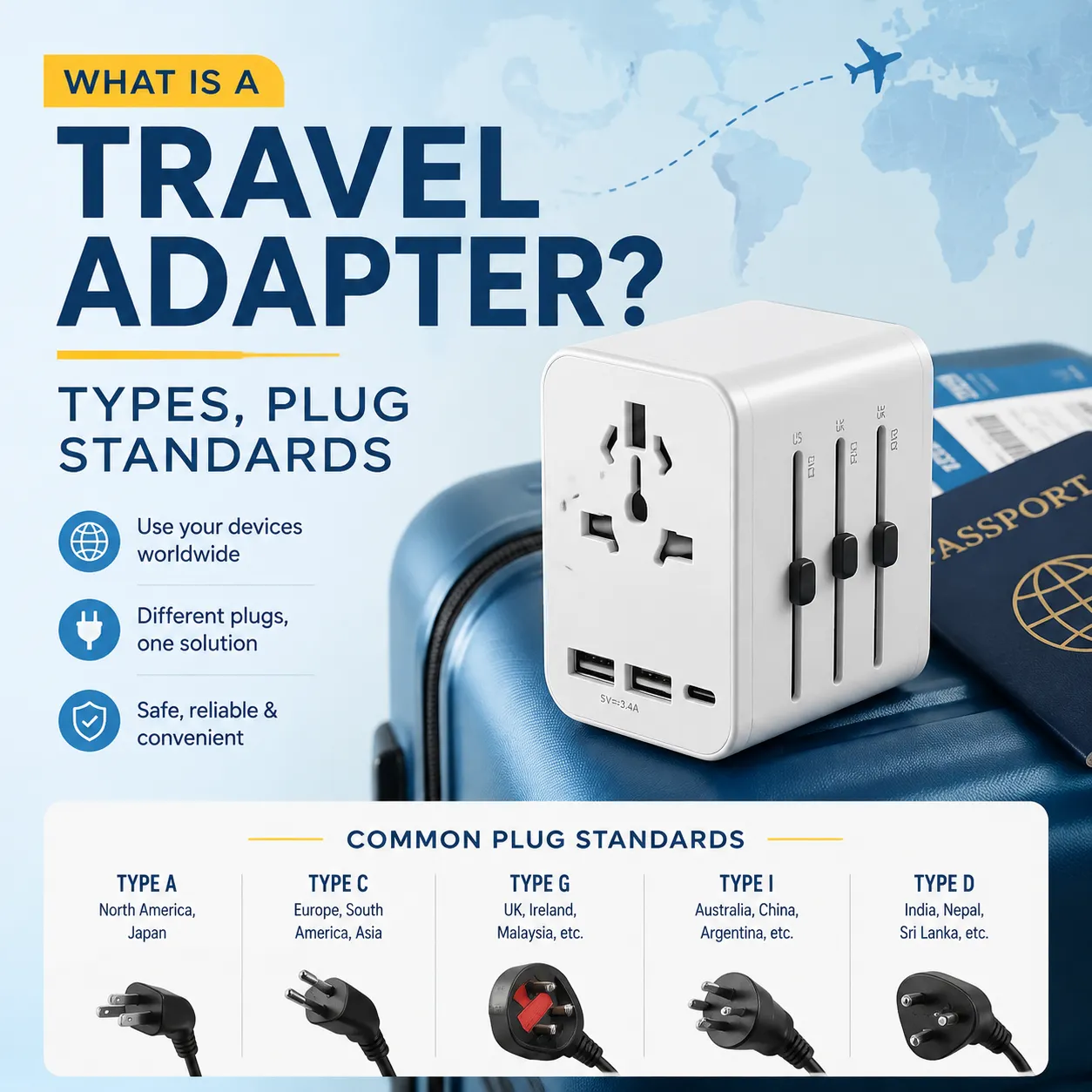
Arriver à votre hôtel après un long vol, vous pourriez avoir hâte de charger votre téléphone, pour découvrir que la prise est totalement différente de celle que vous avez avec vous. Les broches peuvent être rondes ou triangulaires, ce qui crée de la confusion lorsque vous essayez de comprendre comment connecter votre adaptateur au mur. C’est à cela que servent les adaptateurs de voyage ; ils vous permettent d’utiliser l’alimentation électrique du pays dans lequel vous vous trouvez. Cependant, un adaptateur ne modifie pas la tension mais adapte uniquement la forme physique de votre prise. Dans le guide ci-dessous, vous apprendrez tout ce que vous devez savoir sur les adaptateurs de voyage : ce qu’ils font, quand vous en avez besoin, quels types de prises existent, et comment choisir celui qui convient à vos besoins.
Réponse rapide : Un adaptateur de voyage désigne un petit connecteur utilisé pour changer la configuration physique de la prise de votre appareil afin de lui permettre de s’adapter aux prises étrangères. L’adaptateur de voyage ne modifie que la configuration des broches et non la tension. La Commission électrotechnique internationale (IEC) reconnaît un total de 15 types de prises internationales. La plupart des voyageurs doivent utiliser un adaptateur de voyage universel ($15-$35) capable d’adapter les prises de Types A, B, C, E/F, G et I, car ils couvrent plus de 150 pays. Si l’appareil fonctionne sur une seule tension (par exemple un sèche-cheveux US 120V) et que l’on voyage dans un pays avec une tension de 220V, il est conseillé d’utiliser un convertisseur de tension en plus de l’adaptateur. Il n’est pas nécessaire d’utiliser un convertisseur de tension si l’appareil fonctionne sur deux niveaux de tension (100 – 240 volts comme indiqué sur le chargeur de l’appareil).
Qu’est-ce qu’un adaptateur de voyage ?
Un adaptateur de voyage, également appelé adaptateur de prise, adaptateur de prise de voyage ou adaptateur d’alimentation international, est essentiellement un dispositif qui vous permet de brancher votre équipement électrique dans une prise d’un autre pays. Il connecte la prise de votre appareil avec l’ensemble approprié de broches pouvant être branchées à la prise électrique du pays où vous vous rendez.
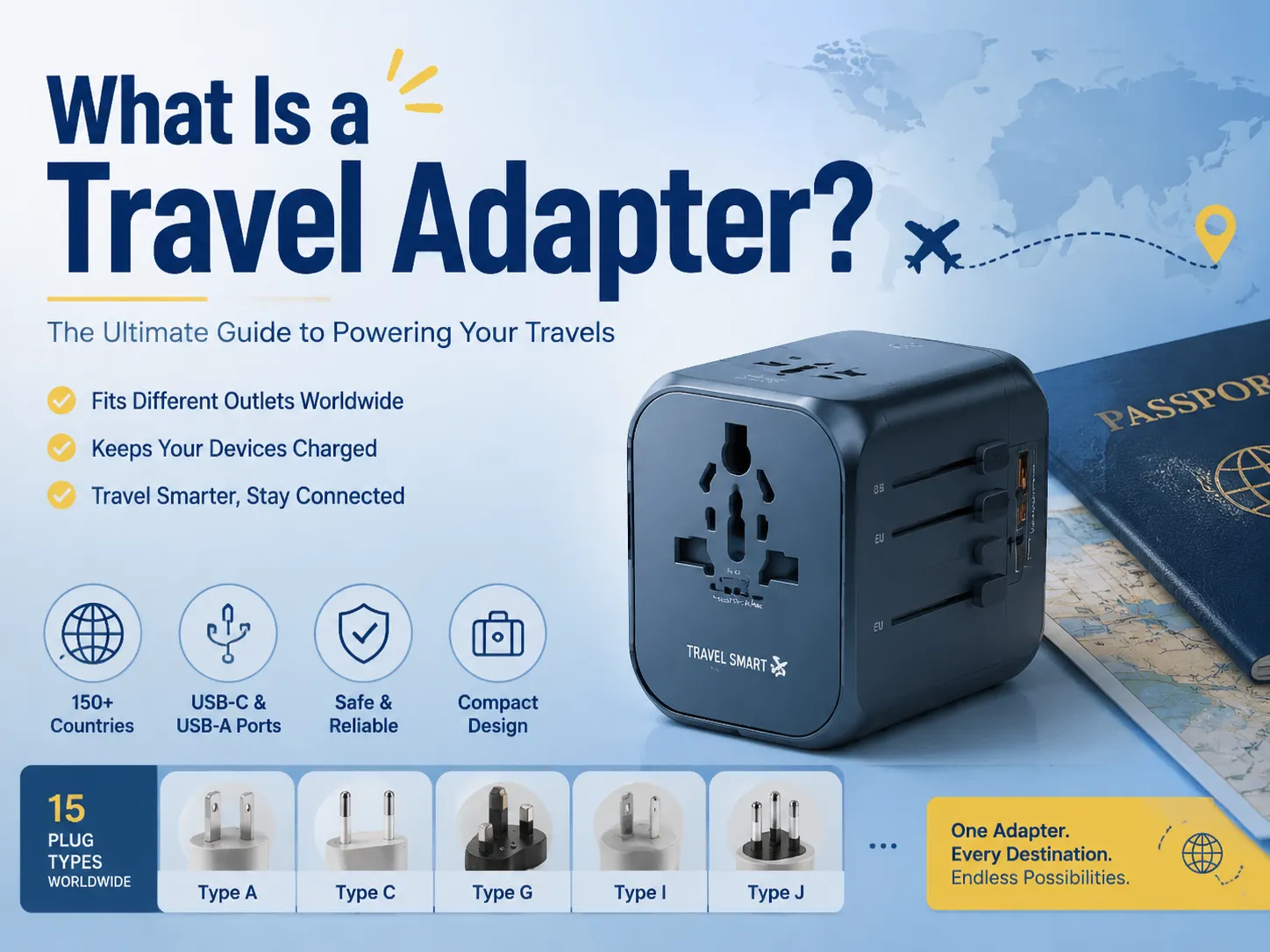
Le point important à noter est ce que l’adaptateur de voyage ne fait pas : il ne modifie pas la tension, la fréquence ou l’intensité de l’électricité dans le mur. L’adaptateur de voyage est simplement un dispositif conçu pour changer la connexion physique — en modifiant la forme des broches, leur espacement et la connexion à la terre, afin que la prise de l’appareil corresponde à la prise murale. Pour une compréhension approfondie des raisons pour lesquelles différents pays ont développé différents designs de prises à l’origine, notre article sur pourquoi différents pays ont différentes prises électriques couvre les raisons historiques et techniques derrière cette fragmentation.
Il existe différentes variétés d’adaptateurs de voyage.
- Adaptateur pour un seul pays – comprend un seul type de prise pour un emplacement et est l’option la plus abordable. Il est parfait pour les voyages dans un seul pays.
- Ensemble d’adaptateurs multinationaux – comprend plusieurs types de prises et plusieurs prises pour différentes régions. Il est conçu pour les personnes voyageant constamment.
- Les adaptateurs de voyage universels – représentent un appareil unique qui comprend des broches mobiles adaptées à différents types de prises. C’est une bonne option pour la plupart des voyageurs.
- Adaptateur universel avec ports USB – similaire au précédent mais avec des ports USB intégrés.
- Adaptateurs universels avec option de changement de tension – incluent l’adaptation de la prise et le changement de tension, et sont le type d’adaptateur de voyage le plus volumineux.
Selon les informations fournies par la Commission électrotechnique internationale (IEC), il existe 15 types de prises divisés en différents types et étiquetés de A à O. Pour comprendre comment ces types de prises correspondent aux configurations des prises murales, notre guide sur différents types de prises électriques fournit une référence complète.
Adaptateur de voyage vs. Convertisseur de tension : la différence cruciale
C’est la seule distinction essentielle à comprendre avant de commencer à voyager, et elle est responsable de plus d’appareils endommagés et de vacances gâchées que toute autre erreur électrique commise en voyage.
| Caractéristique | Adaptateur de voyage | Convertisseur / Transformateur de tension |
|---|---|---|
| Ce qu’il fait | Change la forme de la prise pour s’adapter à une prise étrangère | Change la tension (par exemple, 220V → 110V) |
| Convertit la tension ? | Non | Oui |
| Convertit la fréquence ? | Non | Non (la plupart des modèles grand public) |
| Coût typique | $8–$35 | $35–$120 |
| Taille / poids | Petit, léger (2–5 oz) | Plus lourd et volumineux (8–20 oz) |
| Idéal pour | Appareils à double tension (téléphones, ordinateurs portables, appareils photo) | Appareils à tension unique (sèche-cheveux, fers à friser, certains appareils CPAP) |
| Capacité électrique | Jusqu’au maximum de la prise (généralement 10–15A) | Typiquement 200W–2000W (vérifiez attentivement la puissance nominale) |
Comment savoir si votre appareil est à double tension
La première étape pour déterminer si votre appareil est à double tension est de vérifier les informations imprimées sur l’étiquette de l’adaptateur secteur. Les indications suivantes signifient que l’appareil est à double tension et peut être utilisé presque partout sans besoin de convertisseur de tension.
Par exemple, vous pourriez voir quelque chose comme “ INPUT : 100–240V, 50/60Hz ”. Cela signifie que vous pouvez utiliser l’appareil avec seulement un adaptateur lors de vos voyages dans le monde. Si vous voyez ce type d’inscription sur l’adaptateur secteur “ INPUT : 120V, 60Hz ” ou “ INPUT : 230V, 50Hz ”, cela signifie que vous avez un appareil à tension unique. L’appareil ne peut pas être utilisé en toute sécurité dans un pays avec une tension différente sans convertisseur de tension.
⚠ Avertissement : Brancher un appareil à tension unique évalué à 120V sur une prise de 220V (même en utilisant un adaptateur de voyage) peut provoquer la destruction instantanée de l’appareil et potentiellement déclencher un incendie, électrocuter l’utilisateur ou faire sauter un disjoncteur. L’adaptateur peut permettre à la prise de s’insérer physiquement dans la prise murale — mais 220V sera directement délivré à votre appareil. Lisez toujours l’étiquette de tension sur les appareils pour éviter les accidents.
Les 15 types de prises internationales expliqués
La IEC (Commission électrotechnique internationale) a introduit 15 types de prises électriques, incluant les prises connues de A à O. Le tableau ci-dessous est la référence complète des différents types de prises et de leurs applications.
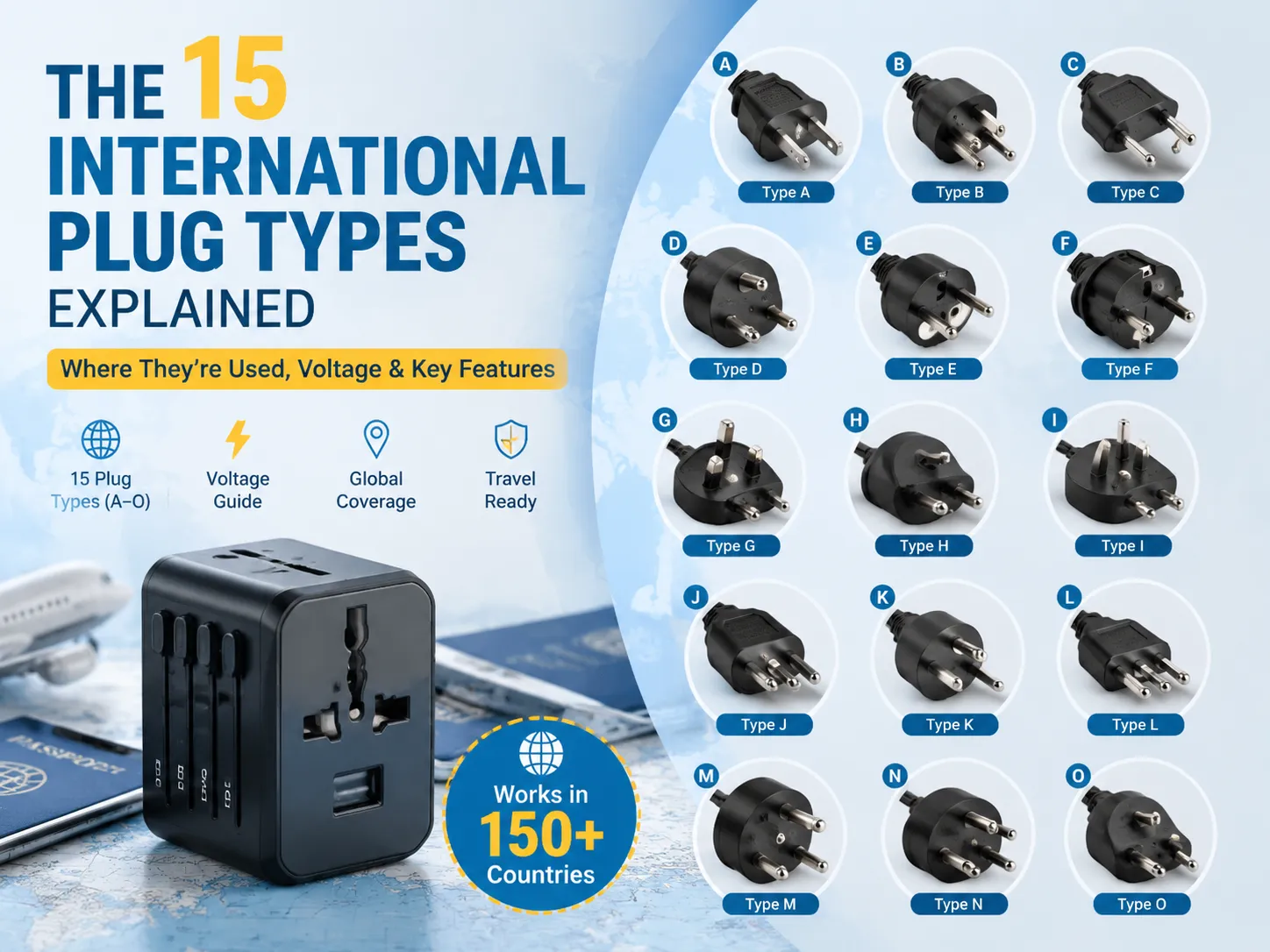
| Type de prise | Description des broches | Tension / Fréquence | Principaux pays / régions |
|---|---|---|---|
| Type A | 2 broches plates parallèles (non mises à la terre) | 100–127V / 50–60Hz | USA, Canada, Mexique, Japon, Amérique centrale |
| Type B | 2 broches plates + broche de terre ronde | 100–127V / 50–60Hz | USA, Canada, Mexico, Japan |
| Type C | 2 broches rondes (Europlug, non mises à la terre) | 220–240V / 50Hz | La plupart de l’Europe, Amérique du Sud, Asie, Afrique |
| Type D | 3 broches rondes larges en triangle | 220–240V / 50Hz | Inde, Népal, Sri Lanka, Namibie |
| prise de courant Type E | 2 broches rondes + trou de terre (français) | 220–240V / 50Hz | France, Belgique, Pologne, Slovaquie, Tunisie |
| Type F | 2 broches rondes + clips latéraux (Schuko) | 220–240V / 50Hz | Allemagne, Espagne, Pays-Bas, Russie, Corée du Sud |
| Type G | 3 broches rectangulaires en triangle | 220–240V / 50Hz | Royaume-Uni, Irlande, Singapour, Hong Kong, Émirats arabes unis, Malaisie |
| Type H | 3 broches plates en forme de Y | 230V / 50Hz | Israël, Palestine |
| Type I | 2 broches plates inclinées + terre optionnelle | 220–240V / 50Hz | Australie, Nouvelle-Zélande, Chine, Argentine |
| Tapez J | 3 broches rondes (terre décalée) | 230V / 50Hz | Switzerland, Liechtenstein |
| Type K | 2 broches rondes + broche de terre | 230V / 50Hz | Denmark, Greenland |
| Type L | 3 broches rondes en ligne | 230V / 50Hz | Italie, Chili |
| Type M | 3 broches rondes larges (comme Type D, plus grandes) | 220–240V / 50Hz | Afrique du Sud, Botswana, Lesotho |
| Type N | 3 broches rondes (2 + terre) | 100–240V / 50–60Hz | Brésil, Afrique du Sud |
| Type O | 3 broches rondes en triangle | 220–240V / 50Hz | Thaïlande |
Pour les voyageurs, les types les plus courants rencontrés sont les Types A/B (Amérique du Nord/Japon), Types C/E/F (Europe), Type G (Royaume-Uni et Commonwealth) et Type I (Australie/Chine). Un adaptateur universel couvrant ces quatre types de normes fonctionnera dans plus de 150 pays. Pour un aperçu des principales catégories de prises, notre article sur les quatre types de prises électriques fournit une référence simplifiée.
Quand avez-vous besoin d’un adaptateur de voyage ?
Un adaptateur de voyage est indispensable lorsque la configuration de la prise de votre équipement diffère des prises électriques dans la zone où vous voyagez. Voici les principales situations où vous devez utiliser un adaptateur de voyage :
Voyager d’une zone de tension à une autre
Le monde est classé en zones de tension suivantes : 100-127V (Amérique du Nord, parties du Japon et parties de l’Amérique du Sud) et 220-240V (Asie, Europe, Afrique et Océanie). Si vous voyagez entre ces tensions, vous rencontrerez probablement des prises totalement différentes également.
Voyager dans une même zone de tension mais avec différents types de prises
Même dans la zone 220-240V, il existe de nombreux types de prises. Par exemple, le Royaume-Uni (Type G) et l’Europe continentale (Type C/E/F) appartiennent à la même classification 230V, mais lorsque vous passez de l’Allemagne au Royaume-Uni, vous devrez utiliser un adaptateur de voyage.
Voyager vers des pays avec des types de prises spécifiques
Certains pays ont des designs de prises uniques à ces nations. L’Inde utilise une prise Type D, l’Afrique du Sud a son Type M, le Brésil est Type N et Israël appartient à la catégorie Type H. Même un adaptateur universel peut ne pas fonctionner, assurez-vous donc que votre adaptateur de voyage inclut ces types uniques.
Lorsque vous ne savez pas à quoi vous attendre à votre destination
Certains hôtels et aéroports fournissent des prises universelles, mais ne comptez pas là-dessus car les petites maisons d’hôtes et hôtels ruraux peuvent ne pas avoir de prise électrique compatible avec votre appareil. Emportez toujours un adaptateur de voyage par précaution.
Astuce :Si vous visitez plusieurs destinations lors d’un même voyage (par exemple, un circuit en Europe comprenant le Royaume-Uni et la Suisse), il est préférable d’utiliser un adaptateur universel plutôt que des adaptateurs individuels pour chaque pays.
Guide des adaptateurs pays par pays
Voici un tableau de référence rapide pour les destinations de voyage populaires, indiquant le type de prise dont vous aurez besoin et la tension locale :
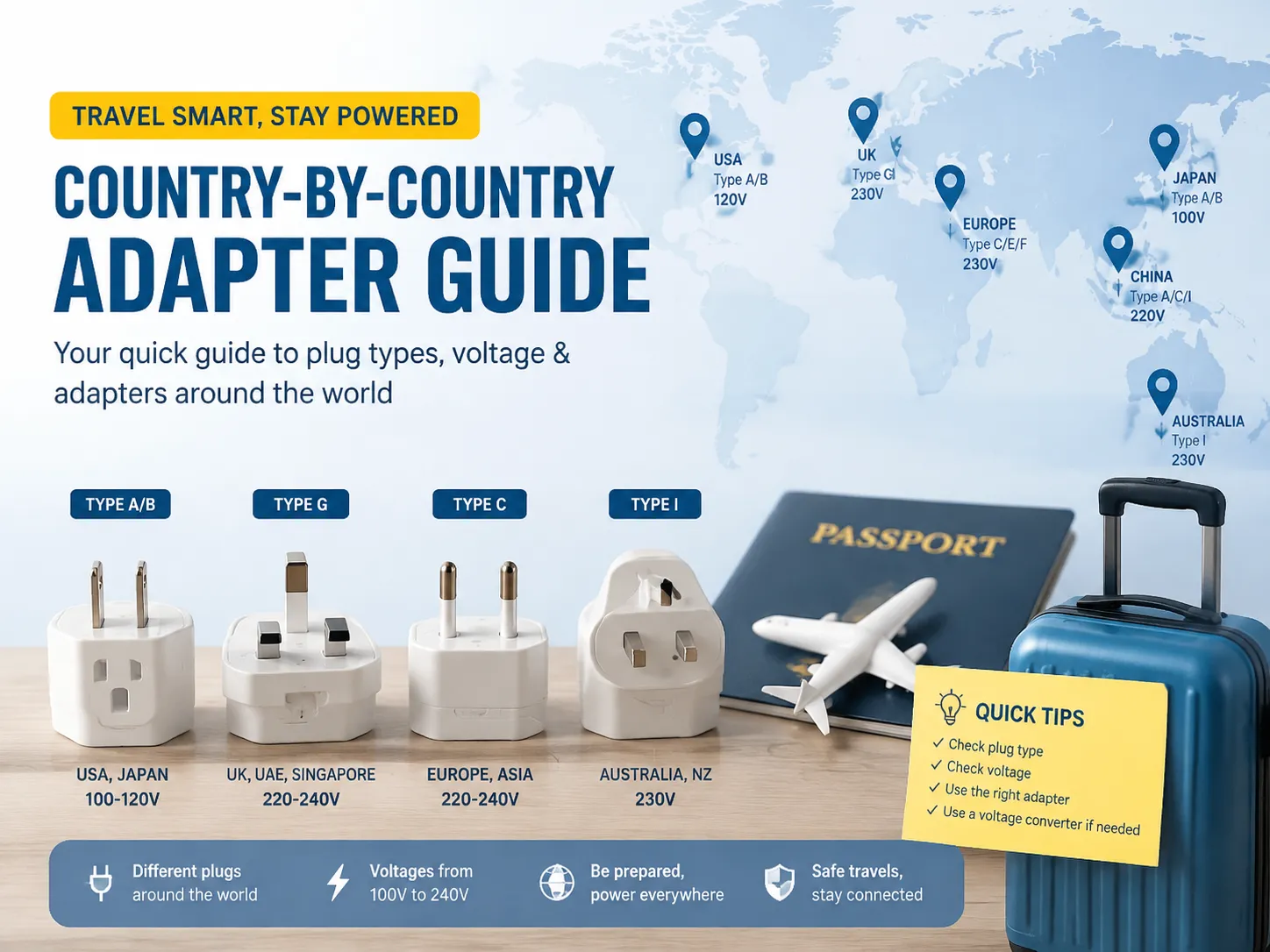
| Destination | Plug Type(s) | Tension | Fréquence | Adaptateur nécessaire depuis les États-Unis ? | Adaptateur nécessaire depuis le Royaume-Uni ? |
|---|---|---|---|---|---|
| États-Unis | A, B | 120V | 60Hz | Non | Oui (G → A/B) |
| Royaume-Uni | G | 230V | 50Hz | Oui (A → G) | Non |
| France / Allemagne / Espagne | C, E, F | 230V | 50Hz | Oui (A → C/E/F) | Oui (G → C/E/F) |
| Italie | C, F, L | 230V | 50Hz | Oui (A → C/L) | Oui (G → C/L) |
| Suisse | C, J | 230V | 50Hz | Oui (A → J) | Oui (G → J) |
| Japon | A, B | 100V | 50/60Hz | Non (la prise convient) | Oui (G → A/B) |
| Chine | A, C, I | 220V | 50Hz | Oui (tension) | Oui (G → A/C/I) |
| Australie / Nouvelle-Zélande | I | 230V | 50Hz | Oui (A → I) | Oui (G → I) |
| Inde | C, D, M | 230V | 50Hz | Oui (A → D) | Oui (G → D) |
| Thaïlande | A, B, C, O | 220V | 50Hz | La prise peut convenir (A/B) | Oui (G → C/A) |
| Brésil | C, N | 127/220V | 60Hz | Oui (A → N) | Oui (G → C/N) |
| Afrique du Sud | M, N | 230V | 50Hz | Oui (A → M) | Oui (G → M) |
| Émirats arabes unis / Dubaï | G | 220V | 50Hz | Oui (A → G) | Non |
| Singapour | G | 230V | 50Hz | Oui (A → G) | Non |
| Corée du Sud | C, F | 220V | 60Hz | Oui (A → C/F) | Oui (G → C/F) |
Note importante : Certains pays (par exemple, le Brésil, la Chine et la Thaïlande) ont différents types de prises qui varient selon la région ou l’âge du bâtiment. Il est donc nécessaire de bien vérifier le pays de destination et ses exigences.
Types d’adaptateurs de voyage sur le marché
Tous les adaptateurs de voyage ne sont pas conçus de la même manière. Les différents types d’adaptateurs sont listés ci-dessous avec des recommandations.
Adaptateurs de prise pour un seul pays
Le type le plus simple et le plus abordable, destiné à un usage dans un seul pays. Coûte entre 5 et 12 USD et convient le mieux pour un voyage dans un seul pays. De nombreux hôtels en proposent également en prêt, mais il ne faut pas en dépendre.
Adaptateurs de voyage universels (tout-en-un)
Le type le plus utilisé et populaire. Un appareil équipé de plusieurs broches rétractables qui s’adaptent à 4-6 types de prises. Presque tous les appareils modernes chargent également les appareils LED et tablettes via le port USB. Les prix varient de 15 à 40 USD. Les marques populaires incluent Epicka, TESSAN, Ceptics et OREI.
Kits d’adaptateurs de prise
Une prise avec plusieurs adaptateurs dans un seul étui, plus un adaptateur physique qui reçoit un type de prise. Les marques populaires de kits d’adaptateurs sont Ceptics et Kensington entre autres. Ce type est recommandé pour ceux qui voyagent souvent et ont besoin d’adaptateurs de rechange ainsi que pour certains types de prises non couverts par les adaptateurs universels (comme D, M ou N).
Adaptateurs avec convertisseurs de tension
Ce type peut adapter une prise et convertir la tension (de 220V à 110V). Ils sont plus volumineux et coûteux (40-120 USD) mais nécessaires pour les voyageurs avec des appareils à tension unique (exemple : un sèche-cheveux). Les marques BESTEK et TESSAN produisent des ensembles très utiles. Une autre chose – assurez-vous de vérifier la puissance nominale car elle est généralement comprise entre 200W et 500W, ce qui n’est pas suffisant pour un sèche-cheveux puissant (1500 W et plus).
Adaptateurs de voyage intelligents avec USB-C PD
Le type le plus récent fabriqué par les marques suivantes – Anker et Zendure. Tous les appareils affichent USB PD (également connu sous le nom de USB Power Delivery) d'environ 65-75 Watt permettant une charge rapide des ordinateurs portables et des appareils connectés simultanément via diverses connexions USB. Pour les voyageurs qui ont besoin de charger téléphones et ordinateurs portables via USB, notre Guide des prises chargeur USB couvre les spécifications clés à rechercher.
Comment choisir le bon adaptateur de voyage
Avec autant d'options sur le marché, voici les facteurs clés à évaluer :
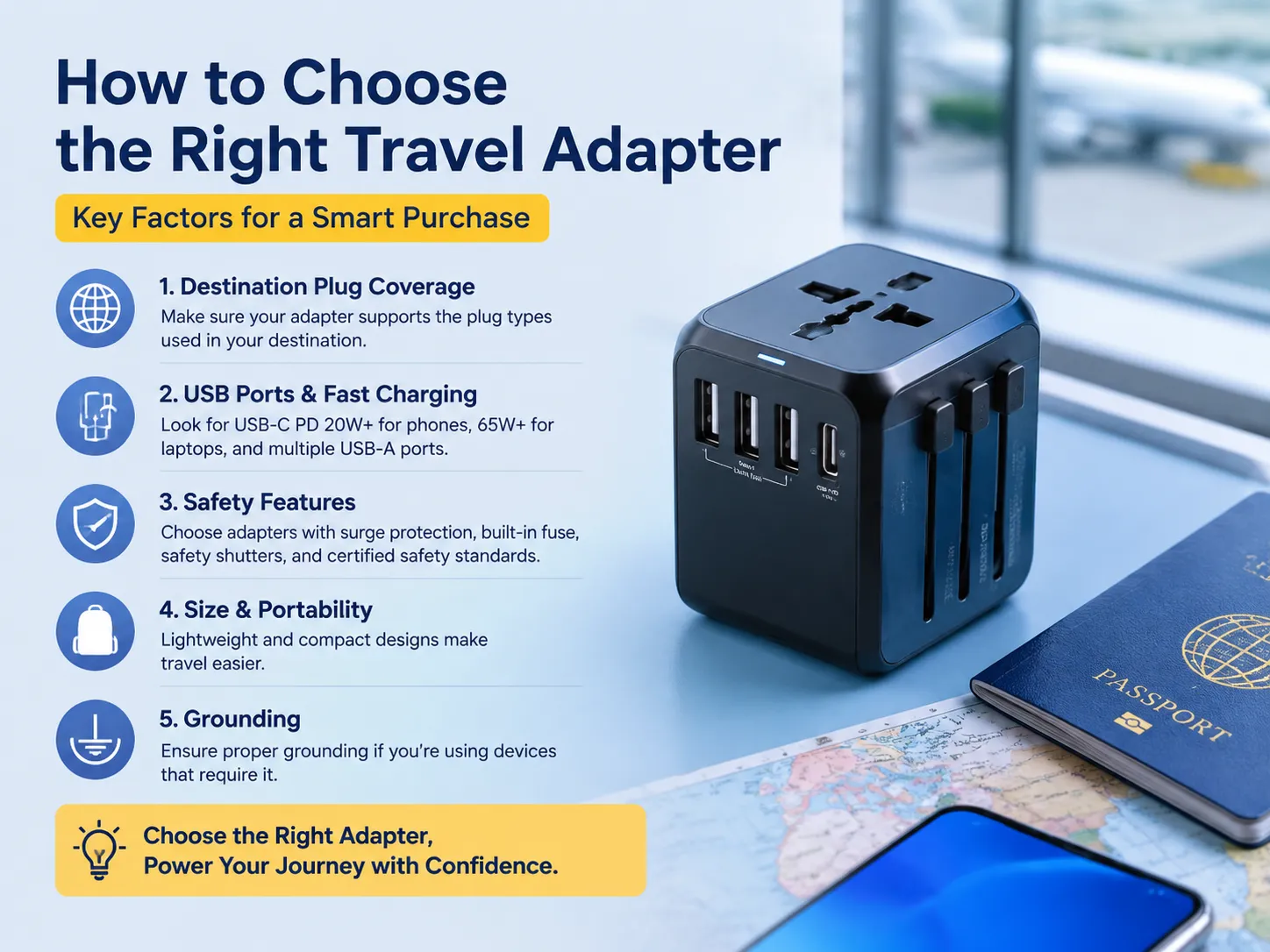
Couverture des prises selon la destination
Avant d'effectuer un achat, vous devez d'abord identifier les types de prises dans le pays où vous voyagez (voir tableau ci-dessus). Ensuite, vous devez vous assurer qu'un adaptateur correspond à ces types. En général, les adaptateurs universels sont compatibles avec les Types A, B, C, E/F, G et I ; mais plusieurs types, tels que D (Inde), M (Afrique du Sud) et N (Brésil), ont tendance à être oubliés. Si vous vous rendez dans l'un de ces pays, assurez-vous de consulter la liste des adaptateurs à l'avance ou d'acheter un adaptateur supplémentaire pour un pays spécifique.
Ports USB et charge rapide
Si vous chargez des téléphones, tablettes ou ordinateurs portables, recherchez un adaptateur avec des ports USB intégrés. Spécifications clés à vérifier :
| Caractéristique | Ce qu'il faut rechercher |
|---|---|
| USB-C Power Delivery | 20W+ pour téléphones, 65W+ pour ordinateurs portables |
| Ports USB-A | 2+ ports pour la charge simultanée de plusieurs appareils |
| Puissance totale | Vérifiez la puissance combinée — certains adaptateurs limitent la puissance lorsque tous les ports sont utilisés |
| Support Quick Charge | QC 3.0 ou QC 4+ pour les appareils Android compatibles |
Caractéristiques de sécurité
Recherchez des adaptateurs équipés des certifications et fonctionnalités suivantes :
- Protection contre les surtensions — protège les appareils contre les pics de tension (courants dans les bâtiments anciens situés dans les pays en développement)
- Fusible intégré — calibré à 6A ou 10A ; se déclenche en cas de courant excessif pour protéger les appareils
- Volets de sécurité — empêchent tout contact accidentel en protégeant les trous de broches vides
- Boîtier ignifuge — généralement en polycarbonate ou ABS V-0
- Certifications — CE, FCC, RoHS, et de préférence BS 8546
Taille et portabilité
Lorsque vous voyagez avec seulement un sac à dos et l'essentiel, chaque gramme compte. Les adaptateurs universels les plus légers pèsent moins de 85 grammes, ce qui est très léger dans un contexte de voyage. Cependant, les adaptateurs les plus lourds avec convertisseurs de tension pèsent entre 225 et 565 grammes. Il est donc important de vérifier les dimensions car ils ne s'adaptent pas tous parfaitement aux autres prises.
Mise à la terre
Certains adaptateurs mondiaux ne sont pas mis à la terre ; ils ont seulement deux broches. Cela présente un avantage lorsque vous utilisez ces appareils avec des chargeurs de téléphone et des ordinateurs portables, qui sont doublement isolés et ne nécessitent pas de mise à la terre. Cependant, cela devient un inconvénient majeur lorsque votre appareil doit être mis à la terre. Assurez-vous d'obtenir un adaptateur qui indique explicitement qu'il est mis à la terre pour tous les types de prises.
Guide des prix des adaptateurs de voyage : à quoi s'attendre
Les prix des adaptateurs de voyage varient considérablement selon le type, les fonctionnalités et la marque. Voici une répartition par catégorie :
| Type d'adaptateur | Gamme de prix | Marques et modèles populaires | Meilleur pour |
|---|---|---|---|
| Adaptateur de prise pour un seul pays | $5–$12 | OREI, Ceptics type unique | Voyages dans un seul pays |
| Adaptateur universel basique (sans USB) | $10–$18 | OREI Universal, Ceptics basique | Voyageurs à petit budget avec chargeurs USB |
| Adaptateur universel avec ports USB-A | $15–$30 | USB-C Power Delivery | La plupart des voyageurs |
| Adaptateur universel avec USB-C PD | $25–$45 | Epicka TA-105 ($19.99), TESSAN ($19.99–$27.30) | Charge ordinateur portable + téléphone |
| Universel premium avec PD 65W+ | Epicka TA-105 ($19.99), TESSAN ($19.99–$27.30) | Ceptics 70W ($31.99), Anker Nano ($25.99) | Voyageurs d’affaires, nomades digitaux |
| Kit d’adaptateur modulaire (9+ prises) | $25–$40 | Kit Ceptics World ($35), Kensington | Voyageurs fréquents multi-pays |
| Adaptateur + convertisseur de tension combo | $35–$120 | BESTEK 250W ($55–$65), TESSAN 350W ($40–$50) | Voyageurs avec appareils à tension unique |
Prix par région (adaptateurs mono-pays)
| Région de destination | Type de prise nécessaire | Prix de l’adaptateur unique |
|---|---|---|
| Europe (Type C/E/F) | C, E ou F | $5–$10 |
| Royaume-Uni / Singapour / Hong Kong (Type G) | G | $6–$12 |
| Australie / Nouvelle-Zélande / Chine (Type I) | I | $6–$12 |
| Inde (Type D) | D | $8–$15 |
| Afrique du Sud (Type M) | M | $8–$15 |
| Brésil (Type N) | N | $8–$15 |
| Japon (Type A/B) | A ou B | $5–$10 |
Astuce : Pour la majorité des voyageurs, un adaptateur universel avec charge USB-C, au prix compris entre $20 et $35, offre la meilleure option. Le TA-105 d’Epicka ($19.99) et l’adaptateur universel de TESSAN ($19.99-$27.30) sont les mieux notés dans cette gamme et peuvent être utilisés dans plus de 150 pays. Si vous avez besoin d’un appareil capable de charger un ordinateur portable rapidement, vous pouvez opter pour les adaptateurs Ceptics 70W ($31.99) ou Zendure Passport III ($69.99).
Conseils de sécurité : ne grillez pas vos appareils
Utiliser un adaptateur de voyage de manière incorrecte peut endommager vos appareils, déclencher le disjoncteur de votre hôtel, voire provoquer un incendie. Respectez les règles de sécurité suivantes :
Vérifiez d’abord la compatibilité de charge
Avant de connecter quoi que ce soit, regardez la tension indiquée sur le chargeur de votre appareil. Si elle indique “ 100–240V ”, vous pouvez utiliser uniquement un adaptateur sans problème. Cependant, si elle indique “ 120V uniquement ” (ou “ 230V uniquement ”) et que la prise a une tension différente, vous devrez utiliser un convertisseur de tension au lieu d’un simple adaptateur.
Ne dépassez jamais la capacité en courant de l’adaptateur
La plupart des adaptateurs de voyage sont fournis avec une capacité de 10A ou 15A. La puissance fournie sera comprise entre 230 et 3450 watts, ce qui est suffisant pour charger des téléphones, ordinateurs ou appareils photo. Néanmoins, les appareils à haute puissance tels que les sèche-cheveux (environ 1500-2000W), bouilloires électriques (1500-3000W) et radiateurs ne doivent pas être chargés avec un adaptateur de voyage. Sinon, cela peut entraîner sa fusion ou le déclenchement du disjoncteur. Les appareils à haute puissance doivent toujours être connectés à une prise correcte et dédiée.
Soyez vigilant avec les imitations
De nombreuses imitations abordables d’adaptateurs sont facilement trouvables sur Internet. Elles sont souvent fabriquées avec des matériaux de mauvaise qualité, ne disposent d’aucune protection contre les surtensions et ne sont pas certifiées. Il vaut mieux dépenser un peu plus et acheter un appareil auprès de fabricants réputés (tels que Epicka, TESSAN, Ceptics, OREI, Anker et Zendure), ainsi que vérifier les certificats sur le site du fabricant.
Ne connectez pas les adaptateurs entre eux
Si vous connectez un adaptateur à un autre adaptateur, puis à une multiprise et enfin à la prise murale, les appareils risquent de tomber en panne et il y a aussi un risque d’incendie. Par conséquent, si vous avez besoin de plus de prises, utilisez simplement une multiprise de voyage limitée à un seul adaptateur, mais pas plusieurs adaptateurs.
Faites attention à la surchauffe
Si un adaptateur est très chaud après utilisation, débranchez-le. Cela signifie qu'il y a une mauvaise connexion, un circuit surchargé ou un adaptateur défectueux. Bien qu'il soit normal qu'ils soient chauds lors de la charge d'un téléphone, cela ne doit pas faire fondre le boîtier.
Erreurs courantes à éviter
Confondre adaptateur et convertisseur
L'erreur la plus courante. Un adaptateur modifie l'alignement physique de la prise. Un convertisseur de tension modifie la charge électrique. Vous endommagerez votre appareil s'il n'est pas conçu pour fonctionner avec différentes tensions et que vous utilisez uniquement un adaptateur. Vérifiez toujours les spécifications de tension sur votre chargeur en premier.
Acheter un adaptateur universel qui ne fonctionne pas dans votre pays de destination
Beaucoup d'adaptateurs “ universels ” n'incluent pas le type D (Inde), le type M (Afrique du Sud), le type N (Brésil) ou le type L (Italie). Lors de l'achat, assurez-vous de lire attentivement les spécifications techniques. Si aucun d'eux ne correspond à celui que vous utiliserez pour charger vos appareils, envisagez d'acheter plusieurs adaptateurs spécifiques à chaque pays.
Ne pas prendre de câbles de charge USB
Même le meilleur adaptateur universel avec ports USB ne vous aidera pas si vous n'avez pas emporté votre câble USB C. Ayez un câble USB supplémentaire pour chaque type d'appareil que vous possédez.
Supposer que l'hôtel disposera de prises universelles
Certains hôtels ont des prises universelles qui permettent de brancher différents types de chargeurs. Cependant, de nombreux hôtels économiques, auberges et AirBnB fournissent uniquement des prises locales à leurs clients. Assurez-vous d'avoir votre propre adaptateur, afin de ne pas dépendre de la disponibilité éventuelle de ceux-ci à la réception.
Oublier que différentes régions ont des fréquences différentes
Les appareils avec moteurs et horloges (par exemple, rasoirs électriques, réveils, platines, etc.) fonctionnent à des vitesses différentes selon la fréquence de l'environnement (50Hz ou 60Hz). Bien que la plupart des appareils électroniques modernes ne dépendent pas de la fréquence, vérifiez l'étiquette de votre appareil si vous emportez un appareil électronique avec moteur.
Questions fréquemment posées
Quelle est la différence entre un adaptateur de voyage et un chargeur de voyage ?
Un adaptateur de voyage est un adaptateur de prise qui permet à la fiche de votre appareil de s'adapter aux prises électriques étrangères. Il ne convertit pas l'énergie et ne charge rien — il offre simplement un point de connexion physique. Un chargeur de voyage, en revanche, est un chargeur qui convertit le courant alternatif de la prise en courant continu pour charger votre téléphone ou ordinateur. Un chargeur de voyage possède sa propre électronique de puissance (régulateur de tension, redresseur, ports de sortie USB) et peut avoir, ou non, des adaptateurs pour différents pays. De nombreux adaptateurs universels modernes incluent une capacité de charge USB, ce qui rend la distinction entre adaptateur et chargeur moins évidente ; cependant, cette distinction reste importante. Si votre adaptateur possède des ports USB, il fonctionne à la fois comme chargeur et adaptateur. S'il n'a qu'une prise AC, vous devrez utiliser votre chargeur pour convertir le courant AC en USB. Trouvez simplement un adaptateur de voyage universel avec ports USB et USB-C, et il fonctionnera comme adaptateur et chargeur.
Comment savoir si j'ai besoin d'un adaptateur de voyage ou d'un convertisseur ?
Vérifiez l'étiquette sur le chargeur de votre appareil. Recherchez les informations “ INPUT ” dessus :
Si elle indique “ INPUT : 100–240V, 50/60Hz ” (ou d'autres plages de tension), alors votre appareil est bi-tension et il vous suffira d'un adaptateur pour qu'il s'adapte à la prise du pays étranger – aucun convertisseur n'est nécessaire pour son fonctionnement. La plupart des derniers chargeurs de téléphone, chargeurs d'ordinateur portable, chargeurs d'appareil photo et chargeurs de tablette sont bi-tension.
Si elle indique “ INPUT : 120V, 60Hz ” (pour les États-Unis uniquement) ou “ INPUT : 230V, 50Hz ” (pour l'Europe uniquement), alors votre appareil est mono-tension et vous aurez besoin d'un convertisseur de tension (en plus de l'adaptateur de prise). Sinon, si vous branchez un appareil 120V sur une prise 230V avec seulement un adaptateur, vous le détruirez et cela pourrait même provoquer un incendie.
En règle générale, presque tous les téléphones, ordinateurs portables, appareils photo et tablettes sont à double tension. Les sèche-cheveux, fers à friser, tondeuses à cheveux et certains appareils électroniques plus anciens sont souvent des appareils à tension unique.
Quelle est la différence entre un convertisseur de voyage et un adaptateur ?
Un adaptateur de voyage et un convertisseur de voyage ont des fonctions totalement différentes.
Adaptateur de voyage — Change la configuration de votre prise pour qu’elle s’adapte aux prises murales étrangères et ne modifie pas la tension, le courant ou la fréquence de l’électricité. L’adaptateur de voyage est un connecteur mécanique léger et de petite taille (2–5 oz). Coût : $8–$35. Utilisez-le lorsque votre appareil électrique est à double tension (100–240V).
Convertisseur de voyage (également appelé convertisseur de tension ou transformateur) — Change réellement la tension de l’électricité. Dans un convertisseur abaisseur, 220–240V est réduit à 110–120V, rendant les appareils 120V utilisables dans les pays à 230V. Dans un convertisseur élévateur, le fonctionnement est inverse. Les convertisseurs sont plus grands, plus lourds (8–20 oz) et plus coûteux (de $35 à $120). Ils doivent avoir une puissance (200W à 2000W) supérieure à la consommation de votre appareil. Utilisez un convertisseur lorsque votre appareil n’a qu’une seule tension et que la tension de destination est différente.
Certains appareils combinent les deux fonctions — un adaptateur avec un convertisseur abaisseur intégré — mais c’est une exception. Dans la plupart des cas, un voyageur n’a besoin d’utiliser qu’un adaptateur puisque les smartphones, ordinateurs et appareils photo sont des appareils à double tension.
À quoi ressemble un adaptateur de voyage ?
Le type d’adaptateur de voyage détermine son apparence.
Adaptateur pour un seul pays : Il s’agit d’une prise compacte qui a un côté façonné selon la conception de la prise du pays d’origine et un autre selon la forme de la prise utilisée dans le pays de destination. Habituellement, il mesure 1,5 à 2,5 pouces, ce qui signifie qu’il s’agit essentiellement de prises avec des sockets à l’autre extrémité.
Adaptateur universel : Il est de forme rectangulaire ou carrée et mesure environ 2 à 3 pouces. Il contient un bouton coulissant ou poussoir qui donne accès aux différents ensembles de broches. La plupart de ces adaptateurs contiennent une prise Type A et Type C à une extrémité et 2 à 5 ports USB à l’autre. Ces types d’adaptateurs ont à peu près la taille d’un jeu de cartes.
Adaptateur universel avec ports USB : Identique au précédent, mais au lieu de simples ports USB, il en possède 2 à 5 disponibles. Certains modèles avancés disposent de voyants LED et d’un autre bouton de réinitialisation pour la fonction de sécurité spéciale de l’appareil.
Combo adaptateur + convertisseur : Celui-ci est plus grand et plus lourd comparé aux deux précédents. Il comprend un câble d’entrée AC ainsi que le transformateur et les prises de sortie.
Références
- Commission électrotechnique internationale (IEC) — Norme IEC 60083 définissant les 15 types de prises internationales (A–O) et leurs spécifications dimensionnelles.
- NEMA (Association Nationale des Fabricants Électriques) — Normes NEMA 1 et NEMA 5 pour les prises Type A et Type B utilisées en Amérique du Nord.
- Travel-Adaptor.com Référence des types de prises — Base de données complète pays par pays des types de prises, tensions et fréquences pour les 15 types de prises IEC.
- BSI (British Standards Institution) — Norme BS 8546 pour les adaptateurs de voyage, couvrant les exigences de sécurité, la résistance mécanique et la performance thermique.
- UL (Underwriters Laboratories) — Norme UL 498 pour les fiches et prises d’attache, et UL 60884-1 pour les fiches et prises de courant domestiques.
- Commission de sécurité des produits de consommation des États-Unis (CPSC) — Directives de sécurité électrique pour les voyageurs, incluant des avertissements sur les incompatibilités de tension et les adaptateurs contrefaits.
- Guide d’adaptateur de voyage Anker — Référence fabricant sur les fonctionnalités des adaptateurs universels, les spécifications USB-C Power Delivery, et les considérations de sécurité.
Un adaptateur de voyage est sans doute l’un des outils les plus essentiels pour voyager à l’étranger, mais aussi l’un des accessoires les plus déroutants. Le point principal à retenir est qu’un adaptateur de voyage ne fait que convertir la forme de votre fiche, mais ne convertit pas la tension. Si votre appareil est double tension (ou compatible avec des tensions allant de 100 à 240 V, comme c’est le cas pour presque tous les téléphones, ordinateurs portables et appareils photo modernes), un simple adaptateur suffit. Cependant, si vous transportez des appareils à tension unique comme des sèche-cheveux ou des fers à friser, vous aurez également besoin d’un convertisseur de tension.
Un adaptateur de voyage universel avec ports USB-C et USB-A dans la gamme $20-$35 serait la meilleure option pour la plupart des voyageurs. Des marques comme Epicka, TESSAN, Ceptics et Anker produisent des produits fiables utilisables dans plus de 150 pays et offrant une protection contre les surtensions ainsi qu’une charge rapide. Avant d’en acheter un, vous devez vérifier si l’adaptateur prend en charge le type de fiche de votre destination.