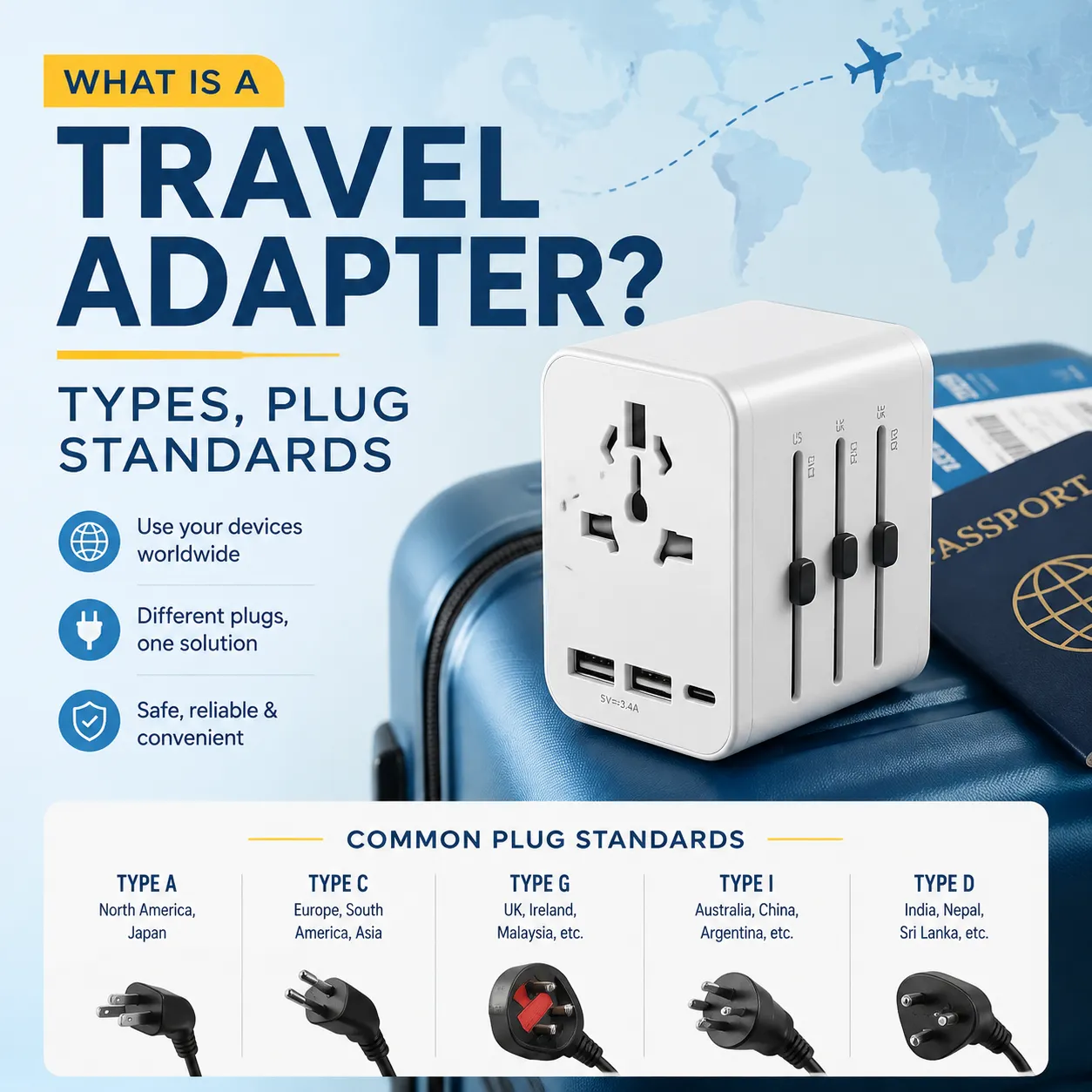
Arriving at your hotel after a lengthy flight, you might be looking forward to charging your phone, only to discover that the socket is totally different from what you have with you. The prongs may be round or triangular, resulting in confusion when you’re trying to figure out how to make your adapter connect to the wall. This is what travel adapters are for; they let you use the electricity supply of the country you are in. However, an adapter will not change the voltage but will only adapt the physical shape of your plug. In the guide below, you will learn everything you need about travel adapters: what they do, when you need one, which types of plugs exist, and how to choose the right one for your needs.
Quick answer: A travel adapter refers to a small connector used to change the physical configuration of your device plug to allow it to fit into foreign sockets. The travel adapter only changes the pin configuration rather than the voltage. The International Electrotechnical Commission (IEC) recognizes a total of 15 types of international plugs. Most travelers must use a universal travel adapter ($15-$35) that can adapt plugs of Types A, B, C, E/F, G, and I since they are sufficient for over 150 nations. If the device operates on a single voltage level (e.g. a 120V US hairdryer) and one travels to a country with voltage of 220V, it is advisable to use a voltage converter and the adapter. There is no need for a voltage converter if the device operates on two voltage levels (100 – 240 volts as specified on the charger of the device).
What Is a Travel Adapter?
A travel adapter, also known as a plug adapter, travel plug adapter, or international power adapter, is essentially a device that lets you plug in your electrical equipment into an outlet in another country. It connects the plug from your device with the appropriate set of prongs that can be connected to the power outlet where you are going.
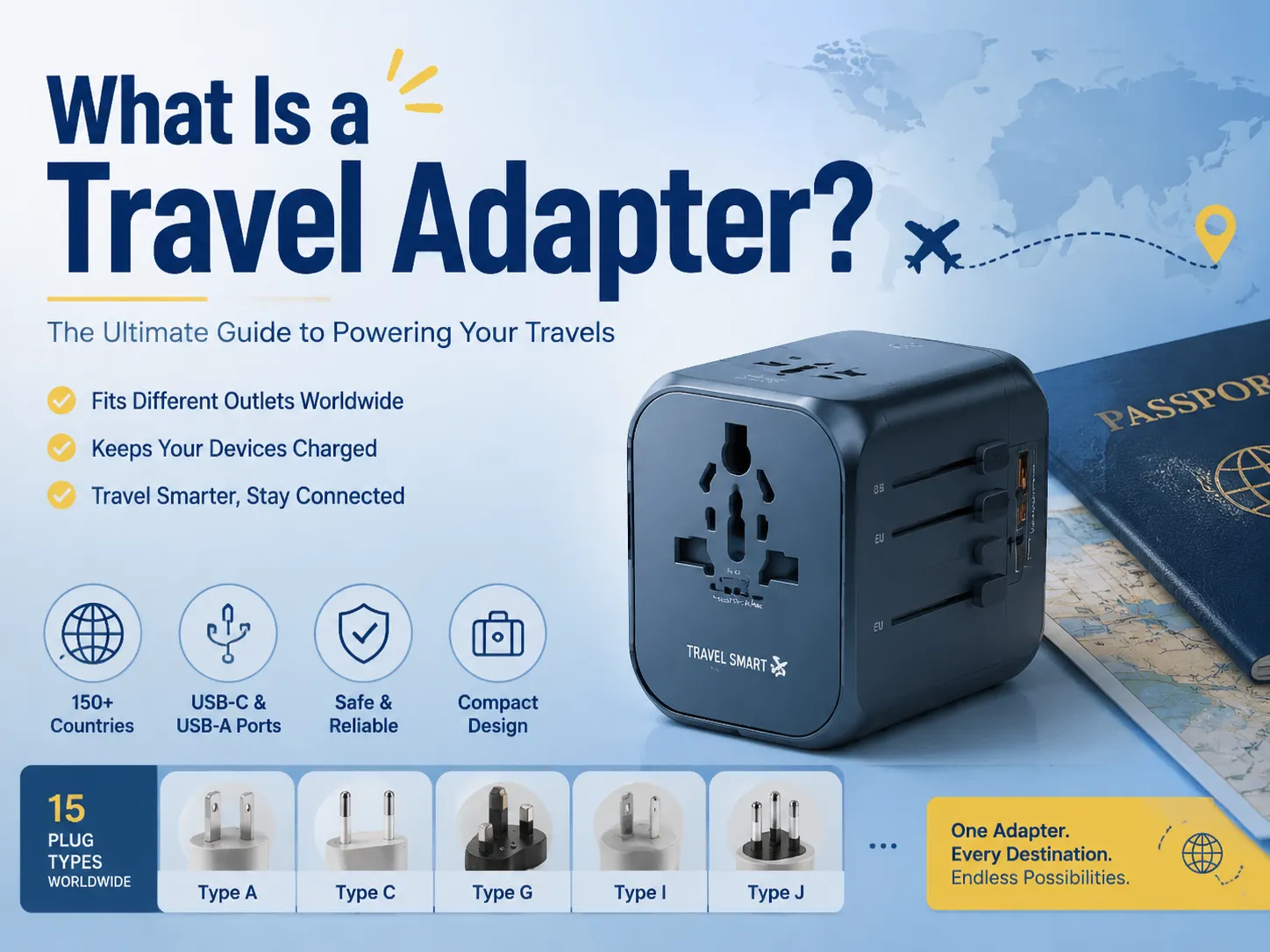
The important point to note is how a travel adapter does not operate: it does not modify the voltage, frequency, or intensity of the electricity in the wall. The travel adapter is simply a device designed to change the physical connection — changing pin shapes, spacing, and ground connection, so that plugging the device will fit the socket.For a deeper understanding of why different countries developed different socket designs in the first place, our article on why different countries have different electrical outlets covers the historical and technical reasons behind this fragmentation.
There are different varieties of travel adapters.
- Single country adapter – includes a single type of plug for one location and is the most affordable option. It is perfect for one-country trips.
- Multinational adapter set – consists of several types of plugs and has several plugs for various areas. It is designed for people constantly traveling.
- Universal travel adapters – represents one device that includes free-moving pins suitable for different plug types. This is a good option for most of the travelers.
- Universal adapter with USB ports – similar to the above but has USB ports inside it.
- Universal adapters with voltage changing option – includes plug adaption and changing of voltage and is a bulkiest type of travel adapter.
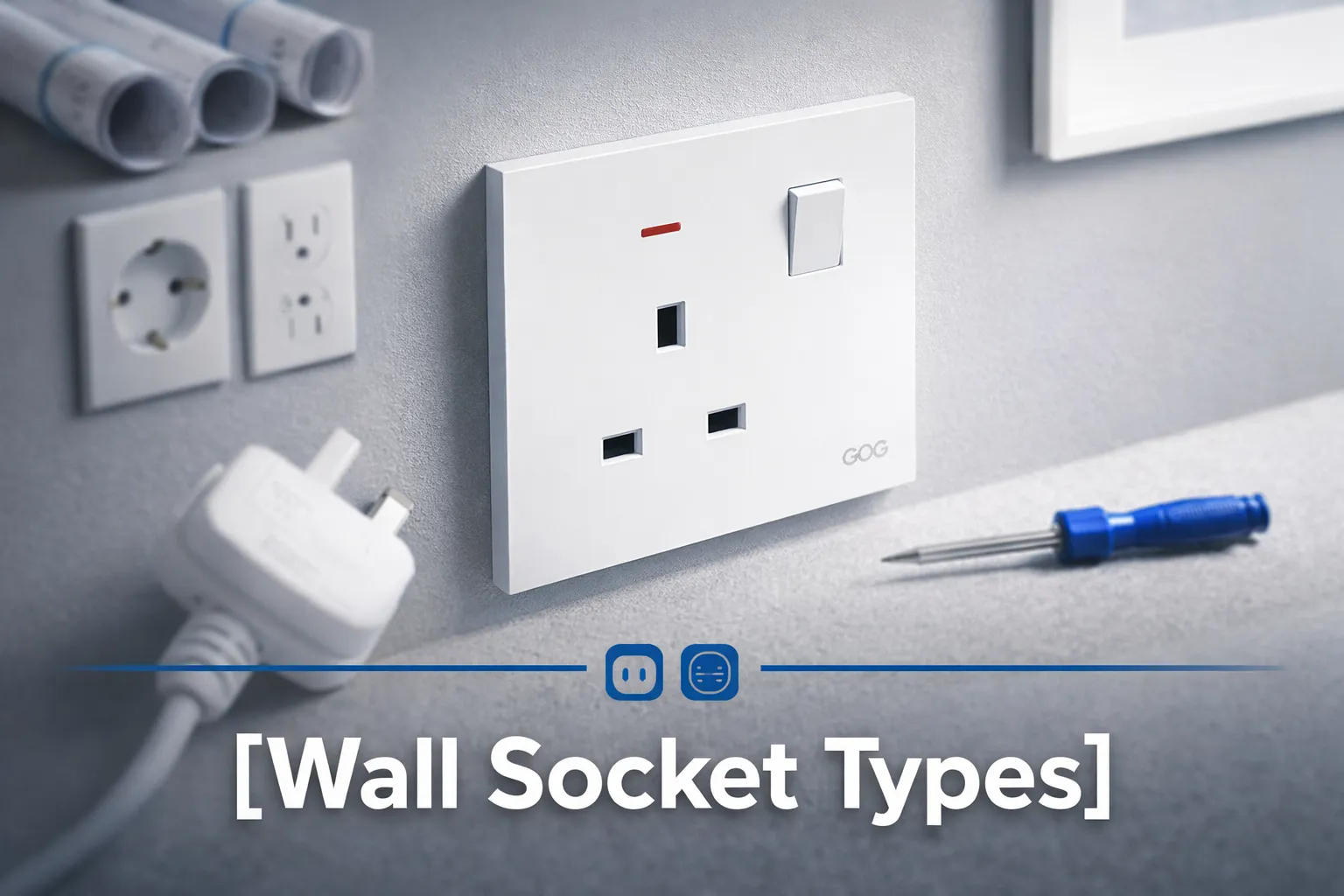
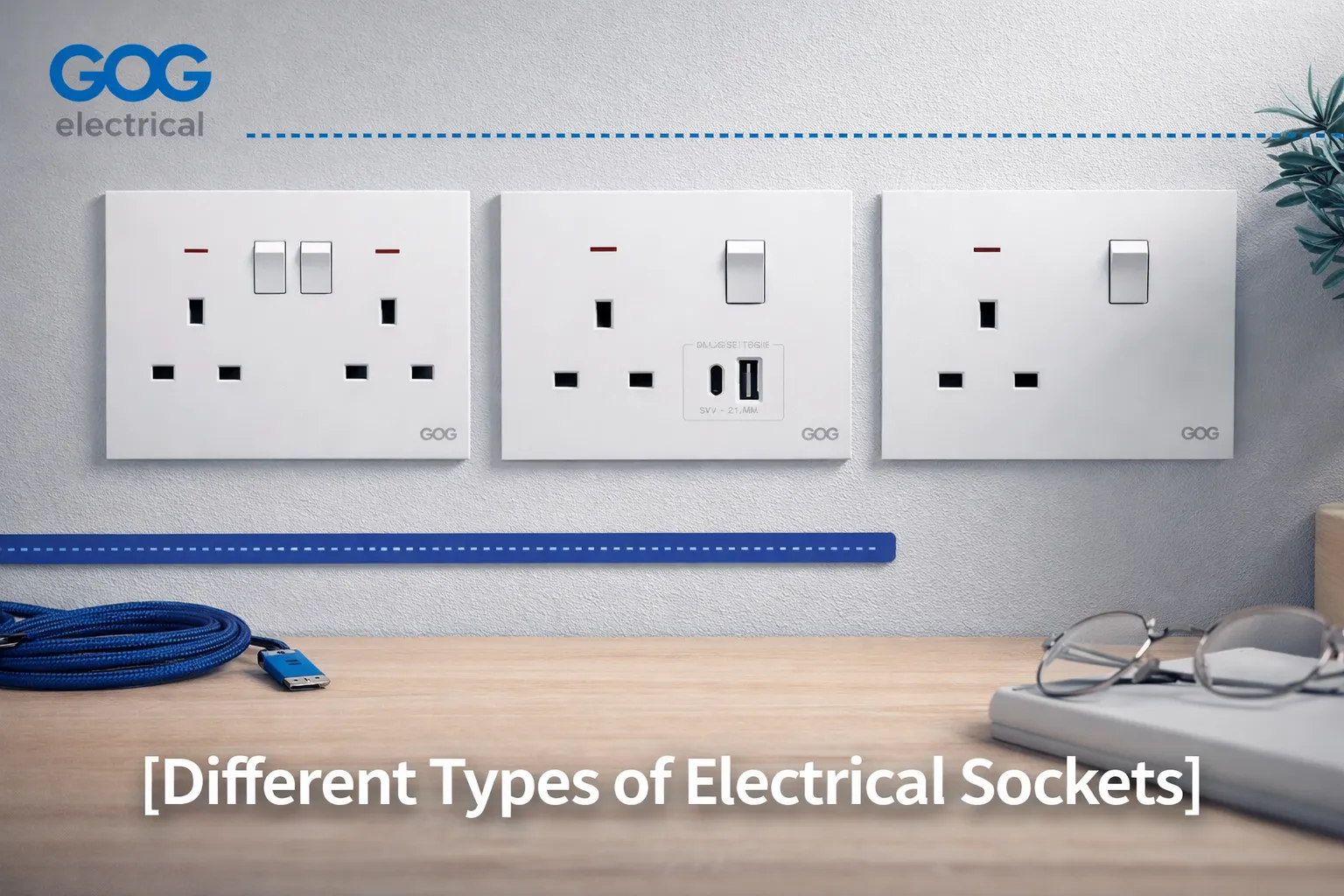
According to the information provided by the International Electrotechnical Commission (IEC) there are 15 types of plugs divided into different types of plugs and labelled from A to O.To understand how these plug types map to wall socket configurations, our guide on different types of electrical sockets provides a comprehensive reference.
Travel Adapter vs. Voltage Converter: The Critical Difference
This is the one single distinction that must be understood before one starts traveling, and it is responsible for more ruined gadgets and ruined vacations than any other electrical mistake made while traveling.
| Feature | Travel Adapter | Voltage Converter / Transformer |
|---|---|---|
| What it does | Changes plug shape to fit foreign socket | Changes voltage (e.g., 220V → 110V) |
| Converts voltage? | No | Yes |
| Converts frequency? | No | No (most consumer models) |
| Typical cost | $8–$35 | $35–$120 |
| Size / weight | Small, lightweight (2–5 oz) | Heavier and bulkier (8–20 oz) |
| Best for | Dual-voltage devices (phones, laptops, cameras) | Single-voltage devices (hair dryers, curling irons, some CPAP machines) |
| Power capacity | Up to the socket’s max (usually 10–15A) | Typically 200W–2000W (check rating carefully) |
How to Tell If Your Device Is Dual-Voltage
The first step in determining if your appliance is dual voltage is to check the information printed on the label of the power adapter. The following statements mean that the appliance is dual voltage and can be used almost anywhere without the need of a voltage converter.
For example, you might see something like “INPUT: 100–240V, 50/60Hz”. It means that you can use the appliance with only an adapter when you’re traveling around the world.If you see this kind of writing on the power adapter “INPUT: 120V, 60Hz” or “INPUT: 230V, 50Hz”, it means that you have a single-voltage appliance. The appliance cannot be safely operated in a country with different voltage without a voltage converter.
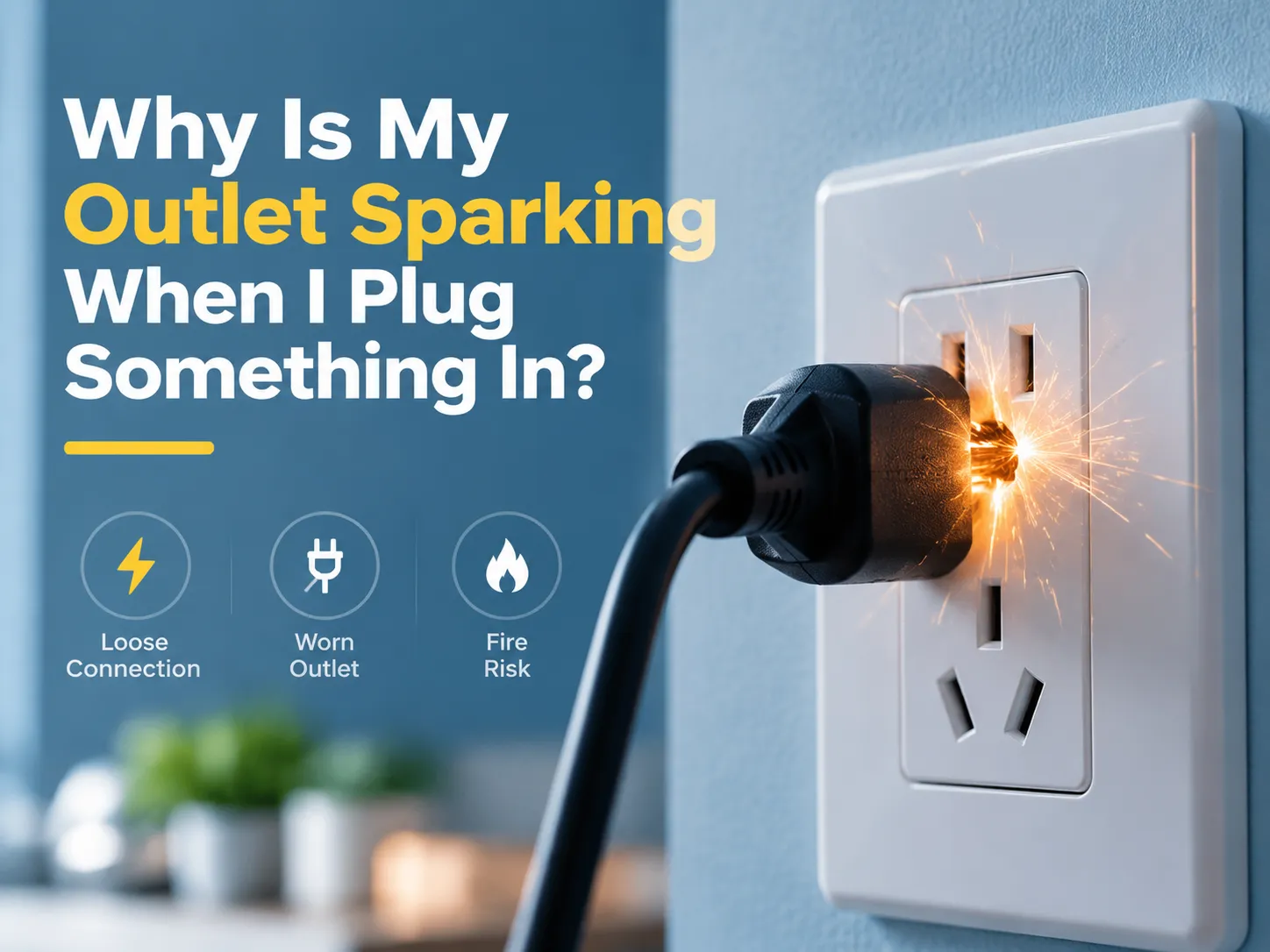
⚠ Warning: Connecting a single-voltage device rated 120V into an outlet rated 220V (even using a travel adapter) could cause instant destruction of the device and possibly start fire, electrocute you, or trip a circuit. The adapter may allow the plug to physically fit in the outlet — but 220V will be delivered to your device directly. Always read the voltage label on the devices to avoid accidents.
The 15 International Plug Types Explained
The IEC (International Electrotechnical Commission) introduced 15 types of electrical plugs these include plugs known as A to O. The table below is the complete reference for different types of plugs and their applications.
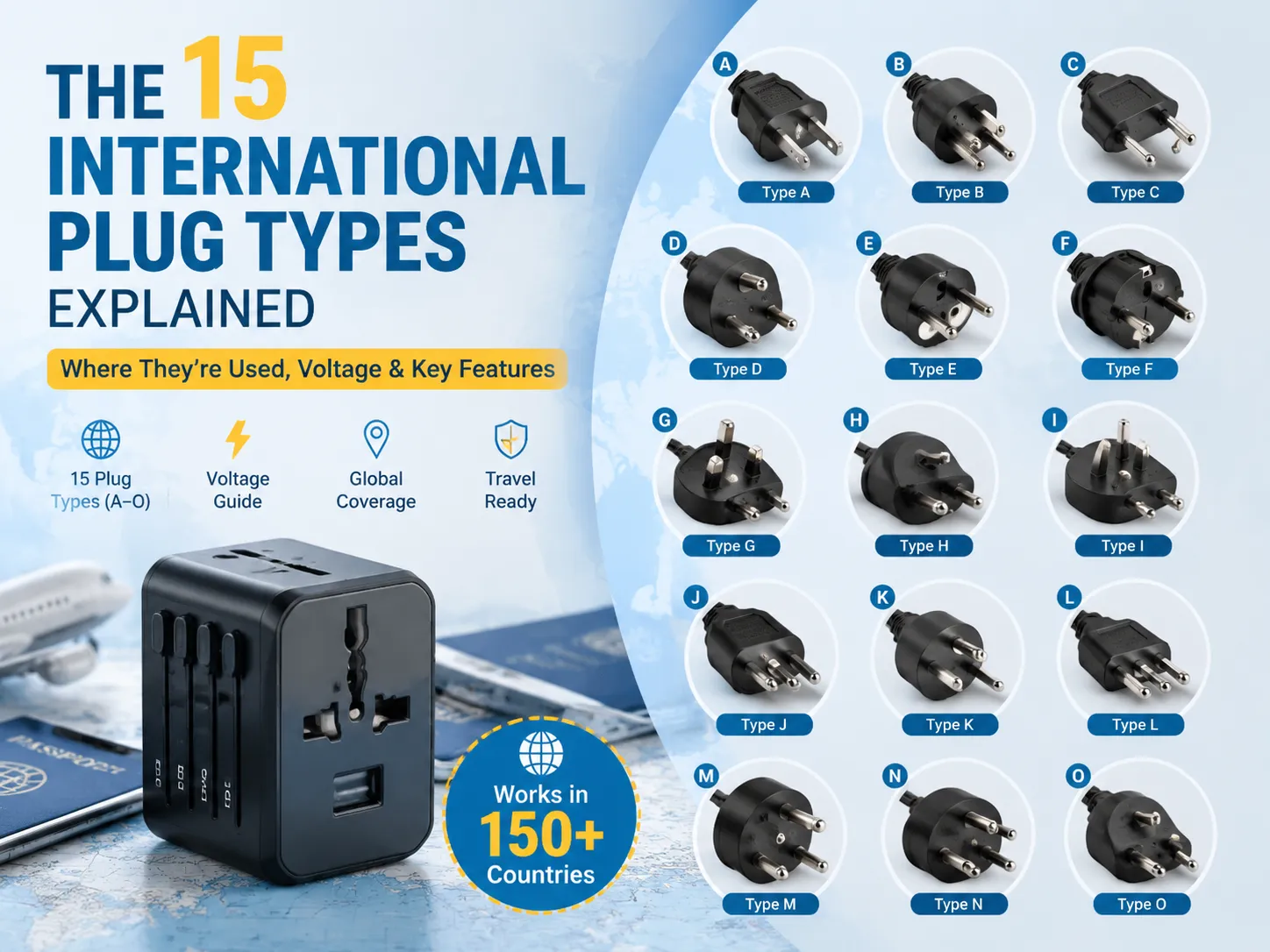
| Plug Type | Pin Description | Voltage / Frequency | Major Countries / Regions |
|---|---|---|---|
| Type A | 2 flat parallel pins (ungrounded) | 100–127V / 50–60Hz | USA, Canada, Mexico, Japan, Central America |
| Type B | 2 flat pins + round ground pin | 100–127V / 50–60Hz | USA, Canada, Mexico, Japan |
| Type C | 2 round pins (Europlug, ungrounded) | 220–240V / 50Hz | Most of Europe, South America, Asia, Africa |
| Type D | 3 large round pins in triangle | 220–240V / 50Hz | India, Nepal, Sri Lanka, Namibia |
| Type E | 2 round pins + ground hole (French) | 220–240V / 50Hz | France, Belgium, Poland, Slovakia, Tunisia |
| Type F | 2 round pins + side clips (Schuko) | 220–240V / 50Hz | Germany, Spain, Netherlands, Russia, South Korea |
| Type G | 3 rectangular pins in triangle | 220–240V / 50Hz | UK, Ireland, Singapore, Hong Kong, UAE, Malaysia |
| Type H | 3 flat pins in Y-shape | 230V / 50Hz | Israel, Palestine |
| Type I | 2 angled flat pins + optional ground | 220–240V / 50Hz | Australia, New Zealand, China, Argentina |
| Type J | 3 round pins (ground offset) | 230V / 50Hz | Switzerland, Liechtenstein |
| Type K | 2 round pins + ground pin | 230V / 50Hz | Denmark, Greenland |
| Type L | 3 round pins in a line | 230V / 50Hz | Italy, Chile |
| Type M | 3 large round pins (like Type D, larger) | 220–240V / 50Hz | South Africa, Botswana, Lesotho |
| Type N | 3 round pins (2 + ground) | 100–240V / 50–60Hz | Brazil, South Africa |
| Type O | 3 round pins in triangle | 220–240V / 50Hz | Thailand |
For travelers, the most common types encountered are Type A/B (North America/Japan), Type C/E/F (Europe), Type G (UK and Commonwealth), and Type I (Australia/China). A universal adapter that covers these four types of standards will work in more than 150 countries.For an overview of the major socket categories, our article on the four types of electrical outlets provides a simplified reference.
When Do You Need a Travel Adapter?
A travel adapter is a must when the plug configuration on your equipment differs from the socket plugs in the area where you’re traveling. Below are the main instances when you need to use a travel adapter:
1. Traveling From One Voltage Zone to Another
The world is classified into the following voltage zones: 100-127V (North America, parts of Japan and parts of South America) and 220-240V (Asia, Europe, Africa and Oceania). If you travel between voltages, you’re likely to run into entirely different sockets as well.
2. Traveling Within One Voltage Region But with Different Socket Types
Even in the 220-240V zone, there are many types of sockets. For example, the UK (Type G) and continental Europe (Type C/E/F) belong to the same 230V classification but when you go from Germany to the UK, you will need to use a travel adapter.
3. Traveling to Countries with Special Plug Types
Some countries have socket designs which are unique to those nations. India is a country with a Type D plug, South Africa has its Type M, Brazil is Type N and Israel belongs to the Type H category. Even a universal plug may not work so make sure your travel adapter has these unique types.
4. When You’re Not Sure What to Expect from Your Destination
There are some hotels and airports that provide universal sockets but don’t rely on that because smaller guest houses and rural hotels may not even have an electricity socket that fits your device. Always carry a traveling adapter just in case.
Tip:If you visit numerous destinations in one trip (for instance, a tour around Europe that consists of the UK and Switzerland), it would be best to use a universal adapter instead of individual adapters for each country.
Country-by-Country Adapter Guide
Here’s a quick-reference table for popular travel destinations, showing which plug type you’ll need and the local voltage:
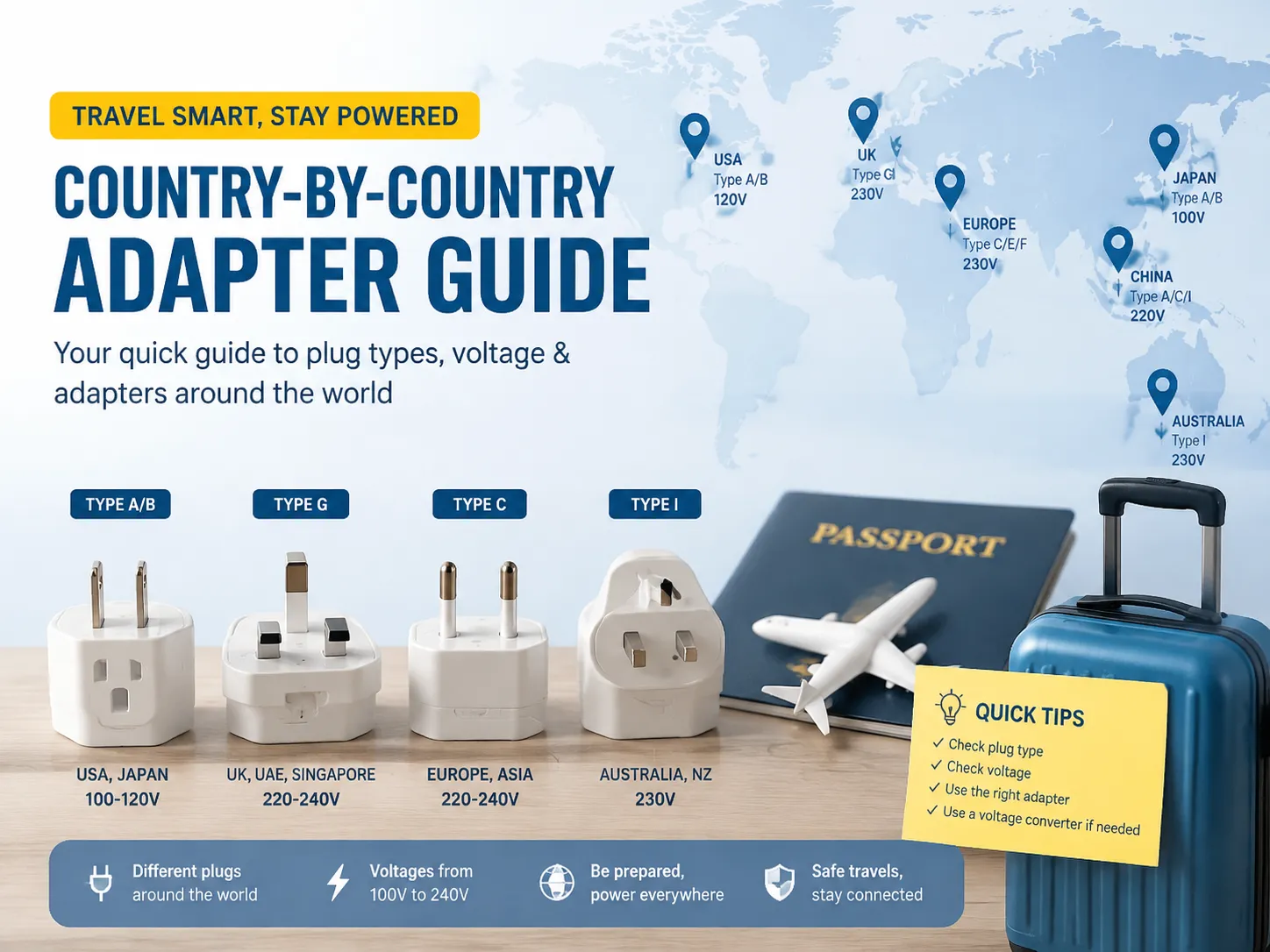
| Destination | Plug Type(s) | Voltage | Frequency | Adapter Needed From US? | Adapter Needed From UK? |
|---|---|---|---|---|---|
| United States | A, B | 120V | 60Hz | No | Yes (G → A/B) |
| United Kingdom | G | 230V | 50Hz | Yes (A → G) | No |
| France / Germany / Spain | C, E, F | 230V | 50Hz | Yes (A → C/E/F) | Yes (G → C/E/F) |
| Italy | C, F, L | 230V | 50Hz | Yes (A → C/L) | Yes (G → C/L) |
| Switzerland | C, J | 230V | 50Hz | Yes (A → J) | Yes (G → J) |
| Japan | A, B | 100V | 50/60Hz | No (plug fits) | Yes (G → A/B) |
| China | A, C, I | 220V | 50Hz | Yes (voltage) | Yes (G → A/C/I) |
| Australia / New Zealand | I | 230V | 50Hz | Yes (A → I) | Yes (G → I) |
| India | C, D, M | 230V | 50Hz | Yes (A → D) | Yes (G → D) |
| Thailand | A, B, C, O | 220V | 50Hz | Plug may fit (A/B) | Yes (G → C/A) |
| Brazil | C, N | 127/220V | 60Hz | Yes (A → N) | Yes (G → C/N) |
| South Africa | M, N | 230V | 50Hz | Yes (A → M) | Yes (G → M) |
| UAE / Dubai | G | 220V | 50Hz | Yes (A → G) | No |
| Singapore | G | 230V | 50Hz | Yes (A → G) | No |
| South Korea | C, F | 220V | 60Hz | Yes (A → C/F) | Yes (G → C/F) |
Important note: Some countries (for instance, Brazil, China and Thailand) have different plug types and have been used according to the region or the age of the building. So you need to be sure about your destination country and its requirements.
Types of Travel Adapters on the Market
Not every travel plug adapter is designed the same way. The different types of adapters are listed below with recommendations.
1. One-Country Plug Adapters
The simplest and most affordable type, for use in one particular destination only. Costs between USD 5 and USD 12 and is most suitable for traveling to a single country. Many hotels will also have them available for borrowing, but don’t rely on this.
2. Worldwide Travel Adapters (All-in-One)
The most widely used and popular type. One device is equipped with several retractable pins that adapt to 4-6 plug types. Almost all modern devices also charged LED devices and tablets through the USB port. Prices fluctuate from USD 15 to USD 40. Popular brands include Epicka, TESSAN, Ceptics, and OREI.
3. Plug Adapter Kits
A plug with many plug adapters in one case, plus a physical adapter that receives a plug type. Popular brands of plug kits are Ceptics and Kensington among others. This type is recommended for those who travel often and need some spare adapters and also have some plug types not covered by universal adapters (like D, M, or N).
4. Adapters with Voltage Converters
This type can adapt a plug and convert voltage (from 220V to 110V). They are bigger and costlier (40-120 USD) but necessary for travelers with devices with one voltage (example – a hair dryer). Brands BESTEK and TESSAN produce very useful sets. One more thing – make sure to check the power rating as there usually can be something about 200W to 500W, which is not enough for the right powered hair drier (1500 W and more).
5. Smart Travel Adapters with USB-C PD
The newest type made by the following brands – Anker and Zendure. All devices show USB PD (as known as USB Power Delivery) of around 65-75 Watt allowing fast charging of laptops and connected devices at once through various USB connections.For travelers who need to charge phones and laptops via USB, our USB charger socket guide covers the key specs to look for.
How to Choose the Right Travel Adapter
With so many options on the market, here are the key factors to evaluate:
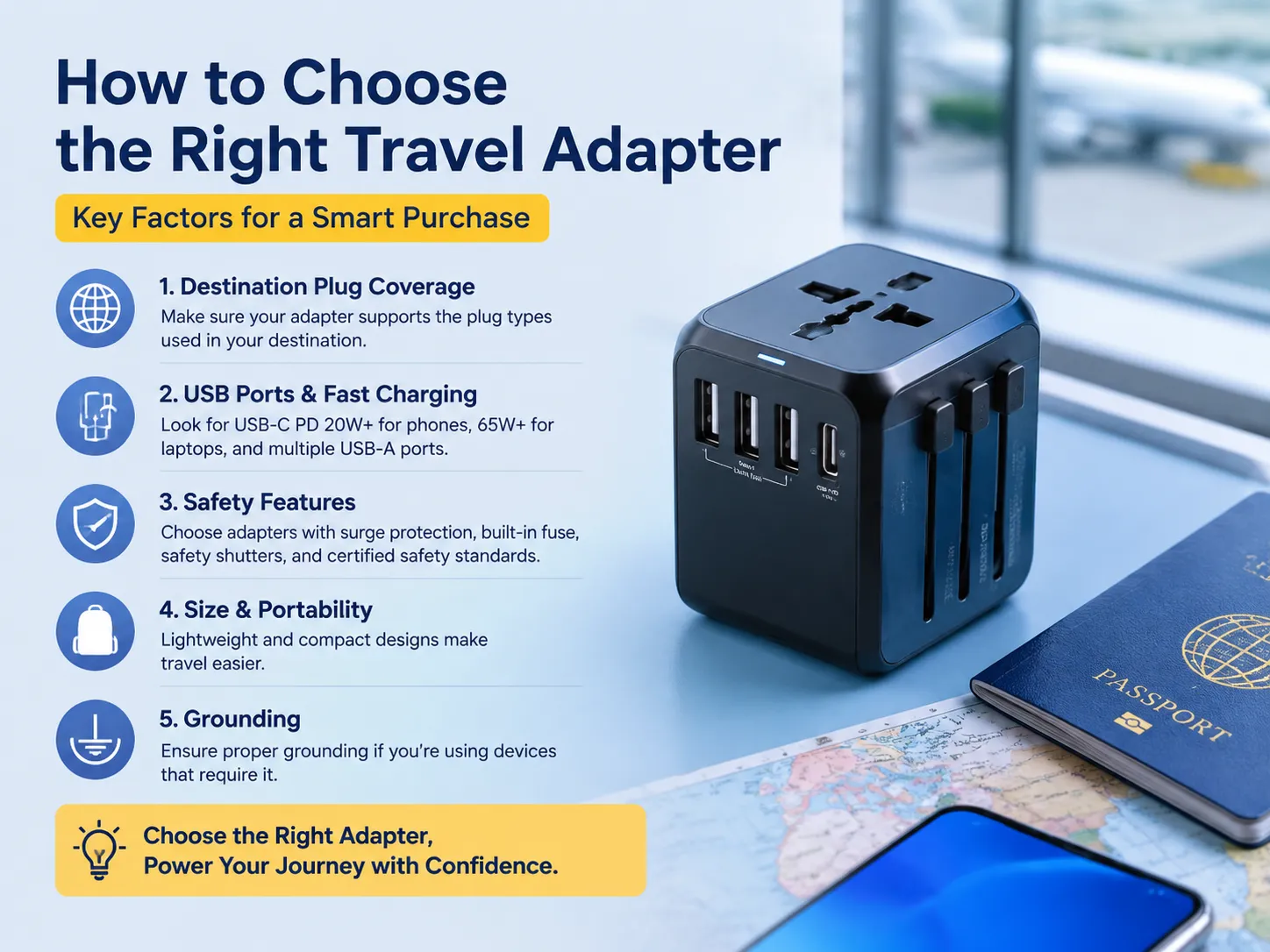
1. Destination Plug Coverage
Before making a purchase, you first need to identify the types of plugs in the country you are traveling to (see table above). After that, you should ensure that an adapter matches those types. Generally, universal adapters are compatible with Types A, B, C, E/F, G, and I; but several types, such as D (India), M (South Africa), and N (Brazil), tend to be forgotten. In case you are going to one of those countries, make sure to see the adapter list beforehand or to buy an additional adapter for one specific country.
2. USB Ports and Fast Charging
If you’re charging phones, tablets, or laptops, look for an adapter with built-in USB ports. Key specs to check:
| Feature | What to Look For |
|---|---|
| USB-C Power Delivery | 20W+ for phones, 65W+ for laptops |
| USB-A ports | 2+ ports for simultaneous charging of multiple devices |
| Total output | Check combined wattage — some adapters throttle when all ports are used |
| Quick Charge support | QC 3.0 or QC 4+ for compatible Android devices |
3. Safety Features
Search for adapters that come equipped with the following certifications and features:
- Surge protection — protects the devices against spikes in voltage (common in the older buildings located in developing countries)
- Integrated fuse — rated at 6A or 10A; blows in case of excess current which protects the devices
- Safety shutters — prevent unwanted contact since they shield the empty pinholes
- Flameproof casing — usually made from polycarbonate or ABS V-0
- Certifications — CE, FCC, RoHS, and preferably BS 8546
4. Size and Portability
When you’re traveling with only a rucksack and the bare essentials, each and every gram counts. The most lightweight universal adaptors weigh below 85 grams which is very much Quantum in a traveling context. However the heaviest adapters with voltage converters weigh between 225 and 565 grams. So it is important to check the dimensions because not all of them fit perfectly in other outlets.
5. Grounding
Some worldwide adapters aren’t grounded; instead, they have only two pins on them. This provides an advantage when you are using these devices with phone chargers and laptops, which are double insulated and do not require grounding. However, this becomes a major drawback when your device needs to be grounded. Make sure you get the kind of adapter that explicitly states it is grounded for all kinds of plugs.
Travel Adapter Price Guide: What to Expect
Travel adapter prices vary widely based on type, features, and brand. Here’s a breakdown by category:
| Adapter Type | Price Range | Popular Brands & Models | Best For |
|---|---|---|---|
| Single-country plug adapter | $5–$12 | OREI, Ceptics single-type | One-country trips |
| Basic universal adapter (no USB) | $10–$18 | OREI Universal, Ceptics basic | Budget travelers with USB chargers |
| Universal adapter with USB-A ports | $15–$30 | Epicka TA-105 ($19.99), TESSAN ($19.99–$27.30) | Most travelers |
| Universal adapter with USB-C PD | $25–$45 | Ceptics 70W ($31.99), Anker Nano ($25.99) | Laptop + phone charging |
| Premium universal with 65W+ PD | $45–$95 | Zendure Passport III ($69.99), MOMAX 170W ($67.93), TA-105 Max ($59.99) | Business travelers, digital nomads |
| Modular adapter kit (9+ plugs) | $25–$40 | Ceptics World Kit ($35), Kensington | Frequent multi-country travelers |
| Adapter + voltage converter combo | $35–$120 | BESTEK 250W ($55–$65), TESSAN 350W ($40–$50) | Travelers with single-voltage devices |
Price by Region (Single-Country Adapters)
| Destination Region | Plug Type Needed | Single Adapter Price |
|---|---|---|
| Europe (Type C/E/F) | C, E, or F | $5–$10 |
| UK / Singapore / Hong Kong (Type G) | G | $6–$12 |
| Australia / New Zealand / China (Type I) | I | $6–$12 |
| India (Type D) | D | $8–$15 |
| South Africa (Type M) | M | $8–$15 |
| Brazil (Type N) | N | $8–$15 |
| Japan (Type A/B) | A or B | $5–$10 |
Tip: For the majority of travelers, a universal adapter with USB-C charging, priced between $20 and $35, provides the best option. Epicka’s TA-105 ($19.99) and TESSAN’s universal adapter ($19.99-$27.30) are the highest-rated in that range and can be used in more than 150 countries. If you need a device that can charge a laptop fast, you could get the Ceptics 70W ($31.99) or Zendure Passport III ($69.99) adapters.
Safety Tips: Don’t Fry Your Devices
Using a travel adapter the wrong way can ruin your devices, trip the circuit in your hotel, or even cause a fire. Observe the following safety rules:
1. Check the Charging Compatibility First
Before connecting anything, take a look at the voltage written on your device’s charger. If it states “100–240V” on it, you can use just an adapter without any problems. However, if it states “120V only” (or “230V only”) and the outlet has a different voltage rating, you will have to use a voltage converter instead of just an adapter.
2. Never Exceed the Adapter’s Current Rating
Most travel adapters are provided with 10A or 15A rate. The amount of energy being supplied will be in the range of 230-3450 watts, which is sufficiently enough for charging phones, computers, or cameras. Nevertheless, high-wattage devices as hair driers (around 1500-2000W), electric kettles (1500-3000W), and heaters should not be charged with the help of a travel adapter. Otherwise, it can lead to melting it or tripping the circuit. High-wattage appliances should always be connected to a correct and dedicated outlet.
3. Be Careful with Imitations
An extensive amount of affordable imitation adapters can be easily found on the Internet. They are commonly made with poor quality materials, do not have any protection from voltage surges, and are not certified. It is worth spending a little more money and buying the device from reputable manufacturers (such as Epicka, TESSAN, Ceptics, OREI, Anker, and Zendure), as well as checking the certificates on the manufacturer’s webpage.
4. Do Not Connect Adapters to Each Other
If you connect an adapter to one more adapter, then the power strip and then the outlet, the devices are bound to fail and there is also a fire risk. Therefore, if you need more sockets, just make use of a travel power strip limited to one adapter, but no multiple adapters.
5. Be Careful of Overheating
If an adapter is very hot after being used, unplug it. This will mean there is a wrong connection, an overloaded circuit, or a defective adapter. While it is normal for them to be warm while charging a phone, it should not melt the casing.
Common Mistakes to Avoid
1. Confusing Adapter with Converter
The most common mistake. An adapter alters the physical alignment of the plug. A voltage converter alters the current load. You will ruin your gadget if it is not designed to operate with different voltages and you only use an adapter. Always check the voltage specifications on your charger first.
2. Buying a universal adapter which does not work in your destination country
A lot of “universal” adapters do not include type D (India), type M (South Africa), type N (Brazil) or type L (Italy). When buying one, make sure to read the technical specifications carefully. If none of them is the one you are going to use for charging devices, consider buying several different single country adapters.
3. Not taking USB charging cables
Even the best universal adapter with USB ports won’t help you if you haven’t packed your USB C cable. Have an extra USB cable for each kind of device you have with you.
4. Assuming that the hotel will have universal sockets
Some hotels have universal sockets which allow you to plug in different kinds of chargers. However, a lot of budget hotels, hostels and AirBnBs provide their guests with local sockets only. Make sure to have your own adapter, so you do not have to rely on hotels potentially having them at the reception.
5. Forgetting that different regions experience different frequencies
Devices with motors and clocks (for example, electric shavers, alarm clocks, turntable etc.) work at different rates when they are used in different frequency environments (50Hz or 60Hz). Although most modern electronics do not depend on frequency, make sure to check the label of your device if you are taking an electronic device with a motor with you.
Frequently Asked Questions
What is the difference between a travel adapter and a travel charger?
A travel adapter is an outlet adapter that allows your device’s plug to fit into foreign electrical outlets. It does not convert power and does not charge anything — it just has a physical point of connection. A travel charger, by contrast, is a charger that does change the AC power from the outlet to DC power in order to charge your phone or computer. A travel charger has its own power electronics (voltage regulator, rectifier, USB output ports) and can have, or not have, attachments for countries. Many modern universal adapters include USB charging capacity so clearly draw the line oneself between an adapter and a charger; however, this distinction is important. If your adapter has USB ports, it works as both a charger and an adapter. If it has only an AC socket, you will have to use your charger to change AC into USB. Simply find a universal travel adapter with USB and USB-C ports, and that will work as an adapter and a charger.
How do I know if I need a travel adapter or converter?
Check the label on your device’s charger. Check for “INPUT” information on it:
If it has “INPUT: 100–240V, 50/60Hz” (or other range options) mentioned, then your device is dual-voltage and it will just need an adapter for it to fit the socket of the foreign country – no converter required for the operation. Most of the latest phone chargers and laptop chargers and camera chargers and tablet chargers are dual-voltage.
If it has “INPUT: 120V, 60Hz” (for US only) or “INPUT: 230V, 50Hz” (for Europe only) written, then your device is single-voltage and you will need a voltage converter for it (in addition to the plug adapter). Otherwise if you plug a 120V device into a 230V outlet with just an adapter, then you will destroy it and may even start a fire.
As a rule of thumb, almost all phones, laptops, cameras and tablets are dual-voltage. Hair dryers, curling irons, hair shavers and some older electronics are often single voltage devices.
What is the difference between a travel converter and adapter?
A travel adapter and a travel converter have totally different functions.
Travel adapter — Changes the configuration of your plug so it fits the foreign wall outlets and does not change voltage, current or frequency of the electricity. Travel adapter is a mechanical connector that is light and small in size (2–5 oz). Cost: $8–$35. Use it when your electrical device is dual-voltage (100–240V).
Travel converter (also known as voltage converter or transformer) — Actually changes the voltage of the electricity. In a step-down converter, 220–240V is lowered to 110–120V, making 120V devices usable in 230V countries. In a step-up converter, the operation is opposite. Converters are bigger, heavier (8–20 oz) and more expensive (from $35 to $120). They have to have the wattage (200W to 2000W) that exceeds your device’s consumption. Use a converter when your device has only one voltage, and the destination voltage is different.
There are some devices that combine both functions — an adapter with the step-down converter inside — but this is an exception. In most cases, a traveler needs to use only an adapter since smartphones, computers, and cameras are dual-voltage devices.
What does a travel adapter look like?
The type of travel adapter determines what it looks like.
Single-country adapter: This is a compact plug that has one side shaped according to the plug design of the home country and one as per the shape of the socket used in the country one is travelling to. Usually, it is 1.5-2.5 inches which means these are basically plugs having sockets on the other end.
Universal adapter: This is either rectangular or square shaped and is about 2-3 inches in size. It contains a sliding or push button which provides access to the different pin sets. Most of these adapters contain Type A and Type C socket at one end and 2-5 USB ports on the other. These types of adapters are approximately the size of a deck of cards.
Universal adapter with USB ports: Identical to the above one, but instead of simple USB ports, it has 2-5 of them available. Some advanced models would have LED lights and another reset button for the special safety feature of the device.
Adapter + converter combo: This one is bigger and heavier compared to the previous two. It has the presence of AC input cable along with the transformer and output sockets.
References
- International Electrotechnical Commission (IEC) — IEC 60083 standard defining the 15 international plug types (A–O) and their dimensional specifications.
- NEMA (National Electrical Manufacturers Association) — NEMA 1 and NEMA 5 standards for Type A and Type B plugs used in North America.
- Travel-Adaptor.com Plug Type Reference — Comprehensive country-by-country database of plug types, voltages, and frequencies for all 15 IEC plug types.
- BSI (British Standards Institution) — BS 8546 standard for travel adapters, covering safety requirements, mechanical strength, and thermal performance.
- UL (Underwriters Laboratories) — UL 498 standard for attachment plugs and receptacles, and UL 60884-1 for plugs and socket-outlets for household use.
- U.S. Consumer Product Safety Commission (CPSC) — Electrical safety guidelines for travelers, including warnings about voltage mismatch and counterfeit adapters.
- Anker Travel Adapter Guide — Manufacturer reference on universal adapter features, USB-C Power Delivery specs, and safety considerations.
A travel adapter is perhaps one of the most crucial tools for traveling abroad but is also one of the most confusing accessories. The main point to know is that a travel adapter only converts your plug to a suitable shape but does not convert the voltage. If your device is dual voltage (or compatible with the voltages ranging from 100 to 240, as nearly all modern phones, laptops, and cameras are), a simple adapter should do. However, if you are carrying single voltage appliances like hair dryers and curling irons, you would also need a voltage converter.
A universal travel adapter with USB-C and USB-A ports in the range of $20-$35 would be the best option for most travelers. Brands like Epicka, TESSAN, Ceptics, and Anker produce reliable products that can be used in over 150 countries and offer surge protection as well as fast charging. Before purchasing one, you should check if the adapter supports the plug type of your destination.