

Fiches et prises électriques du Japon – Type A/B, adaptateur nécessaire ?
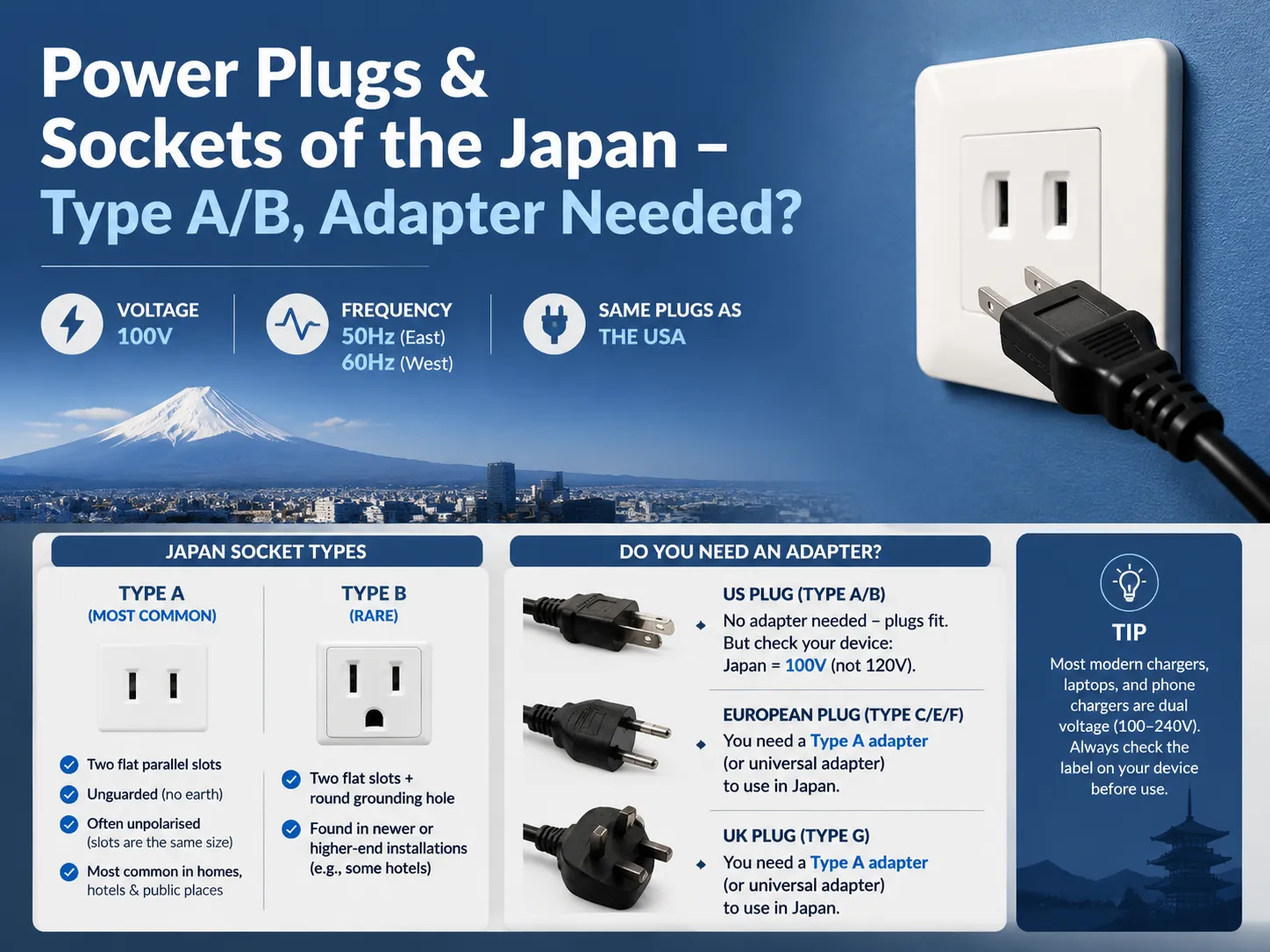
Le pays du Japon est l'endroit où la technologie la plus récente fusionne avec la philosophie ancienne. Cependant, les visiteurs peuvent être surpris d'apprendre certains aspects du système électrique adopté dans ce pays. Bien que les Japonais utilisent les mêmes types de prises A et B que celles utilisées aux États-Unis, il existe certaines caractéristiques distinctives. La tension = seulement 100V et la fréquence = l'une des deux (dans l'est du Japon, elle est de 50Hz et dans l'ouest du Japon, elle est de 60Hz). Dans ce guide, vous trouverez toutes les informations nécessaires sur les prises, les sockets, les systèmes de tension et de fréquence au Japon. De plus, nous allons répondre à certaines questions populaires que vous vous posez probablement en ce moment.
Type de prise électrique au Japon
La prise murale de type A est le type standard au Japon. Sa principale caractéristique est qu'elle possède deux broches plates mais ne dispose pas d'un système de mise à la terre. En revanche, la prise de type B existe mais est beaucoup plus rarement trouvée. La prise de type A est largement utilisée dans les maisons privées, les hôtels et les bâtiments publics.
Points clés concernant les prises japonaises :
- Type A – deux broches plates parallèles, non mises à la terre. C'est la norme.
- Type B Il y a deux broches plates et une broche de terre ronde.
- Polarisation – Les prises japonaises de type A sont généralement non polarisées (les deux ouvertures sont égales) permettant d'insérer une prise dans n'importe quelle position. Ce n'est pas le cas des prises américaines où une ouverture est plus large que l'autre.
- Volets de sécurité – La majorité des prises ne disposent pas de volets de sécurité, ce qui signifie qu'elles ne sont pas aussi sécurisées pour les enfants que les prises modernes européennes ou britanniques.
Lors de l'utilisation d'un appareil à trois broches (prise de type B), vous devez utiliser un convertisseur de type A (qui transforme simplement la prise à trois broches en une prise à deux broches) puisque les prises de type B sont rares. Alternativement, vous pouvez acheter un simple adaptateur de mise à la terre, qui se fixe à la vis de la prise, mais pour la plupart des touristes, il suffit d'utiliser uniquement un adaptateur de prise.
Type de prise au Japon
Les types de prises utilisés au Japon sont :
- Prise Type A – deux broches plates parallèles, sans broche de terre. C'est la norme pour presque tous les appareils.
- Prise Type B – identique au type A mais avec une broche de terre ronde. Rarement utilisé en pratique, sauf pour certains appareils lourds.
Si la prise de votre appareil est de type américain (A ou B), elle devrait s'adapter à la prise électrique au Japon, mais il y aura une légère différence de tension (100V, comparé à 120V). La plupart des appareils peuvent fonctionner correctement avec cette différence, mais il est prudent de vérifier l'étiquette. Si votre appareil possède une prise britannique ou européenne, vous devrez soit obtenir un adaptateur de type A, soit disposer d'un adaptateur universel qui possède l'une des prises US/japonaises.
Astuce pro : Les prises japonaises sont identiques aux prises américaines de type A en termes de conception, cependant, elles diffèrent en tension ; les prises japonaises fournissent 100 V au lieu de 120 V. Ainsi, de nombreux gadgets américains, en particulier les chargeurs, supportent la tension requise par les prises japonaises. Néanmoins, certains gadgets fonctionnant exactement à 120 V peuvent rencontrer des difficultés à utiliser correctement les prises japonaises ; ils peuvent fonctionner à un rythme plus lent sur ces prises.
Tension et fréquence au Japon
Le Japon fonctionne avec une tension standard de 100 volts, qui est la plus basse comparée à celle des autres grandes nations industrielles. Cette tension est inférieure à la tension américaine de 120 volts, et bien plus basse que la norme européenne de 230 volts.
Les fréquence est divisée par région :
- Japon de l'Est (y compris Tokyo, Yokohama, Tohoku) – 50 Hz
- Japon de l'Ouest (y compris Osaka, Kyoto, Hiroshima, Fukuoka) – 60 Hz
Cette différence de fréquence impacte rarement les appareils contemporains (qui utilisent des alimentations à découpage), mais elle peut affecter les moteurs dans des dispositifs tels que les horloges électriques, les tourne-disques ou les tondeuses à cheveux. La plupart des voyageurs n'ont pas à s'inquiéter, car les chargeurs et adaptateurs pour ordinateurs portables sont généralement compatibles dans le monde entier.
Ceux qui viennent d'un pays utilisant 230V auront besoin d'un convertisseur qui augmente la tension afin d'utiliser des appareils ne supportant pas la double tension. La plupart des appareils électroniques tels que les ordinateurs portables et les téléphones sont à double tension et fonctionnent correctement tant que cela est indiqué sur l'étiquette.
Ai-je besoin d'un adaptateur de voyage pour le Japon ?
Cela dépend de votre origine et de votre appareil. Le tableau ci-dessous donne un aperçu rapide pour les régions courantes des voyageurs.
| Votre pays / région | Votre type de prise | Besoin d'un adaptateur pour le Japon ? | Compatibilité de tension |
|---|---|---|---|
| États-Unis / Canada | Type A/B (120V) | ❌ Non – les prises s'adaptent (Type A) / ⚠️ Type B nécessite un adaptateur vers A | ⚠️ 120V contre 100V – la plupart des appareils tolèrent, mais vérifiez l'étiquette |
| Mexique | Type A/B (127V) | ❌ Non – les prises s'adaptent (A) / ⚠️ B nécessite un adaptateur | ⚠️ 127V contre 100V – vérifiez la tolérance de l'appareil |
| Royaume-Uni / Irlande | Type G (230V) | ✅ Oui – besoin d'un adaptateur Type A | ⚠️ 230V contre 100V – besoin d'un convertisseur abaisseur pour les appareils non double tension |
| Europe (la plupart des pays) | Type C/E/F (230V) | ✅ Oui – besoin d'un adaptateur Type A | ⚠️ 230V contre 100V – besoin d'un convertisseur pour les appareils non double tension |
| Australie / Nouvelle-Zélande | Type I (230V) | ✅ Oui – besoin d'un adaptateur Type A | ⚠️ 230V contre 100V – besoin d'un convertisseur pour les appareils non double tension |
| Chine | Type A, C, I (220V) | ✅ Oui – besoin d'un adaptateur Type A (si utilisation de C/I) | ⚠️ 220V contre 100V – besoin d'un convertisseur pour les appareils non double tension |
| Inde | Type D/M (230V) | ✅ Oui – besoin d'un adaptateur Type A | ⚠️ 230V contre 100V – besoin d'un convertisseur pour les appareils non double tension |
| Afrique du Sud | Type M (230V) | ✅ Oui – besoin d'un adaptateur Type A | ⚠️ 230V contre 100V – besoin d'un convertisseur pour les appareils non double tension |
| Brésil | Type N (127V / 220V) | ✅ Oui – besoin d'un adaptateur Type A | ⚠️ 127V / 220V contre 100V – vérifiez la tension ; les appareils 127V peuvent fonctionner, ceux à 220V nécessitent un convertisseur |
Point clé : Utiliser une prise US/Canadienne (Type A) est possible si vous avez un adaptateur pour Type B (prise à trois broches) ou une prise Type A. Toute personne avec un autre type de prise aura besoin d'un adaptateur de prise Type A. En termes de tension, si vos appareils sont à double tension (100-240V), l'adaptateur devrait fonctionner. Si vos appareils sont uniquement 120V, ils devraient également fonctionner correctement à 100V (mais avec une puissance légèrement réduite). En revanche, les appareils à 230V nécessitent un convertisseur abaisseur.
Un adaptateur universel avec des connexions compatibles US/Japon est un bon achat, surtout pour les voyageurs se rendant également en Amérique du Nord.
Questions fréquemment posées (FAQ)
Les prises japonaises et américaines sont-elles identiques ?
Physiquement, oui – elles utilisent toutes deux des prises Type A (deux broches plates). Néanmoins, il existe des différences : les prises japonaises sont généralement non polarisées (aucune des broches n'est plus épaisse), et la mise à la terre est absente (les connecteurs B sont rarement utilisés). De plus, le Japon a une tension de 100 V tandis que les États-Unis ont une tension de 120 V. Par conséquent, vous pouvez insérer une prise américaine dans une prise japonaise, mais comme la tension est plus basse, la plupart des appareils fonctionneront quand même.
Which plug adapter do I need for Japan?
In order to use the device, it requires a type A plug (which is characterized by having two flat parallel pins). If the device happens to have a 3-prong plug (which belongs to type B), then a type A adaptor will be necessary that converts the 3-prong plug to a 2-prong adapter; this type of adapter is often referred to as a grounding adapter. Most universally compatible adaptors come with this type of conversion. If your device is using a European, UK, or Australian plug, it will still require the type A adapter in order to be used.
Can I use a US iPhone charger in Japan?
Yes, absolutely. Apple’s USB power adapters can be used in Japan because they are rated for 100-240V and are compatible with 50 and 60 Hz. The connection (Type A) works with the electrical sockets in Japan. There is no need for an adapter since you just plug it into the socket without any further requirements.
Do I need to bring an outlet adapter to Japan?
It depends on your devices. If the plugs of all your devices are of the American type A with their two prongs, plug pins into the wall socket, and the devices ran on dual voltage (such as smartphones, tablets, or laptops), then no adapter is needed- you can proceed without the adapter.
If the plug is of type B (three-pronged), just an adapter made to ground it is needed. If the plug is of a different type (European, British, etc.), then it is necessary to have an adapter of type A. A small universal adapter with American plugs on it is a useful and inexpensive item to carry while traveling.
Can I use my European hair dryer in Japan?
In Europe, hair dryers use 230V. Using one in a 100V outlet produces very little heat and airflow, if any at all. Moreover, the plug will not fit without an adapter. So, in order to use a European hair dryer, one needs to first bring it from 100V to 230V. Due to high wattage of the device, the converters are usually oversized and costly. For this reason, most people traveling to Japan buy themselves an inexpensive Japanese version of hair dryer.
Are power strips common in Japanese hotels?
Not necessarily so. Numerous hotels have limited electrical plugs, very occasionally just one or two close to the desk. Therefore, it is advisable to take along a compact power strip with a type A plug, or a multi-port USB charger, thus enabling you to charge several devices at once.
Travel Tips for Using Electronics in Japan
- Vérifiez les étiquettes de tension – Even if the plug is compatible, the voltage is also important. While most chargers are able to support multiple voltages, some devices, such as hair styling tools, only function at a specific voltage.
- Apportez une batterie externe – Japan is a fantastic destination for photography as well as navigation. Therefore, you will have to use your smartphone extensively. Having a power bank while you are there is quite necessary.
- Prises dans les hôtels – In some traditional inns (ryokan), an old-fashioned electrical socket may be found. A multi-port charger or travel power strip will take care of that.
- Frequency difference – If you bring any item that has a synchronous motor in it, like a record player, then you should be careful that the difference of 50 and 60 Hz may impact the working of device. Nevertheless, for most tourists, this does not make a big difference.
- USB ports – Many contemporary hotels located in metropolitan areas install USB-A ports, although they are not guaranteed. It is advisable to take along your own charger with you.
- Be cautious with 100V – Appliances rated at 120V in the US work with a 100V supply, and they will not sustain any harm; however, there may be drop in efficiency.
Résumé
The electric system in Japan uses Type A sockets with a voltage of 100V/50Hz (in the East) or 60Hz (in the West). Travelers from the USA and Canada can connect their devices without the use of any adapters – they only need to have the Type A plug. However, keep in mind that there is a difference in the voltage. People travelling from other countries need to make use of a Type A plug adapter in addition to a voltage converter. Luckily, the majority of new electronics function properly in Japan.
Bon voyage et bonne charge !