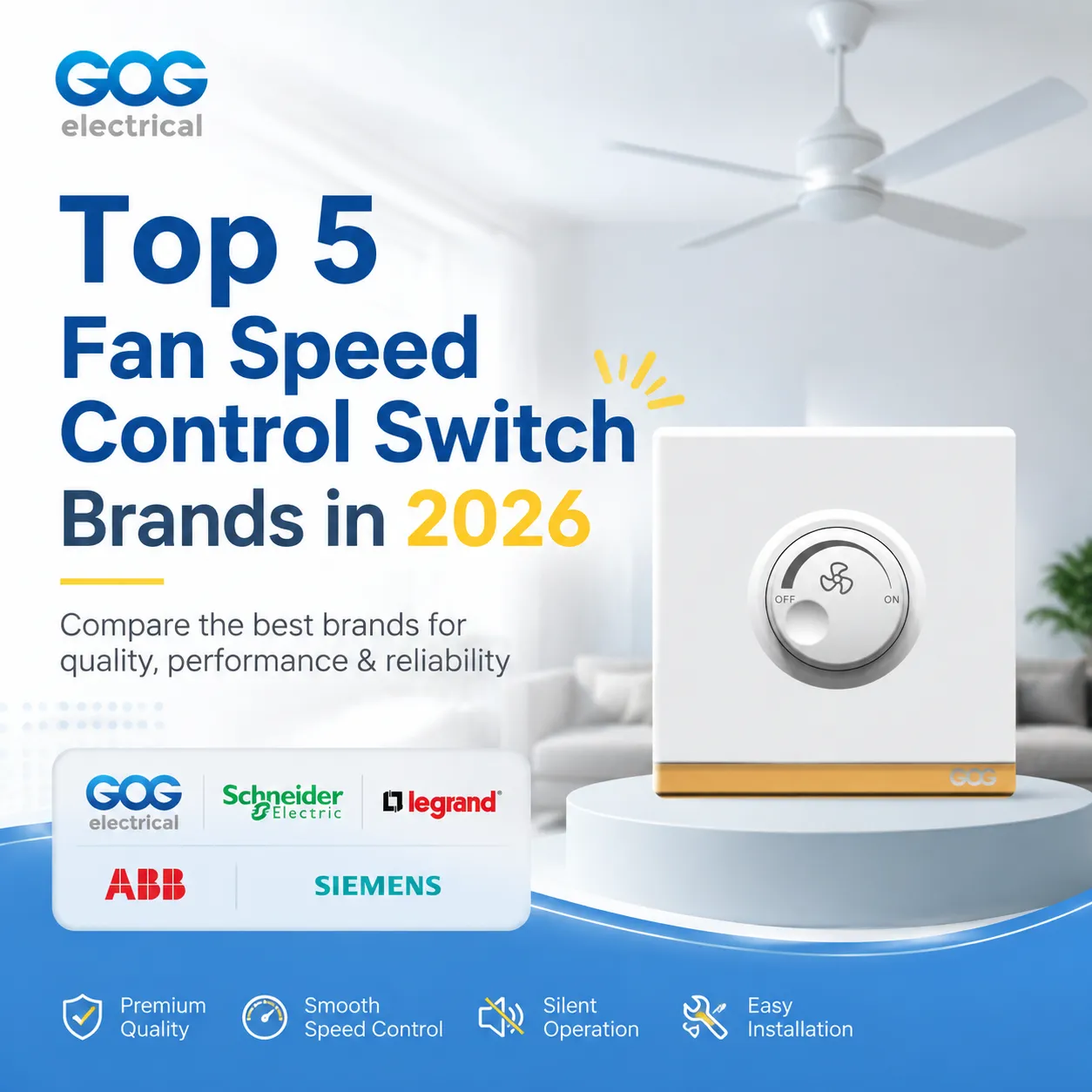
Se você está cansado de puxar a corrente para mudar a velocidade do seu ventilador de teto, ou se você é um fornecedor ou empreiteiro procurando por bons interruptores de controle de velocidade de ventilador para comprar, você encontrará este mercado completamente saturado. Existem muitas marcas como Lutron, Leviton, Westinghouse, Hunter, Hampton Bay, Kasa e muitas outras produzindo interruptores de controle de ventilador a preços muito diferentes – $15 a $95. Qual marca você deve comprar então? Este artigo classifica os 5 melhores interruptores de controle de velocidade de ventilador de 2026 levando em conta confiabilidade, recursos, preço e feedbacks de usuários reais desses interruptores.
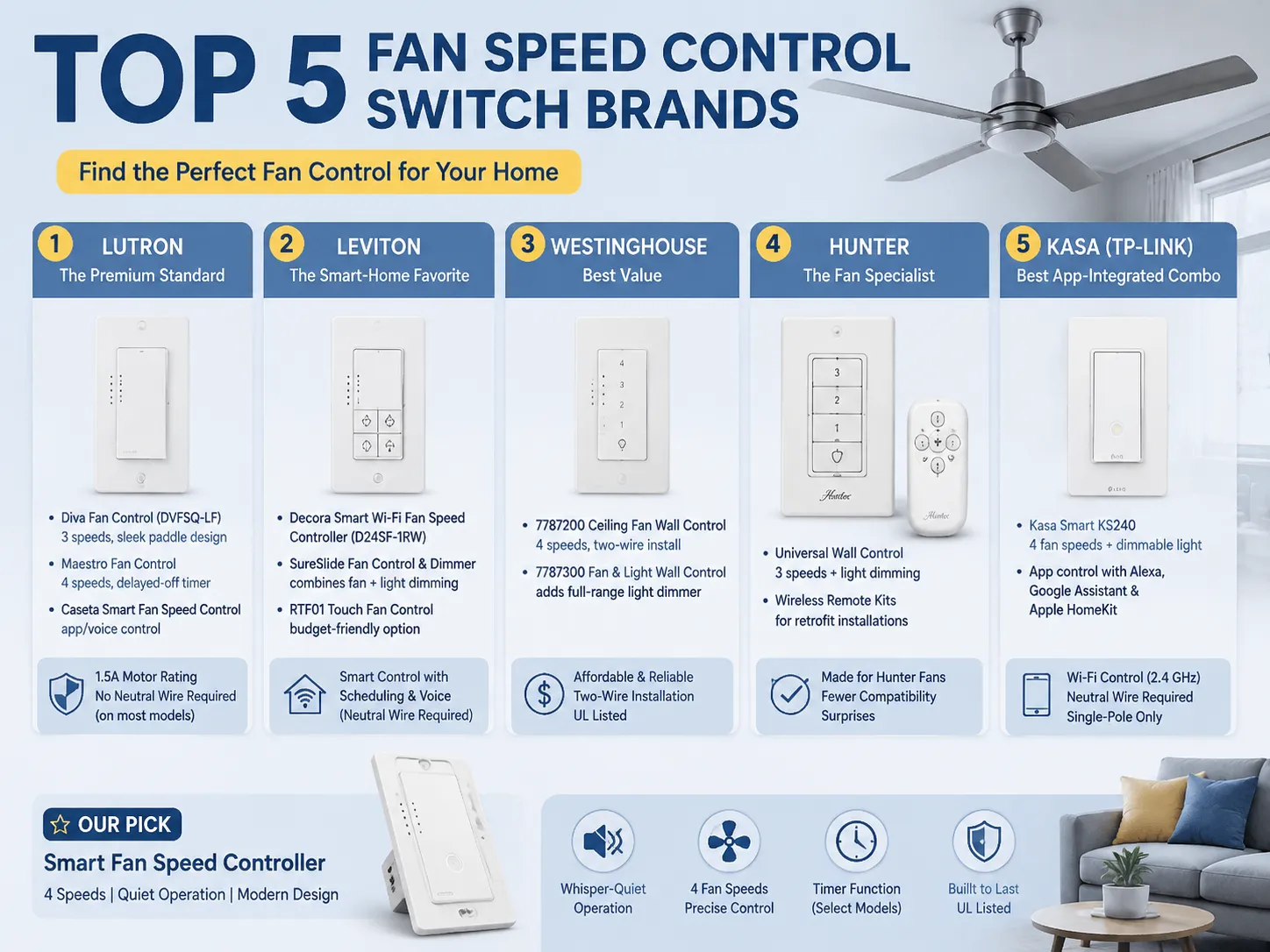
Resposta rápida: Em 2026, as cinco melhores empresas de interruptores de controle de ventilador. Estas incluem: (1) Lutron, (2) Leviton, (3) Westinghouse, (4) Hunter, (5) Kasa (ou TP-Link). Opções menos caras da Hampton Bay, TOPGREENER, ENERLITES e TREATLIFE também parecem ser bem-sucedidas. É muito importante lembrar do controle de velocidade. Se você comprar um produto para seu ventilador, ele deve ser indicado para esse tipo de motor.
Como Classificamos as Marcas
Avaliamos cada marca com base em seis critérios que importam para proprietários e compradores:
| Critérios | O Que Analisamos |
|---|---|
| Confiabilidade | Reputação da marca, garantia, taxa de falhas em avaliações de usuários |
| Compatibilidade com motor | Classificações claras do motor do ventilador (1,5A–2,5A típico) e sem relatos de zumbido |
| Opções de velocidade | Controle de 3 velocidades vs. 4 velocidades, controle contínuo vs. em etapas |
| Recursos inteligentes | Wi-Fi, controle por aplicativo, assistente de voz, agendamento |
| Valor | Preço relativo aos recursos |
| Facilidade de instalação | Requisitos de fio neutro, suporte a 3 vias, instruções |
Top 5 Marcas de Interruptores de Controle de Velocidade de Ventiladores
Lutron — O Padrão Premium
Faixa de preço: $35–$95
Lutron é a marca em que os empreiteiros elétricos mais confiam para controles de iluminação e controles de ventiladores de teto. Os controladores de ventilador têm a reputação de serem extremamente silenciosos, terem um bom design e funcionarem com desempenho brilhante.
- Produtos principais: O Diva Fan Control (DVFSQ-LF, ~$37) com 3 opções de velocidade; o Maestro Fan Control com 4 funções de velocidade e temporizador de desligamento retardado, e o Caseta Smart Fan Speed Control (PD-FSQN-WH) para comando por aplicativo/voz.
- Melhor para: Pessoas que desejam obter um dispositivo excelentemente construído, operação silenciosa e aparelho duradouro; usuários que não se importam de conectá-lo ao hub Caseta.
- Fato interessante: Classificação de motor de 1,5A, listado pela UL, não precisa usar o fio neutro na maioria dos dispositivos (muito conveniente para casas antigas).
Leviton — O Favorito das Casas Inteligentes
Faixa de preço: $20–$95
Leviton tem a maior variedade de opções disponíveis, incluindo um controle por toque econômico e um dos melhores produtos de controlador de ventilador inteligente disponíveis no mercado.
- Produtos principais: Decora Smart Wi-Fi Fan Speed Controller D24SF-1RW custando algo em torno de $80 – $95 e inclui 4 velocidades diferentes, opção de agendamento e compatibilidade com outros dispositivos de casa inteligente como Alexa, Google, HomeKit, etc.; SureSlide Ceiling Fan Control & Dimmer (66DF-10W) a um preço de cerca de $65 – $75 funciona como controle de ventilador e dimmer de luz; controle de ventilador por toque RTF01 custando apenas $20-30 e sendo uma escolha perfeita para orçamento.
- Melhor para:aqueles que são apaixonados por sistemas de casa inteligente e apreciam agendamento e controle por voz e contratantes que gostariam de introduzir a série completa Decora smart-home.
- Fato interessante:produtos inteligentes, exceto o mais barato, precisam de fio neutro conectado; potência do motor classificada em 1,5A; modelos 3-way disponíveis.
Westinghouse — Melhor Custo-Benefício
Faixa de preço: $17–$37
Westinghouse oferece controladores de ventilador confiáveis a preços que estão entre os mais competitivos entre as principais marcas, tornando-os uma escolha principal entre construtores e proprietários.
- Produtos principais:7787200 controlador de parede para ventilador de teto Westinghouse (cerca de $17), que possui 4 velocidades e instalação de dois fios; 7787300 controlador de parede para ventilador e luz (cerca de $19-37), que apresenta um dimmer de luz incandescente de faixa completa.
- Melhor para: projetos econômicos, apartamentos para aluguel e simplicidade técnica que não requer recursos inteligentes.
- Fato interessante: instalação rápida e simples de dois fios que substitui um interruptor toggle padrão; certificado pela UL.
Hunter — O Especialista em Ventiladores
Faixa de preço: $25–45 (controladores); controles remotos a partir de $35
Hunter é responsável pela criação dos próprios ventiladores de teto, o que otimiza os controles para ventiladores Hunter e Casablanca, embora alguns deles também possam funcionar para outras marcas.
- Produtos principais: Controle de Parede Universal Hunter (com três velocidades e dimmer de luz, preço em torno de $35-$45) para seus ventiladores com receptor, e kits de controle remoto sem fio Hunter para modelos reformados.
-
- Melhor para:Proprietários de ventiladores Hunter que desejam garantia de compatibilidade do produto, facilitando o uso.
- Fato interessante:Mais especificidade significa menos surpresas na compatibilidade, mas verifique se o ventilador em uso possui receptor.
Kasa (TP-Link) — Melhor Combo Integrado com App
Faixa de preço: $40–55
O interruptor Kasa KS240 para ventilador de teto e dimmer pode ser o único interruptor Wi-Fi que oferece controle de velocidade do ventilador e dimmer para luzes, enquanto possui um dos controles mais sofisticados disponíveis no mercado.
-
- Produtos principais:Kasa Smart KS240 – 4 configurações de velocidade do ventilador e luz dimmerizável, Wi-Fi 2,4 GHz, compatível com Apple HomeKit, Amazon Alexa e Google Assistant.
- Melhor para: Usuários que procuram uma solução para controlar as atividades do ventilador e da luz usando o mesmo dispositivo sem precisar comprar unidades de controle separadas.
- Fato interessante:Embora precise do fio neutro para funcionar, ser um interruptor unipolar torna o KS240 uma ótima instalação em locais como salas de estar e quartos.
Tabela de Comparação Lado a Lado
| Marca | Faixa de Preço | Velocidades | Inteligente? | Controle de Luz | Fio Neutro | Melhor Para |
|---|---|---|---|---|---|---|
| Lutron | $35–95 | 3–4 | Modelos Caseta | Alguns modelos | Geralmente não | Qualidade premium, operação silenciosa |
| Leviton | $20–95 | 4 | Decora Smart | Modelos SureSlide | Modelos inteligentes sim | Casa inteligente, linha completa |
| Westinghouse | $17–37 | 4 | Não | Modelo 7787300 | Não | Melhor custo-benefício, instalações simples |
| Hunter | $25–45 | 3 | Modelos remotos | Sim | Não | Proprietários de ventiladores Hunter, controles remotos |
| Kasa (TP-Link) | $40–55 | 4 | Sim (Wi-Fi) | Sim (dimerização) | Sim | Controle por aplicativo do ventilador + luz |
Mais Marcas que Vale Conhecer
Essas marcas específicas completam o mercado e são opções viáveis com base no que você necessita:
- Hampton Bay ($25-$35) — este é um controlador de parede sem fio tudo-em-um com simulação de velocidade aleatória Comfort Breeze; uma opção excelente para uso inteligente sem custo.
- TOPGREENER ($20-$40) — combinação de interruptores de valor sólido (ventilador de 3 velocidades e interruptor de luz), classificação de 2,5A para ventilador e certificação UL.
- ENERLITES ($15-$35) — controles de ventilador confiáveis e econômicos com classificação de 2,5A e designs simples de controle deslizante/toggle.
- TREATLIFE ($45-$55) — esta é uma combinação inteligente de ventilador + dimmer com controle por aplicativo e variação de quatro velocidades; não há necessidade de hub.
- meross ($35-$50) — este é um interruptor inteligente de ventilador + luz compatível com HomeKit/Alexa/Google.
- GOG (GOG-Elec) — este é um fabricante de dispositivos elétricos, incluindo controles de velocidade de ventilador e dimmers baseado na China com o propósito direto de atender distribuidores e clientes OEM com preços de fábrica acessíveis e certificações; a empresa é uma boa opção para atacadistas que desejam comprar itens elétricos de marca própria; se um distribuidor pretende buscar negócios OEM reais, a GOG deve ser considerada, pois está junto com marcas universais.
Para uma visão mais ampla de quais marcas de interruptores dominam o mercado de dispositivos de fiação em geral, nosso guia para as 10 principais marcas de dispositivos de fiação no mundo coloca os controles de ventilador em contexto com a categoria completa de produtos.
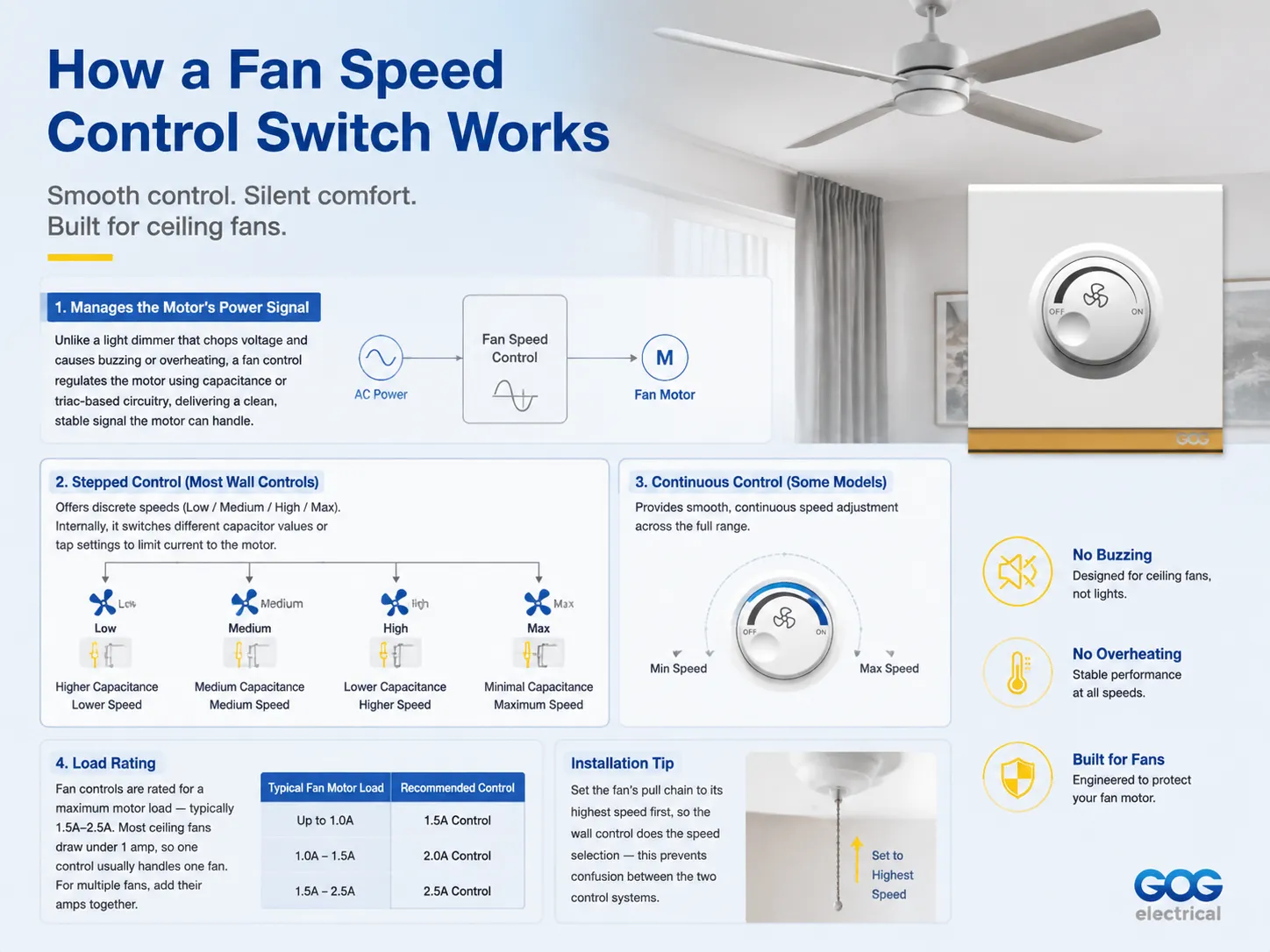
Como Funciona um Interruptor de Controle de Velocidade de Ventilador
A velocidade do motor de um ventilador de teto é controlada por um interruptor de regulação de velocidade do ventilador sem qualquer zumbido ou superaquecimento que ocorreria com dimmers de luz. Veja como funciona:
- O sinal de energia para o motor é gerenciado: em vez de cortar a voltagem como um dimmer de luz, o regulador de ventilador usa sua capacidade ou equipamento baseado em triac para controlar o motor, o que mantém o sinal mais limpo possível para o motor.
- Controles em etapas: controladores montados na parede oferecem velocidades fixas de operação, que podem variar com o uso de diferentes valores de capacitor ou com a conexão em um enrolamento do motor.
- Controle contínuo: alguns modelos avançados de controladores permitem operar em velocidade variável na prática.
- Classificação para carga: os controles de ventilador têm capacidade de carga rotulada em amperes, que geralmente é de 1,5 A a 2,5 A - a maioria dos ventiladores de teto funciona com carga inferior a um ampere e, portanto, um controlador geralmente pode alimentar um ventilador; quando precisa funcionar para mais de um ventilador, basta somar a carga de amperagem de todos os ventiladores.
Ao conectar, certifique-se de que a corrente de puxar esteja ajustada para a velocidade máxima do ventilador de teto para que o controlador garanta que você está usando a melhor potência possível. Se você estiver confortável com a fiação básica, nosso guia sobre how to install a dimmer switch cobre os mesmos fundamentos (desligamento de segurança, identificação linha/carga, fiação e teste) que também se aplicam aos controles de ventilador.
Controle de Ventilador vs. Dimmer: Não os Confunda
Esta questão de segurança é a parte mais crítica do tema. Um dimmer de iluminação comum nunca deve ser usado para um motor de ventilador de teto. Dimmers de iluminação reduzem a tensão para cargas resistivas, que são lâmpadas. O motor do ventilador de teto é uma carga indutiva, o que significa que a redução da tensão faz com que ele consuma mais corrente, aqueça, faça barulho e se desgaste mais rapidamente. Como resultado, causa zumbido, superaquecimento, menor expectativa de vida e até risco de incêndio.
A solução é simples: compre apenas produtos que sejam explicitamente mencionados como dispositivos de controle de velocidade de ventilador (combinações de ventilador + luz). Se a embalagem indicar “fan rated” ou tiver uma classificação de amperagem do motor, compre-o. Caso o ventilador tenha um kit de luz, você terá que usar um controlador duplo de ventilador + luz (por exemplo, Westinghouse 7787300, Leviton SureSlide ou Kasa KS240) que combine ventilador e luz em uma única placa de parede. Será necessário ter fios quentes separados indo para o motor do ventilador e para a luz. Para mais informações sobre os diferentes tipos de interruptores e como eles são ligados, veja nosso artigo sobre os quatro tipos de interruptores de luz.
O que Verificar Antes de Comprar
- Classificação de amperagem da carga do motor do ventilador: certifique-se de que a classificação de amperagem do controle entre 1,5A e 2,5A seja adequada para seu ventilador, com base no manual de instruções do ventilador.
- Disponibilidade de fiação: modelos inteligentes requerem um fio neutro na caixa de parede; se sua casa for antiga, pode não haver um. Nesse caso, escolha um modelo sem neutro.
- Fiação para luzes: se desejar controlar a luz também, você precisa ter fios quentes separados para o motor e as luzes ou um controle remoto sem fio.
- Compatibilidade: se você tiver um ventilador Hunter ou Casablanca com um receptor de ventilador, precisará dos controles Hunter; se seu ventilador estiver equipado com seu próprio receptor, verifique se um controlador de parede não causará interferência.
- Sistema inteligente: se desejar controle por aplicativo ou voz, verifique se o interruptor de luz é compatível com seu aplicativo ou sistema de controle por voz.
- Certificação: verifique se o produto possui classificação UL (para interruptores UL 20) e classificação do motor do ventilador.
Para uma abordagem sistemática na escolha de interruptores para um projeto inteiro, nosso guia sobre como selecionar dispositivos de fiação orienta passo a passo as decisões sobre carga, estilo e conformidade.
Dicas de Compra para Distribuidores e Empreiteiros
Se você está adquirindo controles de velocidade de ventilador para revenda ou instalação, algumas considerações extras:
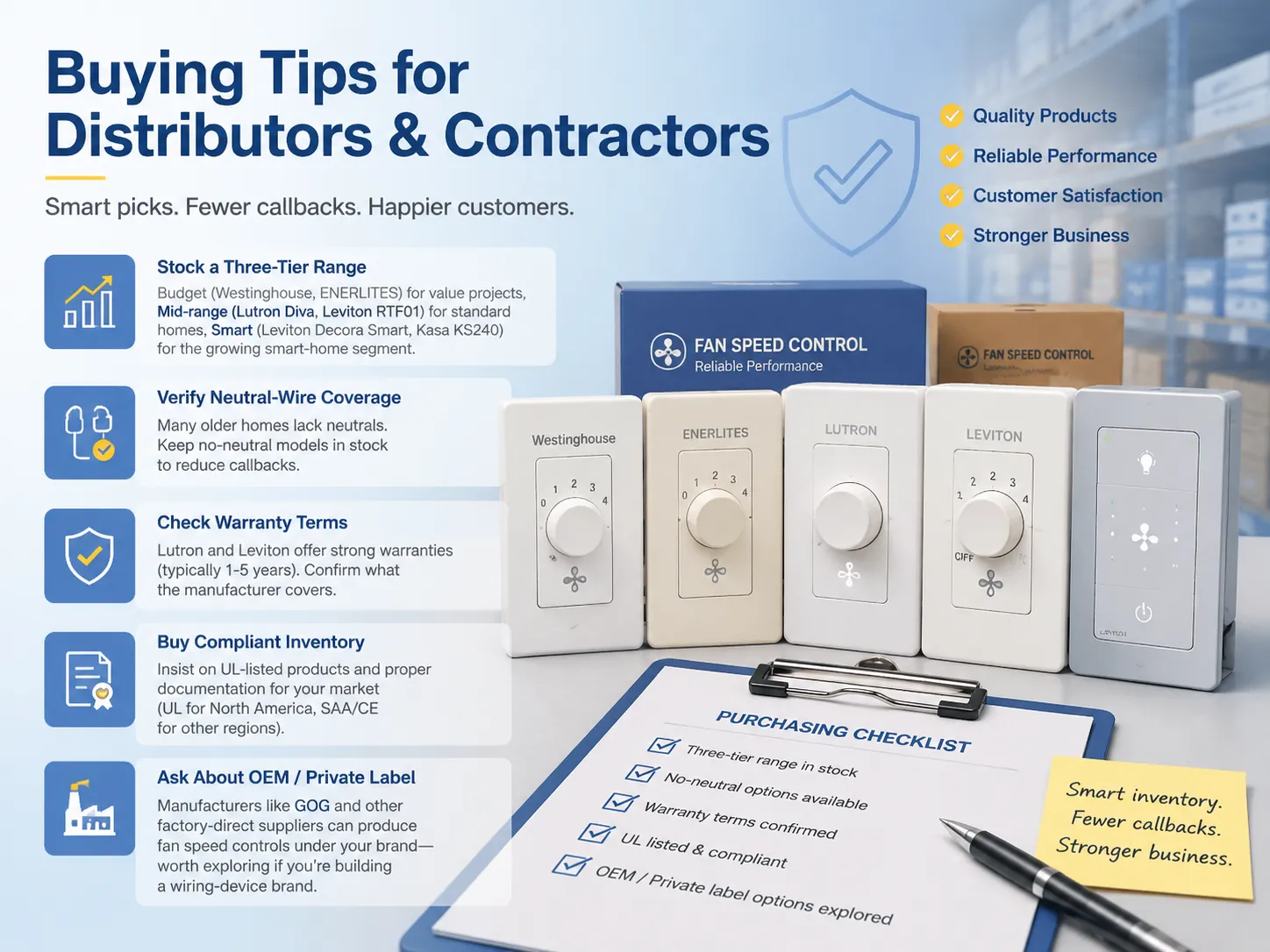
- Estoque três níveis de linhas: orçamento (Westinghouse, ENERLITES) para projetos econômicos, médio padrão (Lutron Diva, Leviton RTF01) para residências padrão, e inteligente (Leviton Decora Smart, Kasa KS240) para o segmento crescente de casas inteligentes.
- Confirme a cobertura do fio neutro: nem todas as casas antigas incluem neutros; portanto, mantendo opções sem neutro, você pode minimizar retornos.
- Verifique a garantia: Lutron e Leviton possuem garantias confiáveis, geralmente entre um e cinco anos; certifique-se de saber o que será coberto.
- Compre equipamentos em conformidade: sempre adquira equipamentos listados pela UL e documentação acompanhante para seu território (UL é exigido na América do Norte e SAA/CE em outros locais).
- Pergunte se OEM/marca própria está disponível: fornecedores como GOG e outros fabricantes diretos de fábrica devem ser capazes de criar dispositivos para você se estiver construindo sua própria marca de dispositivos de fiação.
Problemas comuns de instalação e suas soluções são abordados em nosso artigo sobre os problemas mais comuns em interruptores elétricos — útil tanto para proprietários quanto para técnicos.
Perguntas Frequentes
Como funciona um interruptor de velocidade de ventilador?
O interruptor que regula a velocidade do ventilador alcança esse objetivo controlando a energia fornecida ao motor AC. Isso é realizado por meio da comutação de conjuntos de capacitores ou circuitos triac. Os capacitores introduzem impedância elétrica: uma relação de capacitância maior fará com que mais corrente elétrica flua, enquanto uma capacitância menor restringirá o fluxo de corrente. Como resultado, o sinal de energia permanece relativamente limpo e o motor opera silenciosamente, em vez de superaquecer como quando um dimmer de iluminação que controla a tensão é usado.
Como você controla a velocidade de um ventilador?
Existem quatro métodos básicos para controlar seu ventilador: (1) a corrente de puxar embutida, que usa taps de velocidade internos; (2) um interruptor de parede que substitui seu interruptor de alavanca (este é o método preferido porque é muito conveniente e silencioso); (3) um sistema remoto sem fio com um módulo instalado na cúpula do ventilador; e (4) um interruptor de ventilador inteligente operado por meio de um aplicativo móvel ou assistente de voz (Alexa, Google, HomeKit). Não se esqueça de que interruptores dimmer regulares nunca devem ser usados com um motor de ventilador; é importante usar dispositivos projetados para serem usados com motores de ventilador.
O que é velocidade do interruptor de ventilador?
“Velocidade do interruptor de ventilador” é a capacidade de um interruptor de ventilador de especificar a velocidade de operação do motor do ventilador. Isso especifica quantas velocidades o interruptor fornecerá ao motor. Um interruptor pode ter três ou quatro velocidades possíveis (por exemplo, baixa, média, alta e máxima). A seleção de velocidade permitirá a comutação da corrente elétrica para o motor do ventilador por meio de capacitores ou triacs, resultando na mudança de RPM das pás. Certos interruptores são capazes de ajustar a velocidade do motor continuamente, enquanto modelos inteligentes se conectam por meio de um aplicativo móvel ou comando de voz.
Os controladores de velocidade de ventilador são universais?
Geralmente, sim, mas não universalmente. Reguladores de velocidade de ventilador padrão montados na parede geralmente são universais, o que significa que funcionarão com qualquer motor de ventilador de teto AC regular, desde que esteja dentro da classificação de amperagem. No entanto, (1) interruptores específicos de marca (por exemplo, Hunter) são otimizados para essa marca particular de ventiladores, especialmente se esses ventiladores tiverem receptores; (2) ventiladores com motor DC (inteligentes) normalmente precisarão de seu próprio controle remoto ou aplicativo, pois o interruptor de parede padrão não funcionará; (3) ventiladores com receptor remoto embutido podem ser incompatíveis com o controlador de parede, então verifique a compatibilidade primeiro; (4) interruptores de ventilador inteligentes são universais em termos de motor, mas observe que ainda requerem fiação neutra e o assistente de suporte correto. Sempre verifique seu ventilador e tipo de fiação antes da compra.
Referências
- Lutron — Fabricante dos controles de ventilador Diva, Maestro e Caseta; páginas de produtos documentam classificações de motor, compatibilidade e requisitos de instalação.
- Leviton — Fabricante do controlador de velocidade de ventilador Decora Smart e controles de ventilador/luz SureSlide; referência para recursos inteligentes, requisitos de fio neutro e termos de garantia.
- NFPA 70 (Código Elétrico Nacional) — O código que rege a instalação de interruptores, incluindo classificações de carga, aterramento e a exigência de usar dispositivos dentro de suas aplicações listadas.
- UL Solutions — O órgão de certificação de segurança cujos padrões UL 20 e relacionados cobrem interruptores de encaixe para uso geral e controles de velocidade de ventiladores; verifique a listagem UL antes da compra.
- ENERGY STAR — Ventiladores de Teto — Orientações sobre eficiência de ventiladores de teto e compatibilidade de controle, incluindo notas sobre controles de velocidade e opções inteligentes.
- Direct Energy — Como Substituir um Interruptor de Ventilador de Teto — Guia prático de instalação explicando a diferença entre controles de ventilador e dimmers de luz com fiação passo a passo.
Conclusão
Ao escolher um interruptor de controle de velocidade de ventilador, você verá que envolverá escolher a combinação certa de marcas e suas forças de acordo com suas necessidades, sem nunca ignorar as regras de segurança. A Lutron oferece a melhor solução em termos de controle silencioso e eficaz. Começando com cerca de $37, a Leviton facilita a integração de um sistema de casa inteligente usando a linha Decora Smart ($80-95) e também opções acessíveis ($20-30). A Westinghouse é a líder de orçamento com unidades básicas, porém confiáveis, de controle de quatro velocidades por 17-37 dólares. A Hunter é uma solução segura para os proprietários de ventiladores Hunter/Casablanca e equipamentos de retrofit sem fio. A Kasa (TP-Link) tem a combinação mais eficaz integrada por aplicativo de ventilador e luz ($40-55). Além disso, existem opções mais baratas no mercado como Hampton Bay, TOPGREENER, ENERLITES e TREATLIFE, bem como empresas OEM como GOG.
Antes de fazer a compra, certifique-se de que (1) o motor do ventilador é classificado para usar um interruptor de controle de velocidade de ventilador (nunca devem ser aplicados dimmers de luz), (2) as classificações do interruptor cobrem seu motor de ventilador, e (3) a fiação é compatível com sua escolha de controle de velocidade de ventilador. Após confirmar esses requisitos, você pode ter certeza de que qualquer marca desta lista servirá por anos.