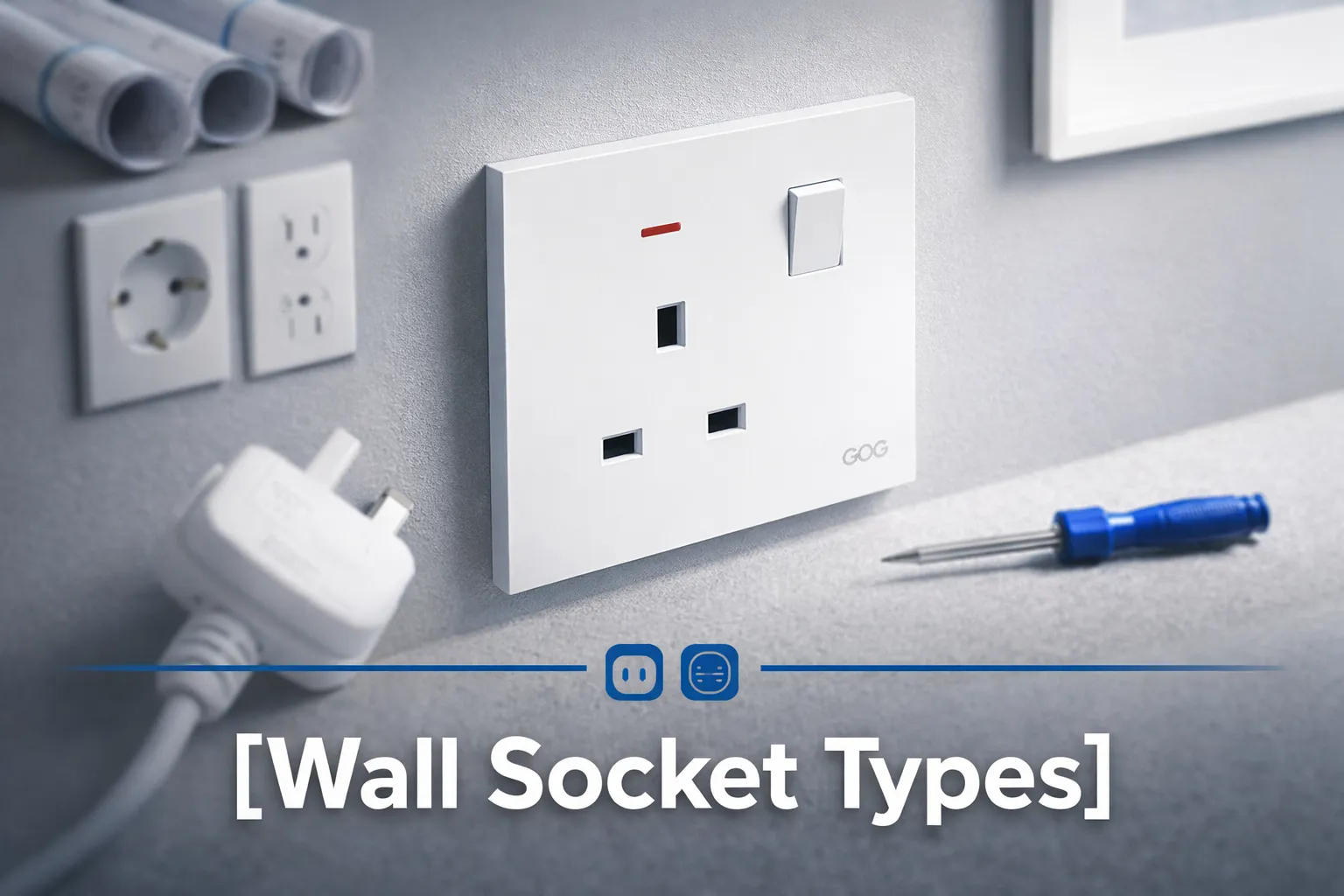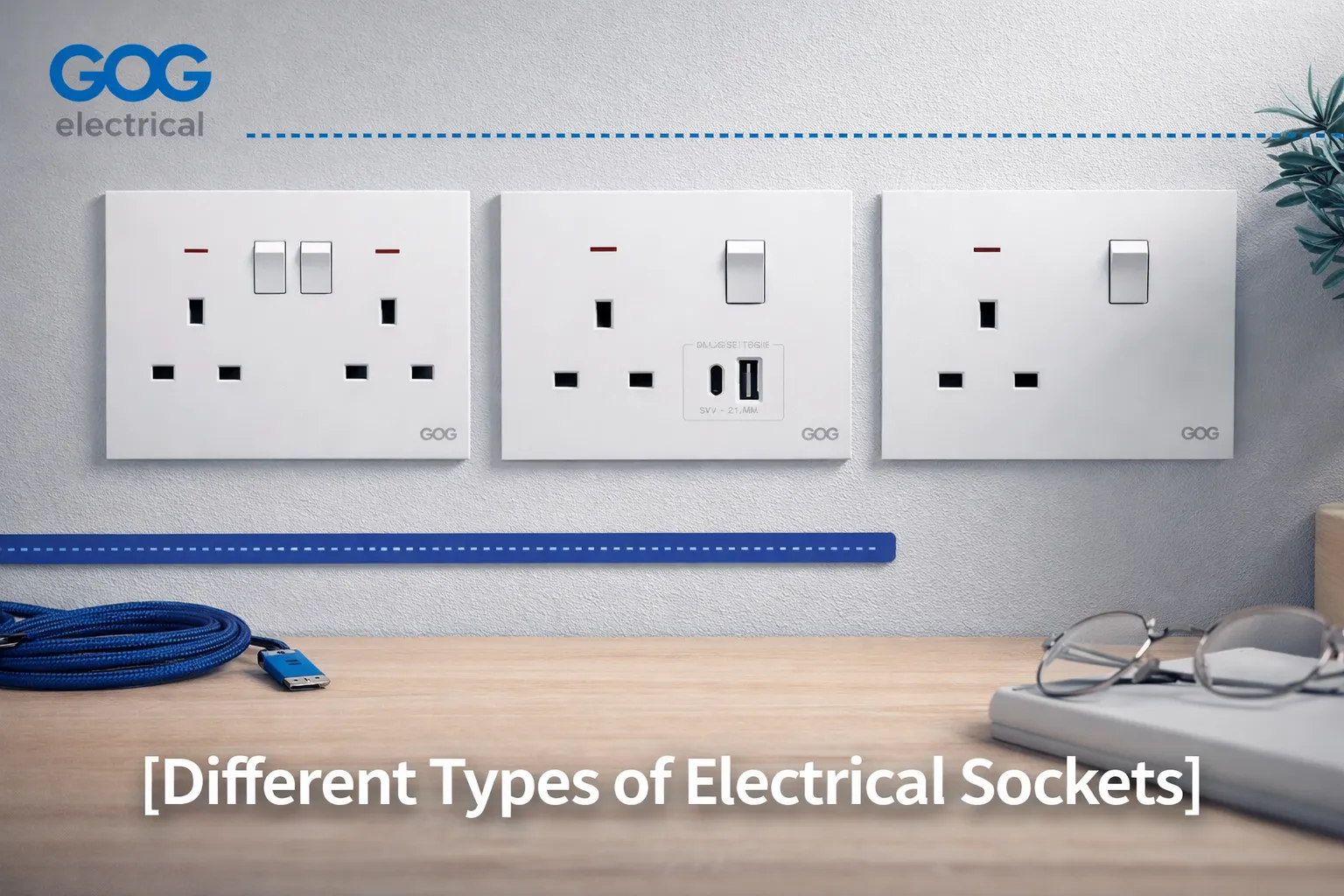
Quer você esteja refazendo a fiação da sua casa, trocando uma tomada ou apenas curioso sobre as várias tomadas elétricas no ambiente, pode se interessar em conhecer os dois tipos diferentes de tomadas elétricas. Embora pareça uma pergunta de quiz, é importante saber essa informação ao comprar tomadas elétricas, planejar reformas na casa ou determinar a segurança da sua casa antiga. De modo geral, todas as tomadas elétricas pertencem a duas famílias básicas, e uma vez que você compreenda essas famílias, será bastante fácil navegar pelo complexo universo das tomadas elétricas. Em outras palavras, o documento responderá perguntas comuns sobre a classificação dos dois tipos diferentes de tomadas de energia elétrica, sua aparência, preço relativo e outros fatores relevantes.
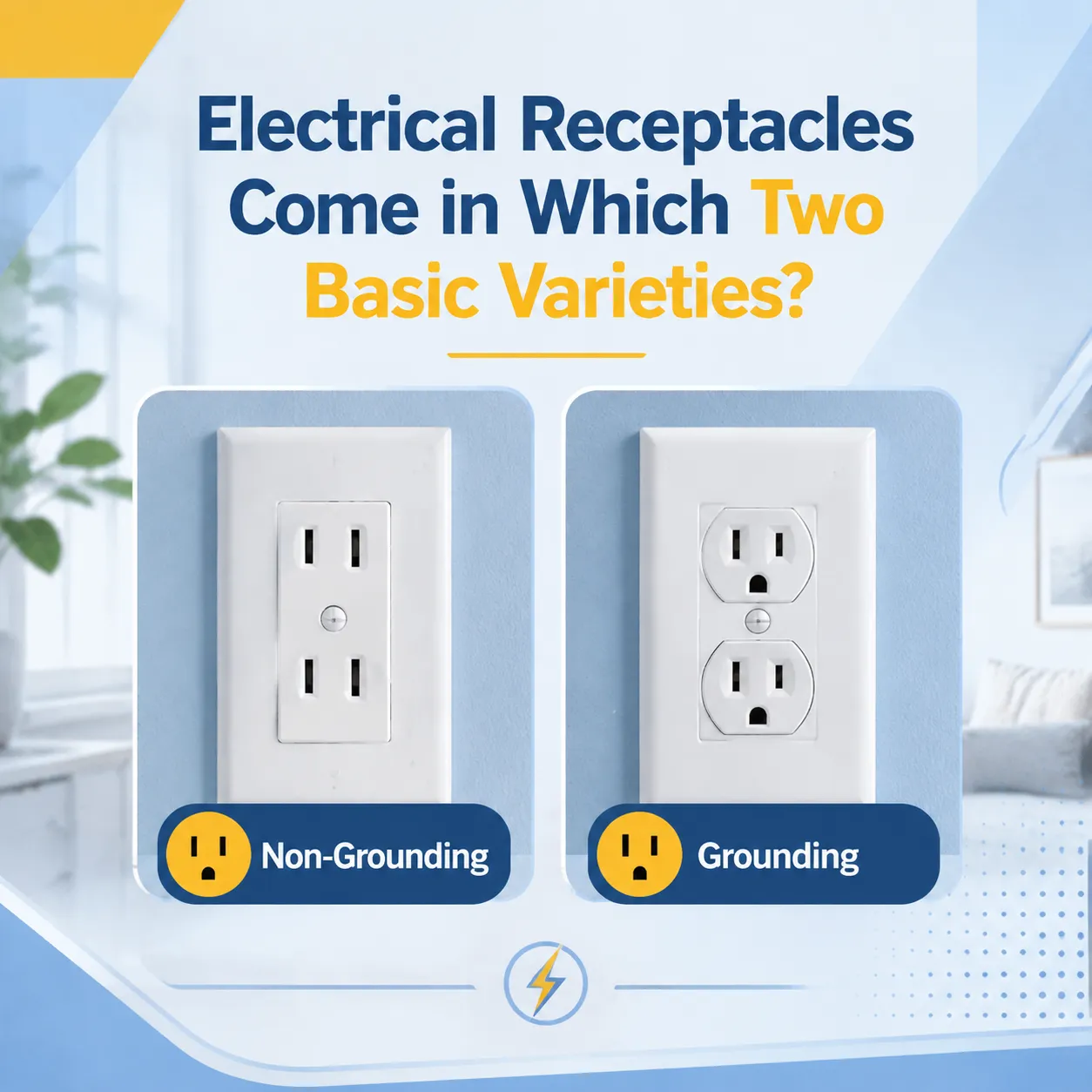
Resposta rápida: Tomadas elétricas (frequentemente chamadas de pontos elétricos, tomadas de parede ou soquetes) estão disponíveis em apenas dois tipos principais: tomada com aterramento e tomada sem aterramento. Uma tomada sem aterramento de dois pinos é referida como tipo Nema 1-15, e a tomada com aterramento de três pinos é chamada de tipo Nema 5-15. Tomadas com aterramento são tomadas padrão de três pinos que possuem um pino redondo adicional para aterramento. Tomadas com aterramento se dividem em várias categorias baseadas tanto na voltagem quanto na amperagem, como tomadas de 120V (15A e 20A).
As Duas Variedades Básicas de Receptáculos Elétricos
A pergunta “receptáculos elétricos vêm em quais duas variedades básicas” é respondida de duas formas comuns, e ambas estão corretas dependendo do contexto:
Resposta 1: Pelo Aterramento — Sem aterramento vs. Com aterramento
| Variedade | Pinos | Tipo NEMA | Status em Casas Modernas |
|---|---|---|---|
| Receptáculo sem aterramento | 2 pinos | NEMA 1-15 | Obsoleto — encontrado apenas em casas antigas |
| Receptáculo com aterramento | 3 pinos | NEMA 5-15 (e 5-20) | Padrão — exigido para novas construções |
Possui duas ranhuras planas, por isso a tomada sem aterramento de dois pinos é conhecida como tomada Tipo A. A tomada com aterramento de três pinos, também chamada de tomada Tipo B, possui um pino redondo de aterramento além das duas ranhuras planas para conexão segura ao sistema de aterramento do edifício. No caso dos códigos de construção recentes, há a obrigação de ter tomadas com aterramento em todos os locais de novos edifícios, bem como a atualização de quaisquer tomadas sem aterramento durante reformas em um ambiente, em caso de inspeção.
Resposta 2: Pela Voltagem — 120V vs. 240V
| Variedade | Voltagem | Usos Comuns | Amperagem Típica |
|---|---|---|---|
| Padrão / uso geral | 120V | Lâmpadas, TVs, telefones, computadores, pequenos eletrodomésticos de cozinha | 15A ou 20A |
| Uso pesado / eletrodomésticos | 240V | Secadoras, fogões, unidades de ar condicionado, carregadores EV, soldadores | 15A–50A |
Tomadas de 120 volts alimentam a grande maioria dos dispositivos domésticos. Tomadas de 240 volts (com seus layouts distintos de pinos) alimentam grandes eletrodomésticos que necessitam do dobro de potência. Se você quiser entender a diferença em detalhes, nosso guia sobre a diferença entre tomadas 120V e 240V explica com exemplos.
Nomes Diferentes para a Mesma Coisa: Tomada, Soquete, Receptáculo
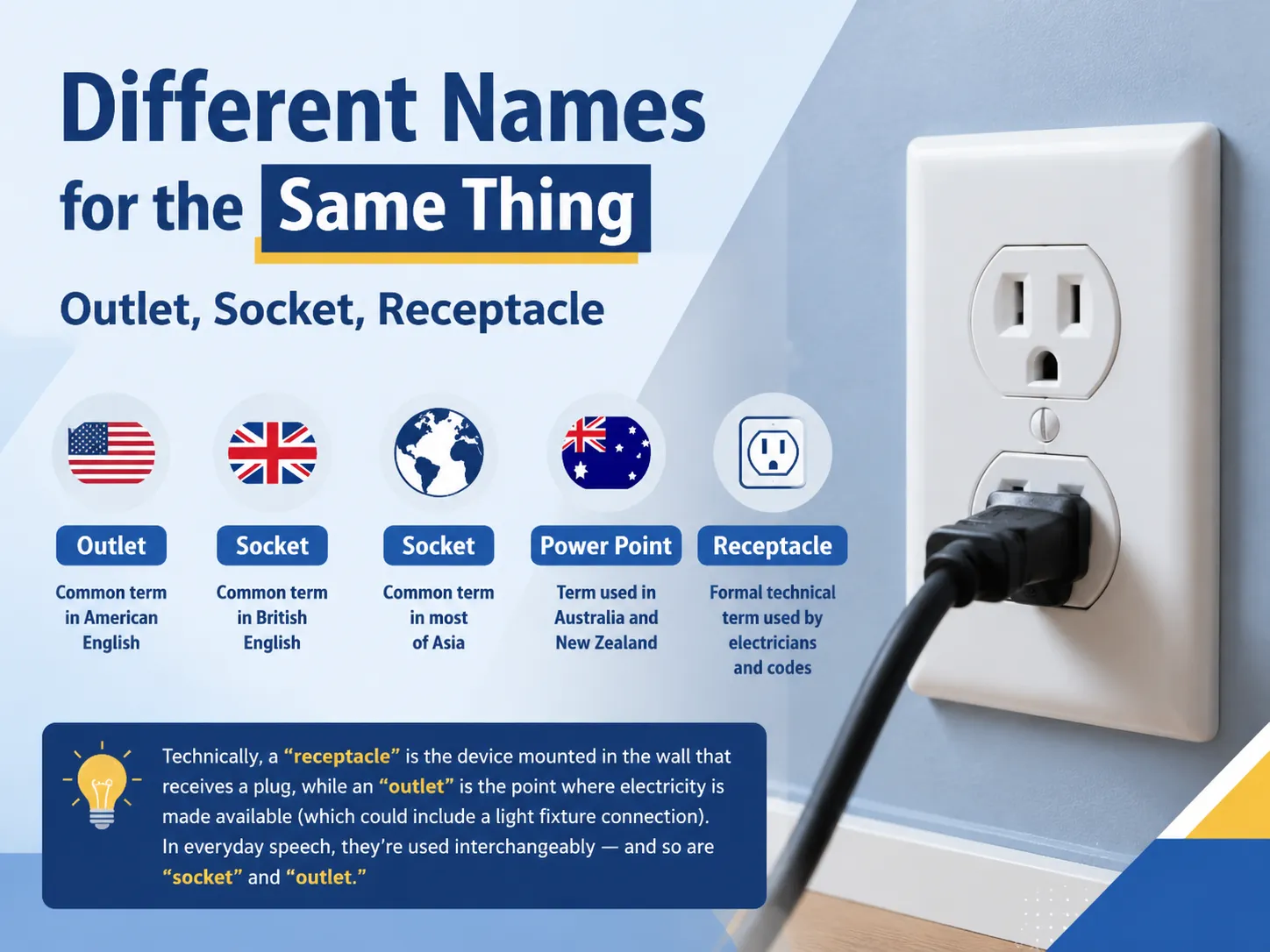
Antes de prosseguirmos com nossa discussão, vamos esclarecer alguns termos, pois o mesmo dispositivo possui múltiplos nomes — todos corretos:
- Receptáculo elétrico — o termo técnico oficial usado por eletricistas e códigos escritos
- Tomada de energia ou tomada elétrica — o termo comum no inglês do Reino Unido e na maior parte da Ásia
- Tomada de parede ou simplesmente tomada — o termo usado na língua americana ao falar sobre este dispositivo
- Ponto de energia — um termo usado pelos australianos
- Tomada de plugue — outro termo popular usado no inglês do Reino Unido
Estritamente falando, “receptáculo” é o dispositivo fixado na parede que recebe o plugue, enquanto “tomada” significa o local da fonte de energia (que também pode implicar a luminária). No entanto, na linguagem falada, eles são usados de forma intercambiável, assim como “socket” e “outlet”. Para uma análise mais detalhada da terminologia e anatomia, veja nosso artigo sobre o que é um receptáculo elétrico.
Como os receptáculos são classificados: o sistema NEMA
O sistema de classificação usado para todos os receptáculos norte-americanos foi desenvolvido pela National Electrical Manufacturers Association (NEMA) e possui um código para classificação. Por exemplo, o código 5-15R é dividido da seguinte forma:
- O primeiro dígito (ou seja, 5) indica o tipo de família de configuração e mostra a voltagem e o aterramento.
- O segundo dígito (ou seja, 15) define a classificação de amperagem.
- A letra denota o tipo de receptáculo (R) em oposição ao plugue (P).
| Código NEMA | Voltagem | Amperagem | Pinos | Uso comum |
|---|---|---|---|---|
| 1-15R | 120V | 15A | 2 | Tomadas antigas sem aterramento (obsoletas) |
| 5-15R | 120V | 15A | 3 | Tomada residencial padrão |
| 5-20R | 120V | 20A | 3 | Cozinhas, banheiros, lavanderias |
| 6-15R | 240V | 15A | 3 | Ar-condicionado de janela, pequenos equipamentos |
| 6-20R | 240V | 20A | 3 | Compressores de ar, ferramentas elétricas |
| 14-30R | 120/240V | 30A | 4 | Secadoras elétricas |
| 14-50R | 120/240V | 50A | 4 | Fogões, conexões para RV, carregadores EV |
Se você quiser saber mais sobre os diferentes estilos usados em tomadas, dê uma olhada em nossa postagem sobre tipos de tomadas elétricas, pois ela discute tanto os tipos NEMA usados na América do Norte quanto outros tipos internacionais de plugues.
Receptáculos 120V: As tomadas do dia a dia
Estas são as tomadas que você usa todos os dias. Todas são aterradas (exceto o tipo obsoleto de 2 pinos) e classificadas para 120 volts.
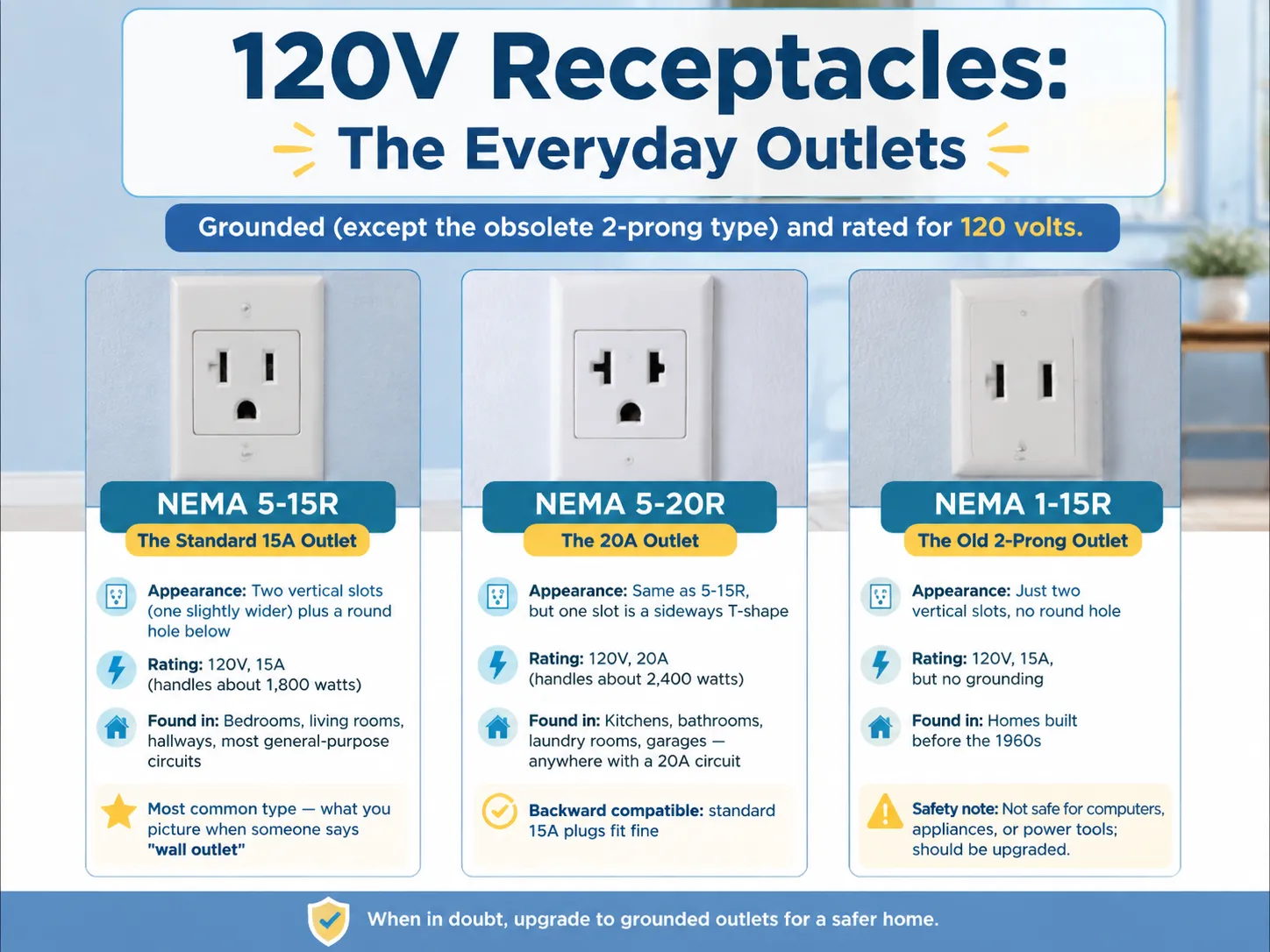
NEMA 5-15R — A tomada padrão de 15A
- Aparência: Dois slots verticais (um deles um pouco mais largo) e um orifício redondo abaixo
- Classificação elétrica: 120 volts, 15 amperes (consumo de energia aprox. 1800 watts)
- Aplicação: Normalmente montada em quartos, salas, corredores e outros tipos de circuitos de uso geral
- Tipo: Este tipo de tomada é o mais comum, que as pessoas geralmente imaginam quando pensam em uma tomada de parede
NEMA 5-20R — A tomada de 20A
- Aparência: Semelhante à 5-15R, exceto que um dos receptáculos tem a forma de um T deitado.
- Classificação: Classificada para 120 Volts, 20 Amperes (suporta cerca de 2.400 watts).
- Instalação: Usada em cozinhas, banheiros, lavanderias, garagens ou em qualquer outro lugar com corrente de 20 Amperes.
- Compatibilidade: Compatível com 15 Amperes.
NEMA 1-15R — A antiga tomada de 2 pinos
- Característica: Simplesmente duas aberturas verticais, sem nenhum orifício circular.
- Capacidade: 120V; mínimo de 15A, mas não possui aterramento.
- Presente em: Casas construídas antes dos anos 60.
- Atenção: Não é seguro para conectar computadores, dispositivos ou máquinas, e deve ser complementado.
Nossa comparação de tomadas de 2 pinos vs. 3 pinos explica as diferenças de segurança em detalhes.
Receptáculos 240V: As tomadas de alta potência
Tomadas de 240 volts fornecem o dobro da voltagem para grandes aparelhos. Elas têm arranjos de pinos distintos que evitam a conexão acidental de um dispositivo 120V nelas.
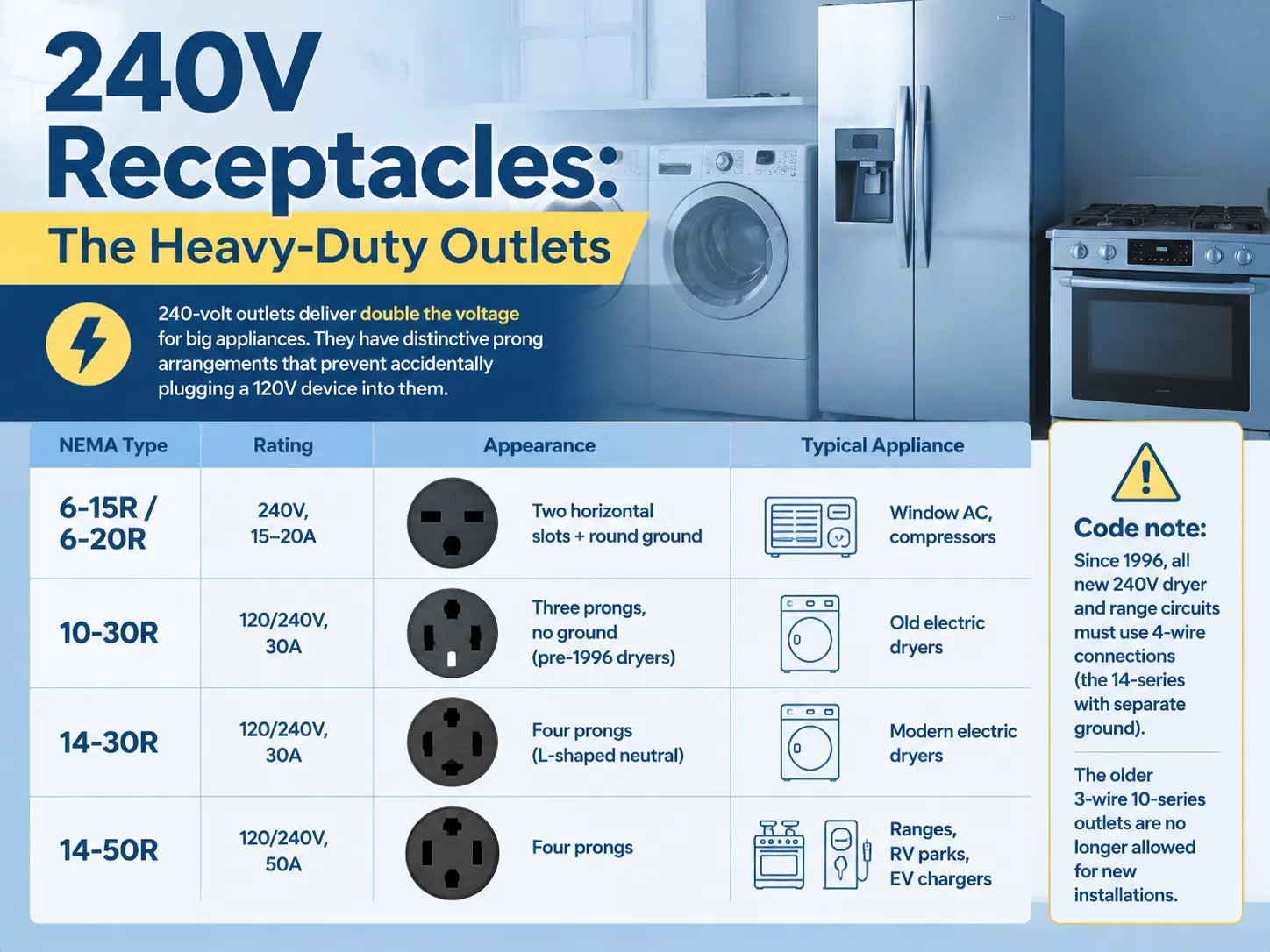
| Tipo NEMA | Classificação | Aparência | Aparelho típico |
|---|---|---|---|
| 6-15R / 6-20R | 240V, 15–20A | Dois slots horizontais + aterramento redondo | Ar-condicionado de janela, compressores |
| 10-30R | 120/240V, 30A | Três pinos, sem aterramento (secadoras pré-1996) | Secadoras elétricas antigas |
| 14-30R | 120/240V, 30A | Quatro pinos (neutro em forma de L) | Secadoras elétricas modernas |
| 14-50R | 120/240V, 50A | Quatro pinos | Fogões, parques de RV, carregadores EV |
Pontos-chave no contexto do código: O código exige que todos os novos circuitos para secadoras e fogões que operam em 240V devem ter conexões de 4 fios ou do tipo série 14 em que a conexão é aterrada. A alternativa de 3 fios da série 10 não pode mais ser usada em novas instalações.
Diferenças de aparência à primeira vista
Veja como distinguir as variedades básicas apenas olhando para elas:
| Tomada | Fendas | Característica distintiva |
|---|---|---|
| 2 pinos sem aterramento (1-15R) | 2 fendas verticais | Nenhum orifício redondo |
| 3 pinos 15A (5-15R) | 2 verticais + 1 redondo | Ambas as fendas verticais, aterramento redondo abaixo |
| 3 pinos 20A (5-20R) | 1 vertical + 1 em forma de T + 1 redondo | Fenda em T lateral à esquerda |
| 240V lâmina reta (6-15R/6-20R) | 2 horizontais + 1 redondo | Ambas as fendas horizontais |
| Secadora (14-30R) | 3 fendas + 1 redondo | Fenda neutra em forma de L |
| Fogão/EV (14-50R) | 3 fendas + 1 redondo | Neutro maior em forma de L |
Examine a placa frontal: os botões TEST e RESET estão presentes em uma tomada GFCI; a tomada resistente a manipulação (tamper-resistant) possui obturadores deslizantes nas aberturas e a tomada USB tem portas USB na placa frontal.
Tomadas de uso especial: GFCI, TR, USB
Além das duas variedades básicas, as tomadas modernas adicionam recursos de segurança e conveniência:
| Tipo | O que Ele Faz | Onde exigido | Preço |
|---|---|---|---|
| Receptáculo GFCI | Desarma o circuito se detectar corrente vazando para o aterramento (previne choque) | Banheiros, cozinhas, garagens, áreas externas, porões | $10–$25 |
| Resistente a manipulação (TR) | Obturadores internos bloqueiam objetos inseridos por crianças | Exigido em todas as novas construções residenciais | $2–$5 |
| Tomada USB | Portas de carregamento USB-A / USB-C integradas | Opcional — mesas, criados-mudos, cozinhas | $15–$45 |
| Receptáculo AFCI | Detecta arco perigoso na fiação | Quartos e áreas de estar (nível de circuito) | $15–$30 |
| Interruptor/tomada combinados | Interruptor e tomada em um único dispositivo | Onde é necessária uma tomada com interruptor | $4–$12 |
Para uma visão geral completa das quatro principais categorias de tomadas usadas em residências, nosso artigo sobre os 4 tipos de tomadas elétricas é uma referência rápida e visual.
Qual Tomada para Qual Ambiente?
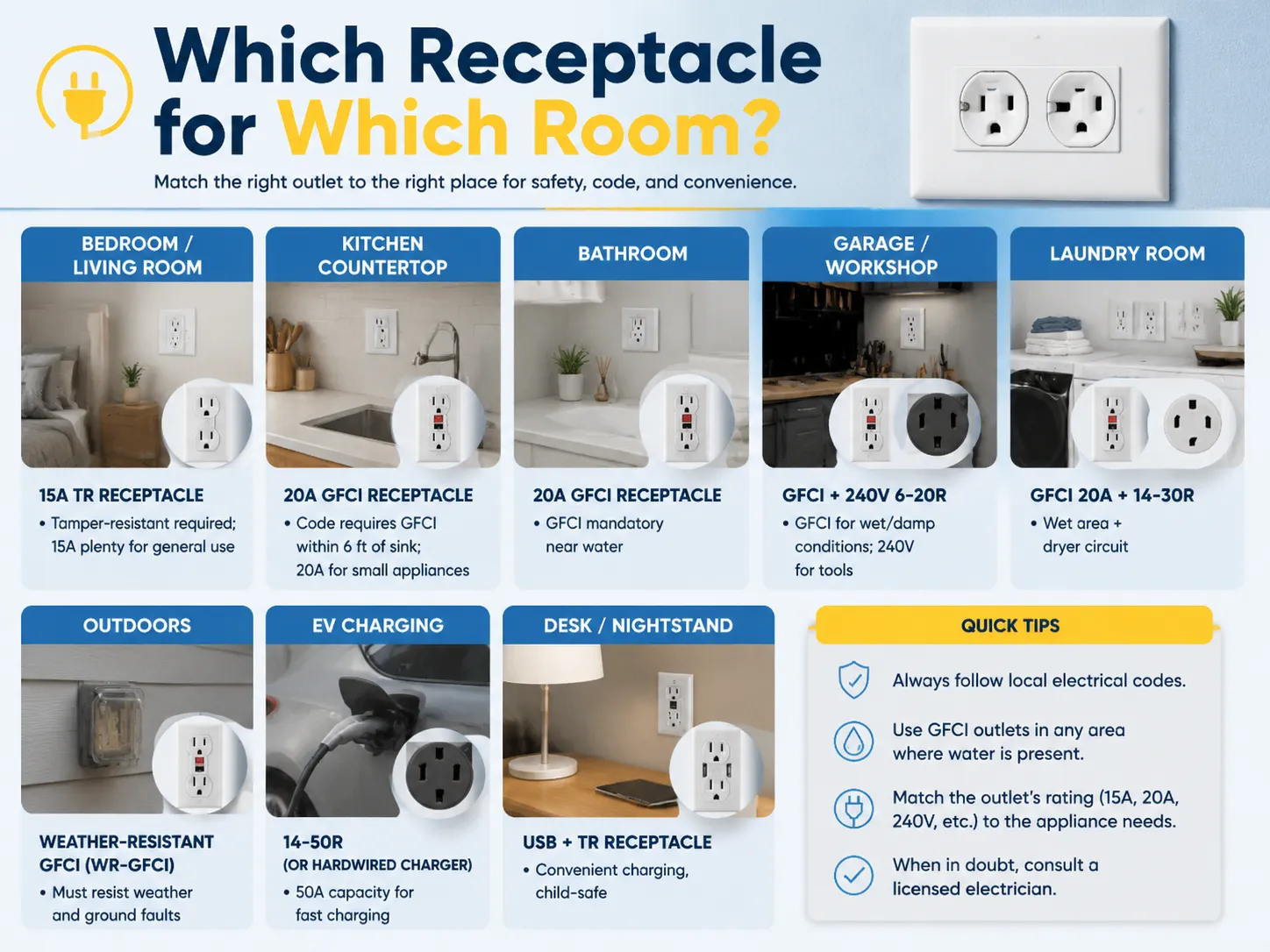
| Localização | Tomada Recomendada | Por quê |
|---|---|---|
| Quarto / sala de estar | Tomada TR 15A | Requerida proteção contra manipulação; 15A suficiente para uso geral |
| Bancada da cozinha | Tomada GFCI 20A | Código exige GFCI a até 6 pés da pia; 20A para pequenos eletrodomésticos |
| Banheiro | GFCI 20A | GFCI obrigatório próximo à água |
| Garagem / oficina | GFCI + 240V 6-20R | GFCI para condições úmidas; 240V para ferramentas |
| Lavanderia | GFCI 20A + tomada para secadora 14-30R | Área úmida + circuito para secadora |
| Externo | GFCI resistente às intempéries (WR-GFCI) | Deve resistir a intempéries e falhas de aterramento |
| Carregamento de EV | 14-50R (ou carregador fixo) | Capacidade de 50A para carregamento rápido |
| Mesa / criado-mudo | Tomada USB + TR | Carregamento conveniente, seguro para crianças |
Guia de Preços: Quanto Custam as Tomadas
| Tipo | Preço de Varejo | Preço da Marca |
|---|---|---|
| Tomada básica 15A 3 pinos | $1–$3 | $2–$5 |
| Tomada 20A | $2–$5 | $4–$8 |
| 15A com proteção contra manipulação | $2–$4 | $3–$6 |
| Receptáculo GFCI | $10–$18 | $15–$25 |
| Tomada USB (porta dupla) | $12–$25 | $20–$45 |
| Receptáculo AFCI | $15–$25 | $20–$30 |
| Tomada para secadora (14-30R) | $8–$15 | $12–$20 |
| Tomada para fogão/EV (14-50R) | $10–$20 | $15–$30 |
Existem diferenças entre marcas, acabamentos (como branco, marfim, preto, latão) e certificação (certificado UL vs. genérico não listado) que influenciam o preço. Além disso, a instalação por profissionais pode custar de USD 50 a 150 por tomada, dependendo do local de instalação e das condições da fiação.
Principais Marcas de Tomadas
| Marca | Country | Faixa de Preço | Conhecida por |
|---|---|---|---|
| Leviton | EUA | Média | Linha Decora designer, ampla seleção, confiável |
| Eaton / Cooper Wiring | EUA | Média | Durabilidade de grau comercial, instalações comerciais |
| Legrand (Pass & Seymour) | França/EUA | Médio-Alto | Acabamentos de designer, tomadas inteligentes |
| Hubbell | EUA | Alto | Tomadas de grau industrial, confiabilidade extrema |
| GE (Current) | EUA | Orçamento-Médio | Tomadas do dia a dia, amplamente disponíveis |
| Kopp / Belanko | Alemanha | Média | Tomadas de qualidade estilo europeu |
| IGOTO | China | Valor | Interruptores e tomadas inteligentes, OEM para marcas globais |
| Schneider Electric | França | Médio-Alto | Linhas Unica e Clipsal, padrões globais |
Para uso residencial diário, Leviton e Eaton são as marcas mais instaladas na América do Norte. Se você deseja acabamentos premium ou recursos inteligentes, Legrand e Schneider lideram o caminho. Nosso guia para as 10 principais marcas de dispositivos de fiação no mundo aprofunda-se nas forças de cada fabricante.
Perguntas Frequentes
Quais são os diferentes tipos de tomadas elétricas?
As tomadas elétricas pertencem a duas categorias principais, a saber, tomadas sem aterramento (com dois pinos) e tomadas com aterramento (com três pinos). Outras classificações podem ser feitas verticalmente. Os tipos de tomadas elétricas comuns hoje incluem: NEMA 1-15 (agora obsoleta de 2 pinos), NEMA 5-15 (tomada padrão de 15 ampères com 3 pinos), NEMA 5-20 (20 ampères com furo em forma de T), NEMA 6-15/6-20 (ferramentas de 240 volts), NEMA 14-30 (para secadoras elétricas) e NEMA 14-50 (para fogão elétrico e veículo recreativo). O uso de tipos especiais de tomadas oferece vantagens adicionais.
Quais são os dois tipos de tomadas encontrados em um sistema elétrico?
Em sistemas elétricos, existem duas variedades principais de tomadas: as tomadas de 120 volts (tomadas elétricas de uso geral usadas para alimentar pequenos dispositivos como lâmpadas, gadgets eletrônicos e outros equipamentos domésticos) e as tomadas de 240 volts (tomadas de alta potência para eletrodomésticos como secadoras, fornos, condicionadores de ar e carregadores de veículos elétricos). Outra forma de identificar os dois tipos diferentes de tomadas é pelo aterramento, que se refere a dois tipos de tomadas, a saber, tomadas sem aterramento de dois pinos (encontradas em casas antigas, agora consideradas obsoletas) e tomadas com aterramento de três pinos (o padrão atual). Elas basicamente se referem às duas formas distintas pelas quais os dispositivos consomem eletricidade de diferentes tipos de tomadas.
Quais são os dois tipos de sistemas elétricos?
Quase todos falam de dois tipos de sistemas elétricos, a saber, sistemas monofásicos e trifásicos. Sistemas monofásicos (geralmente 120/240 volts) são utilizados na maioria das residências. Eles possuem dois condutores ativos e um fio neutro. Sistemas trifásicos (208 volts ou 480 volts) são utilizados em ambientes industriais e comerciais para fornecer maiores quantidades de energia de forma mais eficaz e operar motores pesados. Instalações residenciais quase sempre dependem da eletricidade monofásica. Pode haver alguns casos em que uma residência utilize algum tipo de equipamento elétrico trifásico, como uma bomba de poço, uma oficina ou um inversor solar.
Quais são as duas categorias básicas de interruptores elétricos?
Interruptores elétricos se enquadram em duas classificações principais: o interruptor unipolar que permite o controle de uma carga elétrica a partir de uma única posição e o interruptor three-way que oferece controle de uma carga elétrica a partir de dois locais. Outras classificações existem, entre elas o interruptor four-way (usado para controlar uma luz a partir de três ou mais locais) e tipos especiais de interruptores, como interruptores inteligentes, temporizadores e dimmers. No entanto, os interruptores unipolares e three-way continuam sendo os dois tipos mais importantes de interruptores elétricos. O interruptor unipolar consiste em dois terminais, enquanto o interruptor three-way é composto por três terminais.
Referências
- NEMA (Associação Nacional dos Fabricantes Elétricos) — O órgão de normas que define o sistema de configuração de receptáculos NEMA (1-15, 5-15, 6-15, 14-30, 14-50, etc.) utilizado em toda a América do Norte.
- NFPA 70 (Código Elétrico Nacional) — O código que rege os requisitos para receptáculos, incluindo locais de proteção GFCI, tomadas resistentes a manipulação e circuitos 240V de 4 fios.
- Normas UL para Plugues e Receptáculos — UL 498 cobre os requisitos de segurança para plugues de conexão e receptáculos vendidos nos Estados Unidos.
- Segurança Elétrica OSHA — Diretrizes de segurança no trabalho dos EUA sobre receptáculos, aterramento e requisitos de GFCI.
- Departamento de Energia dos EUA — Tomadas GFCI — Orientação prática sobre como funcionam os receptáculos GFCI e como testá-los.
- Catálogo de Receptáculos Leviton — Referência do fabricante mostrando a gama de tipos de receptáculos, desde tomadas básicas de 15A até modelos GFCI, TR e USB.
Conclusão
Então, quais são os dois tipos gerais de tomadas elétricas? A resposta simples é não aterradas (2 pinos) e aterradas (3 pinos), ou mais simplesmente, 120V para uso geral e 240V para uso pesado. Isso torna a conclusão muito clara:
- Para uso diário, opte por receptáculos aterrados de 15 ou 20 ampères, pois são baratos, seguros e conformes.
- Para locais úmidos (banheiro, cozinha, garagem, áreas externas) é necessário usar tomadas GFCI, pois podem salvar sua vida e são exigidas pelo código.
- Para máquinas pesadas, use o receptáculo NEMA 240V adequado em vez de modificar uma tomada 120V para esses aparelhos.
- Em caso de reforma de prédio antigo, certifique-se de substituir as tomadas antigas não aterradas de 2 pinos por tomadas aterradas (ou protegidas por GFCI).
Assim, não importa onde você queira comprar um receptáculo, você já tem uma ideia de onde começar.