SPECIFICATIONS
| Series | R12 series |
| Item Codes | R12305 (1 Way) | R12306 (2 Way) |
| Description | 3 Gang 1 Way / 3 Gang 2 Way Wall Light Switch (Triple Light Switch) |
| Current / Voltage | 16A / 250V~ per gang |
| Mechanical Life | Max 200,000 cycles per gang |
| Front Panel | Imported high‑transparency, high‑strength PC |
| Base | Imported high‑transparency, high‑strength PC |
| Middle Plate | Full plastic / Steel‑plastic combination |
| Switch Internal | Red copper bush, red copper stamping part, red copper bus bar, Φ3.5mm×0.35mm silver touch point (per gang) |
| Standard | IEC 60669 |
| Warranty | 12 Years |
| Available Colors | White / Gold / Gray / Black |
| Dimensions | H 86mm × W 86mm |
| MOQ | 2,000 pcs per item |
| Packaging | 1 pc per plastic bag | 10 pcs per inner box | 100 pcs per outer carton |
Two Triple Light Switch Configurations
| Model | Switching Type | Typical UK Application |
|---|---|---|
| R12305 | 3 Gang 1 Way | Three circuits, each controlled from one location — large kitchens, open-plan living areas, or commercial spaces. |
| R12306 | 3 Gang 2 Way | Three circuits, each controllable from two positions — hallways, hotel corridors, and multi-entrance rooms. |
3 Gang British Wall Light Switch — Triple Circuit Control, 200,000‑Cycle Rating
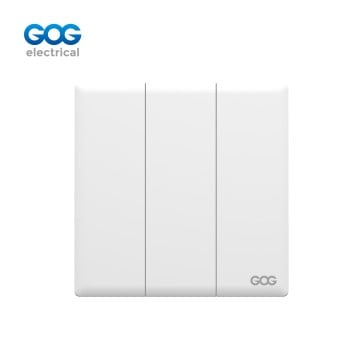
The R12305/R12306 is a 3 gang British wall light switch that consolidates three independent lighting controls into a single 86×86mm panel. Known as a triple light switch, it replaces three separate single-gang switches with one compact, space-efficient design. Featuring a 200,000-cycle mechanical endurance rating for each gang—five times the standard—the switch uses separate red copper and silver internal mechanisms. Available in both 1‑way and 2‑way configurations, each gang is independently wireable. Rated at 16A/250V, IEC 60669 compliant, and offered with a 12‑year warranty, this 3 gang light switch is ideal for large kitchens, open-plan spaces, and commercial areas where multiple lighting circuits converge into a single wall position.
Triple Control from One Standard Back Box: By combining three circuits into one standard 86×86mm back box, the triple light switch eliminates the need for three separate back boxes and plates, saving space. Each rocker operates independently, managing circuits such as main ceiling lights, under-cabinet task lighting, and pendant or accent lighting—all from a single, sleek panel.
200,000 Cycles — Per Gang, No Exceptions: Each gang in this 3 gang British light switch is independently rated at 200,000 cycles. Utilizing red copper bus bars and Φ3.5mm silver alloy contact points, and supported by a rigid middle plate structure, the switch ensures longevity and reliable performance in high-traffic applications. There is no shared mechanism or derating across gangs.
R12 Series Internals — Triple Red Copper & Silver Mechanisms
Each gang in the 3 gang British wall light switch features a dedicated set of red copper bushings, stamped parts, and bus bars, along with Φ3.5mm × 0.35mm silver alloy contact points. Two middle plate options are available: a full plastic plate for standard use or a steel-plastic combination plate for enhanced structural rigidity. The latter offers added durability, particularly beneficial for frequent use. The front panel and base are crafted from imported high-transparency, high-strength PC material, available in White, Gold, Gray, or Black finishes.
Factory-Direct Supply for Wholesale & OEM Partners
Your Source for High‑Endurance Triple Light Switches — 200,000 Cycle Rated
The R12 series 3 gang British wall light switch is manufactured alongside 1 gang and 2 gang R12 models, offering a complete high-endurance multi-gang range from a single production facility. Designed to optimize space and ensure lasting performance, the triple light switch features red copper and silver mechanisms, durable middle plate options, and customizable branding. With OEM branding, bespoke packaging, and global logistics support, it’s an ideal choice for residential and commercial projects requiring a premium lighting solution.
Specifying a 3 Gang Triple Light Switch
Guidance for contractors selecting a 200,000-cycle triple light switch for multi-circuit control.
Application Use Cases
In large residential kitchens, the triple light switch controls ceiling lights, under-cabinet task lighting, and island pendants from one position. Open-plan living spaces benefit from independent control of overhead, wall-mounted sconces, and accent circuits. In commercial spaces or hotel corridors, the 2-way version enables multi-point control of three separate lighting zones with consistent 200,000-cycle endurance.
How to Connect a 3 Gang Wall Switch
Each gang includes its own common, L1, and L2 terminals:
1. Bring the live feed to the common of gang 1 and bridge it to the commons of gangs 2 and 3.
2. Connect each outgoing switched live to the L1 terminals of the respective gangs.
3. For 2‑way circuits, connect the traveler wire to the L2 terminal of the corresponding gang. Terminals are clearly labeled for simplified wiring.
Installation Note
Though designed for three independent circuits, this smartly engineered 86×86mm triple switch fits a standard British back box. Neat cable management is key due to the number of cables entering this box. Where heavy or repeated usage is expected, the steel-plastic middle plate is recommended to prevent flex across the 3-gang rocker panel.
Frequently Asked Questions
What is a triple light switch called?
A triple light switch is most accurately called a 3 gang light switch — “gang” referring to the number of individual rockers on a single wall plate. The R12305/R12306 is a 3 gang British wall light switch, also referred to as a triple light switch. It controls three independent lighting circuits from one standard 86×86mm panel.
What does 3 gang mean on a light switch?
“3 gang” means the switch has three individual rockers on a single faceplate. Each rocker controls its own separate lighting circuit independently. The R12 series 3 gang light switch fits a standard UK back box and lets you operate three different lights or groups of lights from one location.
Can you get a 3 gang switch?
Yes, the 3 gang switch is a standard electrical product. The R12305/R12306 is a British standard 3 gang wall light switch — three rockers on one 86×86mm plate, available in 1‑way and 2‑way versions. It replaces three single‑gang switches with one compact panel, saving significant wall space.
How big is a triple light switch?
The R12 series triple light switch measures 86mm × 86mm — the standard British single‑gang wall plate size. Despite controlling three independent circuits, it fits a standard UK back box without requiring a larger opening. The compact internal design houses three separate red copper and silver mechanisms within this standard footprint.
How to connect a 3 gang wall switch?
Each gang has its own common, L1, and L2 terminals, clearly marked. Connect the incoming live to the common of gang 1, bridge it to gangs 2 and 3, then connect each switched live to the respective L1 terminal. For 2‑way circuits, add the traveler wire to the L2 terminal on the relevant gang. Always isolate the circuit at the consumer unit before wiring work.
Is there such a thing as a 3-way light switch?
Yes — “3‑way” is North American terminology for what the UK calls a 2‑way switch (one circuit controlled from two locations). Don’t confuse this with “3 gang,” which refers to three switches on one plate controlling three separate circuits. For controlling lights from three locations, UK wiring uses an intermediate switch (like the R12313) placed between two 2‑way switches. The R12 series includes both 2‑way and intermediate configurations for full multi‑location lighting control.
What is a light switch with three wires called?
A light switch with three wires connected to its terminals is typically a 2‑way switch (one common terminal plus L1 and L2 traveler terminals). This is the configuration used for controlling a single light from two locations. The R12306 is a 3 gang 2 way switch — each of the three gangs has three terminals for independent 2‑way control.