How many receptacles are allowed on a 15 amp circuit? It would depend upon the information you are given from your local electrician; you could get 8, 10 (depending upon the type) 12 (different types) and as many as you want. All are valid because the codes do not stipulate any limits and the numbers quoted are usually based on what people expect. In this article I will discuss why these numbers exist and highlight why you should choose a number you will be most comfortable with, no matter what type of electrical work you are doing.
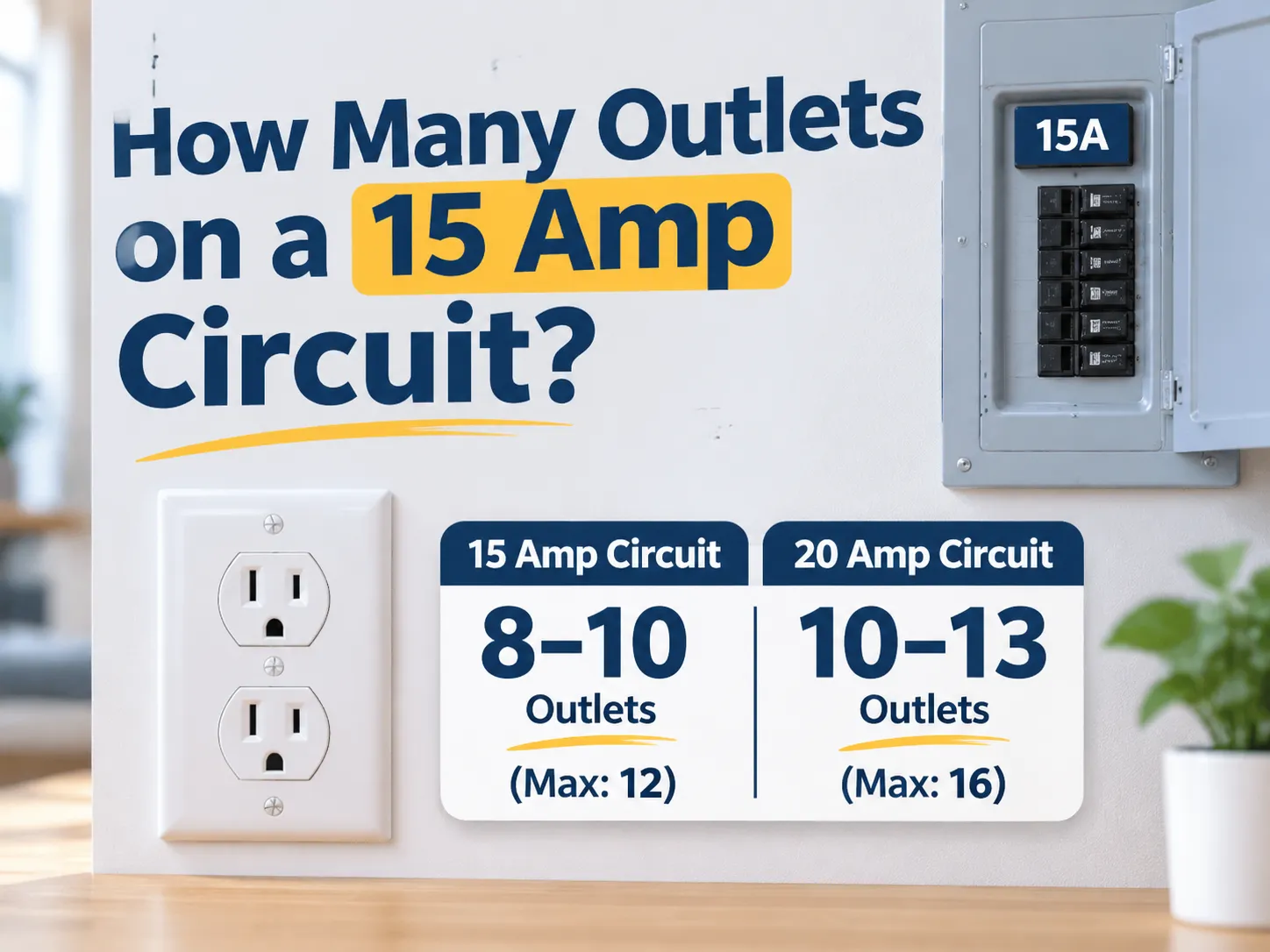
Quick answer: Using the 80% rule as a practical limit, which states no more than 1,440 watts can be used continuously from a 15 amp circuit, brings the number of receptacles to approximately 8-10, maximum 12 for very light use where the load is mixed/intermittent. The same rule is also true at a minimum 1,920 watts for a 20 amp circuit, which is a maximum of 10-13 receptacles, and a maximum of 16 receptacles for very light use where the load is mixed/intermittent.
The codes have specific requirements about loads from these locations and appliances.The following sections of this publication will provide information regarding the 80% Rule, calculations for both circuit sizes, consideration of the fact that 180VA is a planning number, understanding the first trip of a breaker, load tally for current technology equipment, explanation of the 2-6-12 Rule and its significance, circuits that are unique in their requirements, voltage drop, accounting for every room in the residence, and what happens when you add outlets to an existing circuit.
Why There is No Number in the Code
The Code requires demand, not inventory. When calculating total load demand on any dwelling’s general lighting and receptacle loads, Code specifies using floor area at 3VA per sq. ft.; receptacle outlets do not get counted individually in this calculation. Therefore, when an inspector does a rough-in on the building and finds twelve receptacle outlets wired on a single 15A breaker in a basement, they do not fail the rough-in inspection.
On the other hand, with Commercial work each receptacle draws 180VA, which means every receptacle’s count must be calculated, and the designer must add up straps and ultimately compare the sum of those straps versus circuit rating(s). The 180VA number also provides the basis for the residential Rule of Thumb, which is derived from a Commercial requirement and is used as a conservative planning assumption for homes.
Therefore, to accurately address the question, it is not the number of receptacle boxes, but rather the total power consumed by all devices connected to those receptacle boxes. A single receptacle running a lamp and a cell phone charger will consume far less than three receptacles used for space heaters, kettles & microwaves.
What the 80% Rule Actually Says
A Circuit Breaker functions as the main electrical disconnect for a home, protecting it from overcurrent and fault conditions. The term “continuous load” refers to any electrical appliance or device that operates continuously over a period of time greater than three hours. For example, a continuous load is defined as any electrical load that continues to run after its initial startup (i.e. a circuit with a heating element). According to the NEC, “The branch circuit must be rated at 125% of the continuous load.” Another way to say this is: “The continuous load on a circuit cannot exceed 80% of the circuit’s rating.” Therefore, a 15 Amp circuit breaker is allowed to continuously carry 12 Amps (15 Amps x .80 = 12 Amps) while a 20 Amp circuit breaker is allowed to carry 16 Amps continuously (20 Amps x .80 = 16 Amps).
Understanding the logic behind the 80 percent rule helps us understand many of the nuisance trips that occur with thermal-magnetic breakers. A thermal-magnetic breaker has a mechanical component, called a bimetal strip, which bends when it heats up. When the breaker is at its maximum operating temperature, the bimetal strip is already hot and when it is installed in a circuit panel in a garage at 40 deg C, this thermal effect further exacerbates the overheating of the bimetal strip. A circuit that is operated continuously (not intermittently) at 100% of load will trip a breaker unless the load is defective or there is something wrong with the circuit itself. This is why the 80 percent rule exists to protect the thermal-magnetic breaker from being operated so close to its maximum operating temperature.
Most electrical loads found in a home are intermittent, meaning they do not operate for long periods of time (i.e. for example; a kettle run for four minutes) as opposed to an office with a desktop computer, a pair of monitors, and a laser printer being used continuously for eight hours. If the loads in the office above were continuous, the circuit breaker protecting that circuit would likely be tripped.
The Arithmetic for 15 A and 20 A
The following explains the basic calculations for the 15 amp and 20 amp circuits:
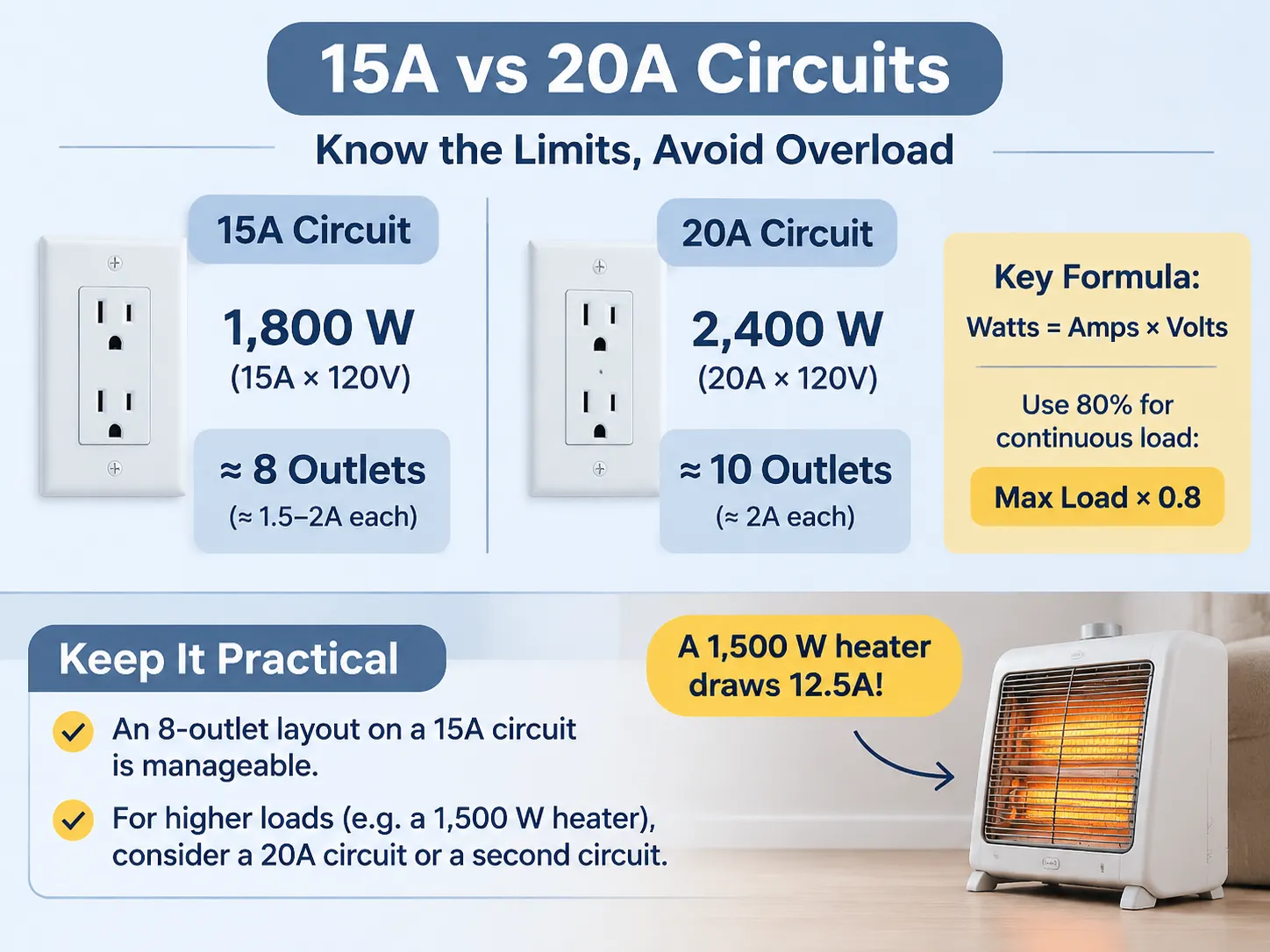
Watts = Amps x Volts; 80% is the acceptable current level (result).
In addition to providing overload protection (which is probably the most important part), it is helpful to provide some idea of what the maximum load on the circuit will be by taking the total capacity of the circuit and dividing it by the number of outlets created from that number.
Maximum Load / 80% Continuous = Outlets
Assuming a load capability of 180 VA per receptacle
Max load is 1800 W (15 A @ 120 V) or 2400 W (20 A @ 120 V).
So the maximum number of receptacles that can be connected to a given circuit is calculated in this format:
Maximum Load (15 A) / 8 receptacles = 60 VA (8 receptacles = 2.5 A each)
Maximum Load (20 A) / 10 receptacles = 60 VA (10 receptacles = 2 A each)
When determining the number of receptacles, it’s important to keep in mind that this assumes all your receptacles will have an average load of either 1.5 A or 2.0 A continuously for the length of time required. If a receptacle does not have a load of 1.5 A or 2.0 A for the length of time it is plugged into the circuit, it would change the potential number of receptacles allowed on that circuit.
The breakdown of outlets on a 20 A circuit is explained in greater detail in the breakdown of circuit options below. The cost of installing a 20 A circuit increases because more outlets can be installed at one time. More importantly, the circuit allows for greater headroom for one device with a large load.When an assumption is true, it means that there are 8 outlets located on a 15A circuit, which is right on schedule with the continuous budget, so everything is good.
However, when that assumption is false, it fails miserably at times. For example, let’s say that there was a 1,500 W space heater; it draws 12.5 A, which is the entire continuous budget of a 15 A circuit by itself. So, in theory, two (2) outlets could overload the circuit – according to the calculations, it would be 10 (in theory); however, there is no code that prevents this from happening, because code presumes that the user won’t have the heater and kettle plugged into the same circuit.
Thus, using the number of outlets as an upper limit is more practical. A room with an eight outlet layout, and mixed electronics is manageable; whereas an area with 12 outlets where any of them could have a heater plugged into them, would probably trip the breaker in January. To solve that issue, install a second circuit rather than reducing the number of outlets available.
The difference between a tripped breaker and a tripped outlet (Inrush Current)
Breakers do not operate based on simple rules (binary). Normally, a thermal magnetic breaker will take longer to trip on an overload than on a short circuit, however, with a thermal magnetic unit, the trip curve is inversely proportional to the current, meaning if you plug in a device that drew 12 A of operating current, it could easily trip out at startup, since the motor will draw 30 – 40 A for an instant when starting up – that is what we see. How far up the curve that surge lands will determine if the magnetic element will trip when seeing it. The second is, a circuit can run for months at 14 A and trip on a hot day because the ambient temperature in the panel pre-loaded the bimetal.
Neither of the above represents outlet number but rather load behaviour, it is why adding outlets will seldom solve nuisance tripping problems. When a circuit trips the question that needs to be asked is what was running at that time not how many boxes are installed in the wall.
Load Tally: What Modern Devices Draw
Failure to accurately measure and/or record all the devices on a given circuit leads to a poor understanding of how much load is present.
Measuring and tracking your load takes about 10 minutes and will give you a true picture. The list below provides the average running load of devices at approximately 120 V; motor loads will typically be higher when first starting.
| Device | Running Watts | Amps at 120 V | % of 15 A Continuous Load |
|---|---|---|---|
| Six LED Downlights | 60 W | 0.5 A | 4% |
| 65-inch TV & Soundbar | 150 W | 1.25 A | 10% |
| Desktop Computer (with two Monitors) | 400 W | 3.3 A | 28% |
| Laser Printer (Under Load) | 500 W | 4.2 A | 35% |
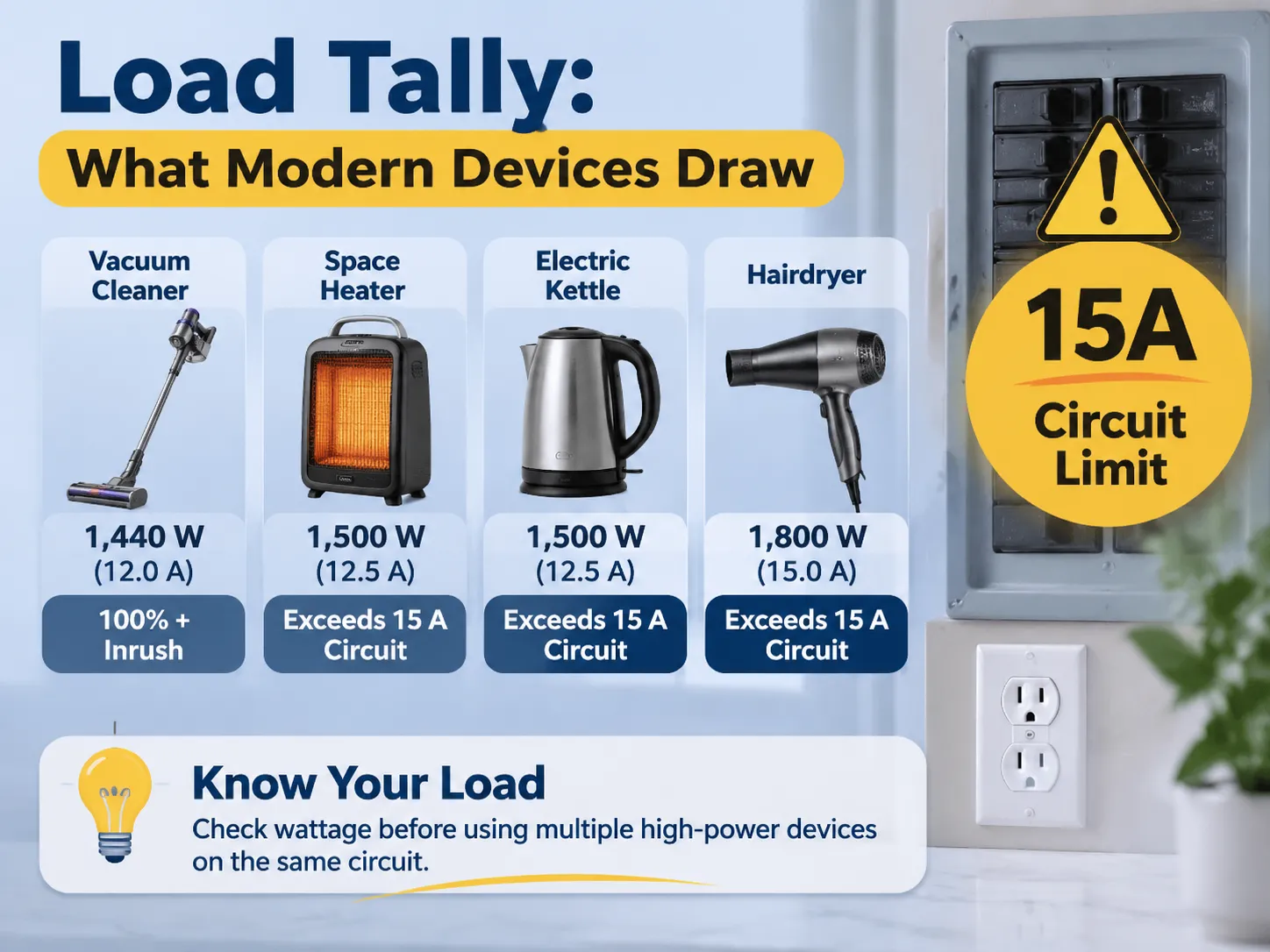
| Vacuum Cleaner (currently in-use) | 1,440 W | 12.0 A | 100% + Inrush |
| Space Heater | 1,500 W | 12.5 A | Exceeds the Continuous Load Budget |
| Electric Kettle | 1,500 W | 12.5 A | Exceeds the Continuous Load Budget |
| Hairdryer (Currently in-use) | 1,800 W | 15.0 A | Exceeds the Circuit Rating |
Three of these four devices (vacuum cleaner, space heater, kettle and hairdryer) when used by themselves will consume an entire 15 A circuit.This is why bathrooms have their own circuit, kitchens have 2 circuits, and the number of outlets in each of those rooms is not included in the calculation of the demand load. To see a little more closely at what one device will draw, the wattage limitations for a standard outlet must be checked before connecting a heater and dryer at the same time into the same room.
The 2-6-12 Rule, and What It Really Means
The 2-6-12 rule is for the convenience of remembering what that means, not as a citation from the code; electricians refer to it in many slight variations. The version that aligns with the code is: No point on a wall shall be more than six feet away from a receptacle, which means that the maximum distance two receptacles can be from each other is twelve feet and that receptacles shall be provided on any wall space of two feet or more in width.
These three numbers come from the dwelling receptacle spacing requirements, and are simple convenience or cord length and not circuit load. The basis for this is so that anyone with a six-foot cord can reach an outlet without using an extension cord, and it is the fault of running cords under rugs (a cause of fire) that the code actually has the power to prevent.
There are two things that this rule does not apply to. It is not a requirement for all rooms; hallways, closets and storage areas do not follow the same rulings as habitable rooms. Additionally, it doesn’t state the maximum number of outlets per room but rather the minimum placement of the outlets.If the circuit has four outlets to meet the 12 ft spacing, then it meets the conditions of having four outlets on that circuit. This is independent of the 80% calculation. Generally, where there are four circuits provided for each dwelling unit, they are considered individually and not as part of the general outlet rule.
Circuits That Have Their Own Rules
The kitchen and bathroom receptacles require each, respectively, to be supplied by their own 20 A circuits, which do not serve any appliance outside of the kitchen and dining area, as opposed to all other areas within a dwelling. Bathroom receptacles also require that a 20 A circuit exclusively serve the bathroom and allow for a single lighting and/or fan connection serving only one bathroom.
Each laundry room must have a dedicated 20 A circuit for the washing machine, and all fixed large appliances that are exempt from the 80% calculation (dishwashers, disposals, microwaves) also must be supplied by their own dedicated circuits.
How the Rules Differ by Country
In countries outside of the U.S. or Canada, the design philosophy works quite differently, and therefore produces a different answer to the original question. For instance, in the UK, where a ring final circuit is used, it is a 32 A breaker feeding 2.5 mm² cables in a loop configuration with no restrictions on the number of sockets, provided the total area of floor served does not exceed 100 m². The overload protection for a circuit like this is provided by the 13 A fuse within the plug connected to that socket. Thus, the question of safety becomes less important, while the issue of convenience becomes more significant. The 13 A socket center products available from our manufacturer stem from the fact that in the UK, they provide a fuse within each plug, whereas in North America, they are typically used in conjunction with 15 A duplex receptacles.A designer’s ability to contrast and compare the differences of two regions is arguably one of the most valuable things they can take from all of their work across both region. For North America, the circuit protects the wiring itself, and the number of outlets (or circuits) you can have is a reflection of how much load you can have on that circuit. For the UK, the plug protects the appliance, and the number of outlets is related to the square footage of the floor. Neither way of looking at this is wrong; a mix of the two results in a design that will work poorly in both cases.
Voltage Drop and Cable Length
When we consider the effect of cable length on voltage drop, we see that; the outlet count gives no consideration to how far the current has to travel through the cable. The amount of voltage that drops across a cable over a certain length will have an effect on how the circuit works. For instance, a 15 amp load at the end of 30 meters of 14 AWG cable will see about a 7 volts voltage drop, or 6 percent of the 120 volts from the source. This would put the voltage drop substantially out of the recommended value of 3 percent for a branch circuit. The load will continue to work correctly, but the motor would operate at a higher temperature and the electronic components would receive a lower voltage input.
In practical terms, cable length limits the number of outlets that can be connected to a circuit. The outlet count is based on a distance, rather than a number. If a circuit runs long distances to garage, or garden office or end of a large floor, the circuit should be larger in size to accommodate those distances, and the outlet count should be limited because the distance between outlets will continue to get larger the further away you go.
A simple voltage drop calculator can help determine the amount of drop in a circuit over the length of cable, and it is best to run one before the first electrical installation (or fixture) is completed. If you wait until the drywall is installed, you will either have to accept the drop or install a new circuit.
How Many Outlets In Each Room
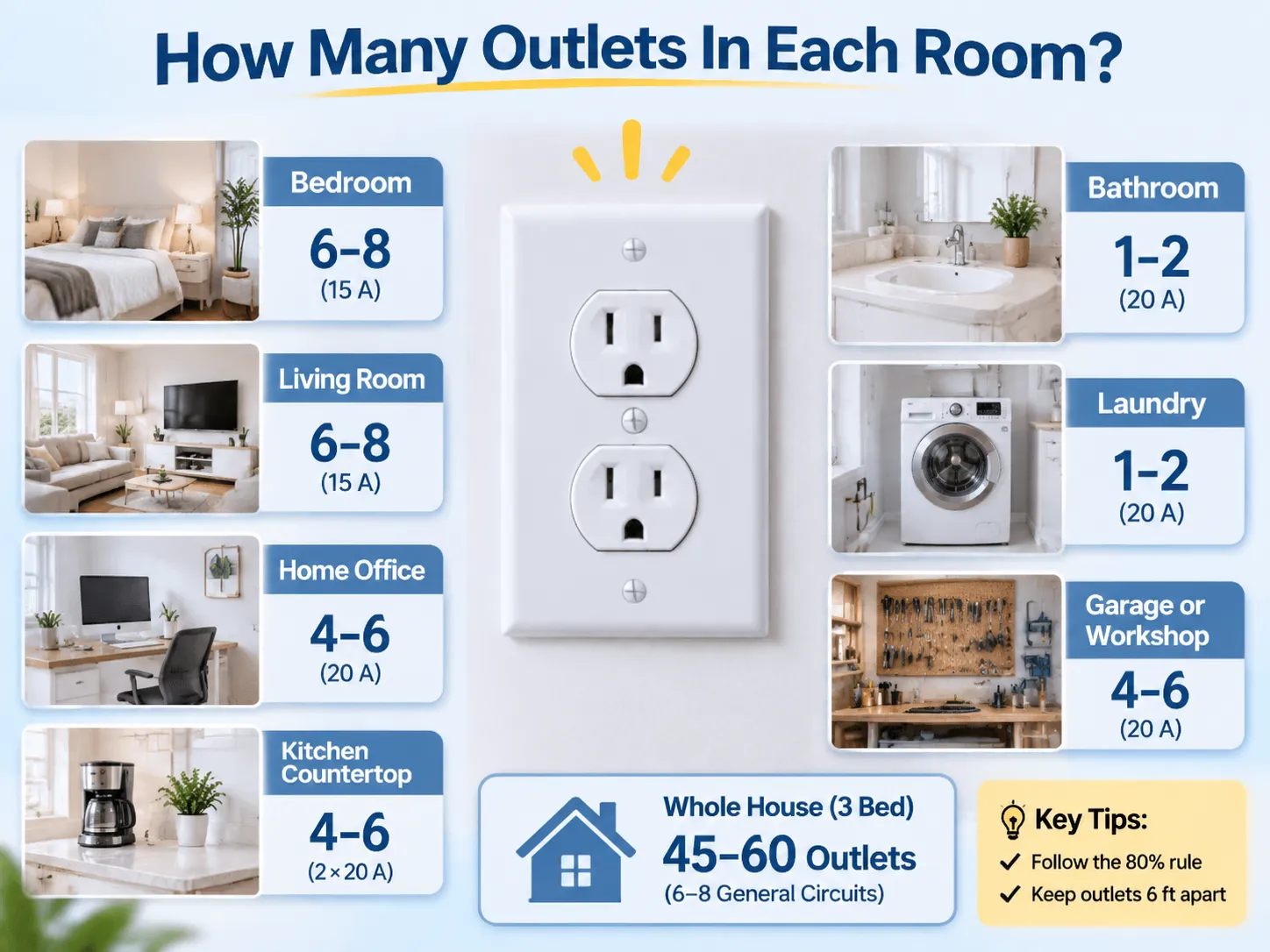
This is the practical solution to answer the question of how many electrical outlets you will need for each room. It combines the 80 percent rule of thumb with minimum distance between electrical outlets and the specific needs of each room. It assumes a general 15 A circuit for most rooms and a 20 A circuit when required by the code.
| Room | Circuit type | Outlets on that circuit | Comments |
|---|---|---|---|
| Bedroom | 15 A General | 6 to 8 | The amount of space available usually dictates how many will fit and how many can be loaded onto a single circuit. |
| Living Room | 15 A General | 6 to 8 | The load is usually 150 to 400 watts for entertainment equipment, which is far below the allowed amount of wattage on the circuit. |
| Home Office | 20 A Dedicated | 4 to 6 | Continuous load, printer inrush, and do not share the circuit with other loads. |
| Kitchen Countertop | 2 – 20 A Small Appliance Circuits | 4 to 6 | Do not aggregate with outlets from general circuits in the kitchen. |
| Bathroom | 20 A Dedicated | 1 to 2 | A hair dryer uses up 15 A, so the count is moot. |
| Laundry | 20 A Dedicated | 1 to 2 | Anticipate the simultaneous use of a washer and possibly the placement of an iron near the washer. |
| Garage or Workshop | 20 A Dedicated | 4 to 6 | Tools have a high inrush current, and they generally have long circuits, so providing some flexibility is advisable. |
| Whole House (3 Bed) | 6 to 8 general circuits | 45 to 60 total | New homes typically have from 45 to 60 outlets using 6 to 8 general circuits; the overall split configuration may be less important than excluding heavy-use rooms from shared general-purpose circuits. |
For a project outlining the electrical devices and services needed in each room of a building, the way in which the socket range is organized is by way of the faceplate (cover) which will hold the number of modules, not by the total number of outlets. Total quantity is ultimately the level to which a final bill of quantities is to be produced for a project.
Adding additional outlets to an existing electrical circuit(s)
Most clients make the request to add one additional electrical outlet in one of their rooms that already has four outlets present, and the circuit for that room has never tripped before. This is typically acceptable; the easiest way to check this is to tally the load, and confirm that nothing else, including the existing outlets, connected to that circuit will create an overload. The worst-case scenario is that an extra outlet is added for a large appliance such as a refrigerator or fridge freezer without checking anything first, and this is how a circuit connected to a large freezer is also connected to a circuit that supplies a laser printer.
Three (3) things to confirm before connecting the wiring for an outlet are: 1. whether the spare capacity (and hence, the spare capacity to fill) of the circuit is within the 80% rule; 2. whether the room where the new outlet will be installed will need to have GFCI or AFCI protection, because under the code, a NEW outlet installed in a kitchen or garage requires the same protective measures, even if the existing outlets did not; and 3. whether the new device will need to be “tamper resistant” per code (which is now standard in all residential dwellings). Hence, tamper resistant outlets are the default replacement for standard electrical outlets, and this is why the majority of customers ask for tamper resistant outlets to replace any existing standard electrical outlet, (not to be put in a different location). So, they will end up requesting the tamper resistant outlet as a replacement.
If the main electrical panel of a house is full, the most truthful answer is to provide your customer with either a new sub-panel or a new circuit. Using a tandem breaker or connecting several devices together in a long daisy chain will only serve to prolong the period between now and when the customer needs to have the issue resolved. The absence of “free ways” in an electrical panel should tell you that the house to which it is connected has expanded beyond the scope of the panel, and connection of an additional outlet(s) to a circuit that is already at maximum capacity places this problem on another circuit rather than solving it.
FAQ
Should outlets be wired on 15 or 20 amp breakers?
General living areas typically use 15 amp circuits with 14-gauge wire which is economical and supports lamps, electronics, etc. While kitchens, bathrooms, laundry rooms, garages, and home offices will typically use a 20-amp circuit with 12-gauge wire because some appliances used in these parts of the home can require more than 12 amps by themselves. A 20-amp outlet can be installed on a 20-amp branch circuit; however, a 15-amp outlet can also be installed on a 20-amp circuit, but not the opposite.
Should lights and outlets be put on the same circuit?
While this is acceptable in many general living areas and was commonly done in older homes, it is advisable to install them separately. If you have a circuit for your outlets and also happen to trip that circuit in the room while you are attempting to find your way around, it may leave the room dark (example: kitchen or bathroom) and would not comply with code at this time, as the receptacles require that they serve only receptacles. Therefore, current practice tends to keep lighting on its own separate circuit.
What does the 2-6-12 rule for outlets mean?
The 2-6-12 rule is a reference for spacing requirements, not for reference to any local code: A maximum of no more than six feet away from any point on the wall (as measured in a straight line) to an outlet; a maximum of no more than 12 feet between any two outlets installed on the same wall; and any wall section that is at least two feet wide must have an outlet installed within that two-foot spacing. This is about where outlets are located, not how many outlets can be on the same branch circuit.
Should I use a 15 Amp or 20 Amp breaker for my lighting?
Normally, a 15 Amp circuit is recommended for lights and with the use of LED lamps, the wattage load is much lower than when using incandescent lamps. The only instance when you may want to use a 20 Amp circuit for lights is when you have high-output fixtures or are sharing the circuit with heavier electrical devices. To use either one, you must ensure that the cable gauge matches the breaker size appropriately.
Is there a limit to how many outlets can be placed on a 15 Amp circuit?
Under the National Electrical Code, there is no defined maximum outlet limit on circuits installed in residences. However, under typical planning assumptions, eight to ten outlets would be the practical application on a 15 Amp circuit and up to 12 outlets could be wired for light mixed usage. The actual limitation will come from the total circuit load. A single (1,500 Watt) heater would use an entire continuous load capacity on a circuit by itself.
How many outlets can be installed on a 20 Amp circuit?
Using the same planning assumptions, ten to thirteen outlets are the average number of outlets that can be powered by a 20 Amp circuit. Up to sixteen outlets can be powered on a 20 Amp circuit when there are very few or no heavy loads connected to that specific circuit. A 20 Amp circuit provides a continuous power delivery capability of 1,920 Watts, so it will support at least one high-power-consuming device in addition to the general load, something that a 15 Amp circuit does not.
References
- UL Solutions – Protection and Certification for Receptacle and Circuit Type
- NEMA – Receptacle and Wiring Device Standards
- Leviton – Residential Wiring Planning and Load Capacity
- NFPA – National Electric Code Art. 210 and 220
- Electrical Engineering Portal – Branch Circuits and Load Calculation
Conclusion
When it comes to real-world applications, eight to ten outlets on a 15 Amp circuit has stood the test of time in actual homes, while twelve outlets will only be functional if nothing heavy is plugged into the circuit. Beyond that, the circuit relies solely on the user to never run two appliances at one time, which is not a credible design approach.
What you need to remember with regard to maximum capacity and planning for a 15 Amp or a 20 Amp circuit is 1,440 W and 1,920 W, respectively. Therefore, everything else mentioned, such as the 180VA planning assumption, the spacing of 2-6-12, outlet count, is simply a method of ensuring that these two figures remain below their respective maximum output without going through the calculations each time.