During the renovation of her Sydney kitchen, a homeowner took the time to make proper selection of the kitchen cabinet, benchtops, and pendant lights. She thought that the last decision regarding the finish of the light switches and outlets would be easy. Upon entering the electrical product store, she saw two metal plates practically identical in color which stopped her. One of the was the brushed nickel, the other was the chrome. Although they were similar in the store’s lighting, she was explained by the designer that the kitchen installations must be made by using the brushed nickel, while chrome should be used in the bathroom. What is the difference? Why is it important? This is the question faced by a homeowner, renovator, or interior designer at a certain time. The first step to making the right choice of the wiring device consists in making proper selection of the finish of the product used. The finish makes the device look good after years of finger drops or cleaning sprays, determines how it interacts with the light in the room, and whether it matches the other facilities in the room or not.
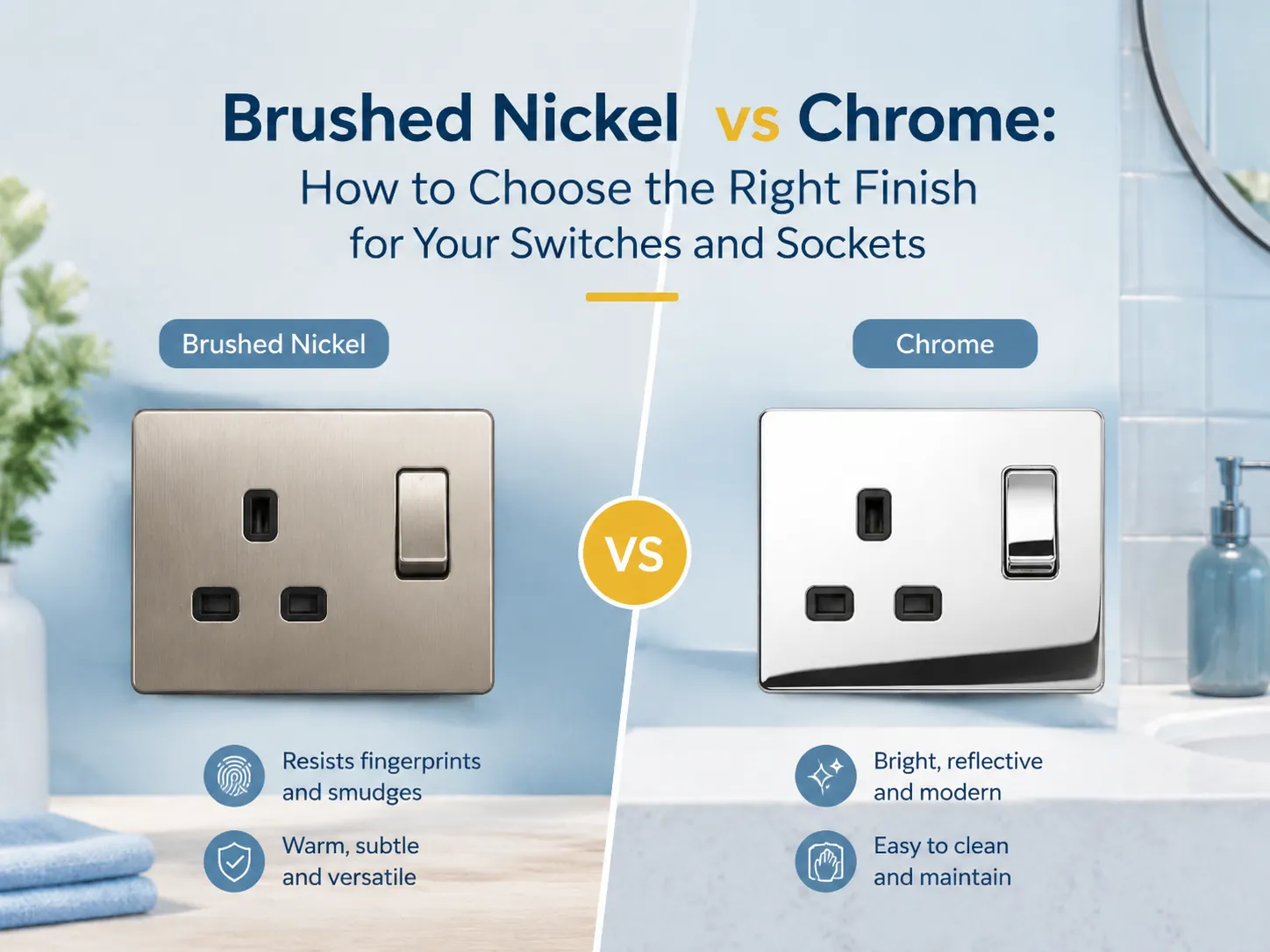
The crucial distinction between burushed nickel and chrome lies in their appearance and texture. Chrome is a shiny skillfully made surface, which shines and reflects. Chrome has a high level of brightness, it is modern and cool in tone. While brushed nickel is plating made out of nickel, which goes through the process of abrasion, and acquires a matte effect. While for chrome, grease, water spots, and dirt are clearly visible, brushed nickel masks the flaws. Chrome quite durable to scratches, because it has a harder and smoother surface, while brushed nickel shows some abrasions more clearly, but handles smaller errors even better than the polished surface.
Brushed Nickel vs. Chrome: A Direct Comparison of the Two Most Popular Metal Finishes
The table below provides a side‑by‑side comparison of brushed nickel and chrome across the criteria that matter most in a real‑world installation—not just how they look on day one, but how they age, how they clean, and how they interact with the rest of the room.
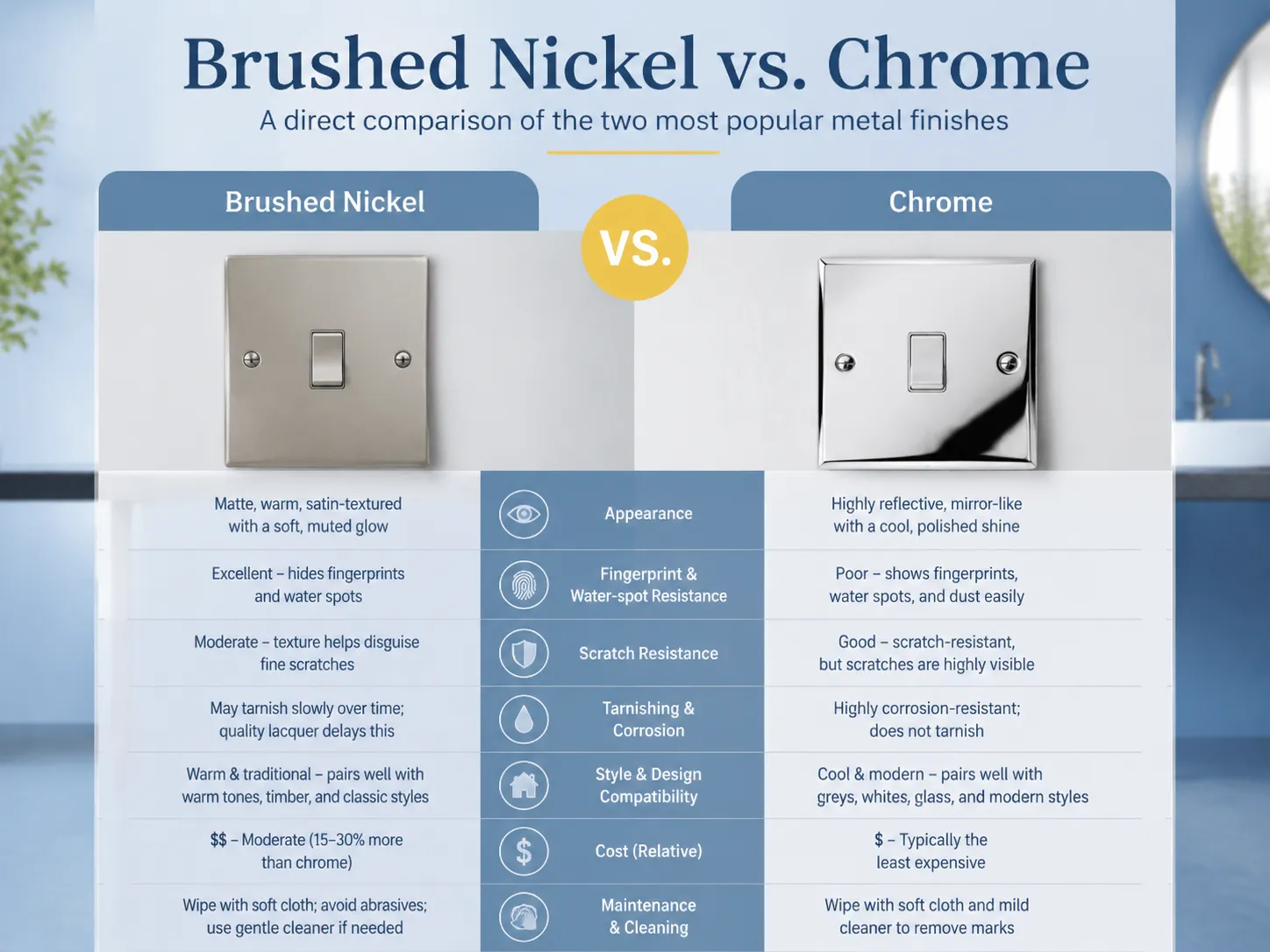
| Characteristic | Brushed Nickel | Chrome |
|---|---|---|
| Appearance | Matte, satin‑textured, with a warm, slightly golden or champagne undertone. The surface scatters light rather than reflecting it, producing a soft, muted glow. | Highly reflective, mirror‑like, with a cool, bluish‑silver undertone. The surface reflects light and the surrounding colours strongly. |
| Fingerprint and water‑spot resistance | Excellent—the matte texture hides fingerprints, smudges, and water spots effectively. A good choice for high‑touch areas such as kitchens and bathrooms. | Poor—the mirror finish shows every fingerprint, every water spot, and every speck of dust. A chrome switch plate in a busy kitchen will look smudged within hours of cleaning. |
| Scratch resistance | Moderate—the matte surface can show scratches if abraded by a sharp object, but the texture helps to disguise fine scratches and minor wear. | Good—the hard, smooth chrome plating is more resistant to scratching than brushed nickel. However, when a scratch does occur, it is highly visible against the mirror finish. |
| Tarnishing and corrosion | Nickel tarnishes slowly, developing a darker, slightly antiqued patina over many years, particularly in humid or coastal environments. A high‑quality plating with a clear protective lacquer delays this. | Chrome is highly corrosion‑resistant and does not tarnish under normal indoor conditions. It is the standard finish for bathroom fixtures for this reason. |
| Style and design compatibility | Warm and traditional. Pairs well with warm whites, beiges, earth tones, timber, and traditional or transitional interiors. Complements brushed nickel, stainless steel, and pewter fixtures. | Cool and modern. Pairs well with pure whites, greys, blacks, glass, and contemporary or minimalist interiors. Complements chrome, polished stainless steel, and mirrored fixtures. |
| Cost (relative) | $$ – Moderate. Brushed nickel is typically 15–30% more expensive than chrome for the same switch or socket model, reflecting the additional brushing process. | $ – Typically the least expensive metal finish. Chrome plating is a mature, high‑volume process, and the cost per unit is lower than nickel. |
| Maintenance and cleaning | Wipe with a soft, dry or damp cloth. Avoid abrasive cleaners, which can damage the brushed texture. A gentle glass cleaner can be used for stubborn marks. | Wipe with a soft cloth and a mild glass or chrome cleaner to remove fingerprints and water spots. Abrasive cleaners will scratch the mirror finish. |
What Are the Disadvantages of Brushed Nickel?
Brushed nickel is an attractive finish with many uses, but it comes with limitations that buyers need to take into account. One disadvantage of brushed nickel is its color consistency. The nickel plating process is slightly different from one manufacturer to another and between one batch and the next. Brushed nickel of one maker has a slightly warmer, champagne-like tint compared to that of another maker so that matching a brushed nickel socket plate and a brushed nickel faucet may be challenging in terms of getting the same color. If a buyer wishes to get an absolutely consistent finish for all metal products in a particular location, it makes sense to order them from one manufacturer or to see samples before making purchases. Another disadvantage is scratching. Brushed finish may easily hide fingerprints but is not immune to any scratches. If an object, such as a key, a towel or a ring gets dragged across the surface of a particular part, it will leave a visible mark. Unlike chromium, where a scratch appears as a distinct line in an otherwise seamless surface, a scratch on brushed nickel will disturb its smooth creamy texture, making it apparent. The third limitation concerns the tarnishing of plated surfaces within restrictive conditions. Coastal environments may present salt-laden air that speeds up the tarnishing process of nickel. The high quality of the plating with all the necessary protection will help overcome this issue. A buyer should make sure that he or she understands the requirements set by different manufacturers concerning the conditions the nickel products should be used in. For those who enjoy the creamy use of brushed nickel and do not mind a somewhat higher price and slightly more difficult maintenance process, it is a great option for the kitchen and for the living room switch plates where the brightness of the design is important.
Beyond Metal Finishes: The Full Range of Switch and Socket Faceplate Materials
When looking for materials available for switch and socket faceplates, brushed nickel and chrome are not the only materials available. Modern market for wiring devices can offer you different types of materials with so many different aesthetics and durability. Understanding all available materials enables a buyer to match the material with a room, budget, and design plan.
PC (Polycarbonate) — The Standard, Economical, and Practical Choice
PC (polycarbonate) is the material used for the vast majority of standard white and coloured switch and socket faceplates. It is an engineering thermoplastic that is strong, impact‑resistant, and inherently flame‑retardant. PC faceplates are the most economical option—a standard white PC single‑gang switch plate costs a fraction of what a metal or glass plate costs—and they are available in white, cream, grey, black, and a range of decorative colours. The advantages of PC are its low cost, its light weight, its ease of cleaning with standard household cleaners, and its electrical non‑conductivity. The disadvantages are that PC can discolour over many years of UV exposure (sunlight through a window), it can become brittle with extreme age, and it does not carry the same design weight as a metal or glass plate in a high‑end interior. PC is the default choice for utility rooms, garages, rental properties, and any location where the switch must be functional, durable, and inexpensive. GOG Electric’s white moulded PC range, including the standard British‑standard switches and sockets, provides this practical, cost‑effective solution with the tamper‑resistant shutters and the robust internal contacts that a modern home demands.
Acrylic Glass — The Screwless, Seamless, Contemporary Look
Acrylic glass, often referred to as PMMA or perspex, is known for its sleek, shiny, and flawless surface without any unsightly screws. The sheet fits onto a sub-frame which in turn is fixed onto the wall, thus creating the unbroken surface loved by those who adore modern kitchen, lounge, and commercial styles. Acrylic glass comes in pure white, solid hues, and other translucent varieties and is lightweight, low-cost, and more scratch-resistant compared to polycarbonate (PC). Acrylic glass has its pros, namely aesthetic appeal, range of colors, and affordability vs. tempered glass. Among the cons are such drawbacks as the ability to become scratched, cracking under severe impact, as well as being vulnerable to heat compared to PC or metals. This makes acrylic glass a great option for those homeowners, who like up-to-date interiors without visible fasteners for a reasonable price. GOG Electric’s exclusive ultra-thin switch and outlet lines feature acrylic glass faceplates with a simple and screwless installation design.
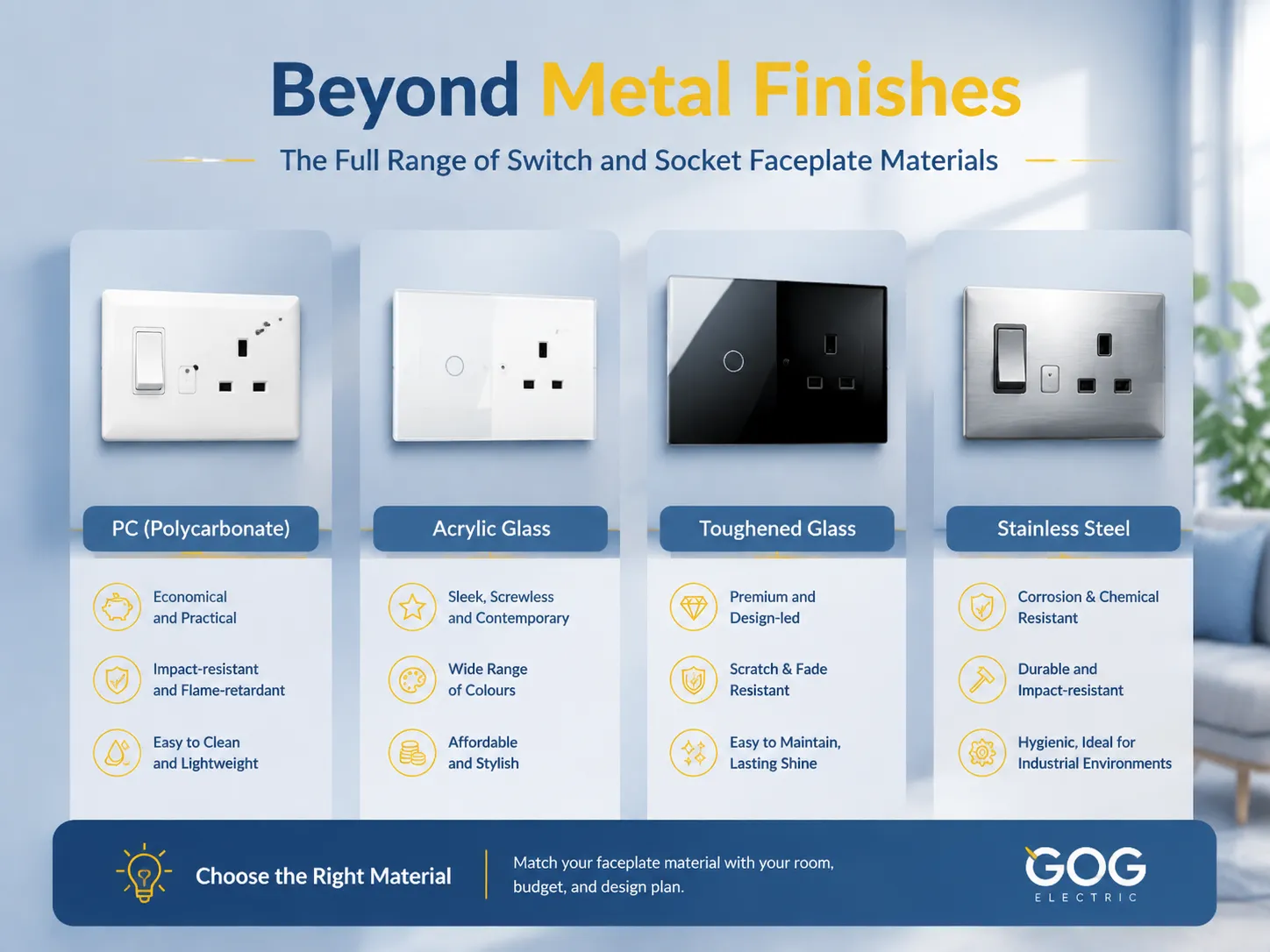
Toughened Glass — The Premium, Design‑Led Statement
Toughened glass faceplates are considered the best alternative among all the types of wiring devices. Toughened glass does not have just any kind of glass. Rather, it is made of glass having undergone chemical or thermal treatment so that it becomes tough and safe. Toughened glass faceplates provide lots of colors, reflections and textures unique to the devices made from plastic. Available in pure white or black, or metallic finishes or even custom, toughened glass faceplates are expensive and heavy but they can perfectly serve interior purposes in luxury homes, hospitality or commercial premises. Some of the benefits provided by toughened glass are its unmatched aesthetic properties, resistance to scratching or fading and easy maintenance—maintaining the original shine of the faceplate only requires wiping with a glass cleaner. Some drawbacks of toughened glass are its expensive price, heavy weight (which makes faceplate installation difficult) and fragility (making it easy to break it by dropping a sharp tool) but broken glass will always remain safe to be used thanks to the technique of tempering. GOG Electric got the wall switch series of glass and aluminum ones in which faceplates made of toughened glass are used combined with aluminum sub-frames to create a really amazing design.
Stainless Steel — The Industrial, Durable, and Hygienic Option
Stainless steel faceplates, which are generally available in either a brushed or satin finish, create a different appearance than brushed nickel or chrome. Stainless steel is naturally resistant to corrosion and does not tarnish and it does not depend on a layer of plating that can degrade over time. Its colour is cooler and greyer than that of nickel and more uniform from one manufacturer or batch of stainless steel to another than nickel plating would be. Stainless steel faceplates have become the main option for the commercial kitchen, food processing sector, hospitals, and other industrial environments where hygiene, durability, and resistance to cleaning agents are critical. Stainless steel’s advantages include corrosion and chemical resistance, as well as impact resistance and uniform colour. Its drawbacks are the potential presence of traces of fingerprints on polished surfaces (which can be decreased on brushed surfaces) as well as the fact that stainless steel is more expensive than materials like PC and acrylic, plus its industrial look might not fit into a warm and traditional interior.
How to Choose the Right Finish and Material for Your Project
Match the material to the wear and cleaning requirements of the room. In the kitchen, the switch plate will suffer from greasy or wet hands or flour-covered fingers, thus warranting the use of brushed nickel or stainless steel switches that require just a damp cloth to clean. In the bathroom, where the plates are prone to be concerned about water spots and toothpaste splashes, chrome or stainless steel finishes can be used as water resisiting and easy-to-clean with a window cleaning product. In a hallway or living room, the switchplate is designed to be the piece of art, so using glass or acrylic glass will make for the design piece at minimal exposure to aggressive cleaning materials.In terms of cost, scrutinize the amount of visibility. A premium coating, such as brushed nickel or toughened glass, will make a big impression and can be justified in areas of the house where the switch plates are positioned such that they are commonly sighted, like the kitchen, the living room, and the master bedroom. However, in places such as the garage, the laundry, and the utility closet, a plain white plastic plate works perfectly and saves costs for finishes in other locations of importance.
Frequently Asked Questions
What’s better, chrome or brushed nickel?
Neither is universally better. Chrome is more reflective, cooler‑toned, more scratch‑resistant, and typically less expensive. Brushed nickel is warmer‑toned, hides fingerprints and water spots better, and is preferred in traditional and transitional interiors. The choice depends on the room’s design, the surrounding fixtures, and the desired maintenance routine.
What are the cons of brushed nickel?
The main disadvantages of brushed nickel are its higher cost compared with chrome, its potential for colour variation between manufacturers and between batches, its susceptibility to tarnishing in humid or coastal environments, and the fact that its matte texture, while excellent at hiding fingerprints, can show scratches from sharp objects.
What is the most timeless finish for faucets?
Chrome and brushed nickel are both considered timeless finishes, but they serve different design languages. Chrome has been a standard bathroom and kitchen finish for nearly a century and is unlikely to look dated; it is the safe, classic, modern choice. Brushed nickel has been popular for several decades and its warm, muted look complements both traditional and contemporary interiors. For a switch or socket plate that will remain in place for decades, either finish—from a reputable manufacturer with a consistent plating quality—is a safe, timeless choice.
Is brushed nickel outdated?
No. Brushed nickel is not outdated. It remains a widely specified finish in residential and commercial interiors, and its warm, fingerprint‑hiding properties make it a practical and attractive choice for kitchens, bathrooms, and living areas. While design trends shift, brushed nickel’s combination of warmth and practicality has kept it relevant through multiple design cycles, and it is likely to remain a standard finish for the foreseeable future.
References
- NEMA — Standards for Wiring Device Finishes and Materials. The National Electrical Manufacturers Association publishes standards that define the performance and testing requirements for the materials and finishes used on electrical wiring devices.
- Leviton — Decorative Wiring Device Finishes and Material Options. Manufacturer of North American wiring devices with a full range of PC, metal, and glass faceplate finishes, including brushed nickel and chrome.
- Legrand — Wiring Device Aesthetics and Finish Selection. European manufacturer of switches and sockets with extensive design ranges in PC, metal, glass, and acrylic finishes for residential and commercial applications.
- Moen — Brushed Nickel and Chrome Finish Technology. While a faucet manufacturer rather than a wiring device manufacturer, Moen’s published finish specifications and durability data for brushed nickel and chrome platings are applicable to any electroplated metal product in a residential environment.
Choice between brushed nickel and chrome, and the wider variety of materials—thanks to the electrics faceplate (from PC to glass to stainless steel)—represents the last and highly visible choice manufacturing. The wall switch turns the light on, but its material determines how the whole room feels about the switch. Brushed nickel is warm, masks fingerprints, and matches the traditional or transitional style of the interior. Chrome makes the room cooler, reflects light in it, and serves as the anchor of the modern design. The white PC plate works quietly and economically in the utility room. The toughened glass plate makes statements in the kitchen or hotel suites. The right finish is the one that suits the interior, budget, and future life of the room—and the manufacturer that offers the finish to provide switches, sockets, dimmers, and USB ports in uniform color and with reliable plating is the manufacturer that turns the electricity device into a design solution. GOG Electric is the manufacturer that offers various finishes and materials, as the switch that turns on the lights should also fit the interior design of the room.