The optimal dimmer for your LED lights will not always be the costliest option or the one compatible with your existing switch plate. Instead, the ideal dimming solution is one that has the proper specifications regarding minimum loading, phase-control compatibility, and neutral needs for the LED light being dimmed. If you make any mistakes regarding these three criteria, your lights will flicker regardless of the dimmer used.
Thus, let’s examine how to choose the right dimmer of the right type with the required specifications.
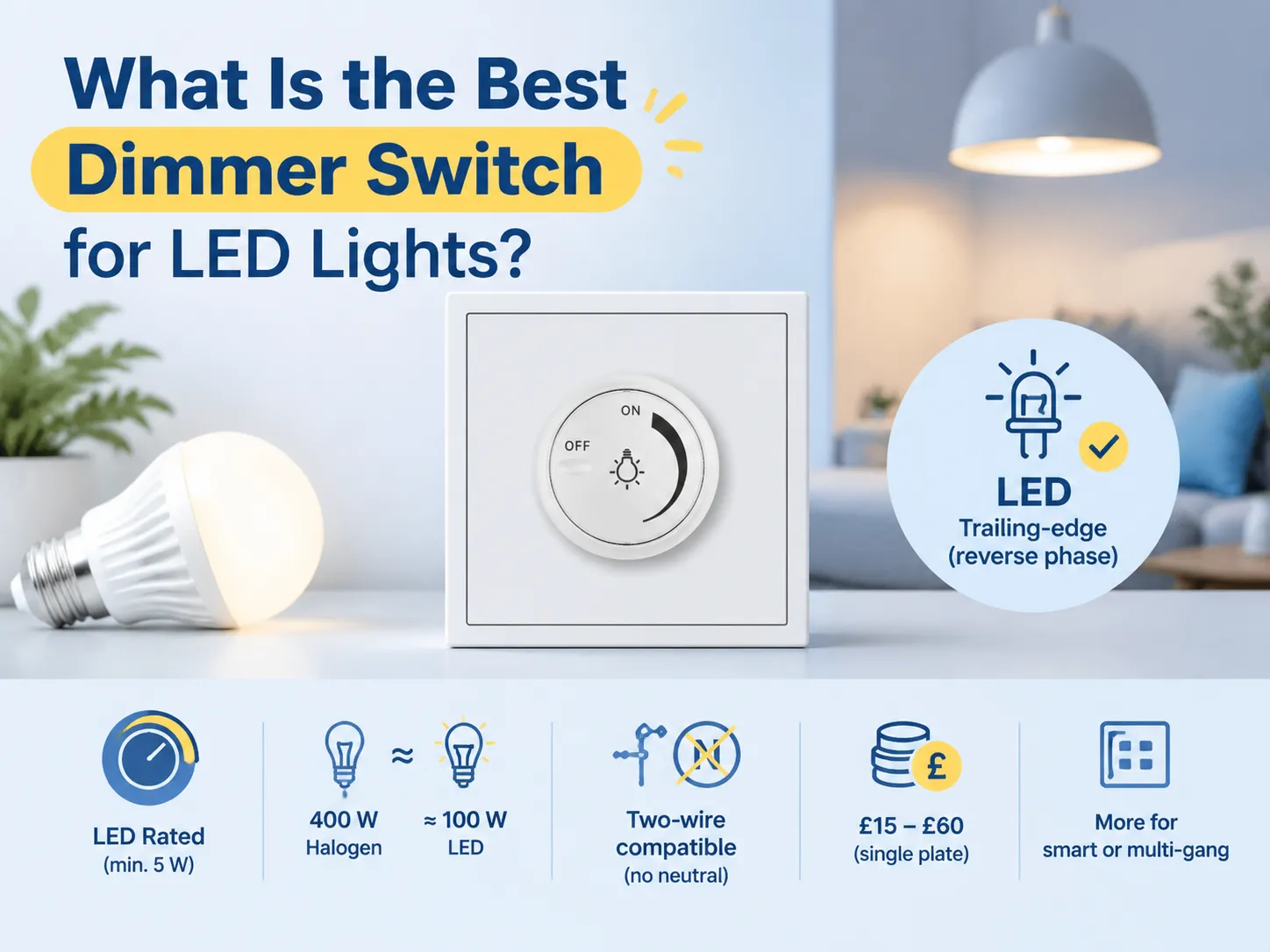
Quick response: Dimmable LED bulbs as well as LED drivers necessitate a trailing-edge dimmer capable of controlling LED loads as indicated, having a minimum load of 5 W and less in addition to an LED rating done in specified LED loads as opposed to halogen loads. The halogen rating of 400 W is, in reality, around 100 W of LED because of the lower power consumption. Make sure to test the dimmer for compatibility with two-wire circuits if the circuit may have no neutral wire. The price of a single-plate dimmer should range between £15 and £60 while the price of smart multi-gang dimmers will be considerably higher.
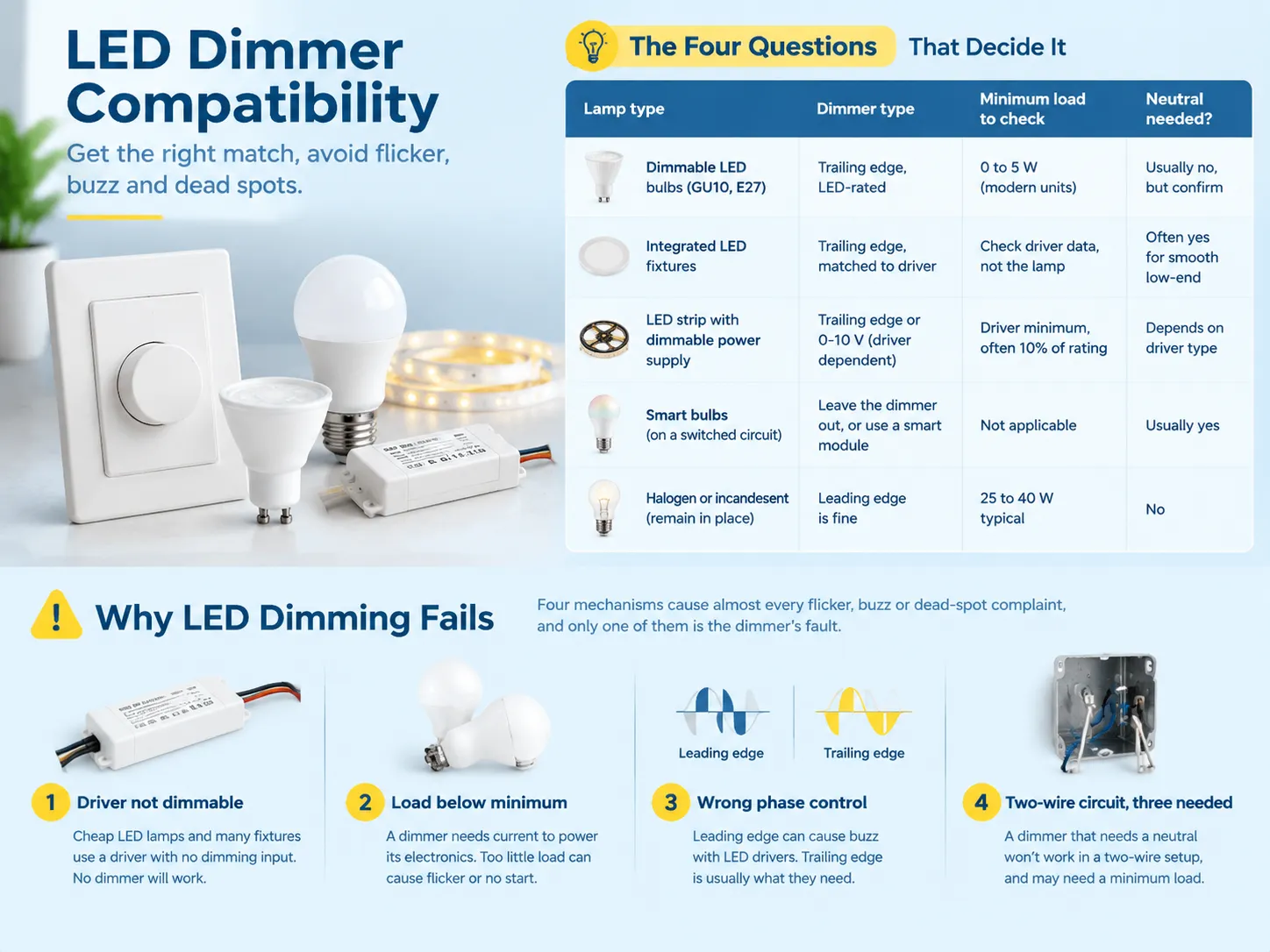
The Four Questions That Decide It
| Lamp type | Dimmer type | Minimum load to check | Neutral needed? |
|---|---|---|---|
| Dimmable LED bulbs (retrofit GU10, E27) | Trailing edge, LED-rated | 0 to 5 W on modern units | Usually no, but confirm |
| Integrated LED fixtures with dimmable driver | Trailing edge, matched to driver | Check driver data, not the lamp | Often yes for smooth low-end |
| LED strip with dimmable power supply | Trailing edge or 0-10 V, depending on driver | Driver minimum, often 10% of rating | Depends on driver type |
| Smart bulbs on a switched circuit | Leave the dimmer out, or use a smart dimmer module | Not applicable | Usually yes |
| Halogen or incandescent remaining in place | Leading edge is fine | 25 to 40 W typical | No |
The information in the table pertains to the lamp you are installing now and not the lamp used in the room in 2005. The cause of the confusion is using confusing details from two different situations: trailing-edge dimmers used with halogen load can act improperly when their range is at the high end whereas leading-edge dimmers used with LEDs cause buzzing issues.
Why LED Dimming Fails
There are four reasons that explain all flickering, buzzing or dead-spot issues, only one of which is attributable specifically to the dimmer.
- Inadequate driver. The driver in question is not dimmable. There are a lot of cheap LED bulbs and fixtures that rely on drivers that operate without any dimming functions. Therefore, dimming is impossible and flicker, dead spots and bright sparks may become key features of the lamps instead.
- Ill-suited load. The load connected to the dimmer must correspond to the standards of the dimmer. For instance, a certain dimming module is rated at 400 W of output but has a minimum acceptable load of 40 W. Therefore, using only two 5 W incandescent lamps creates problems since the dimmer will not be able to switch them on or they will not come on.
- Inappropriate phase control. The noise produced when dimming the driver is due to the fact that some dimmers use phase control for processes. Leading-edge technologies chop the front waves while trailing-edge ones chop the end waves. A driver’s incorrect configuration will result in buzzing and a limited range of levels available for dimming purposes.
- Incorrect wiring. In some situations, functions will not work simply due to the fact that a dimmer is designed as a three-wire device while a specific wiring circuit is a two-wire one.
The compatibility question is deeper than a wattage sum, and the interaction between driver design and dimmer type is set out in this guide to LED dimmer switch compatibility.
Leading Edge and Trailing Edge, Stated Simply
Leading-edge technology (forward phase or TRIAC) is a dimming method that is affordable, rugged, and compatible with incandescent and line-voltage halogen lamps. In leading-edge systems, the current is turned on halfway through the cycle which causes a sudden increase in the voltage. This is a technology that produces typical buzzing sounds.
The trailing-edge technology is an advanced system that works on the principle of reverse phase using MOSFET. It is more costly than leading-edge and works quietly and efficiently with LED systems and electronic transformers. The current is switched off midway through the cycle, which is not so harmful to driver circuits and gives better sound quality.
There is one more method which can not be called a dimmer at all: 0-10 V control or DALI. In this case, the dimmer communicates the necessary level of light to the driver that performs the tasks. This is a technology commonly used in commercial installations since it can be implemented using hundreds of fixtures and integrated with the lighting control systems. In a house, it can work only if the installation has fixtures that have a dimmable driver with a control input.
What to Look For on the Box
- The rating for LED is clearly listed. An example of this is a box with “400 W” written on it, as this is simply a halogen dimmer with a new name.
- Minimum load: for the recent LED rated units, this is from 0 to 5 W; older units will require a minimum load of 20 W and even more.
- Load de-rating for multiple gang switches: two, three or four gang switches typically undergo a de-rating of 10 to 20%.
- Neutral requirement, clearly stated: it needs to be evaluated, and the wire should be checked if it is not stated.
- Adjustable minimum brightness: this feature is really worth the money as this solves the problem of flickering at low brightness.
- Standard and marking: BS EN 60669-2-1 is to be specially marked according to the requirements of the UKCA or CE sticker and sockets made for conductors with 1.5- mm2 size.
The declared ratings, derating tables and terminal capacities are the part of the specification that settles arguments on site, and our download centre holds the datasheets for the ranges we build.
Brands and Price Bands
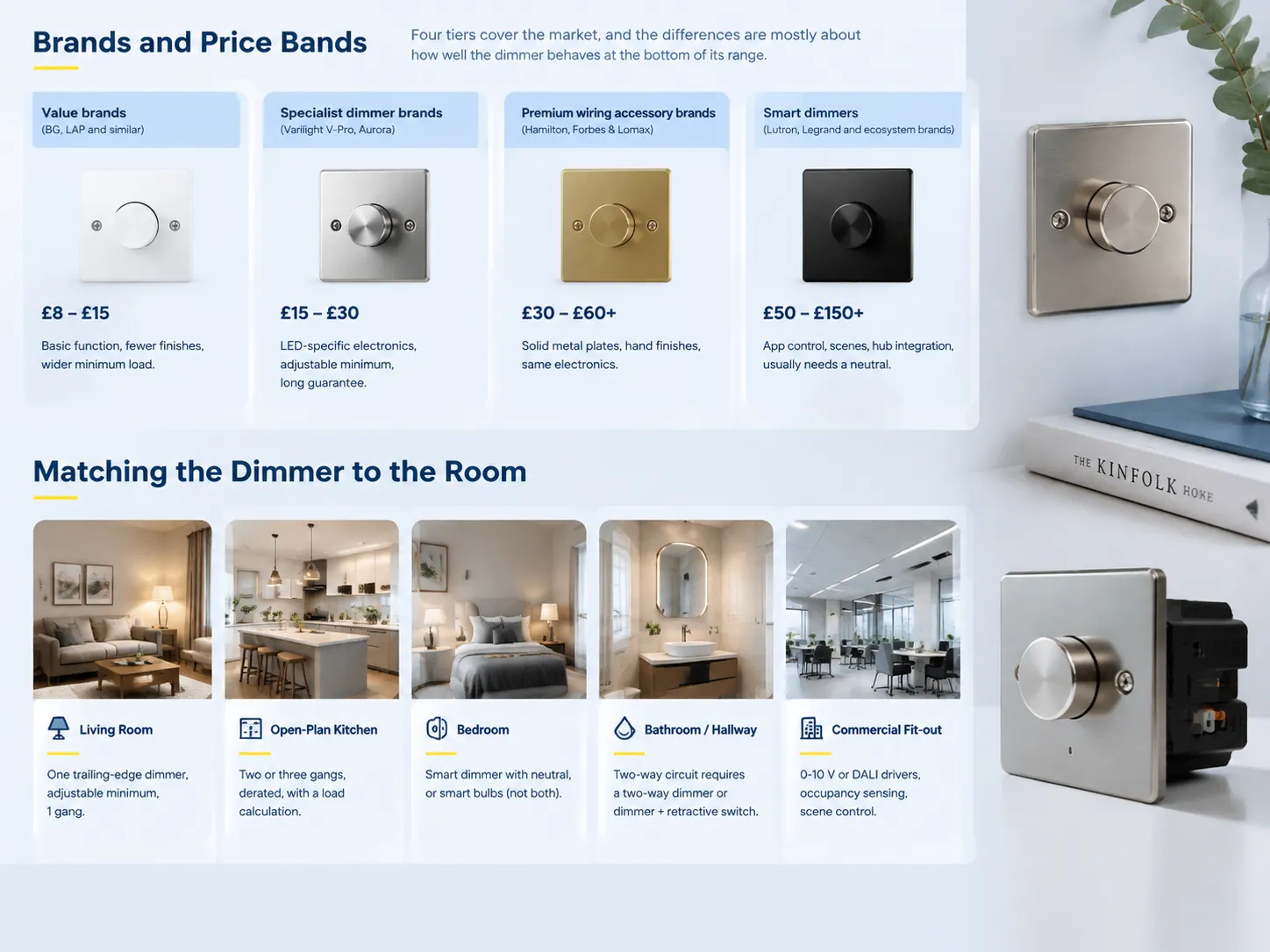
Four tiers cover the market, and the differences are mostly about how well the dimmer behaves at the bottom of its range.
| Tier | Typical price, 1 gang | What you get |
|---|---|---|
| Value brands (BG, LAP and similar) | £8 to £15 | Basic function, fewer finishes, wider minimum load |
| Specialist dimmer brands (Varilight V-Pro, Aurora) | £15 to £30 | LED-specific electronics, adjustable minimum, long guarantee |
| Premium wiring accessory brands (Hamilton, Forbes & Lomax) | £30 to £60+ | Solid metal plates, hand finishes, same electronics |
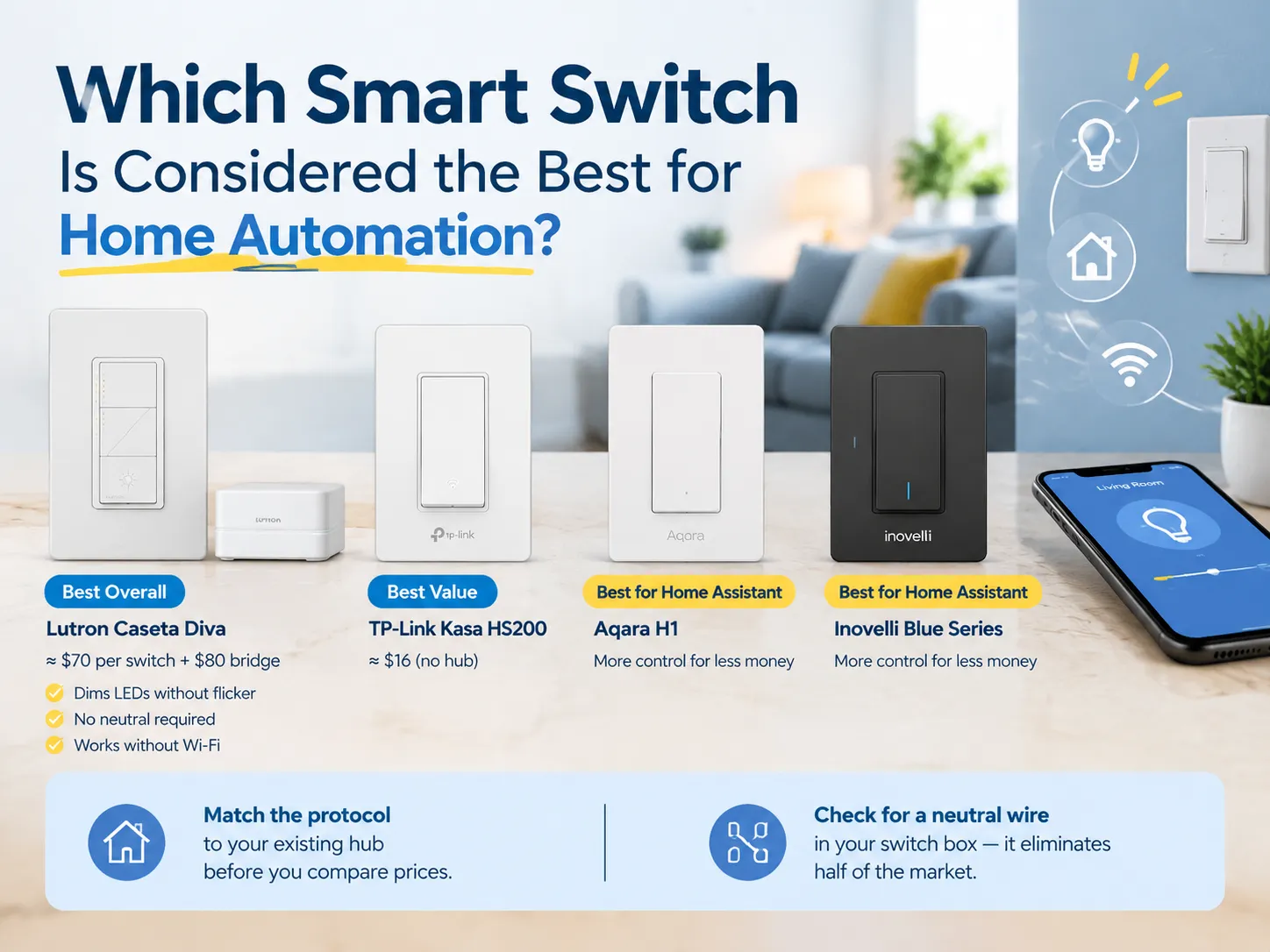
| Smart dimmers (Lutron, Legrand and ecosystem brands) | £50 to £150+ | App control, scenes, hub integration, usually needs a neutral |
One remark from this table. The electronic circuitry responsible for the smooth dimming operation of LEDs has hardly changed in the second and third tiers of the market and therefore an £18 dedicated dimmer often performs better than a £50 plate with standard internals. The cheapest tier is not dangerous, but rather less forgiving, meaning that the minimum load should be greater and the working range – narrower.
The manufacturing side of the same question is what our wall switch factory is built around, because a dimmer module and a switch plate have to be designed together if the plate is not going to buzz.
Matching the Dimmer to the Room
As soon as the technological match is perfect, the decision is about application.
- For the sitting area with few dimmable lamps. Only 1 trailing edge dimmer, which is adjustable for minimum setting and has only one gang. Here, the wattage shouldn’t be overrated and the smaller module should be bought, because the application of 400 W device for the load of 20 W is the case of wrong application.
- How about an open-plan kitchen with more than six fixtures? There must be either two or three gangs, with de-rating and load calculation beforehand, as in this case, the single dimmer rated by the whole load doesn’t work, since in case of three gangs the current reaches less than connected load.
- Bedroom with a smart speaker. It can be either a smart dimmer that has neutral or a traditional dimmer with bulbs that are always turned on. The mix causes the usual problem when the wall switch and the application work against each other.
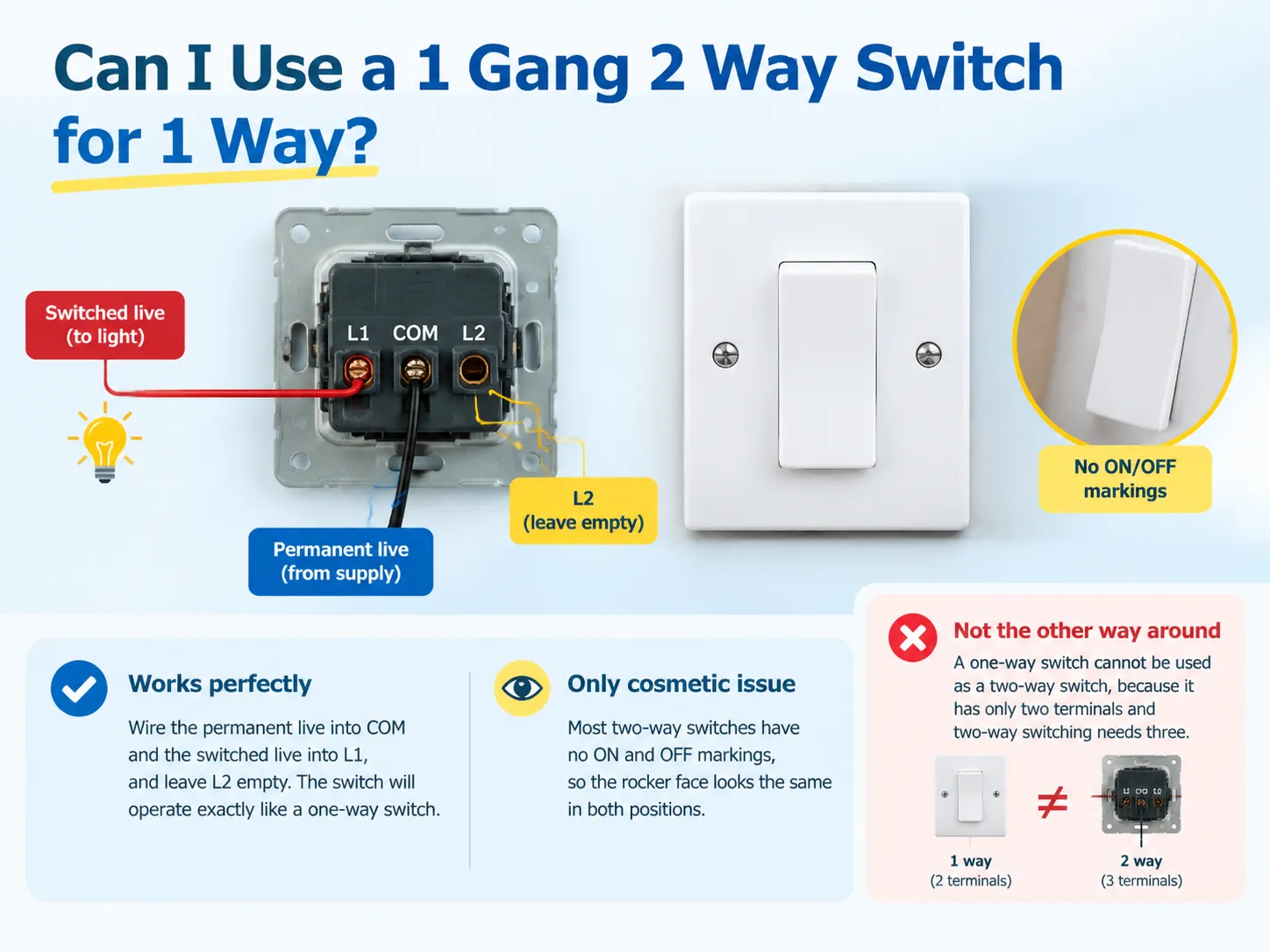
- Bathroom or corridor. The two-way circuit exists if two switches are installed, which means that either the two-way dimmer or the dimmer and the retractive switch should be used. The wiring differs in this case and should be calculated before plastering.
- Business installation. Not a wall dimmer, rather it is a lighting control system with 0–10V or DALI drivers, occupancy detecting and scene control. Thus, the plates act as control panels, rather than energy sources.
Installation and Commissioning
Turning a dimmer into a quality device requires three checks.
- First, set the minimum. Most LED-friendly dimming solutions come with a small adjuster at the back of the cover plate. The key is to set it to just above the point where the flickering stops; it is worthwhile to check again after dark, as the flicker is much more noticeable after dusk.
- Test from maximum to minimum both ways. Turn the dimmer slowly from maximum to minimum and back again while listening. If there is a buzz at high level only it indicates a leading edge dimmer with LED; if there is a buzz at low level, the driver is the culprit.
- Lastly, check the earthing and the torque. The metal cover plate has to be earthed, and loose terminals create a lot of heat that can shorten the life of the dimmer. The wiring sequence and terminal details are in this guide to installing a dimmer switch.

Where GOG Fits
We focus on the production of switch and dimmer plates, rather than dimmer electronics for the general populace, and that is why our true meaning about our status is as follows: If the need is for a comprehensive lighting system, buy it from one of the companies mentioned above. If the requirement is a plate system with a dimmer module behind it, created especially for an entire building and available in the required finishes specified by the designer, that is what we do.
There are more than fifty types of products and more than one thousand types of specifications that are under production in three automation shops, which is the reason behind a project being able to take one dimension of a plate, one size of a screw and one color standard from one supplier rather than three.The engineering side of that is described on our lighting switch manufacturing page.
FAQ
Do LED lights need a special dimmer?
Yes. In order to use LEDs, it is necessary to have a dimmer that has been specifically made for LED load. This means that it must be a trailing edge dimmer and one that has a minimum low load. A regular dimmer for halogen may work, but it is not the best choice.
Why does my LED dimmer flicker?
Usually non-dimmable driver, load less than dimmer minimum, or incorrect phase control. Verify whether the lamp is dimmable first, then confirm the load is more than minimum, and lastly ensure the correct dimmer type.
Can I use a normal dimmer with LED bulbs?
You can try it, and it might work if you’re using dimmable bulbs and the wattage of the load is adequate. However, results vary from lamp brand to lamp brand; this is part of the reasoning behind the existence of dimmers designed for use with LED bulbs that include adjustable minimum brightness settings.
What wattage dimmer do I need for LED lights?
To find an equivalent halogen rating, multiply the total LED wattage figure by roughly four and select a dimmer whose LED rating more than offsets this figure. A 60 watt LED will require a dimmer rated at around 250 watts LED, rather than the 60 watts rating.
References
- Varilight — V-Pro LED Dimming Technology
- Signify — LED Lamps and Dimming Compatibility
- Legrand — Dimmer Selection and Load Ratings
- U.S. Department of Energy — Lighting Controls and Energy Savings
- NEMA — Lighting Systems and Dimming Standards
Conclusion
It has a trailing edge, LED compatible, low load below 5W, and neutral check before purchasing. Everything else boils down to the finish and app functions.
If the project requires a specific type of module, finish or gang configuration, get in touch with us with the load per circuit and plate series and we will suggest the corresponding module.