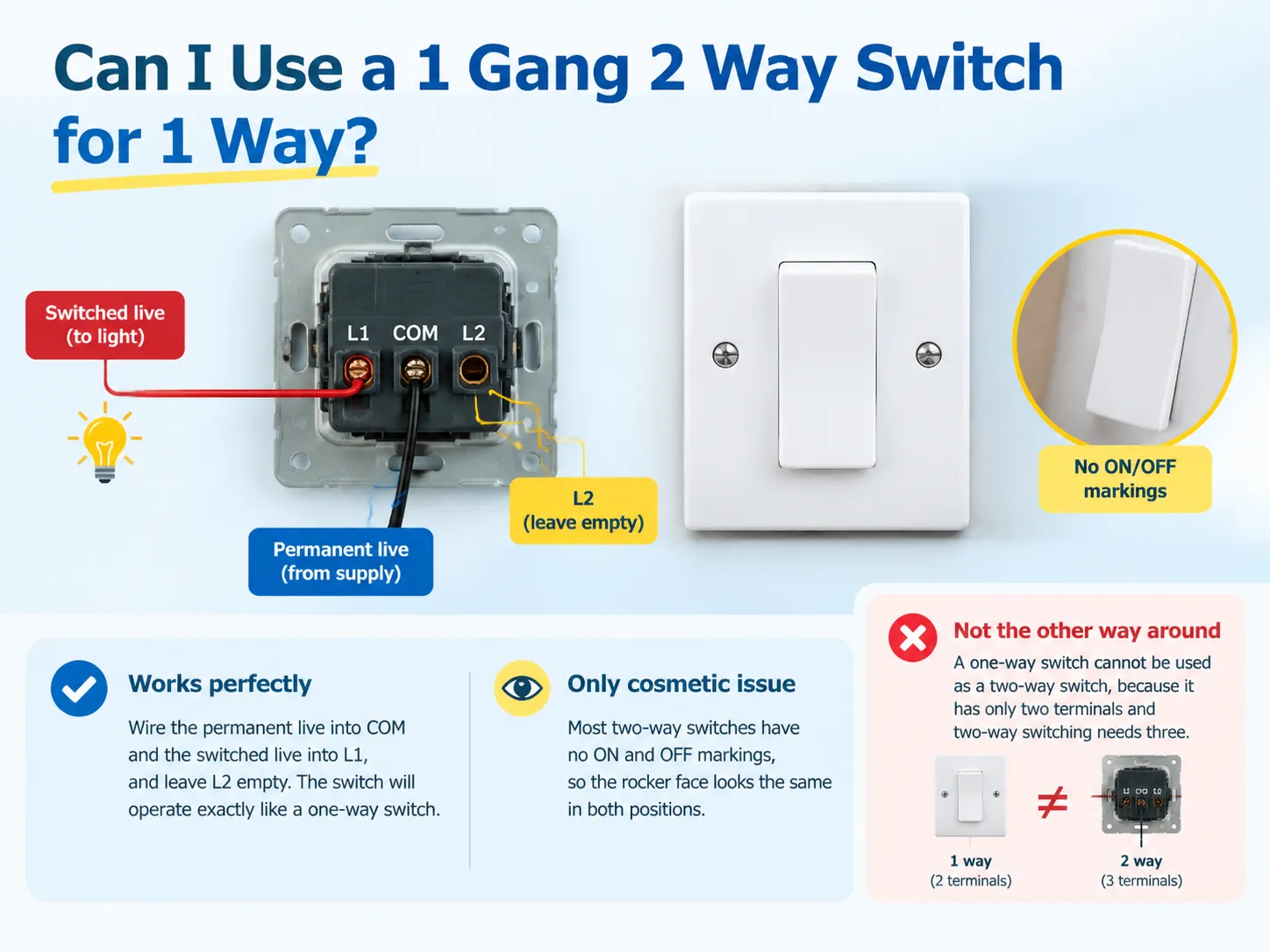
You acquired a two-way switch, or you have one from your previous work on a hallway, and you want to use it to control a simple light that can be turned on and off. The switch fits the place and the contacts are recognizable, and the only thing that remains is to see whether the extra terminal has any significance.
It does not. A two-way switch includes everything that is found in a one-way switch, plus a single additional terminal which will be left unused.
Briefly, the reply is positive: indeed, a 1 gang 2 way switch can be used as a 1 way switch without any problem. You should connect the continuous live to COM and the switched live to L1, leaving L2 without any connection. In this case the switch will work the same as a one-way switch. The only inconvenience here is one related to appearance: most 2 way switches are made without ON and OFF signs, so rocker face of the switch looks identical in two positions.
Gang and Way Are Two Different Things
Almost all confusion in this area comes from treating “gang” and “way” as if they described the same property. They describe perpendicular things.
| Term | What it counts | Example |
|---|---|---|
| Gang | How many switches are on the plate | 1 gang = one rocker, 2 gang = two rockers side by side |
| Way | How many switching positions one switch can serve | 1 way = on or off from one place, 2 way = on or off from two places |
| 1 gang 1 way | One switch, single control point | The standard bedroom light |
| 1 gang 2 way | One switch, capable of changeover duty | A stair light controlled from top and bottom |
| 2 gang 2 way | Two independent changeover switches | Two lighting circuits, each with a second switch elsewhere |
| Intermediate | Inserted between two two-way switches for three or more positions | A long corridor with a switch at each end and one in the middle |
A one gang two-way switch consists of a single rocker in a plate with the rocker functioning as a changeover mechanism. There is no alteration in the plate or the fixtures. The mounting process is similar, the box remains unchanged, and the front plate measures the same.
Worse still, different terminology can also lead to confusion for anybody who is buying products internationally. For instance the two-way switch in the UK is called a three-way switch in North America. Likewise, an intermediate switch in the UK stands for a four-way switch in North America. A one-way switch in UK language refers to what is called a single pole switch within North American terminology. Hence, if you want to order switches from the catalogue of a foreign country, the terminal count is the only thing you can rely upon. The naming conventions and the ways they map onto each other are set out in this explanation of what 1 gang, 2 gang and 3 gang mean.
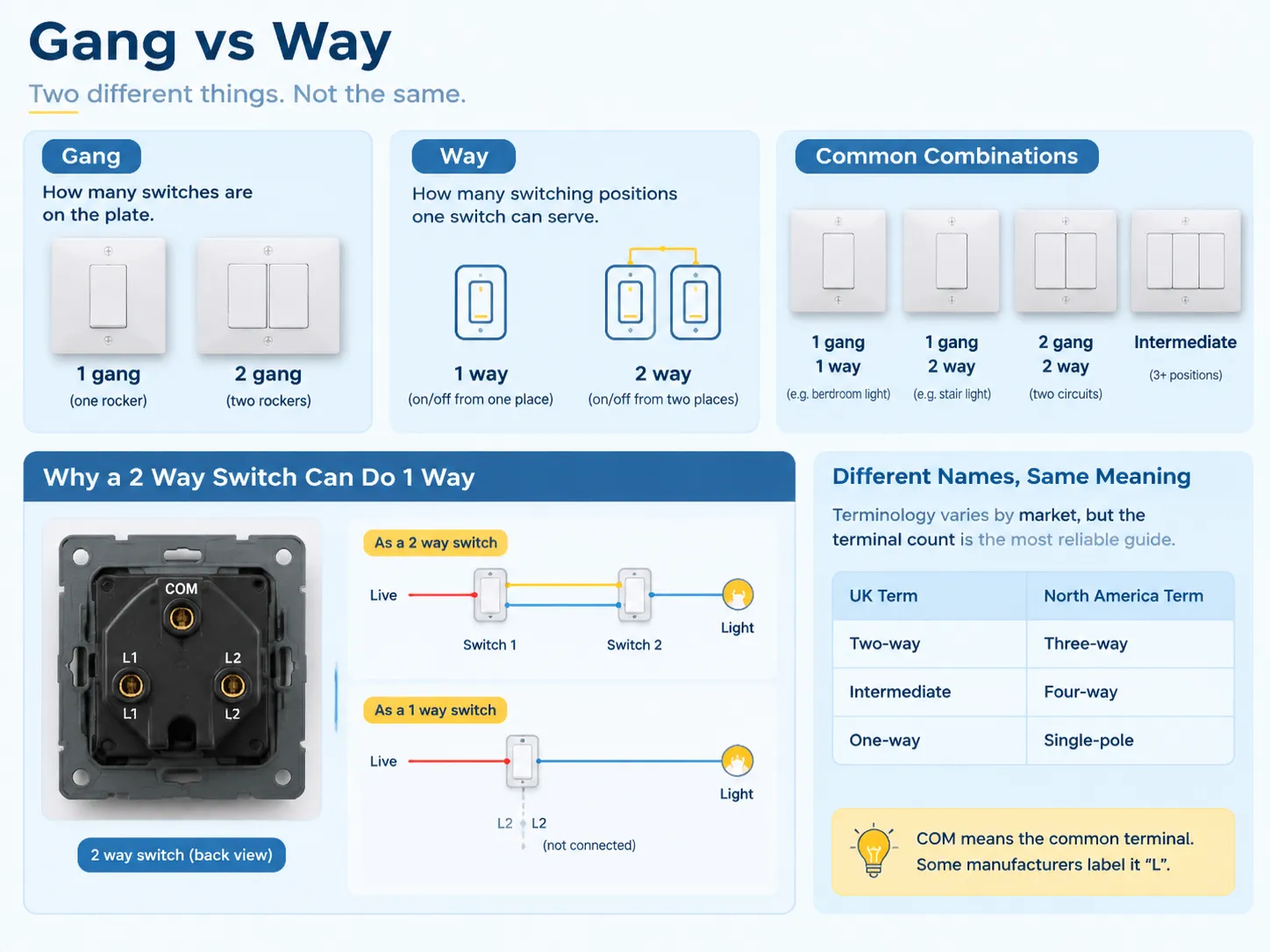
Why a 2 Way Switch Can Do 1 Way
Check out the switch on the back. As a two-way device, it has 3 terminals marked COM, L1, and L2.The mechanism consists of a changeover, where COM connects to either one of L1 or L2 but never both at the same time.Thus, by switching the rocker, you make the connection from one of the terminals to another.
This behaviour is responsible for both applications of the two-way switch.
As a two-way switch, the COM wire is connected to a permanent live while L1 and L2 are strapper conductors which go to another switch. The two switches form a circuit since one of them can complete the circuit.As a one-way switch, the COM wire is still connected to a permanent live. However, L1 now connects to a switched live pin for the light and L2 is effectively left unconnected.The changeover still happens in this case, but because of one of the options being void, it becomes a simple make-and-break switch.
There is no difference electrically between the two-way switch and a one-way switch which uses the same construction with one of the contacts omitted and only two terminals being connected.
What COM means on a switch, and why some manufacturers label the same terminal L instead, is one of the more common points of confusion, covered in this explanation of what the common terminal is on a light switch.
The One Real Drawback: No ON and OFF Marking
A one-way switch is usually identifiable. It will have either an “I” and a “O” symbol, or the switch’s surface will designate which end signals the “on” position.
With a two-way switch, there is no need for indicating markings on it. This is because the switch does not have definite states; in two-way circuits, the switch’s up position is not necessarily the “on” position. Because of that, the two-way switches can be found with either blank rockers or the ones labeled 1 or 2.
If the two-way switch is utilized as a one-off switch, its functionality remains unchanged; however, it may look odd. The owner of the equipment will certainly know which position is that of “on”, though it will not match aesthetics of the rest of the equipment found in the room.
The following three measures can be taken to solve the situation:
- Use a one-way switch. If the circuit is a one-way circuit, then it is better to buy a switch that matches the design. One-way switches are quite cheap.
- Rotate the mechanism. Many modular systems allow you to turn the switch module inside the plate, making the position of the switch correct.
- Accept it. If the equipment is installed in a nonliving area, it will work well, and the owner won’t remember about the design in a few days.
Why a 1 Way Switch Cannot Do 2 Way
In this case, we must say no, and the situation we described above is basically the same again and we have to say that it is a simple make or break contact. Internally a one-way switch has only two terminals connected to each other. The switching operation takes place when the two terminals are either connected to each other or not connected.
On the other hand in case of two-way switching we need a changeover switch at each end of the circuit. There are two strapper conductors between the two switches which complete the circuit when both switches select the same strapper. That operation can take place only with a three-terminal device at each end since the incoming permanent live has to go to one of the two outgoing conductors.
In a one-way switch the lack of the second terminal is a serious drawback. Hence we can always include a one way in a two way circuit but it would work only as an overriding switch and won’t make the system work properly.The three-terminal changeover logic, and its relationship to the four-terminal intermediate switch, is explained in this comparison of two-way and three-way switching.
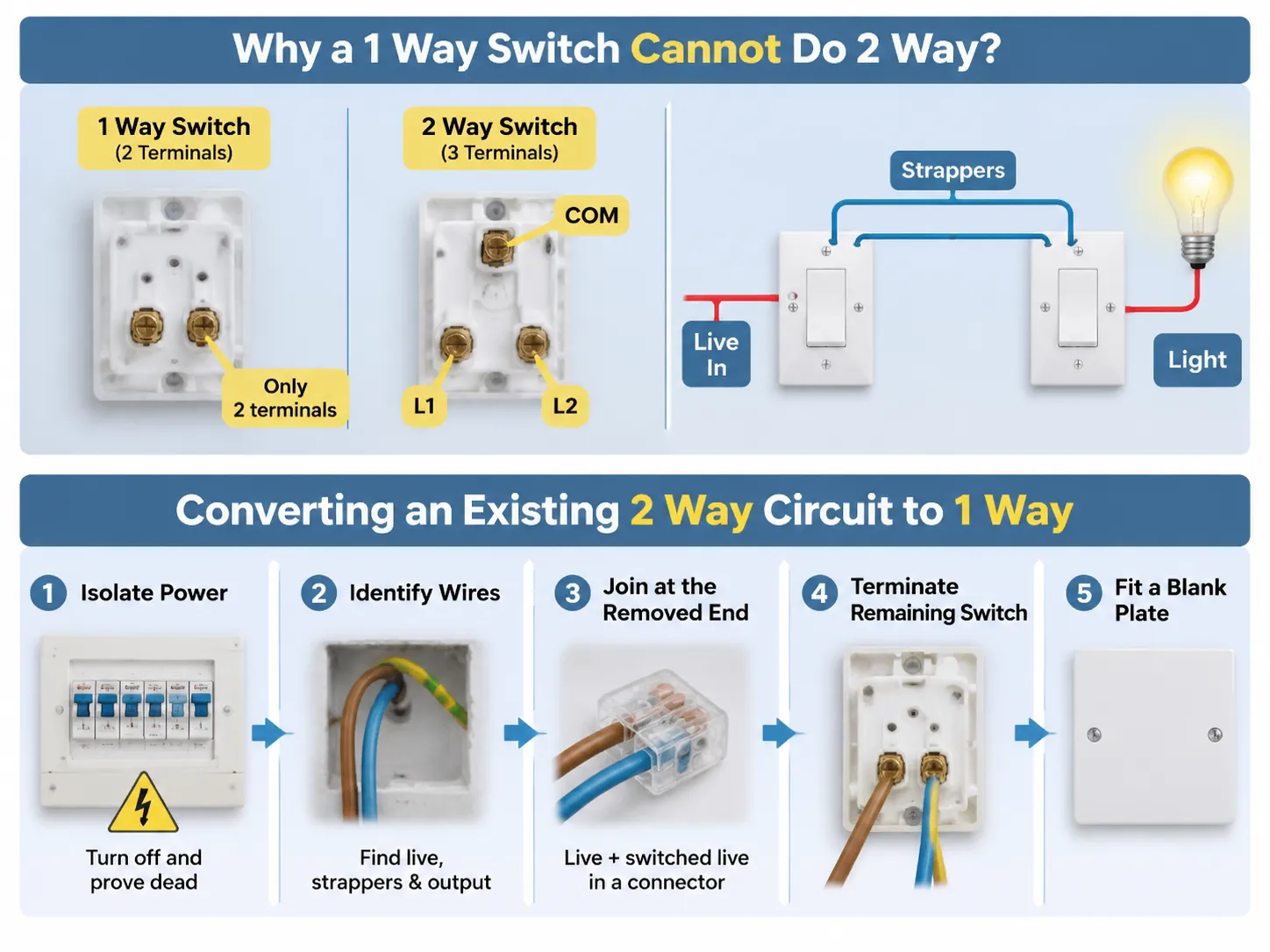
Converting an Existing 2 Way Circuit to 1 Way
Removing a switch can be an effective job, but must be performed in the correct way.
- Deal with the consumer unit by isolating the electricity and checking that everything is dead. Most lighting circuits use 10 A or 6 A MCBs; thus, the circuit for the fixture that has just been switched off may be a different circuit.
- Determine which cable is the permanent live, which is the strapper and which is the switched live at the switch you’re using.
- Remove the second switch and remove its cable. The cable you removed connects the two switches. At the end where the cable was removed, you’re going to connect the permanent live with the switched live to provide current to the lamp.
- Terminate the working switch in a manner that the COM terminal gets constant live current and L1 takes the switched current to the fixture.
- If you kept the box, you’ll have to replace the switch with a blank cover; otherwise, you’ll have to take the box off and get the wires back in the wall if you do not need the room anymore. A blank cover is what most people do and is the most practical solution.
If the two-way circuit is made with three-core cable and the strapper can be easily identified, it’s easy to do. If two separate two-core cables were used, it would be impossible to tell which wire is which, and you may need to consult an expert. The wiring sequence for a switched lighting point is covered in this guide to wiring a light switch to UK conventions.
Double-Pole Switches on 1 Way Duty
A double-pole switch disconnects both the supply and neutral wires. It is used in places where isolation is needed, not regulation, for example, lighting located outside, shower pumps, or other devices that are meant to be switched off for maintenance.
In a single circuit, a double-pole switch only works if it is connected as a double-pole switch, meaning that one supply terminal handles the supply and one handles the neutral. Although, as noted, it may be allowed to use only one pole on the double-pole switch, it does not make sense to buy such a switch in the first place, otherwise, one terminal will stay useless.
Two things to keep in mind: a double-pole switch must be connected to the neutral in the location. Many circuit types do not have neutral conductors present as these circuit types usually have the neutral looping at the ceiling capping. Also, double-pole switches are typically deeper than normal switches and must be checked before buying.
Mixing Switches in a Multi-Gang Plate
In a two-gang plate, the two switches do not influence one another mechanically. One switch can be used in the one-way mode, while the other can either function in the two-way mode or in the one-way mode. The only restriction is physical, as certain modular ranges use a different module for a particular function, and the plate should be suitable for both types of modules.
Such flexibility makes modular ranges quite popular for retrofitting projects, as it is possible to create a plate consisting of a one-way module, another two-way module, and a dimmer module as needed, instead of making a complete change.The trade-offs of that system, including cost and availability, are worth understanding before committing to a whole house, as this comparison of gang switch configurations sets out.
What to Buy, and What to Check
- Ensure you verify the terminal count. A three terminal indicates that the switch can serve both functions, while if it features two terminals it can only serve the one function.
- Check the specification. 10AX is the normal specification for modern LED and fluorescent loads in the UK. Using a switch rated at 6A in a circuit with high inrush is a hazard that could trip the switch accidentally. The AX suffix suggests that the switch is rated for both capacitive and inductive loads rather than resistive loads only.
- Check the depth of the box. Two way and double pole mechanisms are generally thicker than the one way switches, so a 16mm box designed for the old switch might not accommodate the new one.
- Check the plate format. Having a two way switch in a one way position means there is a cosmetic mismatch which means trying to match up with what is already in the room will be more expensive that buying the correct switch for it.
- Avoid doing a very wrong thing: buying a two way switch simply because that is what you found at the store and then keeping terminal L2 connected to an unused wire. An unused terminal should not be connected to anything.
FAQ
Can you use a 2 gang 2-way switch for 1 way?
That is correct. Every gang operates as an independent changeover switch, making it possible to connect it as a one-way switch through COM and L1, leaving L2 vacant. You can use both gangs as one-way switches, or one of them as a one-way while the other as a two-way one at the same time. The only restriction is that you have spent money on a second switch that may not really be necessary.
How do I convert a 2-way switch to 1-way switching?
Disengage the switch and then determine the position of the permanent live and switched live wires. For the second switch being removed connect the permanent live directly to the switched live wire and install a maintenance free enclosure to serve the lamp with power. Finally disconnect the other switch and connect it to the existing switches COM to connect to the permanent live and L1 on the switched live wire. Finally, cover the hole with a cover plate.
Can I use a 1-way switch as a 2-way switch?
A single-pole switch contains only two terminals and cannot transmit the continuous incoming current either to one of the two-way switch strappers that two-way control at every end requires. If it is used in a two-way circuit, a switch will function by cutting off the working principle of the device.
Can I use a 2-pole switch for 1-way switching?
In addition to this, it is essential to remember that this point must also be separated. Run the hot wire through one end and the neutral through the other so that both connections would be opened. It is also important to have the neutral at the switch location which may not be possible with all lighting circuits and also the junction box should be big enough.
References
- Socket Store — Can I Use a 2 Way Switch for 1 Way?
- Electrical Safety First — Electrical Safety Guidance for Householders
- Legrand — Wiring Device Terminal Configurations
- UL Solutions — General-Use Snap Switch Standards
- Hubbell — Switches and Wiring Accessories
Conclusion
By definition a one gang two way switch is a one way switch fitted with an extra contact and is no mark in “ON”. Connect COM and L1 and leave L2 unused; it will work just like one way switch.
The only rule that answers each incarnation of the problem is the terminal count. Three terminals make either one; two terminals can only perform one way task and one in a two way circuit gives you the light from one side and constant irritation from the other.