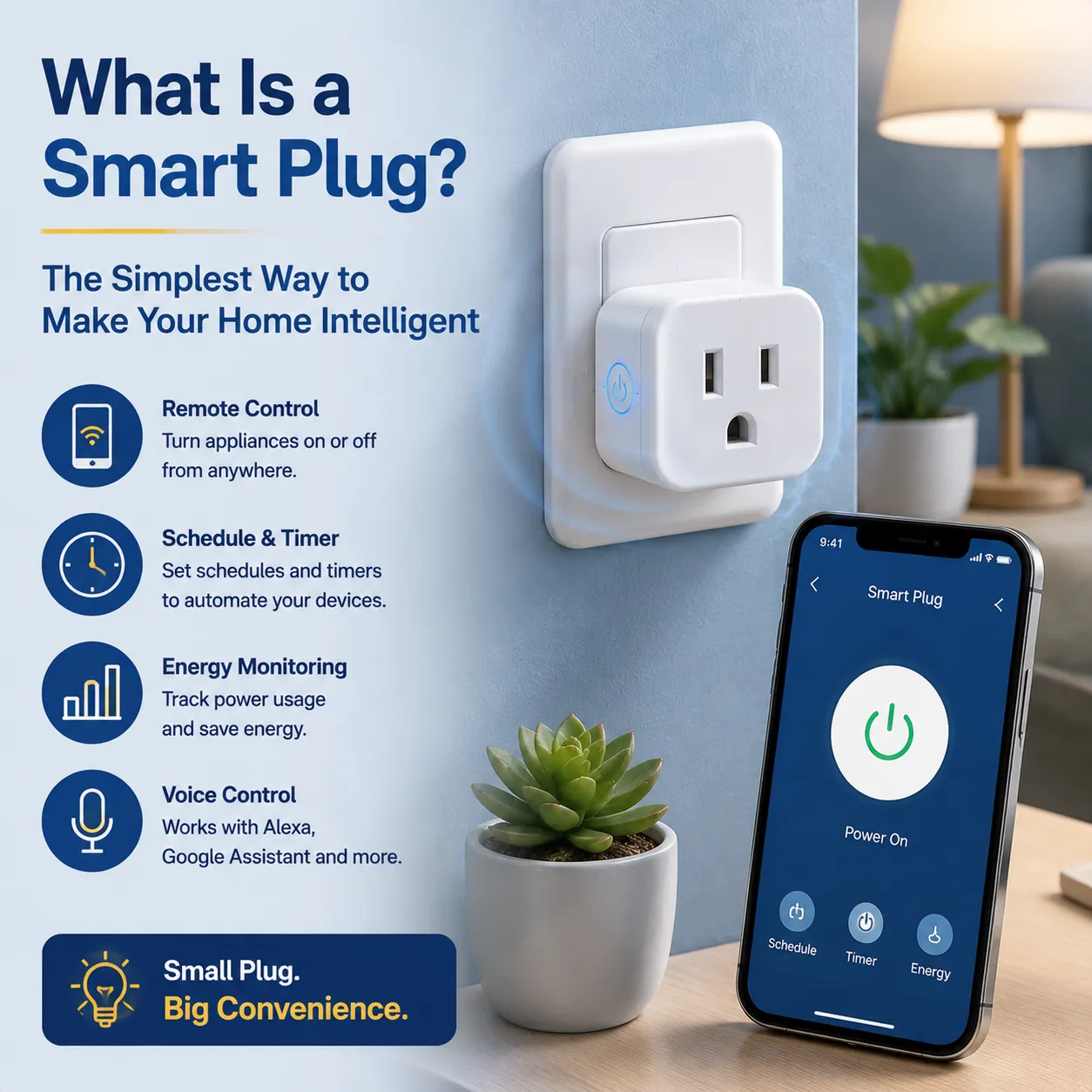
A Bristolian homeowner wished to automate her lamp without changing her outlet or installing wires, so she bought a smart plug, plugged it in, and connected it to Wi‑Fi. That evening, she turned the lamp on with an app on her phone while sitting in her living room. The next morning, she made a program for her lamp to automatically turn on in the evening and turn off at midnight. A smart plug is an accessory, easily connected to Wi‑Fi, that makes anything plugged into it field for a smart home application. Understanding the concept of a smart plug and its functions will allow you to get your house automated at the minimum cost, as no hiring, rewiring, or any other permanent changes to your home are required.
Summary: The smart plug is a small gadget that can be plugged into your wall socket and programmed to function like an ordinary switch one can use to operate any appliance. Meanwhile, by using a smartphone app, a voice-commanded smart speaker, or pre-set schedule, one can control the device connected to the socket from any remote distance. The plug’s inner parts include a tiny electronic circuit board with a microcontroller, a relay or a solid-state switch, and a Wi-Fi/Zigbee radio.
What Exactly is a Smart Plug — and What Makes it Different from a Regular Plugin
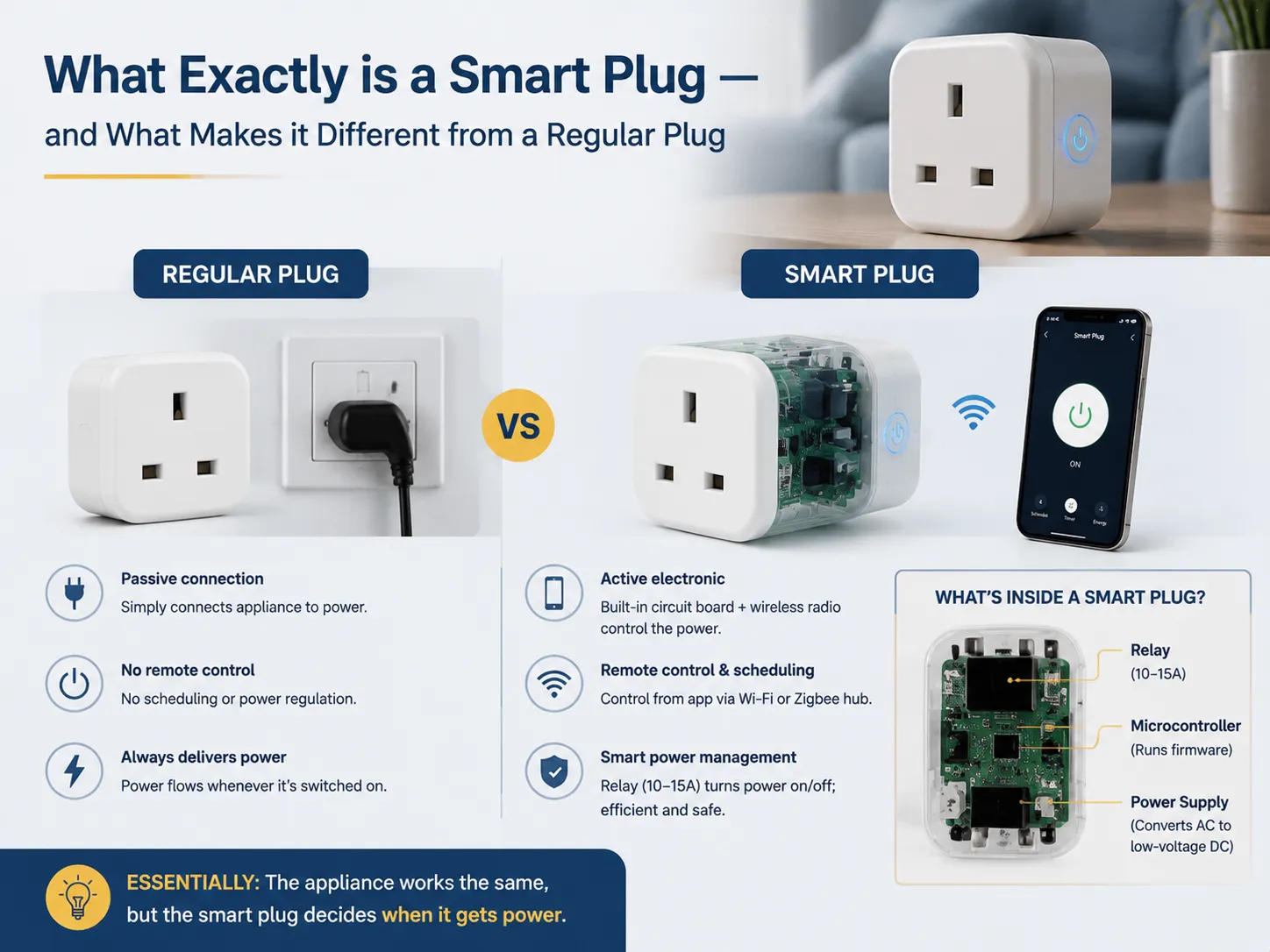
A regular plug is just an inactive conductor that simply connects electrical cord of an appliance with main supply. An appliance is either switched on when the plug is switched on or off whenever the plug is switched off. There are no remote controls or any way of scheduling or regulating the power consumption through normal plugs. But a smart plug makes use of active electronic. This device is made by fitting a compact electronic device inside the plug body. A smart plug consists of two important components: a circuit board and a wireless radio that acts like a relay which regulates the flow of current to an appliance. After setting up smart plugs with tools like Wi-Fi network or Zigbee hub appliance can receive commands from smartphone applications. Thus, any appliance connected to the smart plug will be able to be controlled through a remote smartphone application thus turning the appliance on or off. So, essentially the appliance works the same but the plug makes sure that it receives power. Such a difference puts smart plugs apart from regular plugs that have no commands of controlling power supply. Regular plugs supply all the time and they deliver power actively.
The electronics inside the smart plug are small but powerful. The relay (having at least 10-15 Amperes rating) has the function of turning on and off electricity supply for an appliance. There is also a microcontroller, which implements the firmware that controls the supplying power. The power supply transforms mains voltage into low voltage DC required for smart electronics. That is why a smart plug has a bigger size than a normal plug. It prevents smart plug from becoming compact placed among conventional plugs for the instant.
Applications of Smart Plugs and Devices not to Plug into Them
You can connect to a smart plug any appliance that can be turned on simply by plugging it into the power supply and not necessarily monitored throughout its functioning. Generally, devices that work well with smart plugs include lamps (which is the primary use – so that any lamp can be turned on and off remotely and work according to the sunset and sunrise times and be activated using voice commands through a smart speaker); fans and portable heaters; coffee makers and small kitchen appliances (one can program a drip coffee maker having an ON/OFF switch to work at a specific time electronically with the help of a smart plug, but there are coffee makers with electronic systems that immediately switch off after getting the first power and will work only using a generic power source); holiday lights and other decorative items (the smart plug is a perfect device for turning on and off various holiday lights like lights for a Christmas tree, outdoor Christmas lights and other holiday decorations at night periodically).
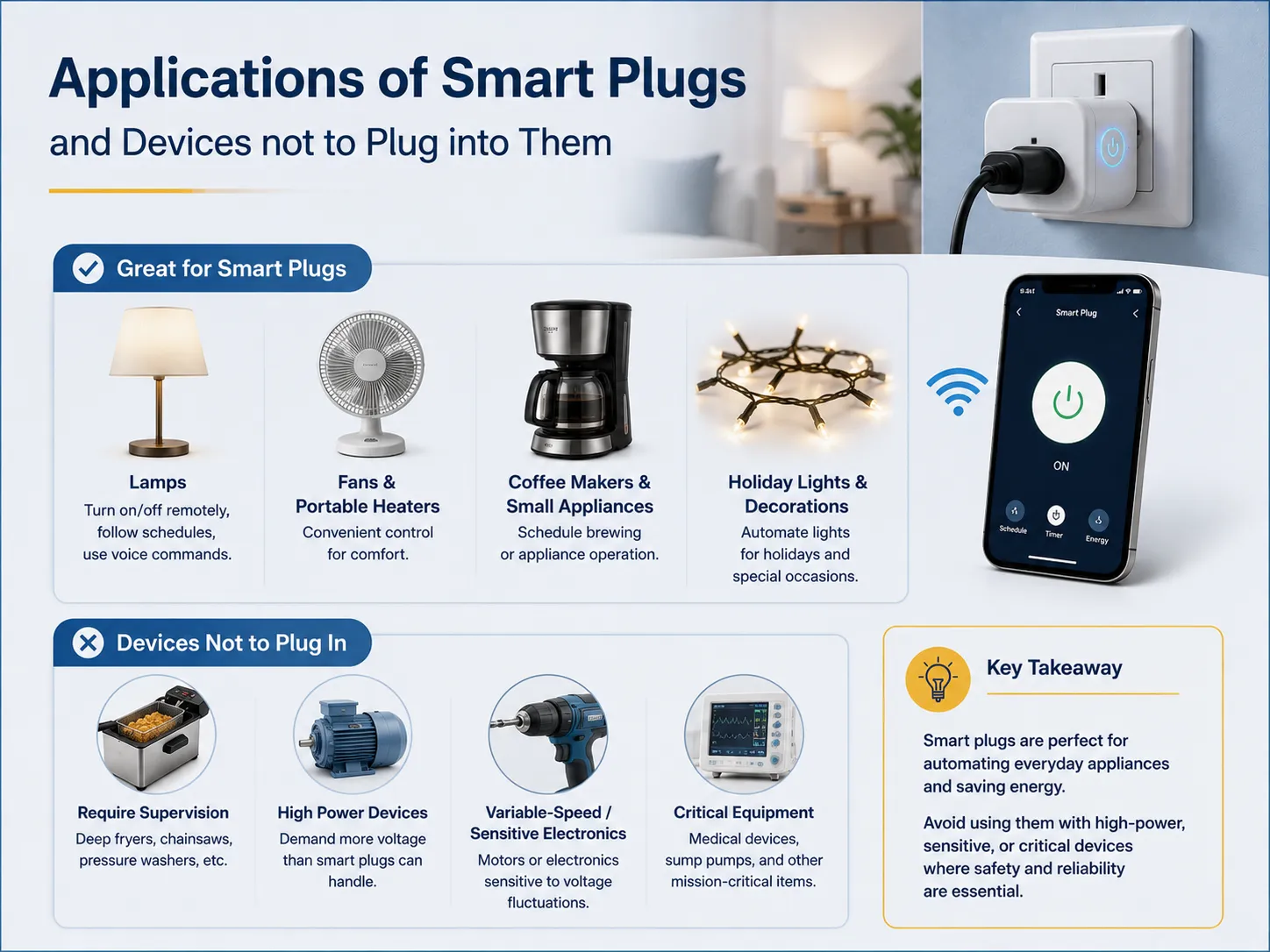
However, there are definite devices that should not be used with smart plugs. These include devices that need a person to be present in the room during their usage, such as a deep fryer, chainsaw, and pressure washer; devices that need too much voltage than smart plugs can manage; devices with a variable-speed engine or electrical system sensitive to voltage load; critically important devices, such as medical equipment, sump pumps in basements. For a comprehensive look at the other smart‑home devices that complement a smart plug, our article on works with Google Home smart light switches covers the wall‑mounted smart controls that provide a more permanent, code‑compliant alternative to plug‑in smart devices.
The Benefits of a Smart Plug: Convenience, Energy Savings, and Safety
A smart plug provides a variety of benefits that a conventional plug cannot provide. The key benefit is that it is convenient. A lamp can switch itself on at sunset, a coffee machine can brew before the alarm goes off, and a fan can turn off after leaving home with no manual input. The second benefit is smart plugs help save power. A smart plug can turn off devices that would otherwise stay on standby mode like a TV set, game console, or computer monitor when no one is home. Even though the consumption of energy of just one device when in standby mode is really low (1-10 watts), it does accumulate over time and several appliances. Some smart plugs provide users with energy monitoring feature where they can see how much electricity the connected devices consume over time. The third benefit of smart plugs is that they are safer than ordinary plugs. The Electrical Safety Foundation International (ESFI) provides guidance on the safe use of smart plugs and other smart‑home electrical devices.
Smart plugs — Are they safe? Certification and overload issues explored
As long the smart plug is made by a reputable manufacturer and has the appropriate safety certification for its market, it is safe to use just like any other electrical device connected via a plug. In North America, smart plugs should carry UL or ETL certifications. In Europe, they should have the CE label along with BS 1363 compliance in the UK. Those certifications indicate that the plug has been tested for dielectric breakdown, overload prevention, and thermal performance of its inner parts. The most frequent safety risk with smart plugs is overload, meaning that the appliance draws a current higher than the maximum allowed for the plug.
For instance, a 1,800-watt heater connected to a 10 amp smart plug on a 230-volt circuit would raise the temperature of the plug’s relay above the maximum limit, resulting in its dog. The maximum load of the smart plug can be found on its body as well as the packaging. The second safety issue is connected to the Wi-Fi. In case of the plug losing its Wi-Fi connection, it wouldn’t be able to respond to commands from the app or voice assistants. Still, the relay of the smart plug would operate in a manual mode. Most models come with a button on their bodies allowing to turn on and off appliances without the use of a Wi-Fi connection. The third problem lies in the size of the smart plug and its ability to block adjacent plugs. For instance, an unusually large smart plug would block another outlet in the same receptacle.
How to Choose a Smart Plug: The Criteria That Matter
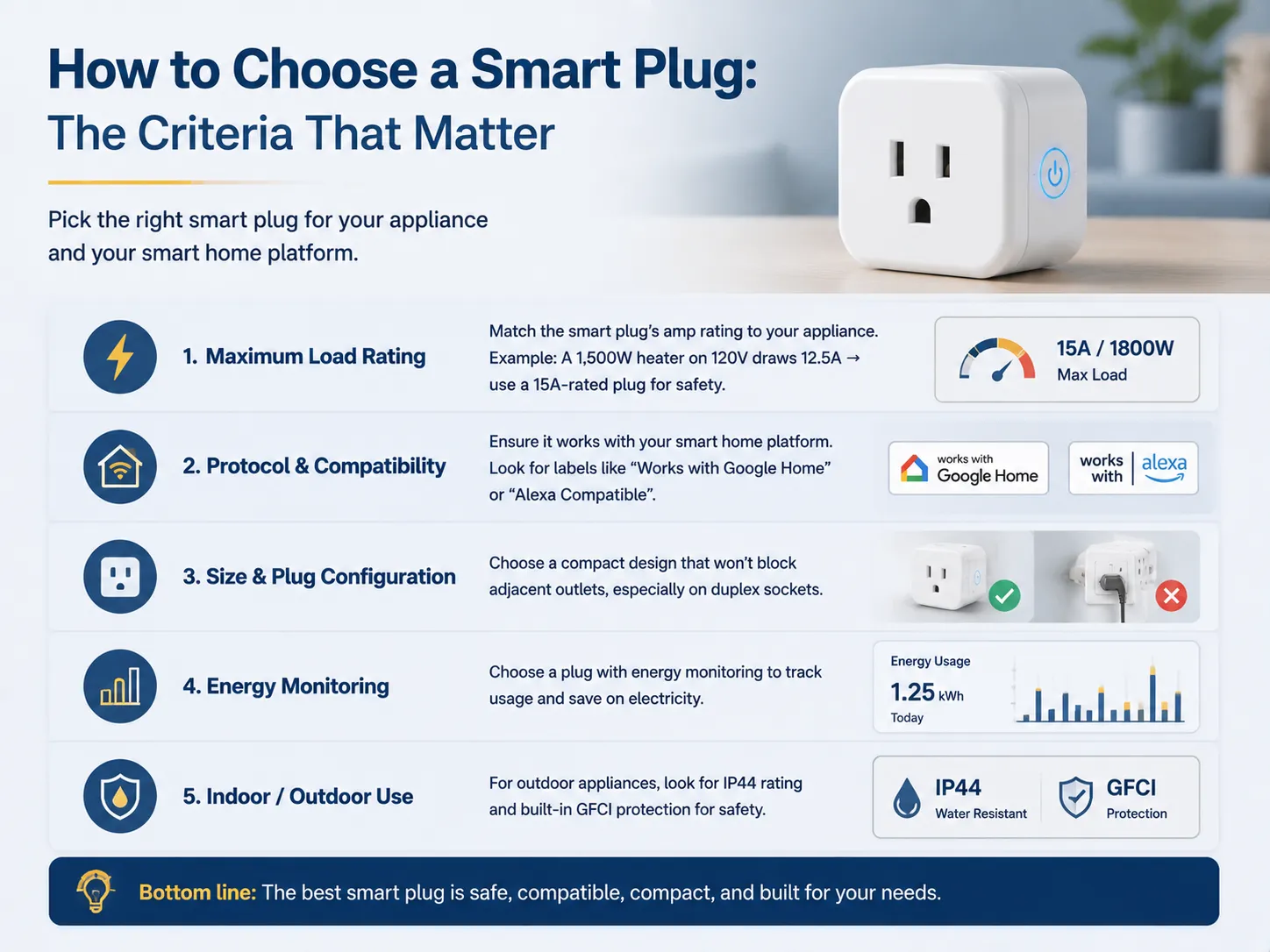
By choosing the appropriate smart plug, one must fulfill specifications of that device taking into account the one controlling appliance and one’s smart home platform. Maximum load rating indicates the smart plug’s compatibility with the electricity consumed by the appliance — a 1,500-watt heater receiving its power from a 120-volt circuit will consume 12.5 amps and therefore, a smart plug rated for 15 amps is required to ensure safety; however, if the heater was powered by a 230-volt circuit, it would only consume 6.5 amps meaning a 10-amp or even a 13-amp smart plug would be alright; protocol involves the need for a device to meet platform requirements, so for example, the device must include “Works with Google Home” label to be able to work with Google Home or must be certified as Alexa compatible to work with Amazon’s assistant; a device that has no information about its compatibility with one’s platform cannot operate with a voice assistant. The next factor is the size and plug’s configuration taking into account such an important detail as interference with adjacent power outlet if using a duplex outlet; the further criteria include energy monitoring ability (that includes energy monitoring as a must-have feature; not all smart plugs are provided with this functionality), and indoor/outdoor appliances specifications (for instance, outdoor smart plug shall be in compliance with IP44 rating and have necessary GFCI protection).
Our article on neutral vs non‑neutral smart switches explains the wiring requirements and the installation process for wall‑mounted smart controls.
What a Smart Plug Costs and Where to Buy One
A smart plug is one of the least expensive smart‑home devices, with prices that reflect the brand, the features, and the wireless protocol. The table below provides typical price ranges for Wi‑Fi smart plugs as of mid‑2025.
| Category | Typical Price Range (USD) | Examples |
|---|---|---|
| Entry‑level Wi‑Fi smart plug (no energy monitoring) | $8–$15 per plug | Kasa Smart (TP‑Link), Amazon Basics, Treatlife — basic on/off control, scheduling, and voice assistant compatibility |
| Mid‑range Wi‑Fi smart plug with energy monitoring | $15–$25 per plug | Kasa Smart KP125, Emporia, GOG Electric — adds real‑time and historical energy tracking |
| Premium or multi‑platform smart plug | $25–$40 per plug | Eve Energy (Thread/HomeKit), Wemo (HomeKit), Leviton — Apple HomeKit compatibility, Thread support, or a premium brand name |
| Outdoor‑rated smart plug | $15–$30 per plug | Kasa Smart KP400, Meross, GOG Electric — IP44 or higher, often with two independently controllable outlets |
Smart plugs can be found through online platforms like Amazon, in electronics shops and also in the home improvement section of any hardware store. Remember to check the safety certification for your country; ensure that the smart plug you are looking into works with your smart home device and that the load requirement of the smart plug meets the requirements. Using a non-certified smart plug or using one that cannot handle the load effectively is going to put you at risk of fire hazards — and also defeat the purpose of buying that plug at all.
Frequently Asked Questions
What should not be connected to a smart plug?
High-current devices that exceed the smart plug’s load capacity (typically 10 A, 13 A, or 15 A) shouldn’t be connected to a smart plug. Avoid connecting any appliance that requires someone to be present for safe operation, such as deep fryers, power saws, and pressure washers. Furthermore, life-safety devices, including medical equipment and sump pumps, should not be connected to consumer smart plugs. Appliances that are controlled electronically and remain turned off when the power comes back shouldn’t be plugged in, as you won’t be able to switch them on with the smart plug.
What are smart plugs cons?
The main disadvantage of smart plugs is that they depend on the availability of a Wi-Fi connection and cloud platform which implies that there is no remote access to the plug when the internet is down. It is also necessary to mention the size of smart plugs which takes the place of an extra outlet. Smart plugs can also be used with certain limitations in terms of load capacity that rules out the possibility of using high-power appliances. Another disadvantage of smart plugs is that they don’t make the process of switching the appliance on and off any easier, as you need to set the plug, make all needed connections, and take care of possible software updates.
How does a smart plug operate?
Smart plugs allow controlling the electricity supply to appliances through an app on your smartphone or smart speaker or by the pre-set schedule. It gets connected to the internet and has a relay unit which makes it possible to operate appliances remotely. The appliances remain unchanged and their power supply is controlled by the smart plug.
What distinguishes smart plugs from simple plugs?
Simple plugs don’t perform any advanced functions and provide electricity automatically. Smart plugs run on a Wi-Fi signal and can be operated practically from anywhere.
References
- Electrical Safety Foundation International (ESFI) — Smart Home Electrical Safety. Consumer and professional guidance on the safe selection and use of smart plugs, smart switches, and connected home devices.
- TP‑Link Kasa — Smart Plugs and Home Automation. Manufacturer of widely used Wi‑Fi smart plugs with energy monitoring, scheduling, and voice‑assistant compatibility.
- Leviton — Smart Plugs and Connected Devices. Manufacturer of North American wiring devices and smart‑home products, including Wi‑Fi smart plugs with UL listing.
- UL — Smart Plug Safety and Certification Standards. The testing and listing requirements that a smart plug must meet to be sold and installed in North America, including dielectric withstand, overload protection, and thermal performance.
A smart plug is the simplest, least expensive, and most reversible step into home automation. There is no need for cables, tools, or any transformation of the building. Simply plug it into the socket, plug in any appliance, and you can now operate all your devices directly from your smartphone. A smart plug does not replace smart switches and is not designed for all appliances, but it is the fastest way to turn your house into a smart one for such things as lamps, fans, coffee machines, or Christmas lights — it is enough for millions of people. GOG Electric produces smart plugs that are safe, reliable, and compatible with different types of platforms.