The Philippines wiring accessories business may look simple, but this is not really the case. A contractor in Manila can buy switches from different places such as the local hardware store, the warehouse in Binondo, or the factory in Wenzhou that will label the products with his name. Different suppliers offer one particular product at the different prices although only certain products can pass the quality control checks.
The purpose of this post is to analyse the switch and socket suppliers in the Philippines and learn what pros and cons the particular suppliers have, as well as how to check the reliability of each seller.
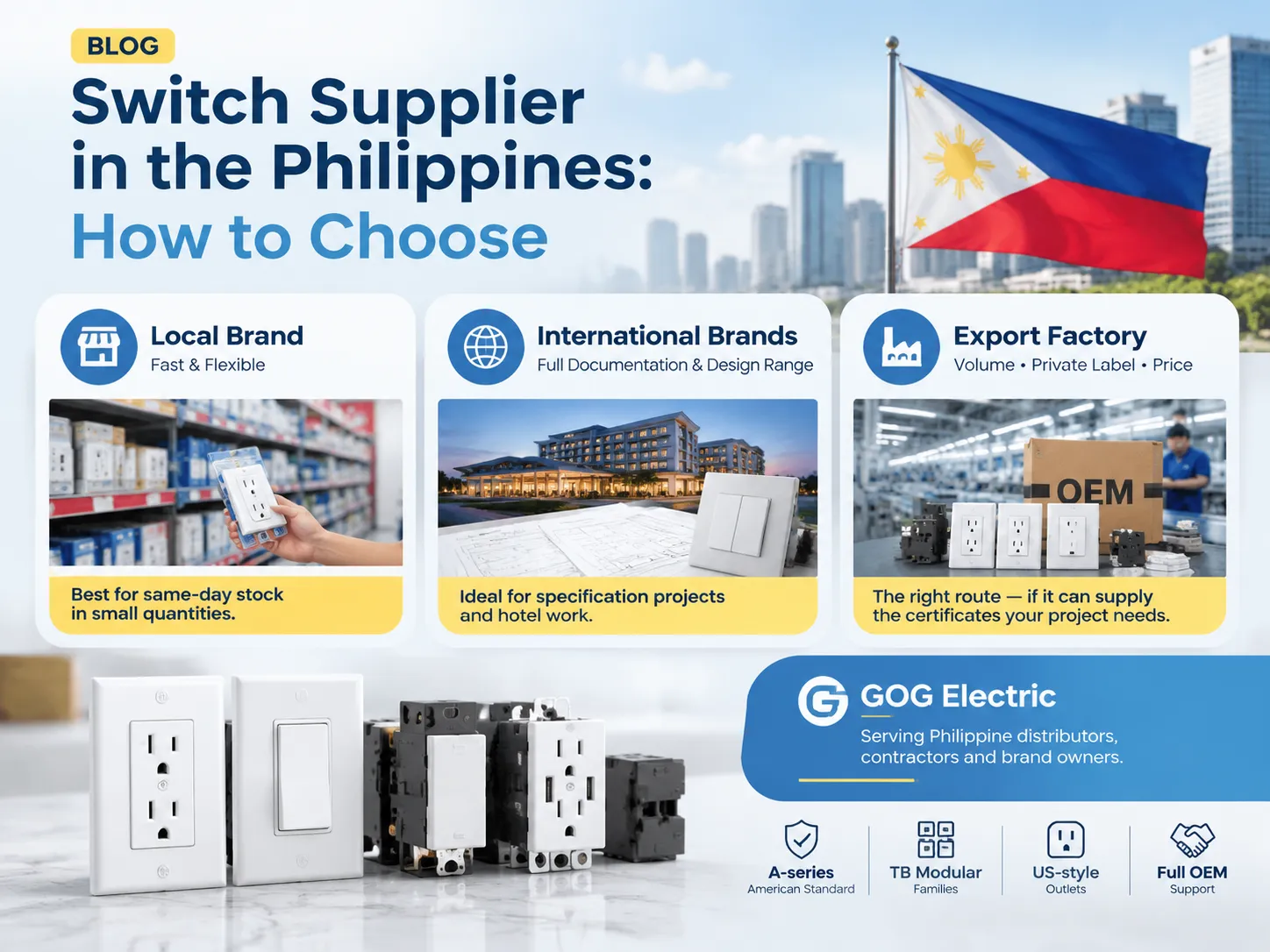
In brief: To procure same-day stock in small quantities, one can opt for a local producer via an electric supply order or home improvement chain. In case of specification and hotel projects, major brands will have the proper documentation and design capabilities. In terms of mass production, an exporting factory should be chosen, as long as the certificates necessary for the project can be provided. GOG Electric provides various types of American electric products and services to contractors, distributors and brand owners in the Philippines.
The Three Supply Routes, Compared
| Route | Typical order | Lead time | Price level | Best for |
|---|---|---|---|---|
| Local brand via distributor or retail chain | 1 to 500 pieces | Same day to 1 week | PHP 80 to 600 per device | Repairs, small fit-outs, mass housing |
| International brand via authorised distributor | 50 to 5,000 pieces | 1 to 6 weeks | PHP 300 to 2,000+ per device | Hotels, hospitals, specification projects |
| Export factory, direct or private label | 1,000 to 100,000 pieces | 25 to 45 days production, plus freight | Landed cost well below both | Distributors, developers, own-brand ranges |
Rather than organizing it according to preference, the table should be read by project size. A 40-unit condominium renovation will not require a container, and a distributor who is starting his own brand should not be purchasing retail boxes from a home type improvement store.
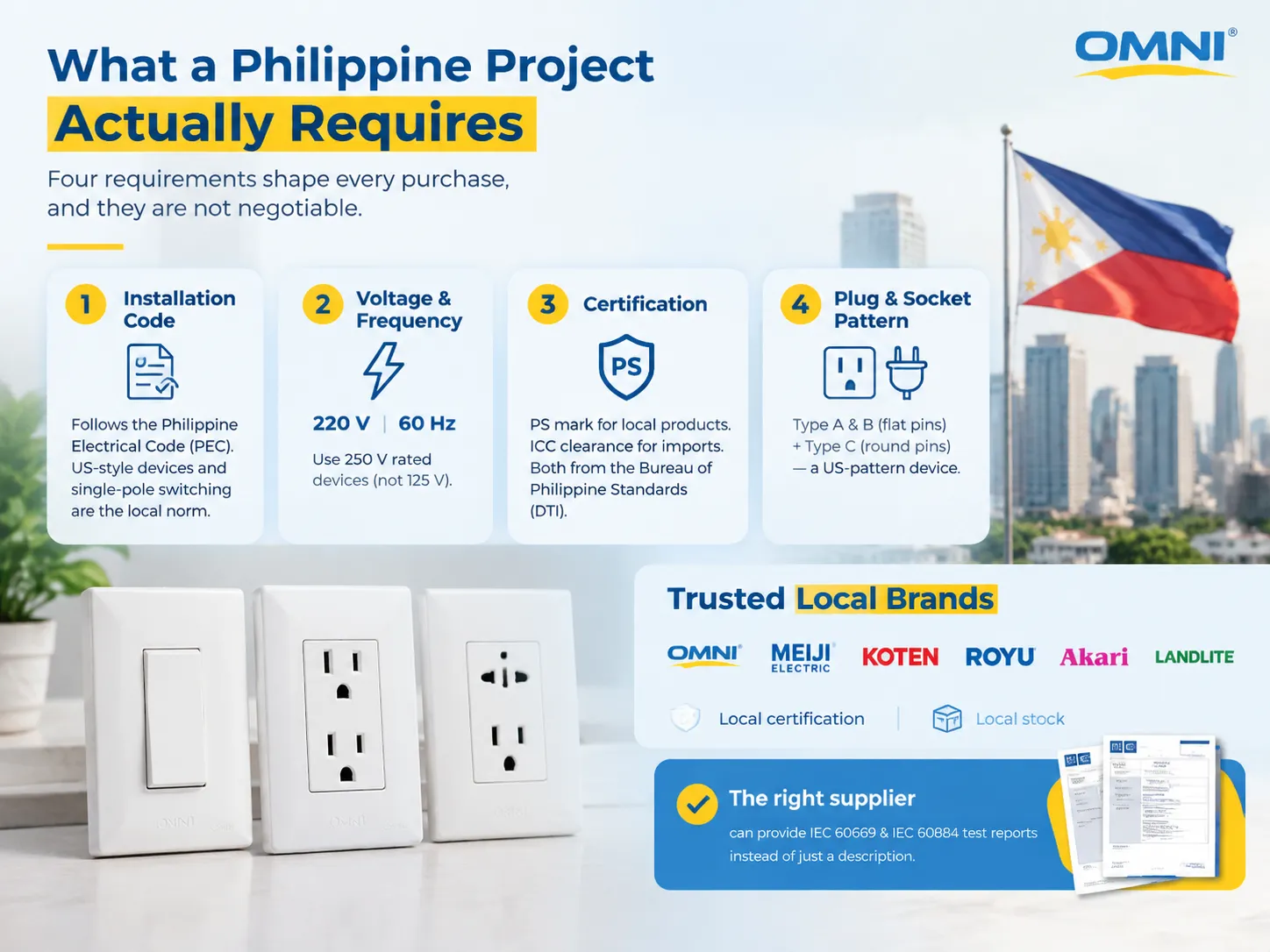
What a Philippine Project Actually Requires
The purchase is influenced by four main factors that do not allow for a negotiation.
- Installation codes. The way the wiring equipment is installed is governed by the Philippine Electrical Code which is checked by inspectors. The wiring code is written in the American style, and that is why the use of US type devices and single pole switching is common.
- Voltage and frequency. The domestic supply voltage is 220 volts and the frequency is 60Hz. Thus devices working on 250V are suitable while devices working on 125 volts are definitely unsuitable even if the shape is the same.
- Certification. The products that must be certified possess a mark PS. Imported electrical goods must also undergo a similar process. Both PS mark and the mark of approved goods are given by the Bureau of Standards of the Philippines. The supplier without the certificate is likely to supply goods that are going to be rejected at customs or at the handover.
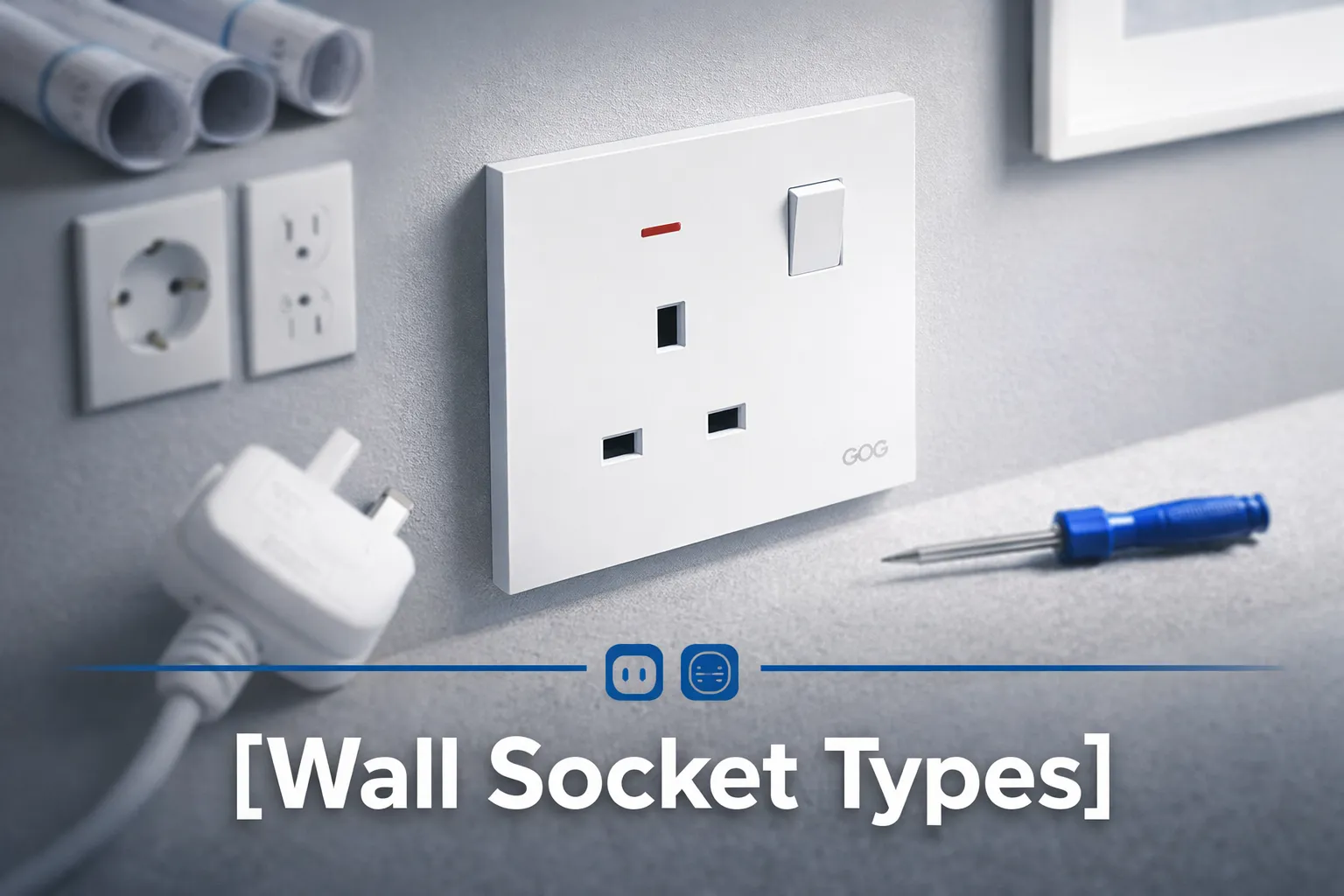
- The nature of the connection. The connection in the Philippines, is done via types A and B plugs and sockets depending on whether the building is an old one or a new one. It is important to remember that the connection through the type A and B plugs and sockets happens in the American way, which is why many buyers often make mistakes buying electrical appliances from the UK.
The outcome of the above statement means that the supplier of the electrical goods in the Philippines should be the one who can certify them according to the IEC 60669 or IEC 60884 standards and provide full reports on their testing. Our download centre exists because that request is the first one every serious buyer makes.
The Local Brands
There are six brands in the local market that are clear market leaders.
- Omni (from Yatai International), established in 1996, is the yardstick: it sells flame-retardant materials, has PNS certification and ICC approval, and keeps a distribution channel to provincial hardware shops. If something is needed that has to withstand repairs for five years anywhere in the country, this is the logical specification.
- Meiji Electric (founded in 1981) offers wiring devices and circuit protection sector goods at specification level as well: it has metal and glass finishes for high-end commercial and residential projects.
- Koten Enterprises (founded in 1987) acts as a mass housing and institutional supplier. It manufactures durable designs, is deep in local warehouse stock and works for mass prices.
- Royu (founded in 2002 and belonging to the FELCO group) builds things for local environment with flame-retardant polycarbonate; it has developed formal wiring devices into cables, breakers, panels and switchgear via Royu Systems.
- Akari (founded in 2002) claims to be unbeatable in the aspect of price and availability for houses with copper terminals that are especially designed for supply fluctuations.
- Landlite (founded in 1999) is somewhere in between budget brands and imported goods, targeting interior designers looking for frameless and simple plates.
What they have in common is local branding and local availability. What prevents them from being universal is their limited design range: if architects need something specific in terms of design, there is a chance to find it locally.
The International Brands and Their Local Presence
Panasonic produces on a regional basis and has an impressive brand presence all over the country. Schneider Electric serves literally all major hotels, hospitals, and commercial advancements with Clipsal and other brand names along with Legrand, Siemens, and ABB taking the second position.
Their advantage lays not in the plastic but in a comprehensive documentation package including completion certificates, test results, fire reports, technical documents, and warranty authority based in the country.
However, their limitations include minimum order quantities, which are set at the very point where other similar projects in the Philippines are completed, and the usage of standardized product categories that do not allow making OEM adjustments. While this approach works perfectly well for a hotel chain upgrades, it is usually impractical for other developers who have to build over 300 residential units.
When a project manager wants to achieve an international look without international costs, the only option is to search for factories producing similar models of goods complying with the same standards.That is the part of the market our lighting switch manufacturing serves, and it is worth understanding what “same standard” actually means before comparing quotations.
Distributors, Retailers and the Import Route
Distribution in the Philippines goes on through electrical supply shops, home improvement stores, and project distributors, such as Wilcon Depot, CW Home Depot, Ace Hardware, and Handyman for retail. These channels work well for basic items and are ineffective for non-standard products; they stock what sells regularly, not what the specification requires occasionally.
When importing products, the type of shipping exceeds in importance compared to the cost. A Philippine importer has to deal with a vendor who knows the Inscription Control Commission (ICC) procedure, packs for ocean freight, issues an invoice and a packing list in a format requested by the customs broker, and can make up for the lost container without a lengthy dispute. The difference between a factory having export experience and one having just found out what export is, will become evident after the first shipment, rather than after the first quotation.
Our own China-based supply operation is structured around that reality: consolidated loading, export documentation and a single contact for the whole order instead of one per product line.
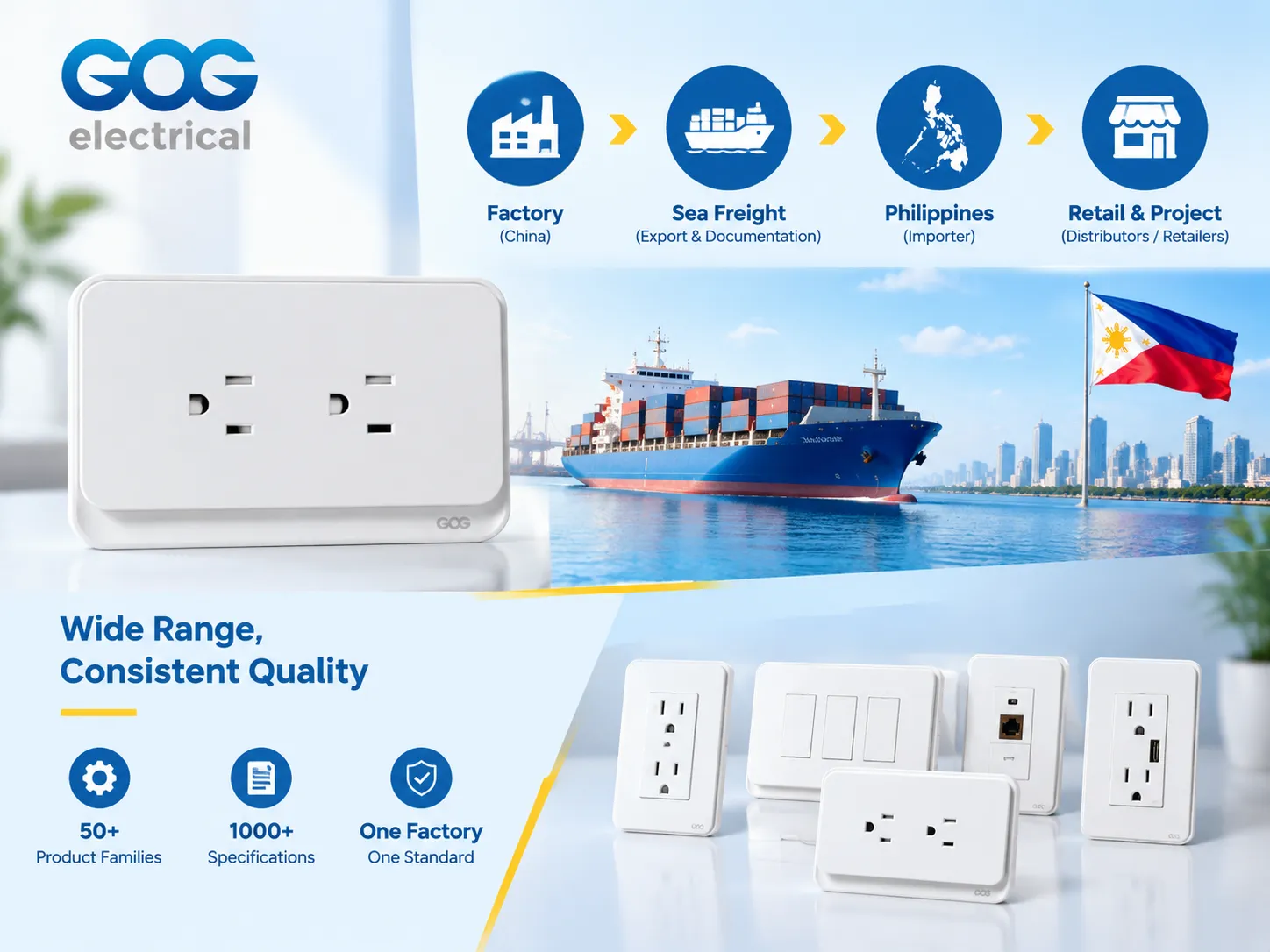
What GOG Supplies to Philippine Buyers
We manufacture wiring devices, which means we do not claim to be a Philippine name with stock here, nor do we consider ourselves a premium European name backed by a local warranty. We are a manufacturer shipping out our products to distributors, developers and brand owners requiring volume, consistency and their own branding on the products.
For the Philippine market this translates to US track products: American A series with plates for up to six gangs, TB modular family for mixed configurations, US outlets of different types including USB and Type C, and plates made of the materials provided by the project. We have over fifty product families in operation at three production facilities hence allowing a customer to order a uniform range of goods rather than putting it together from four producers.
The full catalogue sits in our product range. The practical difference at order stage is that a single factory can hold one plate dimension, one screw pitch and one colour standard across switches, sockets and data outlets, which is exactly what fails when a project buys three categories from three vendors.
Price, Lead Time and What Drives Both
The Philippine retail prices of basic single switch electrical products start from PHP 80 and may reach PHP 2,000 for high-end switches fitted with smart device or dimmer. Outlet prices are in this price category as well. Retail prices already consider VAT, distributor, and retailer mark-ups.
The factory quotes prices per unit when a given number of units is ordered. Prices will depend on four factors: type of plate material (polycarbonate, acrylic, or glass material), metal content in contacts, finishing, and packaging. On some occasions, packaging can be more expensive than the switch itself when mass-produced.
The lead time is from 25 to 45 days depending on whether the samples have been approved. Besides, additions to lead time are necessary for sea transportation from 2 to 4 weeks. The option for air transportation is only applicable for the first batches of orders. The first order must include approval of sample production, as the colour looked at on the screen cannot be trusted when evaluated on a plate.
Five Checks Before You Commit
- Request the standard instead of the certification. Which IEC standard? Which test criteria? A supplier who says “we are certified” didn’t say anything at all.
- Request a test report for a valid serial number. Certificates without any serial number are merely for decoration.
- Ask what happens with respect to a 60 Hertz frequency. Characteristics at 60 Hertz differ from those at 50 Hertz, and a producer familiar with the scientific literature on the Philippines technology knows how real numbers differ.
- Do an order for samples from production instead of showroom samples. The latter appear on the best machine and are operated by the best worker.
- Ensure packaging and documentation are in line with what the company promised before depositing. The carton marking, the barcode style, the warranty statement, and the certificate are all cheaper to alter before production than afterwards.
These five answers can tell the difference between a supplier and trader in about fifteen minutes.Our supply chain service is built to answer them in writing, which is a lower-cost way to fail a supplier than discovering the gap at handover.
FAQ
What is the best brand of electrical switches in the Philippines?
There is no such thing as a single best, only a best fit. Omni is the safest local specification in terms of availability and certification, Meiji and Landlite are ideal for high-end finishes, Koten is good for mass housing, and Schneider, Panasonic and Legrand offer the most efficient solutions for specification jobs. In the case of private label range, it is a factory and not a brand that is picked as the choice.
Where can I buy Nintendo Switch in the Philippines?
That is certainly a different type of switch, and this page is talking about wiring devices. Game consoles are sold through specialized video game shops, electronics chains in malls, and authorized distributors in the relevant region rather than through electrical suppliers. If you got here from search engines while looking for consoles, the word you are looking for is console platform, not wiring device.
How to find a supplier in the Philippines?
The process begins with the needed type of inventory: certified local stock, specified product, or volume for a private label. Then use the appropriate channel. Stock calls for electrical supply companies and hardware chains, while specifications use brand distributors. Expect direct factory contacts for volume. Take advantage of trade shows and professional associations.
Who are the top distributors in the Philippines?
While larger home improvement chains do enjoy higher retail reach, each foreign brand project distributor will carry stock for specifications. Electrical supply houses in Metro Manila and Cebu account for most industrial and utility work. For some materials, it all depends on whether you need that box of switches tomorrow or whether you need that submittal package for this month.
References
- DPWH Philippines — Construction Materials and Standards
- Philippine News Agency — Trade, Industry and Construction Reporting
- Department of Energy Philippines — Electrical Safety and Efficiency
- UL Solutions — Wiring Devices and Certification
- World Bank — Philippines Infrastructure and Construction Data
Conclusion
Acquire supplies from local sources, procure technical specifications from relevant brand distributors, and place the time order with a manufacturing facility. The mistake is in opting for the cheapest possible delivery option with respect to choices based on price alone, for the cheapest delivery costs might become costly when related certificates do not exist.
In case you can tell us what kinds of plates, surface finish, and how many pieces, as well as specify the kinds of certificates you want, we would be eager to get back confirming it in writing regarding the standards, time schedule, and pricing.