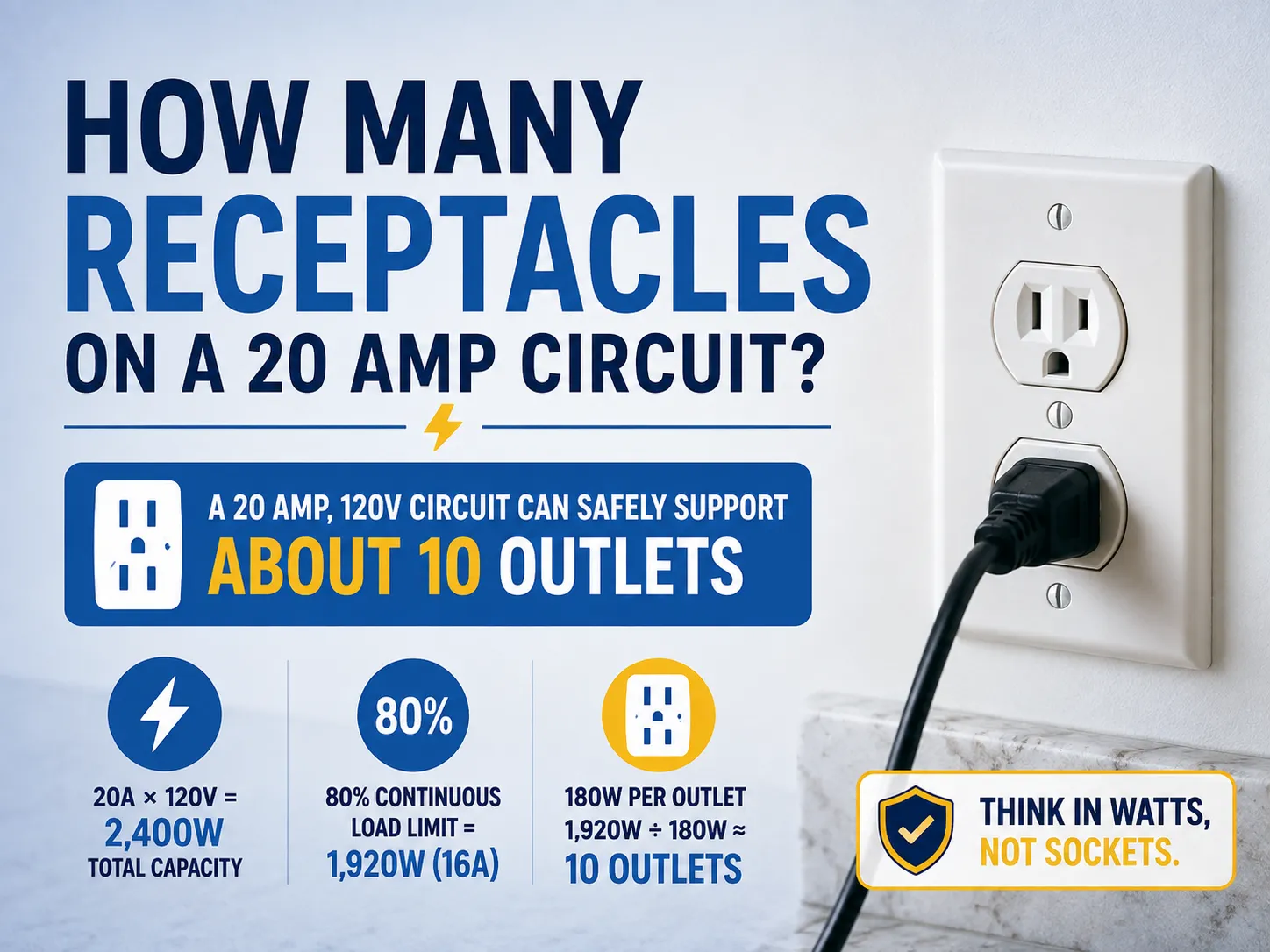
When considering wiring for areas like the kitchen, garage workshop, or office, and wondering the question “how many outlets can I have on a 20 amp circuit?”, you will get two answers: code answer and practical answer. The National Electrical Code (NEC) does not specify a the number of receptacles that can be used on a 20 amp residential circuit; rather, what it does is size the circuit based on the calculation of the load on the circuit. However, from the engineering of the formula, one can figure the general rule of thumb being used; that is about 10 receptacles for a general use 20 amp, 120 volt circuit, where load on per receptacle is 180 VA, and considering the 80% load limit of NEC. Going beyond the limit does not mean breaking the rule; it simply means turning the mathematics upside down.
The guide details the formulas, codes that apply in the case, what can be plugged into a 20 amp circuit, what must be installed in a dedicated 20 amp circuit, and the recommendations for installation of the circuit.
Short response: A 20 amp, 120V circuit is capable of supporting around 10 general-purpose receptacles safely— that figure comes from the understanding of how many receptacles can be plugged in at a certain time. Based on the NEC’s figures regarding general purpose receptacles, the math goes as follows: 20A multiplied by 120V gives total power equal to 2400 Watts; the most prolonged amount of time we can consume power is 80% multiplied by 2400 Watts equals 1920 Watts; dividing the 1920 Watts by the number of Watts a typical receptacle can draw (180 Watts) would give approximately 10.6, which rounds down to 10 outlets. The code does not impose any limits on the number of outlet in a dwelling unit, only the actual load plugged-in devices should be considered.
The Direct Answer: 10 Receptacles
Electricians in the United States utilize 10 outlets to 20 amps circuit in their planning. However, the figure 8, 10 and 12 also pops up, but they used in the same formula. According to the standard, 10 is emplyed, which is derived through the load estimation process according to the NEC code with the 80% continuous load conservancy. For the equivalent 15 amps circuit, the norm is around the 8 outlets. Once 30 amps need to be calculated, there is no need to use this formula since the cords are supposed to be reserved for particular devices. It is important to mention that the outlet number is a means for planning requirements but does not have to be maintained as law since the NEC does not impose regulations of general purpose circuits.
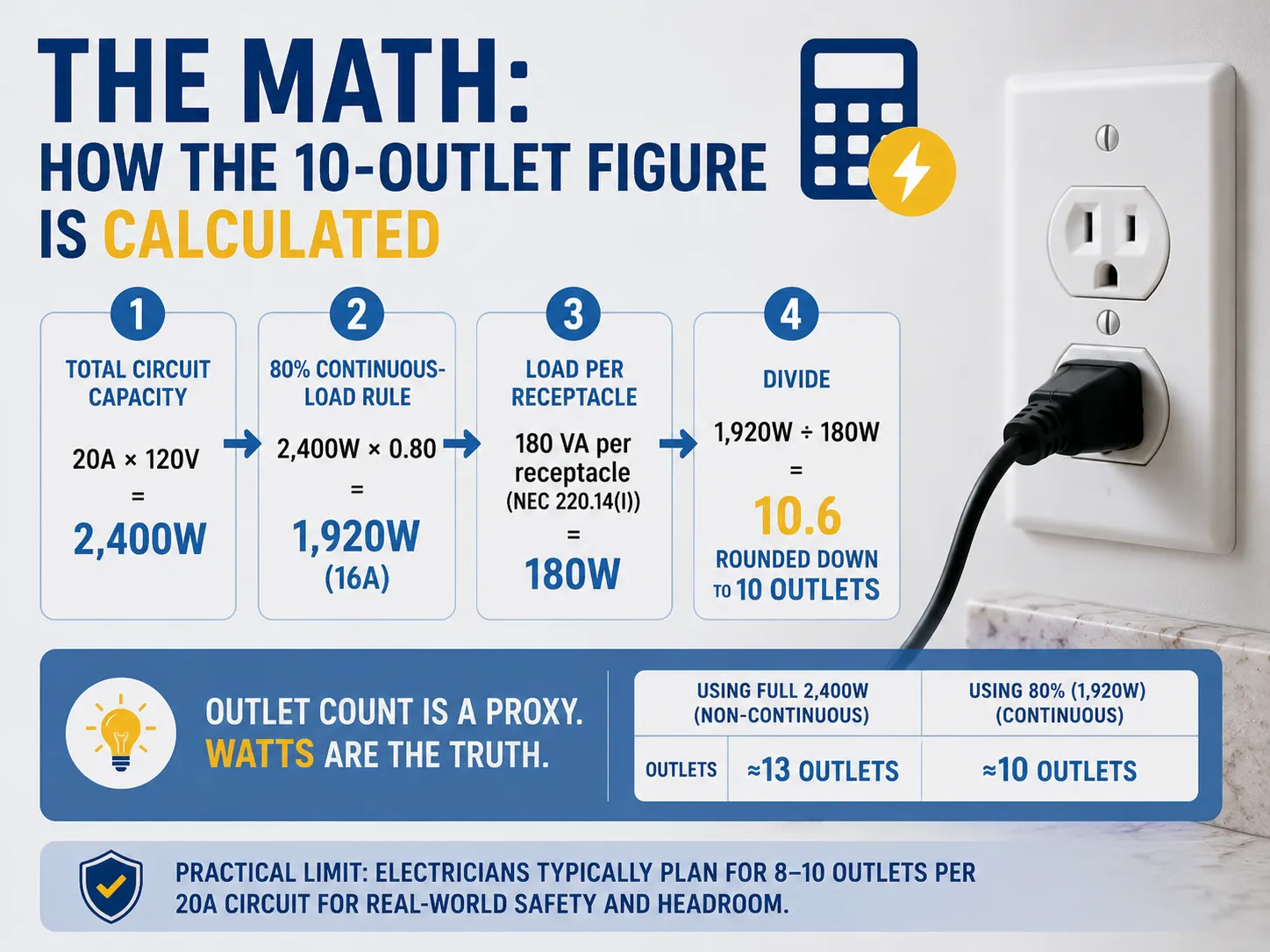
The Math: How the 10-Outlet Figure Is Calculated
If you follow the math here, the magic disappears:
- Total capacity of circuit: 20A × 120V = 2400 watts
- 80% rule: NEC (210.19(A), 210.20(A)) has a limit on continuous loads (over three hours) to 80% of circuit capacity means 2400W × 0.80 = 1920W (16A) available as continuous load.
- Load per receptacle: NEC calculation (220.14(I)) gives 180 VA per receptacle (1.5 A at 120V) as general planning standard.
- Just divide: 1920W ÷ 180W = 10.67 ˃ 10 outlets.
If you decide to lean on the full 2400W (no continuous) and get about 13 spots. However, the smart approach gives you 10 outlets. In practice though, electricians usually go with 8-10 due to the real world which has hair dryers, heating devices, and other stuff not equal to 180W load. The bottom line: count of outlets is the rule of thumb, but watts is the actual number.
What the NEC Actually Says (and Doesn’t Say)
Three codes clarify most of the misunderstandings:
- For housing there’s no defined outlet cap: the NEC does not set a limit for the number of outlets on the general-purpose circuit in the house; the household circuit is determined by the general lighting and outlet load calculation (NEC 220.41). The number of ten outlets is just the design practice but not a regulation.
- For the other types of buildings the NEC 220.14(I) uses 180 VA for the outlet calculation in the branch circuit load calculation (the basis of the number of “13 outlets”).
- 80% rule is true and applies to all: the 20A breaker can work with 16A of continuous load according to 210.19(A)/210.20(A), which means that any circuit being able to work for more than three hours needs to be designed for 80% of the capacity, hence the number of ten outlets instead of 13.
In addition, there is the hard-wiring rule: it is necessary to use 12 AWG copper wire in a 20A circu (NEC 240.4(D)). Using 14 AWG wire in a 20A circuit is prohibited and creates a fire hazard because the breaker will not protect the smaller wire. If you find white-sheathed 14/2 on a 20A breaker during a home inspection, that is a red flag worth fixing — our guide to replacing a light switch covers what to check when you are inside a box on a 20A circuit, and the same box inspection discipline applies whether you are adding a receptacle or planning smart controls.
What Devices Belong on a 20 Amp Circuit
A 20 amp, 120V general-purpose circuit is used for various common plug loads within the 1920W continuous load:
- Lighting and regular outlets in places like living rooms, bedrooms, hallways, and offices.
- Electronics: TVs, computers, monitors, routers, and phone/laptop chargers, etc. (with low wattage).
- Small kitchen appliances work on the kitchen’s 20A small-appliance circuits such as toasters, coffee machines, and blenders (no multiple devices used at once).
- Garage and workshop tools such as drills, sanders up to 15A, etc.
- Air conditioners rated up to 15A (larger ones need dedicated circuits).
- Refrigerators and freezers (normally on dedicated circuits, although a normal circuit would work as well).
The 20A designation is very limited in importance when it comes to the top load, as the 15A circuit doesn’t really have the legal ability to run a continuous load of 15A. A 20A circuit can work for loads of 12 to 16A. Thus, workshops, kitchens, and laundry rooms utilize 20A wiring, as 5A more makes working with the high-consumption equipment safe.
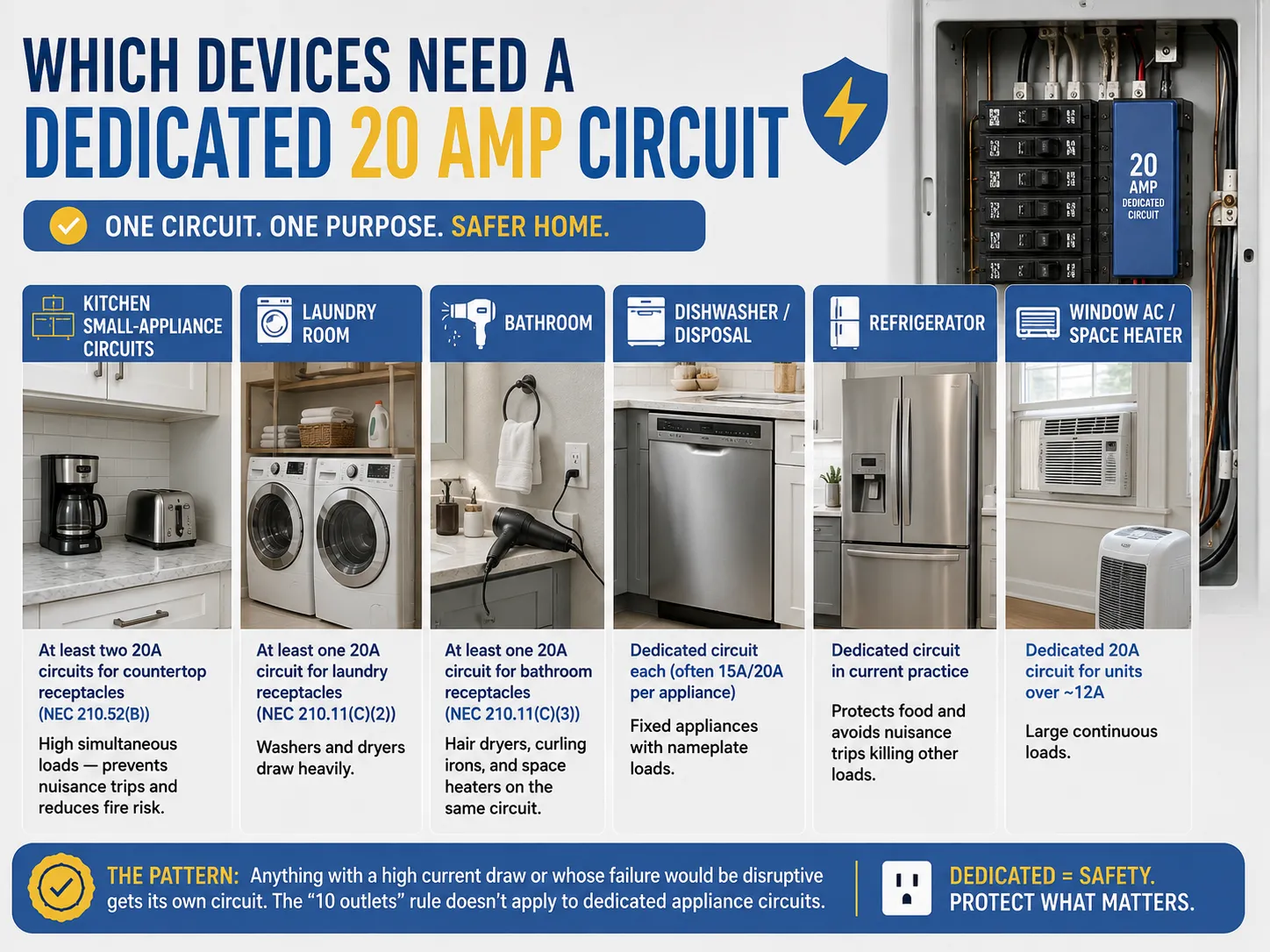
Which Devices Need a Dedicated 20 Amp Circuit
According to the code, it has to be dedicated circuits for the specific sites and the devices – one circuit for one place:
| Circuit | Requirement | Why |
|---|---|---|
| Kitchen small-appliance circuits | At least two 20A circuits for countertop receptacles (NEC 210.52(B)) | High simultaneous loads; a tripped kitchen circuit is a fire-adjacent nuisance |
| Laundry room | At least one 20A circuit for laundry receptacles (NEC 210.11(C)(2)) | Washers and dryers draw heavily |
| Bathroom | At least one 20A circuit for bathroom receptacles (NEC 210.11(C)(3)) | Hair dryers, curling irons, and space heaters on the same circuit |
| Dishwasher / disposal | Dedicated circuit each (often 15A/20A per appliance) | Fixed appliances with nameplate loads |
| Refrigerator | Dedicated circuit in current practice | Protects food and avoids nuisance trips killing other loads |
| Window AC / space heater | Dedicated 20A for units over ~12A | Large continuous loads |
The rule is that anything which has its rated current close to the circuit rating is to be provided with a separate circuit. In the case of such circuits, the rule with regards to the “10 outlets” is not applicable because the load is the appliance itself. The circuit is designed correspondingly.
How Many Devices Can Run at Once?
In simple words, it depends on the combined wattage total which maximum is 1,920W. Let’s give some practical examples of 20A circuit usage:
- A TV (~150W) + a laptop (~60W) + a router (~15W) + lights (~100W) = about 325W. It is feasible to use it all day long with no problems.
- An electric heater (~1,500W) and a hair dryer (~1,200W) = 2,700W that immediately leads to a circuit failure. This is classic overloading.
- Using two heaters of 1,500W on the same circuit = 3,000W, causing an immediate disruption of the circuit which in case of wiring deterioration leads to fire.
The practical rule is to use only one appliance of high wattage (12-16A) on a 20A circuit and never two electric heaters, two hair dryers, or an electric heater along with a microwave. Regular trips in the circuit are a signal to investigate the discovered load rather than being an inconvenience.If the circuit feeds lighting as well, the same load discipline extends to dimmers — the dimming advantages guide shows how modern controls keep lighting loads efficient within the same 1,920W budget.
15A vs 20A Receptacles: What’s Allowed
This is the most commonly misunderstood concept in this discussion. The 20A circuit allows for:
- The use of multiple 15A outlets. The NEC 210.21(B) offers clearance for the usage of 15A outlets in the 20A circuit unipolar system, as long as there are a minimum of two outlets. This is why kitchens and garages seem okay to use in spite of being connected to a 20A circuit. The 20A current in the circuit is transferred using 12 AWG conductors.
- The use of a 20A outlet. When there is only one outlet in the circuit, it must be a 20A type, since a single outlet rated 15A can overload the circuit due to its capability.
- There is a restriction to this reverse application. You should never connect a 20A outlet to a 15A circuit, since it will be capable of drawing more than the circuit can supply.
When you are upgrading outlets or planning smart controls, the circuit rating decides everything — our guide to LED dimmer compatibility starts from the same question of what the circuit can actually feed.
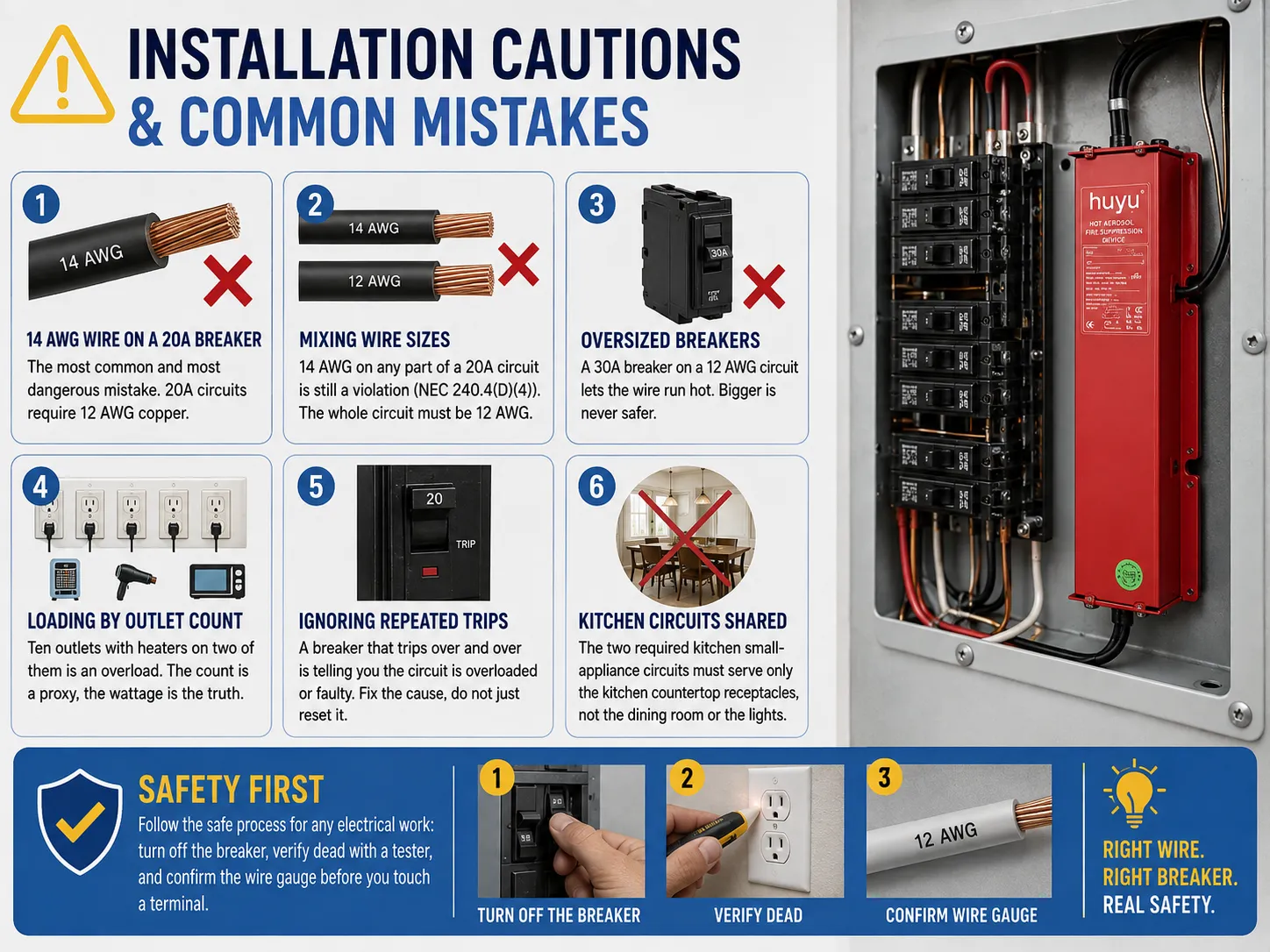
Installation Cautions and Common Mistakes
- Using 14 AWG wire with a 20A breaker is a common error, but dangerous, as it doesn’t protect the smaller wire from overheating and possibly catching fire. For this reason the 20A circuit requires 12 AWG copper.
- This issue comes from mixing wire sizes, which NEC prohibits; any segment of the circuit using 14 AWG is therefore a violation of code, since only 12 AWG can be used on this circuit.
- Using oversized breakers means that a 30A breaker on a 12 AWG circuit will allow too much heat through the wire – bigger is not better in the world of breaker sizing.
- The issue of total wattage versus the number of outlets is vital, because a circuit is overloaded when there are ten outlets but only two plugged in with heaters; this shows that the outright number of outlets only shows part of the picture, because it is not wattage being handled but wattage being plugged in that shows the true loading.
- Ignoring repeated trips of your breaker means that circuit overloads happen; in these instances one must get to the cause of the issue rather than simply resetting it.
- Kitchen circuits with any parts of the house sharing current; the two circuits required for the kitchen must be soley used in the kitchen;
When you either remove a device or install a receptacle in an existing 20-ampere circuit, the process is just like installing any other switch or outlet. First, cut the power at the breaker box. Second, confirm with a tester that there is no power in the area of your work. Finally, check the wire gauge before touching any terminals.And if you are upgrading to smart switches at the same time, the neutral vs non-neutral smart switch guide covers the box-check you need to do before buying.
Frequently Asked Questions
How many outlets should I put on a 20 amp circuit?
One can expect that up to approximately 10 outlets could be installed on a standard 20A/120V circuit as per the NEC’s estimate which suggests that each outlet would require an input of 180 VA, thereby limiting the load to 1920 W, which is 80% of the maximum safe load of 2400 watts per circuit. The actual limit for these appliances will depend not on the regulations but rather on the total power consumed by whatever is plugged into them, e.g. ten phone chargers vs. two normal heaters.
Can lights and outlets be on the same 20 amp circuit?
Yes, it is quite normal for general-purpose circuits rated at 20 A to go with lights and sockets, and the estimate of 180 VA taken per yoke is meant to count both. There are some exceptions though: circuits for refrigerators, kitchen appliances, as well as laundries and bathrooms do require separate dedicated circuits.
Can I run a refrigerator and outlet on a 20 amp circuit?
Technically, it is possible as refrigerators are consuming around 400 – 800W so that the load is well above what can be used on a 1900 W circuit. However, the current best practices suggest using a dedicated circuit in this case so as to avoid food spoilage due to accidental trips caused by shared usage of the circuit.
How many sockets can I run off a 20 amp breaker?
The rule that is usually applied to the installation of outlets is that there should be approximately 10 outlets installed on a circuit rated at 20A. Theoretically, it may be possible to install 13 outlets due to the fact that on a strictly floating basis, the load limit for that circuit will be equal to around 2 400 W. However, the output load will depend mostly on the amount of power used.
References
- NFPA 70 — National Electrical Code (Articles 210, 220)
- Electrical Units — How many outlets are allowed on a 20 amp breaker
- EngineerFix — How many outlets on a 20 amp breaker (180 VA rule)
- EcoPowerSense — How many plugs on a 20 amp circuit (2026 electrician’s guide)
- ExpertCE — NEC rules for outlets on 15/20 amp circuits
Conclusion
The answer to the question “how many outlets on a 20 amp circuit” is 10, and the significance of this answer comes from the fact that it is not necessarily the number but more the idea of one or two items which could end up being plugged into the outlet. 20 amps at 120 volts translates to 2400 watts; however, the continuous-load rule states that one should keep the load limited to 1920 watts. The code estimates load usage per outlet to be about 180 watts which is the foundation for coming to the conclusion that one should limit the number of plugs till 10. It should be kept in mind that while there is no strict regulation of the number of outlets at home, the regulation for the supply of electricity does exist which is something to be taken into consideration while planning the placement of outlets.When you are ready to modernize the controls on those circuits, our top-rated smart switches guide is a good next stop.