In most readings from an electric tester in older American homes, the most common indication you will see is open ground. But it is also the most misunderstood one. Essentially it suggests that one cannot get a shock while touching the outlet. But what it actually means is that the outlet is not functional at all. Open ground suggests that there is no wire behind the third pin which implies that the safety circuit is upended.” The article describes the meaning of this statement, as well as how to test the result.
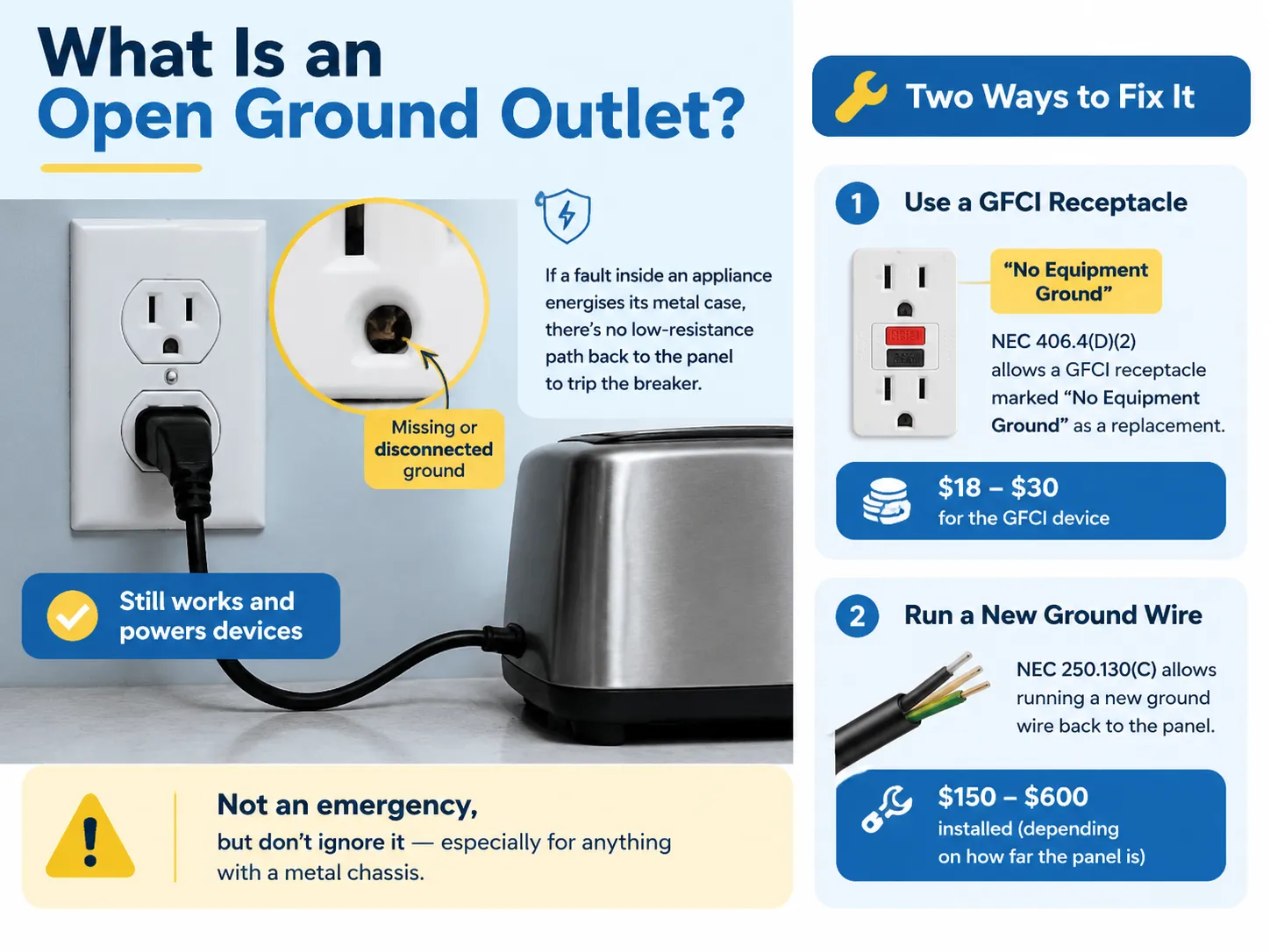
The quick answer is that when there is an open ground, it means the equipment grounding conductor (the third round pin in the power plug) is either broken or missing somewhere along the circuit between the outlet and the panel. Although there is nothing wrong with the outlet and it continues working, any malfunction happening inside an appliance which energizes its metal part will never trigger the breaker due to lack of low-resistance path for the current. The situation is not alarming but it should not be neglected, especially if it is about an appliance with metal body. If you want the solution to this ground issue, the easiest way would be obtaining a GFCI outlet showing the “No Equipment Ground” marking in line with NEC 406.4(D)(2). Another option is running a new grounding conductor to the panel (NEC 250.130(C)).
What “Open Ground” Actually Means
To start with, let’s understand what a receptacle is. A usual outlet has three contacts made of metal: one short and one tall hot slot. They pass current to the load during operation. The ground slot is connected to the wire for grounding the equipment, and it does not perform any role in the receptacle’s functioning until failure occurs. The anatomy of the device, including what each slot connects to and why the blade shapes differ, is set out in this explanation of what an electrical receptacle is.
That is a manufacturing defect. When a current-carrying conductor comes in contact with the chassis, it makes the chassis live. When a ground connection is intact, the current will continue to flow from the chassis to the main panel through the ground connection, thereby tripping the circuit breaker. However, when the ground is open, there is no connection for the current to go through, which keeps the chassis live and the breaker closed.
Hence, an open ground point is simply an electrical outlet that has no ground, and that makes ‘use of the appliance’ possible, although it may be misleading.
How to Confirm an Open Ground
The first test will cost you around $10 and takes no more than 5 seconds. Insert a tester with three indicator lights into the receptacle, and the readings on the light will tell you the following: if the ground is not connected, it will show an indication called “Open Ground.” This reading is important enough for you to proceed but not sufficient to perform the repair since it gives no guarantee that there is no ground wire present somewhere in the box but just isn’t connected.
The second test, however, will provide you with this information. In order to carry it out, use a multimeter and set it to measure AC volts.
| Reading (hot to ground) | What it means | What to do |
|---|---|---|
| Approximately 120 V | A ground path exists and is continuous | Test hot-to-neutral and neutral-to-ground to complete the picture |
| 0 V, with hot-to-neutral reading about 120 V | Confirmed open ground | Trace the ground path or use one of the fixes below |
| 40–60 V on a digital meter | Almost always phantom voltage from capacitive coupling | Re-test with a low-impedance tester, which will read 0 V |
The previous row is significant because it helps people find a problem that is not there. If hot slot and ground slot are close to each other electrically, a high impedance multi-meter will measure some Voltages in the region of 40 to 60 volts. An electrical testing device with low impedance shows that there is no voltage across these slots and gives you correct information. If the readings seem suspicious and look like a fraction of the line voltage, check the low impedance device first.
The last point is important only if we talk about older houses with metal conduits or armored wires. If the ground wire extends from the green screw of the socket to the metallic box and the box is part of a continuous electric raceway system, then the raceway can serve as a ground. You can verify this by checking the resistance between the box and some known ground point when the power supply is switched off. If the resistance is near zero it’s okay, otherwise it’s no ground.
Is an Open Ground Outlet Dangerous?
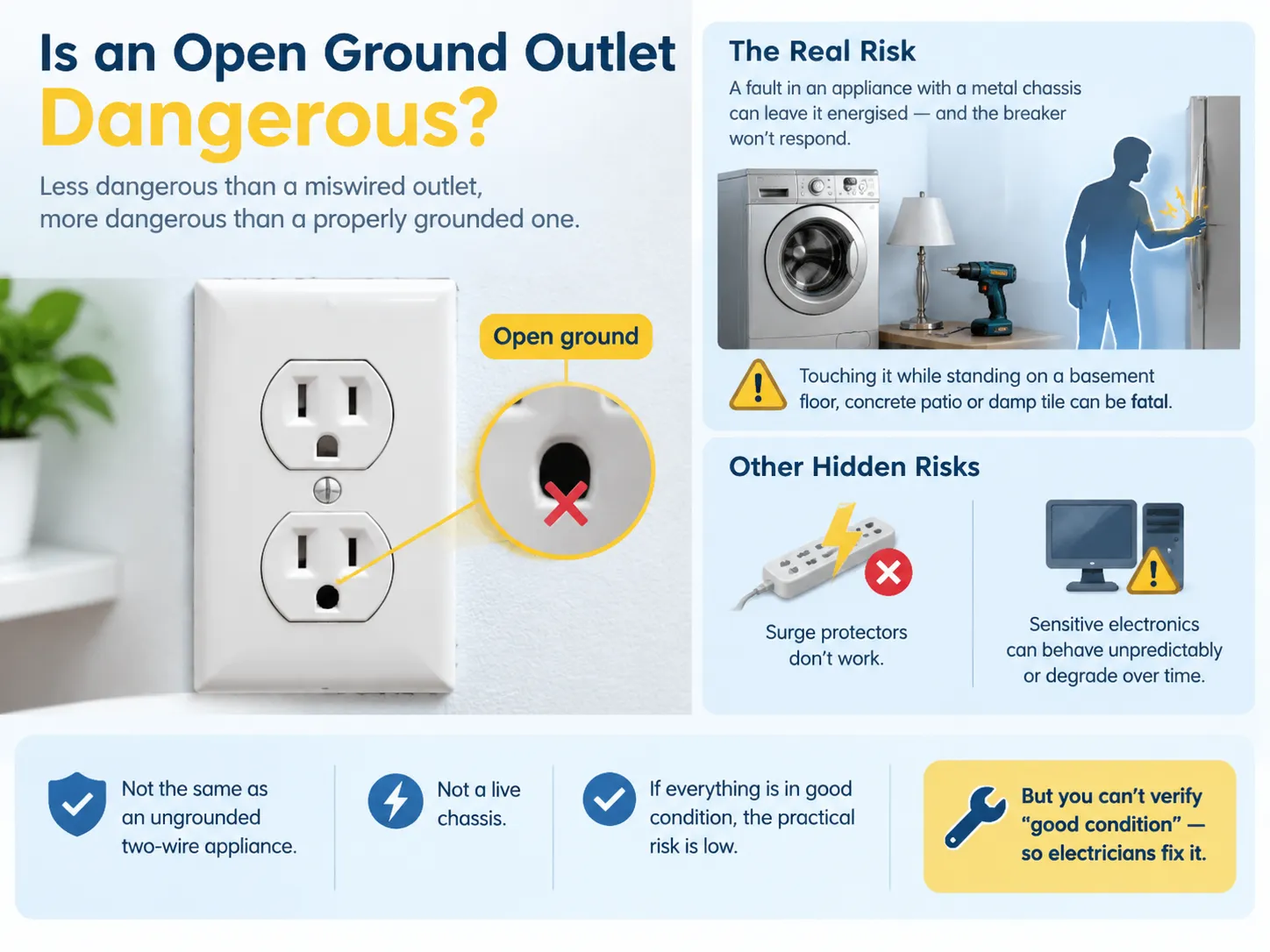
In other words, it is considered very safe compared to reverse-wired outlets, yet it’s less safe because of proper grounding. The truth is that the level of hazard actually depends on the connected devices.
The risk occurs in case of malfunctions in the appliances with a metallic casing. An appliance or any device without a proper grounding is dangerous because the casing may become energized and stay that way for a long time, thus, the circuit breaker won’t react in case of a malfunction. For example, touching such an appliance while standing on the basement floor, damp kitchen tiles or concrete surface may be dangerous.
Among the other consequences of having an open ground, another one is that surge protectors do not function properly. Surge protectors work by directing power excess to the grounding. But in case of an open ground outlet, MOV will not have any place to direct the surge power, therefore the appliance will work with the surge power. Sensitive electronic equipment also depends on ground since it makes its operations more stable.
As for what the open ground is not, it is not the same as having the ungrounded appliance and it does not mean that the chassis is live at that moment. If everything is working properly with the outlet and the appliance, the risk is very low. However, there is a concern that it is almost impossible to check can the appliance operate properly, that is why electricians are treating open ground as a defect that has to be fixed.Any circuit with a live-to-ground fault and no ground path is the same class of hazard as a switch that is not properly bonded, and the reasoning behind that is set out in this explanation of whether switches need to be grounded.
Open Ground vs GFCI vs a Normal Outlet
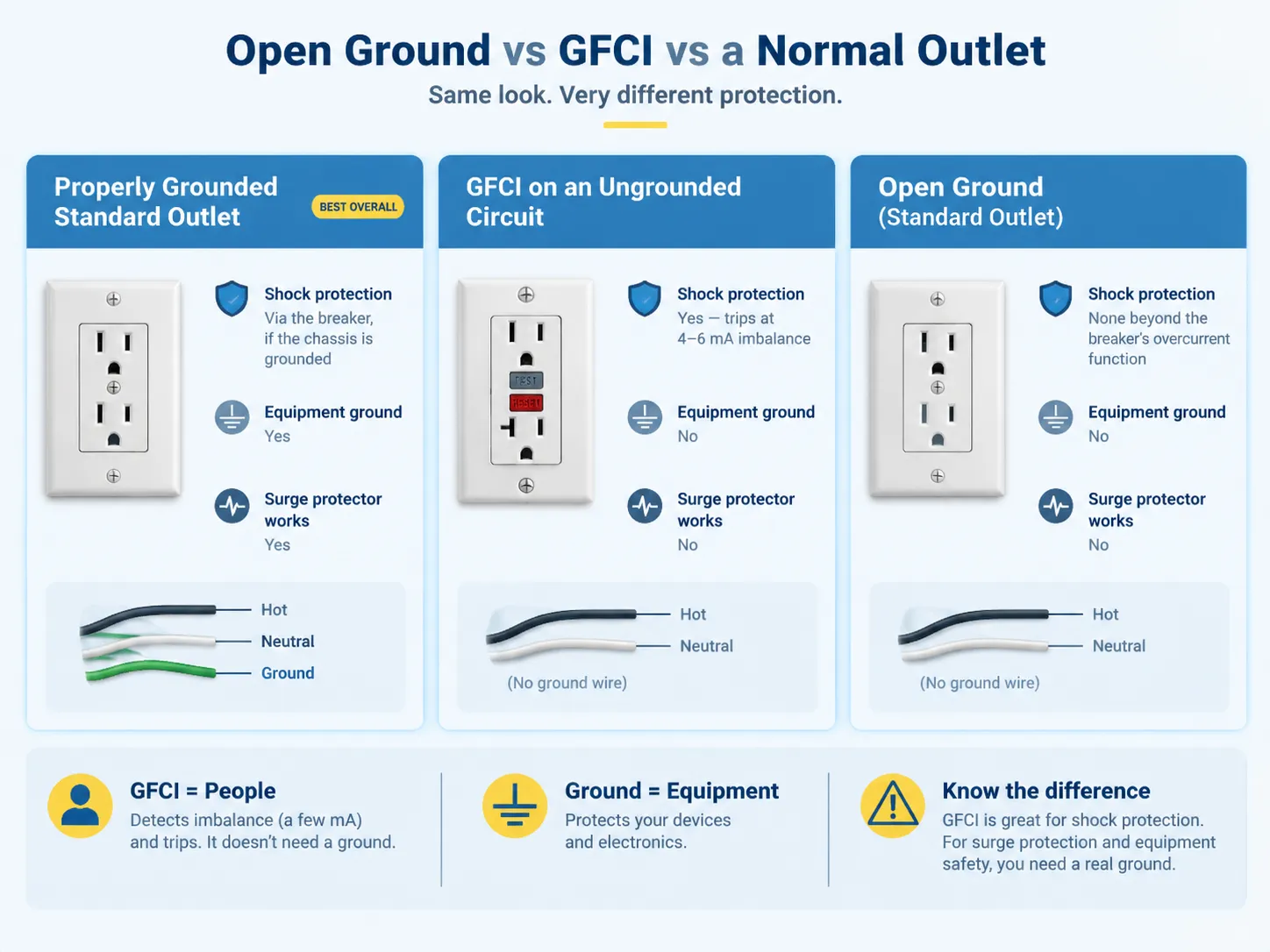
This refers to the fact that the three concepts are often confused with one another, which confuses those who think that a GFCI also restores ground. This is incorrect, as it does not restore ground, since it operates on different principle.
| Outlet type | Shock protection | Equipment ground | Surge protector works |
|---|---|---|---|
| Correctly grounded standard outlet | Via the breaker, if the chassis is grounded | Yes | Yes |
| GFCI on an ungrounded circuit | Yes — trips at 4–6 mA imbalance | No | No |
| Open ground, standard outlet | None beyond the breaker’s overcurrent function | No | No |
| Two-prong outlet (original ungrounded) | None | No | No |
A GFCI functions by measuring the outgoing current on the hot wire against the incoming one on the neutral wire. The circuit opens as soon as it detects that a few milliamps of current are missing — “missing” means going through a person or wet surface. The GFCI does not monitor the ground wire; because of this limitation, it protects people just as well on an ungrounded circuit.
Only two columns from the three presented use to make decisions. GFCI provides protection for humans; equipment grounding is responsible for protecting the equipment and electronic devices. GFCI on an ungrounded outlet is a real solution to the problem of electric shock but does not solve the problem of safeguarding devices from surges. If the outlet supplies power to a home office with a computer and a NAS, GFCI is not sufficient.
Where the practical differences between the two device families sit — trip behaviour, where each is installed, what each protects downstream — is worth reading before you buy, and the comparison is laid out in this explanation of the difference between GFCI and regular outlets.
Why Open Grounds Happen
There are only a few reasons, and finding out what the reason is will help determine the method of repair.
- The cable has never contained a ground wire. A two-wire, non-metallic cable or knob and tube wiring does not include an equipment ground wire. This is the most common reason why homes that were constructed before the mid-1960s exhibit this problem, and the solution to it is to run a ground wire or provide GFCI protection.
- The ground wire has been severed at a junction box. While making changes to the wiring system in the past, a worker shortened the cable without reconnecting the bare copper wire. This is frequently found inside the junction box coiled without being attached.
- The ground screw is loose or covered in paint. This problem is surprisingly common. The ground wire is there but due to a loose connection or being coated with paint does not conduct electrical current.
- A three-wire outlet has been installed on a two-wire circuit. An effort to change the old two-prong outlet to a three-prong one, without obtaining the ground is undertaken. The problem is that three-prong outlets that are not connected to the ground create the illusion of safety.
- The ground path is broken further upstream. It could be an issue of improper connection in the conduit run, broken bonding jumper, or disrupted ground bar in the panel.
How to Fix It
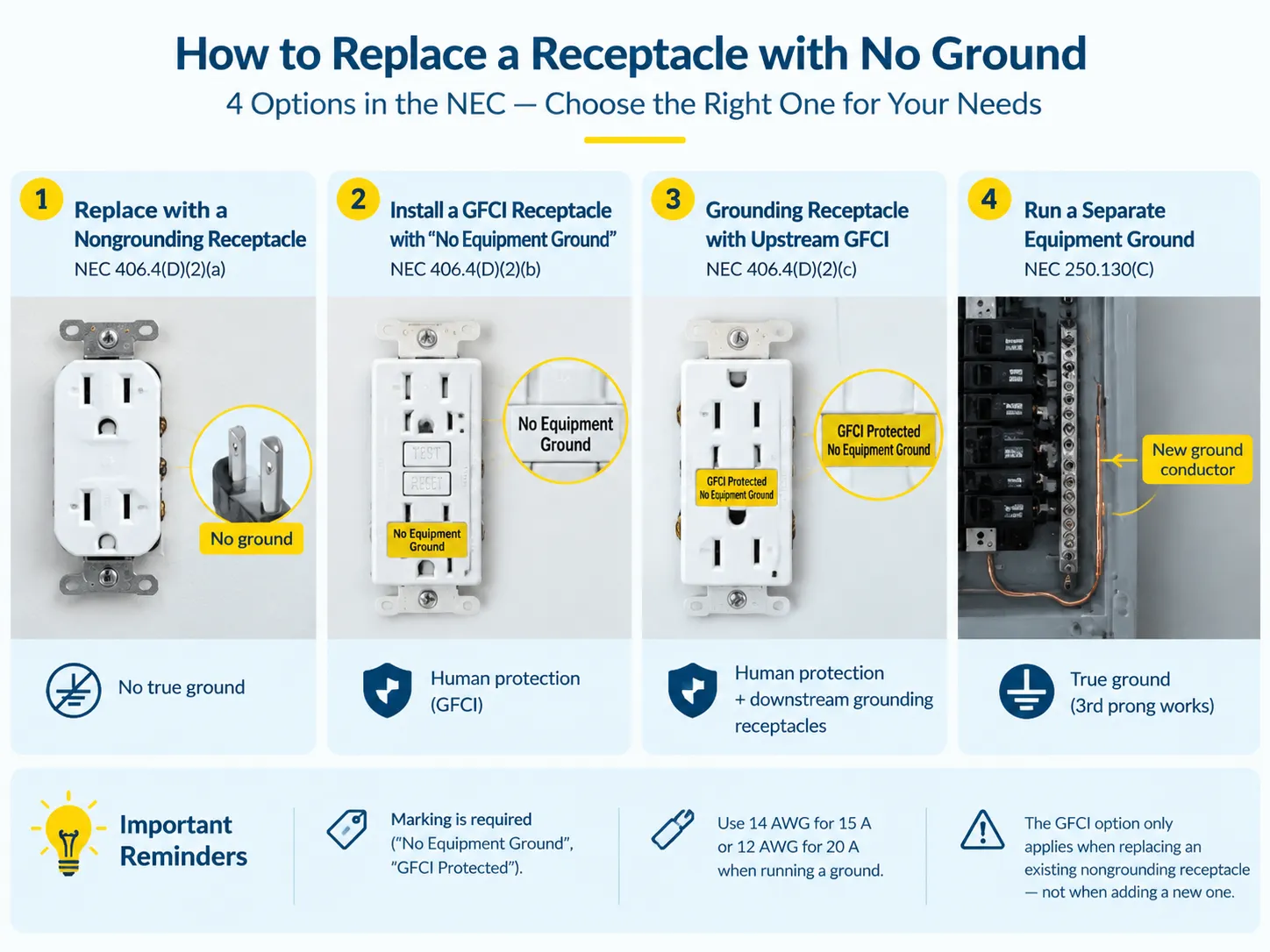
According to the National Electrical Code, there are three methods of replacing a receptacle in the absence of an equipment grounding conductor and a separate possibility. All four methods are acceptable, but which one you use depends on the need for racial protection or true grounding.
| Method | Code reference | Gives a true ground | Typical parts cost |
|---|---|---|---|
| Replace with another nongrounding receptacle | NEC 406.4(D)(2)(a) | No | $3–$8 |
| Install a GFCI receptacle, marked “No Equipment Ground” | NEC 406.4(D)(2)(b) | No | $18–$30 |
| Install a grounding receptacle protected by an upstream GFCI, marked “GFCI Protected” and “No Equipment Ground” | NEC 406.4(D)(2)(c) | No | $18–$30 plus device |
| Retrofit an equipment grounding conductor back to the panel | NEC 250.130(C) | Yes | $40–$120 per circuit in materials |
The marking requirement is mandatory. Whenever replacing a non-grounding receptacle with a GFCI, the device must be labeled as “No Equipment Ground”. Any grounding-type receptacles downstream from it must be labeled “GFCI Protected” and “No Equipment Ground”. These are the labels attached to the device so that the next electrician, and the next homeowner, will know what it is.
The retrofitted ground is the only option to have the third prong work as required. According to NEC 250.130(C), it is possible to run a second equipment grounding conductor either to the grounding terminal bar in the panel powering the circuit or to any accessible point in the grounding electrode system, or to the equipment grounding conductor of another branch circuit being powered from the same panel. Since the ground wire does not need to follow the initial cable, a bare copper wire may be pulled through the attic, basement, or crawlspace. Use 14 AWG for 15 A circuit and 12 AWG for 20 A.
The only restriction to all this is that the use of a GFCI instead of ground applies only to exchanges of existing non-grounding receptacles; as soon as a new receptacle outlet is added to an ungrounded box, the new outlet should provide for the grounding of its grounding terminal in a manner that satisfies the Code requirements. Beyond that moment, the shortcut is closed.
The work process of the swap itself is really a beginner’s job — just secure the circuit, check it is dead, transfer the wires, install it. The sequence and the mistakes to avoid are covered in this walkthrough of how to replace a wall socket. What is not a beginner job is deciding which of the four methods applies, and that decision is worth an electrician’s fifteen minutes if the wiring is old or unfamiliar.
The Bootleg Ground Trap
A bootleg ground is a jumper between the neutral terminal and the ground screw in the electrical outlet. The purpose is often benign: someone wanted a three-way tester to indicate “correct wiring,” so the outlet will pass visual inspection.
However, the outcome is much worse than having the ground wire disconnected. The return current will be split between the neutral and ground, causing the chassis of any device connected to that outlet to carry current under normal operation. If the neutral upstream opens up, it will render all grounded objects in the circuit live. A GFCI protected circuit will trip at the first energizing moment, as the split return circuit gives what appears to be a ground fault.
If you find a bootleg ground, remove it immediately. A bootleg ground is an actual danger and not a simple workaround.
What It Costs
Figures below are typical US ranges for 2026 and separate parts from labour.
| Item | Typical cost | Notes |
|---|---|---|
| Three-light receptacle tester | $8–$20 | Basic outlet fault checks |
| GFCI receptacle, 15/20 A | $18–$30 | Tamper-resistant and weather-resistant versions cost a little more |
| Replace one outlet with a GFCI | $120–$250 installed | Device plus labour, existing circuit |
| Retrofit a ground wire to one outlet | $150–$600 installed | Depends almost entirely on how far the panel is |
| Ground a whole house (per circuit) | $150–$400 each | Volume pricing usually applies |
| GFCI breaker in the panel | $35–$75 plus labour | Protects the whole circuit at once |
Once stated, the economics are clear. If one outlet in six on a circuit is ungrounded, GFCI protection at that outlet makes sense. If all of the outlets in the circuit are ungrounded and the panel is located right downstairs, running a single wire for grounding purposes and bonding that wire can accomplish the job for a fraction of the cost.
Choosing Devices and Brands
In the US market, the replacement devices mostly come from a few companies — Leviton, Eaton, Hubbell, Legrand, and brands available through electrical distributors. The important factors are the brand names (UL 498 for receptacles, and UL 943 for GFCI), the tamper-resistant and weather-resistant designations where applicable, and if the device is a self-test type or not.
When it comes to getting many devices rather than one single device, things are very different. GOG manufactures devices — switches, sockets, and receptacles including tamper-resistant ones for OEM and private label programs instead of selling the devices in the retail market. Our disadvantage is that our products are not well recognized by homeowners but at the same time, our advantages are that the distributor or contractor can specify the product based on price rather than brand.
FAQ
Is it okay to have an open ground outlet?
It is permitted to leave a receptacle unblocked as long as you do not touch the circuit and there is no emergency, but a report of the fault will show up on any inspections of your property. The plug is operational, and there is no danger of it causing injuries. Problems arise when the appliance malfunctions and the metal case of the appliance remains live because the fault current has no way to trip the fuse. To be safe, any outlet serving appliances with a metal casing or any surge protector must be fixed.
What to do if outlet says open ground?
Prioritize using the multimeter to validate readings. If the reading is obtained from hot to ground, the presence of ground circuitry should provide a reading around 120 volts. If nothing shows up in the ground reading, troubleshoot by using a GFCI outlet rated “No Equipment Ground” for human safety concerns, or a retrofit grounding conductor connected to the service panel for firewall resetting of the outlet. Double-check for any existing ground wire that may have become loose, as you might find it is simply not working.
How to find an open ground outlet?
Use a three-light plug-in tester to walk through the house and check every outlet; most testers show “Open Ground” by means of a certain light pattern on the tester face. In an older house, check the rooms that are most prone to having been rewired or added to and check any outlet in which the original two-prong outlet has been replaced with a three-prong one. One GFCI upstream may protect many outlets; consequently, the dead or tripped GFCI might give a reading similar to the fault.
How do you fix an ungrounded outlet?
There are four possible legal ways to go about it. Install a replacement receptacle, which is a legal but outdated option for modern devices. Put in a GFCI outlet that states “No Equipment Ground” and will only protect people, not any equipment. Set up a ground outlet after the GFCI, which indicates both forms of protection. Finally, adapt a ground wire according to NEC 250.130(C), which is the only choice that gives you a real ground connection.
Will an open ground outlet still work?
The hot and neutral wires are the ones that actually provide electricity and will not be affected by the absence of a ground. Therefore, anything that runs on electricity, such as lamps, chargers, vacuum cleaners, or power tools, will work just fine. However, surge protection devices will not work, as they require a ground to direct any excessive current. This is the reason why no one complains about the defective outlets for years.
Does a GFCI fix an open ground?
It works on shocks only but does nothing to the earth. A GFCI checks the equilibrium of the current between the hot and the neutral wires and triggers at a deviation of 4–6 mA, thereby safeguarding those on the circuit. It, however, does not set a ground path along, and one cannot expect the surge protector to perform correctly. Plug sockets that fall under this category consequently need to feature an inscription that states “No Grounding” and any downstream standard sockets should feature an inscription stating that they were protected by GFCI.
References
- NFPA — NFPA 70, National Electrical Code (406.4(D), 250.130(C), 250.118)
- UL Standards & Engagement — UL 498, Attachment Plugs and Receptacles
- UL Standards & Engagement — UL 943, Ground-Fault Circuit-Interrupters
- U.S. Consumer Product Safety Commission — electrical receptacle and GFCI safety guidance
- OSHA — Ground Fault Circuit Interrupter information
- UL Solutions — receptacle and GFCI listing and certification information
Conclusion
Nonetheless, although the outlet is open, it is still able to function. Therefore, the majority of homeowners and real estate sellers discover about the issue just while they are going to sell their houses. There is not the correct method which had eliminated the incident in any electrical device and turned it into the automatic safety switch instead of letting the electric appliance stay electrified.
It is necessary to state three main ideas of the article. First, it is important to check the readings by using a multimeter as an illusion of the voltage 40-60 volts is not a fault. Secondly, when choosing the method of repairing, it is necessary to understand that in case one wants to protect the electrical device, he/she should use the correct wiring while GFCI protects only living beings. Finally, it is mentioned that if it is known that a neutral wire is connected to a grounding wire, it is a mistake, and the open ground is hidden under a bootleg grounding connection and may be even more dangerous than the initial issue.