While finishing his basement, a owner in Portland devised a new circuit featuring a 20-amp for his office, living room, and workshop. He added up the necessary number of outlets in the area and found he would need 18 of them. This is where the electrician had a concern. Although having 18 receptacles on one circuit does not violate any codes, as such codes do not limit the number of receptacles on the circuit, it did present potential danger. With heater and printer plugged in simultaneously, the electricity could go off in the entire basement. So the answer to the question how many outlets are allowed is not simple legally, but basically, it is infinity — as many as you can have, but as little as necessary to prevent constant problems with electricity overload.
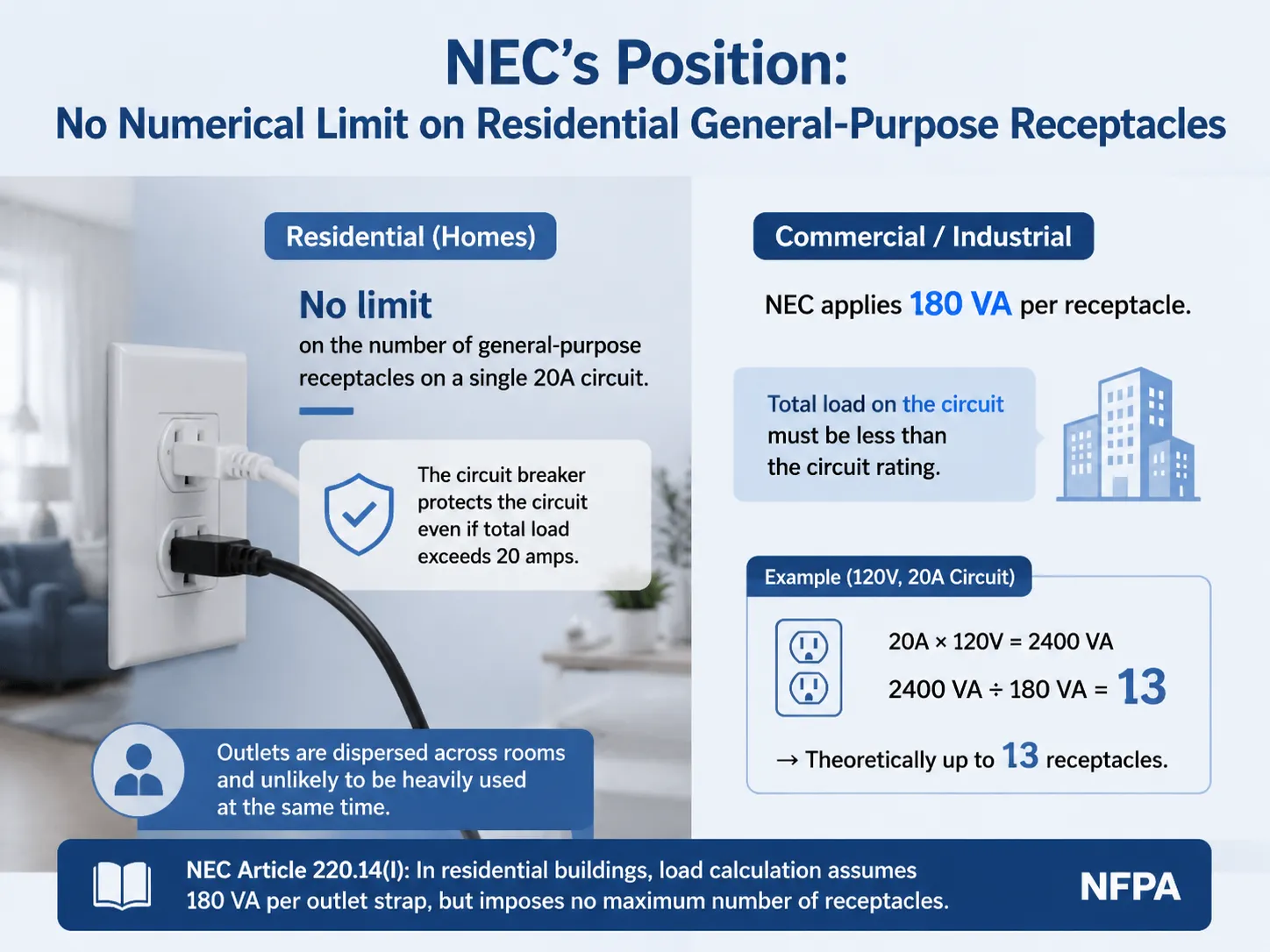
The NEC’s Position: No Numerical Limit on Residential General‑Purpose Receptacles
The National Electrical Code (NEC) issued by the National Fire Protection Association (NFPA) does not state any restriction on the number of receptacles on a single household general-purpose branch circuit. As stated Article 220.14(I), in the case of residential buildings, the number of receptacles is determined using the load calculation method that assumes appliances that each draw 180 volt-amperes per outlet strap but this method does not impose any limitations on the maximum number of appliances that can be connected to a single circuit. It means that in a residential household there could be tens of appliances and even more than that installed on the single 20-amp circuit provided that the wiring is executed correctly and the electrician follows the NEC recommendations and rules.
This does not apply to commercial or industrial installations. For non-residential spaces, NEC has prescribed 180 VA as the rating for each receptacle. The sum of this load in a circuit must be less than the circuit rating. As an example, on a 120 volt circuit providing 20 amps, there can theoretically be 13 receptacles in the system (20×120=2400 VA; 2400/180 = 13). In a household, this rating of 180 VA doesn’t apply. The logic behind it is that in home settings, receptacles are dispersed across rooms and won’t be massively used at once. A person using a vacuum cleaner in their bedroom won’t do whatever else uses heavy electronics on the same circuit. Therefore, the code assumes that the circuit breaker does what it is supposed to do even if the overall load exceeds 20 amps.
The Practical Limit: How Many Outlets Should You Actually Install?
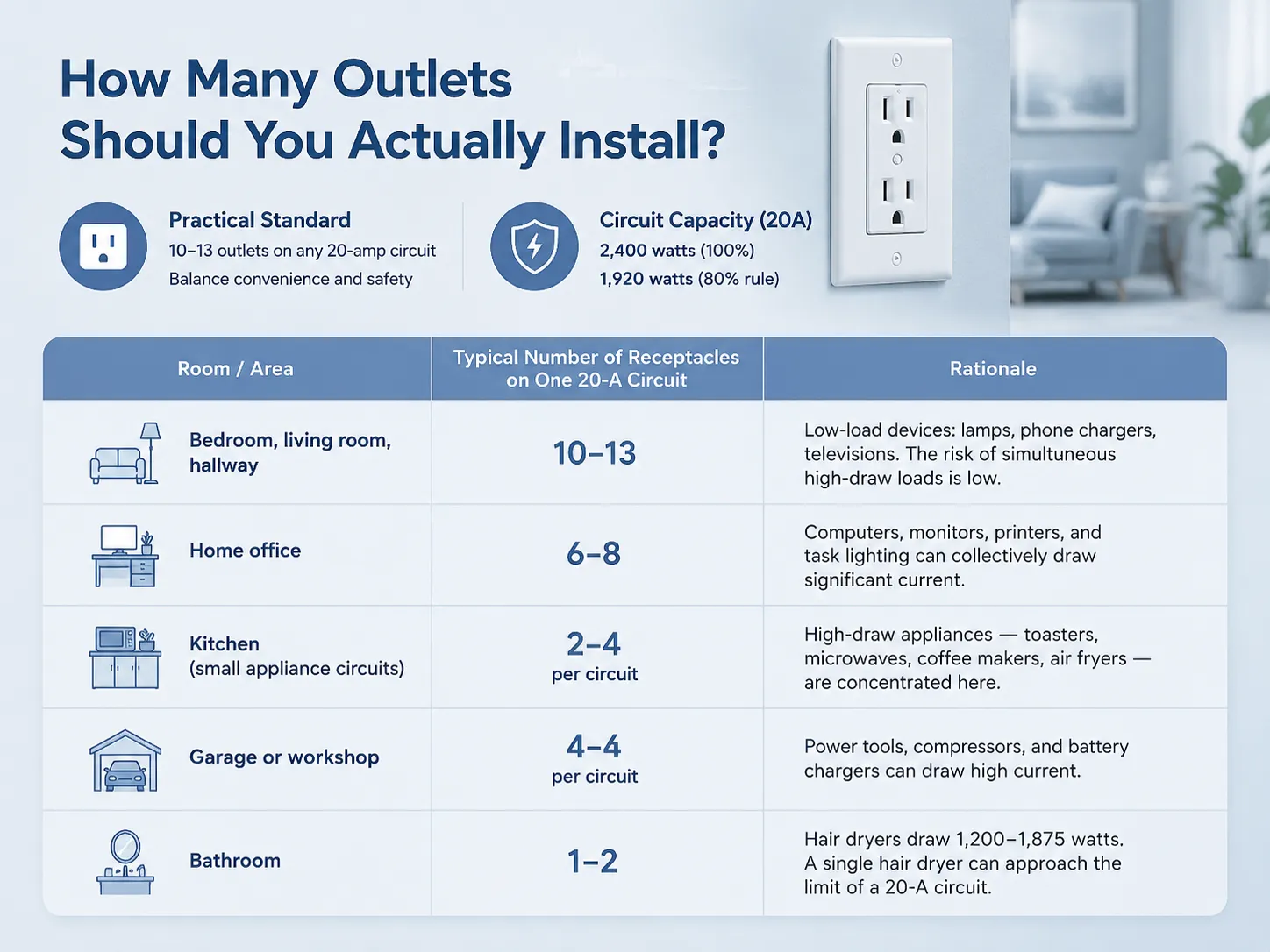
While the electrical code does not specify a limit, there is a practical standard that electricians utilize, which dictates that between 10 and 13 outlets should not be placed on any 20-amp circuit. In this regard, the observation has no legal basis, as it acts as a general principle that balances the need for having sufficiently available outlets with the necessity not to overload the outlet with too many devices. A single 20-amp circuit is capable of delivering the peak amount of 2,400 watts at its best and 1,920 watts when applying to the 80% standard. If the whole circuit uses 150-watt televisions or 100-watt laptop chargers attached to every outlet, many devices can be plugged in. Nevertheless, if one wants to plug in a space heater consuming 1,500 watts, it would take a good share of the circuit’s capacity. If one attempts to connect more than one heater, the device will trip the circuit breaker. The table provided below depicts the actual case of installation of various units in various premises based on typical load.
| Room / Area | Typical Number of Receptacles on One 20‑A Circuit | Rationale |
|---|---|---|
| Bedroom, living room, hallway | 10–13 | Low‑load devices: lamps, phone chargers, televisions. The risk of simultaneous high‑draw loads is low. |
| Home office | 6–8 | Computers, monitors, printers, and task lighting can collectively draw significant current. Fewer outlets reduce the temptation to overload the circuit. |
| Kitchen (small appliance circuits) | 2–4 per circuit (the NEC requires at least two 20‑A small‑appliance circuits in a kitchen) | High‑draw appliances — toasters, microwaves, coffee makers, air fryers — are concentrated here. The NEC requires these circuits to serve only kitchen, pantry, and dining room receptacles, and no other rooms. |
| Garage or workshop | 4–6 per circuit | Power tools, compressors, and battery chargers can draw high current. A single 15‑amp mitre saw on a circuit shared with a freezer can trip the breaker. |
| Bathroom | 1–2 (the NEC requires at least one 20‑A circuit to serve bathroom receptacles, and it can serve multiple bathrooms) | Hair dryers draw 1,200–1,875 watts. A single hair dryer can approach the limit of a 20‑A circuit. |
What Happens When There Are Too Many Outlets on a Circuit
The danger of plugging in too many devices into a 20 amp circuit isn’t the overheating of the wires, since the 20-amp breaker provides sufficient protection to the 12-gauge wires so that the system shuts off when the load exceeds 20 amps. The dangers associated with plugging in too many devices are psychological and operational in nature. One danger is the issue of nuisance tripping. When a tripping circuit breaker causes interruptions due to overloading from too many devices plugged into the same outlet, it creates inconveniences to households, but they get used to the phenomenon and develop either good or negative feelings towards it. T
he second, more important danger is breaker override. A homeowner may ignore the problems caused by overloading the wiring circuit by replacing the circuit breaker with a new one that has more amperage. This situation poses a lot of dangers in the form of an absence of overcurrent protection for wiring circuits and fire hazards as well. The third danger of too many electrical devices being plugged in has to do with the daisy-chain effect. When too many devices are plugged in into one circuit, all the devices lose power at the same time when the circuit breaker trips. As a result of nuisance tripping of one circuit breaker, a person will end up in darkness in the bedroom, hallway, bathroom, and the home office, which can be troublesome for those living with elderly people or children.
The most effective way to minimize the possibility of encountering these risks is to create circuits aimed at defined locations with knowable load profiles instead of using one circuit for all rooms on a single floor. The NEC requires using small appliance circuits for kitchen use. On top of that, specifications require using 20 Amp dedicated circuits for home offices and other creative workshops where high-consuming appliances are used. Our guide on how many watts an outlet can handle provides the wattage benchmarks for common household devices, allowing you to estimate the load on any given circuit before the first device is plugged in.
Can You Put 15‑Amp Outlets on a 20‑Amp Circuit?
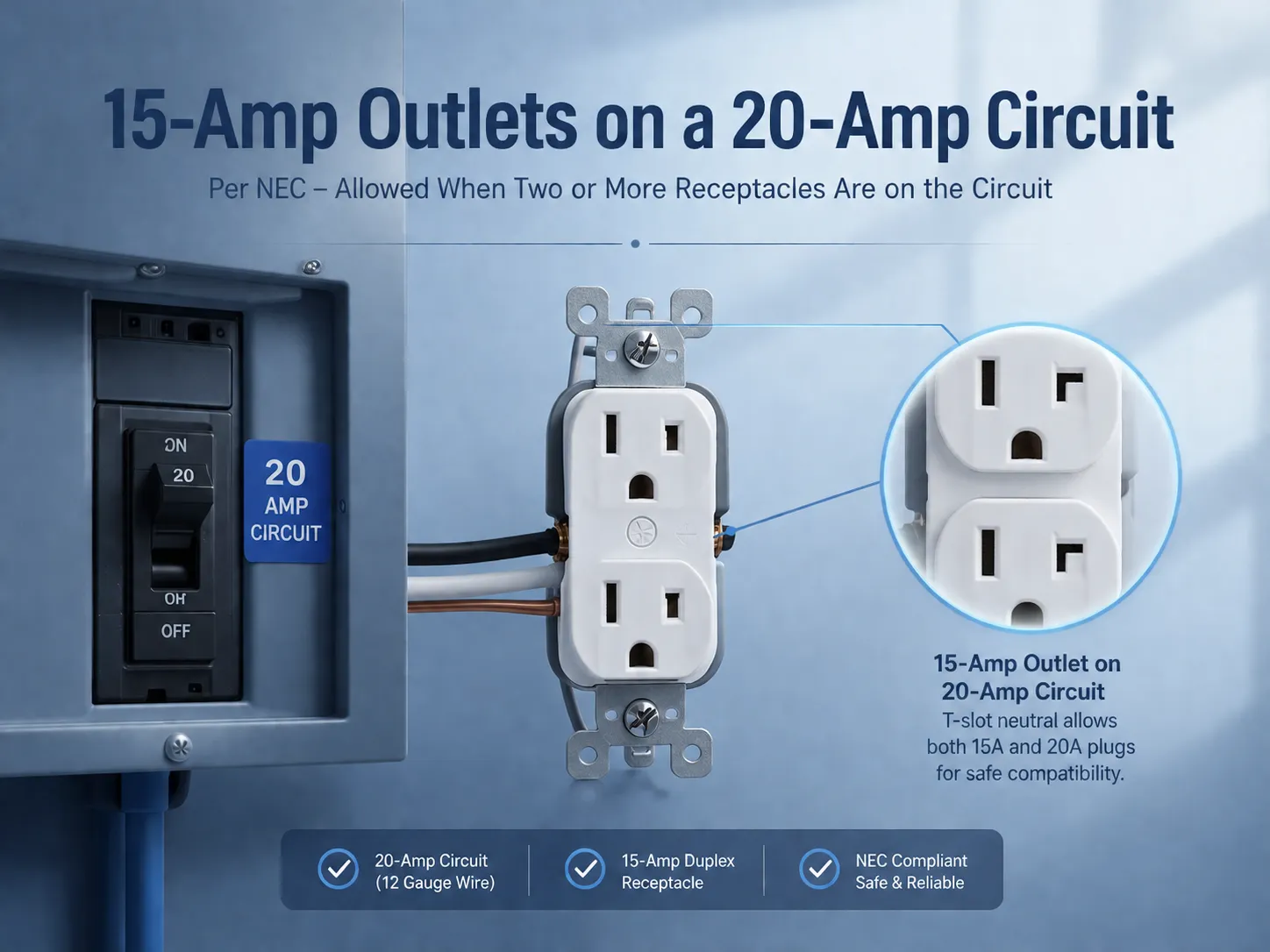
Yes. According to NEC, receptacles with an amp of 15 are allowed in a circuit with an amp of 20 provided that there are two or more receptacles in a circuit. On the other hand, for a standalone receptacle equipped on a separate branch circuit with an amp of 20, the receptacle should have an amp of 20 too. However, with a duplex receptacle that counts as two separate receptacles in a 20 amp circuit, it becomes perfectly legal to install a 15 amp inlet on a 20 amp circuit. It is one of the most widely used options around residential electrical installations: 20-amp circuits in restrooms and kitchens protected with circuit breakers that are equipped with wires of gauge of 12, and regular tamper-resistant duplex receptacles with an amp of 15 being used in the entire house. It is important to note that the 15 amp inlet it created in such a way that it can accommodate both 20 and 15 amp plugs as indicated by the specific positioning of the neutral opening on a receptacle having an amp of 20. At the same time, GOG Electric builds this inlet to withstand the full power of the created circuit of 20 amps.
Lights and Outlets on the Same Circuit: Is It Allowed?
In residential wiring, the National Electrical Code (NEC) does allow for the wiring of both electrical devices and lighting to belong to the same circuit. This practice is often used in bedrooms and living rooms, where lighting and electrical devices operate on the same 20-amp breaker. The rationale is that the lighting in contemporary homes is relatively low. For example, a room with LED lights will, at most, consume 100 watts of power. Thus it makes more sense from a loading perspective to utilize the circuit primarily for electrical devices. When it comes to commercial applications, electrical devices and lighting are typically wired separately so that when the circuit for devices fails, the lights can still operate. However, this issue is less relevant for general domestic applications. Nevertheless, it would still be good practice to keep the different circuits separate even when applying to domestic areas that are important, like home offices, bathrooms, etc. If you are installing the circuit yourself and must choose between either using the same circuit for devices and lighting or creating a completely separate circuit for lighting, the latter option will prove to be the better one. However, creating a separate circuit is not a mandatory requirement according to the code for residential applications.
Frequently Asked Questions
What is the 2 6 12 rule for outlets?
According to NEC 210.52, the 2-6-12 rule outlines the regulation on receptacle outlets in homes. The rule states that there must be a receptacle in any wall that is over 2 ft. wide. Furthermore, there may not be any point on any wall that is over 6 ft. away from a receptacle. The last part of the rule states that two receptacles should not be farther than 12 ft. apart.
Is it okay to put lights and outlets on the same circuit?
In home electrical installations, computers and power points can be on the same circuit. It is common to find wiring of this sort in bedrooms or living rooms. For some critical areas such as workshops, home offices, and bathrooms, the lighting circuit must be different from the receptacle circuit. Therefore, if the circuit trips, the room does not stay dark. Generally, for commercial installations, the usage of separate lighting and receptacle circuits is obligatory.
How many sockets can I run off a 20 amp breaker?
There are no numerical limits as required by codes in a residential installation. However, in practice, the number of duplex receptacles in a 20-amp circuit can range from 10 to 13. In a commercial installation, there is a maximum of 13 receptacles based on 180 VA per receptacle. Indeed, the true limitation will not be the number of receptacles, but the overall load — for example, a single heater could take more than 50% load from a 20-amp circuit.
References
- NFPA 70 (National Electrical Code) — Articles 210 and 220. Requirements for branch circuits, receptacle spacing, and load calculations in residential and commercial occupancies. National Fire Protection Association.
- Electrical Safety Foundation International (ESFI) — Home Electrical Safety. Consumer guidance on circuit loading, breaker sizing, and safe receptacle installation practices.
- Leviton — Residential Receptacles and Circuit Design. Manufacturer guidance on receptacle selection, 15‑amp vs. 20‑amp receptacles, and branch circuit design.
- Family Handyman — How Many Outlets on a Circuit?. Practical homeowner guidance on circuit planning, receptacle counts, and the NEC’s spacing and load requirements.
The question how many outlets on a 20 amp circuit has a code answer — no numerical limit for residential general‑purpose circuits — and a practical answer: enough to serve the room, but not so many that the circuit becomes a nuisance or a hazard. A 20‑amp circuit in a bedroom can comfortably serve ten or twelve receptacles. The same circuit in a kitchen, serving countertop appliances, should serve only the kitchen and should be one of at least two such circuits required by code. The key is not the number of receptacles on the wall but the total load they will carry. Match the circuit to the expected demand, use the correct breaker and wire gauge, and respect the 80% continuous‑load rule, and the breaker will stay on and the wires will stay cool. GOG Electric manufactures the tamper‑resistant, code‑compliant receptacles that fill those circuits, with the internal robustness and terminal clarity that a 20‑amp circuit demands.