When a homeowner from Leeds unscrewed her old twoway switch in order to put a new dimmer switch in its place, she encountered three connections labelled COM, L1 and L2. The L1 and L2 connections were easy to figure out — the two traveller wires were obviously connected to them. The COM connection was, however, more difficult to understand, since this one has only one screw, which is a dark colored one, with one red wire connected to it. Is it live? Is it neutral? What does it mean in this case? The answer is that the home owner was right to feel confused — the fact is that the common connection point is actually the most important connection by all means, since any mistake in it may lead to the circuit stopping functioning or even to electric shock.
What the Common Terminal Actually Is and What It Does
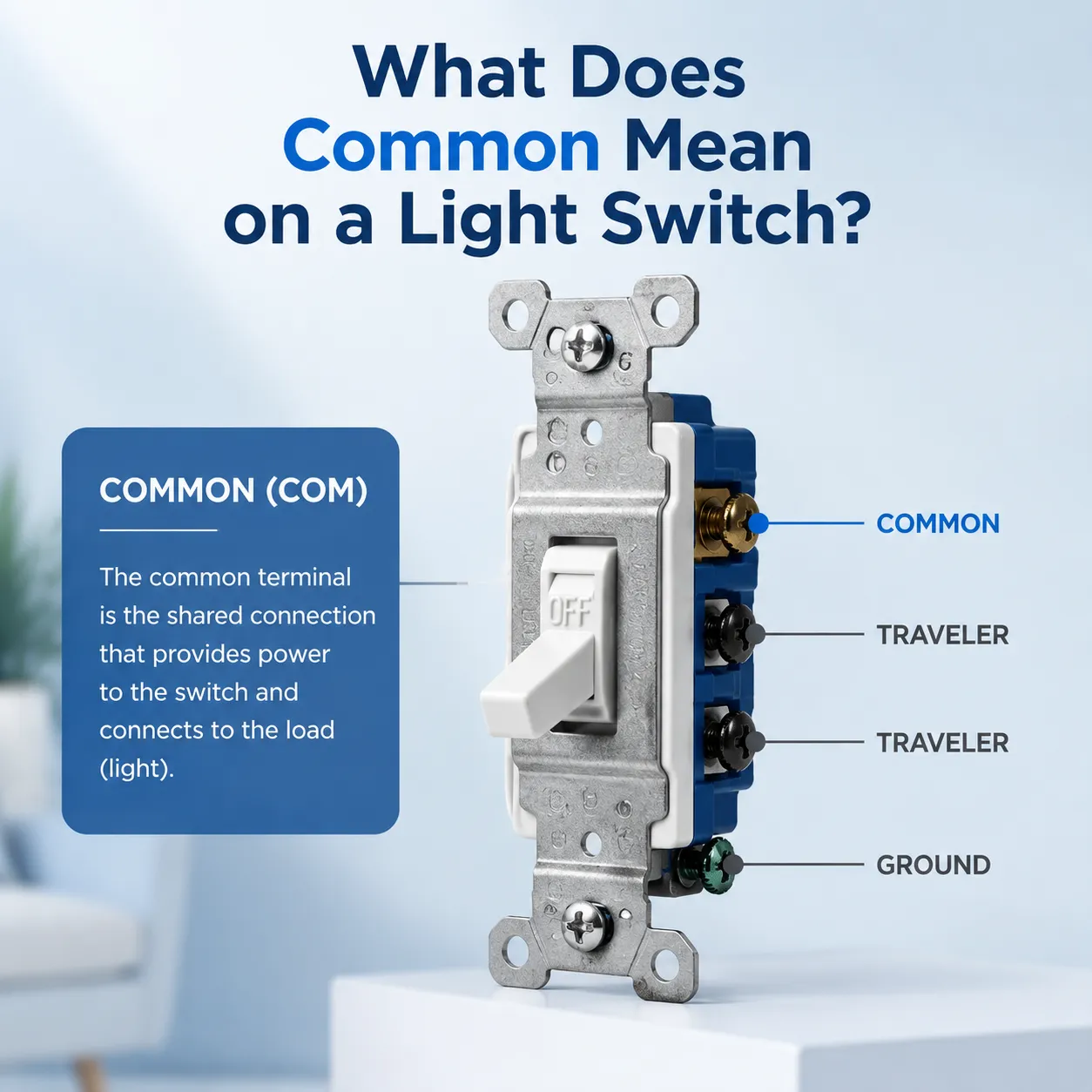
The common terminal of a light switch (the terminal labeled as COM in UK and IEC light switches and the screw with black color in North American light switches) is the place of entry or exit, i.e., the terminal where current flows in or out of the mechanism of the internal system of the switch. The common terminal acts as the “hinge” of the switch i.e., one position connects the common to one of the traveler terminals and the other position connects it with other traveler terminal. It can either act as incoming live current wire or outgoing live current cable depending on the place of the switch in the circuit.
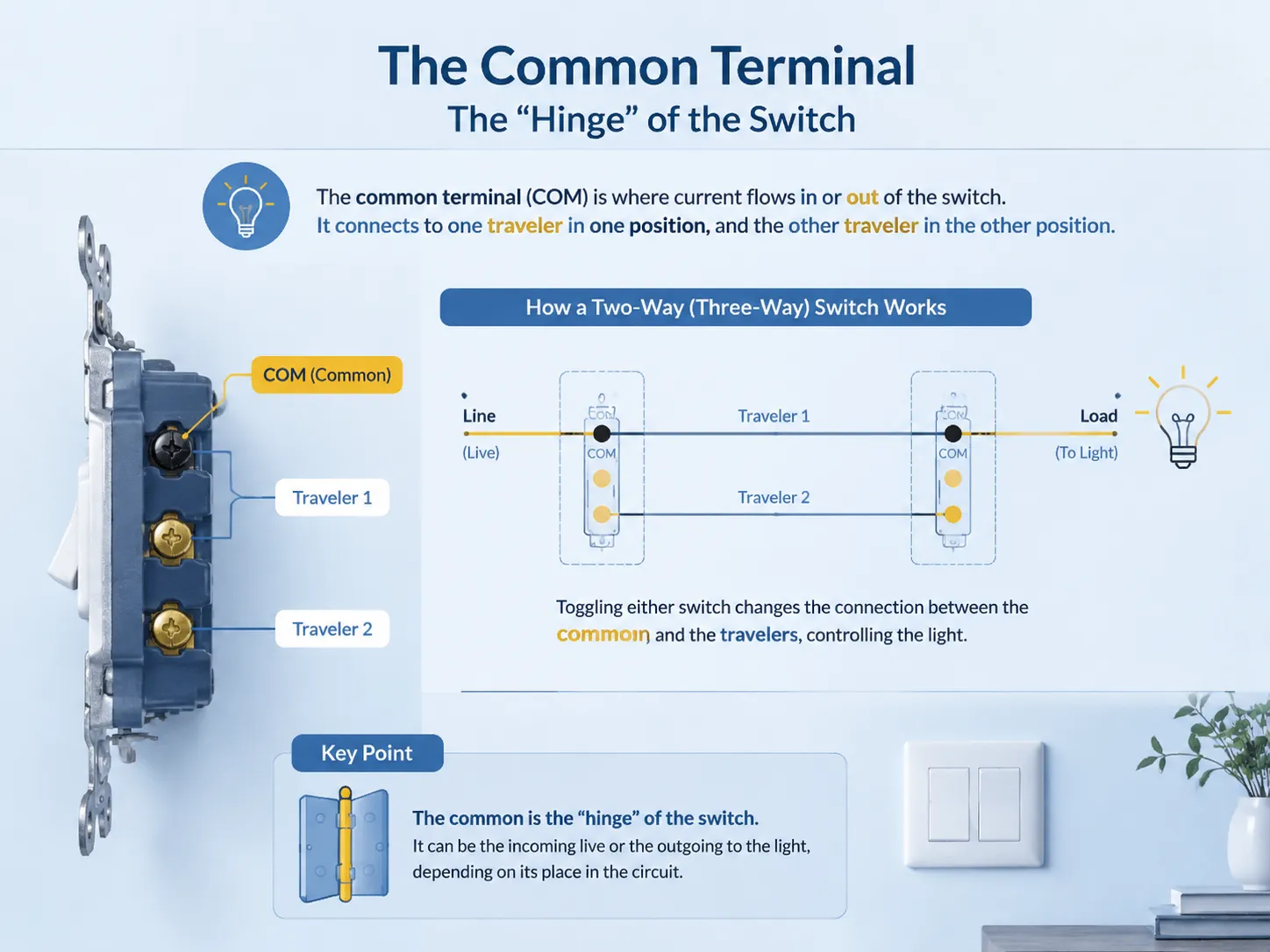
The term “common” can be misunderstood. It does not mean “shared” in the sense of neutral or ground that many circuits can use. In fact it means that common takes in the supply and connects the switch to the two different traveller terminals on the switch. In other words, in the two-way switch circuit (the three-way switch circuit in North America) the incoming live connects to one switch’s common while the other switch’s common connects to the fixture. The two traveller terminals on each switch are interconnected with traveller wires which run from one switch to the other. Any switch being toggled changes the connection between the traveller and the common. Understanding this internal mechanism is the key to diagnosing every miswired multi‑way switch. Our guide on the difference between a 2 way and 3 way switch explains the wiring logic and the terminal identification for both UK and North American configurations.
How the Common Terminal Differs Across Switch Types
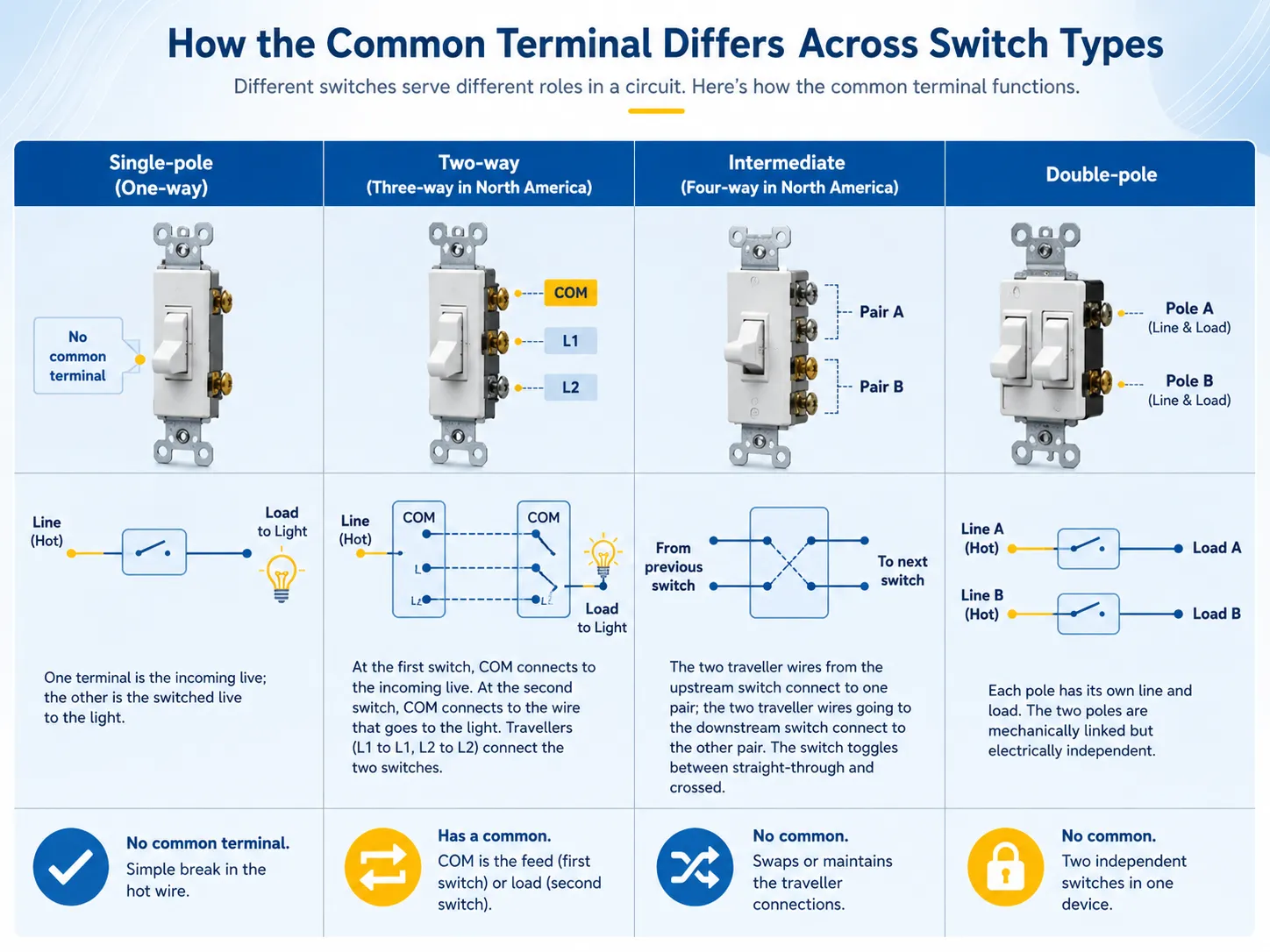
Not every light switch has a common terminal, and the role of the common changes depending on the switch type and its position in the circuit. The table below summarises how the common terminal functions across the most common residential switch configurations.
| Switch Type | Has a Common Terminal? | What the Common Connects To |
|---|---|---|
| Single‑pole (one‑way) switch | No — a standard one‑way switch has only two terminals, both brass. There is no COM marking because there is no traveller circuit. | One terminal is the incoming live; the other is the switched live to the light. Neither is labelled “common” because the switch is a simple break in the hot wire. The two terminals are electrically interchangeable — it does not matter which wire goes to which terminal. |
| Two‑way (three‑way in North America) switch | Yes — three terminals: COM, L1, and L2 (UK); or Common, Traveller 1, and Traveller 2 (North America). | At the first switch in the circuit, COM connects to the incoming live. At the second switch, COM connects to the wire that goes to the light. The traveller wires connect L1 to L1 and L2 to L2 between the two switches. |
| Intermediate (four‑way in North America) switch | No — an intermediate switch has four terminals, arranged in two pairs. It sits between two two‑way switches and simply crosses or uncrosses the traveller wires. There is no “common” because the switch does not connect to a single feed or load. | The two traveller wires from the upstream two‑way switch connect to one pair of terminals; the two traveller wires going to the downstream two‑way switch connect to the other pair. The switch toggles between a straight‑through and a crossed connection. |
| Double‑pole switch | No — a double‑pole switch has four terminals, arranged as two independent pairs. It is essentially two single‑pole switches operated by a single toggle. There is no “common” because each pole controls a separate circuit. | Each pole has its own pair of terminals — line and load. The two poles are mechanically linked but electrically independent. Used for 240‑volt appliances or for circuits requiring full isolation. |
Is the Common Wire Live or Neutral? (And Why It Is Never a Ground)
The common wire found in a light switch will always carry current; either incoming live or electrical being passed on. A key point to consider when wiring switches is that the common wire does not carry any neutral current – neither does it carry any earth/ground connection. Correctly wired circuits allow the neutral wire to bypass the switches altogether so that it goes from the consumer unit to the fitting without any switch terminal remaining connected to it. The common terminal is always live and at voltage i.e. either 120 volts (in North America) or 230 volts (in UK). If you need to understand the full colour‑code context for every wire in a switch box, our article on the colours of electric wires in the UK explains the harmonised brown‑and‑blue standard and the older red‑and‑black system that still exists in many homes. Many people misunderstand the common as being a negative wire. In alternating current (AC) wires, there is no constant positive or negative because the current flips direction constantly: 50-60 times every second. The common is simply an ungrounded wire controlled by the switch, meaning that common is not neutral. Fixing a neutral wire to a common terminal would cause a short circuit or ground fault. Connecting an earth wire to a common terminal would make the whole grounding system live. Common terminal is often confused with common bus of switch ge =315;nes. They have similar names but do different things in the electrical system. The common terminal is an actively live point, while the common bus is doing a neutral return function. Common terminal and common bus must not be connected except in the main panel.
How to Identify the Common Terminal When Replacing a Switch
One of the most significant steps in removing an old light switch and installing a new one is knowing which terminal is common, especially when it comes to a two-way switch, where the problem of misconnecting a common terminal with a traveler is one of the most common reasons for circuit failure. The common terminal can be identified visually or by touch. On a UK two-way switch, it is usually marked “COM” and located at the top or bottom of the switch, so you can easily tell it apart from the other two terminals used for the travelers. In North America, the common terminal is usually indicated by a darker screw — black or dark brass, while the travelers are lighter in color. In some cases, it may be indicated at the bottom of the switch with the word “COMMON” stamped on the metal strap. If the switch is a smart switch or a dimmer, it would normally be indicated by a lead wire instead of a screw. Keep in mind that before making any disconnections or connections, you should take a picture of how the wires are connected and make a note of which wire is connected to COM. If you are replacing a switch and the old device is not labelled, our article on the four types of light switches explains how to identify the switch type and the terminal functions based on the number of terminals and their positions.
Frequently Asked Questions
Which wire goes into the common?
It may be either the live wire or the switched live when it comes to the wire that is connected with the common terminal. In the first switch, the live wire connects to the common terminal. The live wire from the switch gets connected to the common terminal when it is the second switch. It is better to check the live wire with the help of a non contact voltage tester before proceeding with any connections.
What is L1, L2, and common on a light switch?
The COM (common) terminal of a UK two-way light switch connects either to the incoming live wire or the switched live wire. The L1 and L2 terminals of the switch are referred to as the two traveller terminals. When the switch is flipped, this results in changing the connection of the COM terminal between L1 and L2 accordingly. Switching between the two puts the traveller circuit in a different configuration to switch the light ON or OFF.
Does common wire mean negative?
No. In an AC lighting circuit, there is no positive or negative wire. The common wire on a switch is a current‑carrying conductor at line voltage. It is either the live feed or the switched live, but never the neutral, ground, or negative wire. The term “common” is only about its functions, not about its polarity.
Can a ground wire be a common wire?
No way. A ground wire (to earth) must never be connected to the common terminal of a switch. The ground is a safety wire that carries earth fault current only. To connect it to the common would create the risk that the entire grounding system of the building would be at line voltage when the switch is switched on — a serious risk of electric shock. The ground connects only to the green ground screw of the switch or to the metallic back box. The common connects only to the live conductor.
References
- Leviton — Residential Light Switch Installation Guides. Manufacturer wiring diagrams and terminal identification guidance for single‑pole, three‑way, and four‑way switches in the North American market.
- BS 7671 — Requirements for Electrical Installations (IET Wiring Regulations). The UK national standard governing the installation of wiring devices, including terminal identification for one‑way, two‑way, and intermediate switches.
- Family Handyman — How to Identify the Common Terminal on a Light Switch. Practical homeowner guidance on identifying COM, L1, L2, and traveller terminals with a multimeter and a non‑contact voltage tester.
- Eaton — Wiring Device Terminal Markings and Standards. Manufacturer information on the standardised marking of COM, L1, L2, and traveller terminals across UK and North American switch families.
The common terminal on a light switch is the single point that connects the switch mechanism to the rest of the circuit — the incoming live at one end of a two‑way switching pair, and the switched live to the light at the other. The switch always consists of a live conductor, a neutral not being present, and it is essential to be able to identify the kind of terminal before making any changes to the switch. In the case of an ordinary single switch there is no common terminal, simply two brass screws that can be switched. In case of a double switch the COM terminal may have a different colour or be labelled. You must take a picture of old wiring and see where the wires were connected in a new switch. GOG Electric makes switches that are labelled COM, L1, L2 and earth.