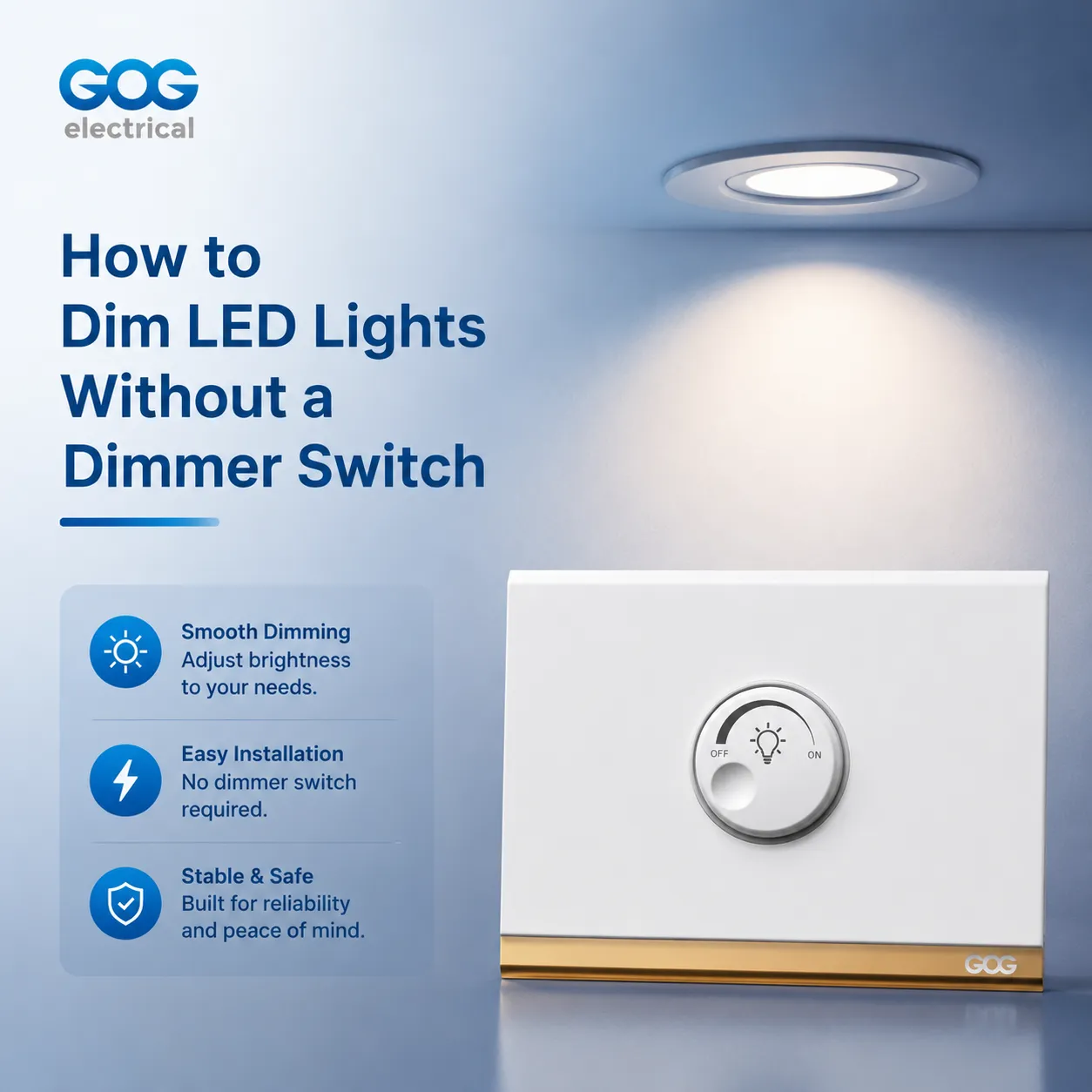
When a tenant in an apartment with no dimmer switch found herself with a bright overhead LED in her living room her first thought was to slightly unscrew the bulb, an old trick back from the days of incandescent lights. Unfortunately, this did not work as she could not successfully dim the LED bulb. She was at a dead end as her landlord did not permit any changes to the electrical wiring and continued to suffer from a bright white light in her house. The above situation is faced by millions of people where their residences have fixed electrical circuits that do not support dimmer switches and the new LED lights replace the outdated incandescent bulbs. However, it is still possible to dim the LED lights without having a dimmer switch. There exist several approaches, each having its own advantages, limitations and safety aspects that can be used instead. The guide below will cover technologies starting from the simplest smart light bulb replacement to much more complex electric work.
Method 1: Smart LED Bulbs — The Simplest, Safest Upgrade
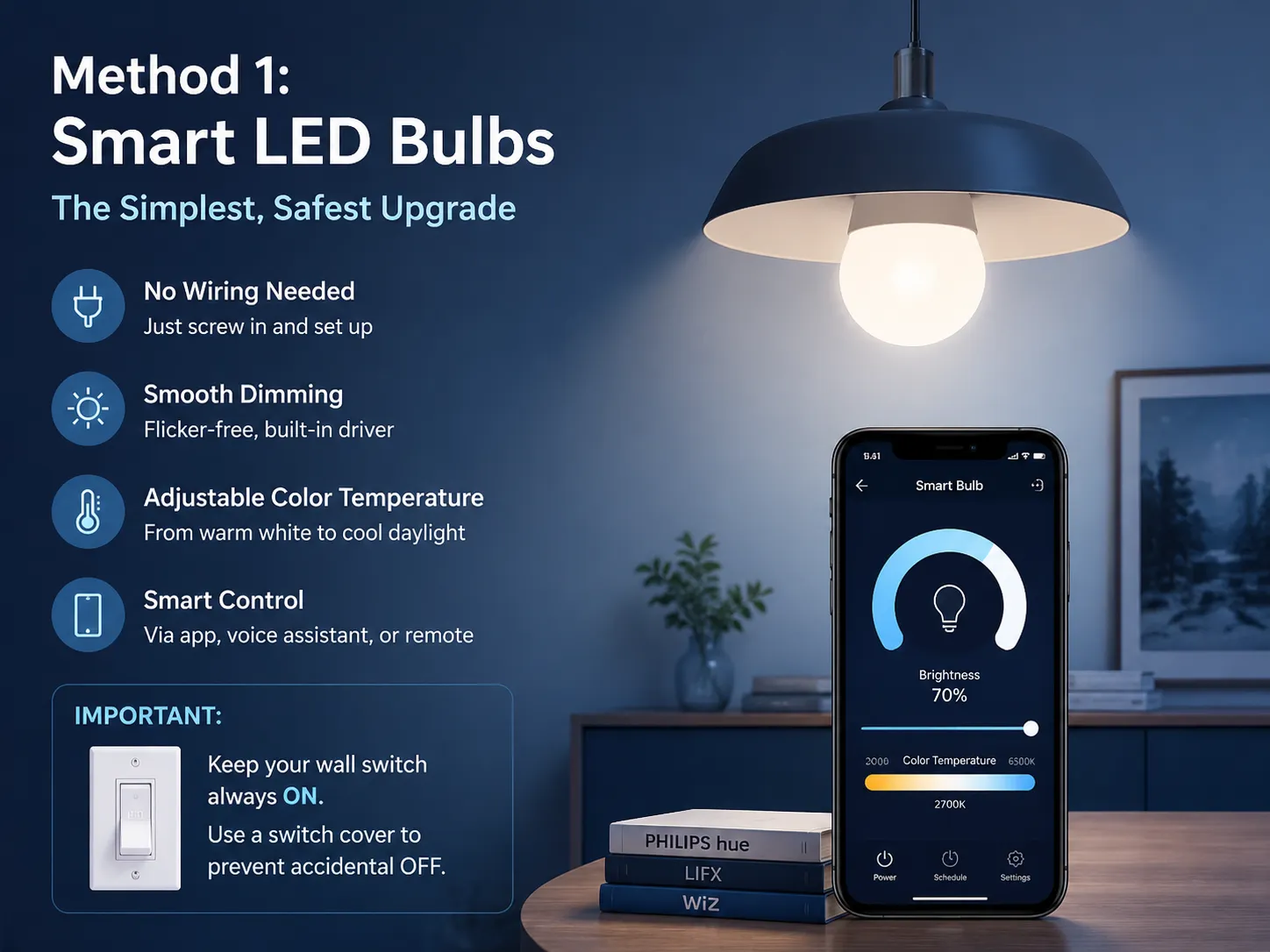
If you wish to dim an LED light without investing in a wall dimmer, consider switching the traditional bulb for a smart LED light bulb. The smart bulb has its own in-built dimming device and is regulated through wireless technology, such as Wi-Fi, Zigbee, Bluetooth, or Z-Wave, via a dedicated application on the phone, a voice assistant, or a remote. The wall light switch will be left in constant ON mode, allowing the LED light to process dimming and switching while regulating its color temperature. The method does not necessitate any electrical jobs, and it can be used in rented apartments, as well as historical houses where wiring alterations are prohibited.
The benefits of smart bulbs start right away: putting them in place means inserting the bulb and paring it with an app. Dimming with smart bulbs is smooth and flicker-free, as the driver of the bulb was developed to do just that. Many smart bulbs give you the opportunity to change the colour temperature of the light, moving the light from warm white to cool daylight. The drawbacks are the cost per bulb ($15 – $40, which is higher than traditional dimmable LED bulbs) and the necessity to keep the wall switch always ON. In case the wall switch is turned off by a family member, guest, or cleaner, the bulb will disconnect from the network and will be unable to perform its functions as a smart bulb until the wall switch is turned on again. A simple solution that helps avoid possible problems with Smart bulbs is to install a switch cover that prevents switching the wall switch into the OFF position accidentally. Leading smart bulb manufacturers include Philips Hue, LIFX, and WiZ, all of which offer full dimming control and wide compatibility with smart home platforms.
Method 2: Smart Plugs and Inline Dimming Modules
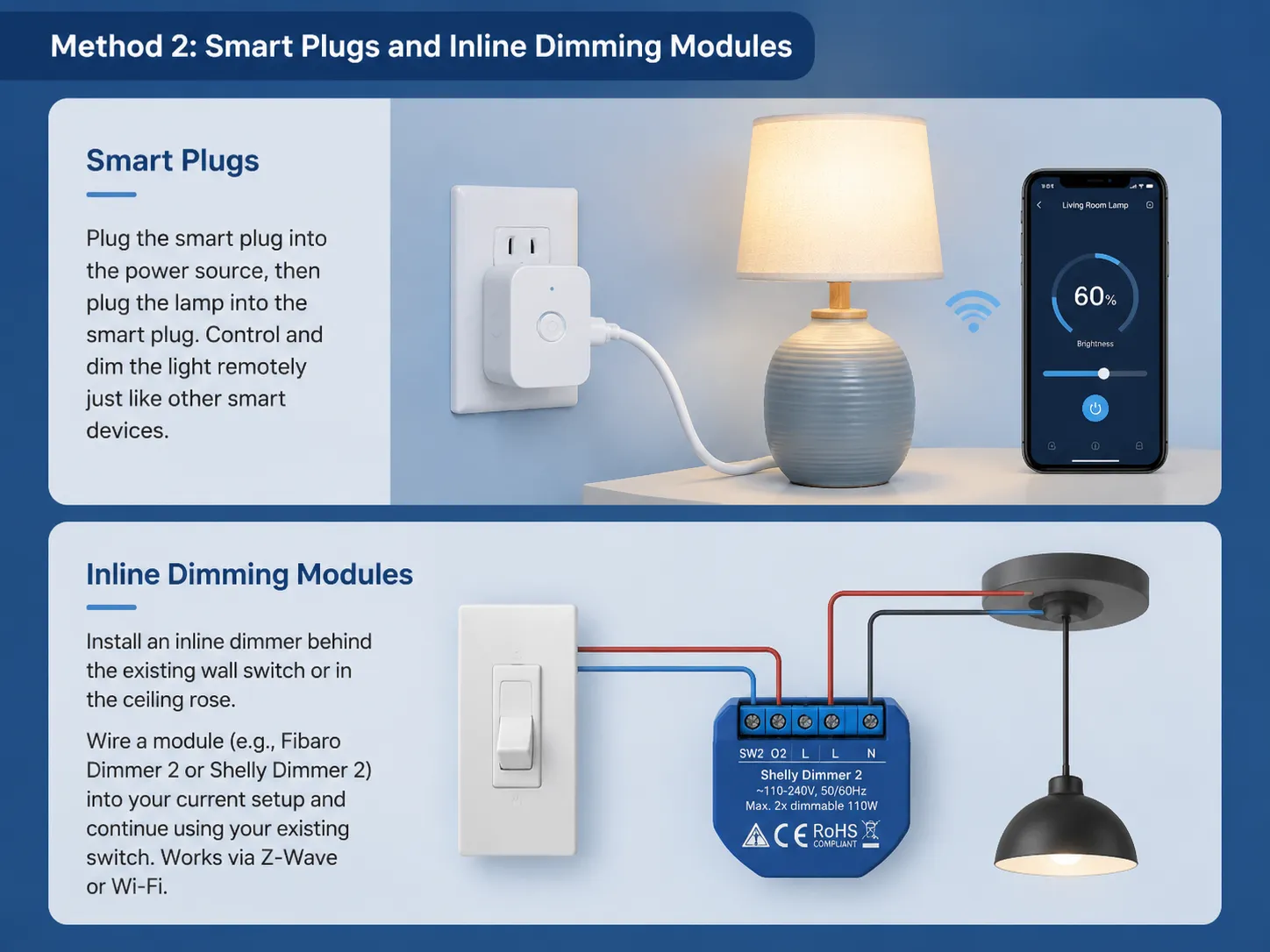
When attempting to transform the brightness of a lamp with a light-emitting diode, consider using a smart plug. A smart plug is similar to a smart device in that it allows one to control the lamp from afar. To use the smart plug, simply plug it into the power source and then plug the lamp into the smart plug. This technology is equally as effective as using a regular smart device.
If you’re utilizing hardwired lights, you can install an inline dimming device behind the existing wall switch or in the ceiling rose. To do this, you can use a small electrical device such as Fibaro Dimmer 2 or Shelly Dimmer 2 and wire it into the current setup while still using your previous light switch. However, the installation requires you to do some work inside the electrical box while ensuring that the power is switched off, so this process is fit for someone who has basic knowledge of DIY projects. The dimmer works by means of Z-Wave or Wi-Fi and allows having the switch to continue running.
Method 3: Physical Light Reduction — Filters, Shades, and Diffusers
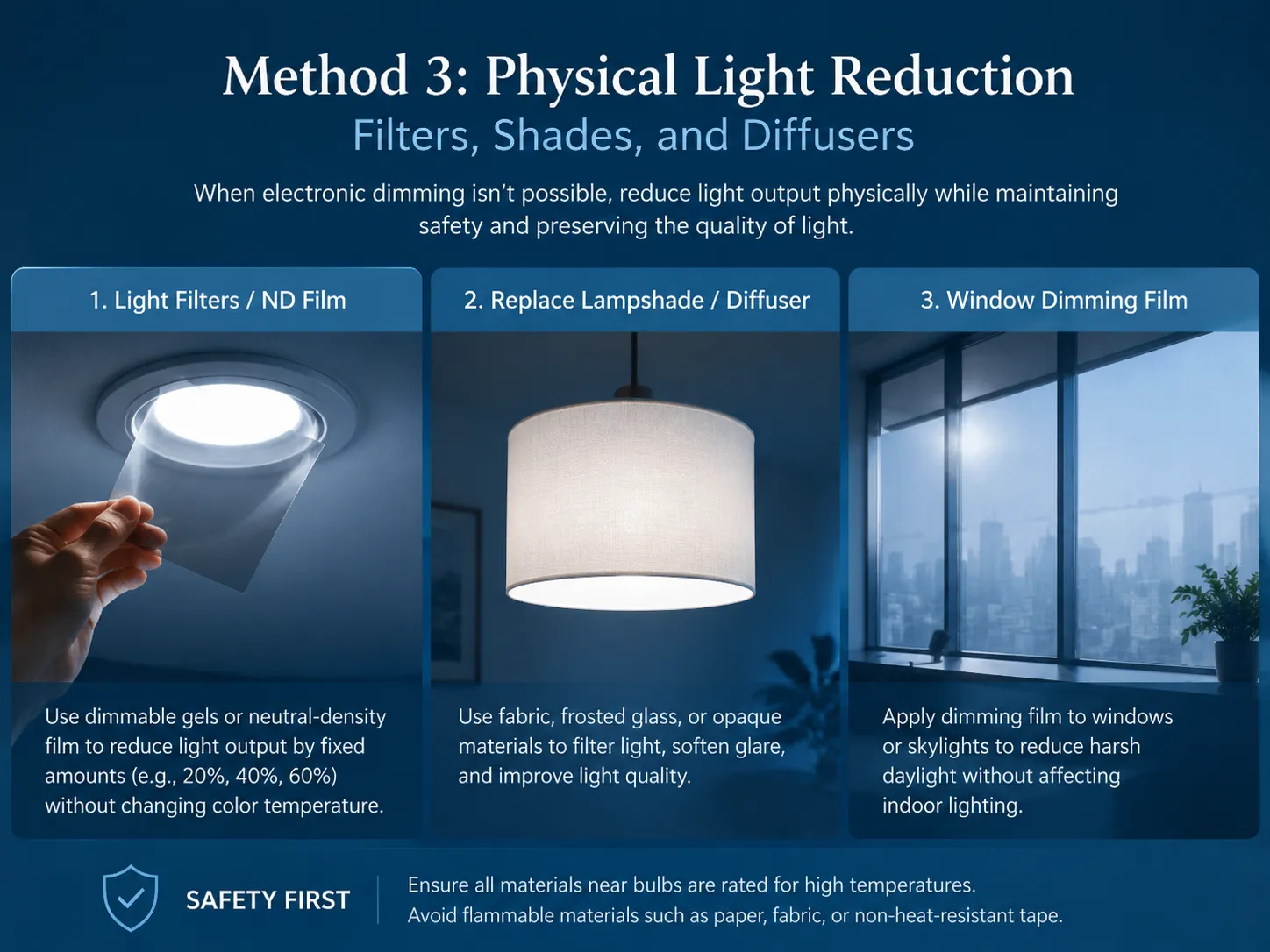
If controlling the appliance through electronic means is infeasible — there’s no funding available, the fixture is unreachable, or the bulb cannot be taken out — then an alternative approach to light reduction should be employed to achieve reduction in the light output. The term ‘dimming’ would not be accurate because the bulb continues to consume the power. However, light going to the room can be diminished through the use of barriers and diffusers. The most widely used techniques to do this are:
- Dimmable lighting gels or neutral‑density film. These sheets are made of lightweight material resistant to heat. They can be cut to size and placed over the bulb or inside the fixture. They work the same as filters, producing fixed amounts of light, such as 20%, 40%, and 60%, without changing the temperature of light. The material is widely used in the theatre and photography, and can be bought from companies that are professionals in lighting.
- Replacing the lampshade or diffuser. A light filtering device created from fabric, frosted glass, or an opaque medium minimizes the output of light and modifies its quality. This is the easiest solution, as no electrical knowledge is needed.
- Applying a dimming film to a window or skylight. When the bright sunlight is coming through the window, solar-control glass allows to minimize its concentration without interfering with the work of the room’s artificial lights.
These techniques are completely safe if anything that is kept in proximity to or on top of the bulb has a rating that corresponds to the bulb’s working temperature. Even though LED bulbs run at a lower temperature than incandescent light bulbs, they still generate heat at the base and driver. A material that is able to block light will also accumulate heat. Plus, any material that can catch fire, such as paper, fabric, or even adhesive tape that is not meant for high temperatures can start burning. The Electrical Safety Foundation International (ESFI) provides guidance on safe practices when modifying or covering light fixtures.
Method 4: Replace the Bulb with a Lower‑Lumen or Warm‑Dim LED
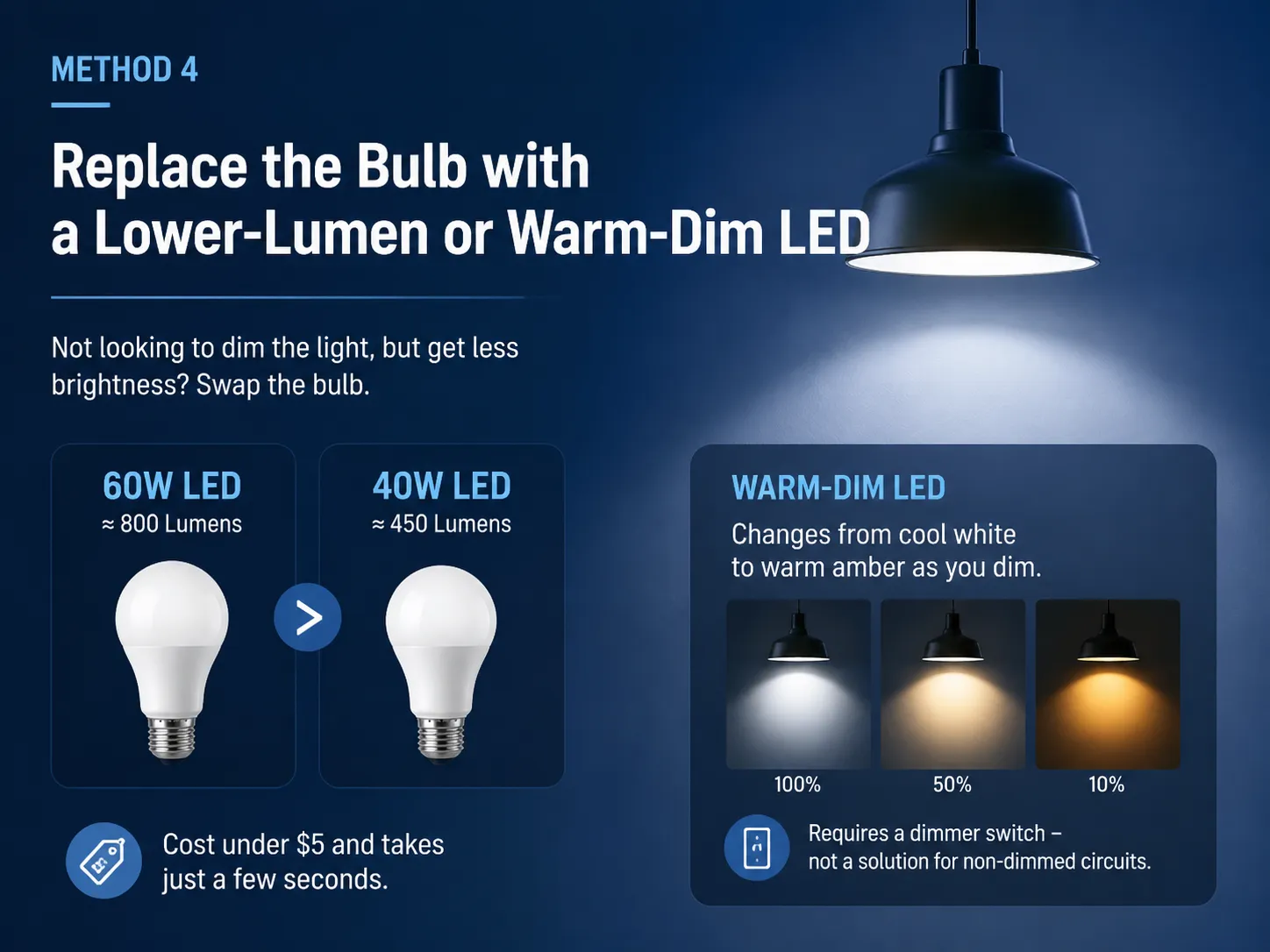
At times, the objective isn’t necessarily the dimming of a light, but rather obtaining a lower illumination. In this situation, it is best to change the light source by installing a low lumen LED bulb. A bulb that emits 60 watts equates to approximately 800 lumens. However, the 40-watt bulb produces only 450 lumens. Thus, it is clear that changing an LED bulb will cost under $5 and take a few seconds, which is the best solution in this case.
A warm-dim LED is another alternative — a special light bulb that changes its color temperature from cool white to warm amber when dimmed. These types of bulbs need a physical dimmer switch to operate, so they do not provide a solution for a non-dimmed circuit, but if you’ve got a dimming circuit and wish to get the warm glow effect, they are the correct bulb choice. Our guide on LED dimmer switch compatibility explains how to match bulbs and dimmers for flicker‑free, reliable dimming when you do have a dimmer on the wall.
What About the Non‑Dimmable LED Already Installed?
An LED bulb remains dimmable provided that the bulb is compatible with the electric dimming method applied to the bulb, whether through a wall dimmer, a smart plug, or any resistor in series. This dimmable ability comes from the definition of the LED bulb as the electrical components used maintain constant brightness. Any reduction in brightness causes the electric drive in the bulb to draw greater power. This causes the LED bulb to flicker and overheat, causing the drive to be damaged or to fail completely. Thus, one has to replace the existing bulb with a dimmable type bulb. This must be noted as the requirement of safety rather than performance. The packaging of the bulb must indicate this.
Frequently Asked Questions
Can I dim LED lights without a dimmer?
The best techniques are to switch your ordinary bulb to a smart LED that dims through an app, use a smart plug with dimming capabilities for table lamps, or put an inline dimming module behind your existing switch. Although it does not eliminate light electronically, physical light reduction via films, shades, or diffusers can help decrease light intensity.
What can I use to dim LED lights?
You may use a smart LED bulb, a smart dimmable plug, a z-wave or Wi-Fi inline dimmer module, or heat-resistant lighting gel/neural density film for a fixed decrease in brightness depending on whether your fixture is hardwired or plug-in, whether or not you’re able to change the wiring, and your budget.
What happens if you try to dim a non-dimmable LED?
When a non-dimmable type of LED is attached to a dimming device or circuit, it may flicker vibrate or become too hot. The bulb’s internal driver works at a constant voltage, and it cannot manage the lowering in energy level effectively. It is possible that the bulb has failed ahead of its time, and the overheating driver might even lead to a fire hazard. The only LEDs that may be used with any means of dimming are dimmable ones.
How can I make an LED light less bright?
You could either change the light bulb to a low-lumen-type LED, replace it with a smart bulb so that you can control it from your app, use a heat-resistant lighting gel or a thicker lampshade to decrease the amount of light that gets emitted by the lamp, or put in an inline dimming device if the wiring allows it. The easiest and fastest no-cost solution is to alter the lampshade or cover the chandelier in a temporary film.
References
- Philips Hue — Smart LED Bulbs and Dimming Control. Manufacturer of smart bulbs with built‑in dimming, controllable via app, voice, and wireless accessories.
- Shelly — Inline Dimmer Modules for Smart Lighting Control. Manufacturer of Wi‑Fi‑controlled inline dimming modules that retrofit behind existing wall switches.
- Fibaro — Z‑Wave Dimmer Modules. Manufacturer of Z‑Wave dimming modules for two‑wire and three‑wire installations, compatible with smart home hubs.
- Electrical Safety Foundation International (ESFI) — Home Electrical Safety. Guidance on safe use and modification of lighting fixtures and electrical devices.
Dimming LED lights without a dimmer switch is a matter of choosing the right alternative for your specific light fixture, your wiring, and your budget. A smart bulb is the simplest path for a single light and requires no tools. A smart plug handles a plug‑in lamp. An inline dimming module behind the switch provides the functionality of a built‑in dimmer without changing the wall plate. And a physical filter or a lower‑lumen bulb solves the problem at zero cost when all you need is less light, not adjustable light. Whatever method you choose, the first check is always the same: confirm that the bulb is dimmable, or use a smart bulb that brings its own dimming capability — because a non‑dimmable LED on a dimmed circuit is a fire waiting to happen. GOG Electric manufactures LED‑compatible dimmer switches and smart lighting controls for when you are ready to install a permanent dimming solution, but for the home where a dimmer is not an option, the methods in this guide will give you control over your light without touching a wire.