When an office manager working at a Bristol office building was tasked with minimizing energy usage by 20% without substituting any lamps, the answer was not to install dimmer switches on the walls. The answer was the tiny yet unnoticed module carefully placed in the electrical room. The module is a lighting control unit connected to a number of sensors including occupancy and daylight harvesters. The control unit is designed to switch lights off in a room if it is not occupied, adjust levels of light from the lamps according to the conditions outside the building, and control the lighting zones in the building. The use of this single control unit enabled the office building to reach its target during the first three months. Understanding the technology of the lighting control unit and its distinctions from the standard wall switches and dimmers is the key to achieving intelligent and efficient lighting in a building.
What a Lighting Control Module Actually Is
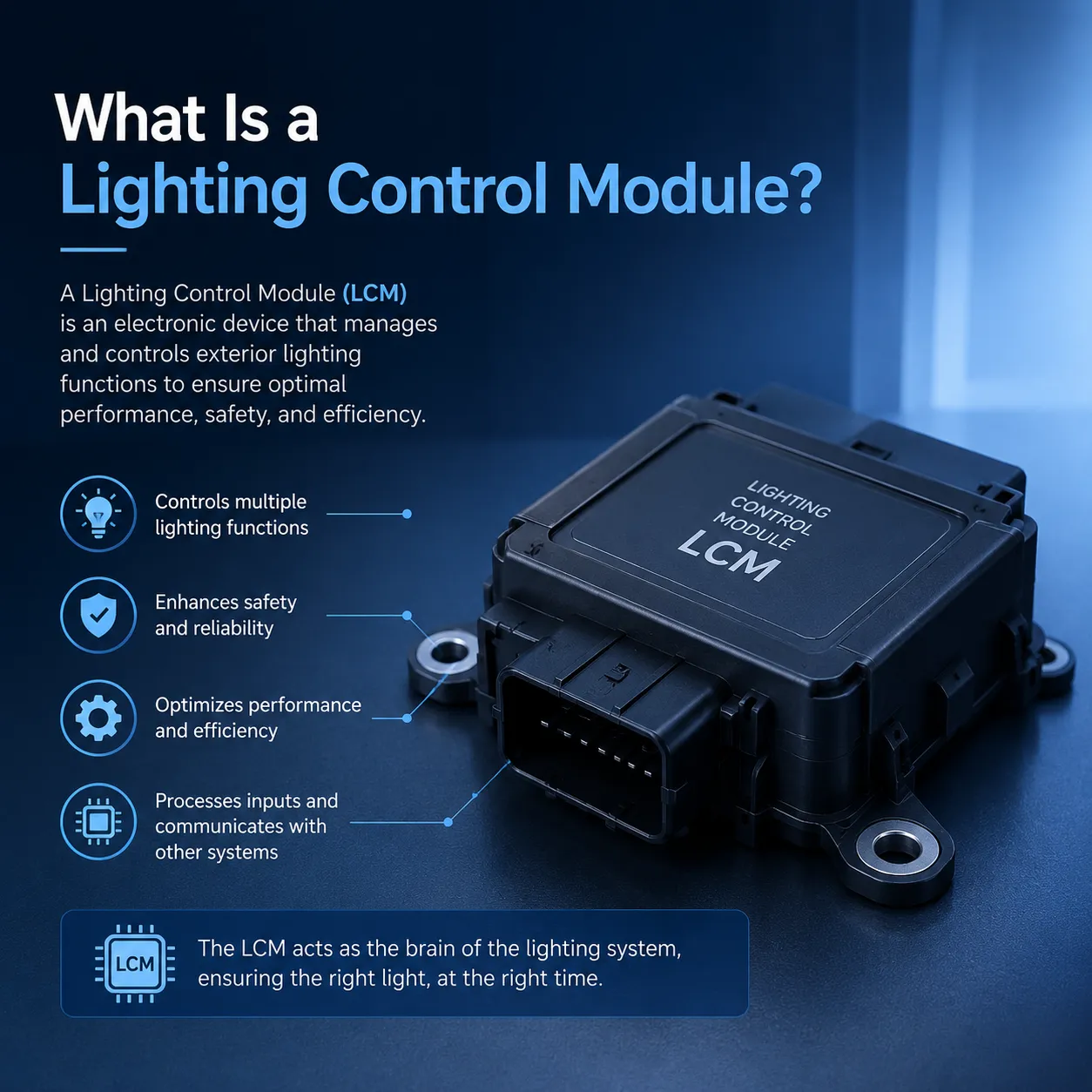
An LCM is an electronic device used to control different lighting circuits with the help of inputs received from timers, switches, sensors, or a central responsive building management system. LCM differs from a regular wall switch, which just makes and breaks the electrical circuit on its premises. However, LCM is a centralized or decentralized controller that can turn on/off and adjust lighting levels from one location. The instrument is located in between the electric current and lights while acting as an intelligent mediator.
The physical appearance of an LCM can differ significantly according to the type of application. For instance, in a home automation system, it would be a DIN rail device that has been mounted on a consumer unit and which sends signals to wall switches as well as an app installed on a phone. In a commercial building, the LCM is likely to be a bigger controller used with different types of relays and dimming feature, which connects to building management systems through BACnet or DALI. In the case of a vehicle, the LCM is responsible for controlling headlights, daytime lights, indicators and interior lights and it does so on the basis of the driver input, the light sensor input and the input from the body control of the vehicle. What connects all of these is that a programming and reactive brains of LCM decides when particular light should turn on or off, not simply transmit the signal as in case of normal switches.
How a Lighting Control Module Differs from a Switch, a Dimmer, and a Relay
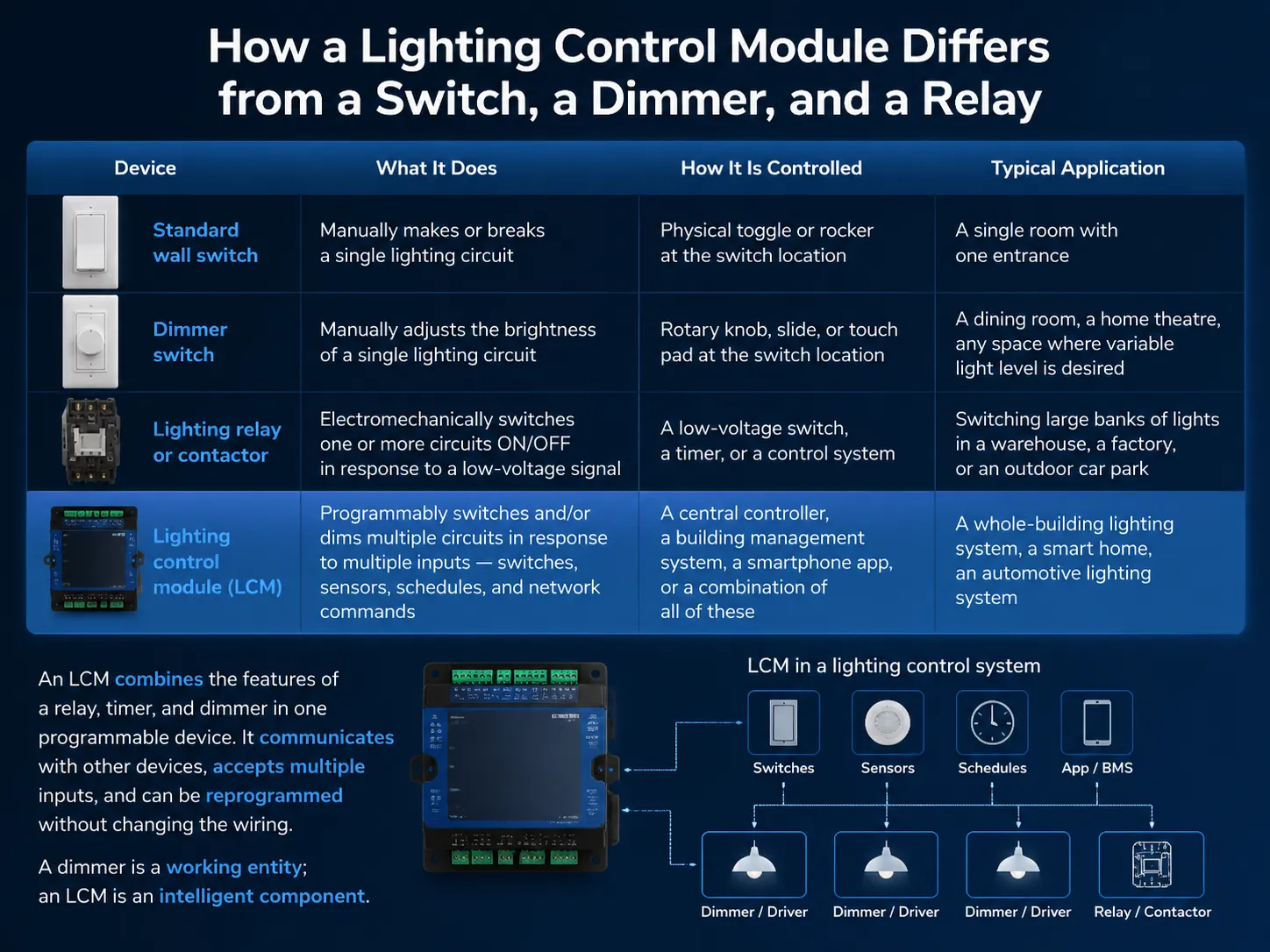
Understanding what an LCM does is easier by first knowing what it is not and how it compares with the more common lighting controls. A brief description of the four major types of lighting controls is given in the table below, in order of increasing sophistication.
| Device | What It Does | How It Is Controlled | Typical Application |
|---|---|---|---|
| Standard wall switch | Manually makes or breaks a single lighting circuit | Physical toggle or rocker at the switch location | A single room with one entrance |
| Dimmer switch | Manually adjusts the brightness of a single lighting circuit | Rotary knob, slide, or touch pad at the switch location | A dining room, a home theatre, any space where variable light level is desired |
| Lighting relay or contactor | Electromechanically switches one or more circuits ON/OFF in response to a low‑voltage signal | A low‑voltage switch, a timer, or a control system | Switching large banks of lights in a warehouse, a factory, or an outdoor car park |
| Lighting control module (LCM) | Programmably switches and/or dims multiple circuits in response to multiple inputs — switches, sensors, schedules, and network commands | A central controller, a building management system, a smartphone app, or a combination of all of these | A whole‑building lighting system, a smart home, an automotive lighting system |
In working terms, an LCM can combine the features of a relay and timer, as well as a dimmer, in a single programmable device. The main difference is that an LCM is intended for a larger system. An LCM interacts and communicates with other appliances; it takes several inputs at the same time; it can be reprogrammed without changing the wiring. A dimmer switch on the wall controls only one circuit with one switch. An LCM is connected to the same dimmer via a low voltage control bus and tells the dimmer how to work depending on a time schedule, an occupancy sensor, or a command. A dimmer is a working entity; an LCM is an intelligent component.
Where Lighting Control Modules Are Used
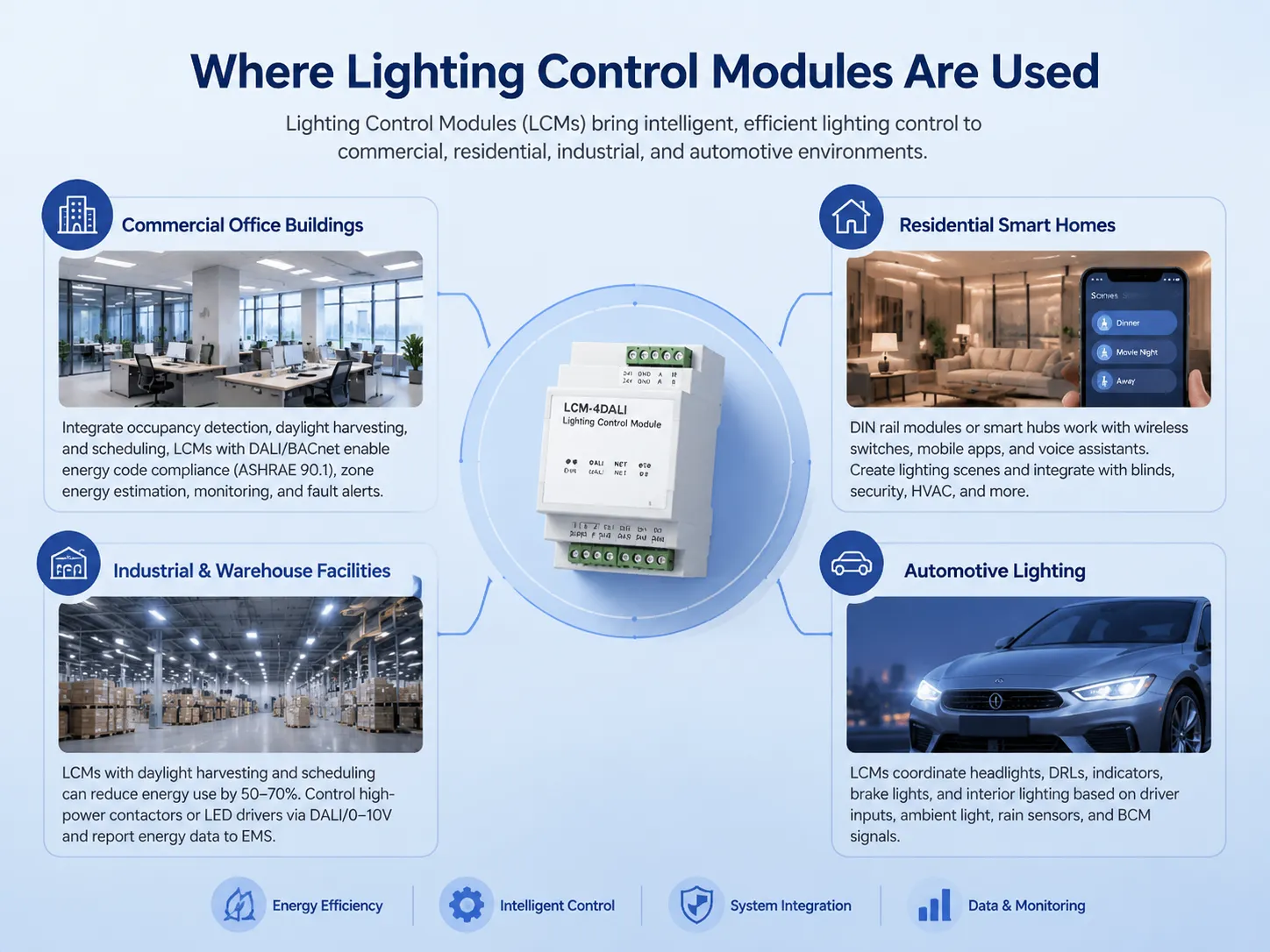
Lighting control modules can be utilized in various environments, each of which has its own specific control demands and communication protocols.
- Commercial office buildings. Lighting Control Modules (LCMs) are utilized in lighting systems compliant with energy codes by integrating occupancy detection, daylight harvesting, and timeliness monitoring, thus enabling compliance with ASHRAE 90.1 standards. The usual configuration makes use of DALI and/or BACnet LCMs connected to a control unit that provides energy estimation by zone, scheduled monitoring, and fault notification resulting from the ballast failure.
- Residential smart homes. LCMs can be either DIN rail modules or smart home hubs that work with wireless wall switches, mobile apps, and voice assistants. This means that homeowners can create lighting scenarios (like Dinner, Movie Night, and Away). The residential LCM is capable of operating several circuits at once. In addition, the residential LCM may also be used with electric blinds, security systems, and HVAC systems. GOG Electric’s smart lighting system comes with compatible switches and devices.
- Industrial and warehouse facilities. The implementation of high‑bay lighting in a warehouse using an LCM that incorporates daylight harvesting and scheduling can cut energy usage by 50 to 70% as opposed to manually switched lighting systems. The LCM provides control over lighting contactors that are high power or directly controls LED drivers by means of DALI or 0–10V systems and also communicates energy data to the overall energy management system installed at the plant.
- Automotive lighting. Modern vehicles are equipped with a minimum of one lighting control module, which is responsible for coordinating headlights, daytime running lights, blinker lights, brake lights, and lighting inside the vehicle. The LCM receives information from the driver’s controls, ambient light sensor, rain sensor, as well as the body control module in the vehicle and then makes the necessary lighting adjustments, like activating the headlights when dusk falls, turning the blinker lights sequentially, and dimming the dashboard into darkness.
The Key Technologies Behind Modern LCMs: DALI, 0–10V, and Wireless Protocols
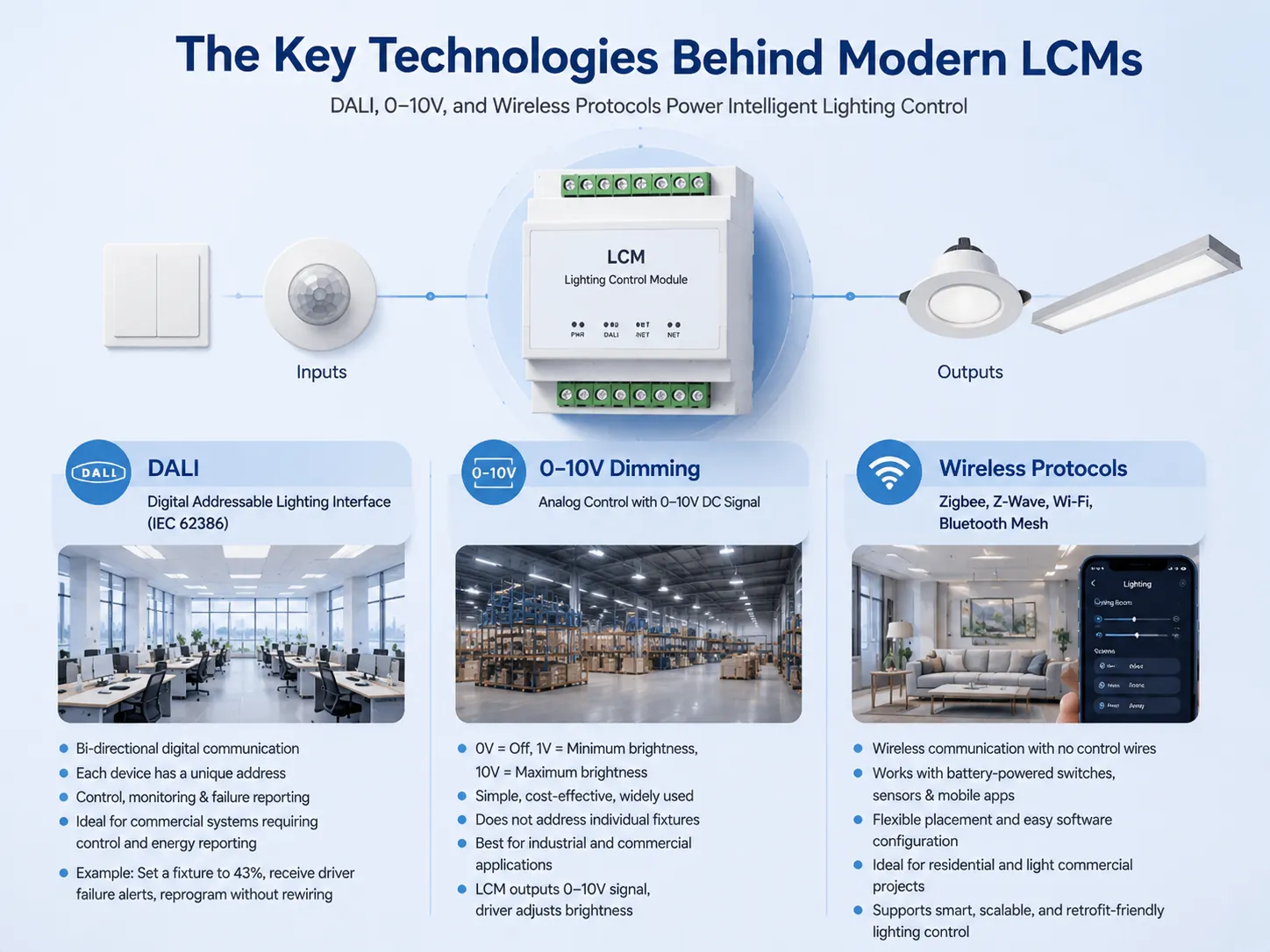
An LCM interacts with the light fixtures it commands, sensors and switches that provide input. The method of communication determines the level of control, installation complexity, compatibility with other systems in the building, and so on. The three main protocols used in commercial and home lighting control are DALI, 0–10V dimming, and wireless mesh systems.
DALI (Digital Addressable Lighting Interface) is an open digital standard described in the IEC 62386 standard which is bi-directional. Each DALI device has its own address, whether it is a ballast, driver, sensor, or switch. LCM can control every DALI device as well as monitor it and receive failure messages. DALI is used in commercial lighting control systems that require both control and energy reporting. DALI LCM can change the intensity of a certain fixture to 43%, notify about the driver failure, and reprogram other fixtures without rewiring.
0–10V dimming This system of control supports a variable DC voltage which can range from 0 to 10 volts for controlling LED fixtures or fluorescent lighting ballasts. The lighting at 10 volts would be at its maximum point of brightness. The voltage level of 1 volt indicates that the light is at its lowest level of brightness, while the voltage level of 0 means that the light is completely off. The control at the minus 10 volts level is simpler than using DALI control approach and is much cheaper and more widely used in industrial or commercial spheres of operation where no need for addressing individual lights is present. The system gives out the required 0–10V while the driver controls the brightness value.
Wireless protocols — Zigbee, Z‑Wave, Wi‑Fi, and Bluetooth Mesh — are the bases for residential and light commercial lighting control modules (LCMs). Wireless LCMs can communicate with battery-powered wall switches, occupancy sensors, and mobile applications with no control wires needed. Switches and sensors can be positioned wherever necessary, and LCMs configured using software instead of new cables. GOG Electric smart lighting control modules implement these wireless technologies in their product range and can therefore be used with standard wired installations providing the possibility of the installation of intelligent programmable lighting control without lengthy rewiring procedures. For a deeper understanding of how wireless smart switches and dimmers fit into this ecosystem, our guide on neutral vs non‑neutral smart switches explains the wiring requirements and device compatibility.
How to Identify a Failing Lighting Control Module
A lighting control module (LCM) is an electro-mechanical appliance that functions just like any other electro-mechanical devices, meaning that it can malfunction. The signs of a starting malfunction of an LCM can vary depending on the use, but certain signs are present in the residential, commercial, and automotive applications alike. Flickering lights, lights that are unresponsive to a switch, or lights that stay either on or off are indications that the LCM may have lost its programming, power, or communication. In a commercial setting, an unexpectedly high electricity consumption that can’t be related to any occupancy is an indication of a malfunctioning scheduling or daylight harvesting function in the LCM. In a vehicle, a malfunctioning LCM is likely to manifest itself as a headlight that isn’t turned on even if everything is working properly (the bulb and the fuse) or as a malfunctioning turn signal that blinks too slowly or fast. The way automotive LCMs are diagnosed involves the use of OBD-II scanning devices which read fault codes- codes that are associated with the body and lighting control system. And resources from automotive diagnostic services like Autel help read and interpret them.
Frequently Asked Questions
How to tell if a headlight control module is bad?
Signs of a malfunctioning headlight control module are that one or both of the headlights are not working even when the bulbs are working. The headlights may flicker or pulse, or the high beams may function erratically. Additionally, the turn signals may flash at the wrong speed. The most dependable way of diagnosing automobile LCMs is via an OBD-II tool that can read body control module codes.
What does a light control module do?
The lighting control module accepts signals from the switches, sensors, timers, or building management systems and uses them to activate or dim one or more lighting circuits. It is a programmable controller that automates lighting according to occupancy status, daylight available, schedules, or commands from the network.
What does the Ford lighting control module take care of?
The lighting control module from Ford, which can also be combined with the body control module (BCM), is responsible for controlling multiple elements of the lights, such as the low and high beam headlamps, running lamps, turn indicators, caution lights, brake lights, fog lights, and courtesy lights, among others. The module reacts according to the information it obtains from the headlight switch, multifunction switch, ambient sensor, and ignition and car security system.
Where is the lighting control module located?
The placement of a lighting control module varies by application. In a building, it may be mounted in an electric closet, a panelboard, or a DIN rail enclosure around the distribution board. As for a vehicle, the lighting control module is typically located in the dashboard, under the steering column, or integrated into the fuse box or the body control module. The exact location is indicated in the electrical drawing of the building or the service manual of the vehicle.
References
- DALI Alliance — Digital Addressable Lighting Interface Standards. The industry body defining and promoting the DALI protocol (IEC 62386), the open standard for digital lighting control.
- Lutron Electronics — Lighting Control Modules and Systems. Manufacturer of commercial and residential lighting control modules, dimmers, and building‑wide control platforms.
- Leviton — Lighting Control Solutions. Manufacturer of residential and commercial LCMs, wireless controls, and networked lighting systems.
- Autel — Automotive Diagnostic Tools and OBD‑II Scanners. Manufacturer of diagnostic tools capable of reading and interpreting body control and lighting‑specific fault codes in modern vehicles.
A lighting control module is the device that turns a collection of individual lights into a coordinated, responsive, and efficient lighting system. It takes the inputs from the switches, the sensors, and the schedules, and it delivers the right amount of light to the right place at the right time. Whether it is a DIN‑rail unit in a residential consumer unit, a panel‑mounted controller in a commercial building, or a microprocessor buried in a car’s dashboard, the LCM is the intelligence that sits between the power and the light — and it is the reason that the lights in a modern building, and a modern vehicle, do so much more than simply turn on and off. GOG Electric’s smart lighting control modules and compatible wiring devices provide that intelligence for the home and the light commercial space, with the wireless connectivity, the app‑based control, and the straightforward installation that make automated lighting accessible to every homeowner.