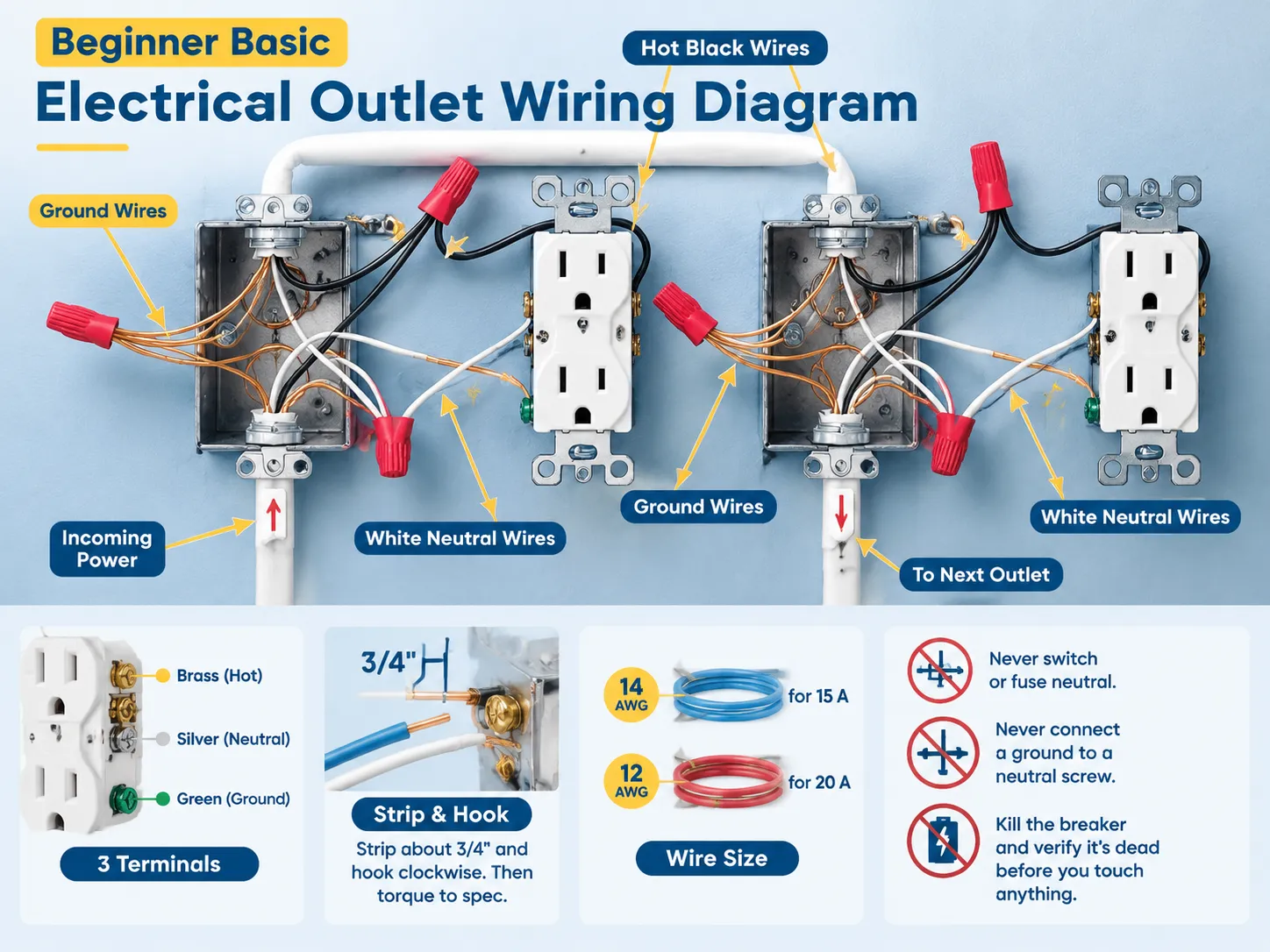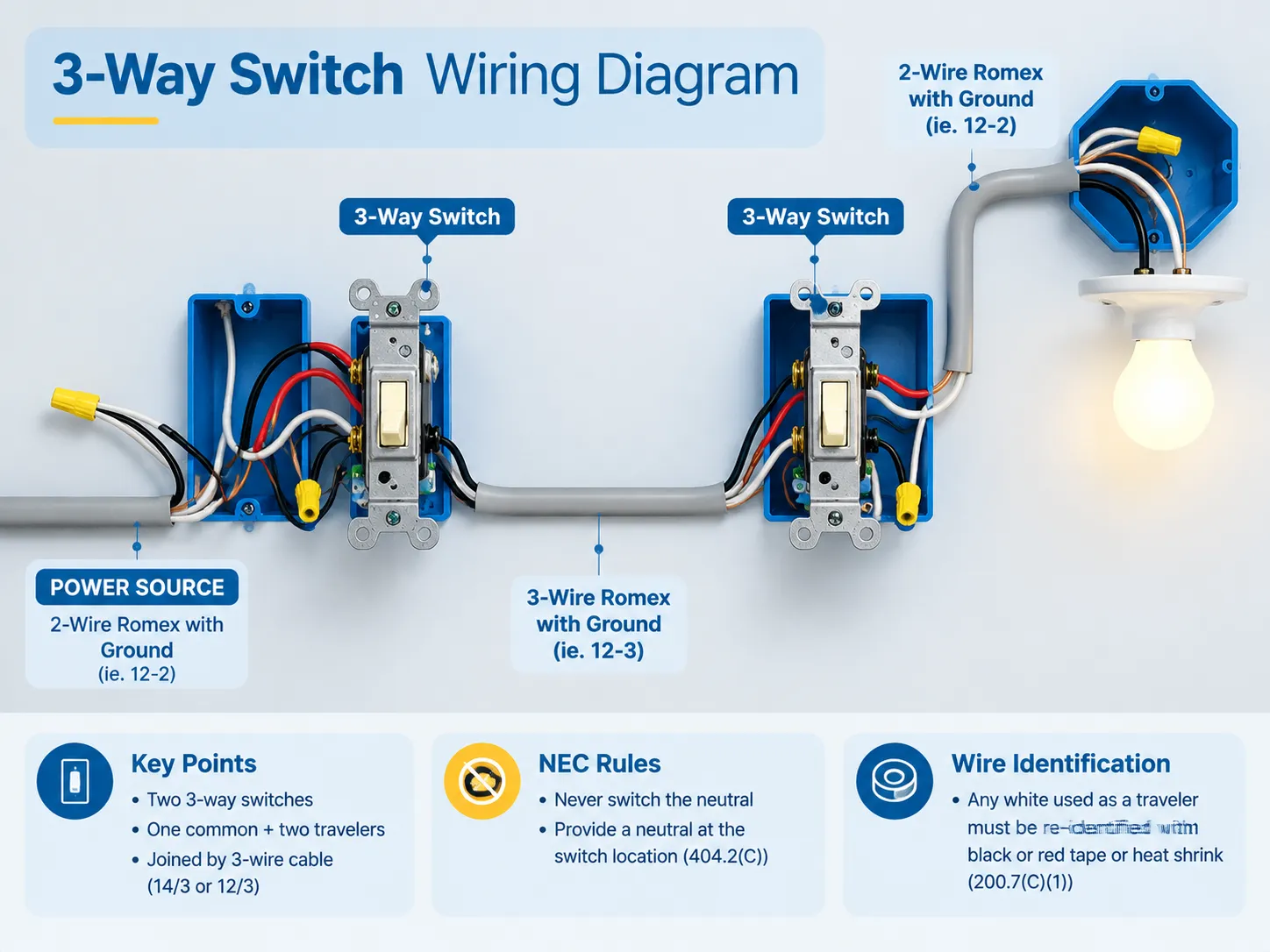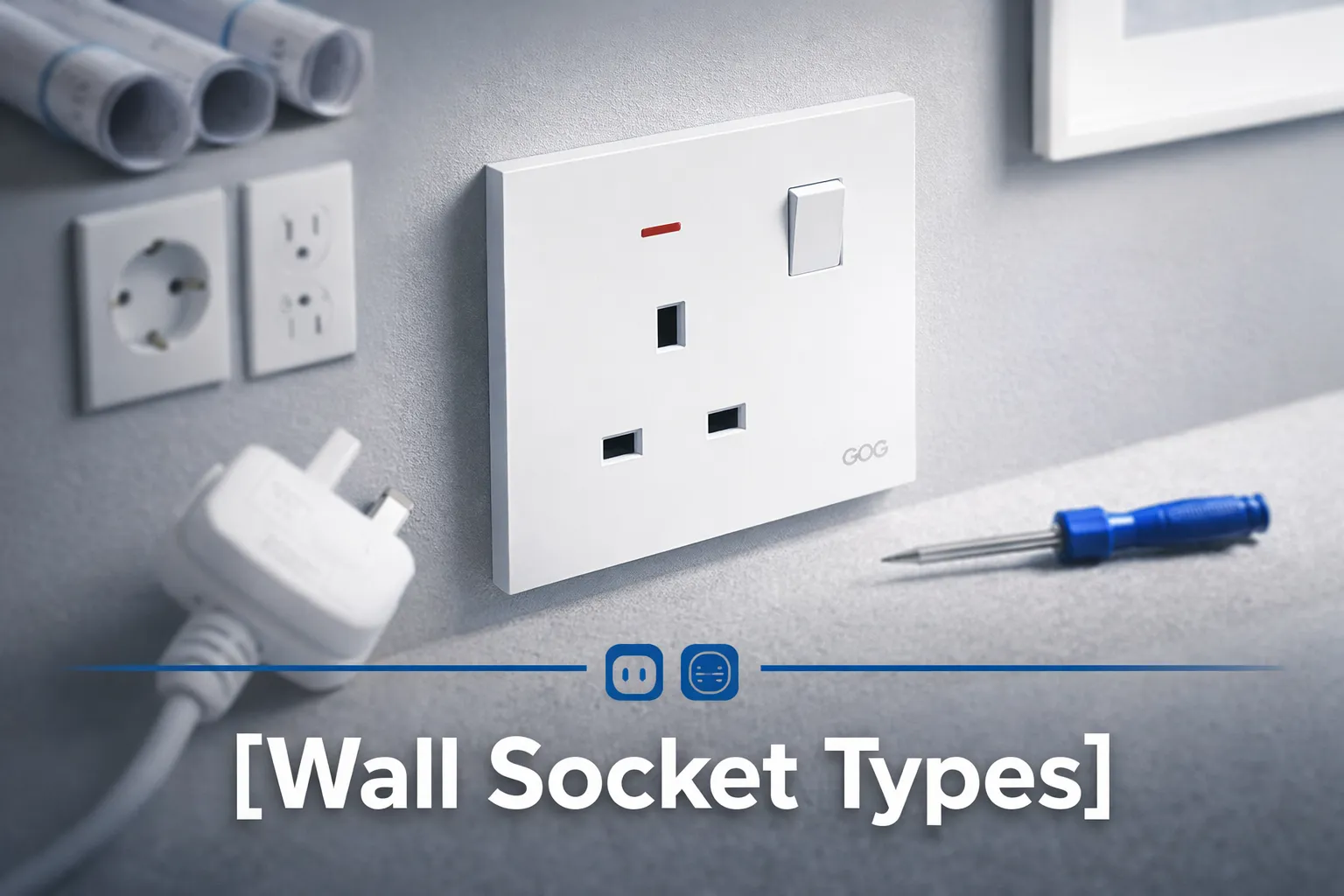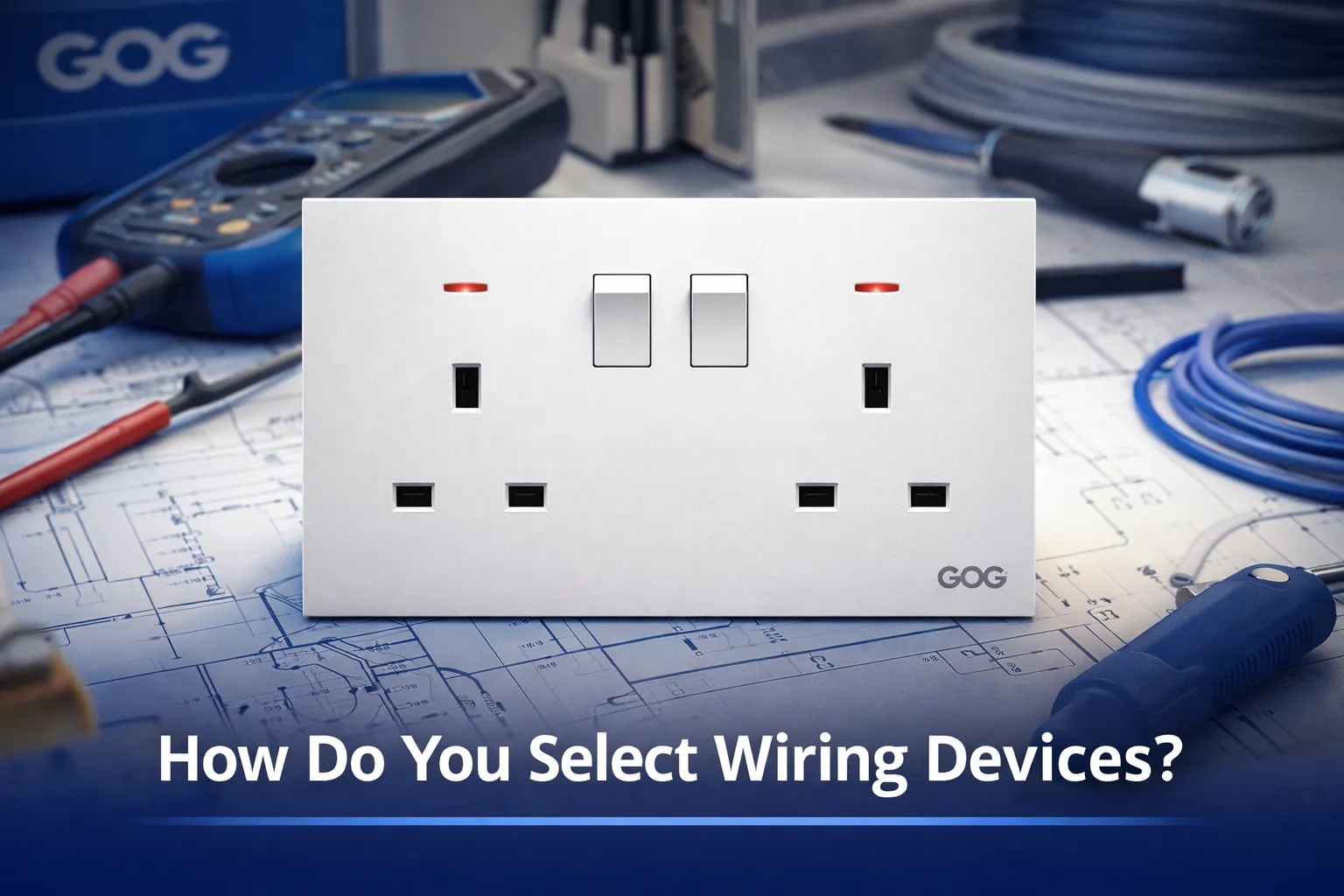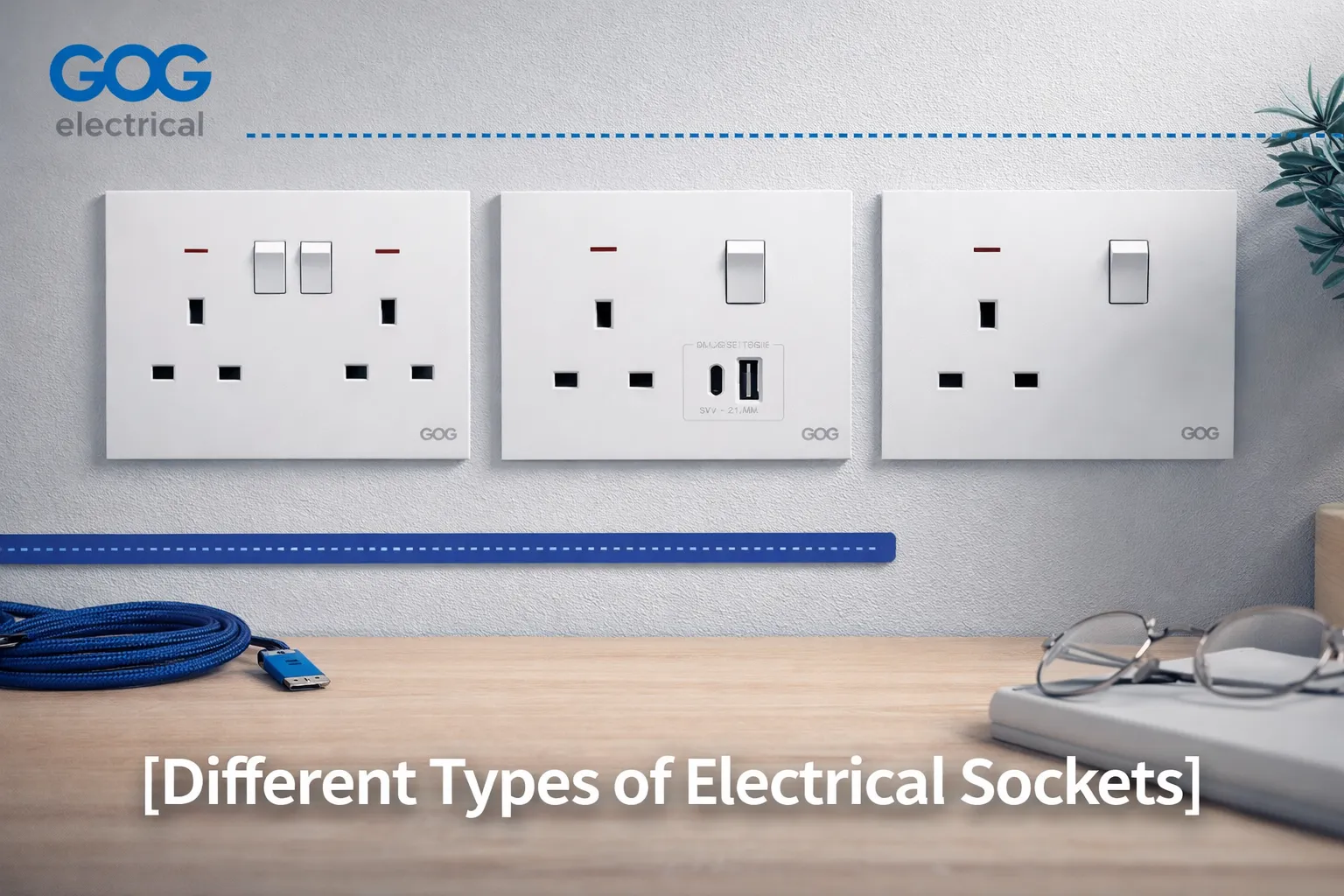
A metal-clad electrical outlet is a device used to connect electrical devices to a building’s electrical supply. Metal-clad electrical outlets are different from traditional electrical outlets made from plastic, and they are designed for use in areas where a traditional plastic outlet may crack, pull away from the wall, or weather.Metal is beneficial for electrical safety by providing an effective grounding conductor, protecting the outlet from impact damage, providing ultraviolet light resistance, and being resistant to corrosion from washing.
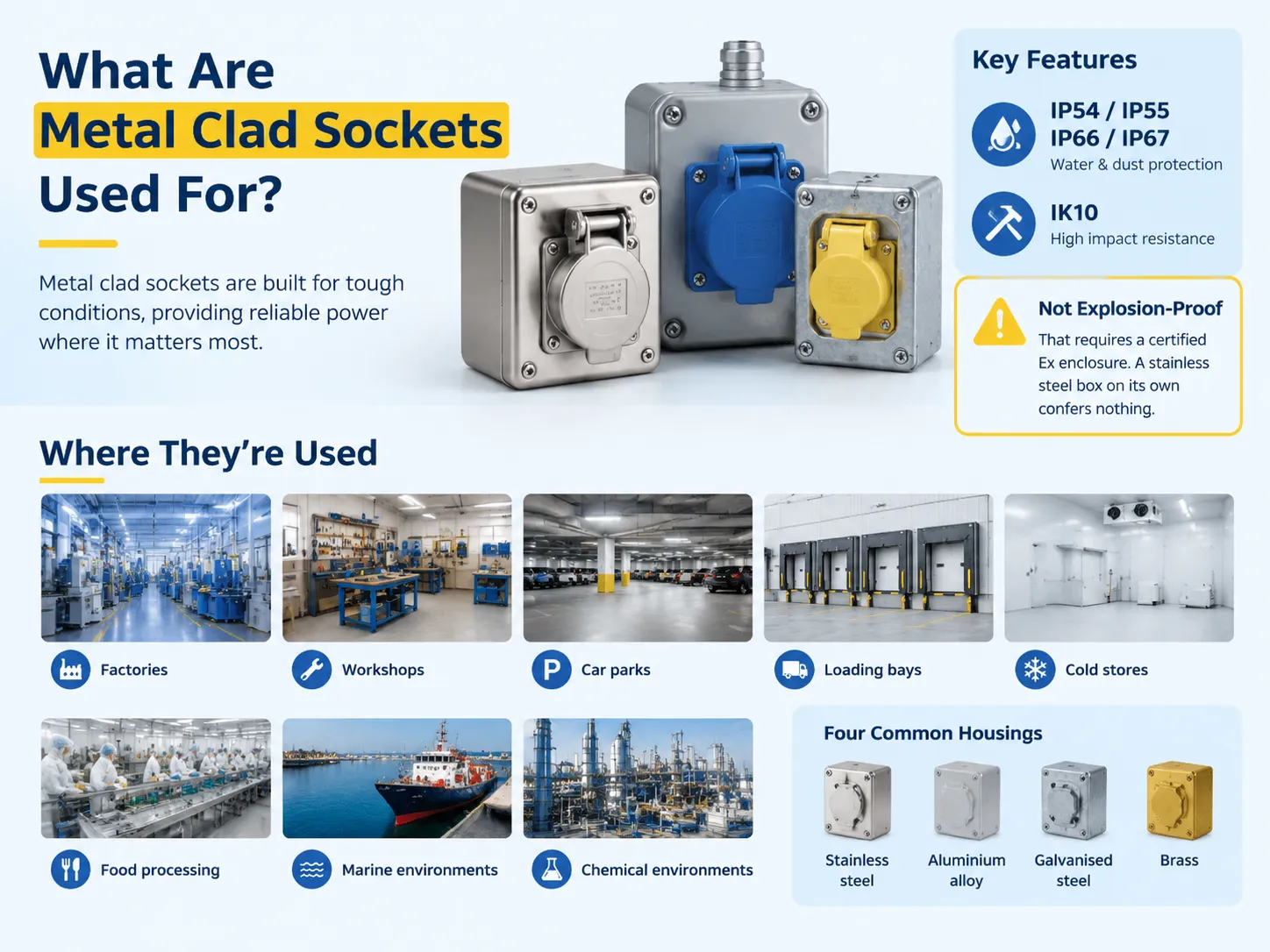
Metal clad socket outlets are primarily used in industrial settings where damage can occur due to external factors such as collision, liquid or moisture intrusion and/or corrosion from chemicals/vandalism. Metal clad socket outlets are not classified as explosion proof devices. Classifications of explosion proof sockets are conducted through testing and certification of the Ex enclosure only; having a stainless steel box alone does not denote it as an explosion proof device. The four primary types of housings for metal clad socket outlets include stainless steel, aluminum alloy, galvanised steel & brass (the 2 numbers that determine IP & IK are 54, 55, 66 or 67 & 10 respectively).
First, what metal clad does not mean
This is the most common mistake which also has implications for safety, not only for procurement reasons.
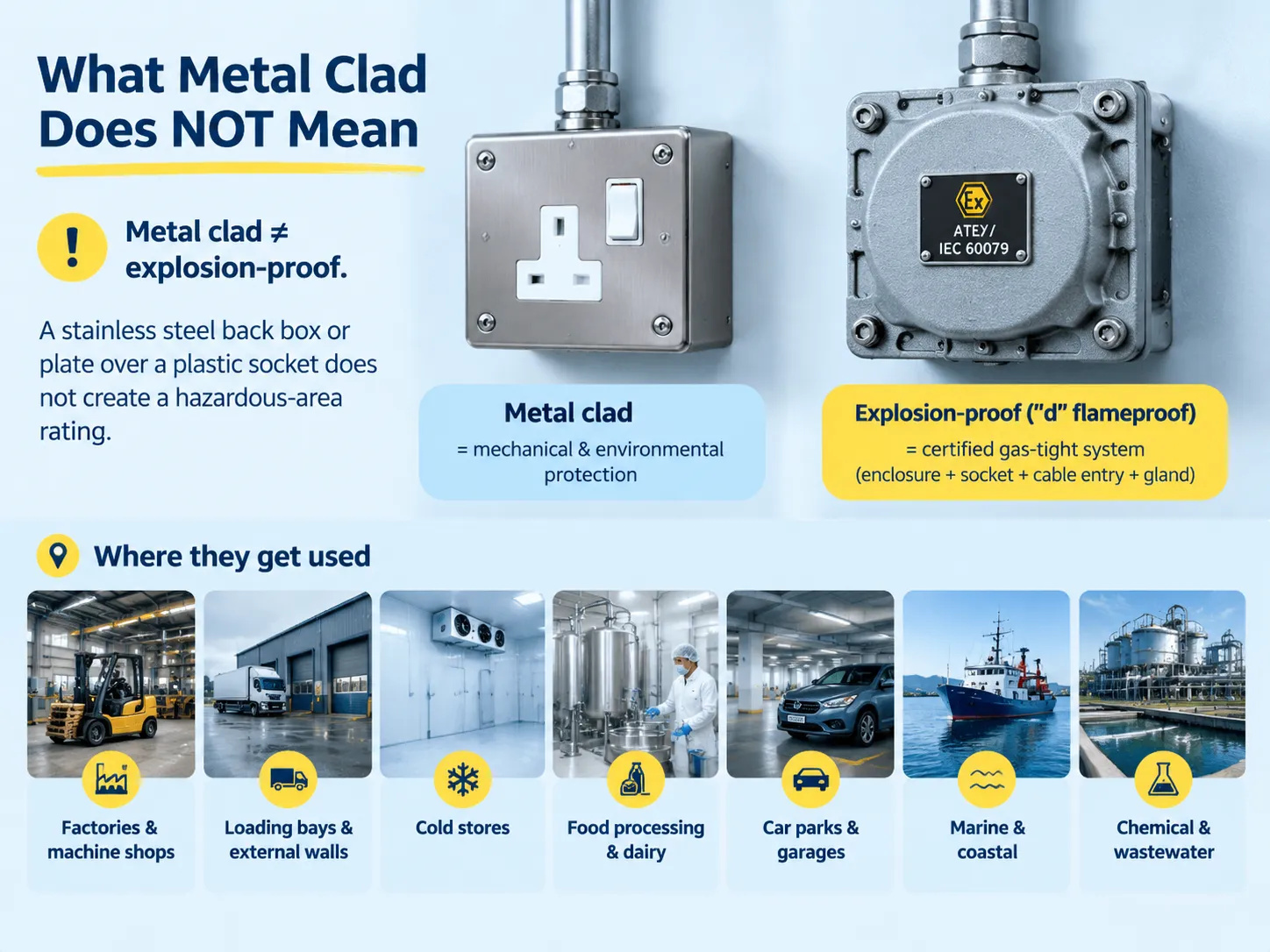
A stainless steel back box is not an explosion-proof housing unit. Explosion proofing is a certified system under IEC 60079 and ATEX. In this case, “d” flameproof construction means a gas-tight enclosure which has specific joints rated for gas. Note that the certificate is for the unit as a whole including the socket, entry and gland. A stainless plate over a plastic socket cannot rate area as hazardous. Its use in Zone 1 or Zone 2 would be a specification error, with implications for insurance.
What metal clad does is provide mechanical protection and protection against environmental hazards. This is indeed an added benefit which may also be sufficient in many cases, but it is a completely different classification of protection from explosion-proof one.
Where they get used
One will be surprised at the extent of the list. Generally speaking, the failure mechanism that makes plastics unusable for this application does not just involve water.
- Factories and machine shops. Forklifts, pallet trucks, metal filings. A plastic fitting in the loading area has to be repaired once every two years, whereas a metal one can last for ten years.
- Loading docks and exterior walls. That is where rain, UV rays, impacts from vehicles, and ladders leaning against a wall all come together.
- Cold stores. In conditions below zero, plastic fittings crack around the mounting hoods, and steam finds its way behind the faceplate.
- Food industry and dairy plants. Everything must withstand deep cleaning with acid and alkali and the pressure washing. Stainless steel 316L is the usual answer here, but finish is as important as the composition.
- Parking garages and car parks. Impact of vehicles and mirrors.
- Marine and coastal areas. Salt air destroys everything soon enough.
- Chemical and waste disposal areas. In other words, a plastic housing has no chance.
GOG’s aluminium and stainless ranges cover several of these, including the aluminium housing combined with a Schuko socket for the utility and workshop end of the market.
What the metal actually buys you
Six differences from a plastic outlet, in rough order of how often they end up mattering. A correctly made body is the starting point, and GOG’s IP66 single-gang enclosure shows what that means: moulded gland seats, a gasket that actually seals, and no decorative parts to work loose.
- Impact. This is the big one: impact resistance is expressed in terms like IK, where a metal enclosure achieves an IK10 rating (20 joules) while most plastic switch sockets reach IK02 (0.2 joules). This is two orders of magnitude, which is the reason why people prefer metal in areas subject to loading and traffic conditions.
- Ingress. A plastic socket feels IP20 to IP44, depending on the model, while metal cladded units achieve an IP66 rating, which is considered proof against dust and powerful jets of water coming from any direction. And unless your plastic outlet is IP67 rated, you may want to avoid risks of water ingress in the kitchen or backyard.
- Fire behaviour. Plastic materials are flammable. Metal enclosure has no impact on fire load, an important factor in fire risk-compliant buildings or local code requiring non-flammable fittings along escape routes.
- Earth continuity. Metal connector, having been bonded with the earth conductor, provides less impedance than plastic materials do. In the conditions of construction site or during temporary works, keeping it safe becomes a matter of real importance.
- UV and temperature. Plastic outlet tends to become brittle when exposed to sunlight, while metal is not affected by this factor. At the same time, it has to expand and be fitted with its gland and seal, which may become the weak point when devices are poorly manufactured.
- Security. The locking metal lid makes it impossible to open coin-operated sockets, which are so easy to deal with in a parking lot; this is because almost all plastic outlets will be easily opened in a month.
On the contrary, there is an argument against metal, as it is heavier, more expensive, and requires fitting of the correct seal, otherwise, the water will still get inside, leading to corrosion. A good reference product of this type is GOG’s IP66 single-gang enclosure, which ensures it’s not vulnerability prone.
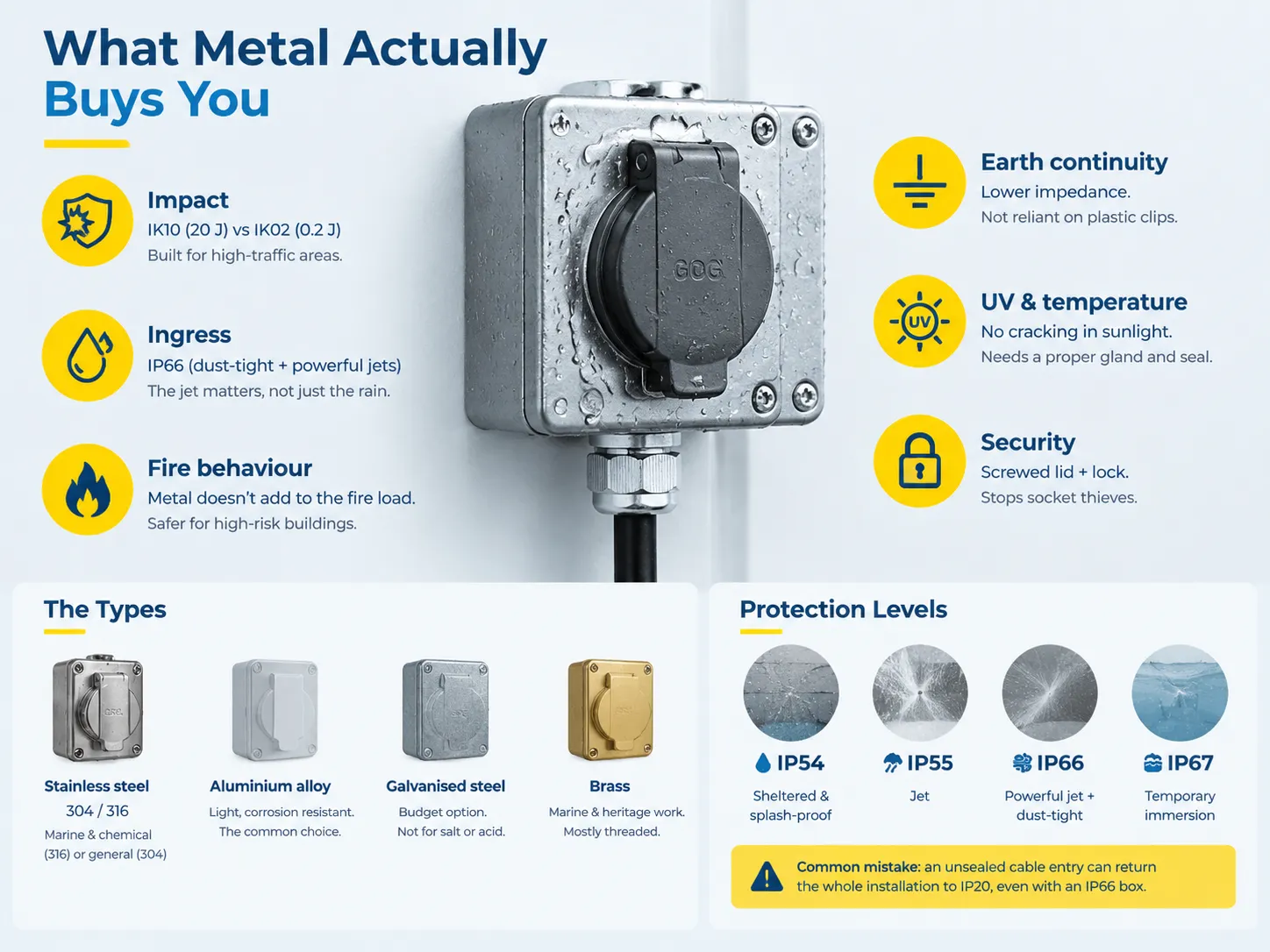
The types
Four housings, with four protection levels, which matter more than each of them.
- Stainless steel 304 or 316: 316 is for food, for chemical and marine applications due to the content of molybdenum; 304 is for general outside purposes. Either electropolished or brushed on the visible parts, the grade has to be shown, not assumed.
- Aluminium alloy: lighter, casting material, resistant to corrosion, it becomes the most common choice for utility outlet and multi-gang plates, this metal is the reason for such popularity in commercial buildings.
- Galvanised steel, cheap and sufficient for sheds and construction sites, this is cheap material, but the zinc coating fails first. Therefore this material is not recommended for the usage in salt or aggressive environment.
Brass, which means it is good for marine and heritage application.
As for the protection level:
- IP54 — protected from splashing water
- IP55 — water jet
- IP66 — powerful water jet and dust-proof
- IP67 — temporarily immersive
The most frequent mistake is IP66 installation with using unsealed hole for cable which means that the entire output is IP20 level.
If you want the wider context on how socket formats differ between markets, the regional breakdown in different types of electrical sockets is worth a look before you commit to a format.
Four ways to solve it
Most projects pick one of these four. Prices are indicative retail-equipment bands for 2026 and exclude installation.
| Option | Built for | Main advantage | Indicative cost |
|---|---|---|---|
| Surface IP66 single-gang, aluminium or ABS lid with stainless fixings | External walls, workshops, small yards | Cheapest route to a compliant external outlet | $12–$35 per unit |
| IP66 stainless 316L, hinged lockable lid | Food processing, washdown, marine, docks | Survives caustic cleaning and tampering | $55–$180 per unit |
| Cast aluminium multi-gang plate with switched or unswitched outlets | Hotels, offices, plant rooms, workshops | Power, data and AV in one plate, robust and replaceable modules | $45–$140 per plate |
| Ex-rated enclosure with certified socket and gland | Hazardous areas, paint, solvent, grain | The only option that is legally permitted in a Zone 1 or 2 area | $400–$1,500+ |
Where two appliances need power from one outdoor plate instead of one, the part changes shape rather than principle: a dual-gang IP66 enclosure such as the FW-X286 two-gang IP66 box replaces the single-gang unit and the specification stays identical.
Two examples in which the high-priced method turns out to be the most economical one. An area subjected to wash-down using fittings encased in 316L plastic undergoes a reorder every 18 months; meanwhile, the hazardous area with fittings made out of stainless steel and without Ex certificate will likely have a complete shutdown.
How to specify one properly
In order to avoid future disputes, it is important to note a few points during the planning stage.
One of these points is determining the IP index by number and showing it for the product being assembled. Thus, if an IP66 box is outfitted with an IP54 socket, the overall IP rating would be IP54.Also, the material used for the device should be mentioned by its name and grade, i.e. saying only “stainless” is insufficient. You should also state the impact rating if the area is subject to vehicle or equipment traffic. The reason for that is that this property distinguishes better devices from cheap ones. It is also necessary to mention the gland and assign it the same IP index as the box, because if a top-grade IP68 gland is used in conjunction with an IP66 box, the box will not be upgraded as a result. You should also indicate how the cables are situated, since having them come through somewhere at the bottom of the box is better than coming through the sides or the top.
Surface mounting is another important factor that has to be decided upon early. Normally, metal sockets are mounted on the surface, as it is almost impossible to do it the other way round.Where appearance matters, the trade-off between surface and flush mounting is set out in more detail.
FAQ
When to use a metal clad socket?
The outlet should be chosen in cases of impact, water jets, chemicals, UV rays, temperature extremes and vandalism, with a non-combustible housing. In practical terms this means outside walls, loading docks, workshops and garages, blast freezers, washing places in food production, places close to water, technical rooms, and temporary buildings at worksites. Inside a dry corridor, a metal outlet is simply a waste of cash.
Why metal clad sockets?
The enclosure is being effective. Metal IS IK10 impact-resistant compared to plastic which only achieves IK02; it provides IP66 or IP67 protection from water ingress, does not combust when exposed to fire, has a bonded earth path that does not depend on plastic clips, and withstands temperatures and UV light much better than plastic for the entire service life of the device, which can last up to 10 years. The price difference is offset by just one avoided replacement.
What is metal clad used for?
The product is capable of weathering rough conditions. Uses of stainless steel 316L for cleaning and chemical applications, aluminium for commercial applications (multiple gang boxes, galvanised steel for buildings and camping accommodations, brass for marine and threaded applications. The casing is responsible for keeping moisture, shock and interference away from the connection points.
What are the two types of sockets?
There are two kinds of classifications in this case involving electrical equipment – one being by its construction,mounted on the surface or flush-mounted, which is the standard classification known to most of the households. The second classification derives from the way it is protected and which might be represented by either fittings meant for dry use indoors or for outdoor and heavy-duty tasks. Another classification method is associated with the type of switch used (switched or unswitched) as well as whether it is a single-gang or multi-gang.
References
- International Electrotechnical Commission — IEC 60529 ingress protection codes and IEC 62262 impact ratings
- Hager — IP-rated industrial and weather-resistant socket outlets
- Legrand — weatherproof socket, switch and enclosure ranges
- ABB — IP-rated industrial plugs, sockets and enclosures
- Rittal — IP-rated stainless steel and sheet-steel enclosures
- UL Solutions — UL 514 weather-resistant outlet boxes and covers
Conclusion
According to the hazards associated with metal-clad sockets, plastic outlets exhibit three failure modes: cracking from impact, leaking when subjected to water, and becoming brittle from extended exposure to ultraviolet light (sunlight). All of these failures will occur on a repeated basis in a loading or washdown area, so ensure that when The schedule will indicate these failures as the failure modes of the equivalent component of plastic outlets.You must identify the type of environment that your socket is being used in (i.e., the IP rating), and the alloy of your socket shell, and the style (gland). Make sure to purchase the socket specified in the hazard assessment for the area you are installing it in. If the area is truly hazardous, you must purchase the certified Ex model of the socket you require.